
There was a mixed response to Ange Postecoglou‘s sacking at Tottenham Hotspur this summer.
However, regardless of which side of the fence you sat on, Thomas Frank was a welcome appointment when he became the new Spurs manager this summer.
He was well regarded by most Spurs fans for his work at Brentford, and it seemed a matter of time before he took the next steps to a bigger club.
Tottenham’s opening fixture results were encouraging, including a well-fought 2-2 draw in the UEFA Super Cup Final (losing on penalties to PSG), a 4-0 thrashing of Burnley on the opening day of the Premier League season, and an away win against Manchester City.
Since then, the momentum has stalled, with home losses to Bournemouth and Aston Villa, as well as less convincing displays against Wolves and AS Monaco.
The table below outlines Tottenham Hotspur’s xG results from August to October 2025 in the Premier League.

Questions about Thomas Frank’s setup and the personnel he selects are now being asked.
There are currently predictable progression routes and an overreliance on wide patterns that do not translate into high-quality final third actions.
The central thread is the double pivot.
When the team’s engine room lacks complementary profiles, the knock-on effects are visible in open play chance creation and territorial control.
These issues tie back to Thomas Frank’s tactical choices.
He wants solidity and vertical compactness as a baseline, but must avoid neglecting the need to attack with authority and impose the game.
The realities of his step up into this role mean expectations are higher than they were at Brentford.
UEFA Champions League football and a big stadium with loftier ambitions prioritise both progression and protection.
But Frank’s desire to be pragmatic has backfired on occasions.
Most recently, Tottenham conceded 41% of the expected goals conceded by the six English teams in UEFA Champions League Matchday three, a sign that the current balance is not working.
Our Tottenham Hotspur tactical analysis goes into detail on the leading causes of Spurs’ bump in the road under Thomas Frank, and suggests how the Danish coach can fix them.
Spurs Double Pivot Problem Of Rodrigo Bentancur & João Palhinha
Thomas Frank has long favoured a stable positional double pivot, prioritising vertical compactness and central shielding.
At Brentford, that bias was centred on a disciplined organiser who secured a rest defence and narrowed the team between the posts.
The table below shows the double pivots Thomas Frank has used at Brentford in each season since he took the club into the Premier League, with context reaching back to their 2020/2021 EFL Championship promotion campaign.
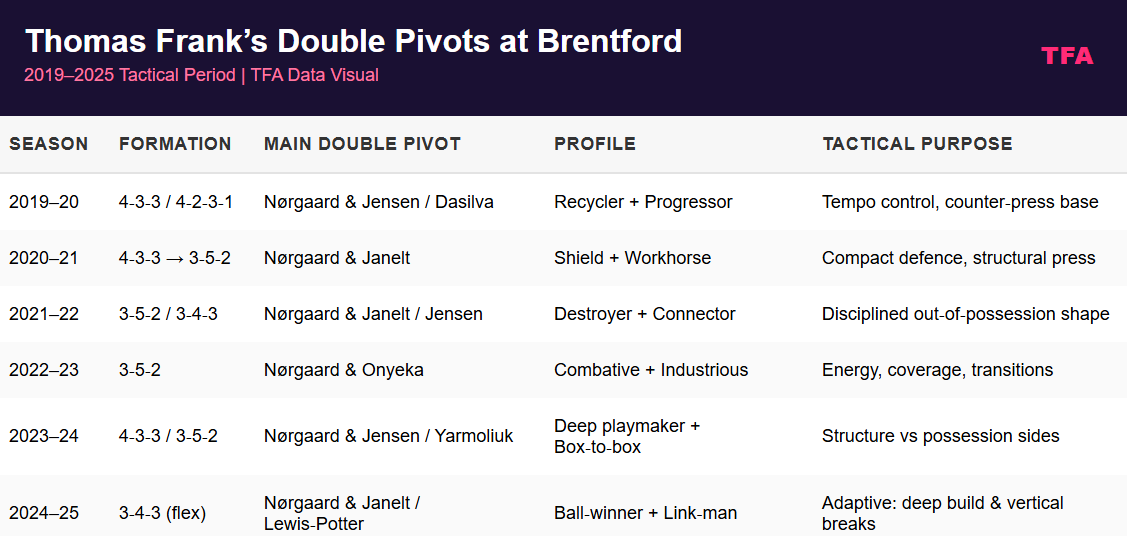
The upside is defensive stability and a screen in front of the back four.
The trade-off is that if the pair is too conservative in possession, they lose vertical connectivity and tend to circulate without making penetrative passes.
In the current Tottenham setup, that trade-off has been magnified, testing Frank’s ability to be solid while still allowing the team to attack and be the main protagonist in most games.
The double pivot is the bridge that connects the defence, midfield, and attack.
It sets pressing traps by drawing pressure to one player and releasing the free man.
It also carries the burden of receiving under pressure, turning on the correct foot, and playing into the next line with the right tempo.
When one pivot anticipates danger and secures the counter, the other must link and progress.
That is the functional symmetry.
Tottenham’s chosen combination has tilted too far toward security, reflecting Frank’s instinct for solidity but missing the attacking brief expected at the club.
João Palhinha is a high-level ball winner and a safe distributor.
He wins duels, screens, and maintains vertical compactness.
Rodrigo Bentancur is a recycler who can shuttle and combine.
Together, they offer control without thrust.
There is no consistent deep progressor who can receive on the half turn in the first line, break the cover shadow, and play passes between the opposition midfield and defence.
The result is an attack that spends too long outside, playing around blocks rather than through them.
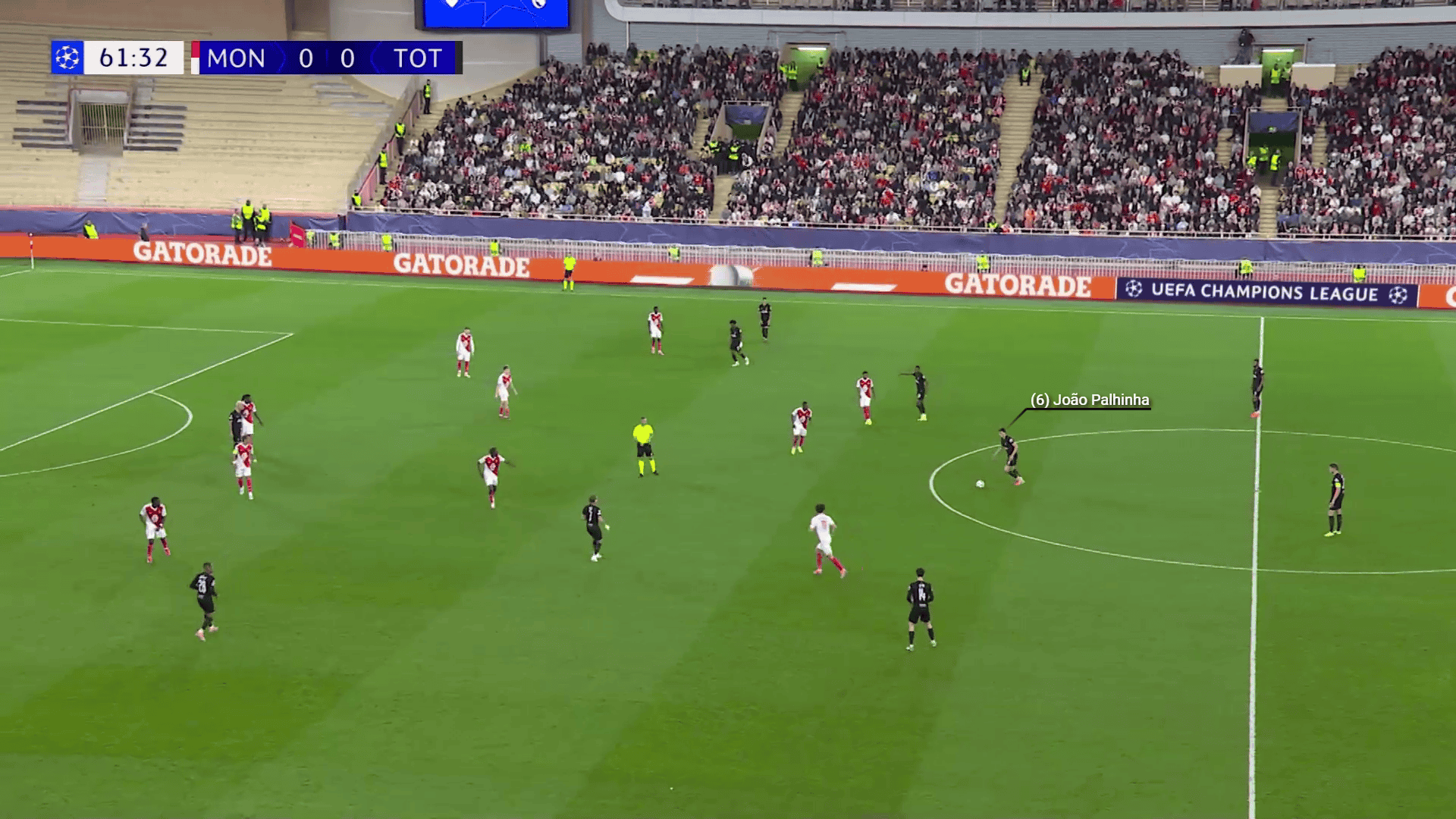
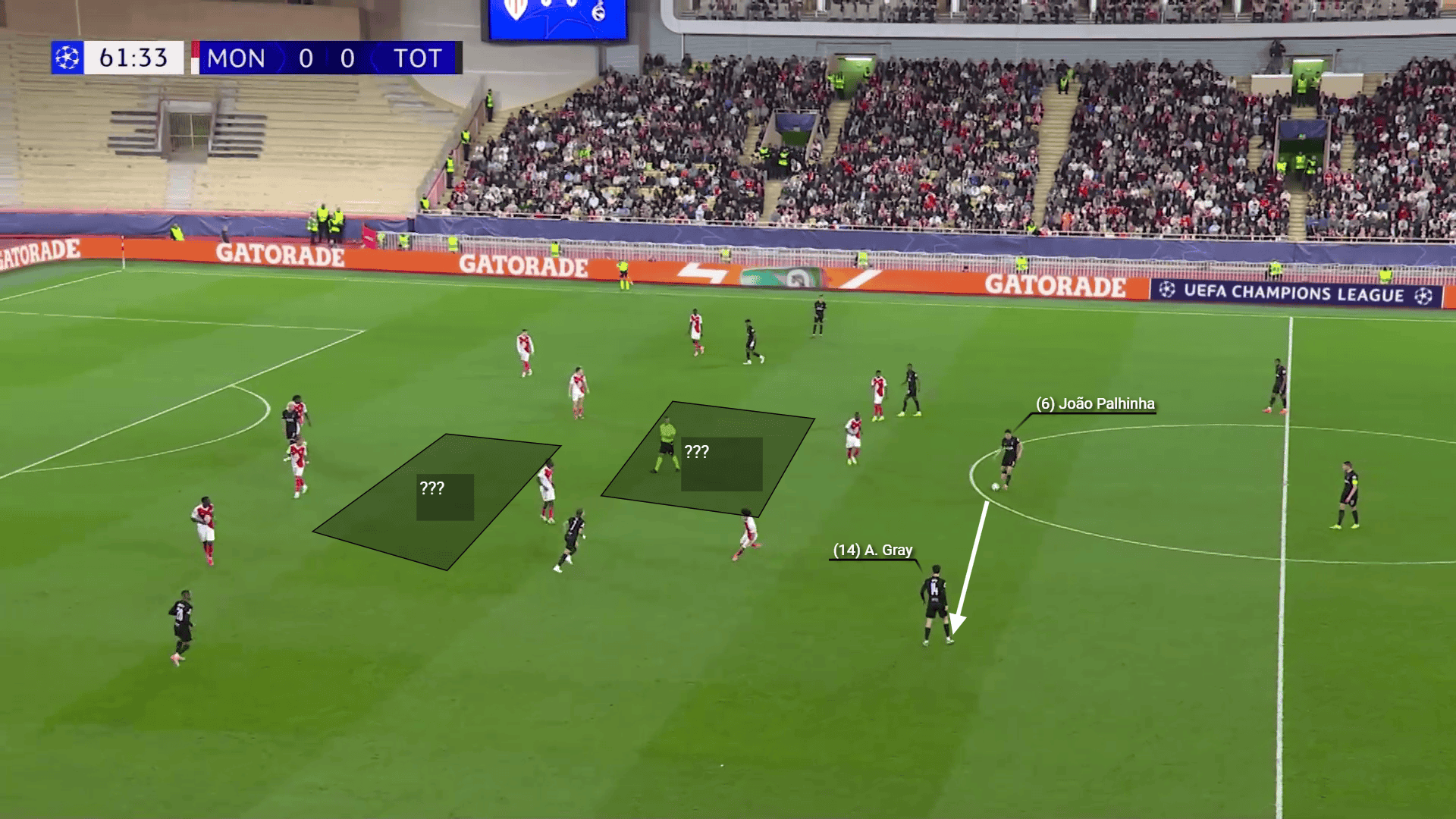
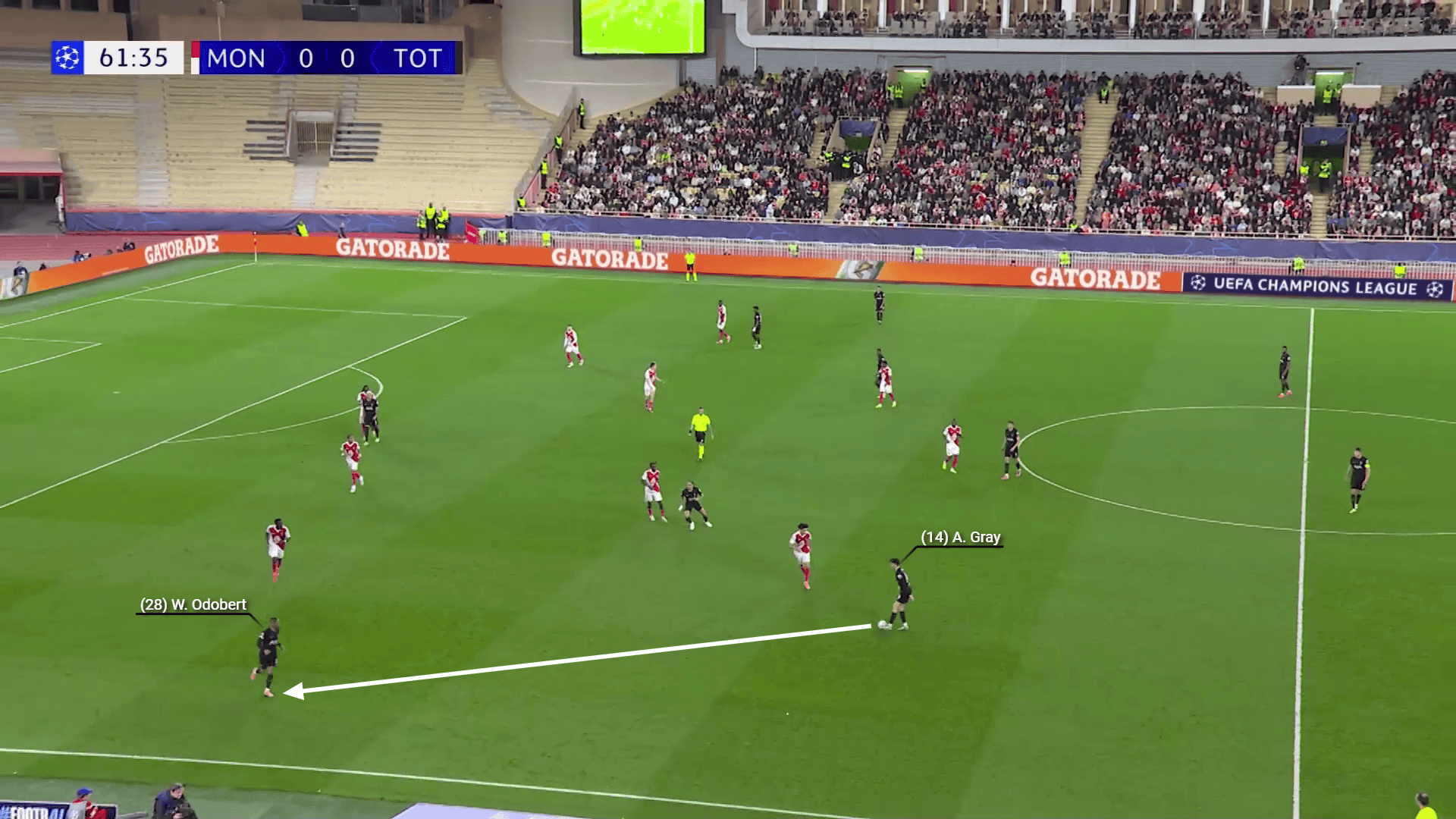
This is shown versus AS Monaco, where Palhinha plays a square pass to Archie Gray, who then plays it out wide to Wilson Odobert.
There is no one in between the lines.
That makes sense for a coach whose default is to prioritise middle first, but the step up in expectations demands more proactive central access.
Neither pivot consistently steps past the first pressing line on the dribble or by splitting opponents with vertical passes, so the centre-backs are asked to advance the ball.
Cristian Romero can do this, and he does it well, but this leads to opposition preparation by screening his lane and forcing play to the less assertive side.
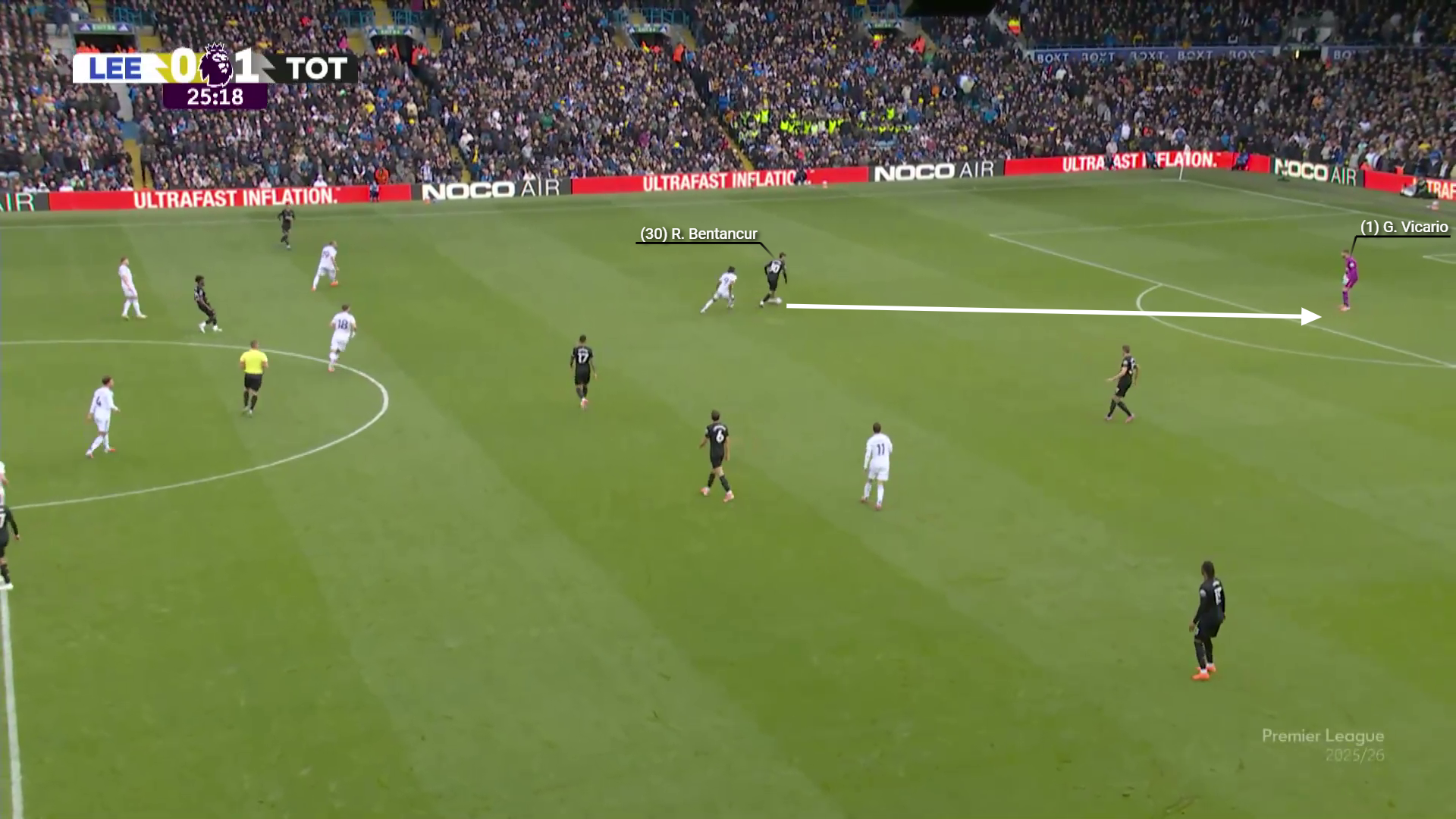
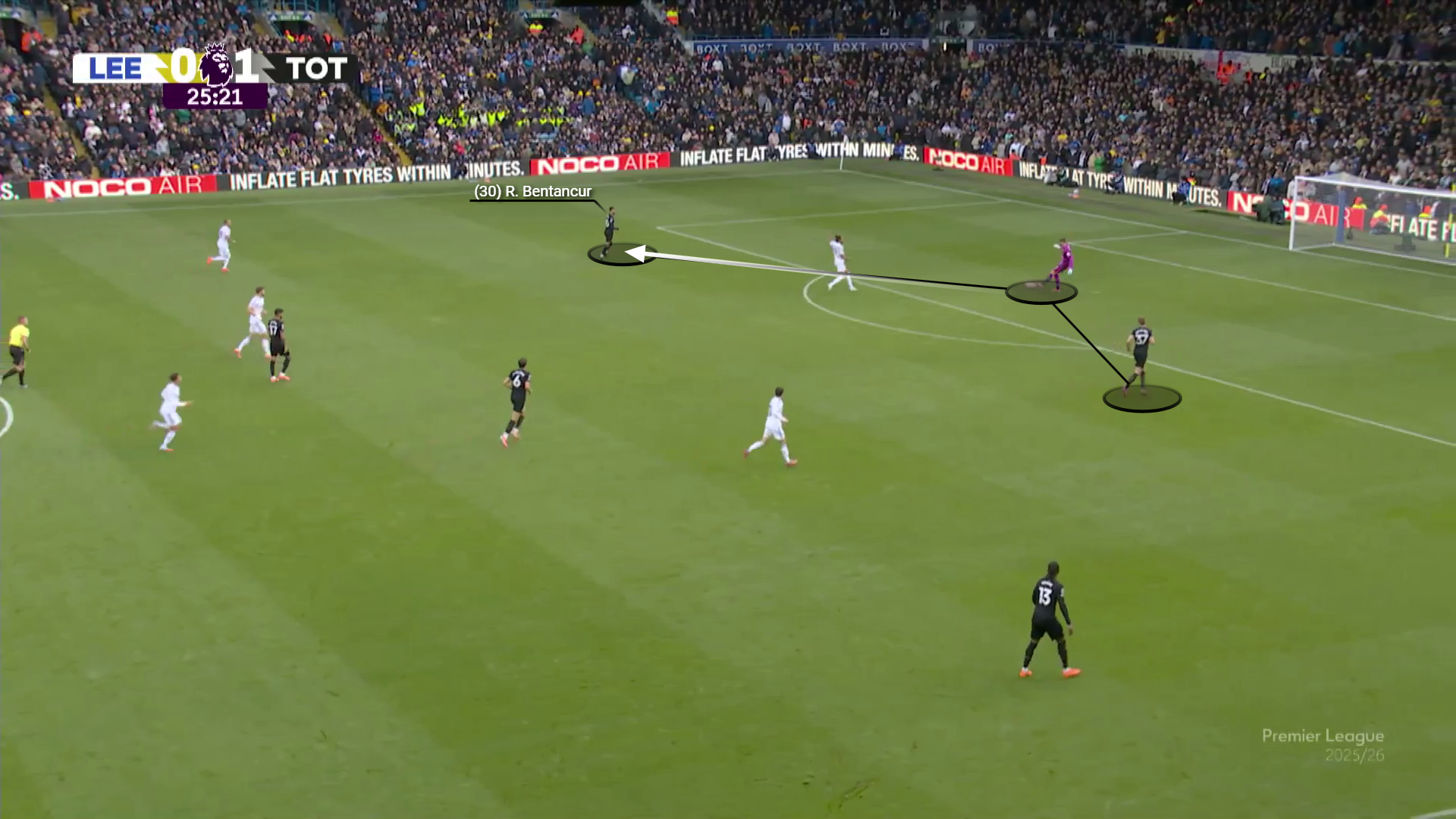
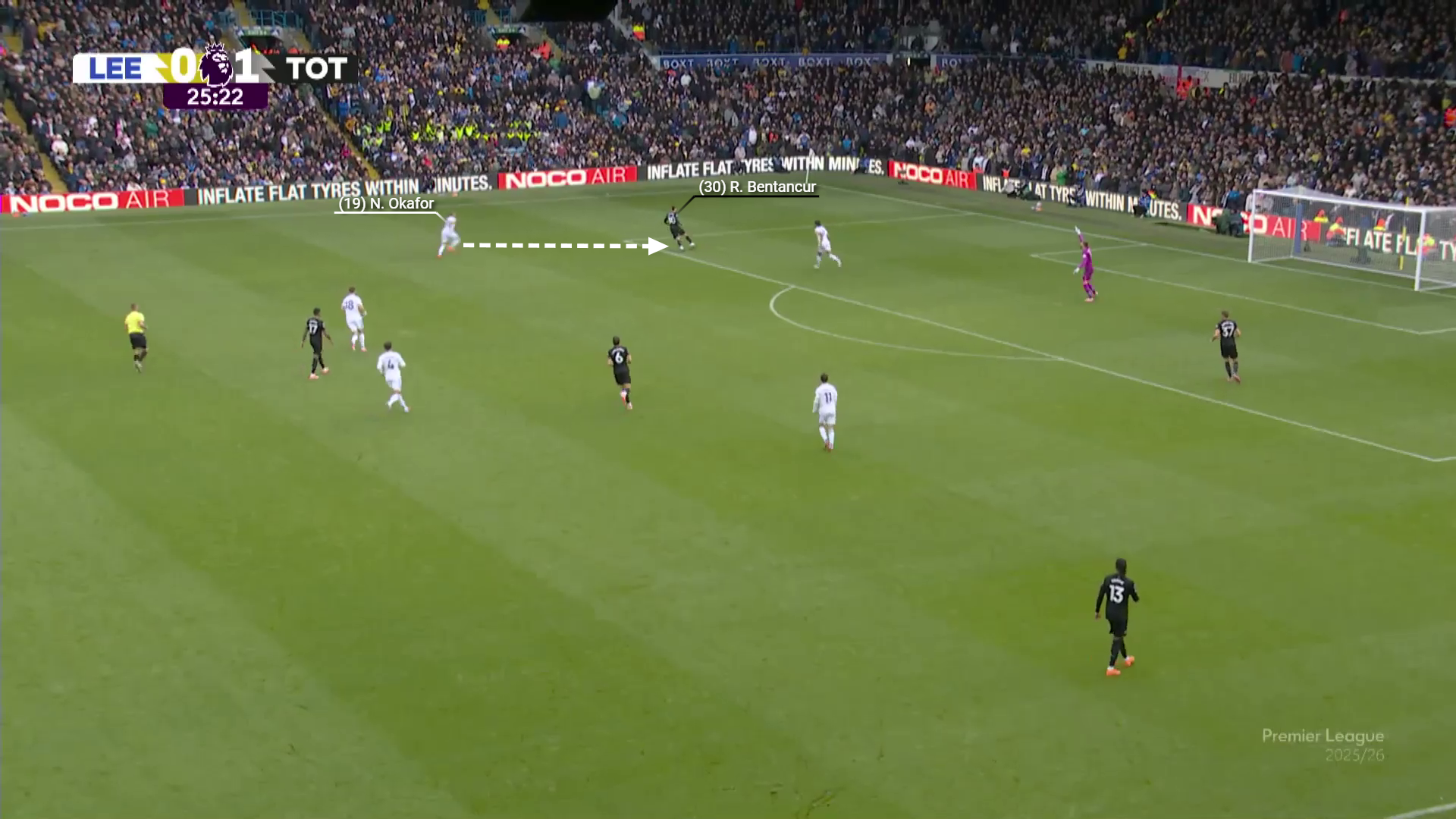
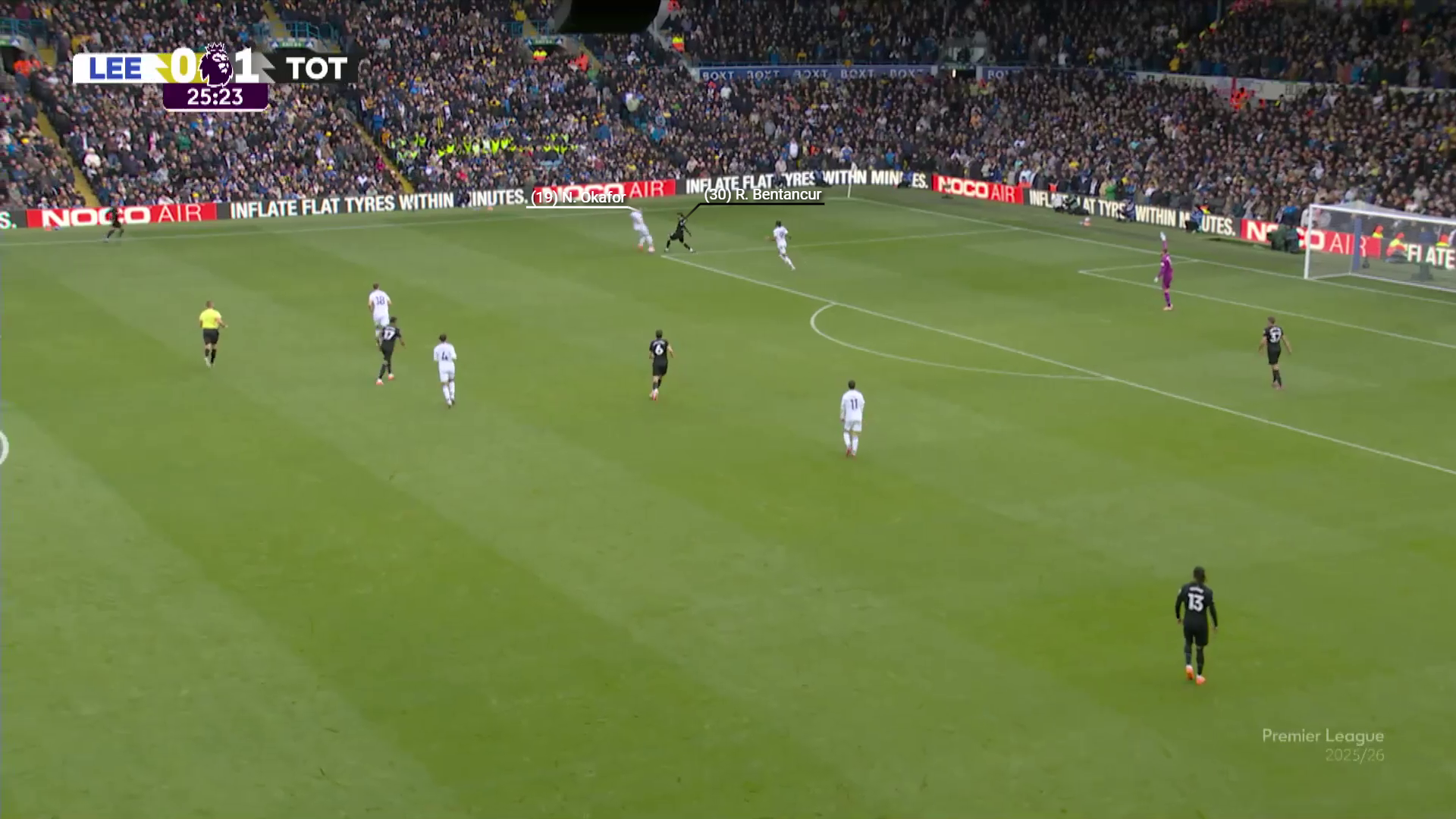
Bentancur dropped into the back line when Romero was injured, taking responsibility for ball progression.
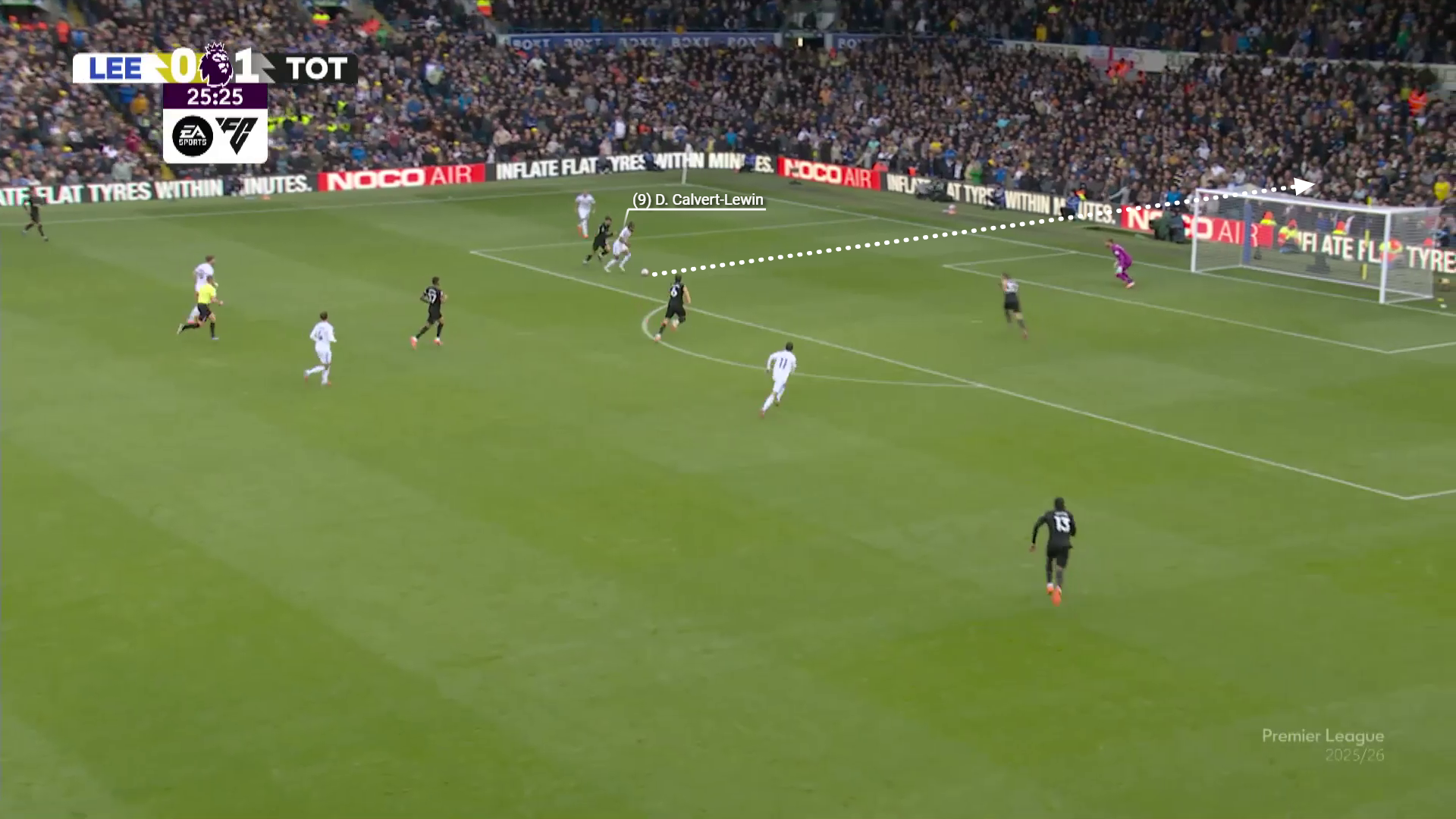
As shown against Leeds United, Bentancur becomes a situational centre-back and part of a three-man build-up.
However, he takes a touch backwards, which makes it ideal for Noah Okafor to win the ball back.
Bentancur is caught and loses the ball, which lands to Dominic Calvert-Lewin, who has a shot on goal.
It provides another steady distributor in the first line but removes a player from the middle third.
Also, this leads to one less player receiving between the lines, combining with the ten, and a longer distance for the nine to bridge back toward the ball.
The spacing begins to stretch, and Tottenham’s ability to connect the first and second phases becomes more difficult.
Frank’s preference for stability is visible here, although the net effect has weakened the team’s ability to impose their plan in the opponent’s half.
This is not a claim that Palhinha and Bentancur are poor players.
It is a profile issue.
When both sixes are primarily safety first, opposition mid blocks can hold their shape.
Tottenham’s centre-backs are invited to pass wide, the full-backs receive to feet with their hips closed, and the first pass goes down the line rather than inside.
Once the ball travels to the wide area under pressure, the next action is either a bounce back to the full-back or a clip down the channel.
Neither brings central entries.
That conservative balance is very pragmatic for a club with Champions League ambitions and an audience that expects proactive control.
The cleanest solution was to pair a ball-winning six with a playmaking partner who could drop and build.
James Maddison’s ability to receive deep, disguise angles, play through the inside lane, and combine with give-and-go patterns would have made the double pivot a progressive option.
Palhinha’s coverage and duelling would have supported his freedom.
However, his ACL injury means that it is not possible.
In the current context, the next best alternative is to lean into a younger profile who can pass and carry through pressure.
Lucas Bergvall deserves more trust.
He is more proactive on the ball, reads pressure well, and is willing to receive in tight spaces and advance possession.
A Palhinha Bergvall pairing, while Pape Matar Sarr rotates situationally, would not abandon security.
Frank would still have his screen when needed, but the structure would also meet the demand to attack centrally and add rhythm befitting the stage.
Spurs Open Play & Creativity
The roots lie in the pivot issue.
When passes that split lines do not threaten the central lane, defenders can keep their hips facing the touchline, show outside, and compress the winger.
Tottenham then either loft the ball over the top or works around the press into a crossing position from a wider zone.
The attack becomes long diagonals or channel runs that do not continuously produce high-quality chances.
The reliance on set-piece return has sometimes masked these issues, but once results cooled, the performances were judged on open play.
The boos after the home defeat to Aston Villa and the frustration during the draw with AS Monaco showed a shared feeling.
The possession looks neat, but it does not bite.
The midfield does not play through the centre to force defenders to make a decision.
The cutback lane is not opened without that, and the second six-yard action never materialises.
The distribution of touches has also limited the attack.
Too many possessions go to the right.
The common pass is Pedro Porro to Mohammed Kudus (both talented players), repeated often and under predictable pressure.
Kudus is an explosive outlet and a high-ceiling ball carrier, but when he gets to his feet on the touchline with two bodies shading inside, his options narrow.
This is shown against AS Monaco, where Kudus was always receiving the ball in wide areas but struggled to achieve much success.
If anything dangerous were to happen, it would be through him, so it was easy for the opposition to apply pressure, especially when he received the ball with his back to play.
A quick interior bounce or a third man angle from the near eight is missing, so he is repeatedly asked to win his duel.
That is not a sustainable chance creation plan against set defences, and it echoes the broader pattern of playing around rather than through.
Xavi Simons still finds his bearings in the league and this structure.
When he plays more centrally, the team must find him early by playing into him or by using the nine as a wall to access him on the half-turn.
At present, he is disconnected, occupying good pockets without the service required to exploit them.
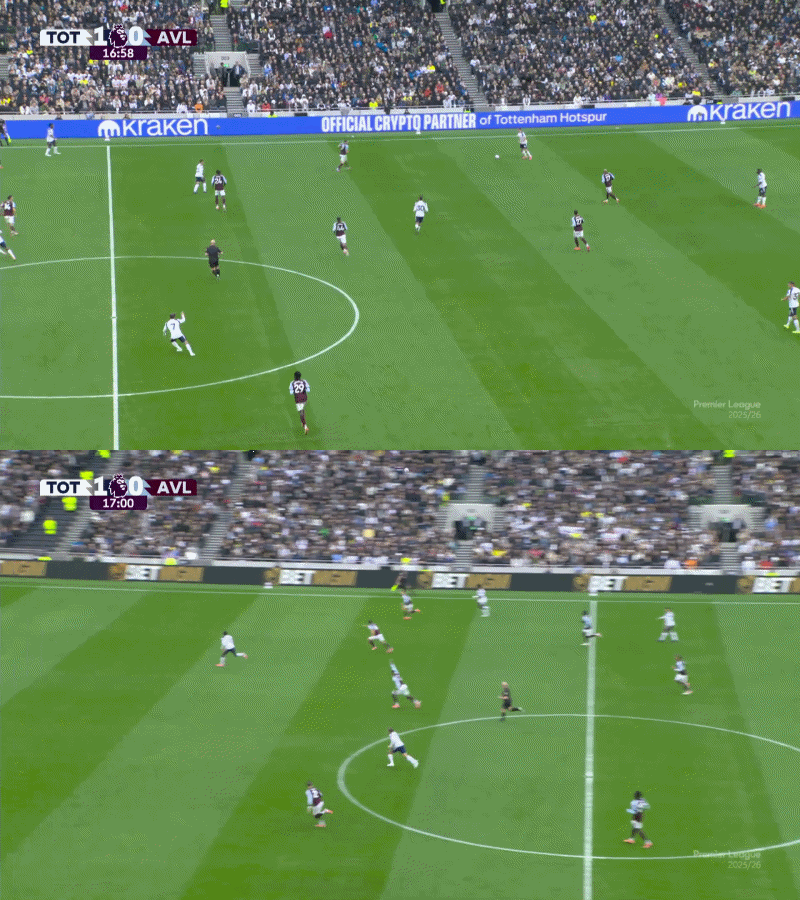
Against Villa, he was between lines, with lanes closed because the build chose the around-the-block route.
In these images, Simons (number 7) has plenty of space to receive.
However, no one can connect from the defensive third and the middle third, so the ball is played over the top in the hope that someone will run onto it.
Frank’s selection choices can change this by prioritising interior receivers (Bergvall).
Wide progression is not without value.
The runners are powerful, the overlaps are timed, and the team can gain territory quickly.
The problem lies in the next action.
Crosses against set backlines have a low conversion rate.
There are methods to restore balance.
For example, a more deliberate use of the third man (i.e., Sarr) in central zones.
The nine can check off the centre back to receive a pass, lay off to Simons inside, and spin to pin the line, while the near pivot advances to offer the next angle.
There is also scope to vary the front line’s starting positions.
When the nine drifts towards the far half-space on goal kicks and early build-up, he can draw one centre-back out, creating a seam for the near winger to attack inside.
The goal is to shift from relying on around to through, and from predictable width to a width that follows an interior who can probe via passes or runs.
Personnel choices matter.
Without Dejan Kulusevski and Maddison, the team loses two natural problem solvers who can receive under pressure and deliver the final ball.
As shown in a league game last season versus Wolverhampton Wanderers, Maddison plays an excellent ball to Emerson Royal, who is in a goalscoring position but is unable to control the ball.
This kind of pass is what Tottenham is missing at the moment.
That cannot be replaced like-for-like, but it can be mitigated.
Bergvall offers more progressive passing from deep than the current default pair.
Sarr provides energy and forward running from the second line, which can create the third man pattern that is currently missing.
Simons should be prioritised as an interior receiver rather than a winger.
When he is positioned between lines in the right half space, the coaching message should emphasise quick access from the pivots and the nine.
Even if it means accepting a higher turnover risk in the middle third.
Better counterpressure structures offset that risk if the pivot balance is corrected.
These changes and selections would show Frank’s willingness to dominate more games.
Conclusion
Tottenham appear to be constrained by a set of structural decisions that have made them more solid defensively, but at the expense of the potential of free-flowing football.
When the central lane is neglected, the wingers are isolated, and the 10 looks lost.
There are practical corrections available, and the players are there to dominate most matchups, but the belief to do so starts with Thomas Frank.
This starts with rebalancing the pivot with at least one proactive progressor.
Whether that’s trusting Bergvall or adding another midfielder into the mix, this will likely lead to Tottenham creating chances at a better rate.
Lastly, work remains to shorten the connections between lines and achieve a balance between protection and assertiveness.
