
When Tottenham Hotspur announced the appointment of Thomas Frank in the summer of 2025, the move was met with both curiosity and anticipation.
Frank, who had built his reputation at Brentford, was not simply seen as another Premier League coach making the step up.
Rather, he represented a distinct tactical thinker with a proven track record of maximising resources and implementing structured, data-driven footballing philosophies.
Spurs, having oscillated between various managerial styles over the past decade, were in need of a coherent identity, something Frank’s tenure promises to provide.
At Brentford, Frank developed a tactical framework rooted in balance: compactness without passivity, directness without recklessness, and creativity without sacrificing structure.
His sides pressed with intelligence, sought value over volume in attack, and frequently manipulated spaces through vertical progression and wide overloads.
Most importantly, he embedded tactical clarity into every phase of play, ensuring that Brentford consistently punched above their weight in one of the world’s most competitive leagues.
This data analysis report does not seek to romanticise Frank’s methods, but rather to dissect them.
By analysing Brentford’s statistical profile across pressing, attacking transitions, progressive passing, shot efficiency, and defensive stability, we can better understand what Frank’s footballing DNA truly entails.
How does his mid-block work under sustained pressure?
What mechanisms define his winger usage and vertical progression?
To what extent is his emphasis on shot quality transferable to a club of Tottenham’s stature?
Through data analysis, this report will unpick each layer of Frank’s approach, building a tactical map that explains not just where Brentford succeeded, but how these ideas might evolve at Spurs.
Ultimately, the question we aim to answer is simple yet profound: what kind of Tottenham will emerge under Thomas Frank tactics?
Brentford Pressing Efficiency & Attacking Transitions Under Thomas Frank 2024/2025
In the 2024/2025 campaign, Brentford established themselves as one of the most proactive pressing sides in the Premier League.
Under Thomas Frank, their approach centred on high turnovers as a primary method of destabilising opponents.
Brentford High Turnovers Under Thomas Frank 2024/2025

Across the season, the Bees generated 319 high turnovers, an output that reflects both the intensity and the structure of their press.
These numbers are more revealing because 45 of those regains were immediately converted into shooting opportunities, six of which resulted in goals.
This conversion rate underlines not only the efficiency of their pressing but also the tactical clarity with which Frank’s side sought to capitalise on transitional moments.
For Tottenham supporters, these statistics are not merely historical records but indicators of the style of football that Frank is expected to transpose onto the Spurs squad.
When contextualised with Brentford’s possession metrics, the picture becomes clearer.
With an average of 4.37 passes per possession, the side showed a preference for quick and direct ball progression, ensuring that turnovers were exploited before defensive blocks could reset.
A long pass rate of 10.91% illustrates a balanced approach: while not overly reliant on vertical balls, they used them selectively to bypass pressure and stretch defensive lines.
The PPDA value of 11.59 suggests a moderately aggressive pressing scheme, effective without committing to reckless over-engagement, which allowed Brentford to sustain energy levels across matches.
Complementing this were an average shot distance of 16.25 metres and an average pass length of 19.23, further demonstrating the pragmatic blend between compact, calculated pressing and direct attacking play.
Such a data profile indicates that Tottenham under Frank may adopt a similar high turnover model, aiming to create shooting opportunities quickly in advanced zones.
The numbers suggest a tactical philosophy rooted in balance: intensity without chaos, directness without predictability.
For Spurs, the promise lies in harnessing these patterns with a squad of greater individual quality, potentially raising the efficiency of high turnovers even further in the Premier League’s upper tier.
Mapping Brentford Winger Actions & Crossing Patterns Under Thomas Frank 2024/2025
One of the most distinctive aspects of Thomas Frank’s system at Brentford in 2024/2025 was the structured support provided to his wingers.
Rather than leaving them isolated on the touchline, Frank designed mechanisms to ease their decision-making and maximise their impact in the final third.
Both No. 8s frequently advanced to the edge of the penalty area, positioning themselves as outlets for cutbacks and creating dilemmas for opposition full-backs.
Meanwhile, the striker’s occupation of the half-space further unsettled defensive lines, buying the wide players time and space to receive, control, and deliver.
This blend of coordinated central movements with wide play ensured that Brentford’s wingers operated in zones of advantage rather than under constant pressure.
Brentford Wingers Actions Under Thomas Frank 2024/2025
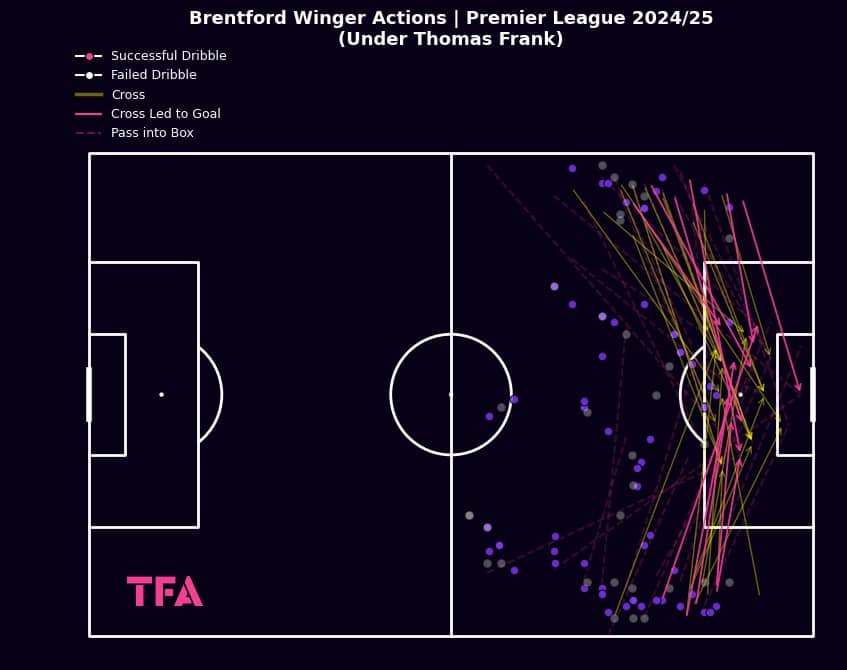
The data offers a clear reflection of how Brentford’s approach stood slightly above the Premier League average.
Across the season, Brentford attempted 592 winger actions, translating to 14.1 per 90 minutes, compared with the league average of 571.9 (13.56 per 90).
Accuracy in crossing also edged higher: 34.1 successful deliveries, marginally above the average of 32.82.
The Bees produced 319 actions from the right flank compared with the league’s 281.7, while from the left flank they attempted 256 against the average of 278.5, showing a subtle right-sided bias.
Notably, Brentford also surpassed the league norm when it came to targeting the six-yard box, registering 96 compared to an average of 84.6.
These numbers underline Frank’s tactical intent: winger actions were not random but carefully engineered within the team’s attacking blueprint.
The emphasis on right-flank overloads, coupled with structured support from central midfielders, meant Brentford consistently created high-quality crossing opportunities.
For Tottenham, this suggests that Frank may replicate a system where wingers are not merely auxiliary attackers but integral to creating controlled chances, operating in tandem with central midfielders and half-space strikers to exploit opposition weaknesses.
Proactive Verticality & Wide Isolation: Brentford Progressive Passing Dynamics Under Thomas Frank
A defining feature of Brentford’s tactical framework in the 2024/2025 season under Thomas Frank was the emphasis on progressive passing as the team’s primary tool for advancing play.
The Bees developed a dynamic balance between directness and control, with long passes increasingly directed towards wingers making runs behind defensive lines.
This verticality ensured that Brentford consistently placed their wide players in advantageous 1-v-1 situations, stretching opponents and forcing them into uncomfortable defensive transitions.
Supporting this, both No. 8s functioned as tempo setters in midfield, constantly seeking rapid penetration through incisive vertical passes that carried the ball into dangerous zones with minimal delay.
The intention was clear: isolate the wingers in space and then exploit their ability to disrupt defensive formations.
Brentford Progressive Pass Map Under Thomas Frank
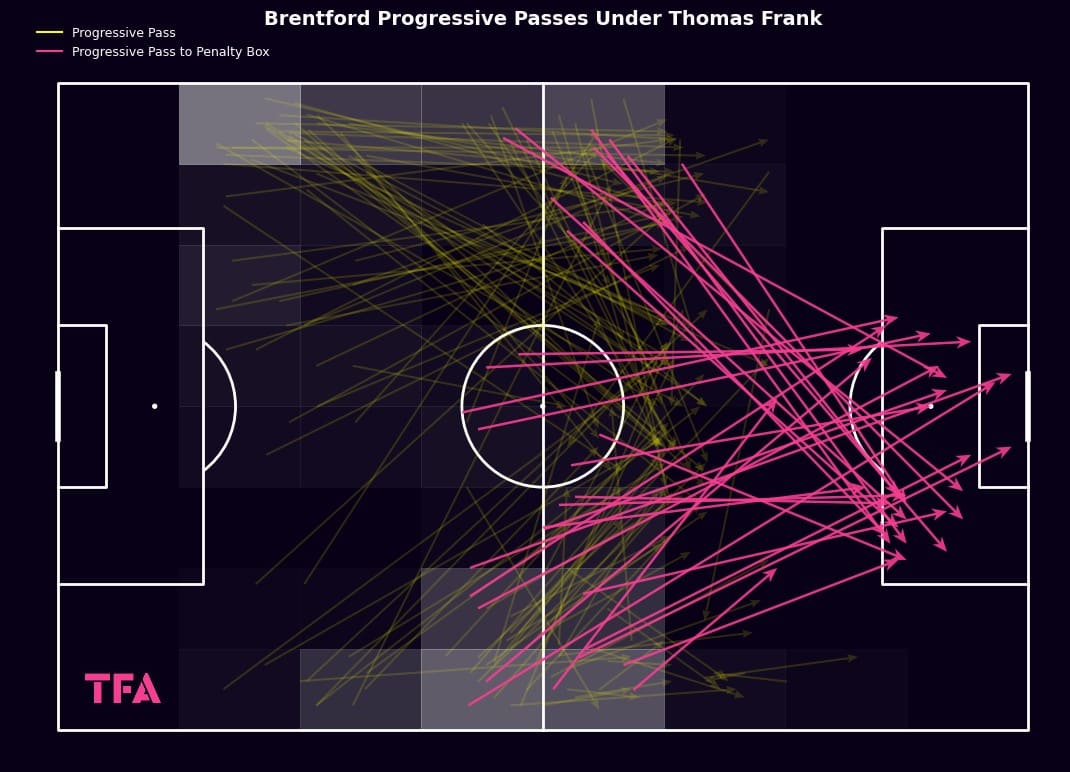
The numbers reinforce this tactical design.
With a match tempo of 16.1, Brentford demonstrated an energetic rhythm, moving the ball quickly without sacrificing accuracy.
Their average of 4.4 passes per possession highlights a direct and purposeful approach, prioritising penetration over prolonged circulation.
The long pass percentage, standing at 10.9%, illustrates a selective yet impactful use of vertical balls.
In contrast, an average pass length of 19.2 metres reflects the team’s inclination to bypass intermediate zones in favour of immediate progression.
Most strikingly, Brentford led the league in switches, registering 18, a figure that underscores their proficiency in rapidly shifting the point of attack.
This capacity to alternate between vertical thrusts and wide rotations made them unpredictable, ensuring opponents struggled to establish defensive balance.
For Tottenham, these patterns offer a clear indication of how Frank might shape their attacking identity.
His Brentford side showcased progressive passing not as a mechanical habit but as a calculated means of destabilising opposition blocks.
With Spurs’ higher technical quality, such principles could translate into even greater efficiency, combining vertical dynamism with structured ball circulation to produce a more sophisticated, multi-layered attacking game.
How Thomas Frank Brentford Maximised Shot Value Through Vertical Play & Wide Support
In the 2024/2025 Premier League season, Brentford under Thomas Frank stood out as one of the most efficient sides in terms of shot quality.
Comparing Shot Efficiency Across EPL With Brentford Under Thomas Frank
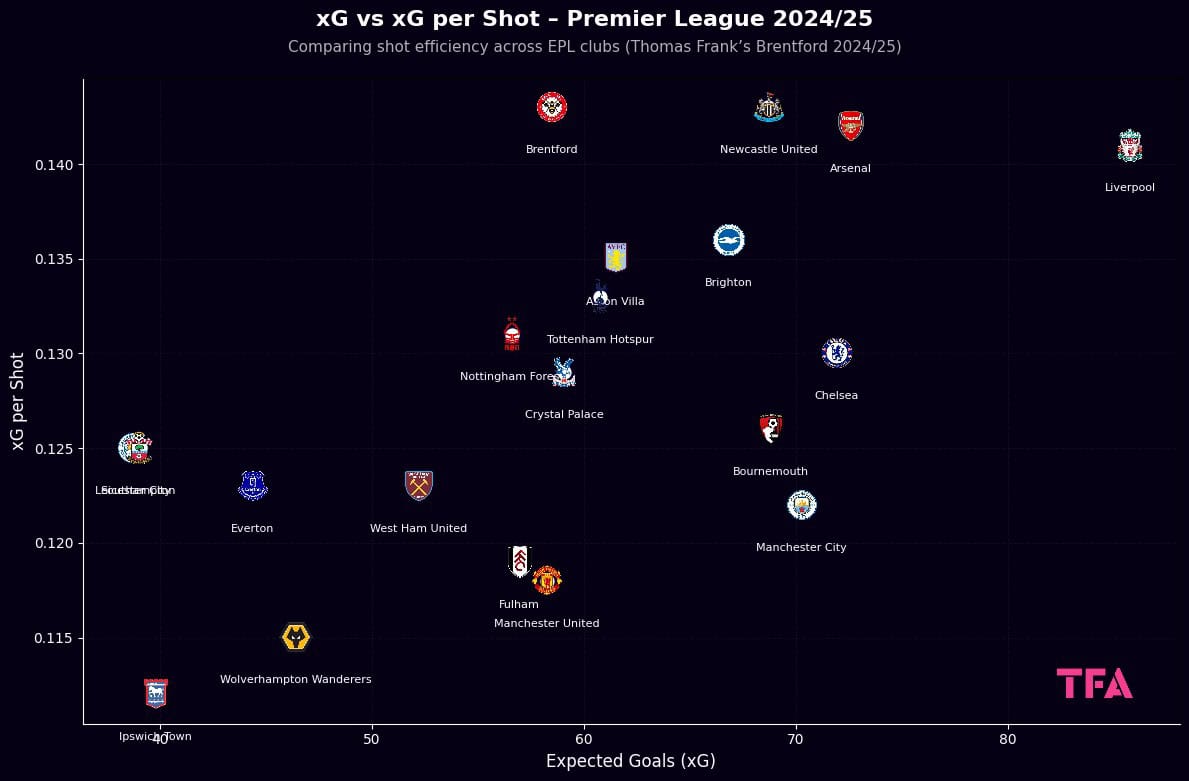
The Bees registered an xG per shot of 0.143, the joint-highest in the league alongside Newcastle United, and notably higher than the overall league average of 0.13.
This figure highlights Brentford’s ability to create shooting opportunities from optimal positions rather than relying on speculative efforts.
Their total xG of 58.49 translated into 66 goals, showing an overperformance that underlines both the precision of their finishing and the clarity of their attacking patterns.
When compared to other top sides, the significance of this efficiency becomes clearer.
Arsenal (0.142) and Liverpool (0.141) both produced higher overall xG tallies but fell slightly behind Brentford in terms of per-shot quality.
Even Manchester City, typically renowned for their chance creation, posted only 0.122, well below Brentford’s standard.
This contrast highlights Frank’s structured approach to engineering fewer but higher-value opportunities, often through coordinated vertical play and support across wide areas.
For Tottenham, this profile offers a clear tactical insight: Frank’s philosophy is built on quality over quantity.
By reproducing these principles with a more technically gifted squad, Spurs could expect an attack defined by efficiency, where each shot is more likely to convert into a goal.
Brentford Attacking Blueprint: Balancing Positional Patience With Counterattacking Precision
Brentford’s attacking output under Thomas Frank in the 2024/2025 season offers a fascinating blend of patience and pragmatism.
The statistics highlight the tactical identity that has become synonymous with the Dane’s philosophy.
Brentford Balance Between Structured Build-Up & Incisive Transitions
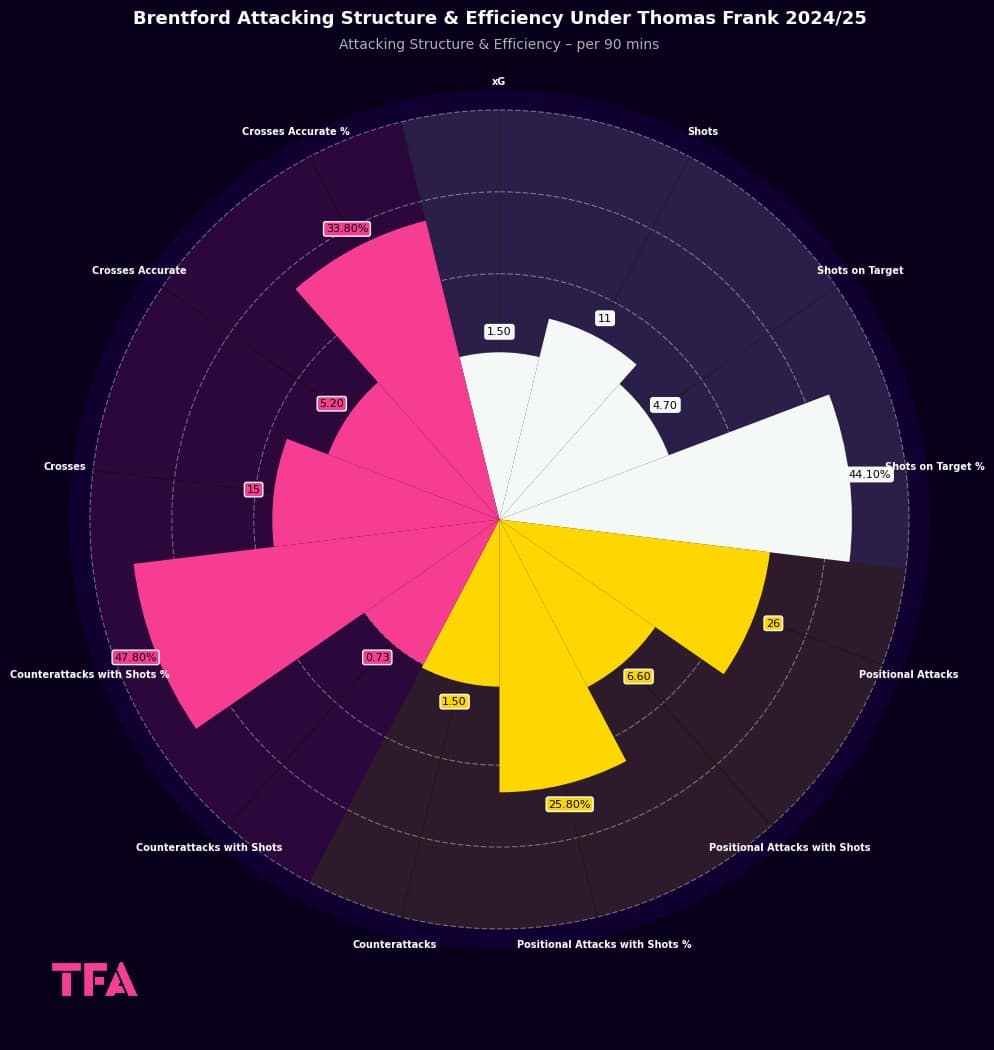
The team’s average expected goals (xG) of 1.53 per match underlines their ability to generate consistent scoring opportunities, despite not being a volume-shooting side.
Averaging 10.6 shots per game, with 4.65 of those on target, Brentford’s shot accuracy rate of 44.1% demonstrates a strong emphasis on efficiency and shot quality rather than speculative attempts.
This approach is closely linked to their structured attacking schemes, as shown by the 25.7 positional attacks per game, of which 6.61 (25.8%) culminated in attempts on goal.
This reflects a carefully choreographed attacking mechanism, designed to manipulate opposition blocks before striking decisively.
Yet, Brentford’s tactical versatility is perhaps best seen in their transitional threat.
With 1.52 counterattacks per match, nearly half (47.8%) of which lead to shots, the Bees are among the most ruthless sides in Europe when transitioning from defence to attack.
This duality, control in possession but explosiveness in moments of transition, embodies Thomas Frank’s ability to tailor his side’s attacking patterns to both the opponent and the game state.
Crossing also remains a prominent feature of their arsenal, with Brentford attempting 15.3 crosses per match, of which 5.16 (33.8%) are accurate.
This efficiency in wide delivery not only highlights their aerial threat but also complements their flexible forward structures, where attackers are encouraged to occupy varied zones in the box.
Taken together, these figures portray a side that marries structure with spontaneity, capable of wearing down opponents with positional patience while punishing them mercilessly in transition.
Compact Mid-Block But Fragile Edges: Analysing Thomas Frank Defensive Structure With Brentford
Brentford’s defensive profile in the 2024/2025 Premier League season under Thomas Frank presents a fascinating balance between structural compactness and recurring weaknesses in aerial and wide areas.
Brentford Defensive Statistics Highlight A Solid Central Compactness But Expose Aerial & Wide Vulnerabilities
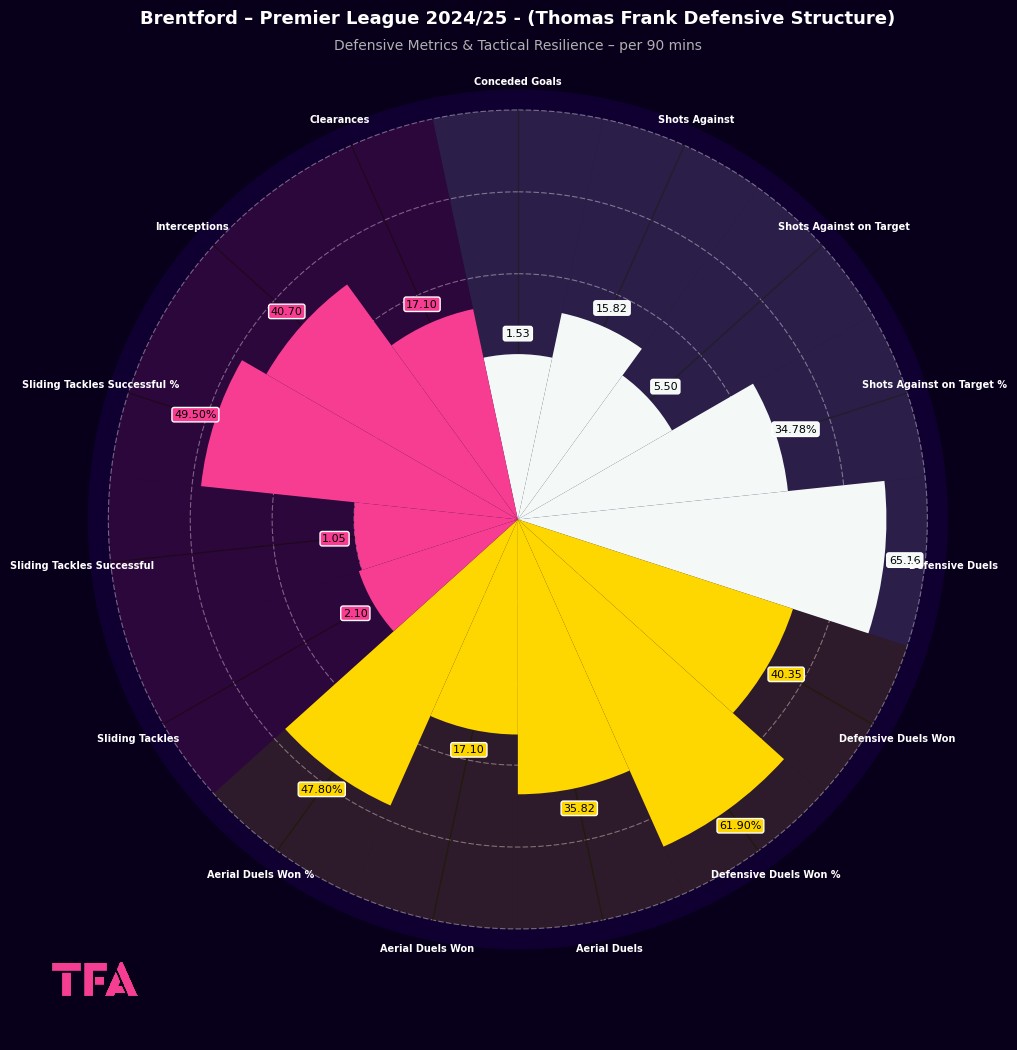
Conceding 1.52 goals per game, the Bees have not collapsed defensively, but the underlying data reveal concerning trends.
They face 15.82 shots per match, with 5.50 of those on target, reflecting that while the team succeeds in limiting shooting efficiency, the volume of efforts against them is relatively high.
The 34.77% shots-on-target rate suggests that opponents are not only testing the goalkeeper frequently but also managing to generate quality chances when Brentford’s block is stretched.
The duel statistics shed further tactical insight.
Brentford engage in 65.16 defensive duels per game, but win only 61.91%, which is a respectable yet unspectacular figure.
More worryingly, in aerial confrontations, the side enters 35.82 duels, but their success rate drops sharply to 47.78%, indicating persistent vulnerability against long balls, set-pieces, and diagonal switches.
This aerial fragility undermines the otherwise cohesive central shape that Frank’s mid-block provides.
On the ground, Brentford attempt 2.11 sliding tackles, succeeding in 1.05 cases, giving them an efficiency of 49.46%, a reflection of their risk-averse defending style, often preferring containment over aggressive interventions.
Interceptions (40.66 per game) and clearances (17.09) highlight Brentford’s reactive tendencies.
Players frequently cut off passing lanes and relieve pressure during sustained attacks.
However, these numbers also underline the heavy defensive workload imposed by the opposition’s ability to sustain possession around their box.
Overall, the statistics suggest a side that remains tactically disciplined in its compactness but struggles when forced into aerial duels or when defending its box against repeated delivery.
Conclusion
The analysis of Brentford’s 2024/2025 data under Thomas Frank provides a clear tactical fingerprint that is highly instructive for Tottenham’s future.
What emerges is a coach whose teams are defined not by stylistic dogma, but by calculated efficiency in every phase of play.
Brentford’s pressing profile, characterised by 319 high turnovers, with 45 leading directly to shots, demonstrated how Frank views defensive aggression as a creative tool.
Their winger actions and progressive passing statistics highlighted the structural mechanisms that allowed wide players to thrive without isolation.
In attack, Brentford consistently pursued quality over quantity, registering the highest xG per shot in the league (0.143) alongside Newcastle.
Their defensive figures revealed both the strengths of a disciplined mid-block and the vulnerabilities in aerial confrontations.
For Spurs, these insights are more than retrospective observations; they provide a tactical roadmap.
With a more technically gifted squad, Tottenham are better positioned to refine Frank’s blueprints into a model capable of challenging the Premier League’s elite.
Pressing could become more efficient with higher-quality ball-winners, while his emphasis on progressive passing and vertical play should dovetail with Spurs’ creative midfield options.
Similarly, the shot-value philosophy that allowed Brentford to outperform their xG could become even more potent when applied to forwards of higher calibre.
Yet, the challenges remain. Spurs will need to overcome the same aerial and defensive fragilities that plagued Brentford, albeit with stronger individual profiles to mitigate risk.
The success of Frank’s project will depend on whether he can adapt his structural discipline to the demands of a club expected not just to compete, but to dictate.
In conclusion, the Tottenham of Thomas Frank promises to be a side defined by efficiency, verticality, and tactical clarity.
If Brentford was the laboratory where his ideas were tested, Spurs may now become the stage where they are perfected.
