
Bradford City have long been one of the biggest ‘fallen giants’ in English football.
Last appearing in the Premier League in 2000/2001 when they finished bottom of the table, the Bantams spent the last six seasons in EFL League Two before finally managing to earn promotion to the third tier under Graham Alexander earlier this year, securing their place in EFL League One for the 2025/2026 campaign.
The Yorkshire club have got off to a flyer in the third tier, as well, going unbeaten in their first six games, winning four and drawing two, placing them sixth at the time of writing.
Bradford City had an average attendance of almost 18,000 in League Two last season, dwarfing the figure achieved by the next best Notts County, who boasted a figure of just over half Bradford’s attendance numbers.
This demonstrates the size of the club, the loyalty of its supporters, and the potential that exists to be tapped into should they continue their ascent up the English footballing pyramid.
After achieving promotion last term, Graham Alexander tactics have led the club to a successful start in 2025/2026; this Bradford City tactical analysis aims to outline the Graham Alexander tactics driving Bradford’s resurgence, focusing on their dominance in transition.
Graham Alexander Style Of Play
Graham Alexander sets his Bradford City side up in a 3-4-2-1 formation.
The Bantams have averaged just 40.9% possession in England’s third tier this season, yet they’ve generated the highest xG (10.45) of any side in their division six games into the 2025/2026 campaign, scoring 10 goals.
They average the third-most shots per 90 (11.75), third-fewest passes per 90 (263.59) and lowest pass accuracy (69.8%) of any side in League One this term.
All this data points to a side that has little interest in playing with patience in possession.
They also engage in a relatively high number of defensive duels and aerial duels per match.
Bradford’s game under Graham Alexander is all about quickly winning the ball back and driving towards goal with it.
Alexander’s players constantly press on the front foot and get their heads up with the ball, looking to progress.
This Bradford side is ultra-aggressive about putting the opposition’s backline under intense pressure in every way possible; that’s what their game is all about.
As we delve further into Graham Alexander’s tactical principles, we’ll explore the ins and outs of how his team achieves this ideal.
Graham Alexander Pressing Tactics
Calling Bradford City a ‘counterattacking’ side or one that thrives in transition may convey the idea that they like to sit deep, absorb pressure, and try to hit the opposition on the break by targeting space behind their backline.
However, Graham Alexander’s side is very comfortable pressing high, aiming to force turnovers on the edge of the opposition’s penalty area as well.
This can create golden opportunities to attack the opposition when they’re a little more open due to having just lost the ball while trying to build out from the back.
They’ll press in their 3-4-2-1 shape, with all players prepared to close the opposition down aggressively on the front foot, trusting a teammate will follow to cover the space behind them and deny the opposition a chance to just play the ball in behind the pressing player.
Thus, the central midfielders and centre-backs in the 3-4-2-1 shape play a key role in the effectiveness of Bradford’s pressing.
As the striker, wingers and wing-backs press high, the central midfielders and centre-backs must be prepared to jump from their settled position to protect the space behind those aggressive pressing players.
This ensures Bradford’s shape remains vertically compact, and it doesn’t invite the opposition to exploit the open space between the lines.
The central midfielders and centre-backs can also be pivotal in forcing high turnovers with their commitment to the press.

Here, the Peterborough United centre-back manages to thread the ball between Bradford’s pressing right-forward and centre-forward, finding a teammate in central midfield.
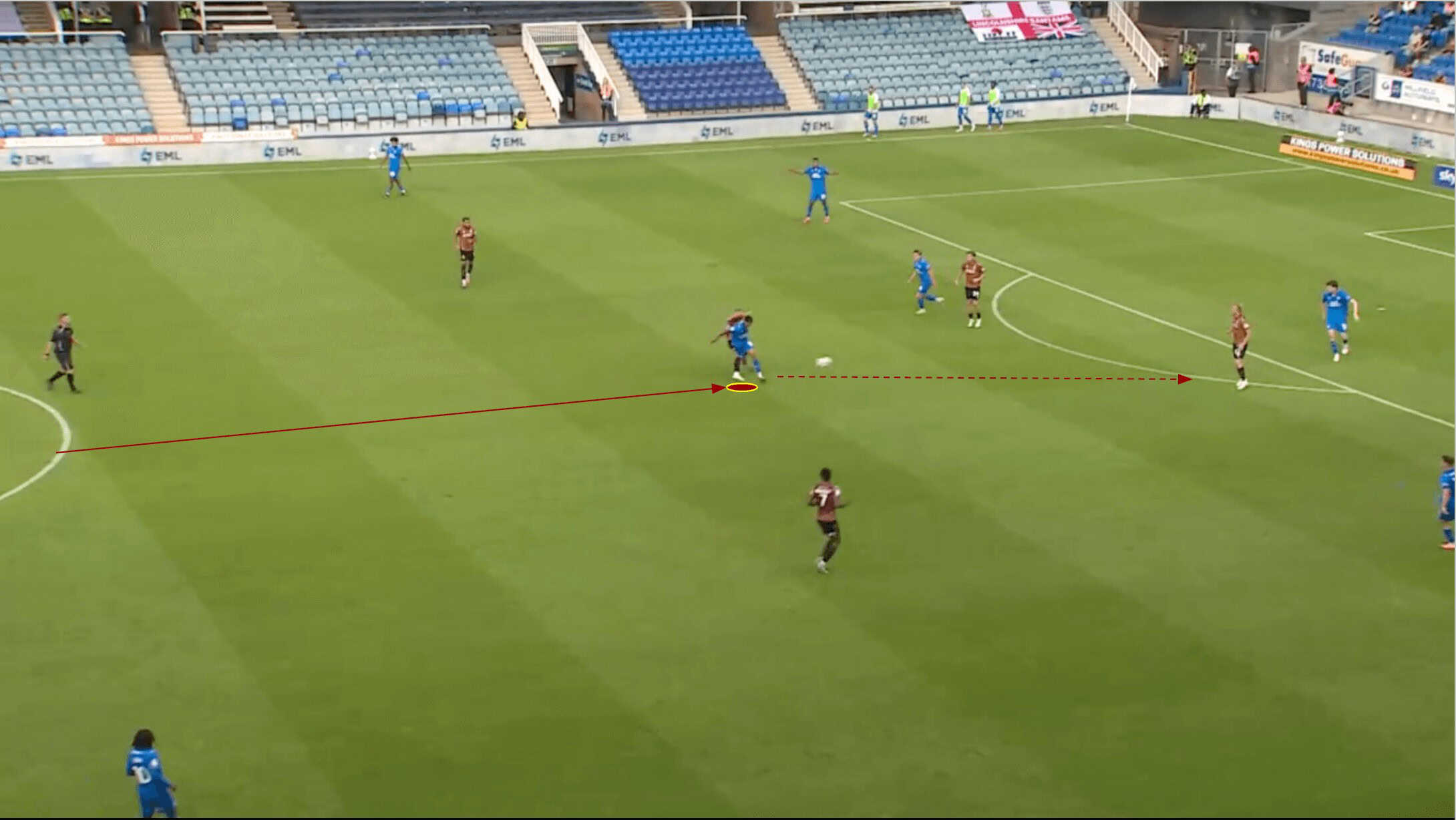
Before the receiver can turn and face forward, one of Bradford’s two central midfielders is on him, performing a successful tackle and turning this into an opportunity to create a goalscoring chance versus an unsettled defence inside the final third.
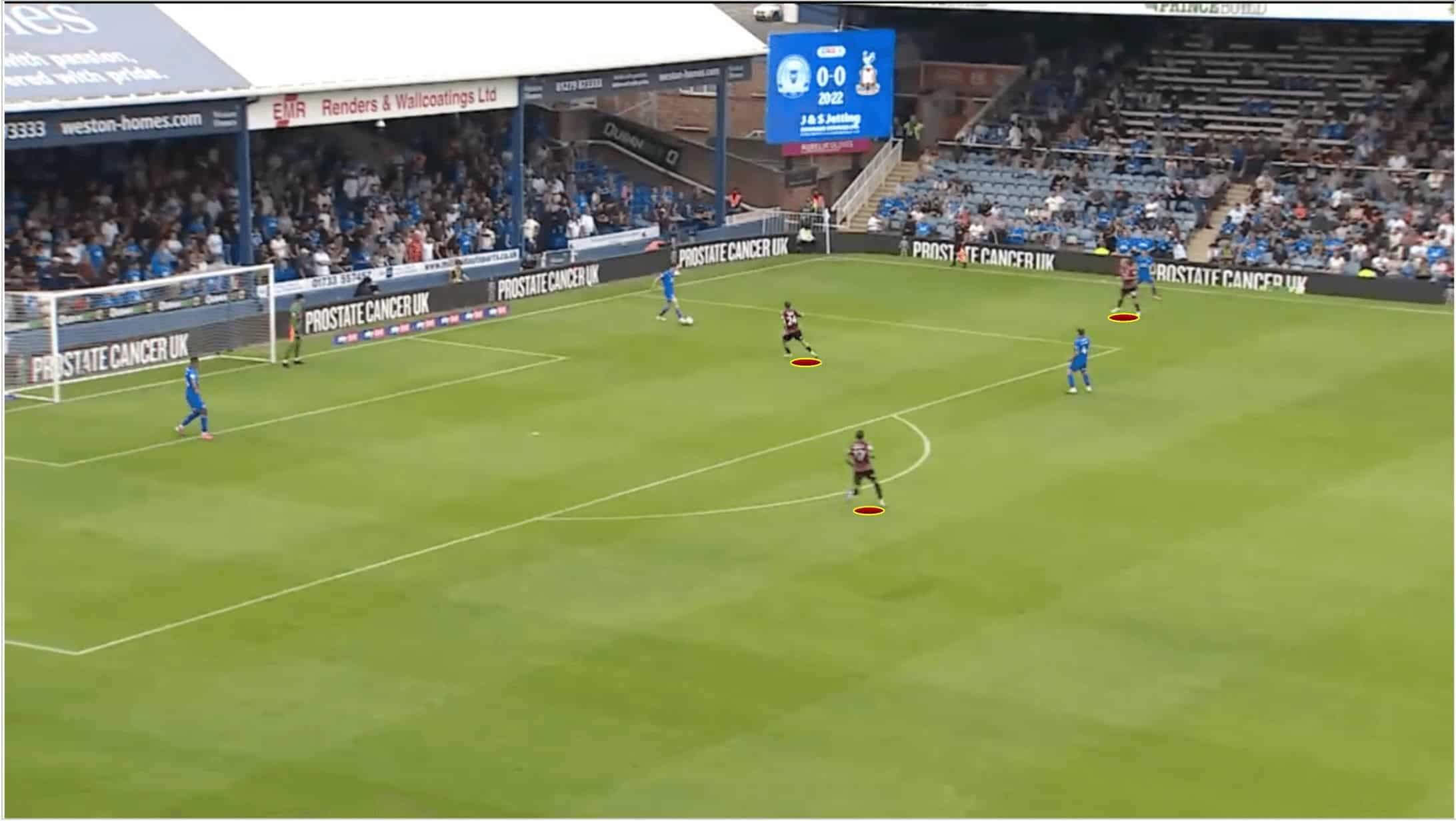
Again, Bradford press the opposition’s build-up high with their front three.
By dropping in behind the striker, Peterborough’s central midfielder becomes a viable passing option if the centre-back can find him.
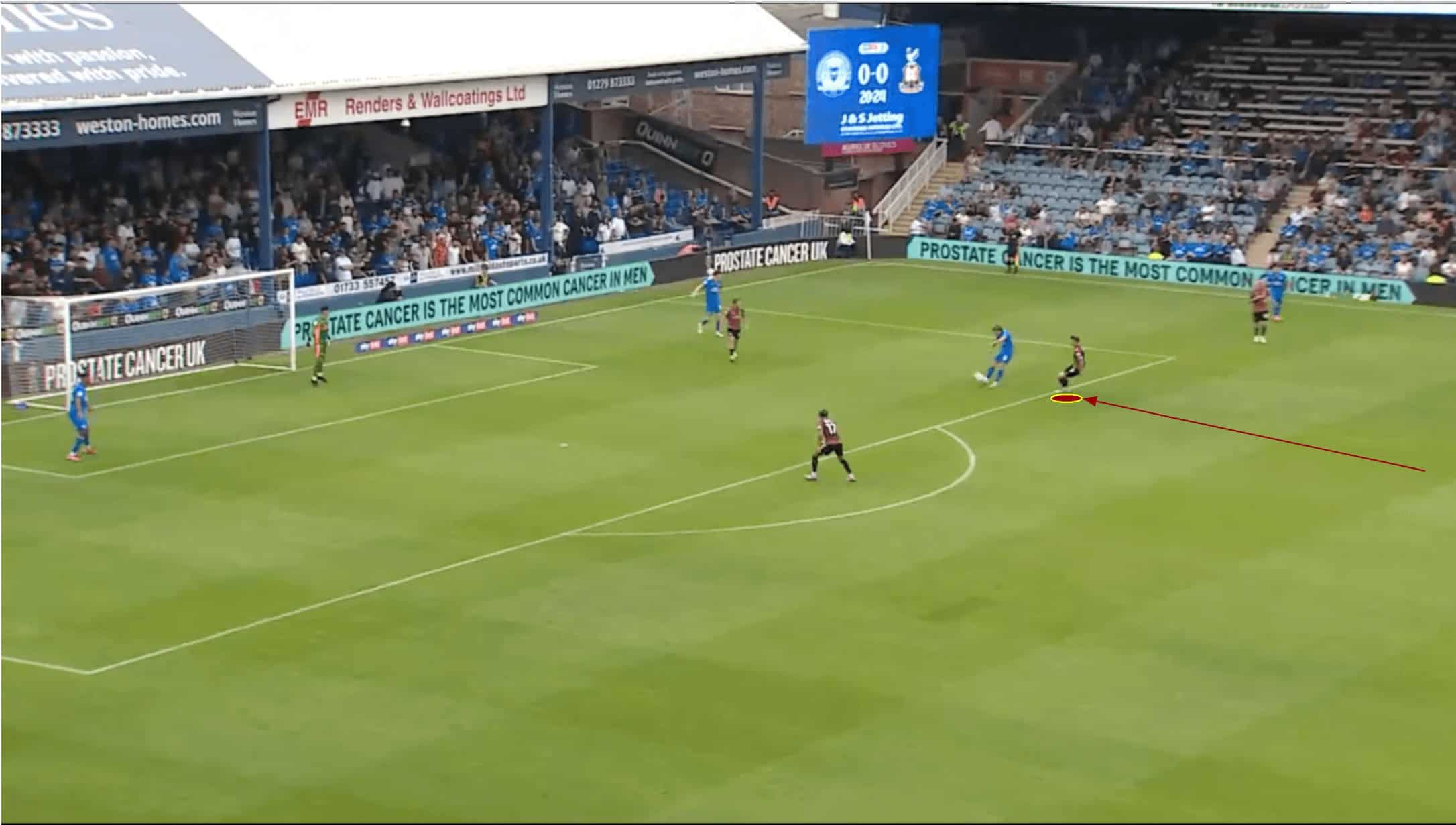
Though he doesn’t force the turnover this time, Bradford’s central midfielder ensures the receiver is unable to turn and gets forced into a rushed long ball, which inevitably leads to a turnover.
Should the opponent play the ball in behind that aggressive central midfielder or the wing-back, a centre-back will be ready to similarly jump forward and close the receiver down.
This can lead to a turnover or, at least, buy Bradford’s midfielders and attackers time to get back behind the ball.
With a two-man central midfield, Bradford City can get overloaded in the middle of the park both in settled phases of defence and transition.
To prevent this, it’s crucial that the wide forwards drop in to support the central midfielders out of possession.
However, there is a weakness that can be exploited, whether that’s by getting the ball in behind the central midfielders or otherwise.
Overloading the midfield and targeting space behind both central midfielders and wing-backs should be a major consideration for Bradford’s opponents; many of the chances opponents have crafted against the Bantams this season have come from attacks that attempt to do this.
For Bradford, it’s key that they remain compact and moving as a unit as much as possible, with wide forwards dropping back and centre-backs pushing up as required to protect the space between the lines and in central midfield.
A lot of Bradford’s success this season will hinge on who wins that specific midfield battle: themselves or their opponents, and a lot of the time, that may come down to who’s better organised and better prepared to react to the unique challenges that come up in relation to this feature of Bradford’s game.
The key takeaway from this section in relation to Bradford City style of play is that the Bantams are not a side that likes to soak up pressure.
They obviously have to defend in the low block sometimes, but they are most comfortable pressing high and pressing aggressively, aiming to turn the opposition’s build-up into a goalscoring opportunity of their own.
Graham Alexander Counter-Attacking Tactics – Capitalising On Mid-High Turnovers
This section looks at some of Bradford City’s counterattacking principles, as outlined above, in action versus Luton Town.
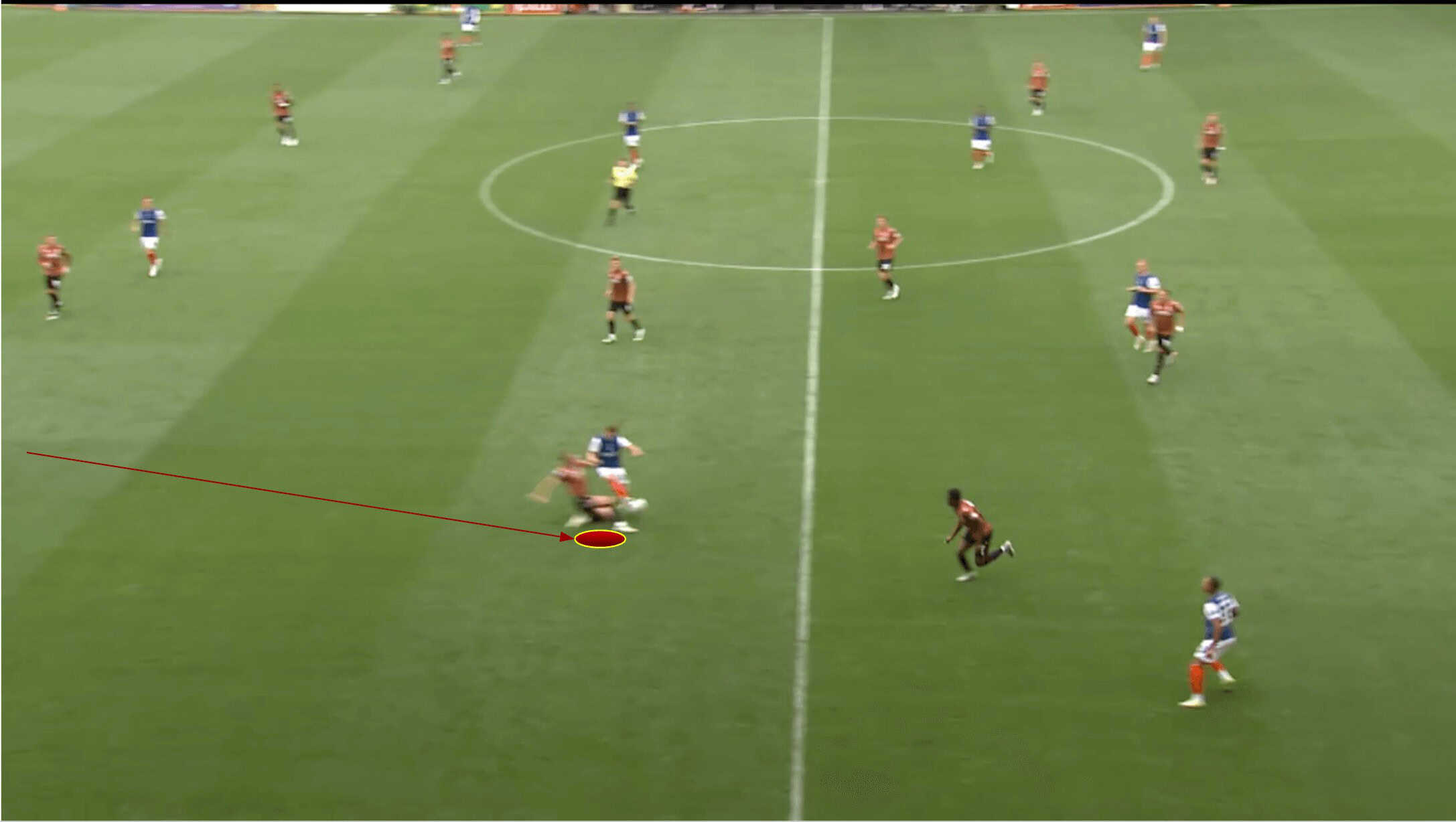
As we join the action here, we see Bradford’s right centre-back, Matthew Pennington, winning the ball back from Luton with a hard tackle in the middle of the park after Luton tried and failed to exploit the space behind the Bantams’ right wing-back, Josh Neufville.
Neufville has been one of Bradford’s most significant attacking assets in the 2025/2026 season.
Bradford tend to try and get Neufville on the ball frequently, launching long balls towards the right wing more often than they try to attack down the left in order to take advantage of Neufville’s playmaking ability.
This can lead to space opening up behind Neufville more often than it opens up behind left wing-back Ibou Touray, resulting in Bradford’s right centre-back needing to act as something of a right full-back a lot of the time.
Neufville will press high on the right wing and carry the ball forward aggressively.
When his team wins the ball back deep, he’ll try to get forward fast in order to become a quick outlet for a forward pass.
Defensively, this places a lot of responsibility on the rest of the backline to shift over to the right accordingly to cover Neufville, enabling his attacking role, as seen from Pennington above.
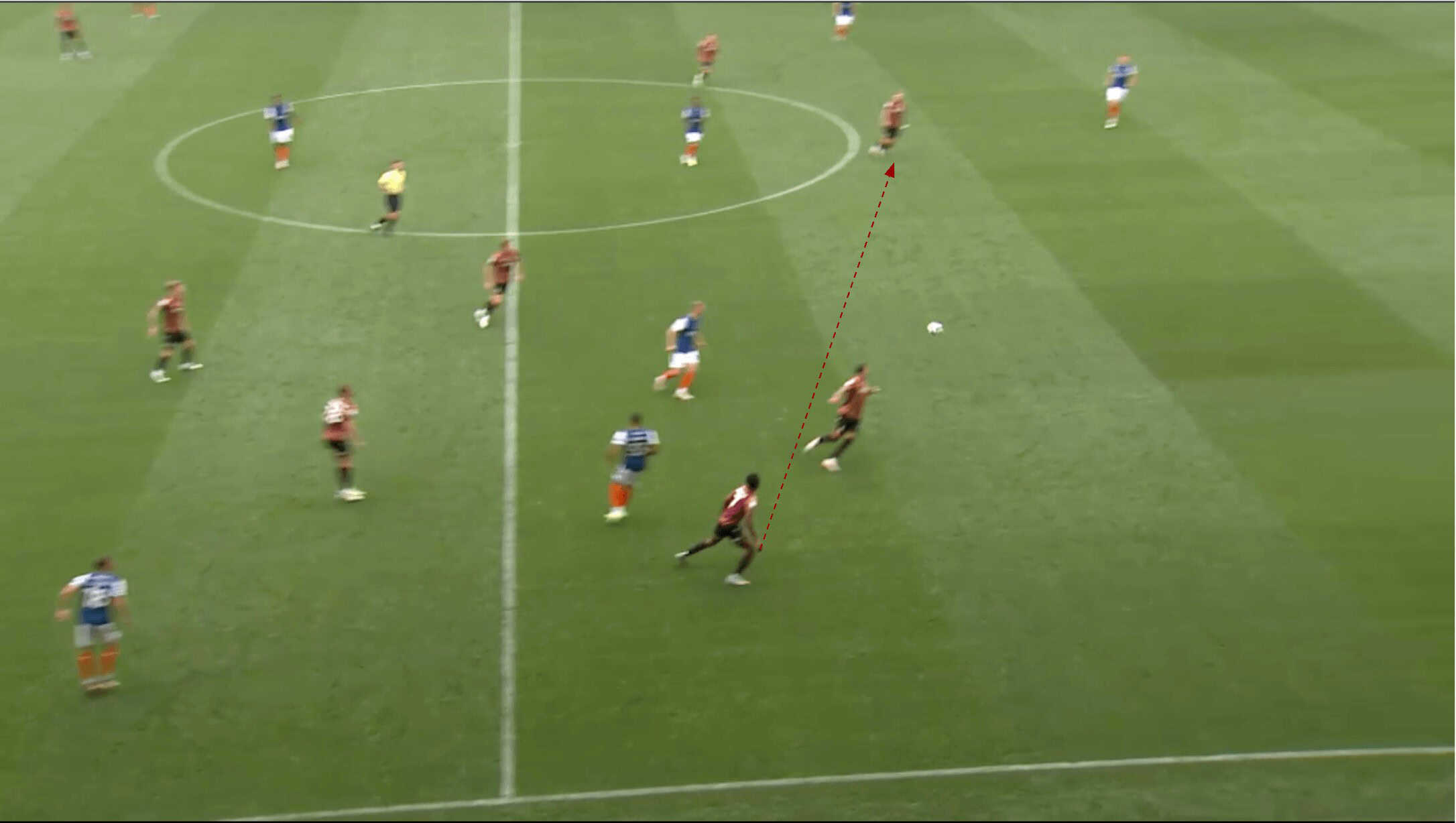
After Pennington wins the ball back, he knocks it forward to Neufville.
The right wing-back can turn towards the middle of the pitch, get a pass played to centre-forward Stephen Humphrys and set off on his run, targeting space on the right wing.
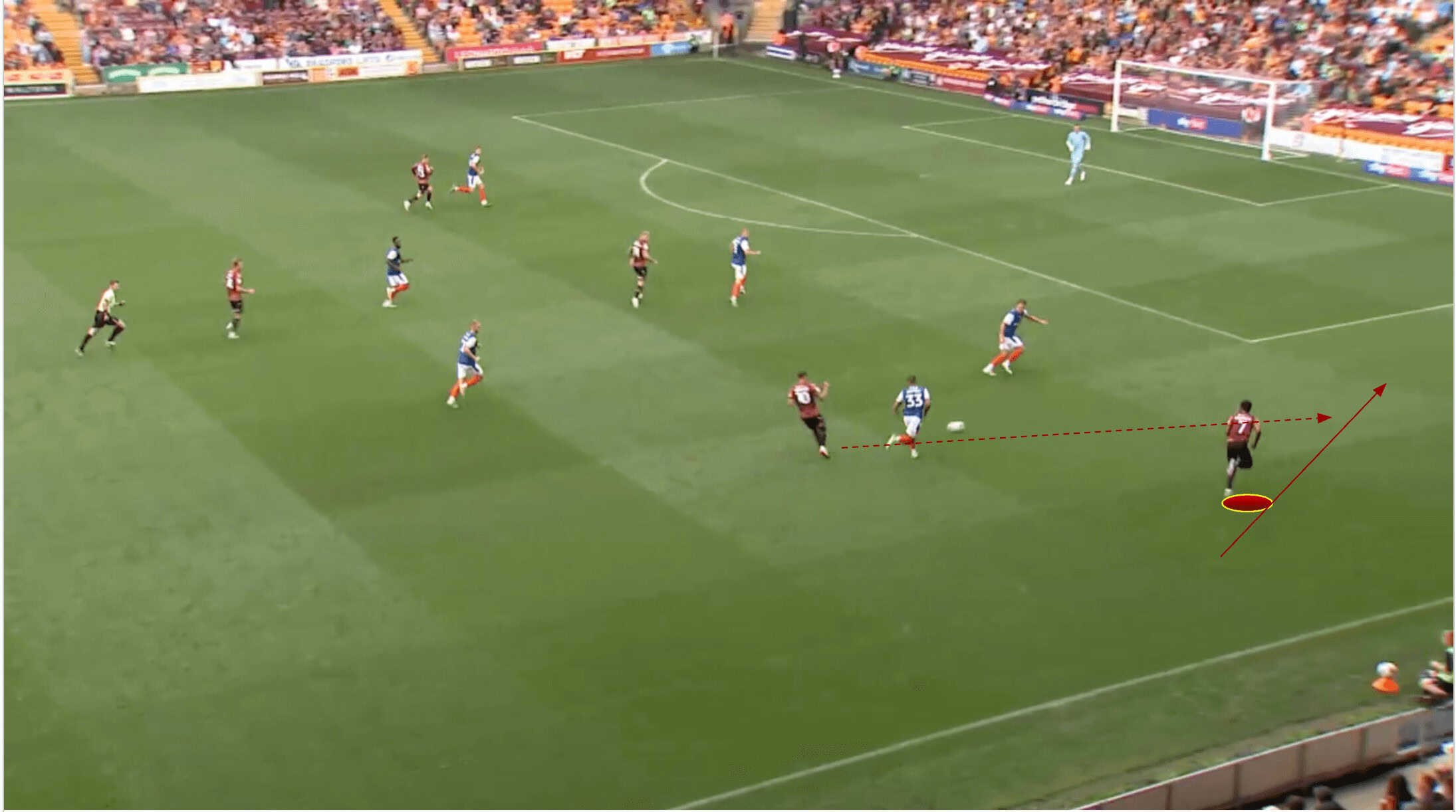
Right-forward Antoni Sarcevic receives the ball in the half-space before playing it through to Neufville on the overlap.
From here, Neufville can cross the ball low into the box, finding left-forward Bobby Pointon, who’s able to tuck the ball away in the bottom right-hand corner of the net.
This goal is typical of Bradford City’s electric counterattacking style in 2025/2026.
They win the ball back through the centre-back’s aggressive decision to come out and close down the receiver on the wing behind Neufville.
Then, Neufville’s instinct is to immediately get his head up, play the ball into the forwards and run in behind to exploit space on the wing before he receives and sets up a goal.
This example clearly displays Bradford’s aggressive, forward-thinking tactics both in and out of possession.
Graham Alexander Counterattacking Tactics – Transitioning From Deep
Of course, Bradford City won’t always win the ball back in the middle third or the final third.
Some of their recoveries will come in deeper areas of the pitch, and they are prepared to quickly but intelligently get the ball forward into dangerous positions when they recover the ball deep, as well.
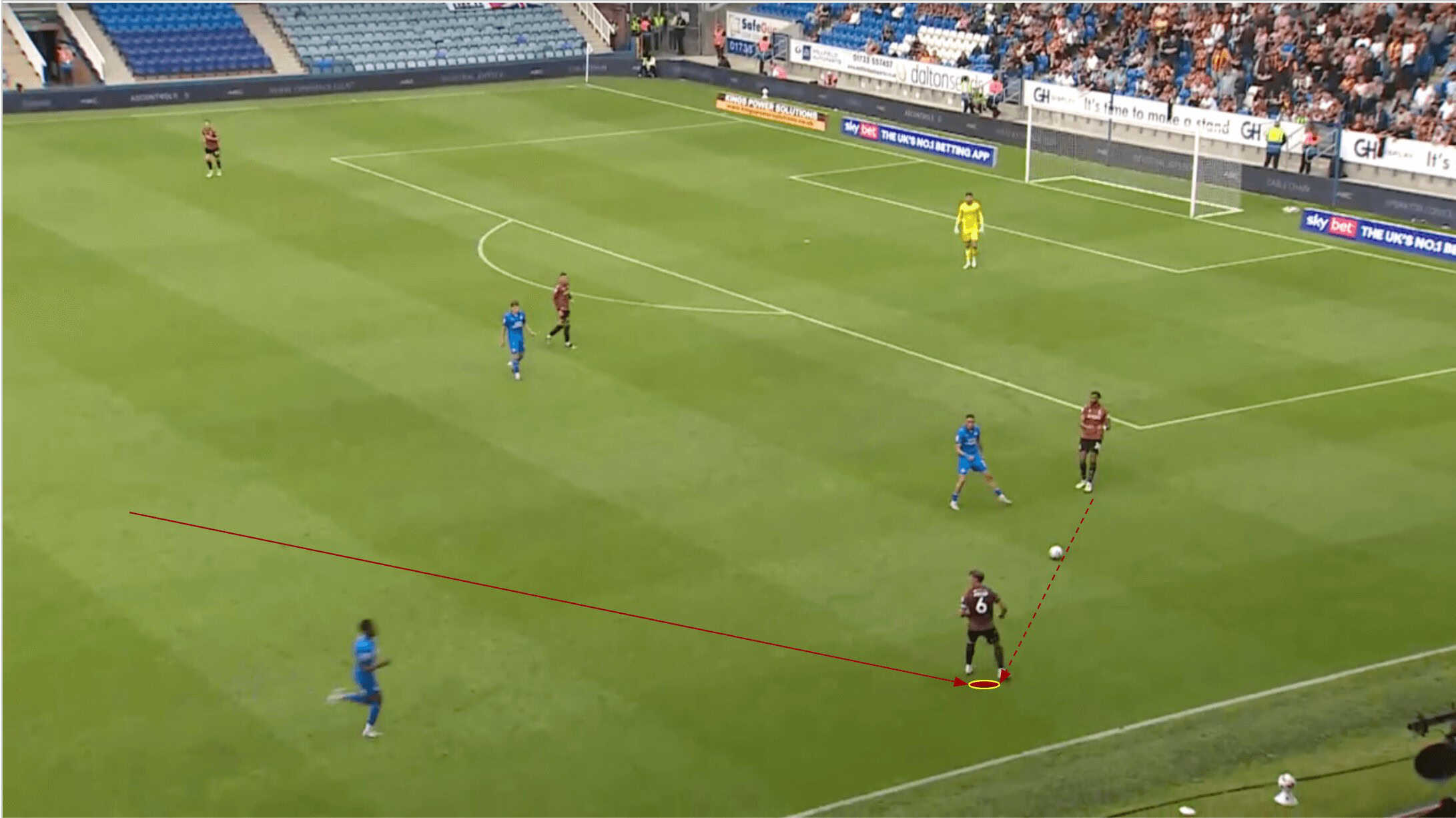
Bradford’s central midfielders, Max Power, Tommy Leigh, Jenson Metcalfe, and Alex Pattison, whichever combination of two from those four is playing, are key creators for the side in terms of their ability to carve out chances and their ball progression capabilities.
Here, while building out from deep, Power moves out of the Peterborough forward’s cover shadow, finding space on the wing where he can receive from the left centre-back, Curtis Tilt.
As the ball is on its way to Power, he scans over his left shoulder, as we can see in the image.
It’s an appropriate time to scan as the pass has already been played, and the ball is in motion towards the midfielder who’s taken up a wide position.
After receiving here, Power is prepared to quickly turn and fire the ball into one of the Bradford forwards, adhering to the team’s philosophy under Graham Alexander of getting the ball upfield fast.
From there, with Peterborough’s backline sitting high as a result of Bradford drawing some pressure, Bradford can manufacture a ‘microtransition’ moment, quickly running at and in behind the opposition’s high backline, exploiting the pace and ball-carrying ability of their forward line.
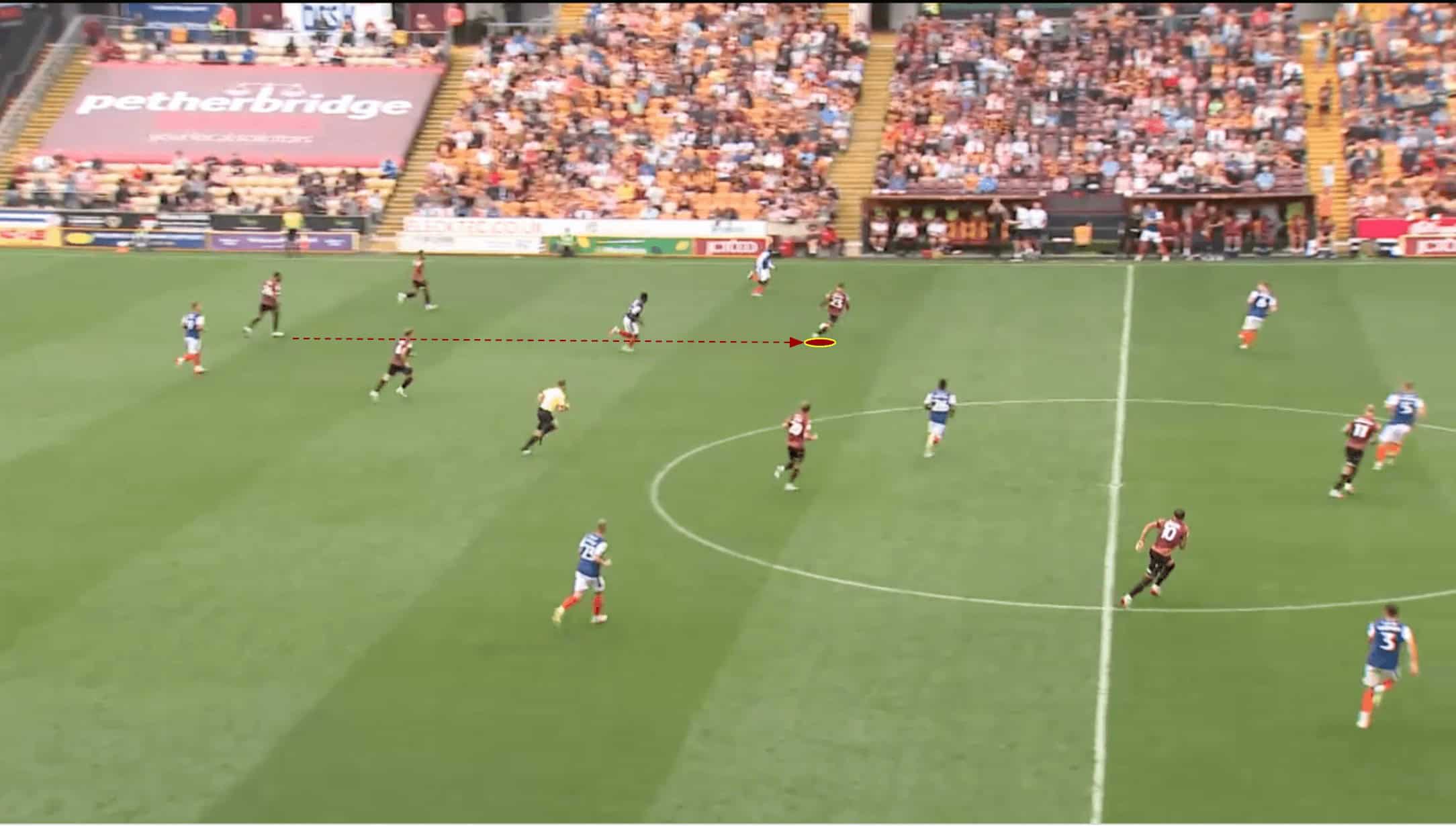
Just as they have a key role to play in preventing their team from being overloaded in midfield, Bradford’s wide forwards also play a crucial role in enabling their team’s transitional attacks from deep.
Here, left-forward Bobby Pointon receives in the left half-space, just after his centre-back has won possession after Luton played a long ball forward.
Before the long ball had been played by Luton’s left centre-back, Pointon was sitting in this position, retaining access to the right centre-back should he need to press.
As the long ball was sent forward and Bradford regained possession, Pointon was in a perfect position to receive in the left half-space.
Pointon took the ball on the half-turn and ran at Luton’s backline, immediately putting Bradford back in the driving seat and showing the value the wide forwards in Bradford’s 3-4-2-1 can offer on the counter when the team is starting from deep.
Conclusion
To conclude our Bradford City tactical analysis, Graham Alexander has engineered a successful return to the EFL League One for the Bantams, with an exhilarating style of play based on aggressive tactics both on and off the ball.
Indeed, Bradford City’s style of play does lend itself to opportunities opening up for the opposition due to their forward-thinking nature as a side, which can border on ‘carelessness’ in possession.
However, their style of play works because they are prepared to lose the ball to pile pressure on the opponent’s backline and press high as much as possible.
This approach has been effective so far this season, while also minimising the opposition’s chances.
For now, the goal has to be to keep bedding in the likes of Neufville at League One level, with the best of the right wing-back still yet to be seen in the third tier as he adapts to the division.
Currently, Alexander is excelling at extracting his team’s potential with this thrilling setup, keeping Bantams fans on the edge of their seats.
