
When Niko Kovač took over at Borussia Dortmund in early February, his side was 11th in the Bundesliga and appeared likely to miss out on European football in the 2025/2026 season.
Even as we reached the end of March, Dortmund had hardly moved an inch in the standings, as they still occupied a place in the lower half of the league.
Following the March international break, Kovač decided to change the team’s tactical structure, shifting away from their usual 4-2-3-1 formation and adopting a 3-4-2-1 shape.
Their only loss after the international break came against Barcelona away in April, when they lined up in a 4-5-1 formation.
With their 3-4-2-1 tactics, Dortmund has now gone 13 games unbeaten.
They qualified for the UEFA Champions League again and are set to face Real Madrid in the FIFA Club World Cup quarterfinal.
This tactical analysis will delve into the tweaks that the Croatian manager has made to bring this Dortmund team back to performing at a high level and what that could mean for them going into next season.
Listen to this article free on the Total Football Analysis Podcast via Spotify, Apple Podcast, or RSS.
Niko Kovač Borussia Dortmund Tactics & Setup
After attempting to initially continue with the 4-2-3-1 structure that had been tried by many previous Dortmund managers, including his predecessor Nuri Şahin, Niko Kovač quickly learned that the team’s defensive struggles wouldn’t be fixed in this system.
The unbalanced squad, which lacks a true defensive-minded midfielder who can hold his position in front of the defence, combined with full-backs who tend to push up, left Dortmund far too exposed, especially in transitions, where they conceded a host of chances throughout the season.
In late March, Kovač adopted a new base structure in the home game against Mainz: a 3-4-2-1 formation, which consists of three central defenders, two wing-backs, two midfielders in the centre of the park, and two attacking midfielders flanking a centre-forward.

The obvious change from before is the installation of a third central defender for an attacking player, which was a necessary move given BVB’s issues at the back.
By having that extra cover behind them, this system also allows both wing-backs and the central midfielders more room to focus on what they’re good at, which is going forward and not playing a defensive game.
Niko Kovač places high demands on his players in terms of professionalism, durability, and intensity on the field.
That especially applies to the four players in this 3-4-2-1, who are expected to do a lot of running and pressing work while maintaining the team’s shape off the ball.
Up front, that leaves two attacking players operating in the half-spaces on either side of their top marksman, Serhou Guirassy, but with more freedom and flexibility to roam offensively than the rest of the team.
Another thing Kovač is known for is his tactical flexibility and ability to adapt to the specific requirements of particular games or circumstances.

While Dortmund starts off in a 3-4-2-1 shape, they have also shifted to other formations, such as 3-4-1-2, 3-5-2, 4-3-1-2, and 3-2-4-1, in various defensive and offensive situations.
We’ll cover some of these later on in the article.
Improved Defensive Awareness
Dortmund have made many improvements over the last three months since Niko Kovač installed this 3-4-2-1 setup.
One of them has been on the defensive end as they’ve found more stability at the back, conceding one goal or less in seven of the 12 games they’ve played with this tactical structure.
Defending had been Dortmund’s Achilles’ heel for quite some time, and while not everything has been solved, they are moving in the right direction again towards achieving this goal.
Their new structure, under Niko Kovač’s tactics, prioritises defensive organisation as a foundation for their quick, direct offensive game, which requires a great deal of intensity, adaptability, and situational awareness to be successful.

A good example of Dortmund’s approach and adaptability can be seen in the penultimate league game against Bayer Leverkusen.
There, we can see Dortmund pressing Leverkusen high up the field with five players, including the front three of Karim Adeyemi, Julian Brandt, and Guirassy.
Pascal Groß and Felix Nmecha join them from central midfield.
While pressing with those five players is common in this tactic so far under Kovač, they often also push their wing-backs higher up the field to squeeze the opposition in these situations.
However, in this instance, they did not.
As we can see, Dortmund’s wing-backs Julian Ryerson and Daniel Svensson are positioned much deeper in the same line as the three central defenders, forming a 5-2-2-1 shape instead.
The main reason for this was to avert the danger that Leverkusen, through their influential wide players, Jeremie Frimpong and Alex Grimaldo, pose in those areas.
So instead of venturing further upfield to join the press as they likely would against a lesser opponent, they adjusted their positioning to the more cautious side, cutting out the supply to those danger men from the opposition.
Another note in the same example is Waldemar Anton, who is most often the central figure of the back three, stepping up out of his position to close down Florian Wirtz, who is dropping off from the attack to exploit the space in behind Dortmund’s press.
This is another example of how Dortmund adapts to in-game situations.
The centre-backs often take turns stepping up and looking to cover an open opponent or win the ball off them rather than keep a static position individually and collectively.
This sort of flexibility is important to the team’s success on and especially off the ball.
Having an organised set-up such as the one now under Kovač affords them the ability to take calculated individual risks without compromising the whole defensive structure, as their chaotic football has cost them in the past.
What’s also been important to their improvement is Kovač figuring out pretty quickly who his main players are that he counts upon to make his system work.
One player who has been key to Niko Kovač’s style of play is Daniel Svensson, their winter arrival from the Danish outfit Nordsjælland.
Although previously known primarily as a central midfielder, Svensson has transitioned to playing more as a left-back or left-sided midfielder in the past year.
As a player, he possesses traits such as strong running and durability, the ability to invert and play between the lines, and good tactical awareness, all of which have made him an instant starter in this Dortmund side under Kovač.
Daniel Svensson Radar Chart
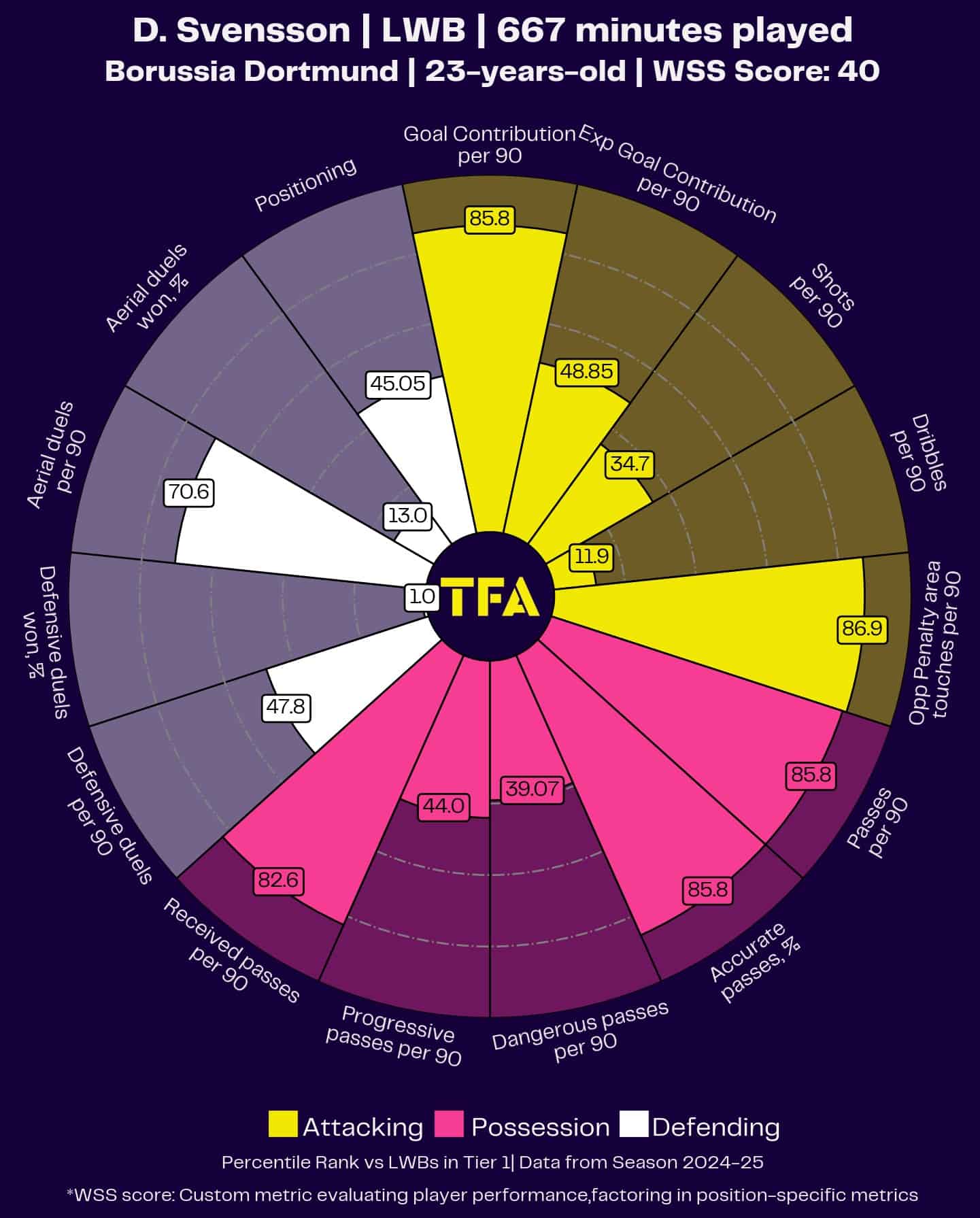
While he’s not a defensive player by trade, his tireless ability to cover ground up and down the left flank still makes him a good example of what Niko Kovač is looking for from his players in this system.
As his radar map indicates, he brings quality both on the ball and in the final third, as evidenced by his possession metrics and his attacking involvements in dangerous areas.
With six goal contributions in just twenty games, he’s more than done enough to turn his loan into a permanent transfer, which was completed on Tuesday for a fee of €6.5m.
A great piece of business for the German club, who have tied down a very capable performer to their ranks long-term after a low-risk, high-reward winter loan move, and one who Kovač will relish continuing to work with going into next season.
Borussia Dortmund Offensive Strategies
Niko Kovač’s 3-4-2-1 formation has also proven to be adaptable offensively, as Dortmund are able to reshape and restructure accordingly, depending on what is asked of them.

Here’s an example in possession against a low-block opponent in Ulsan HD during the Club World Cup group stage.
Ryerson and Ramy Bensebaini are the wide centre-backs on the right of the graphic, while the wide outlets are Yan Couto at the top right and Adeyemi, dropping off from the left wing, on the bottom left.
Centrally, we can see Nmecha on the ball getting ready to distribute a pass, with his midfield partner Groß joining the attack alongside Guirassy with a deep run from the middle of the park.
New signing Jobe Bellingham and the inverting Svensson take up central positions instead.
This creates a 3-2-5 shape for BVB, a formation that has also been commonly used under Kovač, particularly against opponents who like to sit deep.
However, Dortmund are no longer aiming to be the possession-based side they sought to become under Şahin, but rather a more direct version of themselves with a more organised structure.
Their counterpressing is still key to their offence, as is their use of deep runs (like the one from Groß above) and the wide players who, as mentioned earlier, have more license to get forward now, given the extra protection present at the back.
A good example is the Borussia Mönchengladbach game, in which Dortmund scored three goals in quick succession at the end of the first half, all coming from the right after regaining possession through their counterpress.

Above, we can see three Dortmund players closing down the Gladbach player on the ball, eventually winning possession as he tries to play it backwards.

A few seconds later, and it’s a deep run from Nmecha joining late from midfield, who gets on the end of the low cross at the edge of the penalty area and fires in to give Dortmund the lead.
Whether it’s a deep run off the ball or a progressive carry from deep, Dortmund have found success with both going forward, which adds to their arsenal of ways to hurt the opposition.
BVB have improved significantly offensively with this new tactic, scoring 34 times in the 12 games since adopting it, for an average of nearly three goals per contest.
And the improvement it has led to for specific individuals marks their success on the attacking end as well.
Three beneficiaries who have contributed heavily to those numbers are Brandt, Adeyemi, and Guirassy.
Although Guirassy ended the season as the second top scorer in the league behind Harry Kane, he did go on a run of scoring in just five out of 15 Bundesliga games between November and April.
However, following the change in tactics, he scored in six of the final seven games of the campaign as Dortmund made a charge towards Champions League qualification.
Brandt contributed eight league goals before Matchday 28 and added another seven in the final seven rounds of the season, possibly giving him a new lease of life at the club after his time at the Westfalenstadion looked to be up.
And Adeyemi also doubled his numbers in those closing stages of the campaign, adding four goals and three assists to the five he had all season before March 30th.
Kovač has found a way to make this team tick again on both sides, and in short order, has proven himself to be a great appointment by the Dortmund board in the time he’s been there.
Conclusion
After a largely rough season, Borussia Dortmund ended the 2024/25 campaign strongly, edging into the top four in the Bundesliga and qualifying for the Champions League.
That was largely due to Kovač’s ability to diagnose key issues that had plagued the team and find a solution by installing a new setup that has maximised the team’s capabilities on both sides of the ball.
When first signed by the club, the Croatian manager was intended to be a short-term solution, but rumours are now circulating that he will be offered a new long-term deal, having earned it by transforming the team’s fortunes in a matter of months.
And with BVB still currently active in the last eight of the Club World Cup in addition to their qualification for Europe’s elite competition, there’s more than enough money in the bank in every sense of the word to both pay Niko Kovač and give him what he needs in the market to support his work going into 2025/2026, where Dortmund will be looking to battle for honors again and re-establish themselves as a threat to the top clubs in German and European football.
