
Joan García’s arrival at Barcelona has reignited interest in the club’s long-running goalkeeping dilemma.
This scout report and data analysis examine whether the former Espanyol goalkeeper, known for his calm presence and proactive style of play, can be the long-term solution between the sticks for Hansi Flick’s side.
Following a standout 2024/2025 campaign in La Liga, García has earned a reputation as one of the most reliable shot-stoppers in Spain, despite operating behind one of the league’s weakest defensive lines.
This article explores Joan García style of play through a detailed statistical lens, positioning his profile within the broader tactical framework of Blaugrana under Hansi Flick tactics.
It delves into key metrics such as save percentage, post-shot expected goals (PSxG), clean sheet consistency, passing and distribution patterns, and aerial command, offering insights into how his skill set compares to both his La Liga peers and the demands of elite European competition.
With Wojciech Szczęsny’s brief but impactful return from retirement serving only as a temporary fix, Barcelona’s search for a lasting answer in goal continues.
Can Joan Garcia meet the tactical and technical expectations required at the top level?
This data-driven player analysis aims to find out.
Listen to this article free on the Total Football Analysis Podcast via Spotify, Apple Podcast, or RSS.
Joan García Shot-Stopping Analysis
In the realm of goalkeeping, the most visible and arguably the most consequential metric is shot-stopping.
LaLiga‘s 2024/2025 season witnessed an impressive variety of performances between the posts.
When focusing on raw numbers, such as saves, shots on target faced, and goals conceded, specific patterns emerge that distinguish the exceptional from the average.
Joan García Made A League-High 140 Saves In the 2024/2025 Season

At the top end, Joan García, newly signed by Barcelona from Espanyol, made the most saves in the league with 140, from a league-high 192 shots on target faced.
While his raw save count is impressive, his save percentage (75.5%) offers more nuance, placing him among the upper-middle bracket of La Liga goalkeepers.
Luiz Lúcio Reis Júnior (78.6%) and Unai Simón (79%) recorded the best save percentages.
Both operate behind significantly more disciplined defensive lines than García’s Espanyol, which conceded 51 goals.
However, these percentages can be somewhat misleading when taken in isolation.
Both Lúcio (47 saves) and Simón (48 saves) faced far fewer shots on target than García, whose tally of 140 saves came from relentless exposure throughout the campaign.
This disparity in workload adds important context: maintaining high efficiency over fewer attempts is not equivalent to sustaining performance under constant pressure, as García consistently did.
García’s case is fascinating; while his team struggled defensively, his contribution kept Espanyol afloat in multiple matches, evidenced by his eight clean sheets (21% CS%), which might not seem exceptional at face value but gain significance considering his exposure to high volumes of shots.
This highlights García’s sharper reflexes and improved positioning under pressure.
Moreover, his high workload and consistent starting record (38/38) indicate reliability and trust from his coaching staff, qualities Barcelona clearly noticed ahead of his summer move.
When shot-stopping is viewed in volume and efficiency under duress, Joan García emerges as one of LaLiga’s most resilient keepers.
The numbers suggest he has been saving more than just shots; he has been saving Espanyol points, and Barcelona will be hoping he can replicate this under higher expectations.
PSxG Metrics: Measuring The True Shot-Stopping Quality
While raw save numbers and percentages provide a solid starting point, the post-shot expected goals (PSxG) metric allows for a deeper insight into goalkeeping performance.
PSxG accounts for the quality of shots a goalkeeper faces—incorporating placement, speed, and trajectory—and thus measures the likelihood of a shot resulting in a goal.
La Liga 2024/2025 PSxG Stats
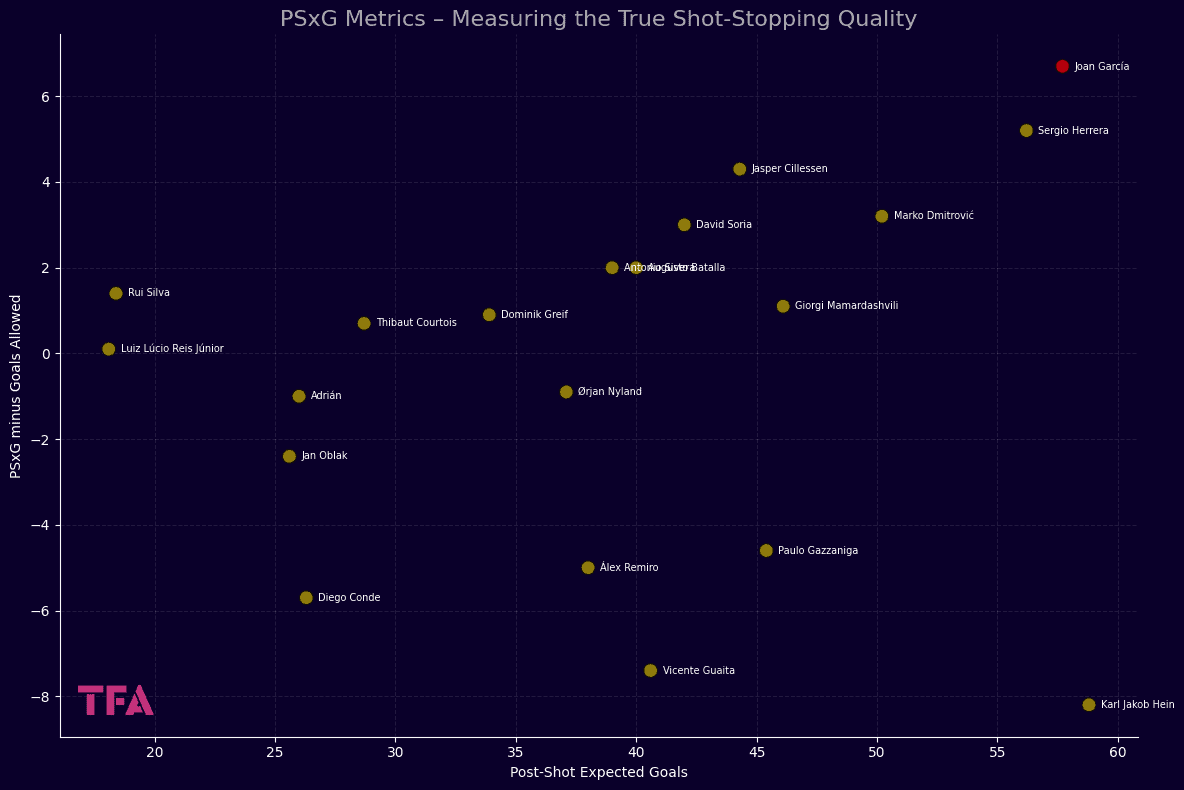
In this context, Joan García again proves his worth.
He faced an astonishing 192 shots on target, resulting in a PSxG total of 57.7, yet conceded only 51 goals, meaning he ‘saved’ 6.7 more goals than expected, a positive PSxG differential that places him among the most effective shot-stoppers in the league.
This overperformance is no small feat, especially considering Espanyol’s defensive vulnerabilities.
In contrast, other high-traffic keepers, such as Jasper Cillessen and Unai Simón, posted negative differentials, conceding more goals than expected based on shot quality.
García’s PSxG per shot on target stands at 0.30, confirming he dealt with a relatively high-quality number of attempts.
It highlights reflex saves and intelligent positioning, angle reading, and confidence in 1v1 scenarios.
Barcelona’s interest in García likely stemmed from these numbers.
With a defence that often operates high up the pitch and leaves gaps for transitions, a keeper who consistently outperforms his expected metrics is vital.
The gap between PSxG and goals allowed provides compelling statistical evidence that García didn’t just react to shots; he proactively denied goals that, on average, should have beaten him.
If Barcelona are to maintain their competitive edge without a complete defensive overhaul, they will require a goalkeeper who can replicate this level of performance.
García’s PSxG numbers suggest he has the instinct and athleticism to do just that.
Sweeper Keepers: Defensive Actions Outside The Box
With many La Liga sides adopting high defensive lines and complex off-the-ball structures, a goalkeeper’s role increasingly extends to sweeping up behind the last line.
Joan García’s numbers in this department further reinforce his modern, proactive shot-stopper credentials.
Defensive Actions Outside The Box
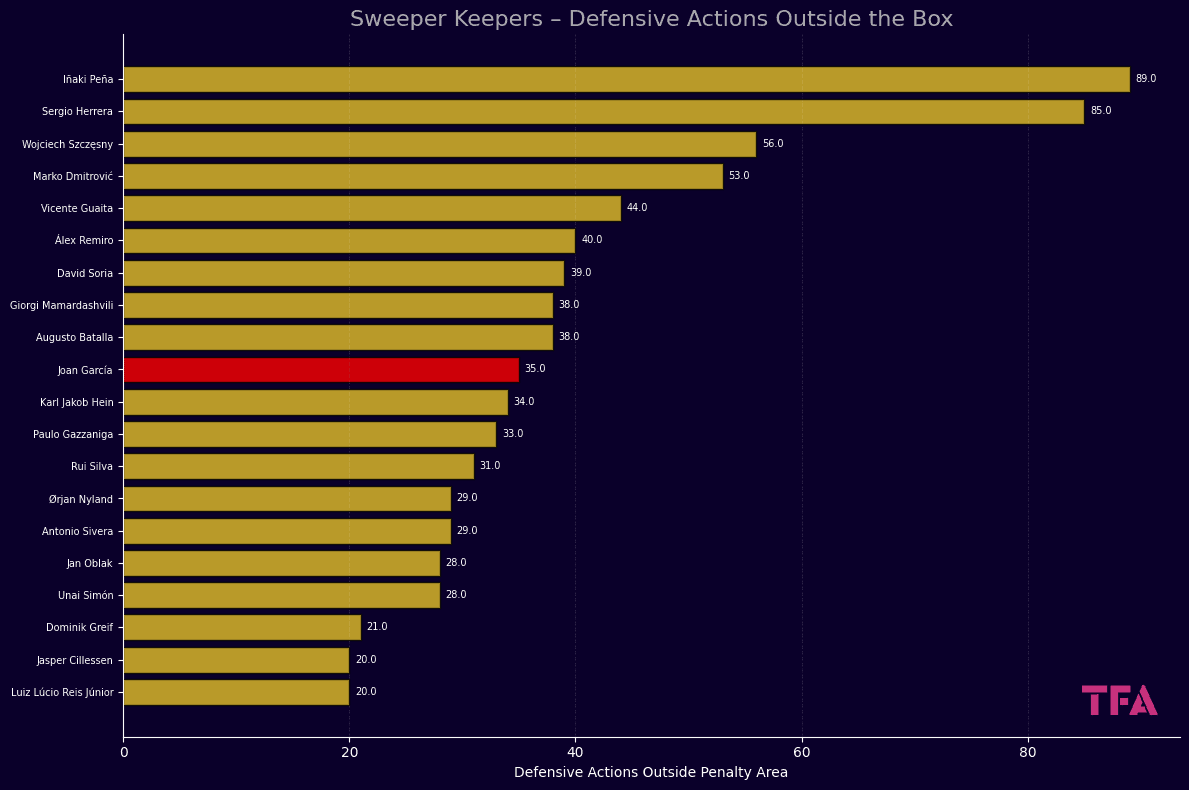
Joan García completed 35 defensive actions outside his penalty area, with an average distance of 12 metres from goal, placing him among the more assertive sweeper-keepers in the league.
This proactive style was essential in Espanyol’s tactical setup, which often left space in behind due to pressing imbalances.
García demonstrated excellent timing when rushing out to intercept through balls, engage advancing attackers, or clear danger with his feet.
His average action distance is comparable to more established names like Unai Simón and Álvaro Vallés, underlining his sharp reading of the game and spatial awareness.
What distinguishes García from reckless sweepers is his decision-making discipline.
His interventions are calculated rather than impulsive, and he rarely concedes fouls or picks up bookings, a testament to his athleticism and football intelligence.
For Barcelona, whose centre-backs frequently hold a high line to compress space, having a goalkeeper capable of acting as a genuine eleventh outfielder is not a luxury, but a necessity.
While Wojciech Szczęsny has long excelled in this role, García appears ready to inherit that responsibility if required.
His ability to function as a defensive buffer adds a vital tactical dimension for Hansi Flick, particularly against teams with pacey forwards or those who thrive in transitional play.
As LaLiga continues to evolve tactically, goalkeepers who contribute beyond basic shot-stopping will be increasingly prized.
With his natural sweeping instincts, Joan García offers precisely that: a modern solution to a modern challenge in Barcelona’s defensive system.
Clean Sheet Consistency: Stability Vs Spikes
Clean sheets often become the shorthand measure of a goalkeeper’s success, yet they must be contextualised within team structure and match situations.
Joan García ended the 2024/2025 season with eight clean sheets, translating to a clean sheet percentage of 21%.
While this may not rank him among the very elite in La Liga, it’s notable when considering Espanyol’s general defensive fragility and the number of shots he faced across the campaign.
La Liga 2024/2025: Clean Sheet Stats
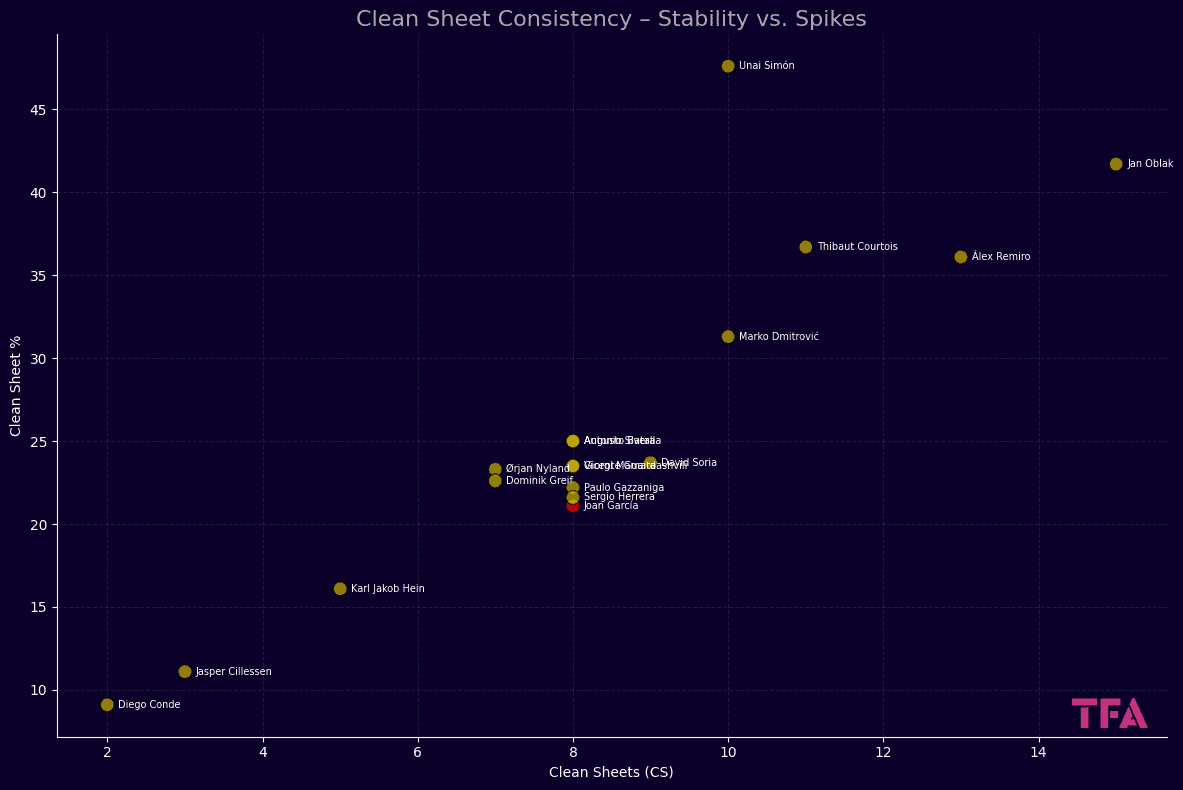
Keepers such as Jan Oblak (15 CS) and Álex Remiro (13) recorded higher percentages, yet operated behind better-organised backlines.
García, by contrast, often faced extended periods of pressure, especially against top-half sides.
His ability to maintain composure and deliver shutouts in critical fixtures—particularly against Real Madrid and Atlético Madrid—showcased both mental resilience and sharp in-game concentration.
Moreover, clean sheets achieved in games with high PSxG against are a mark of extraordinary individual performance.
In at least three matches, García’s PSxG against exceeded two, yet he managed to keep the opposition out, illustrating games where he single-handedly salvaged results.
This differs from ‘routine’ clean sheets that come from defensive domination or passive opposition.
For Barcelona, whose defensive line is frequently tested by transitions and overlaps, having a keeper with experience in chaotic defensive scenarios is invaluable.
García’s clean sheet record demonstrates not only potential but also a repeatable ability to deliver results even without systemic protection.
His consistency, when properly contextualised, suggests that his numbers could improve further in a more controlled environment like Barça’s, potentially pushing him into the top tier of La Liga goalkeepers.
Distribution & Ball-Playing Ability
The modern goalkeeper is as much a distributor as a shot-stopper, especially in possession-oriented teams like Barcelona.
A keeper’s passing ability, launching strategy, and composure under pressure are now critical in initiating attacks and maintaining tempo.
Completed Passes & Throws – La Liga Goalkeepers 2024/2025
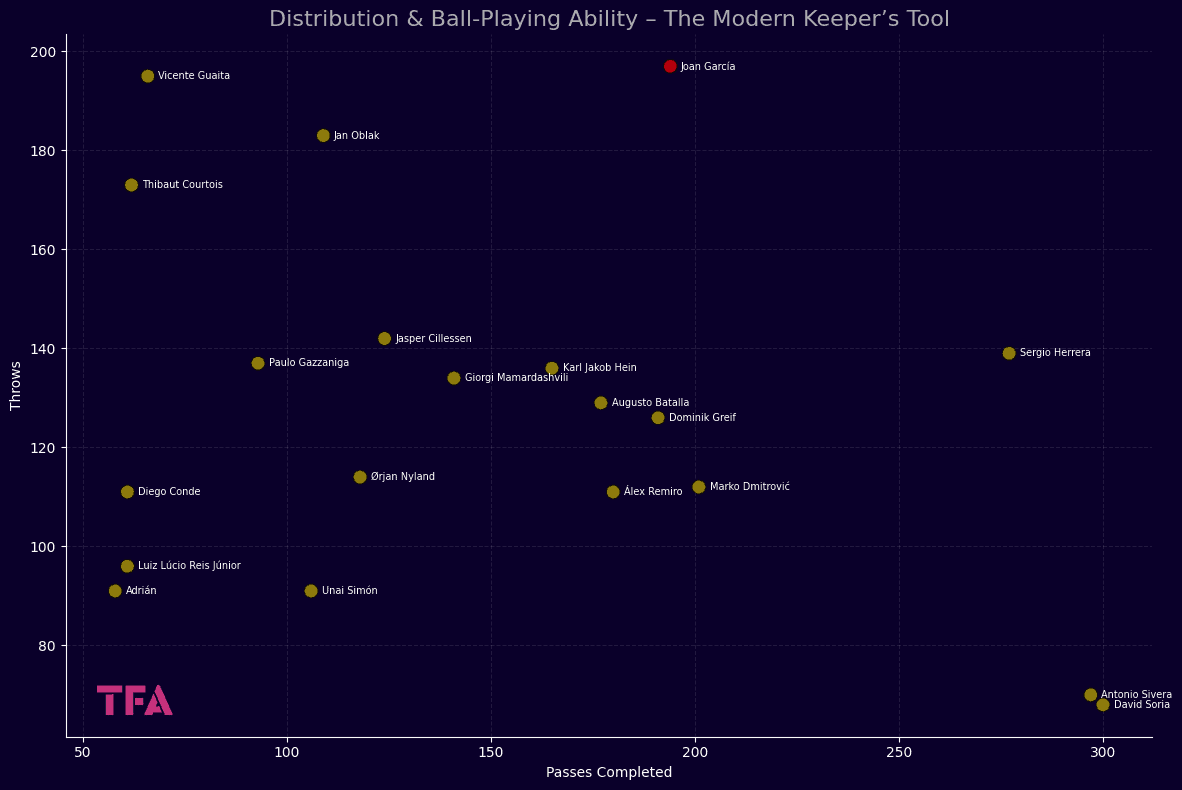
Joan García brings notable qualities in this regard.
In 2024/2025, he completed 194 long passes from 526 attempts, with a balanced launch percentage of 37.6% and an average pass length of 34.8m, numbers that reflect a mixed approach: capable of going short or long as needed.
Although his long pass completion rate (37.6%) seems low, it’s essential to note that Espanyol’s tactical setup often required García to bypass pressing traps by launching the ball longer.
His throws (197 – one of the highest among all La Liga goalkeepers) also reveal a preference for quick restarts and exploiting width when possible.
Unlike some traditional long-ball keepers, García attempted over 1000 passes, excluding goal-kicks – a strong indicator of involvement in active play rather than set-piece restarts.
Compared to Barcelona’s usual requirements, García’s profile is promising.
His numbers may not yet mirror those of Marc-André ter Stegen in terms of pinpoint short passing, but they show a foundation that can be developed within a more possession-based structure.
More importantly, his passing decisions reflect game intelligence.
He knows when to play short under pressure, when to drive the ball to wide full-backs, and when to launch strategically.
In a Barça side where the first phase of build-up often begins with the goalkeeper, García’s existing habits of mixed distribution, combined with his evident confidence with the ball at his feet, suggest a relatively smooth adaptation process, with room for growth under Flick’s coaching staff.
Command Of The Box: Crosses & High Claims
An often-overlooked component of goalkeeping is the ability to command aerial situations.
The ability to judge, claim, or punch crosses under pressure directly affects a team’s defensive stability.
Crosses Faced & High Claims: La Liga Goalkeepers 2024/2025
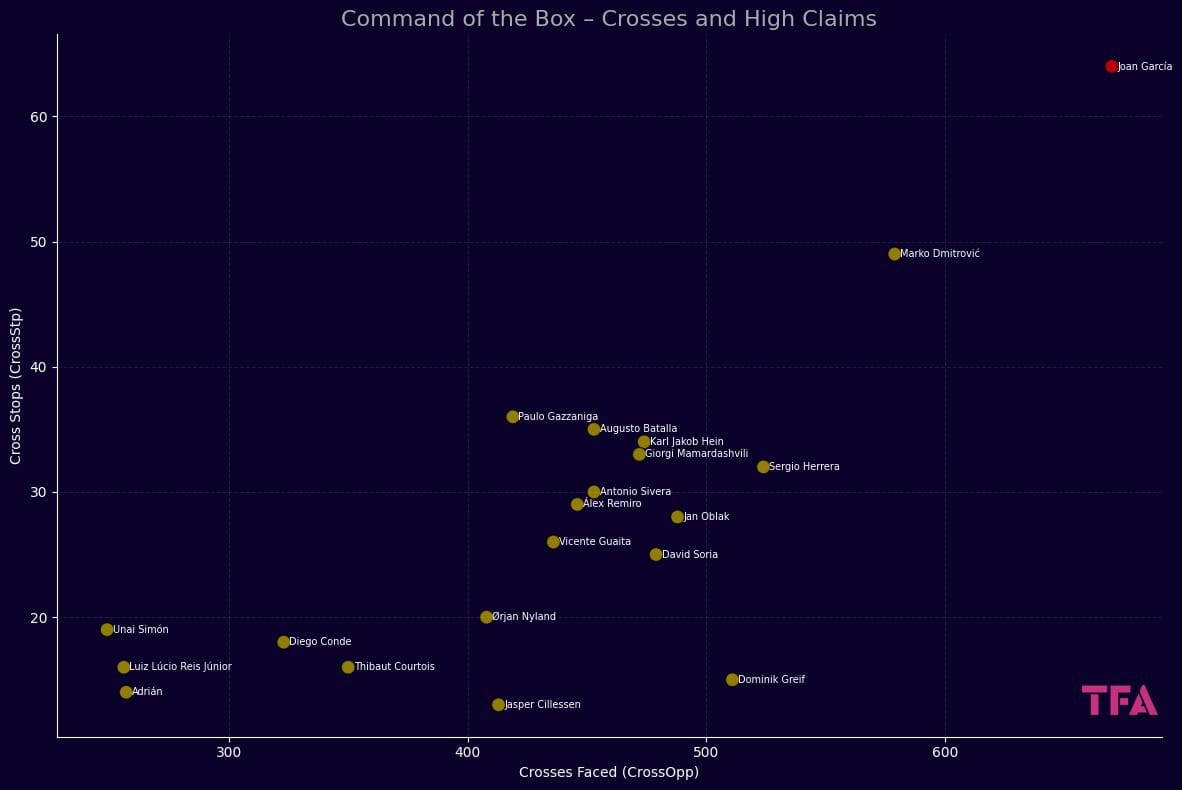
Joan García was one of LaLiga’s most active keepers in this aspect, facing 670 cross attempts into his area and successfully stopping 64 of them.
These figures highlight not only his confidence in aerial duels but also his regular exposure to opponents targeting Espanyol’s box from wide areas.
A cross-stop rate of nearly 10% may seem modest, but it stands out in comparison with other keepers who had similar volumes.
For example, Jasper Cillessen faced 413 crosses and stopped just 13, a far lower success ratio.
García’s 64 interventions were not just about numbers, but also about impact.
Many of his claims came in high-stakes scenarios, notably in late-match sequences where a failure to intervene could result in goals or prolonged pressure.
García’s tendency to attack the ball at its highest point rather than wait passively adds to his appeal for a club like Barcelona, which often pushes its full-backs high and requires its keeper to dominate the area.
His aerial command also relieves pressure from central defenders, which could be crucial for players like Ronald Araújo or Jules Koundé, who often face overloads from opposing wingers and late runners.
As Barcelona seek to become more assertive defensively in their own box, García’s capacity to command the six-yard area and beyond will be a welcome trait.
His aerial presence could offer Barcelona a newfound sense of calm in a league where set pieces and wide deliveries often decide tight games.
Conclusion
After a detailed exploration of Joan García’s 2024/2025 campaign within the broader context of La Liga goalkeeping, a clear pattern emerges: Barcelona may have found the ideal long-term successor to their vacillating line of recent custodians.
Through advanced metrics and comparative league data, García distinguishes himself as a well-rounded, proactive, and mentally resilient presence between the posts.
This rare profile blends traditional reflexes with modern tactical versatility.
The numbers provide compelling answers to the key questions posed at the start of this report.
In terms of shot-stopping, García not only led the league in total saves but also maintained a save percentage that outperformed peers facing similar volumes.
His PSxG differential of +6.7 confirms that his interventions actively prevented goals beyond expectation, a hallmark of elite goalkeepers.
While his clean sheet count may seem modest, the context of Espanyol’s defensive frailty repositions it as evidence of his influence under challenging conditions.
Moreover, his distribution metrics, especially those over 1,000 passes excluding goal kicks and a top-tier passing rate, reflect the ball-playing confidence essential to Barça’s build-up play.
His handling of crosses and high claims, coupled with a 10% stop rate from wide deliveries, further supports his physical assertiveness.
Finally, García’s profile as a sweeper-keeper, averaging 12 metres per defensive action, aligns perfectly with Hansi Flick’s need for an 11th outfielder capable of controlling transitions behind a high line.
This is more than a statistical validation of García’s ability; it’s an endorsement of his suitability for Barcelona’s next chapter.
If performance under pressure, tactical adaptability, and developmental ceiling are the benchmarks, Joan García ticks every box.
He may not be a household name just yet, but the data suggests he’s poised to be precisely what Barcelona have been missing between the sticks.
