
The 2025 FIFA Club World Cup is poised to usher in a bold new era for global football.
For the first time, the tournament has expanded to feature 32 clubs, so fans are no longer just witnessing a showdown between European giants and South American powerhouses.
Instead, this revamped format offers a truly global spectacle, with clubs from Asia, Africa, North America, and Oceania taking centre stage alongside their more illustrious counterparts.
While much of the spotlight will naturally fall on Real Madrid, Manchester City, and Bayern Munich, non-European contenders bring an exciting mix of tactical ingenuity, rising stars, and a hunger to challenge the global hierarchy.
2025 FIFA Club World Cup Non-European Teams

From the flair and discipline of Al Ahly of Egypt to the explosive attacking play of Al Hilal, these sides are not just participants; they are disruptors.
They come with unique tactical frameworks, regional styles, and player profiles that contrast sharply with the established rhythms of European football.
The globalisation of the club game is no longer a concept; it is now a tangible reality playing out across American stadiums.
This data analysis report delves into the key non-European teams participating in the FIFA Club World Cup 2025.
Through advanced metrics and visual breakdowns, we will explore how these clubs set up tactically, how they compare statistically to their rivals, and where their greatest strengths and vulnerabilities lie.
From ball progression and pressing intensity to expected goals and creative output, this report aims to uncover not only how these teams play, but why their approaches matter in this newly levelled global arena.
Let’s begin by dissecting the tactical and statistical profiles of the non-European clubs poised to shake up the status quo.
Al Hilal – Saudi Arabia’s Structured Dynamism
Al Hilal SFC enter the 2025 FIFA Club World Cup as one of the most tactically disciplined non-European sides, combining structural compactness with dynamic attacking flows.
Al Hilal Data Profile 2024/2025
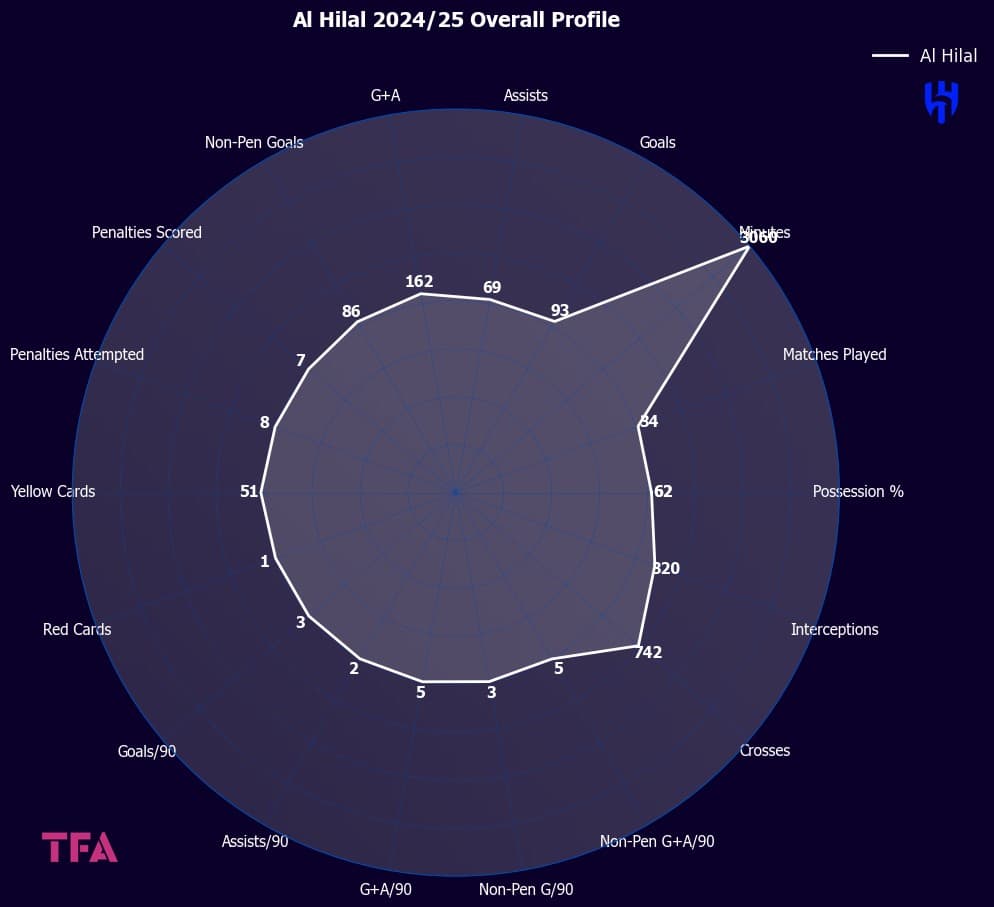
Representing Saudi Arabia, their statistical profile is impressive: a possession rate of 62.1% speaks volumes about their ball dominance across phases.
Their offensive numbers are particularly striking, 93 goals and 69 assists across 34 matches, giving them a combined G+A of 162, the highest among the non-European teams.
With 742 crosses and 320 interceptions, Al Hilal’s tactical identity appears twofold: they prioritise width in attack and remain active in pressing and recoveries.
Their 2.74 goals per 90 and 4.76 G+A per 90 are numbers typically reserved for elite continental teams.
They are supported by high penalty involvement (seven converted from eight attempts).
The 2.53 G-PK per 90 and 4.56 G+A-PK underline a consistent open play contribution and ability to create in tight spaces.
Defensively, their disciplinary record remains acceptable (51 yellow cards and just one red), highlighting a side that can disrupt opposition flow without losing composure.
Al Hilal tactically mirror a 4-2-3-1 or 4-3-3 structure, built around controlling midfield zones and launching frequent wide rotations.
The wide players are often the protagonists in final third actions, while central midfielders recycle possession patiently.
In a tournament where European-style control is often dominant, Al Hilal offer a tactical hybrid: they blend positional play with a vertical urgency.
Their ability to sustain possession and simultaneously hurt teams in transition makes them not just competitive but potentially decisive.
If they can maintain their offensive efficiency while tightening their defensive transitions, they could be one of the tournament’s dark horses.
Mamelodi Sundowns – South Africa’s Progressive Pioneers
From South Africa, Mamelodi Sundowns present themselves as arguably the most progressive side tactically among African representatives.
Mamelodi Sundowns Data Profile 2024/2025
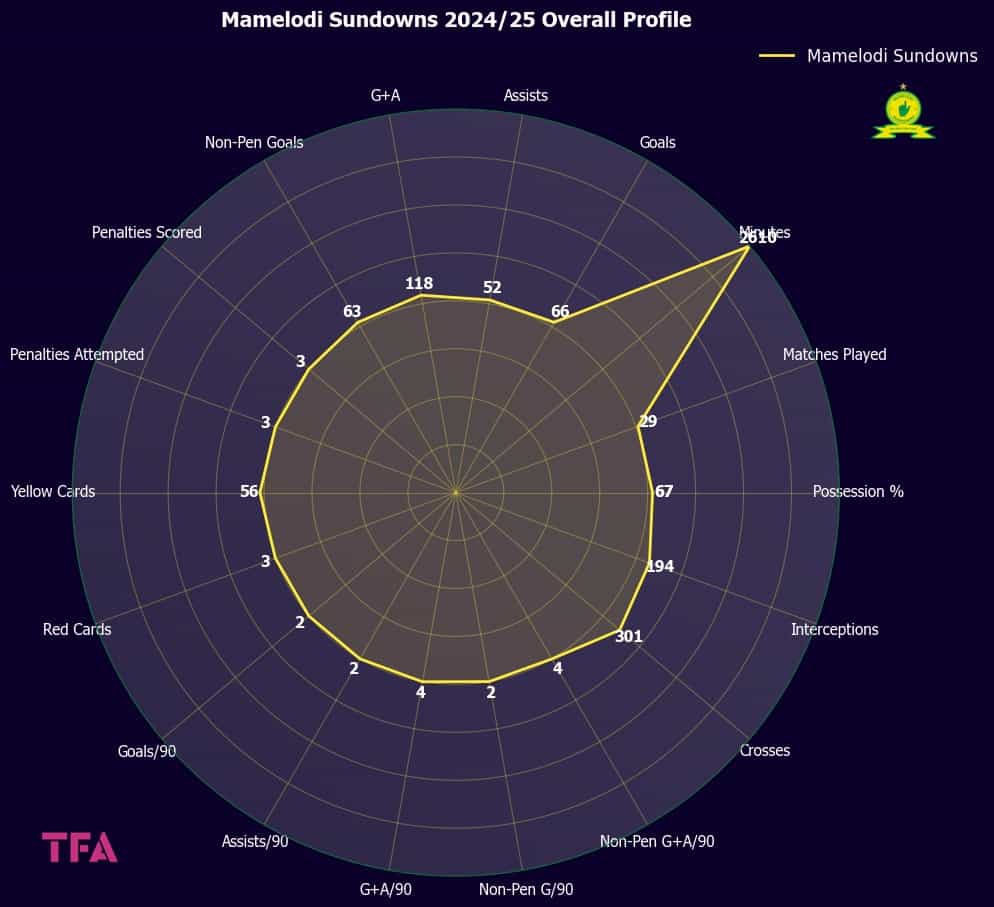
Their average possession of 67.1%—the highest in this dataset—underlines a firm commitment to building up play and controlling tempo.
They scored 66 goals and assisted 52, boasting a G+A of 118, spread across 29 matches.
This results in formidable 2.28 goals per 90 minutes and 4.07 G+A per 90 minutes—elite metrics in any context.
Sundowns’ consistency in non-penalty goals (63 G-PK) and their balanced threat both centrally and from wide areas (301 crosses and 194 interceptions) distinguishes them.
Their G+A-PK of 3.97 per 90 indicates a reliance on open-play effectiveness rather than set-pieces or spot kicks, speaking to tactical fluidity and structured freedom in attacking zones.
Positionally, they often deploy a 3-4-2-1 or a 4-3-3 with full-backs pushing high and central midfielders dictating rhythm.
Their high and synchronised press explains their active defensive stats, which are accompanied by a relatively modest disciplinary load (three red cards, 56 yellow cards).
This controlled aggression suits their pressing style while reducing unnecessary risks.
The tactical ideology is very much aligned with modern possession-based football.
The central pivot players recycle possession and draw pressing traps before launching progression through the half-spaces.
Their ability to overload flanks and then switch play swiftly has troubled opposition defences across domestic and continental competitions.
In the Club World Cup context, where physicality often overrides technique, Sundowns’ commitment to structure and ball retention could prove advantageous.
They may outperform expectations if their transitions remain sharp and they manage defensive overloads against counterattacks.
They aren’t just South Africa’s champions – they could become a model for African tactical evolution.
Boca Juniors – Argentina’s Tactical Purists
CA Boca Juniors, representing Argentina, arrive at the tournament with a rich tactical heritage and a structured, defence-oriented game model.
Boca Juniors Data Profile 2024/2025
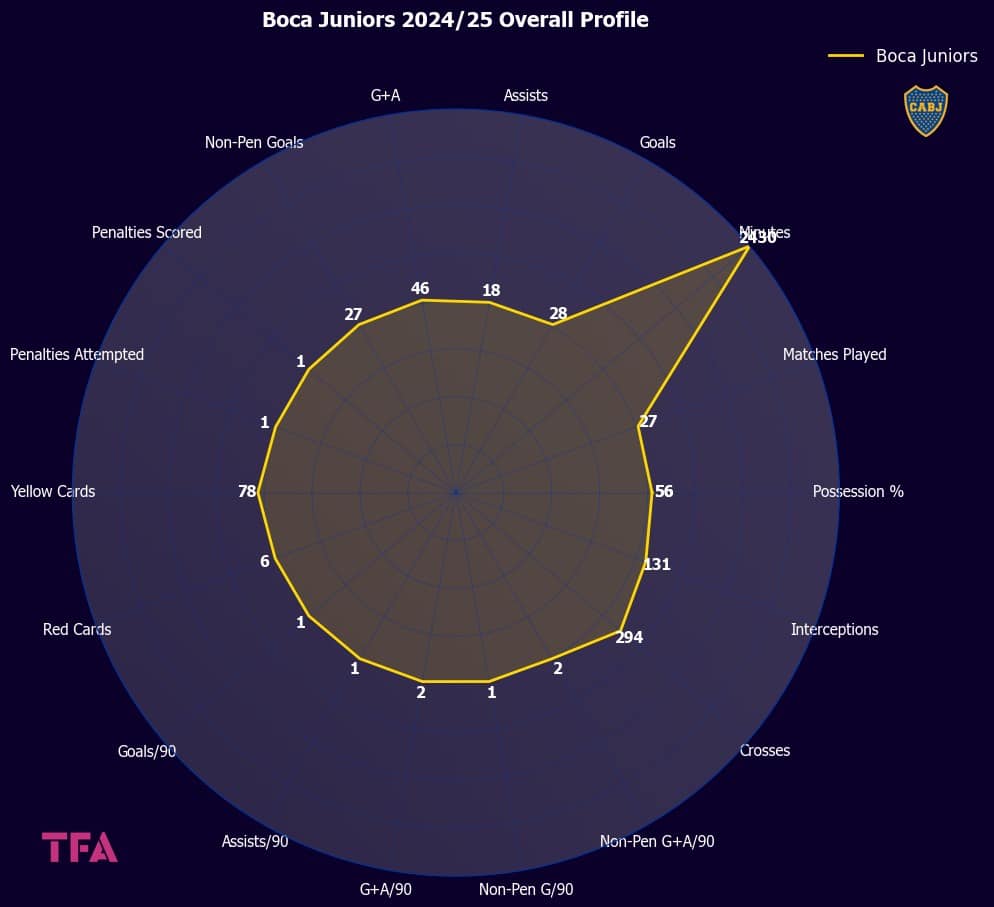
Statistically, they display the lowest G+A per 90 among the top teams (1.7), reflecting a conservative attacking output.
With 28 goals and 18 assists across 27 matches, their 1.04 goals and 0.67 assists per 90 point toward a team that prefers controlled progression over attacking exuberance.
Their 56.2% average possession indicates moderate ball control, yet the team’s strength lies in their compact shape and high pressing discipline, evidenced by 294 crosses and 131 interceptions.
The low G+A-PK of 1.67 per 90 and just one penalty scored out of a single attempt reveal a tactical identity that rarely relies on individualism or set-pieces to create chances.
Boca often set up in a narrow 4-4-2 or a flexible 4-3-1-2, with an emphasis on midfield density and defensive stability.
Their wide midfielders often tuck in to form a midfield block, allowing full-backs to overlap selectively.
This layered structure helps reduce defensive exposure, but at the cost of attacking spontaneity.
Tactically, Boca excel in disrupting rhythm rather than dictating it.
They force mistakes through central congestion and well-timed pressing traps.
Their yellow and red card counts (78 and six, respectively) suggest a willingness to engage physically when needed—a classic South American trait that often unsettles more technical opponents.
Boca’s calculated caution could frustrate even the most possession-hungry teams in a tournament defined by rapid transitions and direct play.
While not the most prolific side, their tactical discipline and heritage of grinding out results make them a formidable opponent for any team that underestimates their methods.
Inter Miami – The American Flair & Final Third Aggression
Inter Miami, representing the United States, will bring to the Club World Cup a blend of MLS-style verticality and South American-inspired individual brilliance.
At the heart of their identity lies a group of iconic players led by none other than Lionel Messi.
His creative vision and calm decisiveness in the final third are central to the team’s attacking output.
Alongside him, Sergio Busquets anchors the midfield with composure and intelligence, while Jordi Alba offers vital width and overlapping runs from full-back.
These veterans inject tactical maturity, big-game experience, and a sense of structure into an otherwise instinct-driven attacking side.
Inter Miami Data Profile 2024/2025
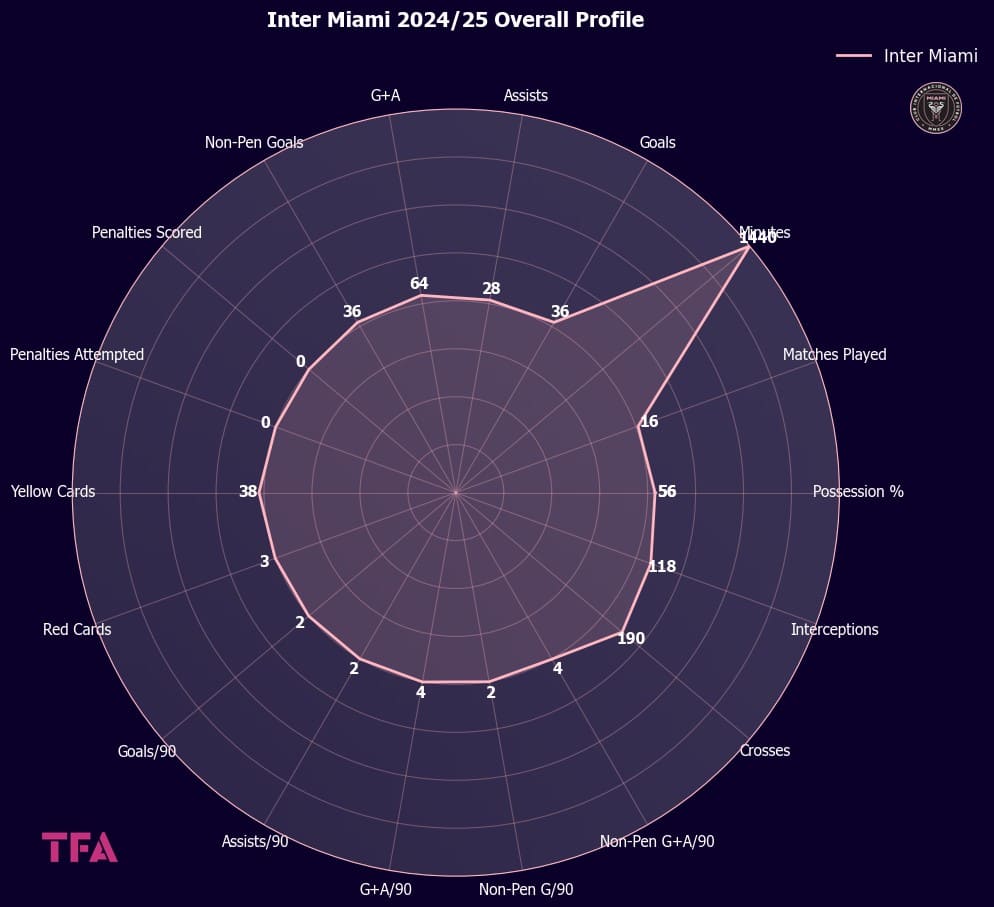
Despite playing just 16 matches, their impact is remarkable: 36 goals and 28 assists yield a G+A of 64 – a staggering four G+A per 90.
Their 2.25 goals per 90 further underline a direct and incisive attacking style.
With 55.8% possession, the team favours quick ball progression over prolonged build-up.
Their low volume of crosses (190) and interceptions (118) confirms a vertical approach, relying more on central penetrations and off-the-ball movement rather than wide overloads or counterpressing recoveries.
Tactically, Inter Miami often operate in a fluid 4-2-3-1 or 4-4-2 diamond, tailored to accommodate their creative stars in central spaces.
Their non-penalty goal rate is equal to their total goals (2.25 G-PK), indicating no reliance on penalties—a sign of high-quality chance creation in open play.
Their G+A-PK of four further supports this narrative.
The tactical idea is clear: attract the press, create vertical lanes, exploit through balls and third-man runs.
The attacking midfielders operate between lines, often dragging opposition defenders out of shape.
However, their defensive numbers suggest vulnerability: a modest number of interceptions and 38 yellow cards across just 16 matches point to a side that may struggle to manage opposition transitions.
In short tournaments, explosive attacking output can sometimes outweigh structural imperfections.
If Inter Miami manage to tighten their defensive shape while maintaining their sharpness in front of goal, they could cause major upsets.
Their style may lack the positional maturity of their European counterparts, but their flair and aggression make them an unpredictable and exciting force.
C.F. Monterrey – Mexico’s Tactical Balance & Structured Offence
Monterrey enter the competition as one of North America’s most tactically balanced sides.
CF Monterrey Data Profile 2024/2025
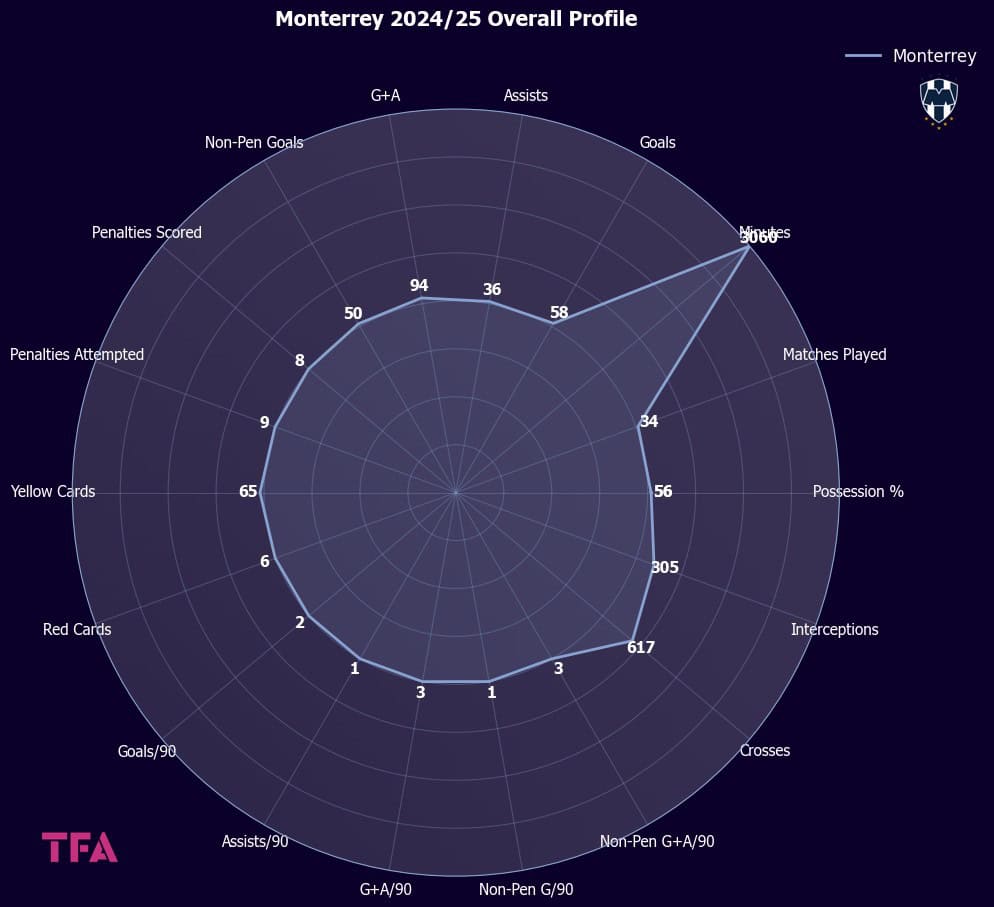
With 58 goals and 36 assists over 34 matches, their G+A per 90 (2.76) reflects a consistent attacking output.
Notably, their 1.71 goals and 1.06 assists per 90 indicate that chance creation is well-distributed and not overly reliant on individual brilliance.
On average, Monterrey have 55.6% of the ball.
They operate with methodical control, preferring to build through the thirds rather than engage in chaotic transitions.
Their 617 crosses and 305 interceptions show a team capable of switching between wide overloads and intense midfield pressing, adapting tactically to the opponent’s shape.
Their G+A-PK per 90 (2.53) compared to their total G+A (2.76) demonstrates that they frequently create open-play chances while still possessing the nous to win and convert penalties when necessary (eight converted from nine attempts).
Monterrey’s shape, often a 4-3-3 or 4-2-3-1, features dynamic full-backs and inverted wingers, with midfielders supporting both ball circulation and counter-pressing.
Defensively, their 65 yellow cards and six reds suggest a physically robust style, especially in duels across the midfield line.
While this physicality can be risky, it often halts counterattacks and keeps the team structurally compact.
Monterrey’s strength lies in their blend of tactical flexibility and attacking efficiency.
They can dominate weaker teams through possession and adapt defensively against more technical sides.
In a tournament where adaptability is key, their blend of structured possession and disciplined transitions could make them serious contenders among the non-European field.
Al Ahly – Egypt’s Tactical Resilience & Final Third Precision
Al Ahly, the dominant force from Egypt, bring a blend of tactical maturity, efficient execution, and deep tournament experience.
Following their defeat to Mamelodi Sundowns in the CAF Champions League semi‑final, Al Ahly parted ways with Swiss coach Marcel Koller.
The club initially turned to Emad El-Nahhas as a caretaker manager.
Still, ahead of the Club World Cup, they appointed José Ribeiro, signalling a more permanent and tactically refined direction.
Ribeiro has rapidly introduced a structured 3‑5‑2 system, emphasising wing‑back width and a compact central block.
This formation—with three at the back and five across midfield—provides a strong defensive spine while offering fluid attacking options, particularly vital in high‑stakes, knockout‑style tournament football.
Al Ahly Data Profile 2024/2025
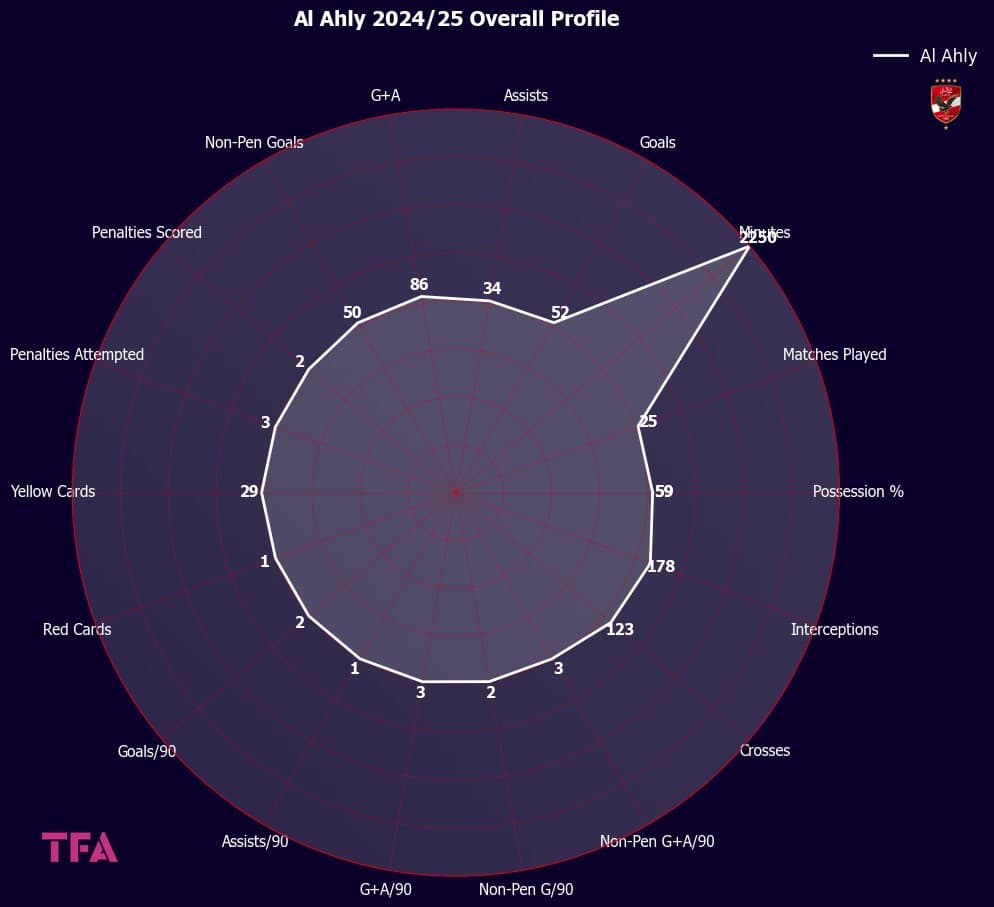
With 52 goals and 34 assists in 25 matches, they average an impressive 3.44 G+A per 90, including a non-penalty contribution of 3.36, revealing their creativity and collective threat in open play.
Their 59.2% possession reflects a team that knows how to control tempo while probing for high-value chances.
They average 2.08 goals and 1.36 assists per 90, among the highest of any non-European side.
This efficiency stems from a tightly structured attacking shape—typically a 4-2-3-1 or 3-5-2 with vertical spacing—which enables quick combinations and rotational movement in the half-spaces.
Tactically, Al Ahly relies on intelligent occupation of zones rather than brute force.
They cross just 123 times—the lowest of any side—highlighting their focus on central penetration and one-touch passing in the final third.
Defensively, they demonstrate balance, with 29 yellow cards and one red across the sample, indicating controlled aggression and good pressing discipline.
With 178 interceptions, their defensive midfielders play a crucial role in ball recovery and second-ball control.
Their penalty numbers are also solid (two scored from three attempts), but with a G+A-PK of 3.36 per 90, it’s clear Al Ahly do not depend on set-pieces for goal output.
This makes them less predictable and harder to neutralise.
In short-format tournaments, Al Ahly’s ability to manage momentum, exploit defensive gaps with surgical precision, and maintain defensive organisation could elevate them beyond expectations.
Their cohesion, forged over years of continental competition, makes them a model of African tactical excellence.
Botafogo – Brazil’s Direct Power & Vertical Threat
Botafogo, representing Brazil with flair and aggression, are a side built around direct play and high verticality.
Botafogo Data Profile 2024/2025
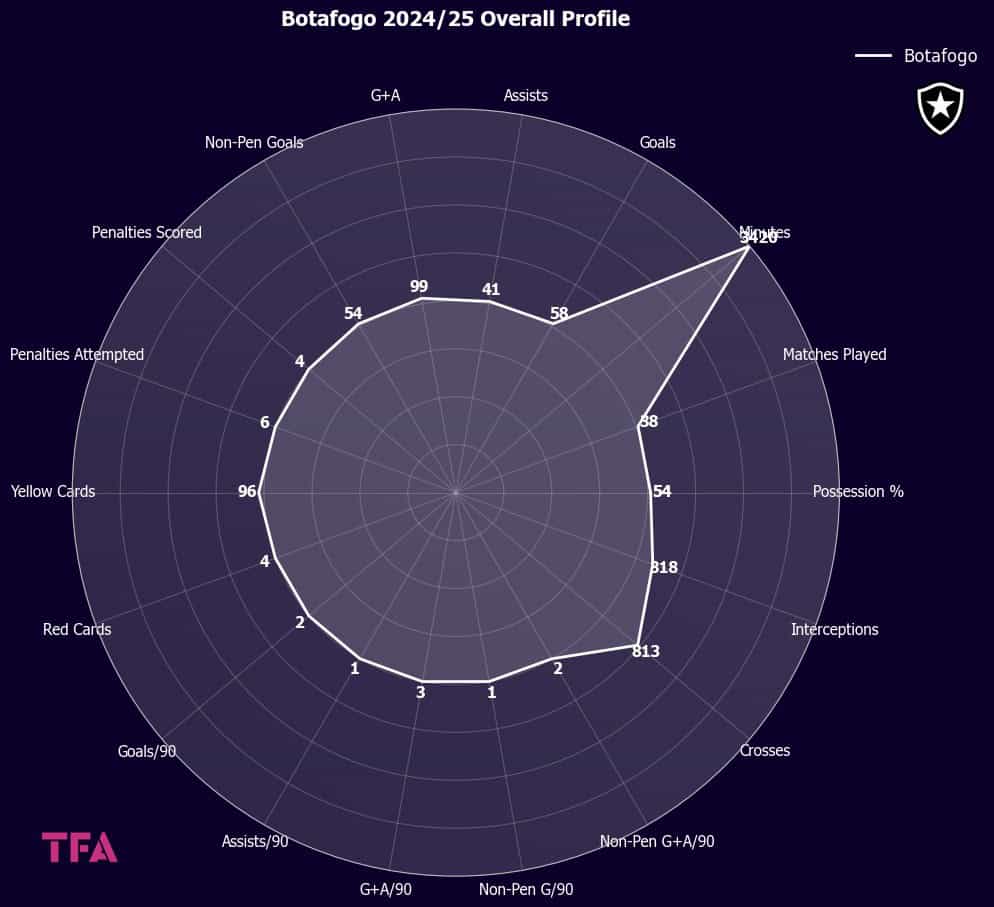
With 58 goals and 41 assists across 38 matches, they record 2.61 G+A per 90 – a strong attacking return, particularly when considering that 2.5 of this total comes from non-penalty situations.
This highlights their ability to penetrate defences without reliance on set pieces, showcasing fluent attacking movements in open play.
Although their average possession (53.8%) may not stand out among ball-dominant teams, Botafogo uses the ball efficiently.
Rather than endless circulation, they favour fast combinations and early entries into the final third.
Their 813 crosses – among the highest in the dataset – reflect a clear strategy of exploiting width, with overlapping full-backs and wide forwards driving service into the box.
Defensively, they employ a high-intervention approach, with 318 interceptions and 96 yellow cards, indicating a high level of intensity in the press but also vulnerability to fouls in transitional moments.
With four red cards, discipline may be an issue under pressure, especially in high-stakes matches.
Tactically, Botafogo often play a 4-2-3-1 or 4-3-3 with attacking midfielders given license to drift into pockets behind the striker.
Their tempo is rapid, and they often overwhelm opponents who attempt to press high.
They exploit space behind defensive lines with well-timed through balls and aggressive forward runs.
Their penalty contribution (with only four PKs scored) shows a team that is less dependent on referee decisions and more focused on creating high-quality chances from open play patterns.
Botafogo’s ability to stretch opponents horizontally and deliver constant service into danger zones will be crucial in a tournament where compact defensive blocks are common.
Their directness and physicality make them a threatening opponent to any side.
SE Palmeiras – Brazil’s Balanced Control & Structural Rigidity
Palmeiras approach the Club World Cup as one of South America’s most tactically disciplined and structurally consistent teams.
Palmeiras Data Profile 2024/2025
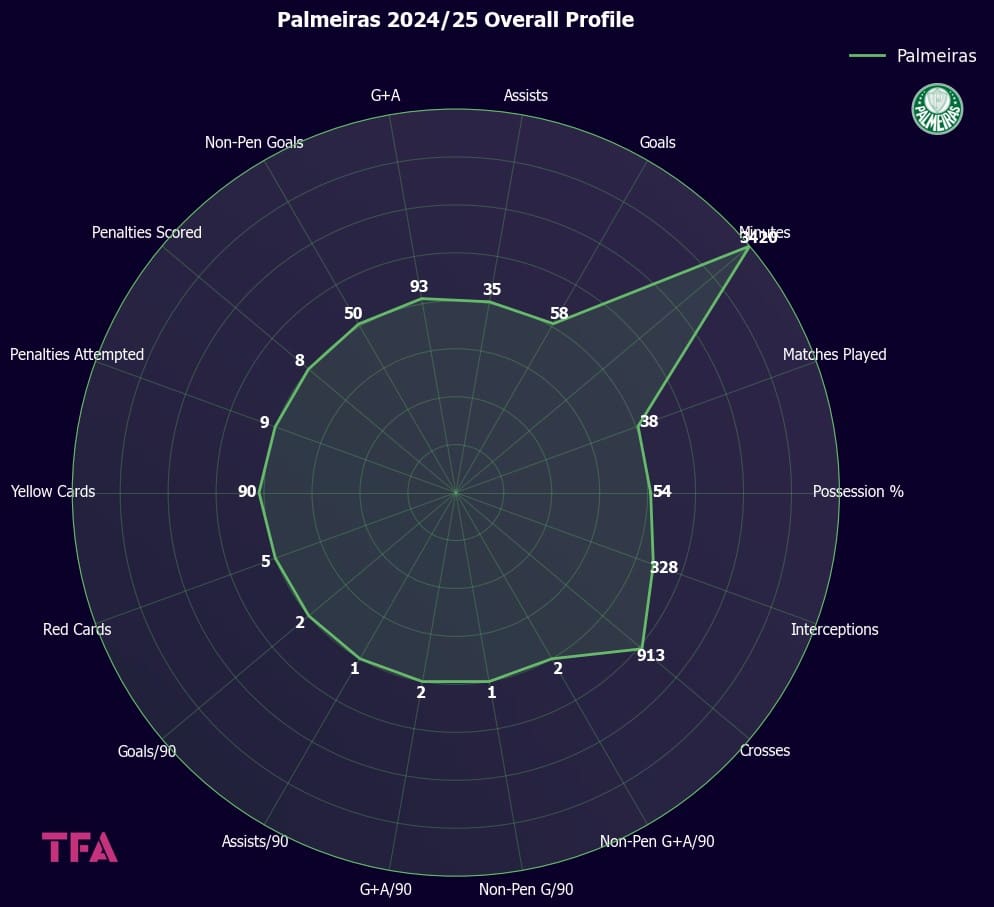
With 58 goals and 35 assists across 38 games, they average 2.45 G+A per 90 minutes, 2.24 of which comes from open play.
This balance between creation and conversion reflects a well-coached unit that knows how to maximise each phase of possession.
Operating with an average of 53.7% possession, Palmeiras do not obsess over ball dominance, but use possession with a clear purpose.
They blend short passing phases in midfield with timely switches and overlaps to destabilise opponents.
Their 913 crosses—the highest among all teams—show a heavy reliance on wide areas, often through full-backs and wingers who stretch defences and deliver into the box regularly.
Despite their structured build-up, Palmeiras remain dangerous in transitions.
Their midfield maintains vertical compactness, enabling quick recovery after losing the ball.
They demonstrate strong defensive control, with 90 yellow cards and only five red cards – a sign of managed aggression and intelligent pressing.
Tactically, Palmeiras prefer a 4-2-3-1 or 4-1-4-1 setup, offering fluidity in attack and numerical control in midfield.
Their off-the-ball shape is compact, particularly against higher-level opposition, and they excel at forcing wide attacks where they can isolate and trap opponents.
With eight penalties scored and a G+A-PK of 2.24 per 90, their ability to create open chances remains reliable; they also possess the physical presence to draw fouls in the box.
With a squad that combines youthful energy and experienced leadership, Palmeiras may lack flamboyance but compensate with structure, resilience, and a clarity of tactical identity that suits tournament football.
Flamengo – Brazil’s Relentless Attack Built On High-Tempo Combinations
Flamengo enter the Club World Cup as one of the most offensively prolific sides in South America.
Flamengo Data Profile 2024/2025
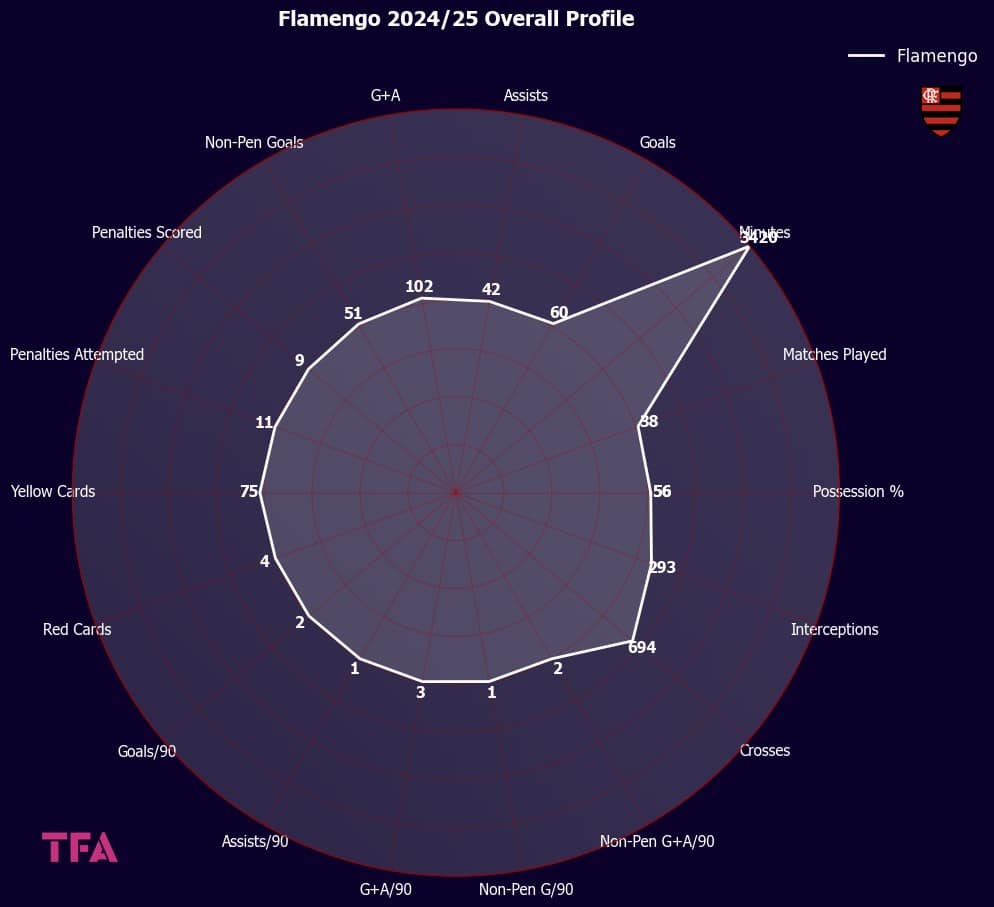
They scored 60 goals and provided 42 assists across 38 matches, totalling 102 G+A, which translates to 2.68 per 90 minutes.
This output is even more impressive because 2.45 G+A per 90 came from non-penalty situations, underlining their creativity and chance generation through open play patterns.
Despite holding a modest 55.8% possession rate, Flamengo do not aim for sterile control.
Instead, their football is built on dynamic tempo, short-passing triangles in tight areas, and explosive wing play.
With 694 crosses and a high frequency of touches in the half-spaces, they constantly pull opposition blocks apart to open up central channels.
Their penalty area presence is strong, with nine penalties scored and 11 attempts, showing their attackers’ ability to draw fouls in dangerous areas.
However, their 75 yellow cards and four red cards reflect a team that walks a fine line between intensity and recklessness.
Their 293 interceptions place them mid-table among their peers, indicating a preference for proactive pressing rather than deep sitting.
Tactically, Flamengo frequently deploy a 4-3-3 or 4-2-3-1, with fluid rotations between their wide forwards and attacking midfielders.
This fluidity is mirrored in their vertical progression, with midfielders like Gerson or playmakers like Giorgian de Arrascaeta (if fit) orchestrating attacks between the lines.
Their high G+A-PK ratio and open-play penetration make them one of the most dangerous teams in broken or transitional phases.
As a side that thrives in chaos and accelerates the tempo, Flamengo is best suited to facing teams that open up space.
Their quick interchanges and direct dribbling can punish even the slightest structural weakness.
However, controlling the tempo and defensive transitions will be key to sustaining their attacking threat without overexposure.
Seattle Sounders – The MLS Contender Rooted In Compactness & Transitions
Seattle Sounders bring a distinctly North American tactical identity to the tournament, one grounded in organisation, athleticism, and transitional efficiency.
Seattle Sounders Data Profile 2024/2025
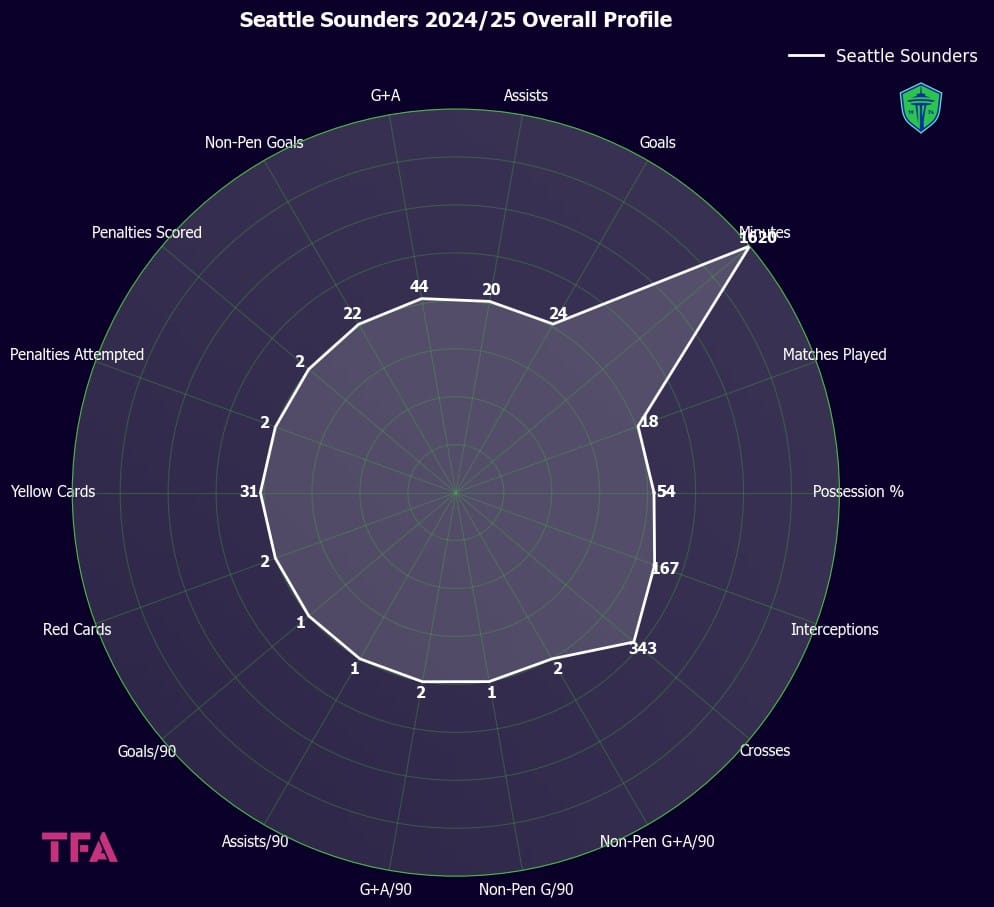
They produced 24 goals and 20 assists across 18 matches, averaging 2.44 G+A per 90 minutes—2.33 of that figure coming from non-penalty scenarios.
This indicates their ability to create and finish chances in open play, despite a relatively modest possession share of 53.9%.
Seattle Sounders FC’s attacking style favours vertical progression and direct ball movement rather than patient build-up.
Their 343 crosses suggest reliance on flanks and overlapping full-backs, especially when trying to bypass compact central blocks.
In the final third, they often look to create isolation scenarios for their wide forwards, feeding quick balls into the box or targeting cutbacks from the byline.
Defensively, Seattle are disciplined and robust.
They maintain aggressive pressure with 31 yellow cards and just two reds without descending into chaos.
Their 167 interceptions support a mid-block pressing structure, allowing opponents some space in deeper areas before triggering pressure traps in midfield.
Tactically, they often operate in a 4-2-3-1 system that shifts into a 4-4-2 out of possession.
This provides a solid base for counterattacks, with the double pivot offering both protection and vertical passing options.
The balance between athletic midfielders and intelligent full-backs allows for controlled transitions and consistent recovery runs.
Though not the flashiest side, Seattle’s tactical discipline and strong team cohesion enable them to punch above their weight.
Their relatively low G+A total is compensated by efficiency in shot selection and a collective understanding of roles.
Against more possession-heavy opponents, their ability to absorb pressure and hit with speed could be a key factor in progressing deep into the tournament.
Ulsan HD – Korea’s Disciplined Build-Up & Compact Defensive Shape
Ulsan HD arrive at the Club World Cup as the K-League’s most consistent tactical outfit.
Ulsan HD Data Profile 2024/2025
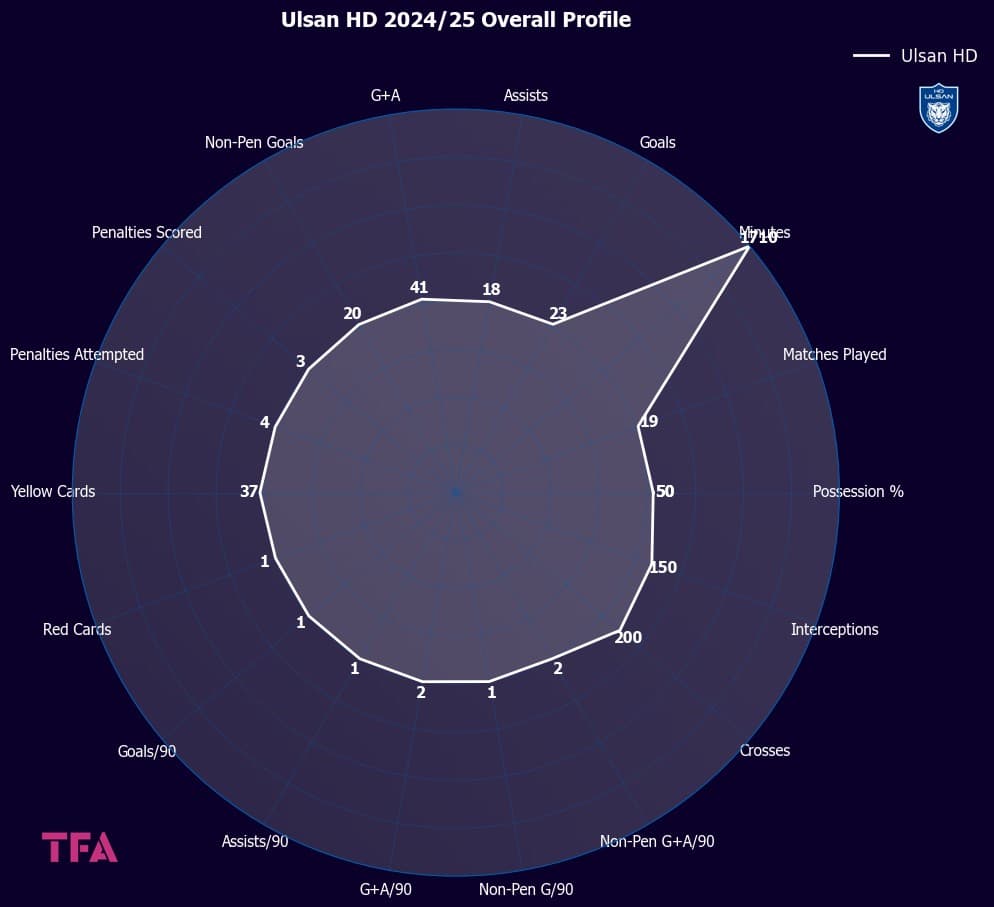
While their overall attacking numbers are modest—23 goals and 18 assists across 19 matches, with a G+A per 90 of 2.16—their style reflects a cautious, possession-based approach that prioritises structure over chaos.
Their possession share sits at exactly 50%, suggesting a measured balance between control and pragmatism.
Their attacking output largely stems from well-rehearsed build-up patterns.
Rather than playing vertically at all costs, Ulsan patiently rotate possession through their midfield pivot, looking to create overloads on the flanks before releasing their wide players.
With 200 crosses and 150 interceptions, they maintain a solid two-way game plan.
The team’s relatively low penalty area presence—just three penalties taken—reflects a tendency to avoid risky individual duels in favour of collective movement.
Defensively, Ulsan are exceptionally organised.
They conceded only 37 yellow cards and one red card across their matches, highlighting disciplined defending without excessive fouling.
Their 150 interceptions point to a reactive, zonal marking system rather than aggressive pressing.
They often retreat into a mid-to-low block to suffocate space centrally.
From a tactical standpoint, Ulsan generally operate in a 4-4-2 or 4-2-3-1, depending on the game context.
Their wide midfielders are expected to contribute defensively as much as offensively, doubling up on opposition wingers and preventing overloads.
This disciplined shape makes them difficult to break down, but can limit their transitions into the final third.
Ultimately, Ulsan’s strength lies in their cohesion and risk-averse system.
In knockout settings, their emphasis on structure, coupled with moments of vertical incision from their full-backs or No. 10, could frustrate more adventurous sides.
They may not dazzle, but their reliability and defensive clarity make them a challenging opponent for any team.
Urawa Reds – Japan’s Pragmatic Pressers With Targeted Penetration
Urawa Reds represent Japan‘s contribution to the 2025 Club World Cup with a pragmatic yet sharp-edged playing style.
Urawa Reds Data Profile 2024/2025
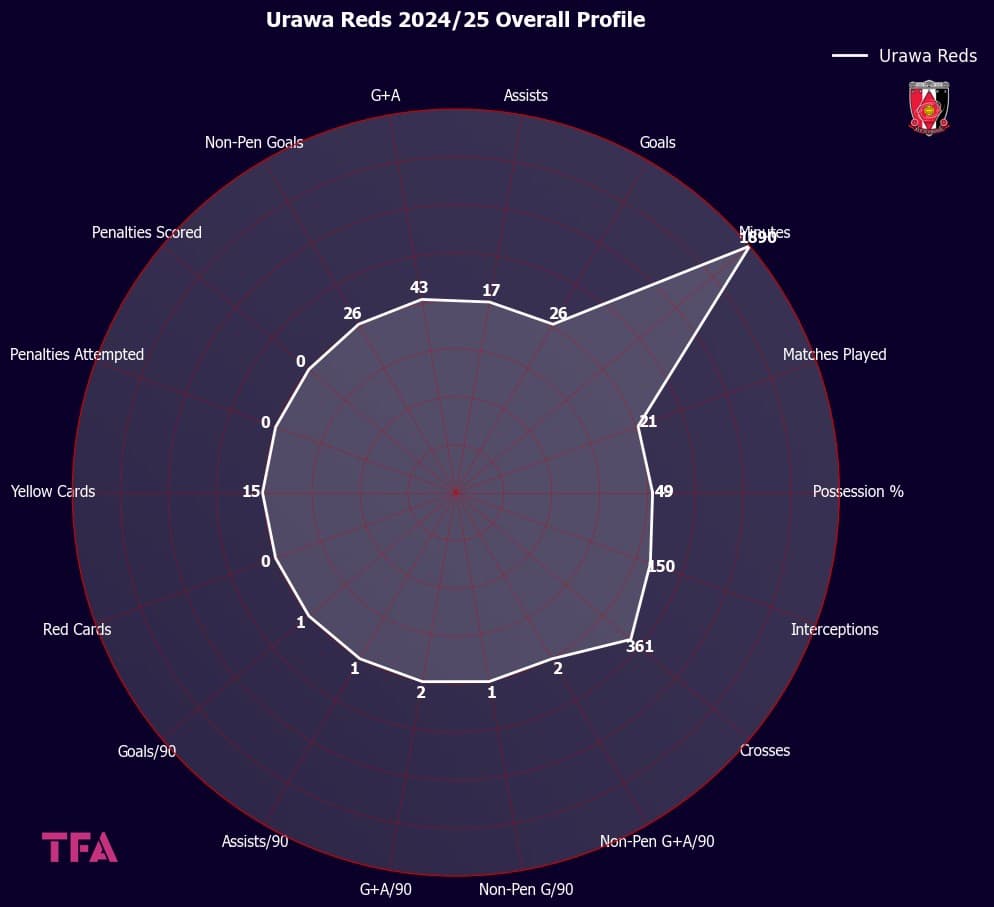
Despite possessing only 49.3% of the ball across 21 matches, they have registered 26 goals and 17 assists – 43 G+A in total, equating to a respectable 2.05 G+A per 90 minutes.
Notably, all their goals have come from open play, with zero penalties awarded, underscoring a clean attacking approach that relies on buildup rather than set-piece advantage.
The Reds favour calculated pressing rather than full-pitch aggression.
Their 361 crosses and 150 interceptions suggest a system built on patient ball recovery followed by quick progression.
Unlike teams that warm the ball immediately, Urawa tends to invite pressure before launching short passing sequences to break the lines.
They often use their full-backs or central midfielders to shift the opponent’s shape.
Tactically, Urawa frequently shift between a 4-2-3-1 and a compact 3-4-2-1 depending on the opposition.
Their width comes more from structure than flair—they rely on overlapping wing-backs or full-backs rather than isolated wingers.
This allows them to maintain defensive solidity while still stretching the field.
Defensively, they are among the cleanest sides in the competition, receiving only 15 yellow cards and no red cards across 21 games.
This demonstrates an emphasis on timing and positioning rather than physicality.
Their defensive line is well-drilled, often catching teams offside or forcing low-quality shots from distance.
In knockout football, Urawa’s tactical flexibility and disciplined setup make them a tough nut to crack.
Though not prolific scorers, their efficiency in breaking defensive lines and maintaining defensive shape could be the key to an underdog run in the tournament.
They are well-equipped to exploit the margins against overcommitted opponents.
Conclusion
As we conclude this analytical journey through the data landscapes of the FIFA Club World Cup 2025’s non-European contenders, one theme stands out clearly: tactical diversity is thriving outside of Europe.
The numbers reveal not only variation in style but also sophistication in approach.
These clubs are not passive participants – they are tactically and statistically equipped to pose genuine threats on the world stage.
From the pressing precision of Al Ahly and Boca Juniors’ defensive rigour to the vertical fluidity of Inter Miami and Botafogo, each team demonstrates a deep tactical identity shaped by its regional football culture.
Mamelodi Sundowns’ possession dominance and Palmeiras’ structural discipline demonstrate how control can manifest in different forms.
Meanwhile, Al Hilal and Monterrey offer tactical hybrids that strike a balance between flair and form.
This blend of structure and expression challenges the long-held perception that only European clubs embody modern football’s elite methodologies.
The statistics reveal more than just goals and assists; they reflect adaptability, consistency, and a clear purpose.
Whether in metrics like G+A-PK, possession percentages, or interceptions per match, the data supports a strong case for the tactical evolution taking place globally.
These teams are learning not only to survive against elite competition but to impose their identities in the process.
Ultimately, while European sides may still be favourites, the 2025 tournament could be shaped just as much by how they respond to the tests posed by these tactically rich non-European challengers.
In short-format football, where one game can alter legacies, the ability to disrupt and adapt becomes more important than heritage alone.
This tournament, then, is not just a stage for competition—it is a global classroom.
The non-European sides are no longer students; they are beginning to write their own syllabus.
