
After analysing Rayo Vallecano’s philosophy (part one), today we dive deep into Jorge Vallejo’s tactics that Rayo Vallecano B uses in Tercera RFEF.
Considering Rayo Vallecano B is the most positional team in the tournament, we will focus on in-possession awareness and the squad’s remarkable players.
We recently had the privilege of interviewing Jorge Vallejo about his tactical philosophy and formation construction.
Rayo Vallecano B Tactical Analysis & Formations
Jorge Vallejo’s Rayo Vallecano B tend to play with a 4-3-3 shape, which can also be considered a 4-2-3-1 in possession according to the position of the highest midfielder.
In that sense, this is a flexible 4-2-3-1 as they use the five channels to occupy the spaces in order—there must always be a player in the wide channel, one in half-spaces, and another in the centre.
No matter who, but one at least.
This is a positional idea, and he explains it in detail below.

The Key Space: Between The Centre-Back & The Full-Back
Jorge Vallejo:
“We play with five clearly defined channels: one central and two wide, which are further split into inside and outside zones.
What are we looking for? Always have one player occupying the half-spaces and another in the widest channel.
Why? Be wide to be deep!”
That’s exactly what happened with Marco De Las Sías’ goal against México: the ball was played completely out to the wing, and a diagonal pass was made into the inside channel.
We’ve repeated that play a lot because we know the key is breaking between the centre-back and the full-back, a gap that’s very hard to defend.
When a player moves to receive in that area, it creates uncertainty: Does the centre-back step up? Does the full-back go? Or does someone else track the run? And if the full-back steps up, it leaves the wide channel open.
These movements create big advantages.
We work a lot with what we call squares, aiming to create situations that allow us to penetrate the box.
It could be the full-back cutting inside, the winger dropping into that zone to receive, or even an attacking midfielder like Becerra or Juanchi breaking into that space.
It’s not about always running the same play but ensuring that space is occupied, no matter who does it.
We want the players to understand where the spaces are, how they’re created, and how to occupy them.
In the final third, we don’t rely on fully pre-planned plays like in the build-up phase.
Instead, we want the players to be aware of the spaces available and use their mobility and positioning to create the necessary situations from there.”
TFA:
The goal below against Tres Cantos explains this situation: the widest channel penetrates the inner channel.
Let’s see it in the sequence below.
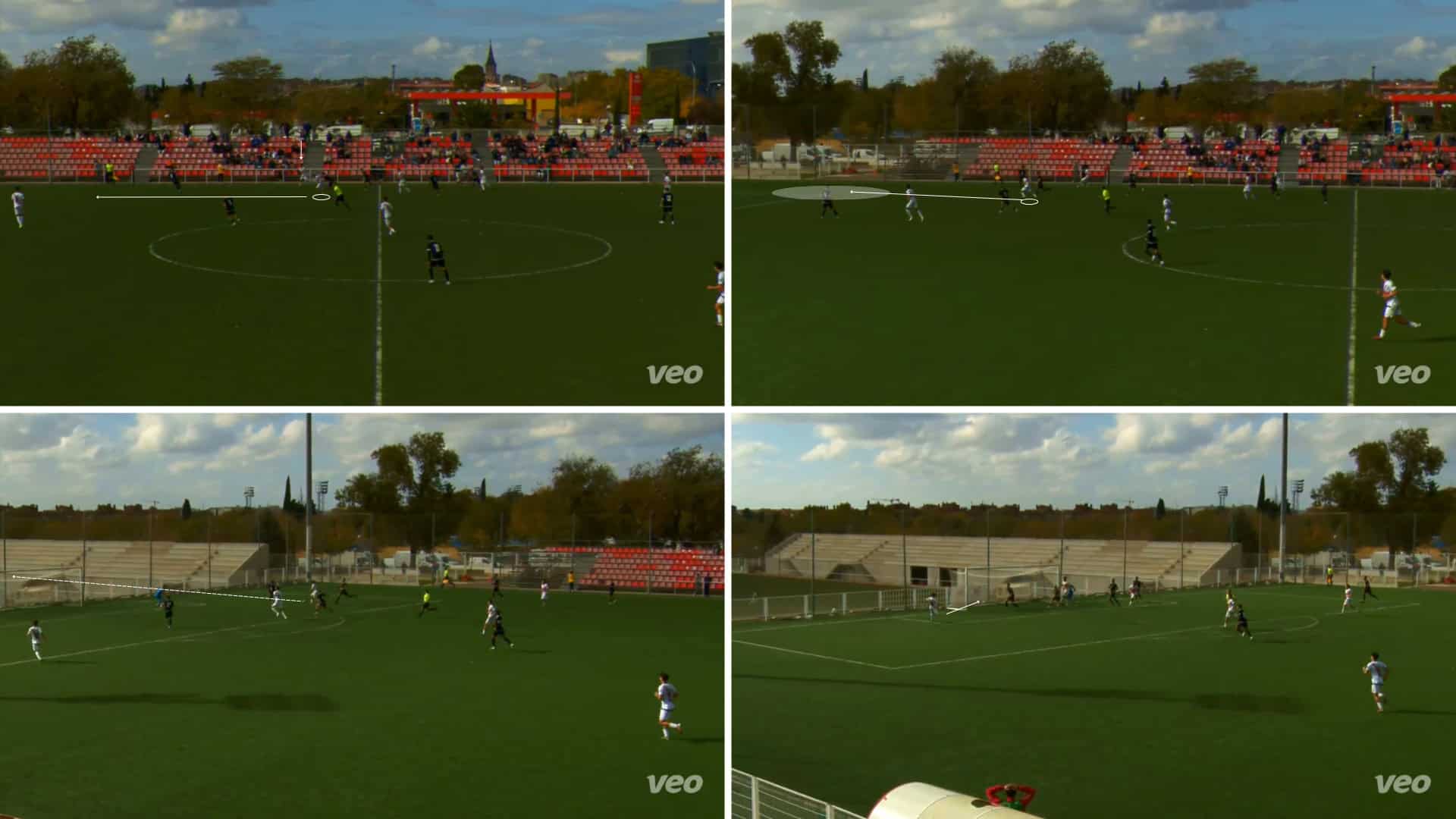
In Figure 2, we can see what Jorge Vallejo describes.
The ball is in Baladía’s feet while Becerra runs in the right half-space.
Then, the full-back chases Bala to try to steal the ball, and Becerra gets free as Eto’o pins the centre-back, and the defensive midfielder cannot win the space.
That sequence ended with a shot from Becerra, which crashed off the bar before Juan Ybarra finally finished the action.
However, these types of runs can also happen starting from the centre.
Let’s examine this with another sequence, recently against Trival Valderas.
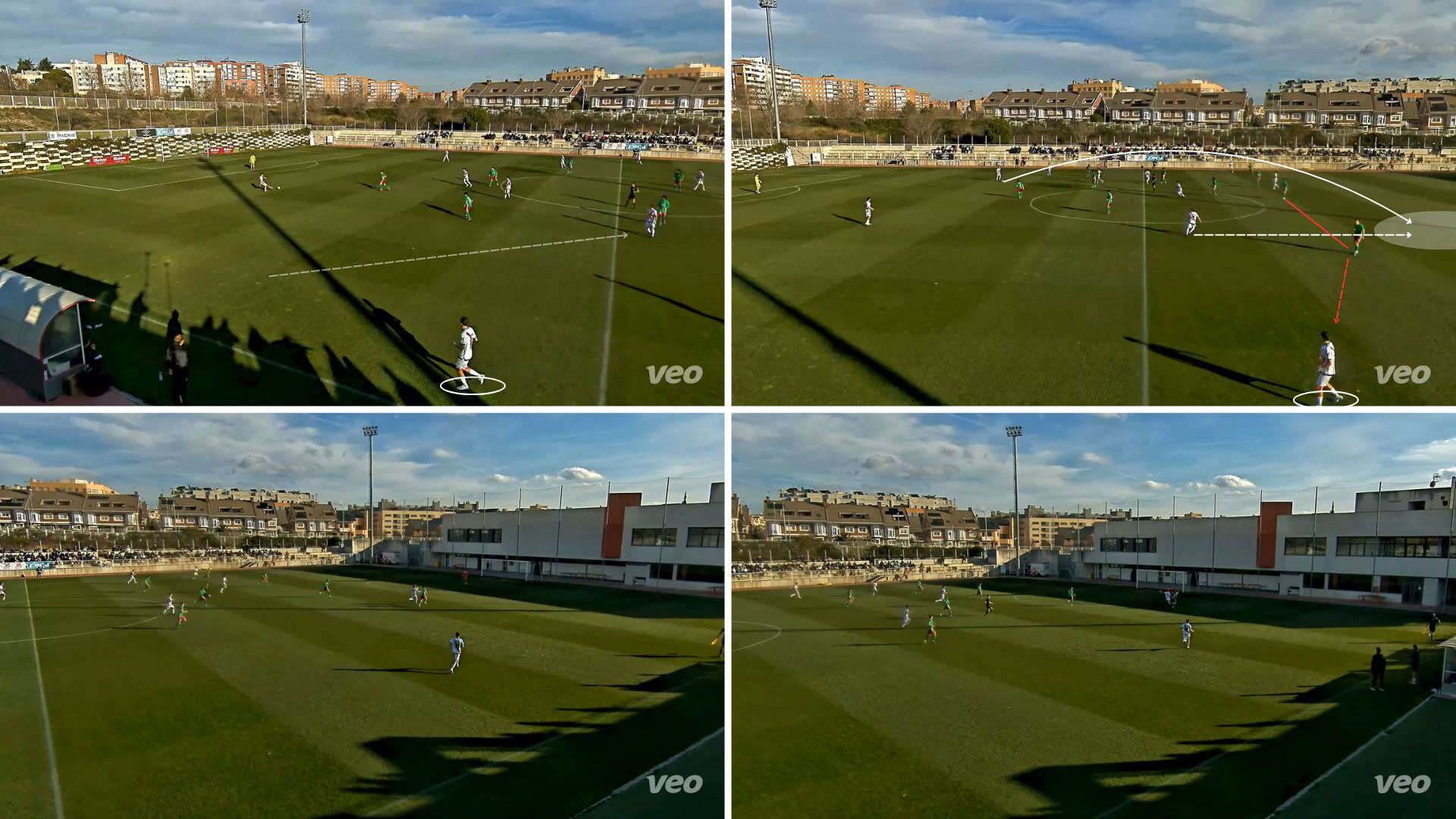
In Figure 3, Marco De Las Sías left his initial position and went to the right half-space.
At the same time, Álvaro Baladía stayed at the touchline, attacking what we have considered the most important zone during the article: the distance between the centre-back and the fullback.
The full-backs can exploit their powerful low body to break lines with their runs.
Meanwhile, like Sergio Lozano in Figure 3, the centre-backs can use their long passing range with good options in the final third.
The Build-Up: A Challenge
As the first part of the interview makes clear, building up to search for the free man or trying to move the ball to open spaces is one of the main challenges in a combinative game model like this.
Even the centre-backs like Juanchi and Aitor are exposed to making mistakes in dangerous positions.
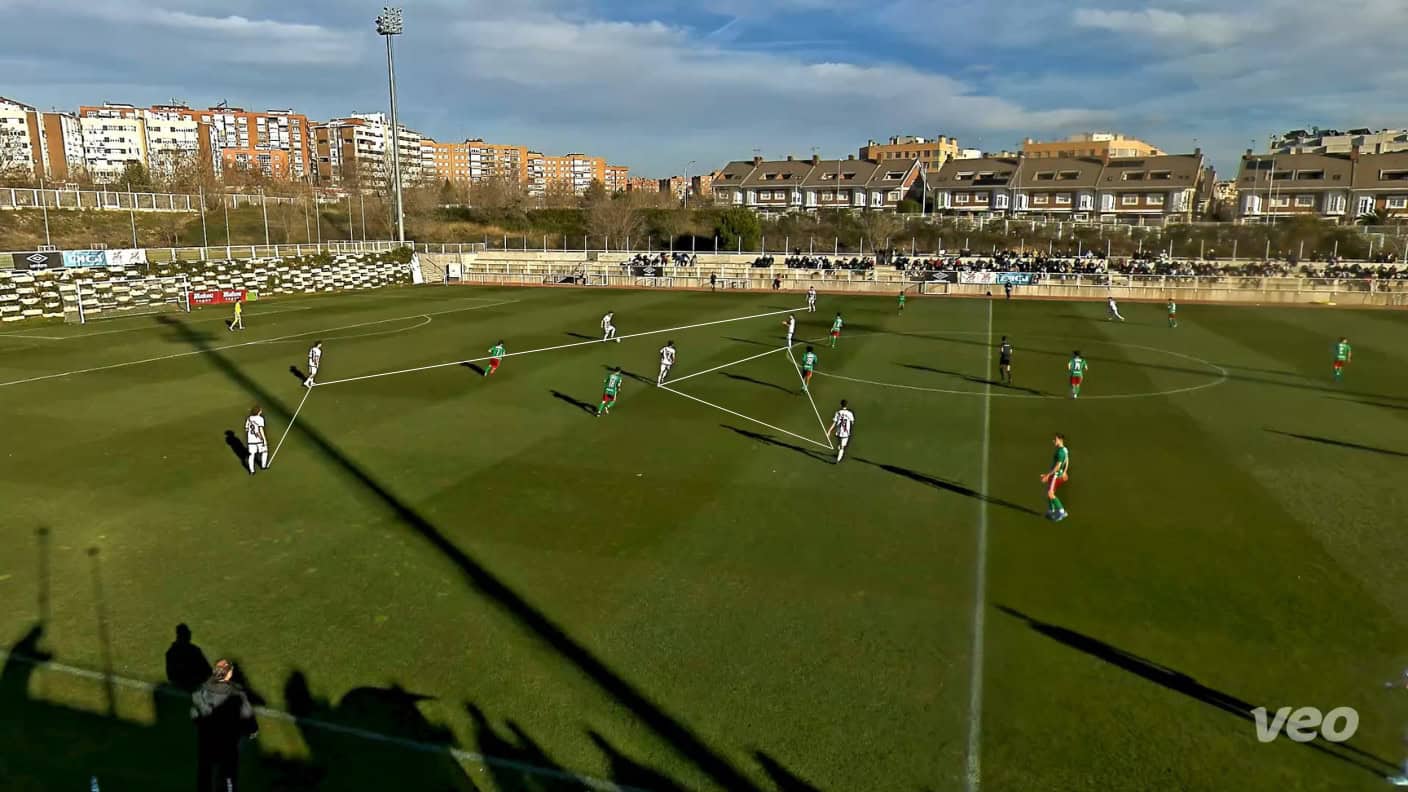
During the build-up, Rayo Vallecano B use a 4+2 or 3+2, always with the first two midfielders as the focus point for pressure between the lines, like Aitor and Juanchi in Figure 4.
In the first part of the season, with the players still working on creating synergy, they made mistakes more than once in the passing circuits.
Jorge Vallejo:
“It’s true that the most talented players are usually in central areas, and that’s also where they’re the most exposed.
Both those two midfielders and the centre-backs are put in tough situations.
I’ve never been a fan of forbidding things like, “You can’t pass to a holding midfielder if he’s receiving with his back to the goal.”
No, you can—he has to know that he needs to lay it off to keep play facing forward, create a third-man option, or shift sideways to receive with the field in front of him instead of being forced to turn under pressure.
It’s about teaching them mechanisms so that, with their mobility—they’re usually the ones covering the most distance per game—and the wingers dropping in, they make movements to create space for the next line.
Then, in possession, they should be made to understand that the right move is often to set the ball for a teammate rather than turning into pressure and losing it because that can lead to dangerous transitions for the opponent.
It’s the same with the centre-backs—they’re exposed, too.
Before, their job was to defend, but modern football demands they have good ball distribution.
The key is minimizing mistakes: knowing when to drive forward, restart, and play long for a flick-on…they shouldn’t feel like they’re betraying the system just because they hit a diagonal ball.
There are a thousand different situations in a game.
No passing lane at that moment? Reset, keep the ball moving, and it’ll return to you in a better position so we can progress.”
The Goalkeeper: Another Player In Possession
During the passing circuits and working under pressure, the goalkeepers, Juanpe Gil or Adrián Molina, are very good at attracting rivals and playing into space, as in the image below.
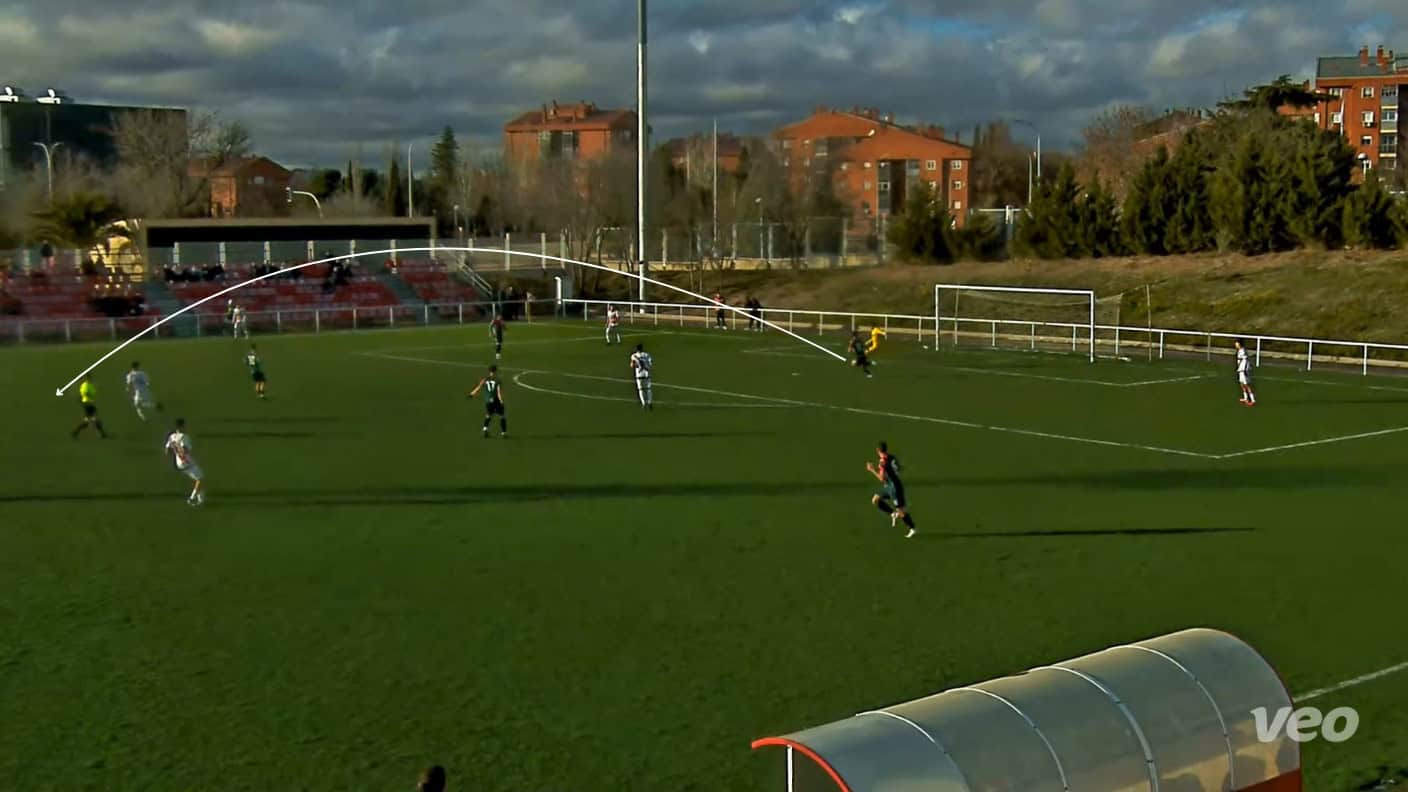
We asked Jorge Vallejo about this, and he considers the goalkeepers to be field players in the training sessions.
Jorge Vallejo:
“Adrián has been doing great in the youth team for years.
He joined the first team for preseason a few times last season, and we already knew he could be with us this year and play an important role.
Juanpe, on the other hand, is a new signing, but he’s played for clubs like Real Madrid and Alcorcón, where they obviously value good ball control.
Nowadays, given all the possession drills and training sessions, it’s rare for goalkeepers not to be good with their feet.
Personally, from day one, aside from the fact that we have a goalkeeper coach working with them individually, I include them in all group drills.
They take part in rondos and early possession exercises—they play with their feet; they’re just other players.
I was joking with Juanpe the other day because I referred to him as a left winger or something like that and asked him, “Have you ever trained as an outfield player?” He told me that as a kid, he used to play outfield.
I wouldn’t be afraid to put him out there someday.
It’s good for goalkeepers to be involved in the game and not just stay between the posts.
I strongly believe in distribution with the feet and their understanding of the game because it’s a tough role.
Just like midfielders and centre-backs are exposed when they’re on the ball, goalkeepers often have to play passes that, if they get wrong, can cost a lot.
So, we have to help them understand when to play a through pass when to break the press… They’re smart guys, and they pick it up quickly.”
Rayo Vallecano B’s False Wingers
Rayo Vallecano B’s wingers tend to move inside to progress from the centre and give the wide channel to the full-backs.
Juan Ybarra usually drops in.
Although he is an attacking midfielder, he plays as a winger under Jorge Vallejo’s style of play.
Jorge Vallejo:
“Throughout his years in the youth team, he’s always been a ‘10’, operating more centrally.
Last season, just like this one, we’ve had top-quality players in the midfield.
That’s why we pushed Asier and Ybarra out wide the past year—to make room for all the talent we had inside.
This year, it’s more or less the same.
He could easily play as an attacking midfielder, no doubt about it.
What happens? He’s such an intelligent player that he knows exactly when to drift inside or when to stay wide… He links up perfectly with Robles and makes Robles better because their synergy allows him to push higher up and break lines.
They complement each other really well.
The fluidity was not the same when we played Becerra or Juanchi out wide.
If you move him away from central areas, you take away a bit of what makes him special because he understands the game so well.
But we give him the freedom to roam inside, get into the box, and showcase that composure in front of goal.
It’s all about helping him grow.
I believe players must be versatile as they develop and reach higher levels.
The more positions they can play—three or four, ideally—the better their chances of making the jump.
Because if there’s already a top player in their exact position in the first team, they’ll never get a shot.”
TFA:
A few weeks ago, against Aravaca, the below goal showed many of the details we have discussed in the article.
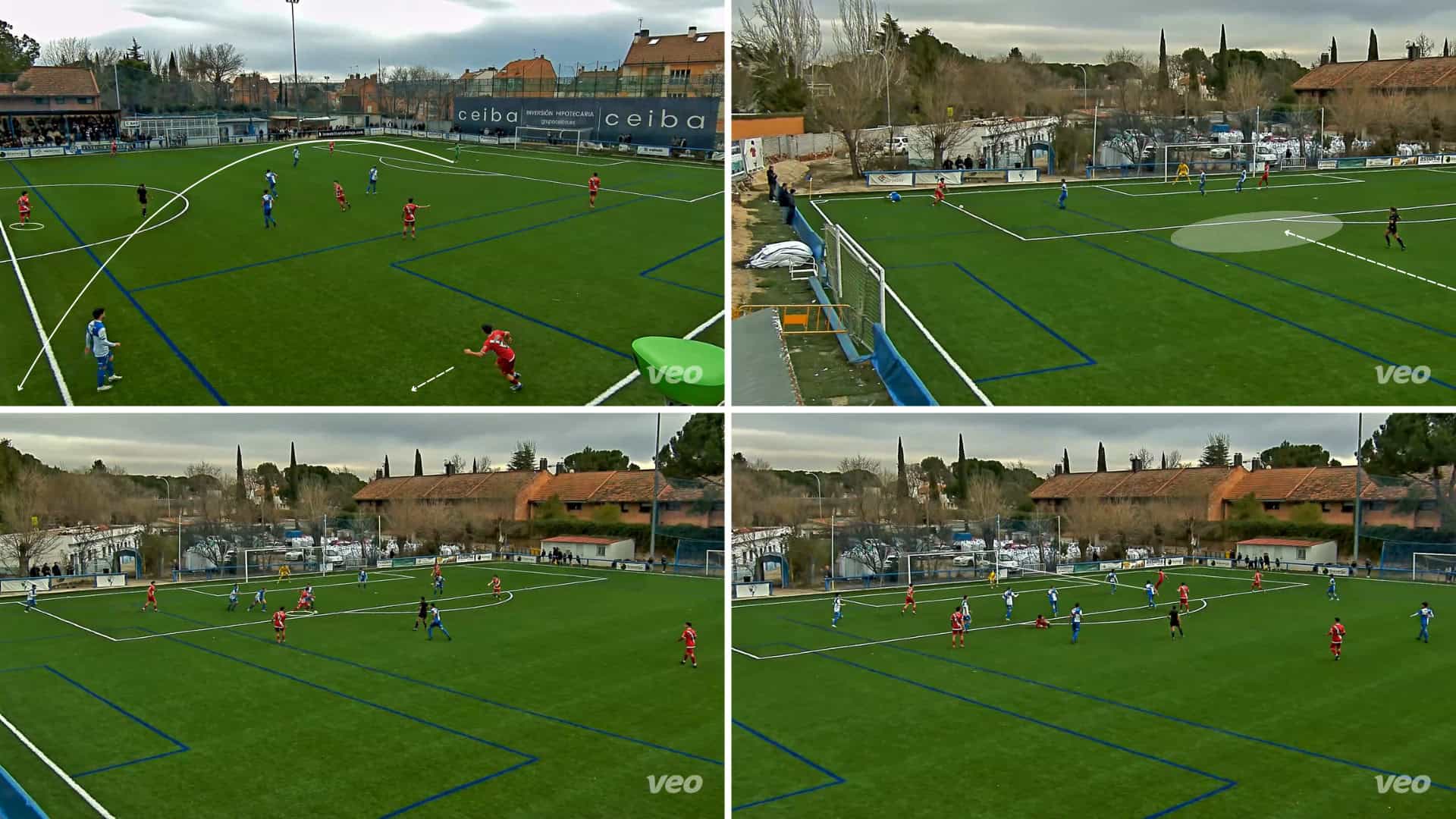
In Figure 6, we see a lot of things.
Firstly, the play restarted, and Juanpe got the ball.
Juan Ybarra moved in, and Robles took the wide channel to run behind.
Juanpe played beyond, and Robles won the duel against Aravaca’s winger, so Ybarra was ready to receive centrally at the top of the box.
He passed to Eto’o, and the striker finished the goal.
So, here are some quotes from Vallejo about Eto’o, the current top scorer of the tournament.
In this positional proposal, Etienne’s physique and domain in the duels is not very exploited, so let’s see what Jorge says.
Jorge Vallejo:
“In the past, he’s played as a left winger and a second striker—he knows the attacking positions well.
But for us, he’s always been the reference up top, a true number nine.
That naturally makes him less involved in the build-up.
At first, he would get a bit frustrated, wanting to drop everywhere to get on the ball.
Now, not so much.
It’s true that in a possession-heavy system, with a lot of link-up play and ball circulation, the striker can get bored.
He’s involved less and has to be patient, waiting for his moment to impact the final third and the box.
It’s not an end-to-end game with constant action in the box.
We want control, and a lot of the game happens in midfield.
In the past, I’ve used the striker more in build-up play, but now, with players like Ybarra and Íñigo—wingers who operate high and can drop inside—we prefer the forward to stretch the team, make constant runs, and create depth.
Our wingers are more about receiving to feet than attacking space since they’re not the quickest.
On the other hand, Etienne is fast in behind, makes great runs, and is lethal in the box.
He doesn’t get a huge volume of chances, but he finishes almost everything he gets—that’s massive for us.
We can still help him improve his hold-up play.
Since he’s played as a winger or attacking midfielder, he’s not used to holding it up, laying it off, and breaking into space.
But he’s growing in that area.
Defensively, his aerial game is a lifesaver.
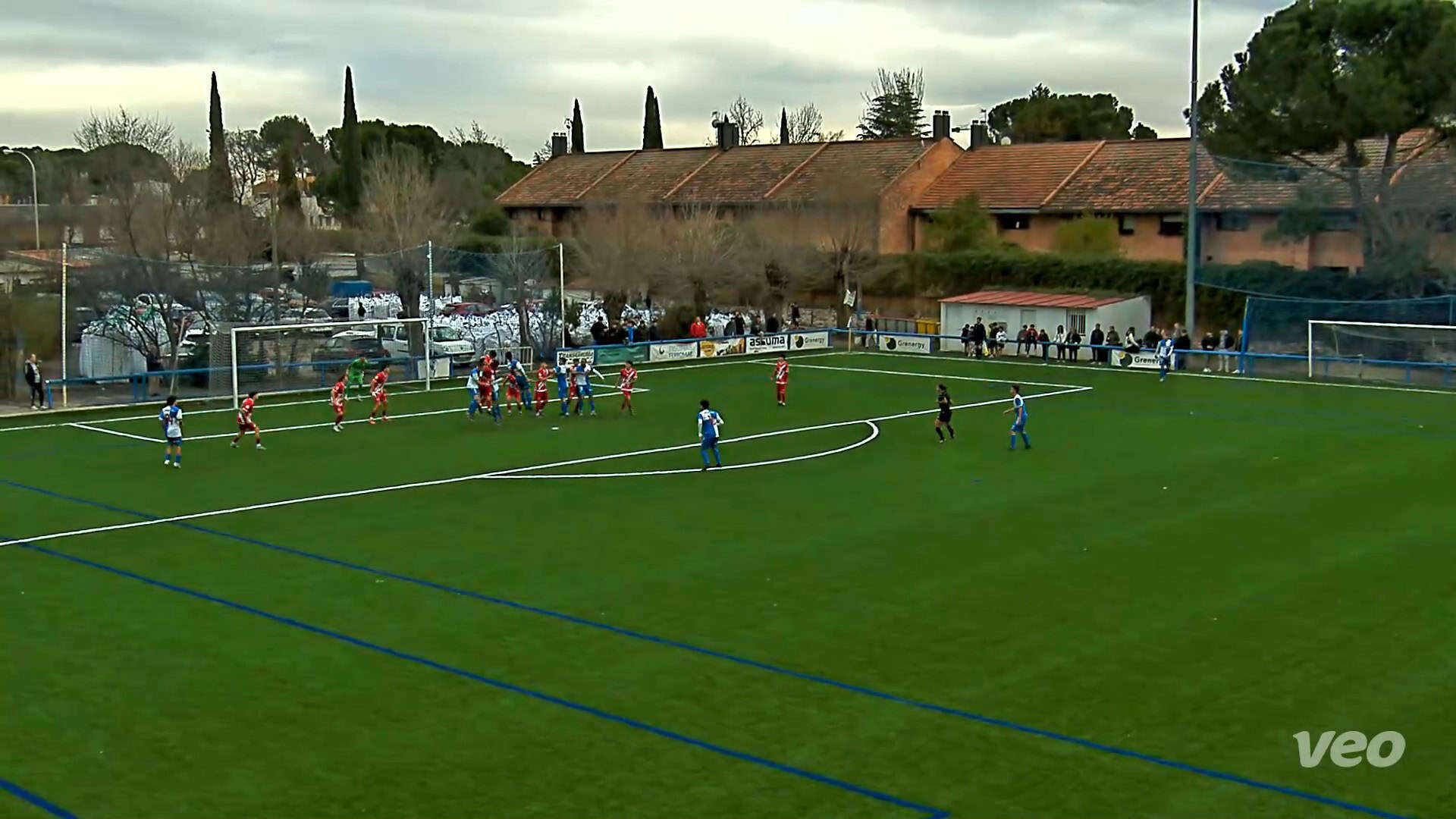
I always tell him—he wins everything in the air when we defend set pieces.
We haven’t been able offensively to make the most of it yet because we don’t whip in crosses or play for aerial duels.
Our attacking play is more about getting wide, cutting back, quick combinations, and layoffs, so his aerial ability isn’t as visible in attack.
That being said, he’s already the top scorer.
I think he’ll easily break 20, and hopefully, he puts up huge numbers.
No striker in Tercera RFEF has done that in recent years.
He’s on the right path—he needs to keep pushing himself, not settle, and finish the season with top-class stats while improving other areas of his game.”
TFA:
Even without the ball, being the target man and the player with the eyes on him, Eto’o has developed his ability to read the play and give space to his teammates, like in another goal against Aravaca, this time from Baladía.
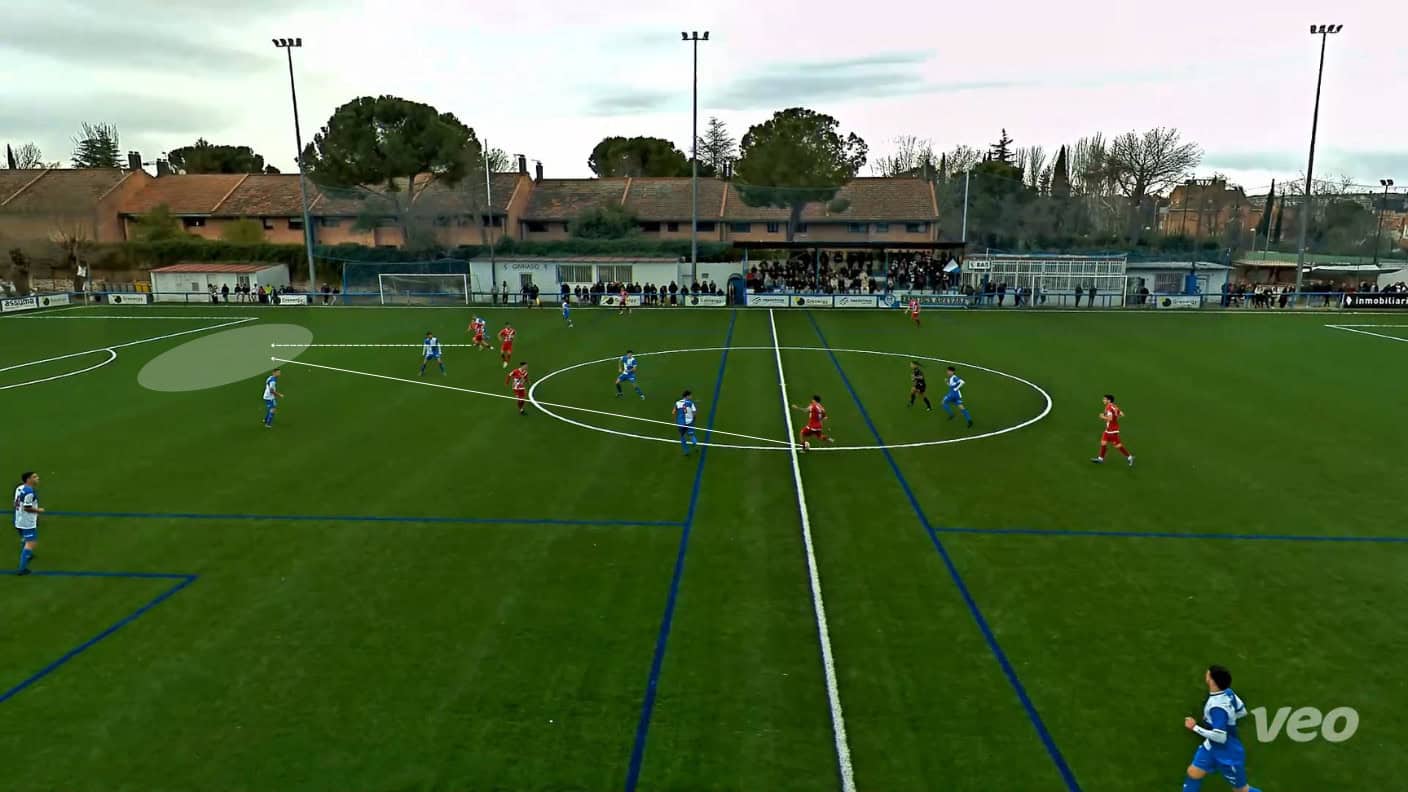
In Figure 8, he exploits the attention that he has on him without even touching the ball.
Alongside his great skills inside the box, Eto’o is developing tactically and is one of the players to watch in the short term.
He has been in the first-team squad more than once and is incredibly in-form in front of the goal.
Conclusion
This tactical interview with Jorge Vallejo shows how one of the La Liga youth teams in Tercera RFEF is dominating Group 7 with a lot of talent, a unique style of play and a logical methodology.
The next step for this team would be promotion, but we still do not know what will happen in a tournament with many competitive teams and a dynamic classification.
Keep an eye on Rayo Vallecano B’s work during the season and watch for players to be called up to the first-team squad, like Adrián Molina, Etienne Eto’o and Marco De Las Sías.
