
AD Alcorcón are currently sitting in the relegation zone following promotion from the third tier of Spanish football last season. Their owner, David Blitzer, also owns Bundesliga side Augsburg, Estoril in the Portuguese Primeira Liga, and other clubs scattered around Europe’s football-obsessed nations, with shares in Crystal Palace in the Premier League. Almost every club he owns has been positively impacted regarding league position, proving that it is no coincidence.
From a set play angle, AD Alcorcón have been interesting to keep an eye on, although have not achieved much success thus far. The four set-piece goals they have achieved do make up a significant portion of their goals scored, and with nearly a league-low of 76 corner kicks in 22 matches, it is fair to argue opportunities have been limited. The corner kick routines have varied from game to game; however, while there have been many positive intentions, there has been a lot of inconsistency within the movements and actions of each player, which is a cause for concern. With the relegation battle being so tight, Alcorcón have the opportunity to use set-pieces to gain those crucial points needed to survive in the division, only if they improve upon the current standard.
In this tactical analysis, we will look into the tactics behind AD Alcorcón’s offensive set-pieces, with an in-depth analysis of the critical elements of corner kicks they have managed to achieve. This set-piece analysis will also look into the problems with some of their set-piece routines and some solutions that can be used to increase output in the future and potentially save their season from relegation.
Positive Intentions
One of Alcorcón’s best routines shows precisely why clarity is crucial during corner kicks. Clarity during corner kicks refers to players making movements toward the ball’s intended path as a corner is taken rather than reacting to where the cross is heading. During Alcorcón’s most successful routine, each player knew their role, with some players tasked to create space and some to attack both the space and the ball. A successful corner kick should always consist of two main elements;
1) Players creating space (through screens/decoy runs, etc.) for 2) to have easy access to
2) Players attacking the ball, with clear separation from their marker (to make the first contact). This can also be achieved through screens, as well as varying the starting position of the run or individual player advantages (timing, vertical leap, movement)
In instances where the ball is designed to be flicked on or headed down, some players should also attack the space where the ball is intended to travel following the first contact.
Alcorcón have been able to create space at the near edge of the six-yard box consistently through the use of a ball side screen. As the corner taker begins his run-up, the attacker who starts beside the goalkeeper makes a sharp movement to plant himself in front of the nearest zonal defender. This makes it possible for a flat delivery to arrive into the near side of the six-yard box without getting cleared, where an attacker from deep can access the highlighted area to make the first contact.

While the above movements are set in motion, the deepest attacker holds his position behind his marker’s shoulder, waiting to make the sprint toward the back post to make the second contact and finish the move. The image below shows the trouble the marker has with the attacker lurking behind him, unable to see both the ball and the man. As soon as the defender turns his eyes towards the ball, the attacker is able to change the angle of his approach to arrive at the back post unopposed.

When all of the elements of a successful kick are attempted during a corner kick, with the correct timing, execution, and clarity amongst the players, the pieces of the puzzle align to create a high-quality chance. The results are both effective and exciting to witness. Still, the issue is that Alcorcón have often failed to align each element during corners, meaning that maybe one of the elements was attempted and successfully executed (perhaps creating space through a screen on a zonal defender), whilst others were neglected/failed (not attacking the ball with separation).
One alternative method that Alcorcón have used to better their corner kicks has been through moving the attacking unit further away from the goal, to the edge of the penalty area. Increasing the depth means that there is more space between the man-markers and the goal. As a result, it becomes much easier for attackers to lose their markers and maintain that separation due to the extra space they can attack. Suppose an attacker can create that initial bit of space from their markers. In that case, they can attack the six-yard box and potentially wait for a couple of seconds before the ball arrives and attack it before a defender recovers their position. Beforehand, when the attacking unit originated between the six-yard box and penalty spot, attackers had less space to attempt to attack behind the defender’s backs, meaning that even if they did create that separation, they would only be able to have it for a moment before the defender recovered the small distance they had lost. This is a step used by Alcorcón to help increase the probability of the second element (making the first contact).
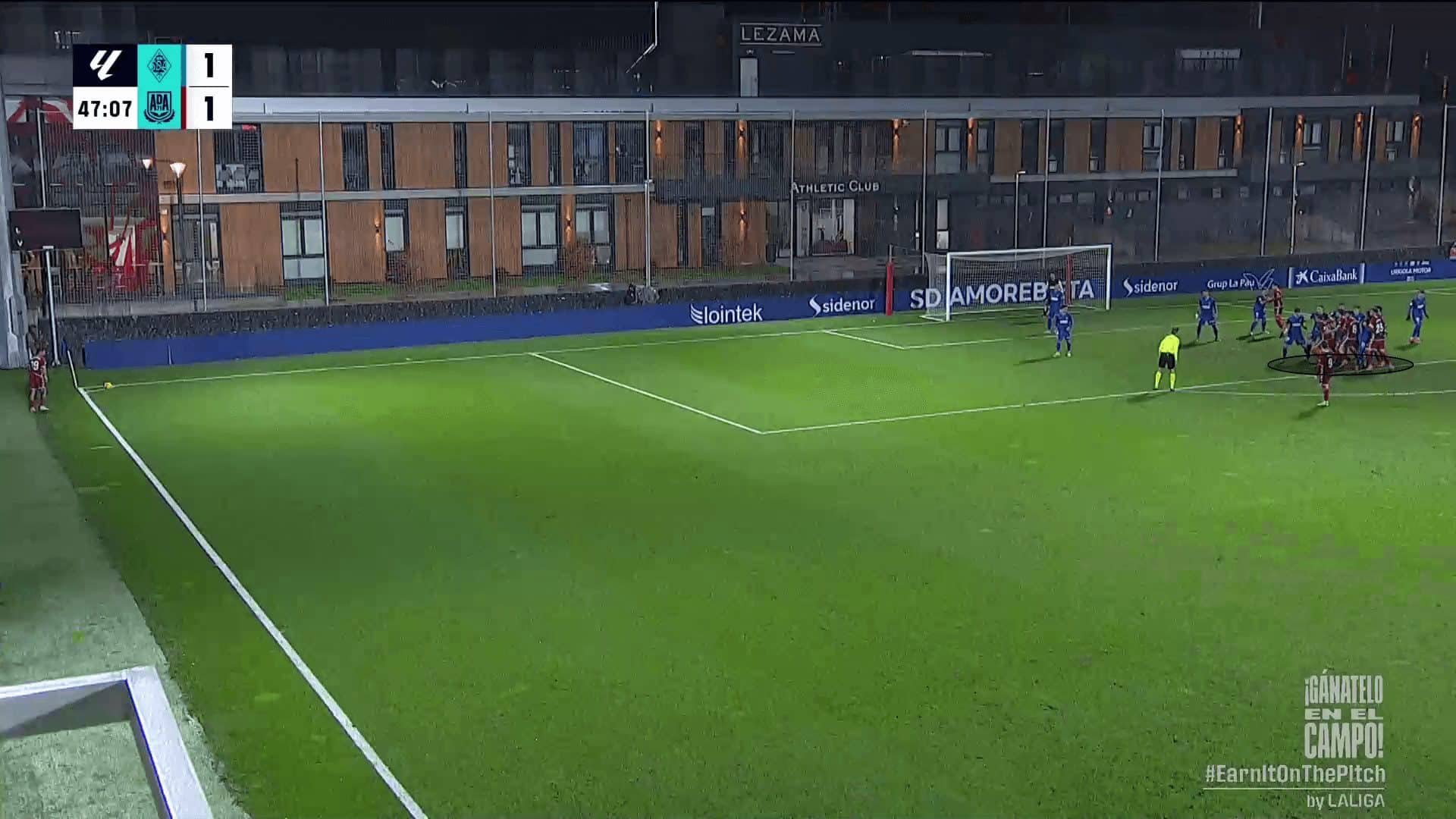
As seen in the first image, Alcorcón have attempted to use screens on zonal defenders. Below is another example where a screen is set on a zonal defender, creating space at the edge of the six-yard box for a teammate to have easy access into. However, as described earlier, the issue has been with the lack of consistency in the corner kicks. While the space is free to enter, no attacker is able to enter the area unopposed, as no work has been done to ensure the primary ball attacker has separation from his marker.
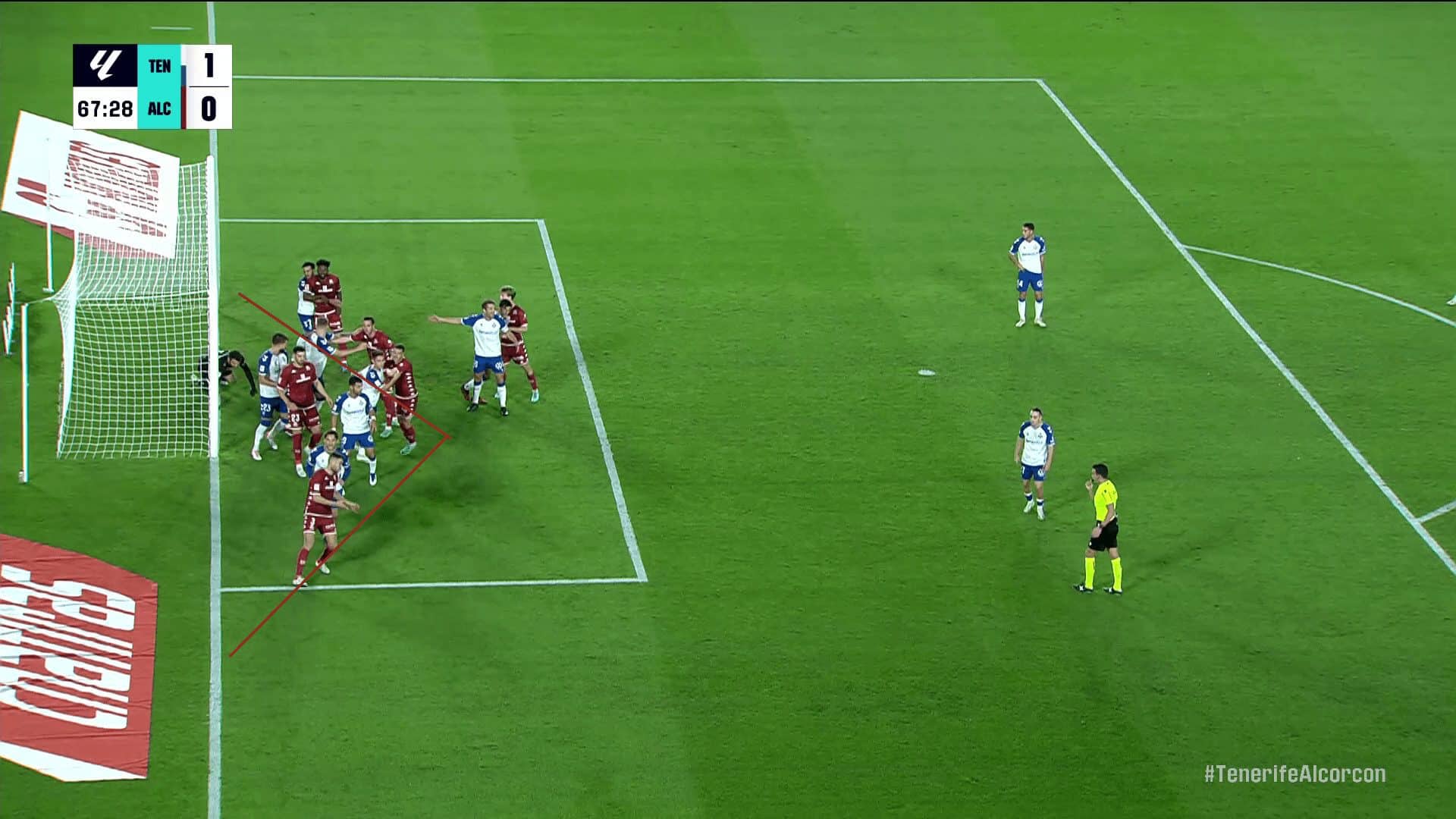
One of the more recent innovations by Alcorcón to vary their corner routines has been the introduction of packing the six-yard box prior to a corner being taken. As seen in the image below, Alcorcón throws six attackers into the six-yard box, around the near post, intending to prevent defenders from really being able to spring towards the ball to clear it. Each attacker backs up into their marker, which prevents them from being able to attack the ball. This results in space being created in the space between the attacking unit and the six-yard line. Attackers can attempt to gain backward separation, where any sort of contact from such a close distance can likely result in a goal.
Issues with Consistency & Execution
There have been several tactical errors in the build-up to corner kick routines and during their execution, which has hindered Alcorcón’s ability to be effective from them more often, as well as a lack of consistency in attempting some of the positive ideas mentioned earlier. Firstly, looking at the routine just mentioned above, there are some issues with the positioning of the attacking unit which immediately put Alcorcón at a disadvantage.
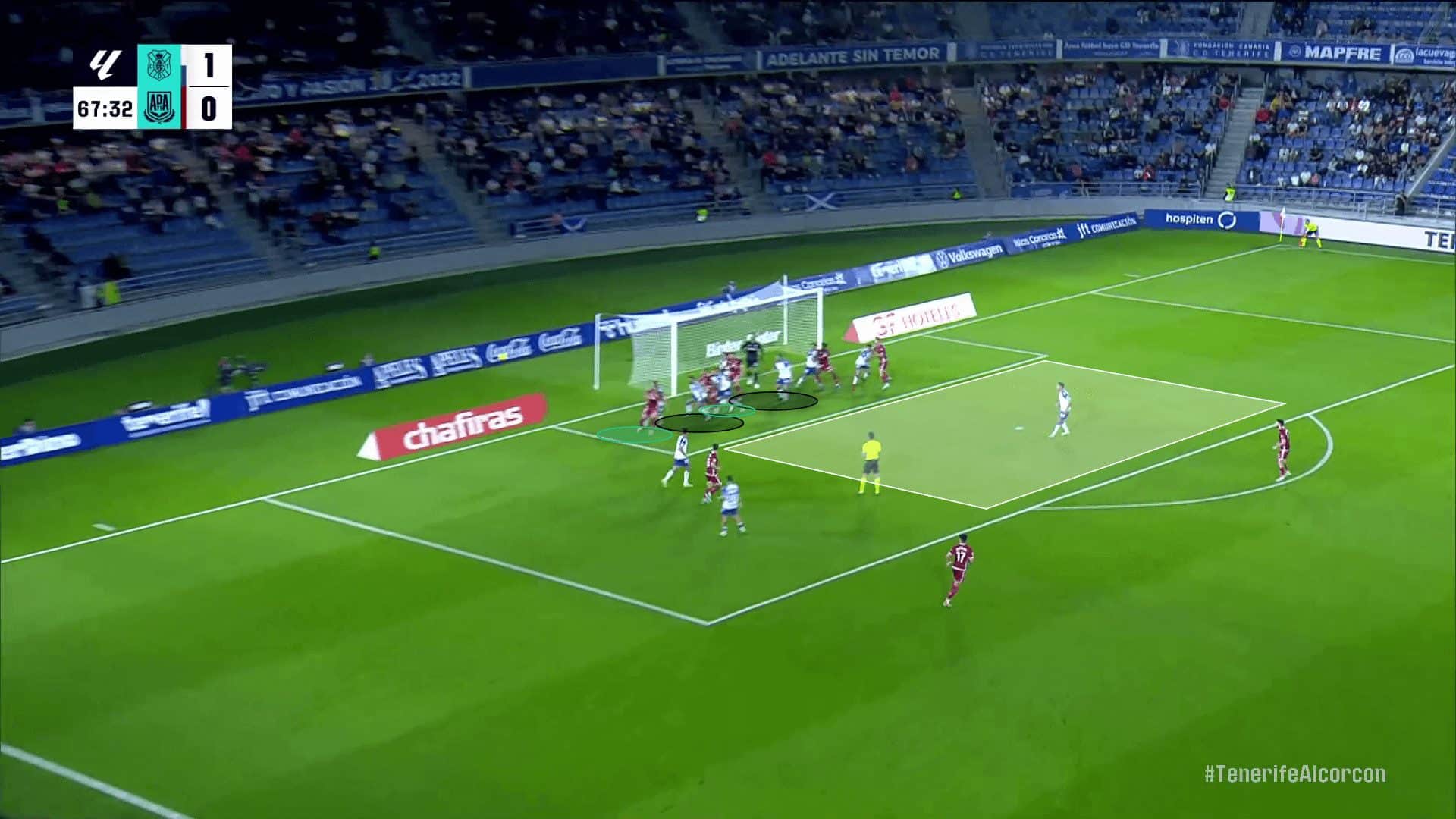
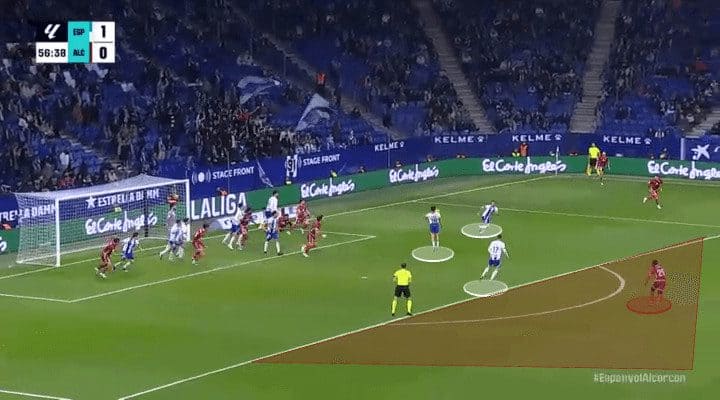
When attacking space inside the six-yard box, especially at the near post, all that is required is the smallest contact to take the ball into the back of the net. As a result, the priority should be for Alcorcón to ensure that they make that first contact. Of course, it isn’t easy to win headers inside the opposition’s six-yard box. Otherwise, every team would be attempting this, but Alcorcón can do more to increase the probability of getting that first crucial touch on the cross. As shown in the image below, the green areas highlight the areas that are occupied by red attacking shirts, whilst the black areas show where the defensive side is dominant.
The lack of attackers attacking the intended destination of the cross means that the delivery has to be perfect to be met by a red shirt. You cannot expect every cross to take the same path every time, so Alcorcón should increase the number of runs toward that near post to make sure they make that first contact, or alter the origin of the run, where players arriving in that area may have the advantage through their movement and momentum in the aerial duel. It is also an option to immobilise some of the defensive presence at the near post through screens.
Furthermore, Alcorcón are vulnerable to losing possession after the first contact due to the lack of players ready to collect the ball in the rebound zone in the white area below. Any ball which is headed away from the goal by a defender is likely to be picked up by the solo defender on the penalty spot. Reducing the distance between the players on the edge of the box and the goal can help increase the number of loose balls Alcorcón collect and create chances subsequently. At the same time, they still maintain one player slightly deeper to cover for the direct pass in behind should a player manage to clear the ball.
The lack of defensive cover on the edge of the box has been an issue this season, where Alcorcón is clearly struggling to sustain pressure on their opponents in the second phase. Some corners will inevitably be mishit, or attackers will lose out on aerial duels. Still, there should always be adequate cover in the rest defence, around the edge of the penalty area, to prevent the opposition from picking up the loose ball and relieving their team off the pressure by clearing the ball.
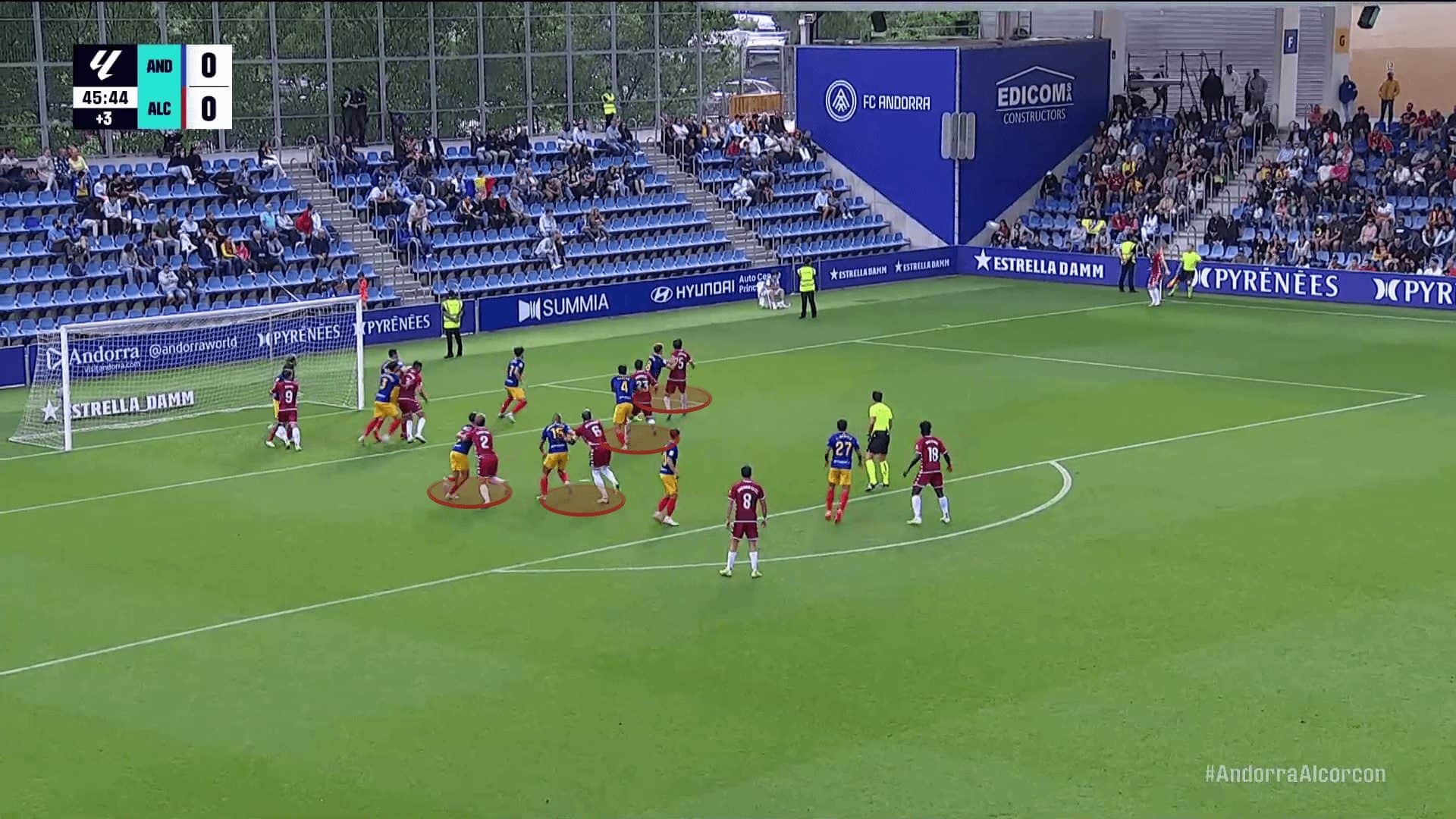
The issue with consistency lies in what happens between the attacking unit. As we can see here, there are four attackers highlighted, all attempting to win the aerial duel and score the goal themselves rather than creating an advantage for a teammate. Each player is in a battle for the ball when the ball will only reach one of the four players. In these instances, at least one of these attackers should take on the role of creating space for their teammates to allow them to attack the ball unopposed.
If Alcorcón can have clarity in knowing the rough path of the ball, it will help them achieve some sort of consistency where it is clear who is attacking the ball and who is attempting to create space, rather than all four attackers thinking the ball will be aimed towards them.
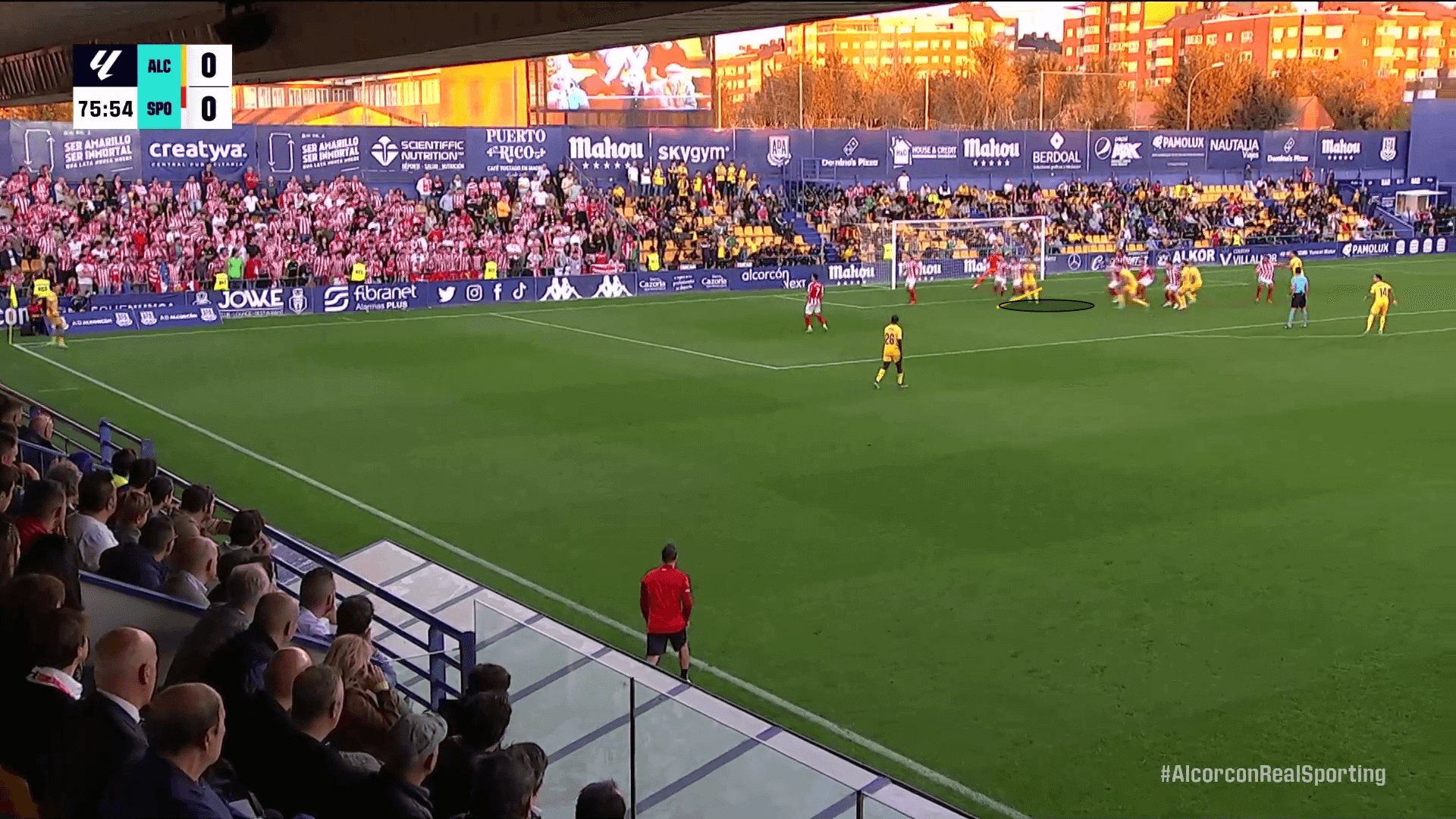
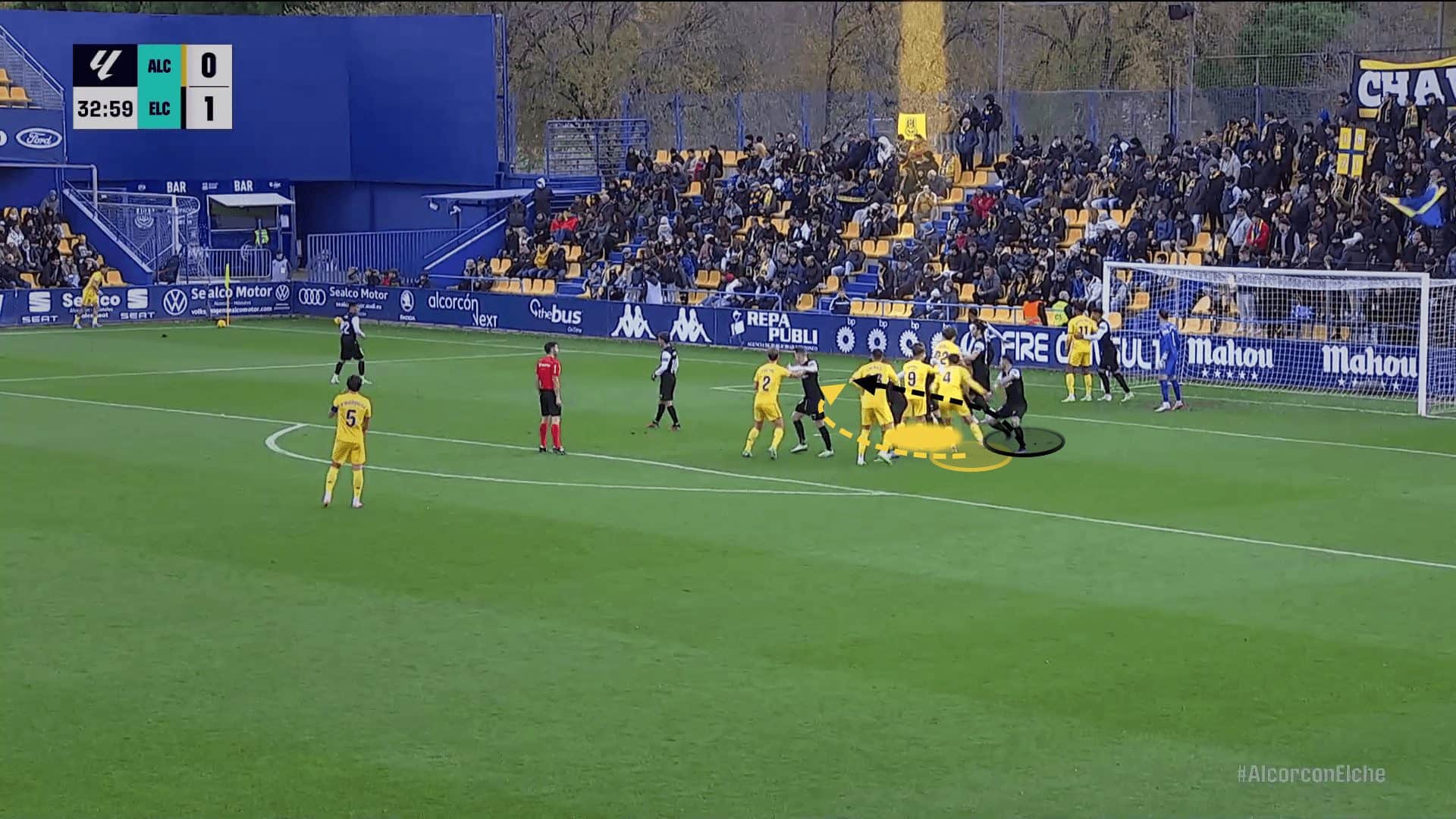
Another issue that Alcorcón have faced is their poor execution of screens and other types of movements to lose their marker. The image below shows an attacker in the yellow shirt using his teammate as an obstacle, forcing his marker to give up some space. The separation is created. However, the area he is attempting to target, inside the six-yard box, is actually closer to the defender.
This means that although he has created space for himself, due to the angle of his movement and starting position, the attacker must take an awkward route into the six-yard box, giving his marker plenty of time to recover his position. In the future, the movement away from a marker should also be simultaneously made towards the space in order to arrive in the space without the defender having time to make up lost ground.
Another error in the execution of the screen lies in the orientation of the screen-setter. When setting a screen, you must recognise the purpose of it. A screen can be designed to prevent a defender from reaching his opponent. However, a screen can also be used in order to prevent a defender from reaching a certain space.
This second purpose is most commonly used in those deep attacking units, where an attacker is aiming to reach a certain space before his respective marker. The image below shows that both the attacker and defender are trying to reach the near side of the six-yard box.
The screen on the defender should be made at such an angle that the attacker is in the way of the defender from reaching the space by blocking the path. However, instead of blocking the path to the space, the screen-setter blocks the path from the defender to his marker. This gives the defender a direct path to the space which he knows the attacker wants to target, meaning they can arrive in that space almost at the same time.
If the defender’s path was blocked, the additional steps that would have to be taken around the screen to evade it would give the attacker an extra couple of crucial seconds, where he could attack the ball unopposed.

Summary
This set-piece analysis has demonstrated why having clarity amongst the entire team during corner kicks is vital. When every member of the team is on the same wavelength and all know where the cross is heading and who should be the recipient, they can all support each other to create space in the intended target area for the intended target player to take an easy shot on goal.
However, the lack of clarity has meant that Alcorcón have often struggled from set plays due to the space they want to attack being crowded. Even in the instances where an Alcorcón player may have managed to win a header, they have often been tightly marked by a defender due to Alcorcón’s attacking unit not being prepared and not knowing which attacker the cross is heading to and who should set a screen.
