
For some time now, the name Patricio Pacífico has been circulating by word of mouth among Uruguayan football fans.
Developed at Defensor Sporting, the left-footed centre-back had previously stood out in Uruguay’s youth national teams as one of the most promising players of the 2006 generation.
Identified as part of a new wave of centre-backs capable of orchestrating build-up play from the back, manipulating opposition pressure and assuming responsibility on the ball, Pacífico took a clear step forward during the 2025 season in the top division.
His competitive pathway is not recent.
In 2023, he took part in the U17 South American Championship, sharing a generation with names such as Thiago Helguera and Gonzalo Petit, and made his professional debut a year later during the 2024 Apertura Tournament under Martín Varini, whose interview with Total Football Analysis you can read here.
In that initial context, Pacífico mainly operated as the third centre-back during the build-up phase, integrating 3+2 and 3+1 structures, where his role as a first passer was key to attracting and overcoming the opponent’s first line of pressure.
Although he accumulated close to 1,000 minutes during his first season as a professional, it was in 2025 when he managed to establish himself as a regular starter, especially during the second half of the Clausura Tournament.
A trajectory that included a pause due to his participation in the U20 South American Championship with the Uruguayan national team, an experience that delayed his continuity at the start of the year but also added new layers to his competitive development.
Under the guidance of Ignacio Ithurralde, his role underwent a significant transformation.
The coach chose to reinterpret his profile, recognizing that he is still in a developmental phase before settling definitively as a centre-back.
Favoured by his aerobic capacity, technical reliability, and ability to overcome pressure, Pacífico has mainly featured as a classic left-back, with freedom to move laterally at lower heights and sustained influence during the build-up phase.
This Patricio Pacífico scout report aims to break down his current game, analyse the implications of this positional reconversion, and explain why, beyond his present role on the flank, Patricio Pacífico’s near future seems destined to develop once again on the inside, as a centre-back.
Patricio Pacífico On-Ball Influence
Patricio Pacífico’s main on-ball virtue does not lie solely in his technical quality, but in the clarity with which he interprets every action within the collective context.
His background as a centre-back is reflected in a mature relationship with the ball, where passing, body orientation, and prior scanning appear as parts of a single gesture.
Patricio Pacífico Body Orientation
One of the most consistent traits of his game is his use of an open body shape to gain time and advantage.
Pacífico rarely receives with his back to play: he orients his first touch towards free space or the next passing lane, allowing him to reduce the number of touches required to execute.
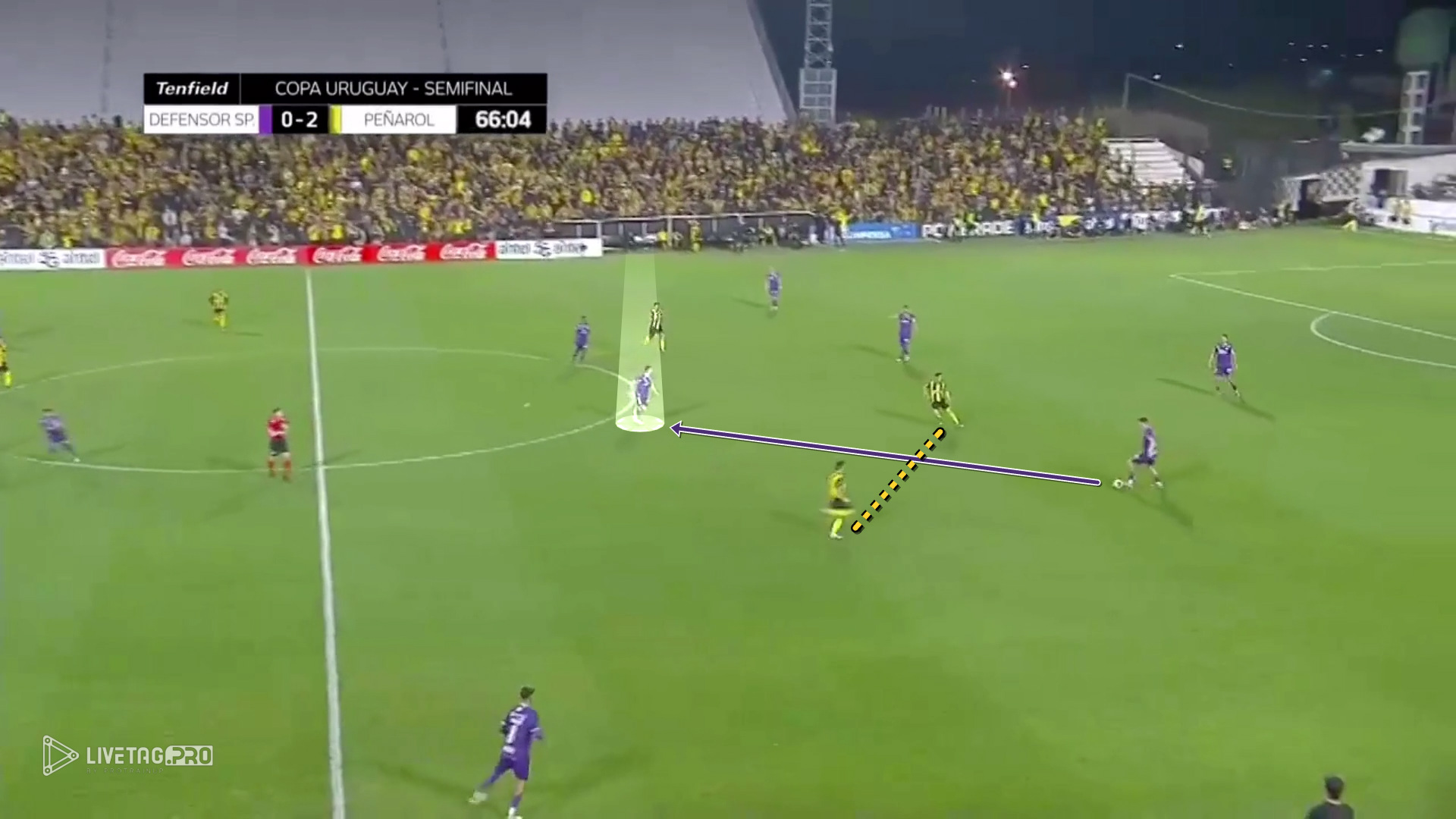
This is supported by sound receiving technique, opening and arcing the body to increase his field of vision and expand the range of possible passing angles.
This technical detail has a direct impact on the tempo of circulation.
By not requiring long pauses to adjust his body, he accelerates ball progression and prevents the opponent from resetting their block after the first pass.
In build-up structures, this ability is key to sustaining clean progressions even against mid- or high-pressing.
Likewise, in settled attacks, it becomes vital to switch play towards the weak side when he is positioned at the base, successfully forcing the opponent to shift laterally.
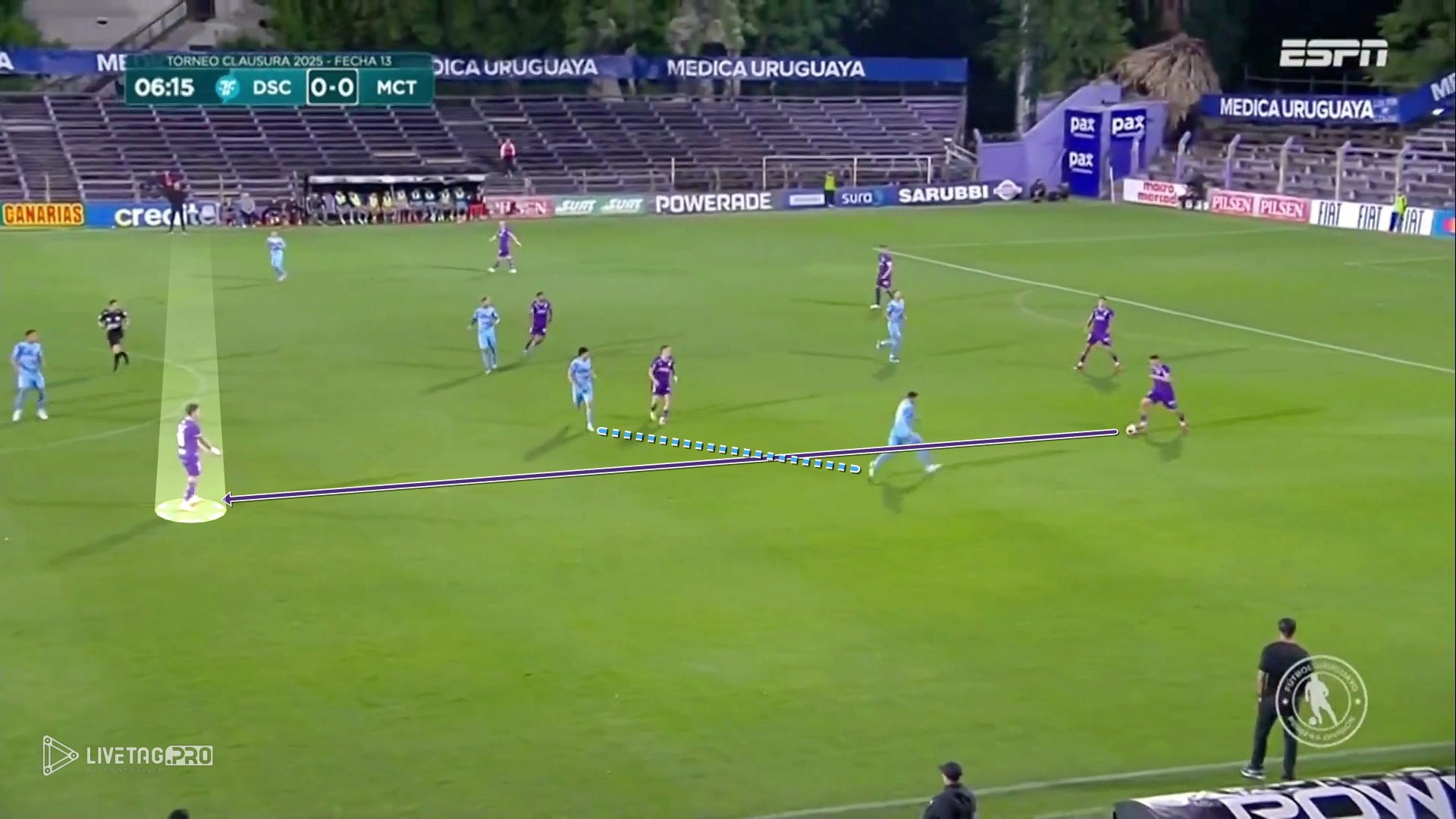
From left-back, he does not limit himself to acting as a simple wide support.
He manages a wide range of passing angles, both forward and inside, allowing him to adapt to different attacking structures, whether receiving in width or from pivot-like positions.
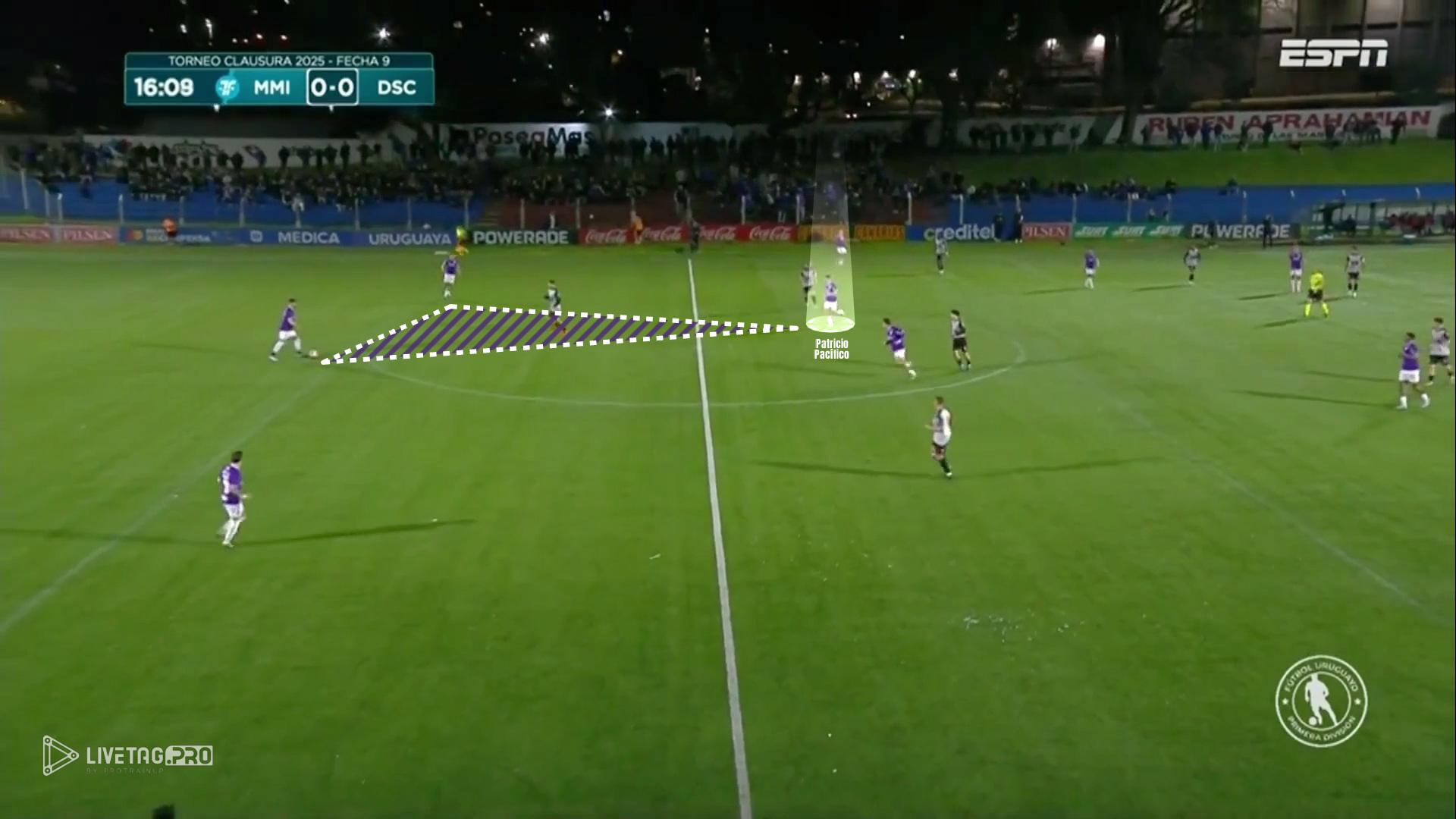
His environmental awareness, supported by prior scanning, enables him to identify the positioning of midfielders behind the first line of pressure.
When the context allows, he is capable of threading low, line-breaking passes over short and medium distances, breaking the first or second opposition line without forced gestures.
This ability to re-enter the game inside from the flank reinforces the idea of a full-back who does not act as a mere endpoint of the sequence, but rather as an active link in construction.
Beyond accuracy, Pacífico understands passing as a way of manipulating opposition pressure.
In build-up, he knows how to attract the opposing winger or interior midfielder before releasing the ball at the right moment, finding the free teammate behind them.
This behaviour was already evident during his time as a third centre-back in 3+2 or 3+1 structures, where he acted as the first passer tasked with conditioning the opponent’s pressing jump.
His shift to full-back has not diluted this function; on the contrary, it has relocated it to a lane from which he can generate new progression lines.
Patricio Pacífico Carrying Under Pressure
When passing lanes are closed, or the opponent presses in a disorganised manner (such as an even-to-odd pressing jump), Pacífico incorporates ball carrying as a complementary resource.
His strong lower body allows him to protect the ball and absorb contact, while his coordination and balance enable him to advance without losing stability.
These carries are not aimed at individual display, but at fixing opponents and buying time for the team to reorganise its attacking structure.
By attracting markers, he frees teammates in interior zones or creates temporary advantages that can be exploited with the next pass.
Overall, his on-ball performance as a left-back reinforces the idea that this role functions as a developmental platform rather than a final destination.
Pacífico not only fulfils the specific demands of the position but also transfers the principles typical of the modern centre-back to the flank: reading the game, pausing, body orientation, and decision-making under pressure.
Far from distancing him from the centre of the game, his current position allows him to intervene from different lanes and enrich his understanding of attacking dynamics.
An experience that, in the future, may prove decisive for his return to the heart of the defence with a more complete skill set.
Patricio Pacífico Off-Ball Influence
If the role of left-back has served to expand Patricio Pacífico’s on-ball influence, it has also represented a key defensive learning space, especially in contexts far from the penalty area.
Defending on the flank demands a different type of reading than that of the classic centre-back: greater exposure, more ground to cover, and constant decision-making in open spaces.
Patricio Pacífico Defending On The Front Foot
One of the main differences between centre-back and full-back lies in the type of duels they must face.
On the flank, Pacífico is forced to defend on the front foot, with his body oriented towards the opponent’s half and with less immediate cover behind him.
In this context, he shows good ability to adjust his distance to the ball-carrier, to delay when necessary, and to select the right moment to step in.
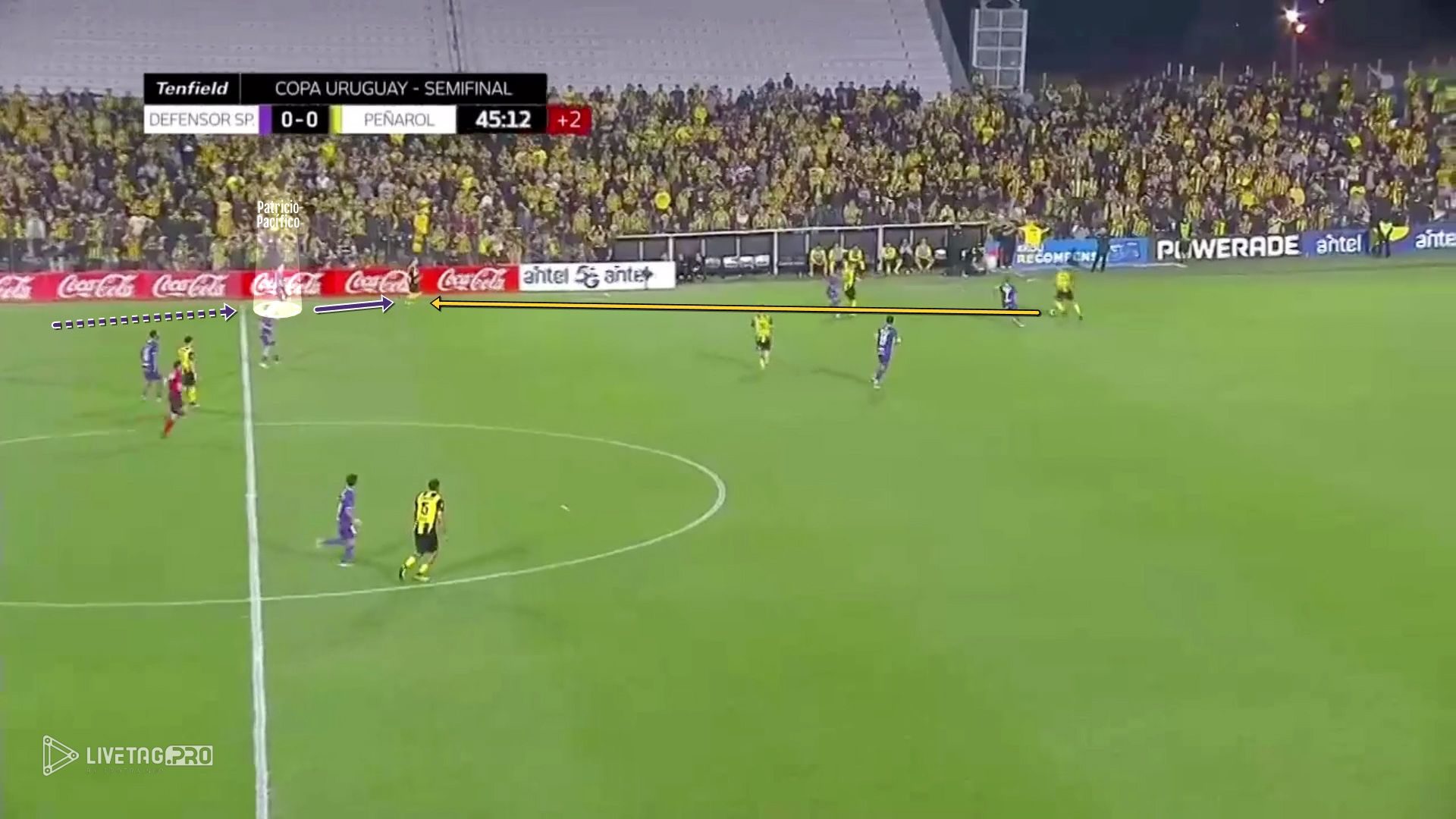
He does not tend to rush into tackles: he prioritises closing progression lanes and guiding the opponent towards less dangerous areas, waiting for support from the winger or interior midfielder on his side.
This behaviour reveals a growing understanding of defensive timing, a fundamental quality for any defender aiming to compete in high defensive lines.
Patricio Pacífico 1-v-1: Stance, Profiling & Body Control
In 1-v-1 situations, Pacífico displays a balanced defensive stance, with a solid base of support and a body profile that allows him to react to changes of pace or direction.
He avoids exaggerated movements and prioritises economical turns, remaining stable even when the opponent attempts to beat him with short feints.
This economy of movement reduces the risk of losing balance and allows him to sustain the duel for longer, forcing the attacker into less favourable decisions.
His ability to quickly reprofile himself is one of the keys behind his reliability on the flank.
From a physical standpoint, his acceleration and top speed, both over short and long strides, expand his defensive margin for error.
These qualities allow him to recover ground, match the winger’s run, and avoid numerical inferiority in defensive transitions.
More importantly, they give him the ability to choose.
Pacífico does not rely exclusively on anticipation: he can delay, retreat, and close spaces without needing to risk an early tackle.
This spatial management is especially valuable in young full-backs, where the temptation to engage immediately is often high.
Patricio Pacífico Defending The Box
The only question that remains is his continuity when defending frontally and inside the penalty area.
His current role on the flank reduces the frequency with which he is exposed to these situations, making the sample necessarily partial.
However, when intervening from the weak side, positive indicators emerge.
Pacífico shows good spatial awareness, supported by prior scanning that allows him to identify references before the ball enters the box.
He tends to position himself intelligently to cover the far post, adjust marking assignments or close passing lanes on low crosses.
These actions suggest that his defensive reading inside the box is present, although it still requires continuity to consolidate and develop the automatisms specific to the centre-back role.
Conclusion
Patricio Pacífico’s trajectory throughout this season makes his spell at left-back less a circumstantial solution than a formative stage that has broadened his profile.
Far from diluting his strengths, the role on the flank enhanced his on-ball influence, exposed him to more open defensive contexts, and enriched his reading of the game.
From the flank, Pacífico transferred principles typical of the modern centre-back: open body shape, clarity in first-pass play, ability to manipulate pressure, and ball-carrying under pressure.
At the same time, defending far from the area allowed him to incorporate key resources to compete in high-defensive structures, such as delaying, managing 1-v-1s in open space, and making corrections in open field.
The question is no longer whether he can perform as a centre-back, but rather when and in what context that return will take place.
The technical, cognitive, and physical foundations are already in place; what remains is to consolidate continuity, defending frontally and inside the box, something that will only come with sustained minutes at the heart of the defence.
