
Manchester City defeated Crystal Palace 3-0 in Gameweek 16 of the 2025/2026 edition of the Premier League.
With a brace from Erling Haaland and a stunner from Phil Foden, the Cityzens secured the all-important points to maintain second place, as Aston Villa chase them with just a point difference.
The Eagles are not far behind, as they hold onto fifth position.
The scoreline, although disappointing for Palace, is not a fair reflection of what transpired in the game.
Oliver Glasner’s game plan largely neutralised the visitors’ approach.
Additionally, Man City faced considerable pressure from the hosts throughout.
However, Pep Guardiola’s side scored during crucial points in the fixture, which overturned the flow of the game.
Through this tactical analysis, we aim to examine how Crystal Palace caused problems for Manchester City, along with what the latter did well to turn the game in their favour.
Crystal Palace Vs Manchester City Lineups & Formations
Let us look at how Oliver Glasner and Pep Guardiola fielded their squads.

The hosts, Crystal Palace, played in a 3-4-2-1 formation.
Dean Henderson was in goal.
The back three were Chris Richards (right centre-back), Maxence Lacroix (central centre-back), and skipper Marc Guéhi (left centre-back).
Nathaniel Clyne (right) and Tyrick Mitchell (left) played as the wing-backs.
Clyne was replaced by Christantus Uche at the 77th minute.
Adam Wharton and Daichi Kamada played as the centre-midfielders.
Kamada made way for Will Hughes after 67 minutes.
Yéremy Pino and Ismaïla Sarr played as the two attacking midfielders, right behind Jean-Philippe Mateta (striker).
Edward Nketiah substituted Mateta at the 63rd minute.
The visitors, Manchester City, played in a 4-3-2-1 formation.
Gianluigi Donnarumma started between the sticks, behind a back four of Matheus Nunes (right-back), Rúben Dias (right centre-back), Joško Gvardiol (left centre-back), and Nico O’Reilly (left-back).
Rayan Aït-Nouri came on for O’Reilly (90’+1).
Nico González played as the pivot.
Skipper Bernardo Silva and Tijjani Reijnders played as the centre-midfielders, and were replaced by Rico Lewis (90’+1) and Savinho (85′) respectively.
Rayan Cherki and Phil Foden played as the two attackers alongside Erling Haaland (striker).
Omar Marmoush came on for Haaland (90’+1).
Crystal Palace Attacking Tactics
The hosts displayed a healthy blend of short build-up and direct play to create chances.
Crystal Palace execute a rapid build-up to escape pressure.
They move the ball from the left wide channel to the left half-space, where Pino receives inside a pocket and moves it to Wharton in the central channel.
The Englishman opens up to shift play by finding Clyne in the right wide channel, before getting on the ball himself once he moves to the right half-space.
At this moment, Sarr makes a blind side run along Man City’s last line to receive a through ball in-behind.
These collective actions of attracting opponents to one side before making a quick switch of play opened up spaces for Crystal Palace, which they capitalised on and caused problems.
They continued to threaten during the second half as well.
Glasner’s side find an in-to-out pass from the right wide channel in the defensive third.
Once multiple opponents are drawn to one side, they quickly execute angled passes to shift play, as they eventually find their far-side winger in space.
Through this build-up, they get a cross into the penalty area, which ends up in a shot.
In multiple situations, Man City left space between their lines of pressure, which Palace exploited.
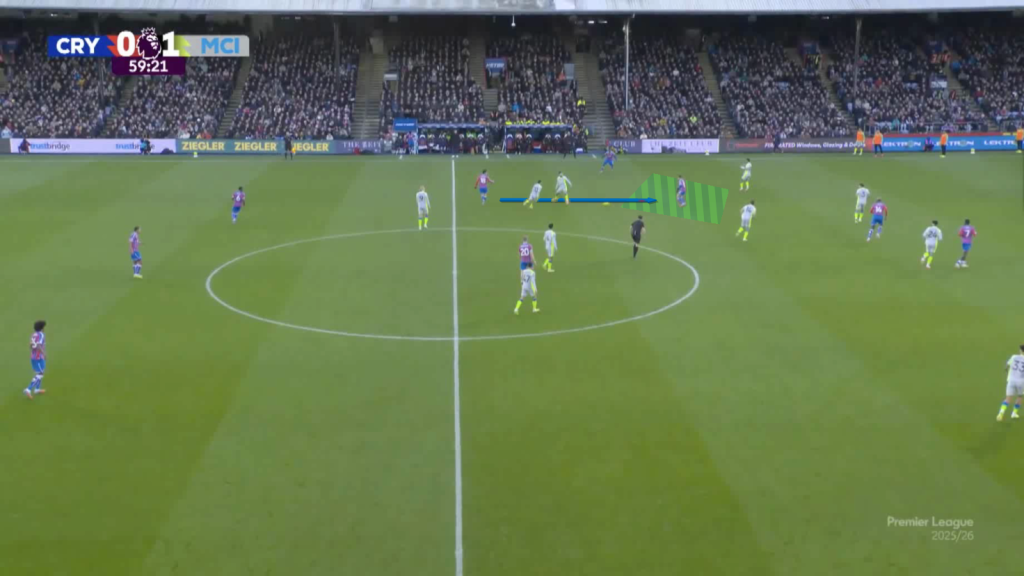
The visitors leave the half-space in the midfield third unattended.
Palace are quick to play a line-breaking pass to find a player inside the pocket.
This results in the ball reaching the attacking third in the next few moments.
Realising these patterns, the City defenders were at times seen jumping to put pressure on the Palace players receiving between the lines.
However, Crystal Palace were a step ahead: they played quick third-man passes to get the ball away from blind side pressure.
The space left behind by the aggressive City defenders was exploited by runners in-behind.
In this case, Mateta makes the diagonal in-behind run, meeting the through pass.
These chances came from dynamic build-up scenarios as well as from winning the ball high up the pitch.
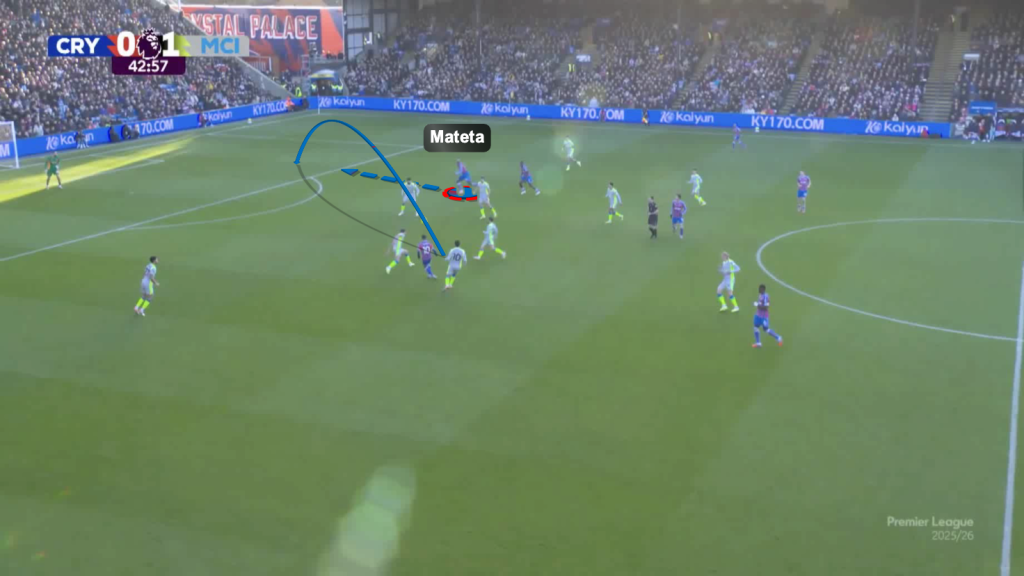
Man City get dispossessed in their own half.
This is quickly exploited by Crystal Palace, as Pino plays a chipped through pass for the run of Mateta.
With these chances coming frequently for Glasner’s side, they maintained a considerable amount of pressure till the time City scored the opener.
The only aspect missing for the Eagles was the finishing touch.
There were situations where Palace took the direct approach, playing over the top passes to find penetration.
Lacroix finds Wharton behind the first line of pressure; the midfielder plays a chipped through ball from the midfield third.
With Yéremy Pino getting on the end of it, City conceded another chance, as the Spaniard hit the crossbar on that occasion.
Crystal Palace Defending Tactics
Knowing how Man City can hurt unorganised sides defensively, the hosts gave them adequate respect by staying compact and disciplined.
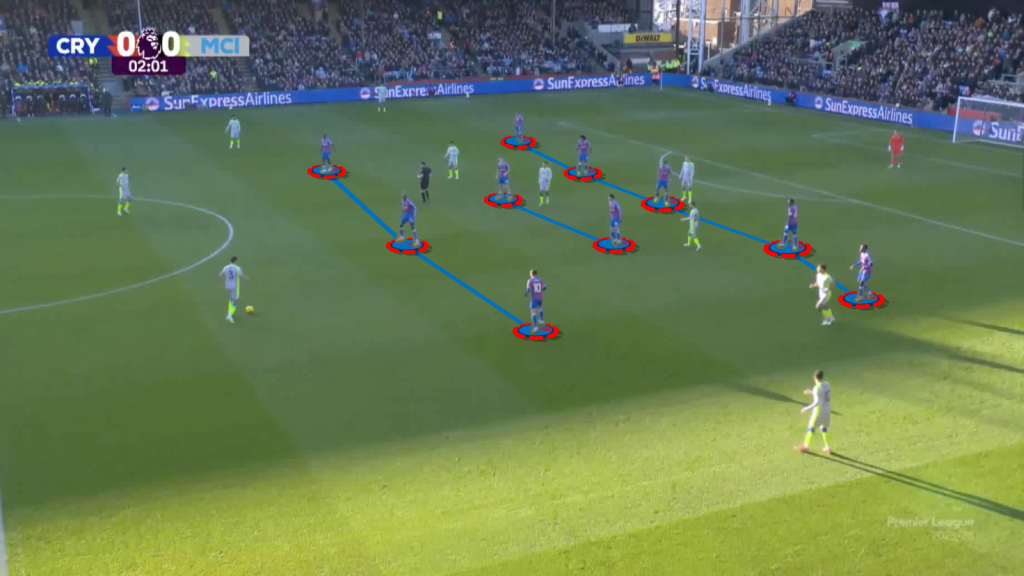
They defended in a 5-2-3 shape for the most part: the wing-backs dropped into the back line to make a back five; meanwhile, the attacking midfielders stayed alongside the striker to make a front three.
The shape saw some changes time and again, altering into a 5-4-1 when the centre-midfielders required more cover.
The defensive effort from the central players was commendable, as they made sure to shut down most of the vertical passes in the central channel, with the cover extending to the half-spaces at times.
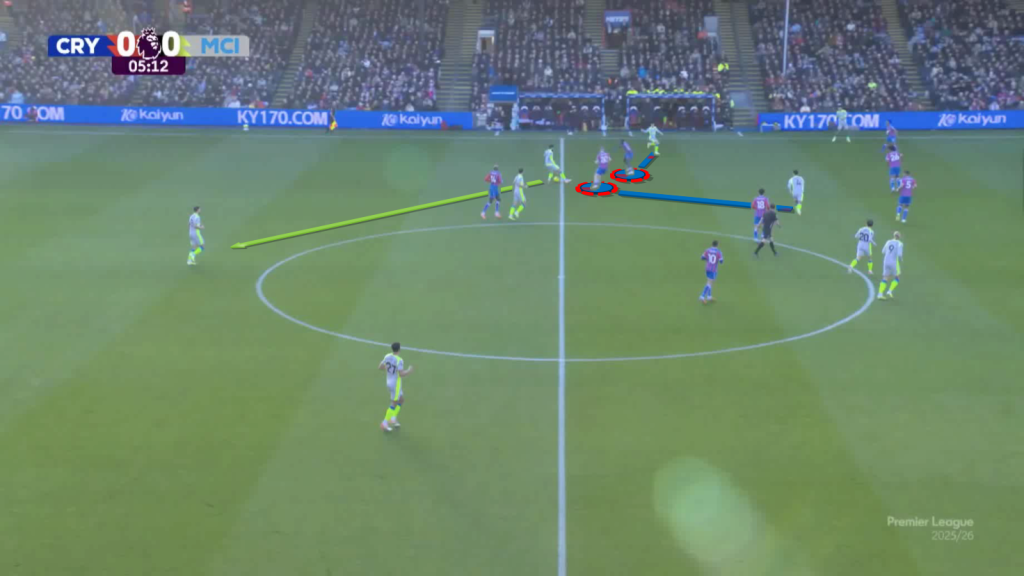
Man City attempt to find progression down the left half-space.
However, the Crystal Palace players in the vicinity step up, cutting out vertical options.
Guardiola’s side are forced to go backwards.
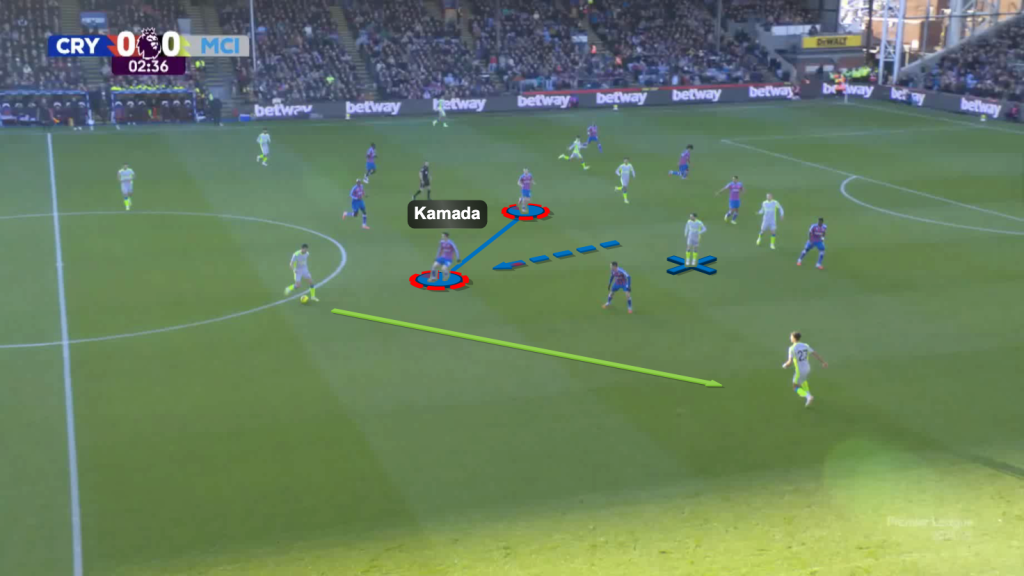
Within their 5-2-3 shape, Kamada steps up as the ball comes to the central channel.
This action from the Japanese blocks the passing lane to Cherki in this particular situation.
Meanwhile, Wharton slides across to stay connected; he gets into a covering position, minimising the possibility of City playing a line-breaking pass.
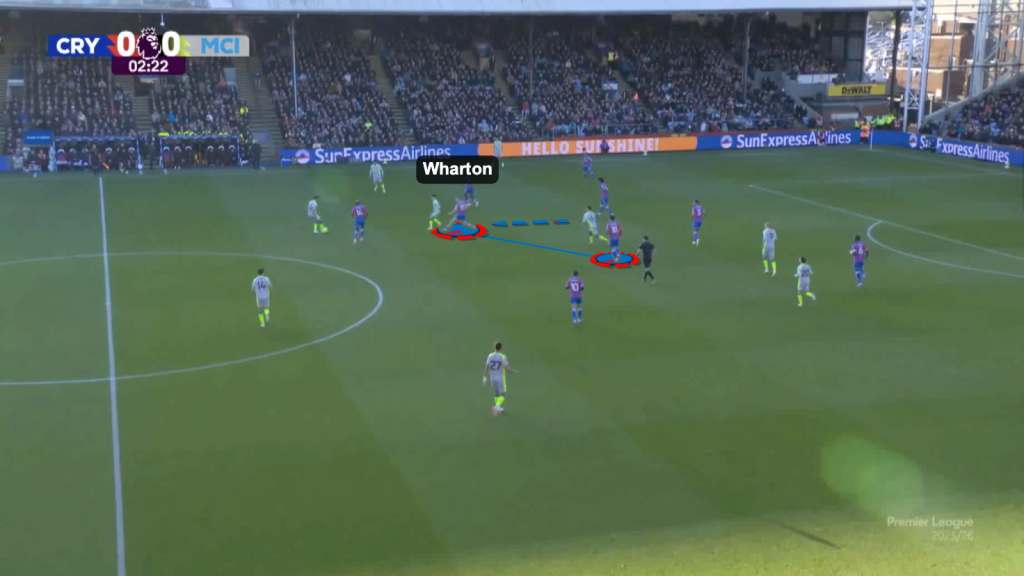
In a similar situation on the other side, Wharton steps up to stay tight to a City midfielder attempting to receive in the central channel.
Meanwhile, Kamada slides across to stick close to the City player lurking in Wharton’s blind side.
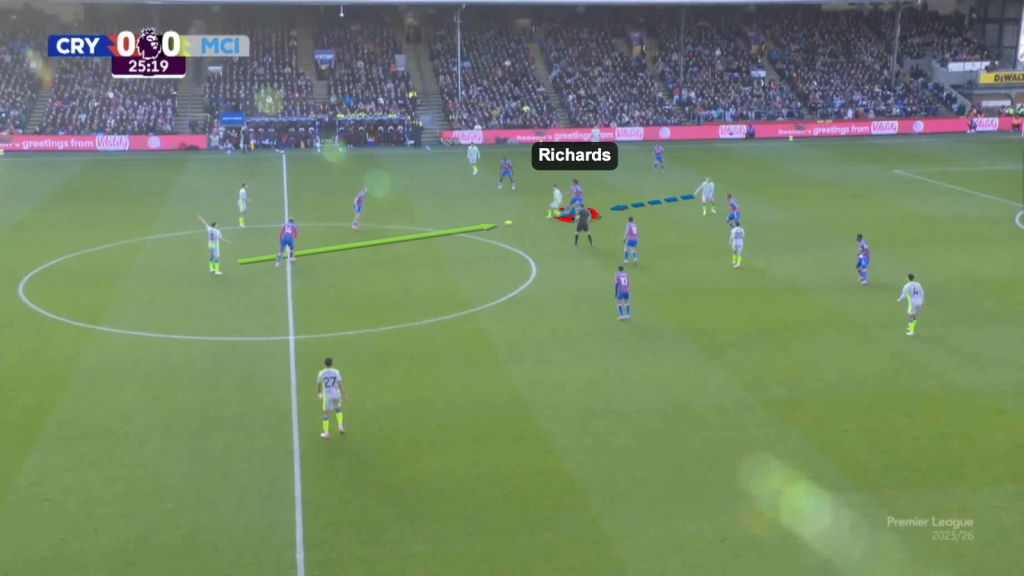
Foden frequently attempted to receive the ball in the half-space.
However, Richards made sure to keep him out by stepping up whenever the Englishman received between the lines on his side.
Foden was either forced to play it backwards or misplaced the pass.
The impact is reflected by the number of times he was dispossessed (16).
Apart from stepping out of position to close down opponents, the Palace players also moved horizontally to make interceptions.
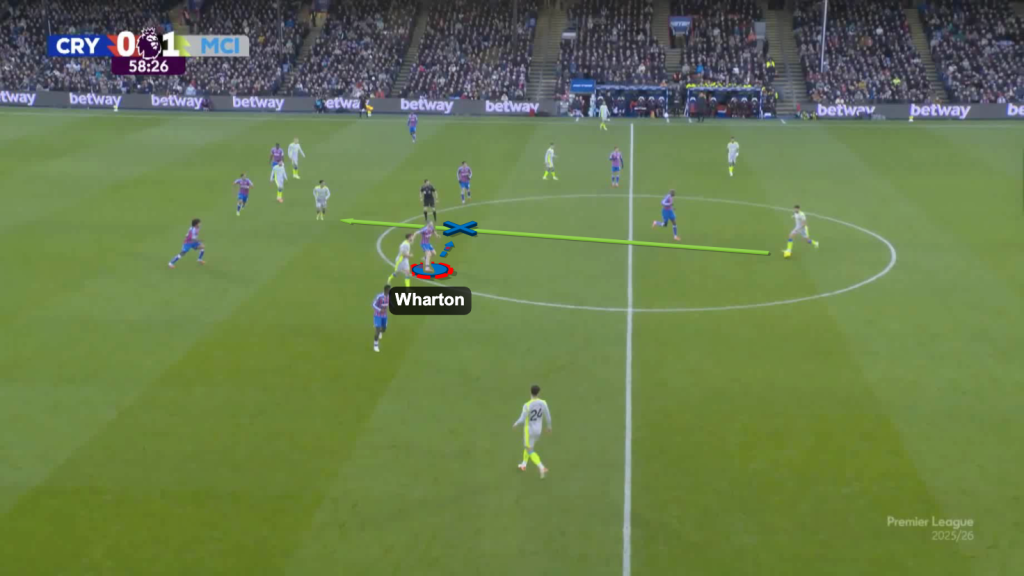
Wharton anticipates a vertical pass from the Man City defender.
He immediately changes direction and shuffles laterally to cut out the pass.
This gives way to a counterattack from the mid-third for the hosts.
With individual defensive actions being prominent, Palace’s group defensive actions also made a lot of difference with regard to putting pressure on their opponents.
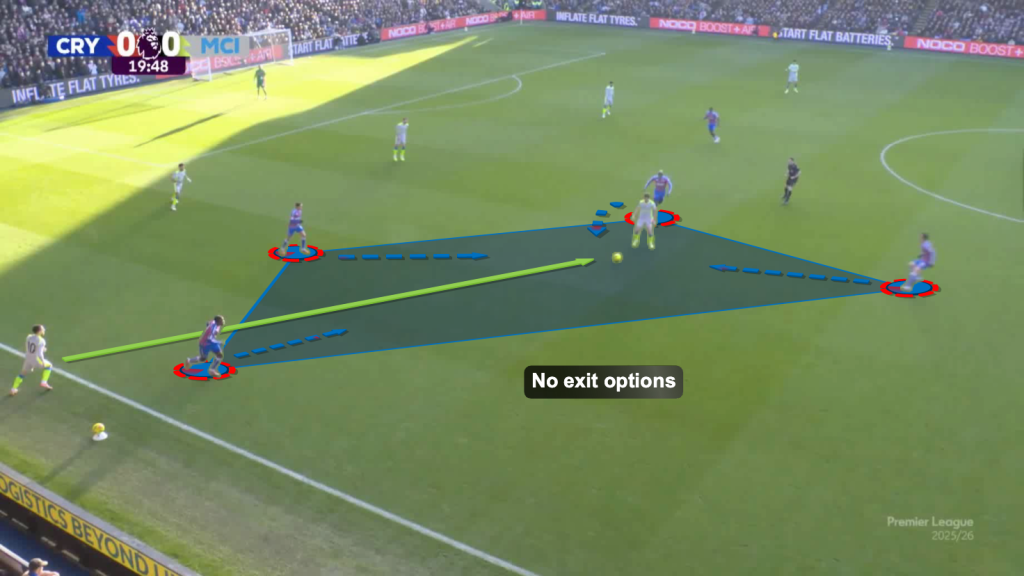
Often, when City attempted to find inside passes, the Crystal Palace players applied pressure from multiple directions, cutting off exit pass options.
This resulted in Man City losing possession within their own half, sometimes even inside their own defensive third.
Palace generated some quick attacks through these defensive actions, resulting in box entries.
They made a total of 40 final third entries, a majority of which were swift attacks after regaining the ball.
However, they were unfortunate not to convert.
A significant part of Palace’s defensive success was their ability to direct Man City’s play through their pressure.
They often forced play to one side by the players curving their pressing run.
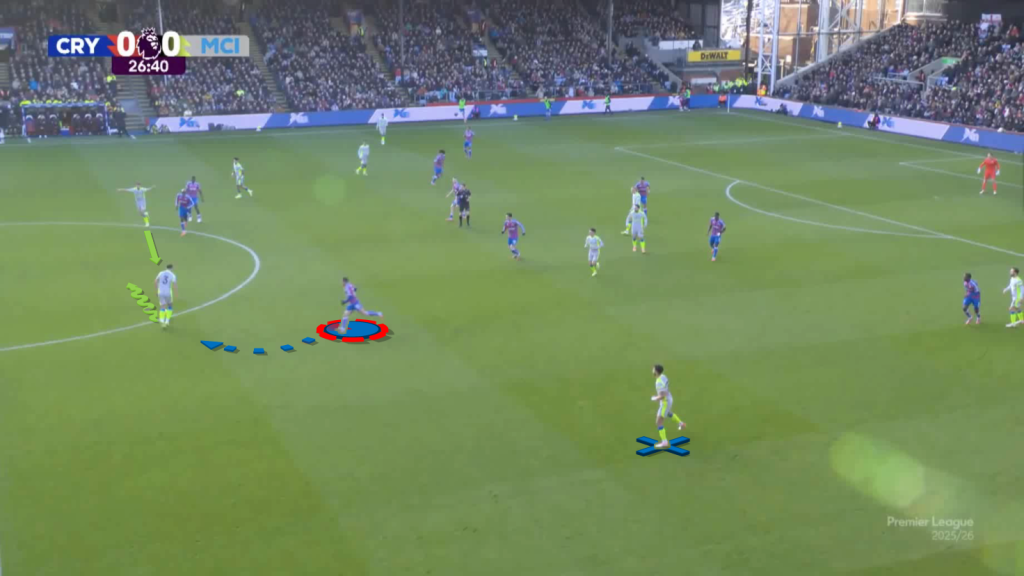
Here, City attempt to shift play to the right wide channel.
However, a Palace player steps up, curving his press from the opponent’s blind side.
This forces him to go back to the same side.
Manchester City Strengths Vs Crystal Palace
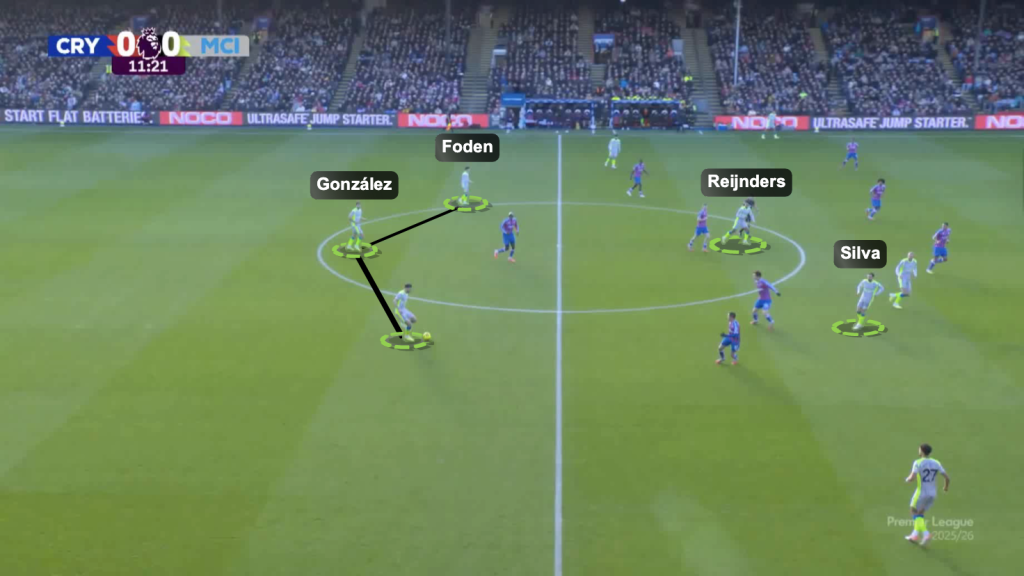
Man City played with five midfielders, namely González, Foden, Reijnders, Silva, and Cherki.
This meant they had multiple options inside the opponent’s structure.
Their objective was to exploit pockets of space between the lines.
However, with Palace’s compact shape, it became a tedious task.
González spent most of his time tucked in as the third centre-back, dictating play from deep.
Meanwhile, Foden and Silva were seen dropping outside the structure frequently.
This gave City more stability in the build-up and, in turn, enabled them to control the tempo.
Since Palace did not allow the visitors to find vertical passes in the central zone, they had to either go around the defensive block or over it.
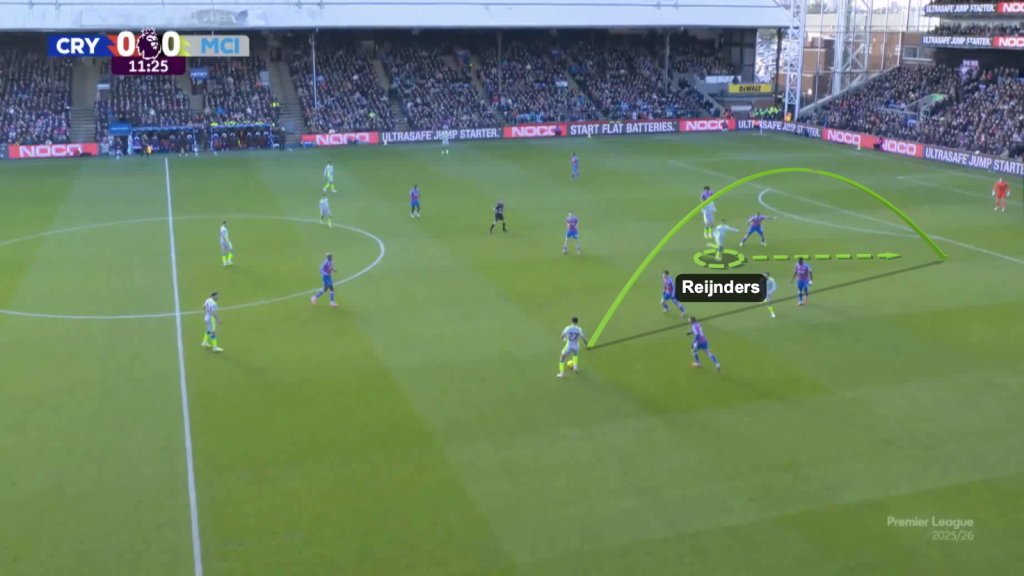
Since Haaland was closely followed, Reijnders’ making diagonal runs in-behind gave City a chance to attack depth.
Chipped through balls helped as the Dutchman met the passes with in-to-out runs.
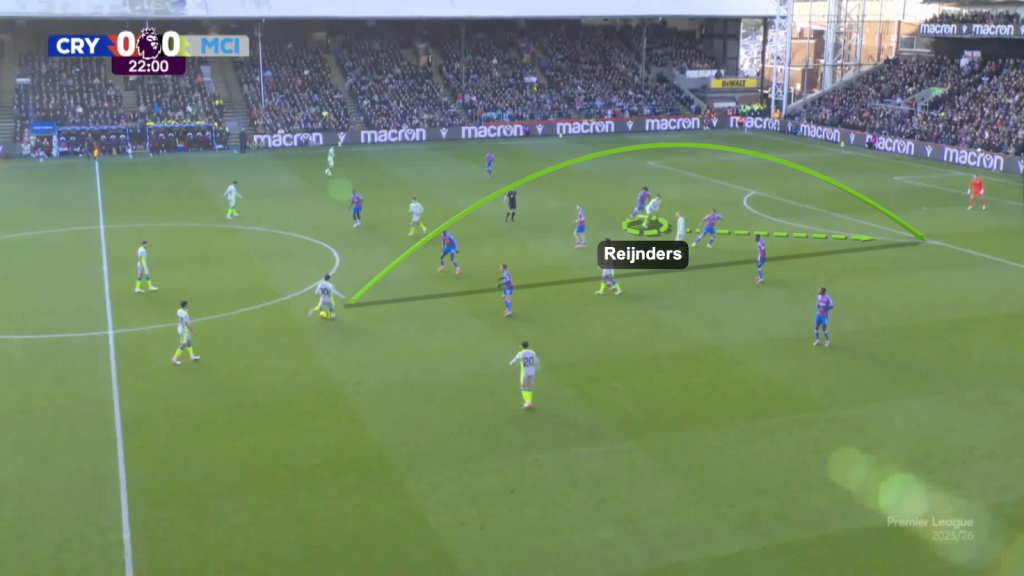
To play these chipped through passes, the passer had to drop outside the opponent’s structure.
Making blind side runs right next to the defender who was marking Haaland gave Reijnders enough of a head start.
Apart from over-the-top passes, City also explored the opportunities to cross from the wide channel and half-spaces.
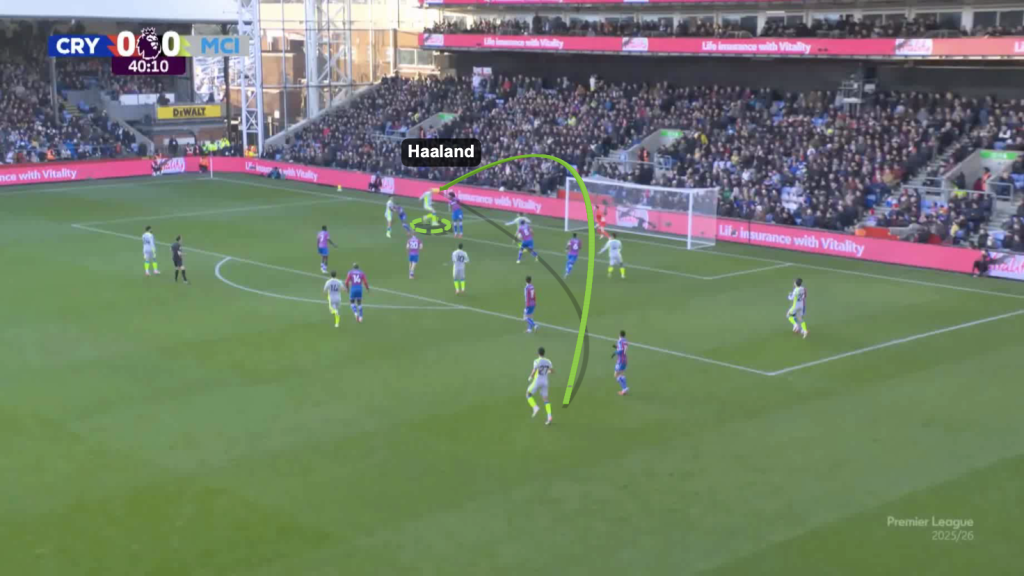
Haaland’s opener came from a cross from the edge of the box.
The Norwegian did well to peel off onto the blind side of Richards.
Gaining a yard of separation helped him get a free header.
The goal from Foden was a case of defensive lapse in concentration from Crystal Palace.
Both the centre-midfielders were dragged out of position.
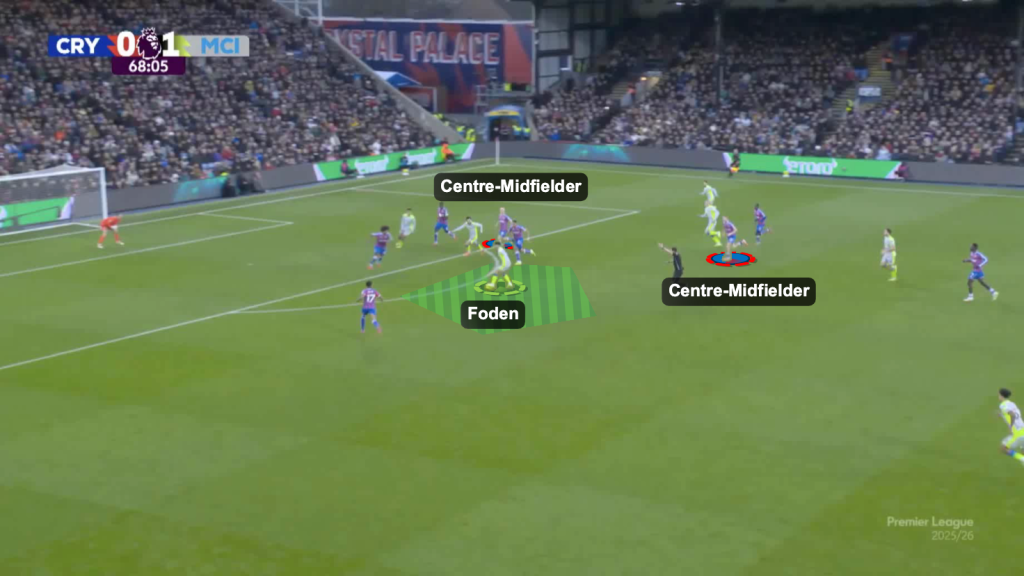
This gave the Englishman enough space in the zone-14 to set himself up for a comfortable finish.
In the image, it is visible how both the Palace centre-midfielders are out of position, giving Foden a few yards of space to work with.
Apart from these solutions to create chances in the attacking phase, Man City also relied on positive transitions to make final-third entries.
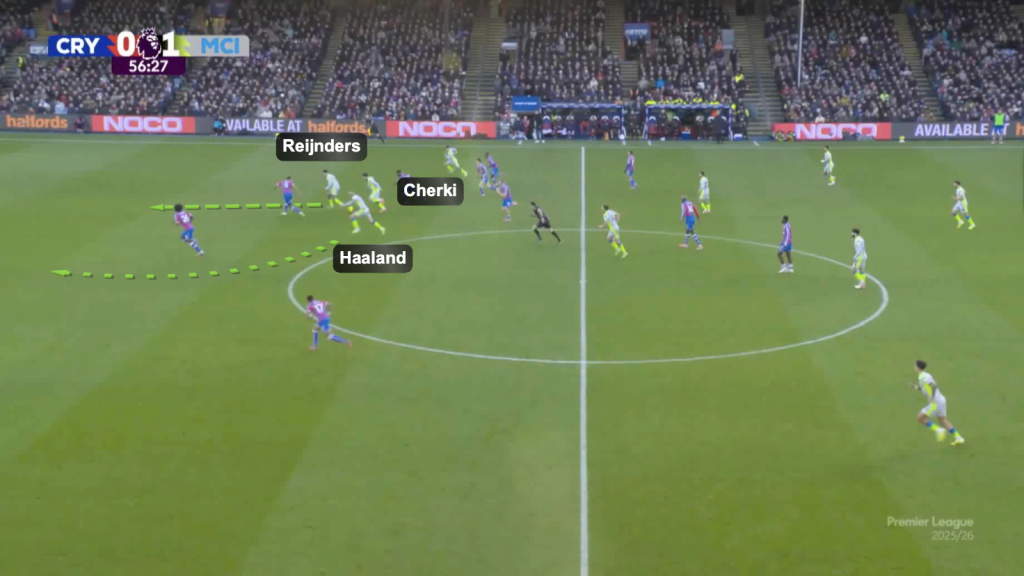
Man City are breaking forward, with Reijnders and Haaland making forward runs.
Cherki releases the Dutchman, who goes through on goal.
The base for the third goal came from a quick transition.
Palace’s set-piece was well defended by the visitors, after which Glasner’s side did poorly to win the second ball.
Savinho recognised the opportunity and pounced forward.
The deepest defender being stuck out of position did not help, as the Brazilian won a penalty while going around the goalkeeper.
Conclusion
Crystal Palace tactically outmanoeuvred Manchester City, closing down gaps and cutting out passing lanes with their compactness and positional discipline.
They also generated quick attacks frequently, which put a huge amount of pressure on Pep Guardiola’s side.
However, they lacked the finishing touch, which mounted pressure on them.
Eventually, Man City managed to pick out their goals by exploiting the underlying weaknesses in Palace’s defence.
Although they struggled in this game, Man City found ways to advance and penetrate.
They either went around the defensive block to put crosses in, or went over the pressure to find runners in-behind.
Crystal Palace’s failure reflects lapses in concentration defensively and a lack of clinicality in front of goal.
Meanwhile, Manchester City’s success reflects their pragmatism, problem-solving, and ruthlessness in front of goal.
