
People often obsess over formations and forget that it is the personnel and the actions behind the structure that determine whether a formation becomes functional or not.
The numbers on paper are just a base or a reference point.
What matters is how the system breathes, how players interpret their zones, and how the manager manipulates space.
Inside them are principles of width, depth, and relational spacing.
A three-at-the-back shape can be expansive, hard to break down, or transitional, depending on those human decisions.
Oliver Glasner and Ruben Amorim both favour a three-at-the-back system, but their executions are completely different.
Oliver Glasner Crystal Palace expands, accelerates, and adapts; Ruben Amorim Manchester United compresses, slows, and suffocates.
The same design, the same backbone, but drastically different outcomes.
This tactical football analysis will aim to dissect both models, their mechanics, their logic, and their failures.
The 3-4-2-1 Structural Blueprint
Both managers build around a back three, two wing-backs, a double pivot, and two inside forwards behind a central striker.
However, Glasner’s 3-4-2-1 is an expanding system, while Ruben Amorim’s is a contracting one.
Oliver Glasner Expansion
Oliver Glasner’s Palace builds through a 3+1 structure with three central defenders plus Dean Henderson, who steps into the line as an auxiliary centre-back.
Centre-backs Maxence Lacroix, Marc Guehi, and Chris Richards split wide, inviting the press, while Henderson becomes the spare man.
As shown in their home win versus Liverpool, Henderson steps out to create a numerical advantage (as well as making it easier) to build up and find a teammate centrally or out wide (i.e., the wing-backs).
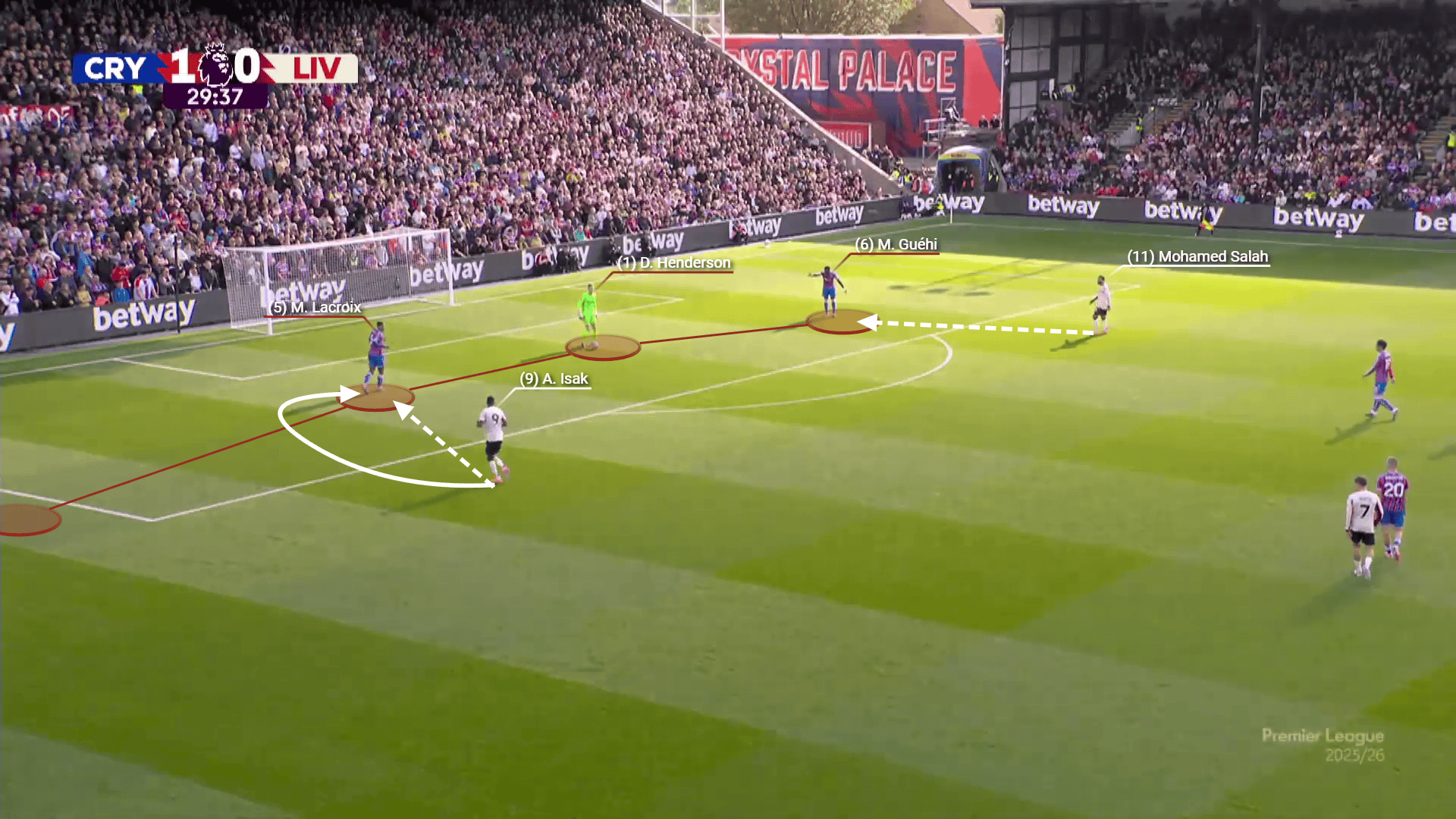
The wing-backs Daniel Munoz and Tyrick Mitchell push high and wide, giving the shape a lateral stretch.
This progression produces a 3-2-5 in possession, with three at the base, a pivot pair connecting centrally, and five across the top line.
Ruben Amorim Limitations
Ruben Amorim, by contrast, keeps his three centre-backs flat and deep.
Instead of widening or stepping forward, they remain close to each other in the same vertical channel.
Moreover, André Onana was instructed to play long rather than build up.
This immediately collapses the vertical length of the team.
His wing-backs, nominally the sources of width, are conservative.
The structure resembles a 5-2-3 in all phases, the third line maintaining defensive numbers rather than attacking angles.
The model compresses upon itself.
The first big difference is that Oliver Glasner is expanding to play forward, and Ruben Amorim is trying not to get beaten.
Build-Up & The First Phase
Oliver Glasner Build-Up
In Oliver Glasner’s build-up, Henderson’s role is important.
He forms a back four by splitting between or sliding behind the wide centre-backs, which cancels the first presser.
This allows Palace to draw pressure into wide zones and open central spaces.
When pressed, their wing-backs pin the opposition’s full-backs high, creating exit lanes into midfield for the two tens (Yeremy Pino, Ismaïla Sarr or Daichi Kamada).
From here, the structure builds fluidly through the lines.
Defenders find wing backs, who then combine inside with the tens, switching to isolate the opposite wing back at the far post.
Oliver Glasner’s first phase is deceptive in its security.
The three defenders are technically comfortable, but it is the goalkeeper as a spare man that keeps the spacing fluid and creates a plus-one advantage.
Ruben Amorim Disconnected Base
When Ruben Amorim instructs his middle centre-back (Harry Maguire or Matthijs de Ligt) to step into the top of the box at goal kicks, he creates a spare central figure above the first line.
In practice, it fails for profile reasons.
Maguire and de Ligt are not line-breaking carriers or press manipulators.
Their first touch invites rather than evades pressure.
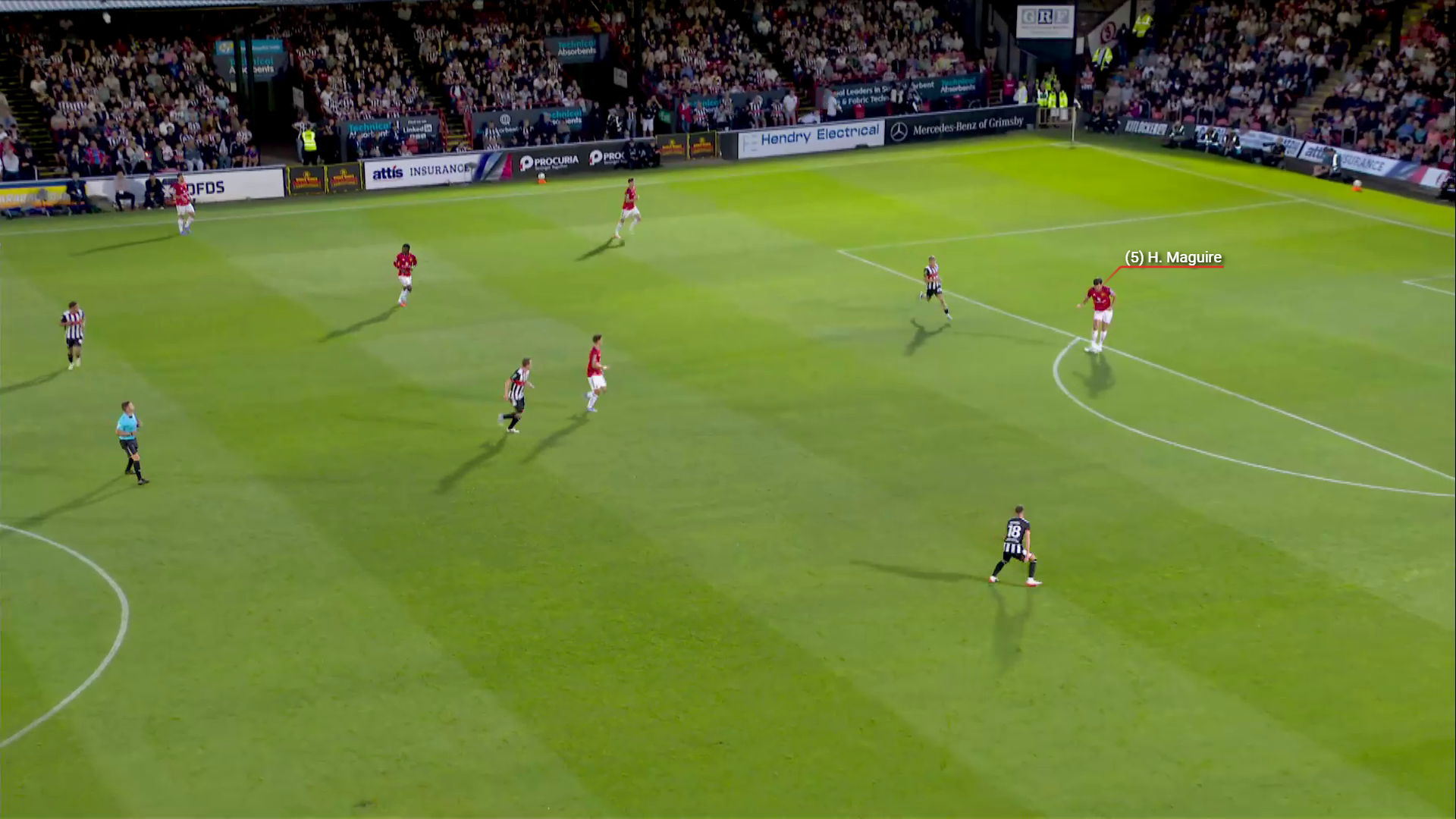
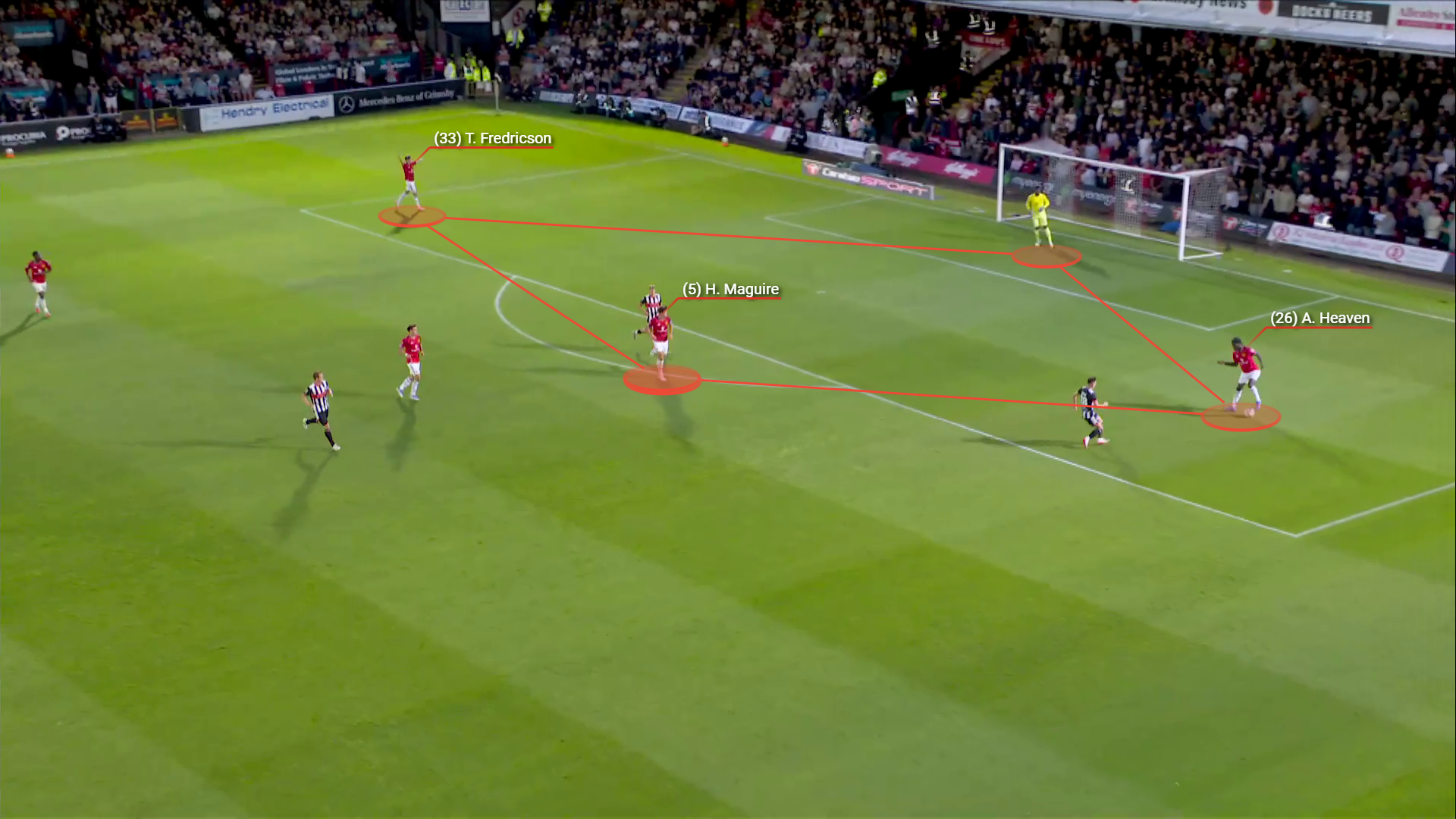
As shown in their Carabao Cup exit versus Grimsby Town, Maguire steps into midfield as the nominal inverter during United’s build-up.
However, his movement compounds the congestion rather than creating superiority.
With Grimsby Town maintaining an aggressive, narrow press, United’s central progression becomes restricted.
The pitch isn’t stretched horizontally, and all circulation channels remain inside the block.
That forces United into intricate combinations in the most crowded area of the field, a low-percentage approach under pressure.
The entire cycle stems from Maguire’s inversion, which reduces the width in the first line instead of generating a new free man, which then leads to a turnover.
Instead of widening or stepping forward, they remain close to each other in the same vertical channel.
On many occasions, Onana avoided the short option and played long toward Rasmus Hojlund, where he would engage in duels.
United bypass their midfield and lose connectivity and rhythm.
The central midfield zone at Manchester United becomes vacated, yet United hold the ball for longer sequences but progress less efficiently.
Their direct speed has dropped from 1.87 metres per second under Erik ten Hag to 1.55 metres under Ruben Amorim.
Long possessions and little penetration show their lack of dominance.
Midfield & The Shape Of Creativity
The two systems have different creative points.
Oliver Glasner Width & Layering
Palace’s midfield setup prioritises depth before height.
The double pivot, usually Will Hughes beside Adam Wharton, forms the system’s metronome, protecting the centre while enabling the wing-backs to attack.
The pair’s positioning allows Oliver Glasner’s inside forwards to drift wide or drop, creating the famous three box three pattern with the back three, two midfielders, two tens, and three forwards.
In the final third, this shape overwhelms blocks with double width.
The wing-backs operate outside, the ten inside, and Jean-Philippe Mateta is central.
The constant rotation, one ten dropping, and the wing-back driving are deliberate chaos that forces defensive line shifts.
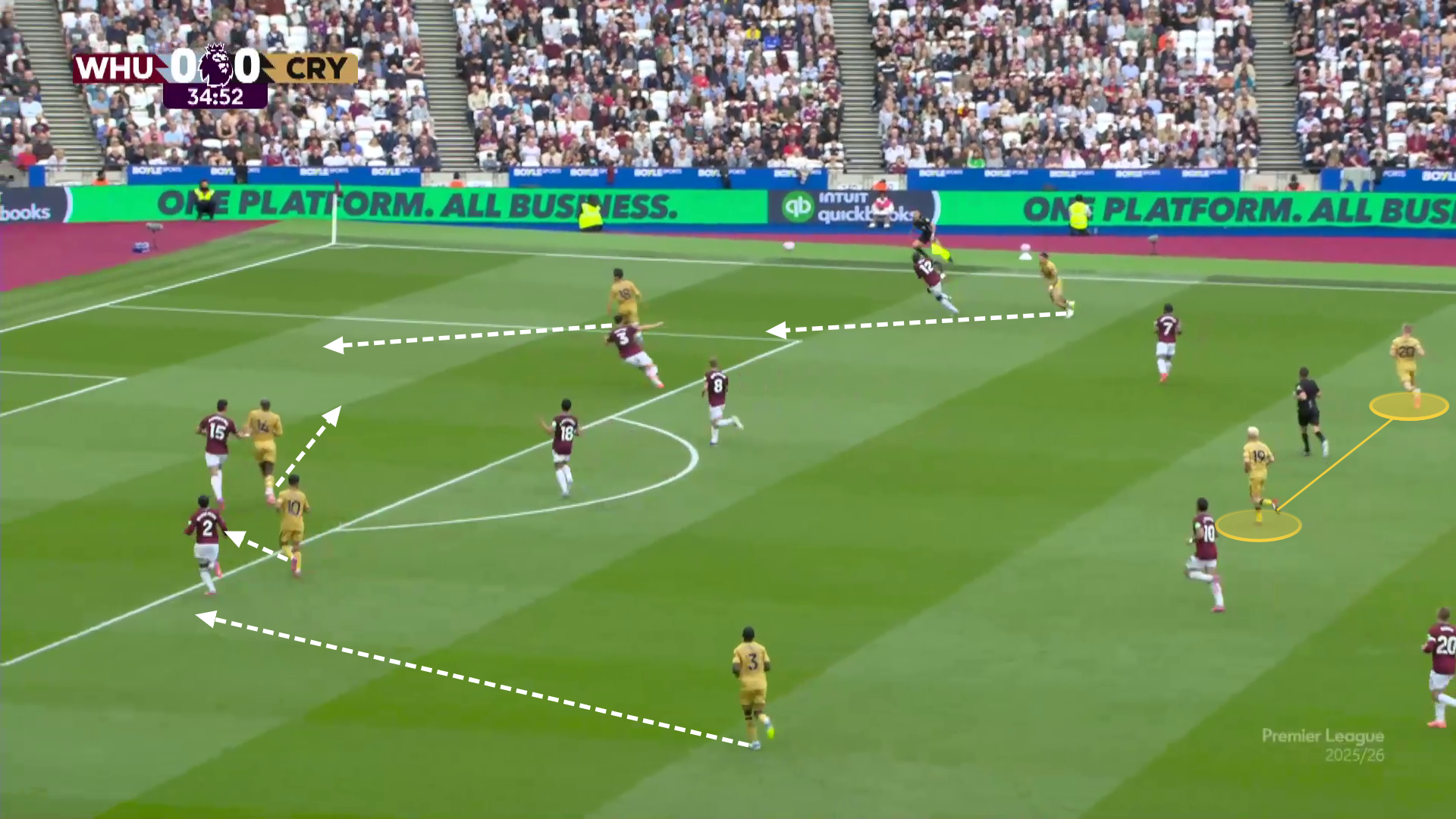
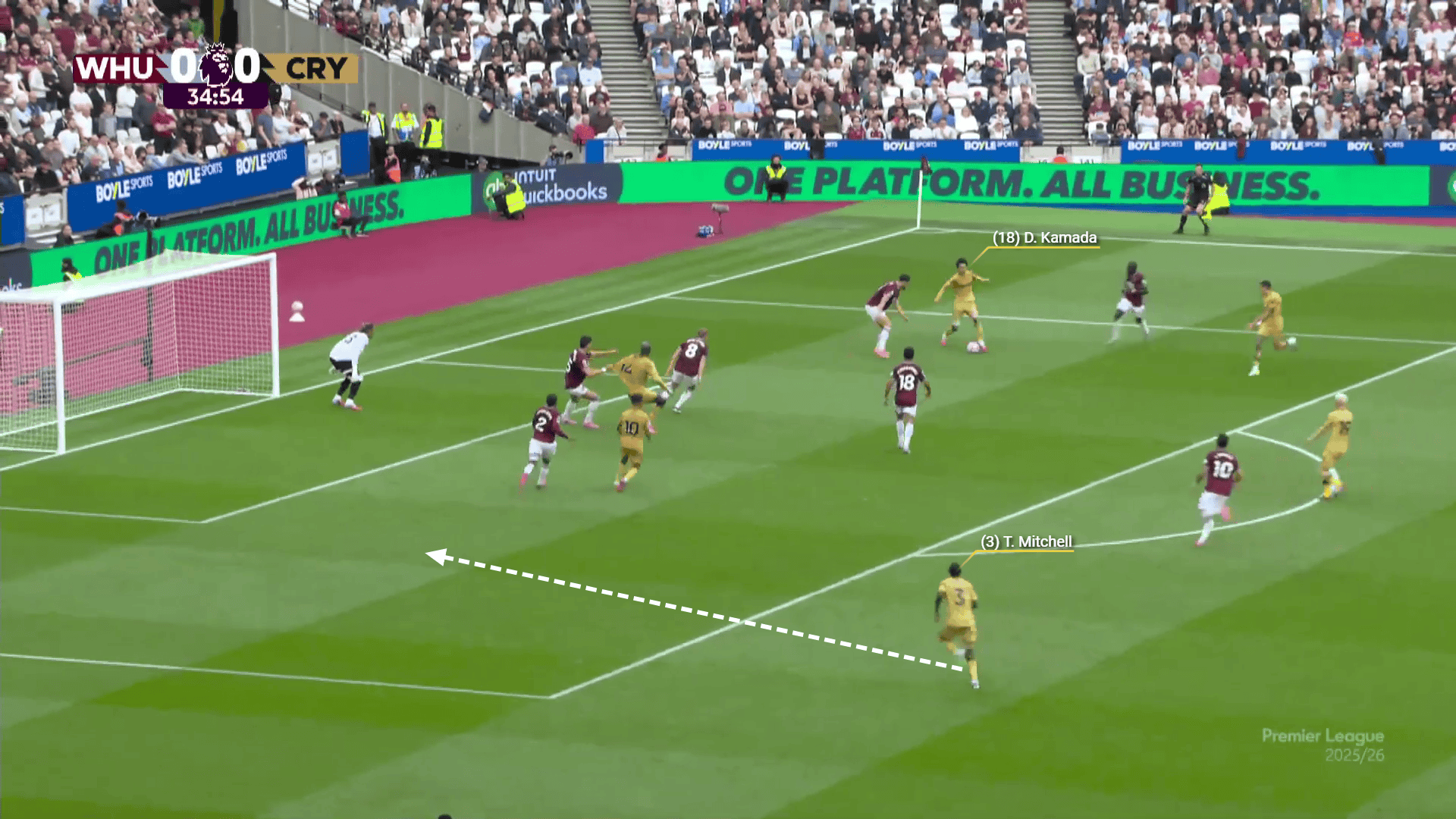
As shown in the West Ham United game, there is a lot of rotation and movement.
The wing-backs, especially Tyrick Mitchell, threaten in wide areas, while Yeremy Pino tucks into the half-space.
The double pivot of Will Hughes and Adam Wharton supports the attack while providing a solid base in case of a turnover.
Daichi Kamada frequently drifts into the box and carries the ball into the final third.
With so much movement, it becomes difficult to predict when the killer ball will be played.
Palace rank second in absolute width usage across the Premier League.
Oliver Glasner’s attackers are trained to attack space, not possession.
Their direct speed of 1.9 metres per second and 20th-place sequence show that Palace do not need the ball for long periods to hurt opponents.
Ruben Amorim Midfield Conundrum
Ruben Amorim’s midfield has become an issue.
Bruno Fernandes, nominally an attacking talisman, has been redeployed as a pivot alongside Casemiro or Manuel Ugarte.
His removal from the final third strips United of imagination.
The twin pocket players, previously Marcus Rashford, Alejandro Garnacho, and now the likes of Amad Diallo and Matheus Cunha, rarely receive the ball between the lines because United’s buildup never reaches those areas.
The absence of rotations makes the problem worse.
Wing-backs hold their lanes, pocket players stand isolated, and Benjamin Šeško waits for service that never arrives.
Where Oliver Glasner’s 3-4-2-1 constantly generates overloads, Ruben Amorim’s version collapses inward due to positional rigidness.
The Defensive Block & Pressing Identity
Oliver Glasner Compact Dynamism
Off the ball, Oliver Glasner’s Palace might be the most tactically disciplined unit outside the traditional big six.
Their back five works by stringing along horizontally rather than acting in disconnected lines.
When the wing back engages the opposition full back, the rest of the back five slides across, preserving man-to-man cover.
This turns a nominal 5-4-1 mid-block into an active pressing trap.
Where most systems use wingers to jump and wing backs retreat, Oliver Glasner reverses the model.
From the video below, Palace sit in their 5-4-1 shape and wait for the ball to go out wide to engage.
This is where Tyrick Mitchell is able to win the ball and start a counterattack.
The wide tens shield inside lanes while wing backs attack outward.
This provides compactness as Wharton and Hughes reinforce half spaces rather than chase channels.
At any moment, the shape can turn from a 5-4-1 to a ball-sided 3-4-3 man press.
Ruben Amorim Passive 5-2-3
The intent is to go man for man across the pitch, with the front three locking on to the opposition’s back three.
The centre-backs are meant to step into midfield to follow dropping forwards.
However, the execution is poor.
Wide centre-backs such as Maguire and De Ligt are reluctant to vacate their defensive line.
The timing of jumps is late, and the angles of approach are inconsistent.
The result is a wide, empty half-space where opposition can easily pick up the ball.
United’s supposed 5-2-3 frequently degenerates into a 5-4-1 mid-block with huge vertical gaps.
In their league draw against Fulham, the front three press to apply pressure on Joachim Andersen as he combines with Alex Iwobi and Sander Berge in the build-up.
They are able to play through the front three, which leaves Bruno charging forward to stop play from progressing into the central areas.
There, they are outnumbered, with only himself and Casemiro occupying that space.
Sander Berge then plays it into Iwobi, allowing Fulham to bypass the first two lines and drive at goal.
There is no support from the wing-backs, who are supposed to assist the press, nor from the centre-backs, who remain conservative.
Without compression between the lines, opponents pass through.
The passive pressing and long recovery distances leave the side stretched.
The forwards are high, the defence is low, and the midfield is stranded.
Scalability In A Modern Context
Oliver Glasner Scalable Modernism
Oliver Glasner’s model is scalable because its building blocks, compactness, width, transition, wing-back output, and goalkeeper involvement are modern universals.
Each principle is portable.
The system depends on energy and role clarity more than star quality, allowing mid-table squads to reach their maximum potential.
Ruben Amorim Conditional Scalability
Ruben Amorim’s structure, however, requires highly specific components.
Wing backs must behave as wingers, centre backs must feel comfortable stepping into midfield, and midfielders must control tempo under pressure.
Without those, the system does not work.
Until Ruben Amorim develops greater malleability, his game model will be unfit for purpose.
Conclusion
Oliver Glasner’s Palace looks settled within the top half of the league.
Evolution for Palace may involve additional creative midfielders or alternative forward profiles.
For Ruben Amorim, survival depends on adaptation.
His 5-2-3 press must change into a 4-4-2 when the ball goes wide, similar to Simone Inzaghi‘s Inter Milan wing-back push.
But as of now, Oliver Glasner and Ruben Amorim stand at opposite ends of the tactical success arc.
