
The Dutch Eredivisie is already approaching its fourth matchday, and after three games, a huge surprise has emerged at the top.
Instead of the usual names like Ajax Amsterdam, PSV Eindhoven, Feyenoord Rotterdam or AZ Alkmaar, NEC Nijmegen are leading the league heading into the weekend.
Scoring 12 goals while conceding only one in three games is impressive enough, but it’s not just the results that are impressive; NEC has put in three impressive performances to start the season.
They are not just efficient, but a really good team!
There are multiple things that make them so special, but the most impressive part of their game is their play in possession.
With nearly 65% possession in their opening three games, NEC is leading the league in terms of possession and the table. Therefore, we will examine that facet of their game in this article.
After a rather average season, the club decided on a coaching change this offseason, hiring Dick Schreuder, brother of former Hoffenheim and Ajax coach and FC Barcelona assistant coach Alfred Schreuder.
Schreuder was an assistant for a long time before taking over PEC Zwolle and promoting them back to the Eredivisie in 2023.
After that, he promoted Castellón to LaLiga Smartbank, the second division of Spanish football, but was sacked during their first season in that league.
Now he has taken over NEC Nijmegen by storm.
In this NEC Nijmegen tactical analysis and scout report, we will examine the tactics employed by Schreuder at NEC during possession.
This analysis will be structured around their build-up phase from the first line to the second line.
We will also examine NEC’s attacking play so far this season.
NEC Nijmegen Build-up In The First Line
The first thing we need to establish is NEC’s shape in possession.
Dick Schreuder has been using a 3-4-2-1 formation so far in Nijmegen, but it often shifts into a 3-1-5-1 shape while building up.
The second central midfielder often pushes up the field to drag one more player away from the build-up.
This extends the entire shape and allows for a significant gap between the four key players in the build-up and the rest of the team.
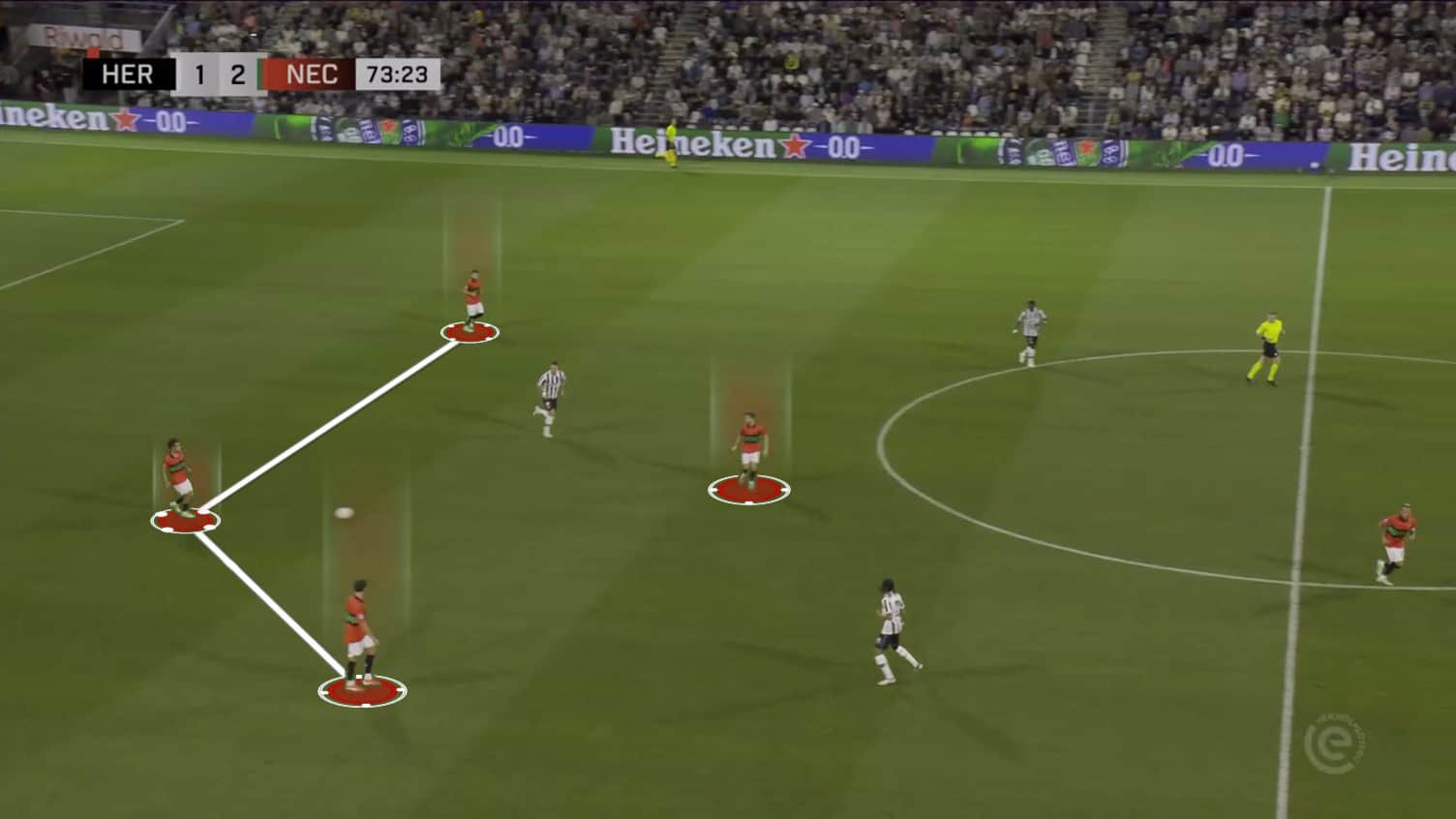
Here, we can see their shape as they build up from deep in their own half, and we even see the second midfielder pushing up the pitch.
Being spaced out in this manner has many risks, as there are not many players near the ball, but it allows Schreuder’s men to move into those open spaces between the lines, creating a lot of dynamics that the opposing team’s press needs to account for.
Usually, NEC try to be plus-one in build-up, so the second midfielder needs to account for that and adjust his positioning according to the opposing team.
With their back three, they usually have more defenders than pressing attackers in the first line.
Depending on how many midfielders the opponent commits to the press, NEC use a 3-1 shape or a 3-2 shape with a very narrow double pivot.
Ultimately, Schreuder does not want his men to be in the first line for a long time anyway.
Usually, they play the first or second pass towards one of the wing-backs and then back to a midfielder or centre-back, pushing forward into the second line quickly.
If possible, the entire team moves forward from the get-go, skips the first line, and one centre-back carries the ball into the second line immediately.
NEC Nijmegen Second Line
When Dick Schreuder wants his men to build up against a deep block, there are a couple of minor changes compared to what they do when building up in the first line, but they still maintain the key principles and movements intact.
One thing is the fact that the effective playing space is quite a bit smaller when they are playing with a high line, so their way of using their movement into the open spaces to create some dynamic does not work quite as well as it does when they can use the entire pitch to stretch out the defenders.
Still, Schreuder wants his men to create as much space as possible.
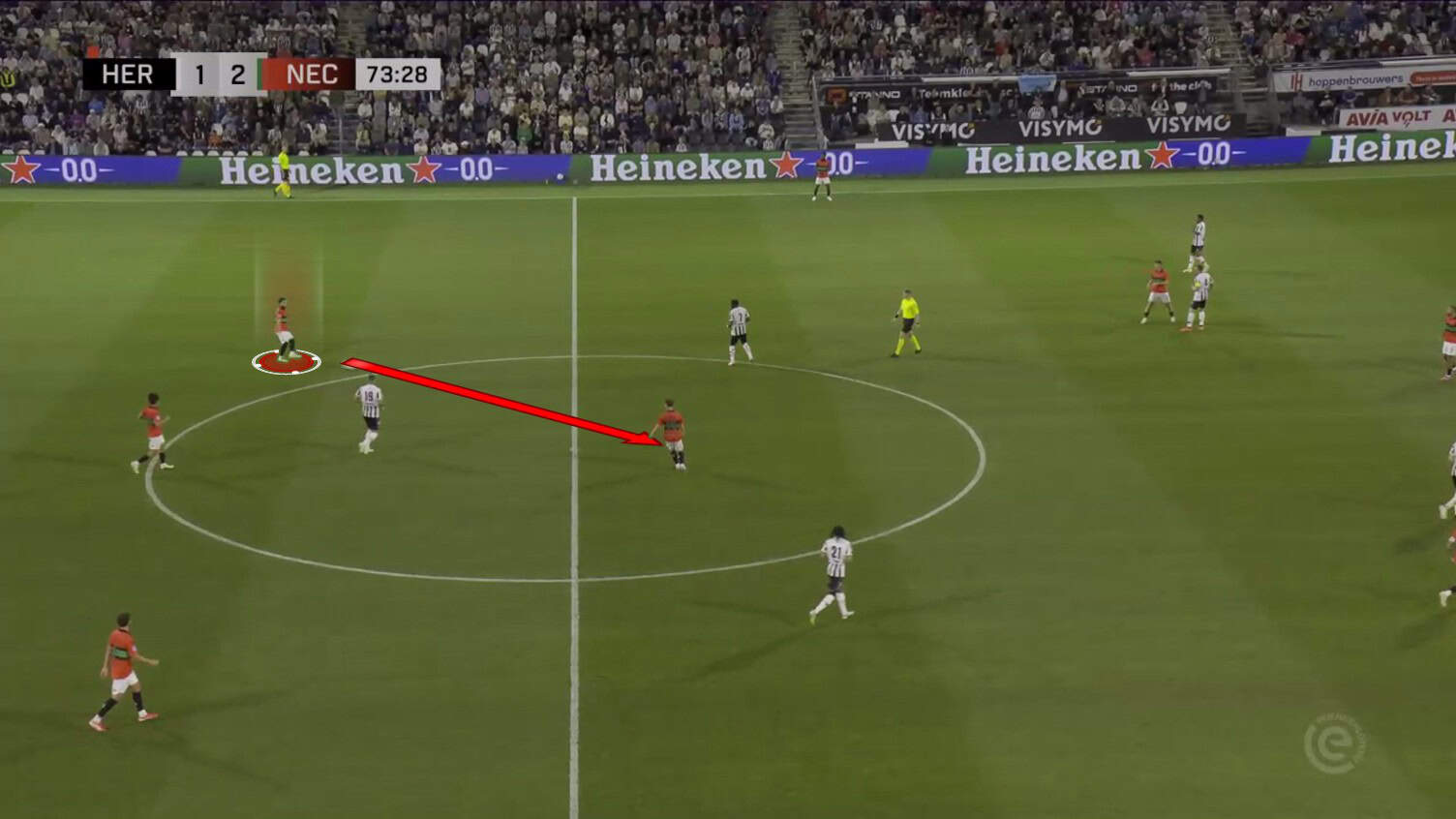
As we can see, the three defenders stay rather narrow, with the two outside centre-backs positioning themselves on the inside of the half-space.
Schreuder does this to force the first line of pressure to be concentrated into the centre as well.
This opens up space towards the wing, where both wing-backs are positioned very wide, hugging the sideline and providing width for the team.
In the picture above, NEC was already up, and additionally, one opponent had been sent off, so they had even more space to exploit.
While they like to play through their wings, they particularly enjoy playing the first pass towards their midfielders and then the second pass to the outside, creating movement in opposing directions and utilising the inside-outside principle.
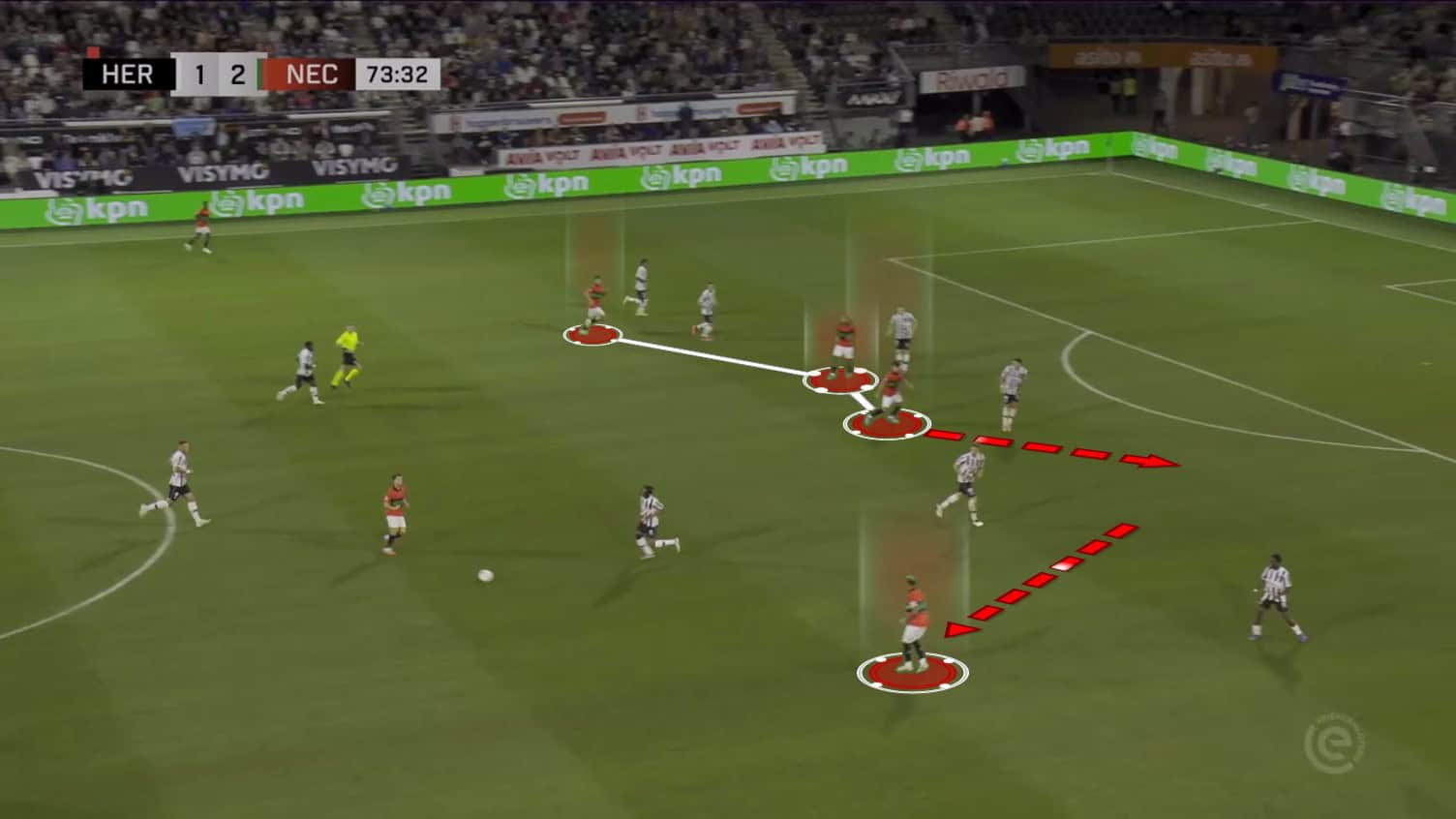
Like the first line, the attacking line is positioned rather narrowly, trying to keep the defensive line in the centre of the pitch.
From there on out, NEC have multiple options to progress the ball into the final third, we’ll look at their most common pattern in the following paragraph, but here we can see movement in opposing directions once again, with one attacker dropping back diametrically into the half-space and the other attacker attacking the space behind the forward-moving defender, providing the option for a ball behind the defensive line for the midfielder, but most of the time NEC are happy with the ball to the half-space.
From there on out, NEC are incredibly patient with their approach.
Schreuder has his men switch play consistently, playing through the far-sided midfielder as the first option and through the back three as the second option.
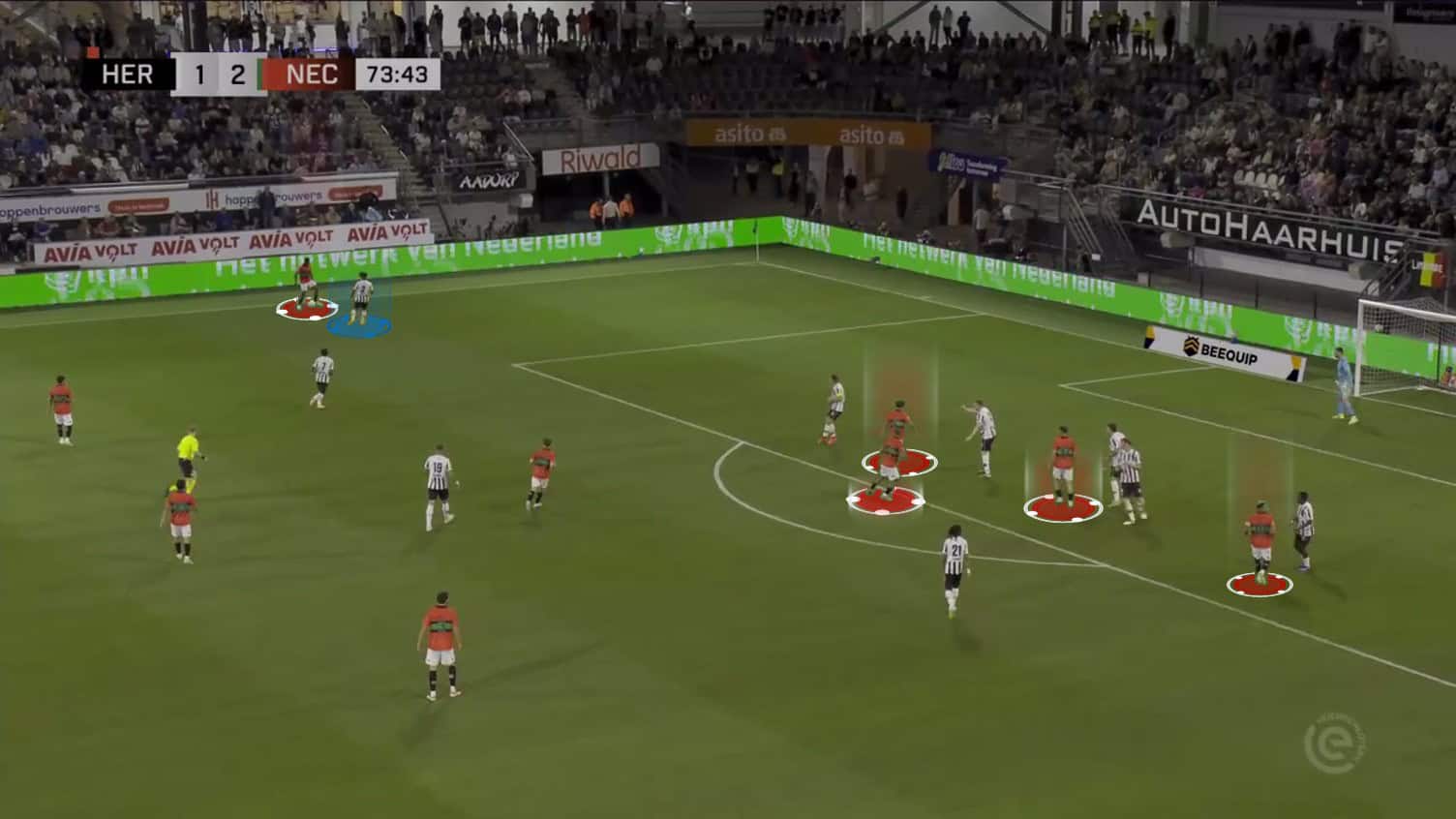
This means that they often end up in their attacking shape, which is interesting.
However, looking at what’s even more important for what we are examining in this paragraph, we can see that the backline is pushing incredibly high up the field, to about 30 metres away from the opposing goal.
NEC often create isolated 1v1 situations on the wing and play out of those actions from their wing-backs.
They have a very good presence in the box, always committing four players into the box, always towards the far post.
We will take a look at that later as well.
The central midfielders are splitting up here; one looks to pick up second balls but is positioned towards the ball, while the other midfielder drops back, dragging out one player and being ready to receive a backwards pass and initiate the switch.
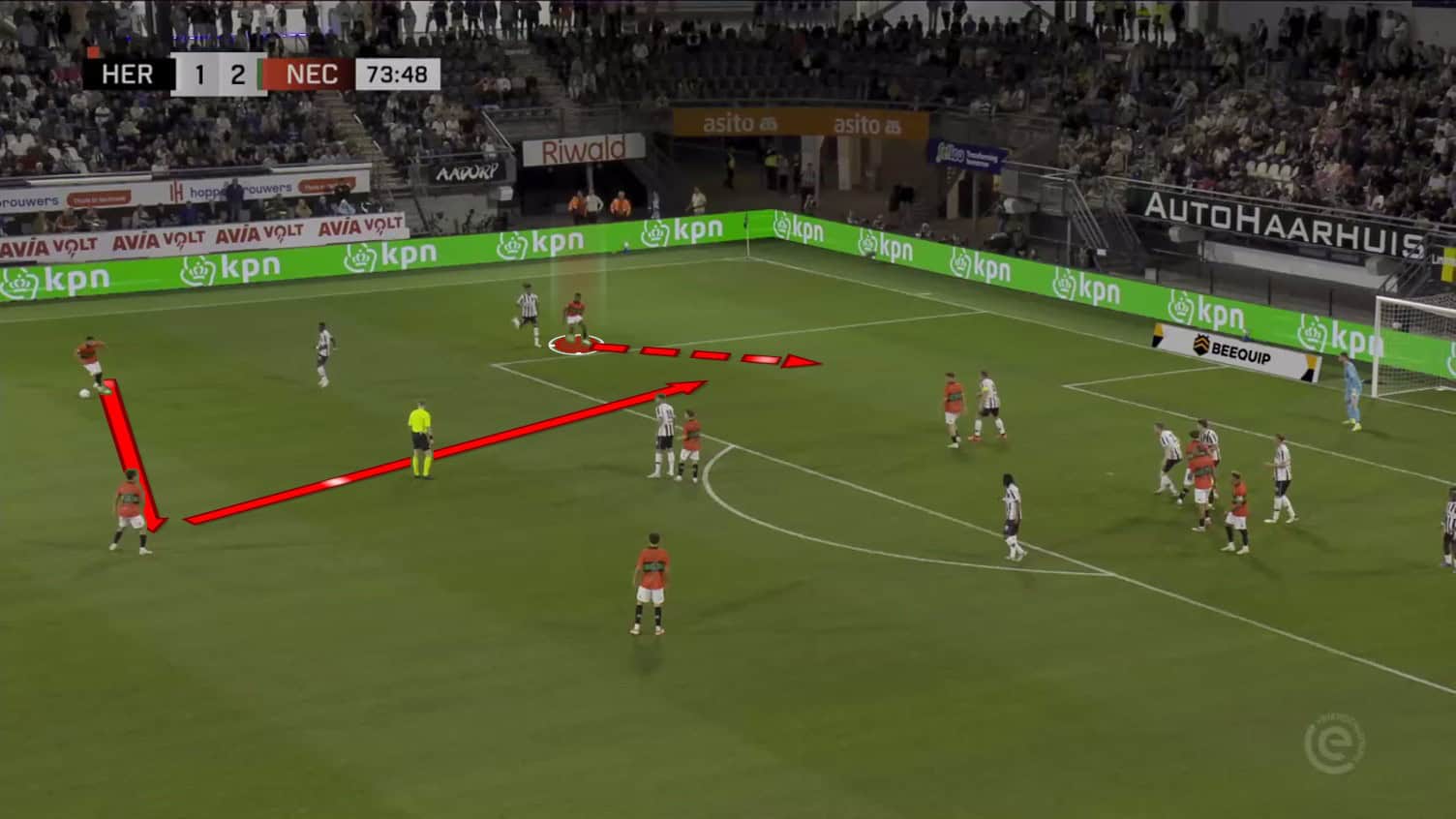
While it looks like NEC are playing for a cross, they are not.
We will examine this in the following two paragraphs, but to illustrate their goal when building from the back, we can take a look at the picture above.
Schreuder does not want to play the cross from the wing; he wants to bait the switch and attack the channel in the half-space.
Therefore, he has one player moving right into the space behind the dragged-out full-back and then wants his midfielders and centre-backs to play the vertical through pass.
Overall, Dick Schreuder’s tactics when building up want to stretch the defence with positional play, keep them moving through switches, always be one player ahead in the first line, and prepare to attack the channels in the half-space with vertical passes.
Key players include their left centre-back, Philippe Sandler, who is very talented on the ball, and their Japanese midfielder, Kodai Sano, who is quick and composed on the ball.
Transitioning From Build Up To Attack
In this part of the piece, we will examine the way that NEC transition from their build-up into their attacking phase.
However, this part of their play in possession is rather brief and smoothly connected to the other two phases, so it will likely be a brief look.
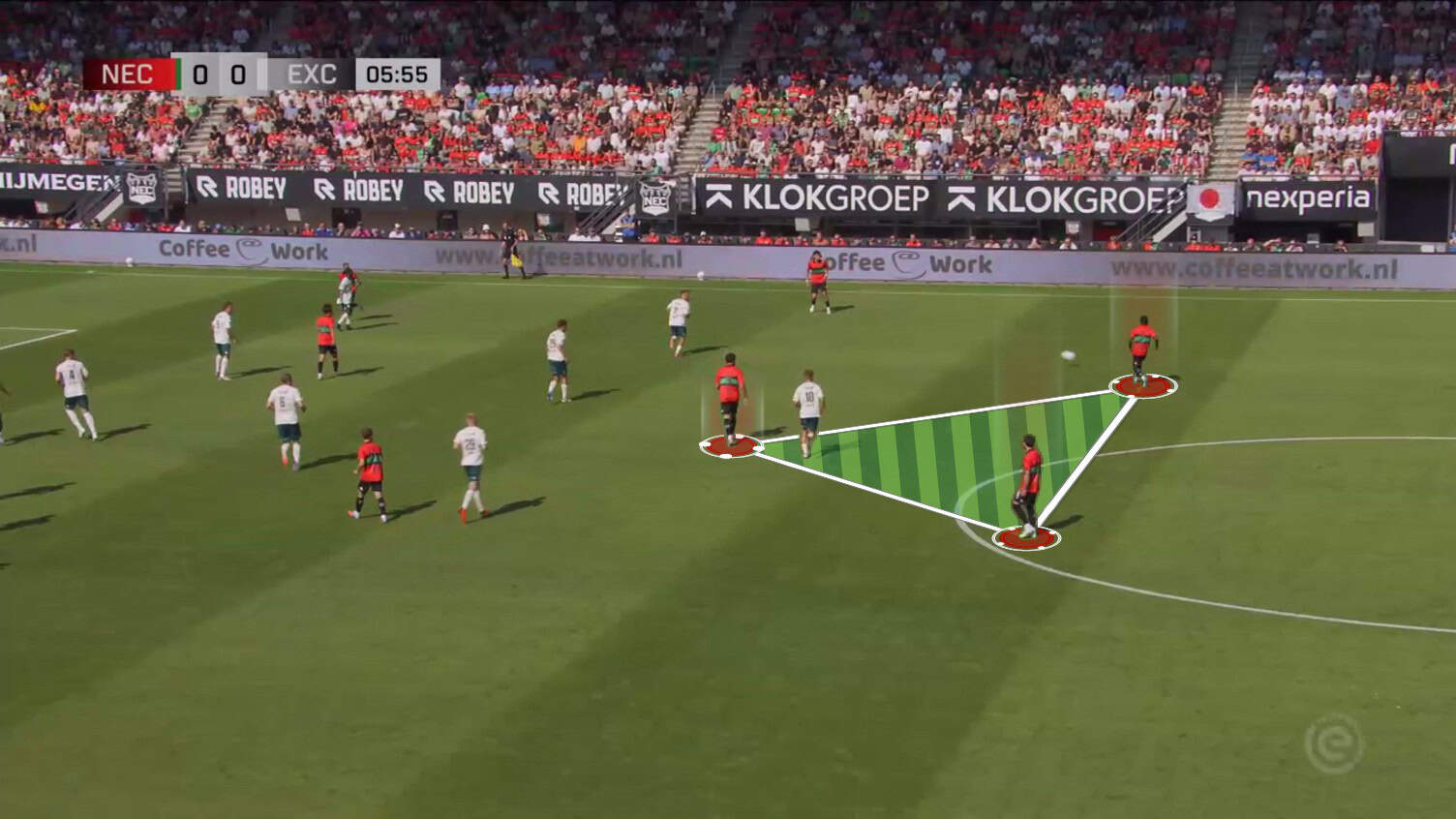
Looking at how NEC start, we already know what they want to do.
They have their back three stay back while building up and use one of the two midfielders to form a triangle with the two near-sided defenders, always being plus one in these situations.
They played against a single striker in this case, so they are plus two here.
This allows NEC to always find solutions through the triangle with quick one-twos and even switch out of pressure quickly.
Once again, we can see that Schreuder pushes his backline up the field into the opposing half.
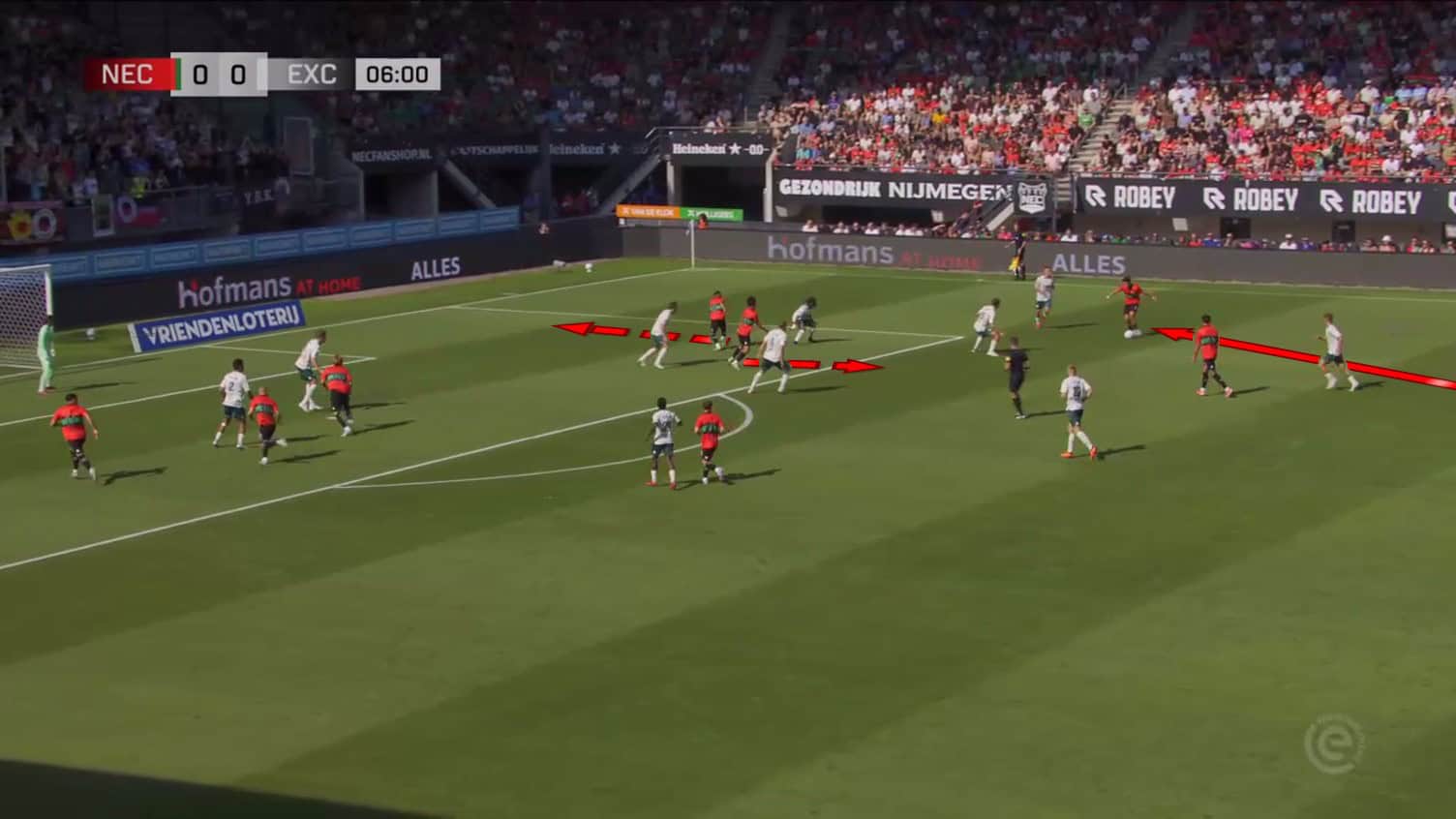
From there on, the transitions are relatively quick and straightforward.
Most of the time, it’s just one pass from the outside centre-back outwards towards the wing-back, just as we can see in the marked picture.
With their narrow backline and one midfielder pushing forward, they can bind multiple opposing players to guarantee that pass to be open.
The wing-backs need to receive the ball in at least a half-open stance, so they can have a follow-up action directed towards the centre of the pitch, rather than just playing the ball backwards when pressed by a defender.
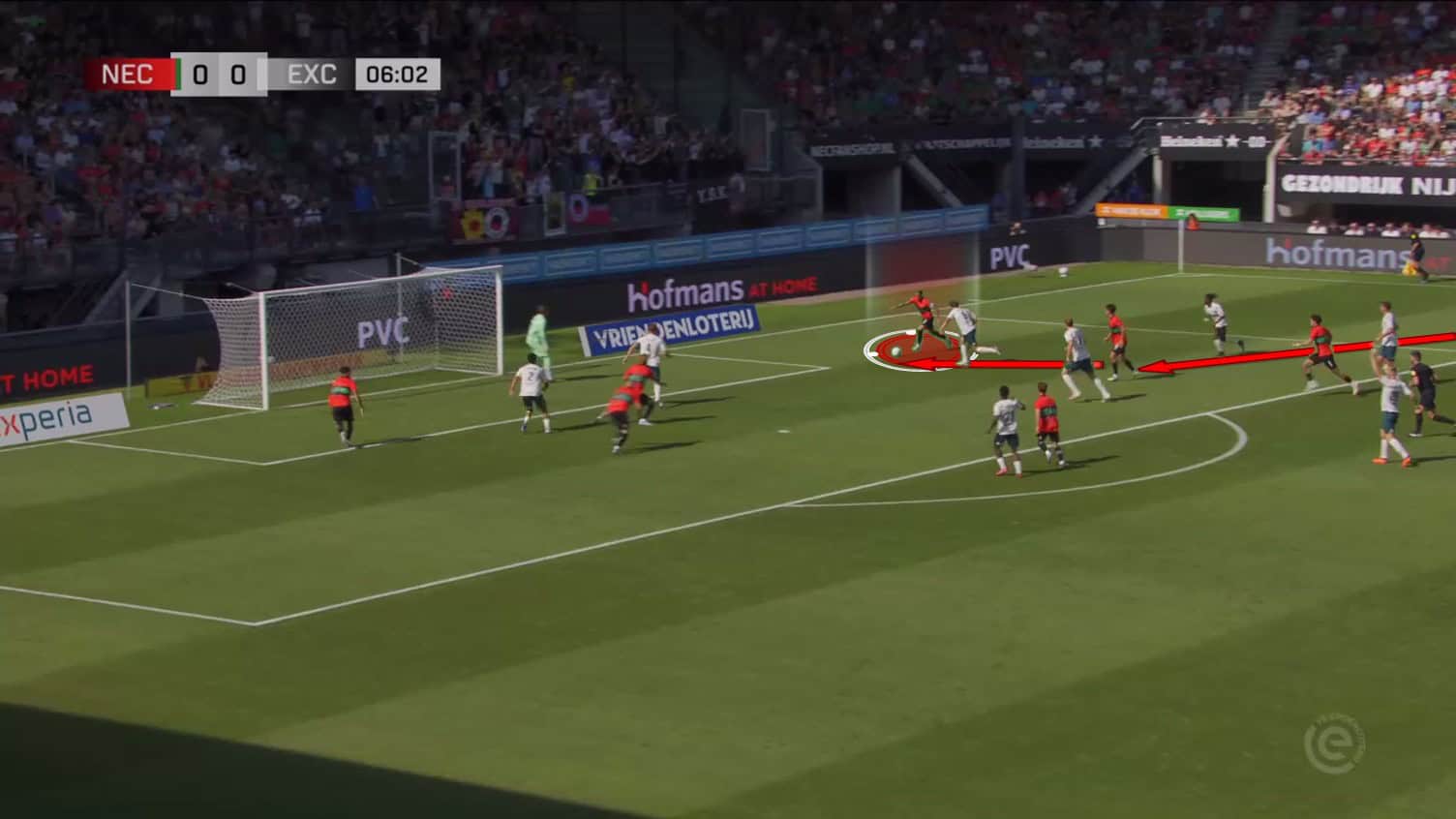
From there on, NEC are pretty much already in their attacking phase, pushing their backline forward into the position we saw earlier, trying to get into the half-spaces.
If possible, the wing-back instantly plays the first pass into the half-space after dribbling inwards, as shown in the picture.
Here, they find Sano, who positioned himself well in the box and plays a first-time backheel pass behind the defensive line.
The team is in the position Schreuder wants them to be, even though they don’t convert the opportunity here.
NEC Nijmegen Attacking Play
12 goals in three matches is incredible value, and now we are going to take a look at Dick Schreuder’s tactics and style of play in the final third with NEC Nijmegen this season.
We already established their shape and positional play throughout this article, so we will only take a short look at how Schreuder positions his players.
The clear patterns can be seen even in the attacking phase.
NEC currently has a very coherent system in possession, allowing them not to have to change or rotate throughout their play.
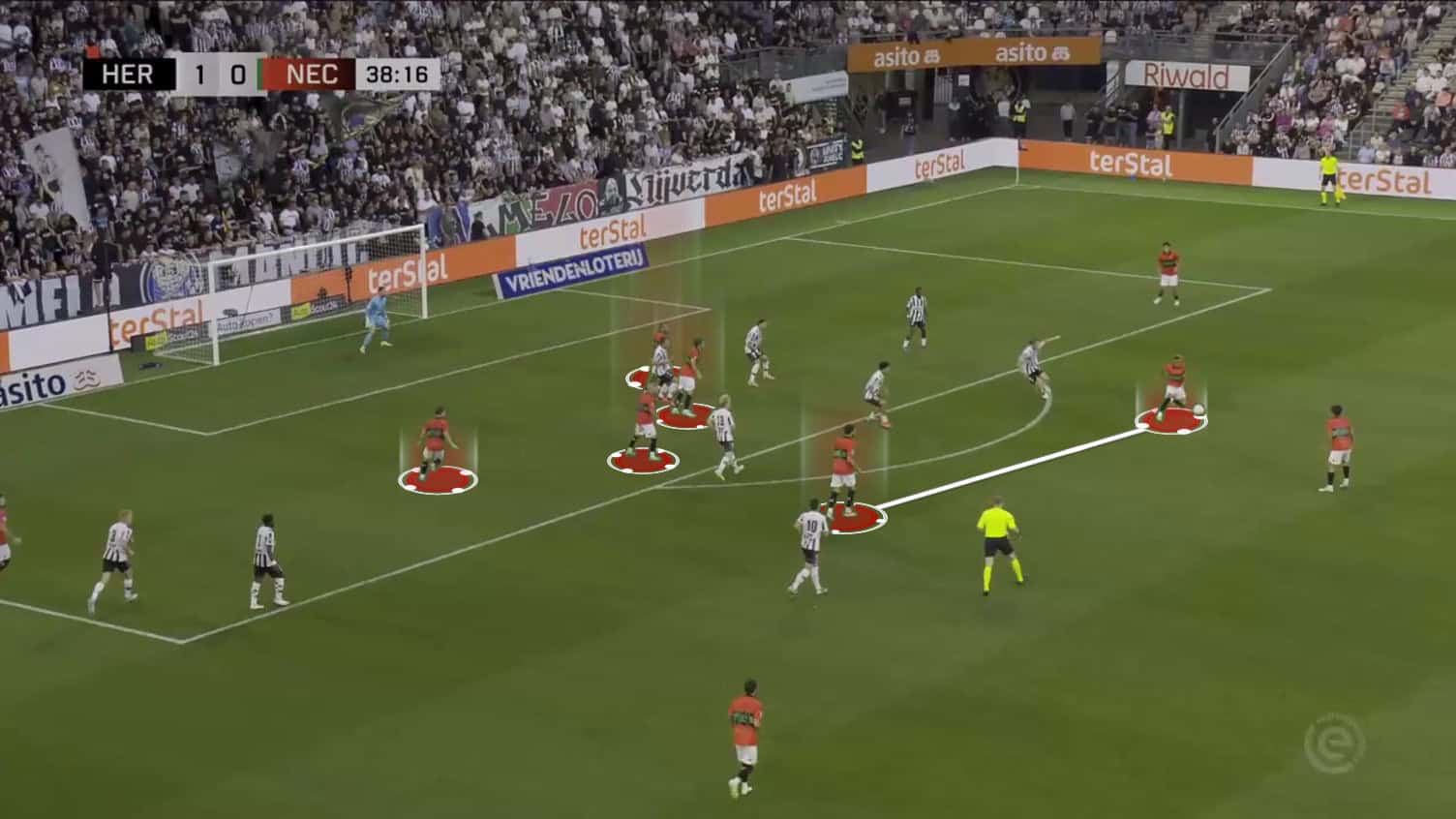
One thing we need to examine is how they position themselves both inside and outside the box here.
The two wing-backs are the outside points of the shape; the rest of the players are in the central areas of the pitch.
As stated before, four players are always in the box, on the far side of the ball.
Two players are positioned right outside the box, in a very narrow formation, and their task is to collect second balls, overload the half-spaces quickly, and trigger the counterpress.
I positioned a third player in the middle, between the two, a couple of metres back, tasked with switching play if needed and securing the space behind the many forward-committed players to prevent counterattacks.
We won’t go into detail here, but the four phases are always interconnected, and their positional play and structure not only help them with the ball but also prepare them for what happens if they lose possession.
Very good work by Schreuder.
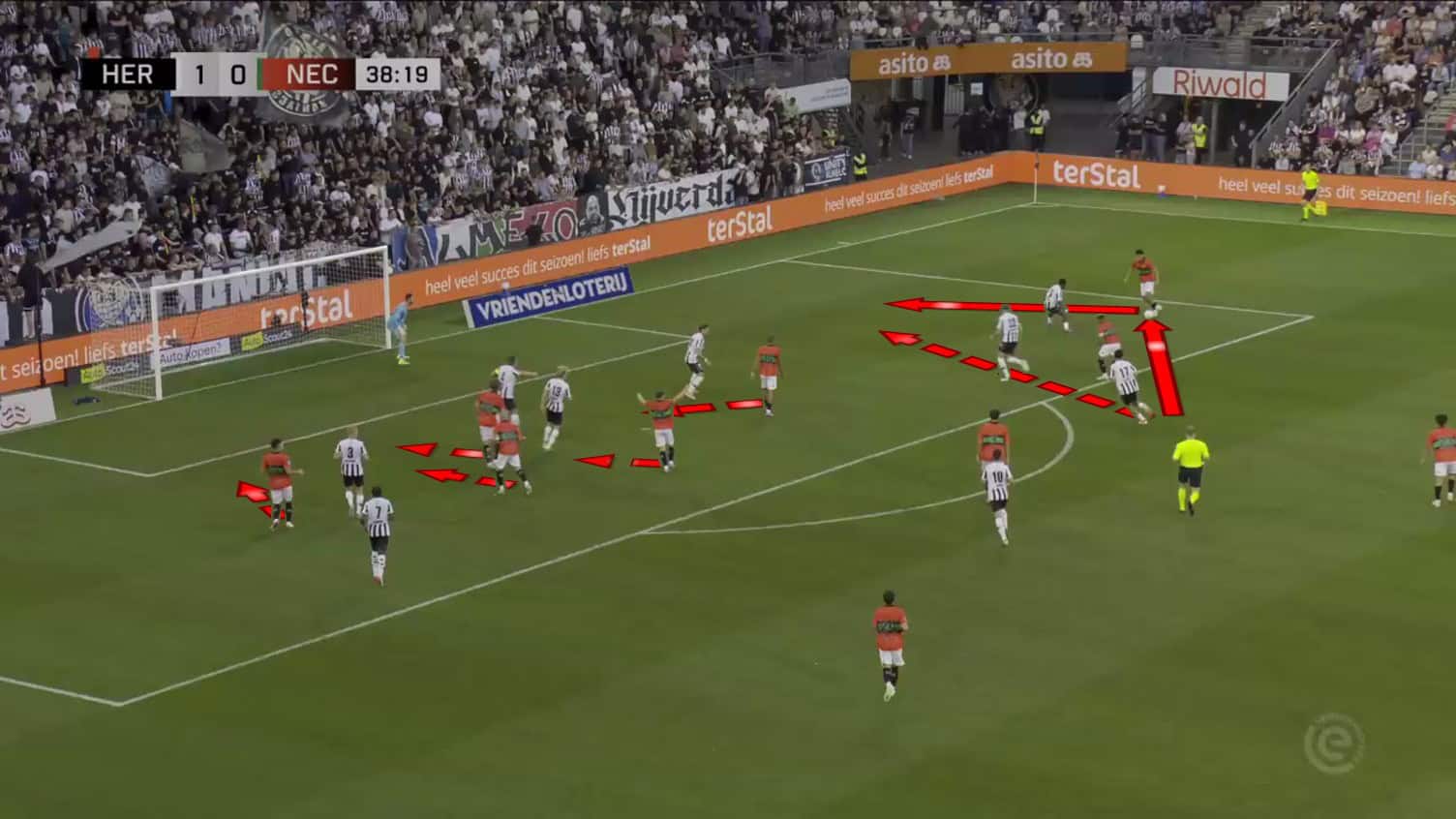
From there on, NEC tries to suffocate their opponent, keeping the block moving through switches, essentially forming a pendulum, playing from one wing-back to the other quickly, and always waiting for a single mistake to get into the box.
The distances the Nijmegen players have to cover are much shorter than the distances that the opponent needs to cover, so it’s rather easy for NEC to create advantages here.
The space they want to attack remains the same; they aim to enter the channel in the half-space and position themselves behind the backline.
Their first way of approaching this is forming a pseudo-triangle with the switch to their wing-back.
After the switch is played through towards the wing-back, the players in the box make runs towards the far post, forcing the backline to stay in the centre and opening up the space they want to attack.
From there, the ball is played to the wing-back, and the near-sided midfielder at the edge of the box attacks the channel in the half-space with a vertical run after playing the pass outside, forming a triangle with just two players, as shown in the marked picture above.
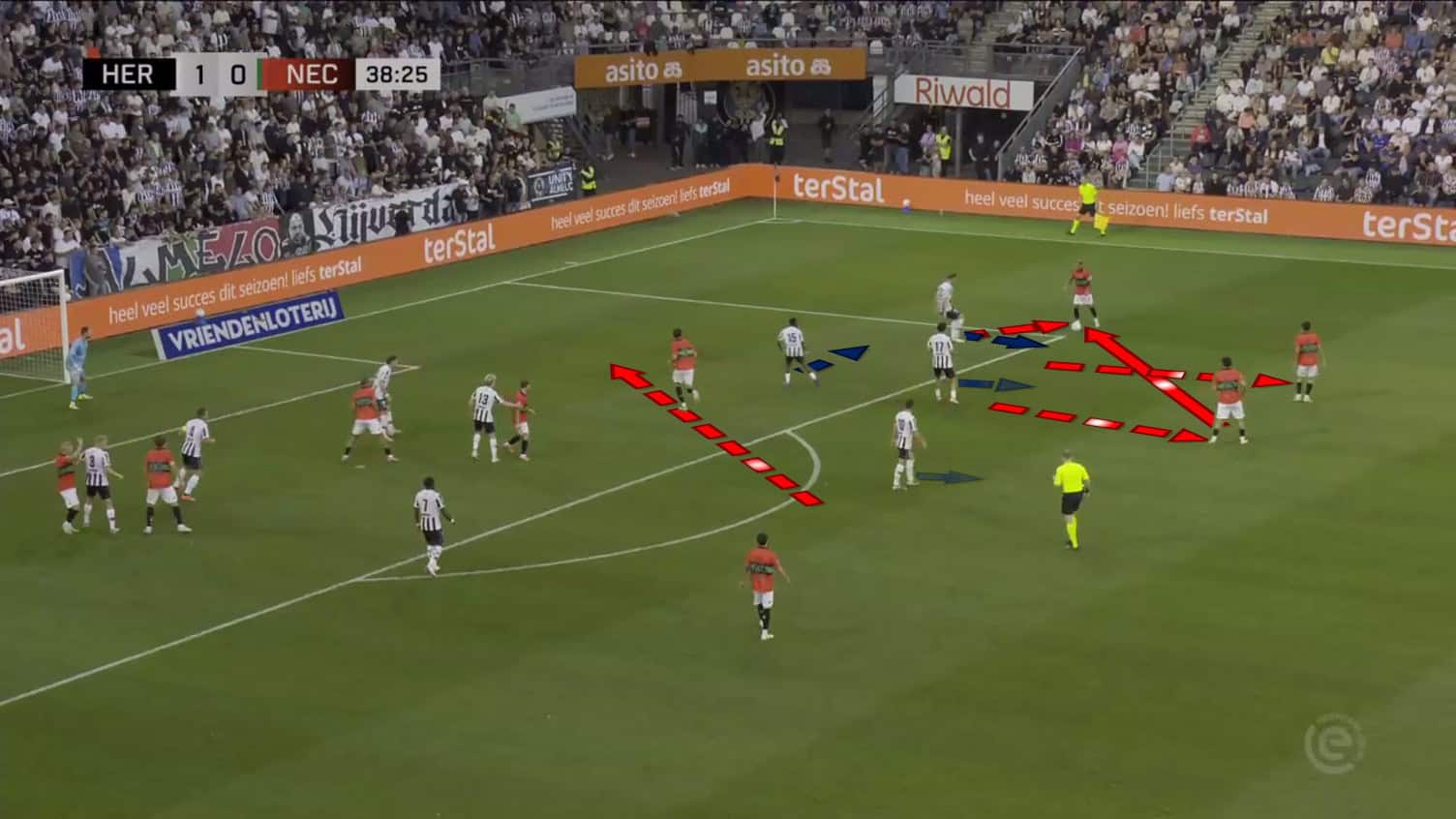
If that doesn’t work, it becomes a bit more complicated, but Schreuder has also provided his players with a solution for the situation.
The two midfielders are now overloading the half-space and moving backwards, binding at least two more defenders and creating a larger triangle in the process.
This also opens up the space behind the backline in the half-space.
Now, the other midfielder is attacking that space with a diagonal run, completing the triangle and allowing for a direct or indirect pass through the wing-back towards the space they want to attack.
Now that they are behind the backline, breakthroughs towards the baseline occur frequently in NEC Nijmegen’s games, and they can create opportunities from there on out.
Players are allowed to attempt to finish the attack here if possible; we saw this in the last paragraph, and the team has already scored goals in this manner this season.
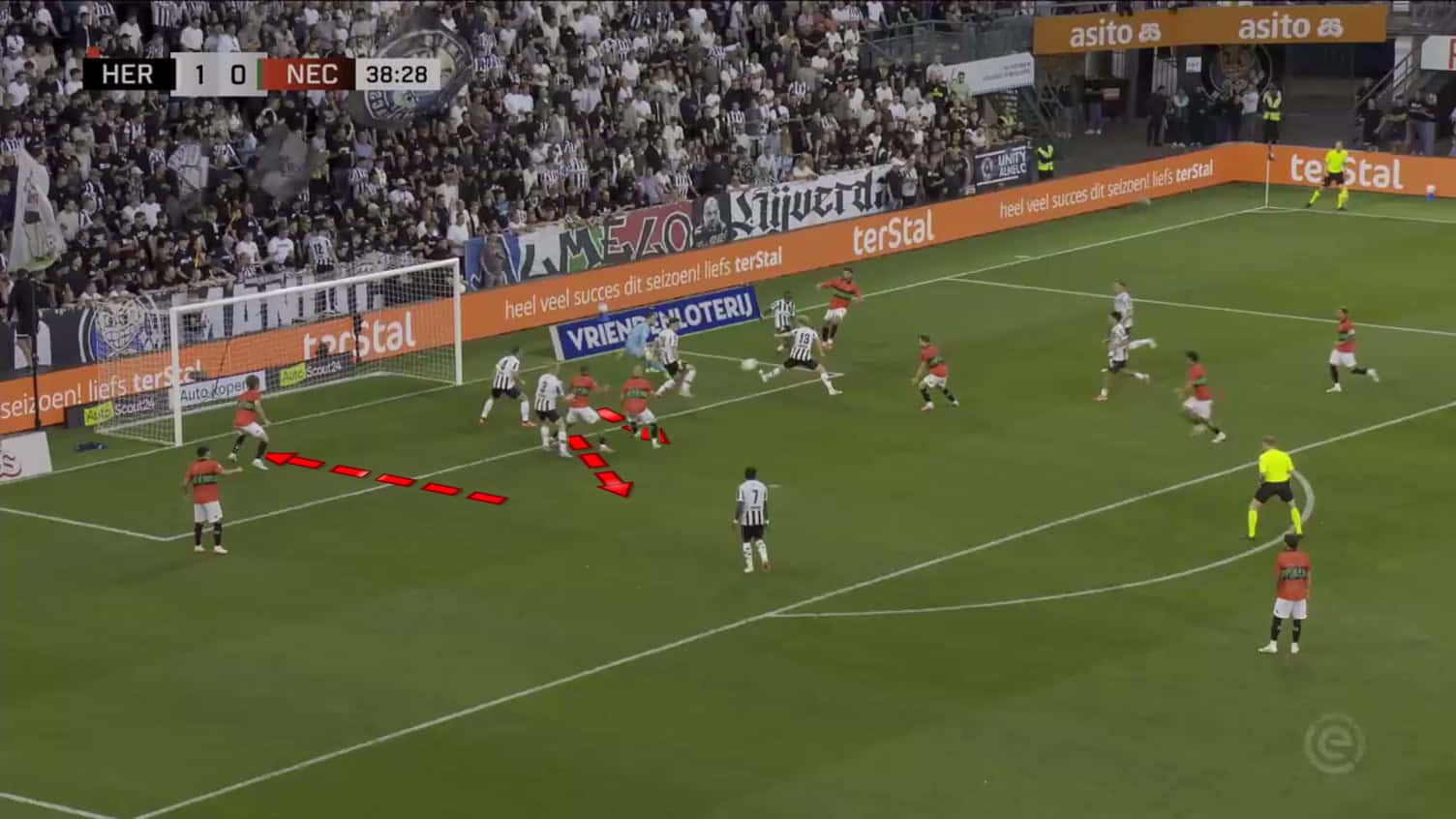
If they can’t shoot because the angle becomes too tough for the player in the channel to finish, they try to square the ball low.
As outlined throughout this article, Schreuder positions many players in the box, which creates a lot of presence and numbers for the defenders to account for in a chaotic situation, always an advantage for the attacking team.
The players in the box also always move in the same pattern.
If you look at the pictures throughout the article, you can see this pattern a couple of times.
The two players at the near post are dropping backwards, a couple of metres behind the ball, trying to get open there and being ready to receive the cut-back from the baseline.
The third player at the far post is moving right towards the post, behind the defenders who are now oriented towards the ball, trying to find a gap for a pass and an easy tap-in.
The other players are just moving into open space, trying to get open, but the key to their presence in the box is the three coordinated movements in the centre.
With these tactical measures, Dick Schreuder has created an attacking machine, being secure on the ball and always finding solutions to attack the space in the half-space behind the backline out of different positions, dragging the block wide and keeping them moving with ease.
Conclusion
Dick Schreuder tactics focus on stretching out opposing defences and creating dynamics through off-the-ball movement and triangles all over the pitch.
The team is very secure on the ball, has solutions and a clear idea in every situation and managed to push Dick Schreuder’s style of play onto the opposing teams, nearly suffocating them.
While the start to the season was very important, we must say that the opponents NEC have faced so far are not the strongest teams in the league, and many things have gone their way.
Still, in Germany, we say that you have to put in the work to be in the position to be lucky, and NEC are doing just that.
After the international break, NEC Nijmegen and Dick Schreuder will face off against PSV Eindhoven, putting their tactics to the test for the first time.
It will be interesting to see how the team copes against a team with more individual class.
