
The competition in the Premier League is intensifying.
After seven rounds, Arsenal are in third place with 17 points, tied with the defending champions Manchester City and trailing the current league leaders, Liverpool, by a single point.
The indicators are pretty promising for the Gunners, as they possess the third-strongest attack in the league, having scored 15 goals, trailing only Manchester City and Chelsea, who have scored 17 and 16 goals, respectively.
In terms of defensive performance, Mikel Arteta‘s side boasts the second-strongest defence, having conceded only six goals.
This places them behind Liverpool, who have conceded only two goals.
There is nothing new to mention at the level of set pieces, as Arsenal are currently the team with the highest expected goals (xG) from set pieces in the Premier League, with a value of 3.57.
Analysts have rushed to study and analyse the reasons behind this distinction and its persistence despite opponents’ awareness of Mikel Arteta style of play.
However, when you think you are sufficiently impressed by the work of Arsenal set-piece coach Nicolas Jover, you realise that there is still greater potential for astonishment.
The aspect we will discuss is somewhat different from what analysts typically mention, yet it is of utmost importance.
This aspect is their defensive strength during corner kick attacks.
Yes, you read that correctly.
Defending during an attack has become one of the most critical elements in football, known as “rest defence.”
Regarding set-pieces, Arsenal not only focus on creating danger for the opponent’s goal but also ensure they are defensively secure during those attacks.
They can win the second ball and stifle counterattacks at their source while maintaining intense pressure on the opponent.
This allows them to regain possession and initiate new high-intensity offensive waves.
Even if the opponent succeeds in clearing the ball, which is rare, they remain secure at the back.
In this tactical analysis, we will discuss Mikel Arteta tactics to remain secure against counterattacks while executing attacks on the opponent’s goal.
Additionally, they can regain possession to threaten the opponent’s goal once again.
Targeting The Far Post With Floated In-swingers & Framing The Goal
We should first mention that Arsenal use in-swinging crosses to target only the six-yard, near or far post, without targeting any other zone.
This is what makes them so effective and harmful.
They keep the ball flying toward the opponent’s goal, not towards the pitch, as in the out-swinging crosses and other zones.
This extreme focus, supported by many strategies and principles, often yields outcomes that typically include threats to the opponent’s goal, goal kicks, additional corner kicks, or miraculous touches from the opponent’s goalkeeper or defender to clear the ball.
It is rare for the opposing team to gain control of the ball to clear it away effectively.
We will start by discussing how Arsenal, under Mikel Arteta’s coaching, don’t even allow opportunities to rebound the ball.
Before we do that, though, let’s quickly recap their attacking strategies from another perspective as they relate to “rest defence”.
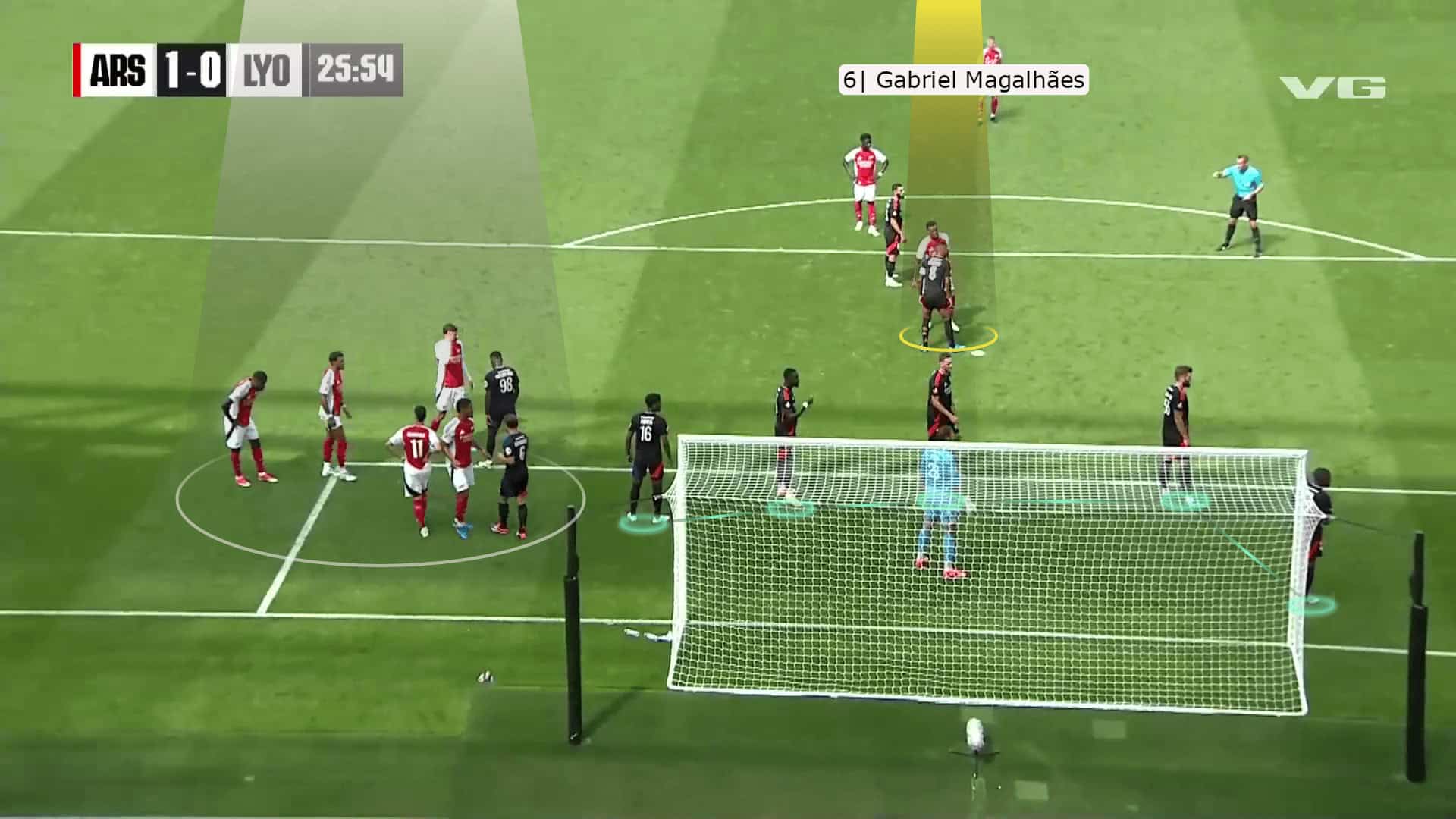
As shown in the photo below, they use a five-player pack beyond the far post, which puts them on the green zonal defenders’ blind side.
Thus, they can’t track the ball and the attackers in the air at the same time.
The same issue occurs with the two-man markers in the white spot, which forces them to turn their backs to the ball, and we refer to this issue as the “orientation problem.”
Let’s move to why Gabriel Magalhães stands near the penalty spot.
Now we start with targeting the far post and how they do that, relating it to our topic.
In the photo below, Kai Havertz (white) drags his marker toward the near post and stays there to frame the goal, as we will explain.
William Saliba (blue) goes to block the goalkeeper or, let’s say, stand beside him, taking his attention and standing in his way to jump toward the far post to delay his reaction so as not to claim the ball.
This happens with many different approaches to avoid fouls, such as using another player to create traffic, especially when they drag their man-markers with them, or standing between the goalkeeper and their path to claim the ball.
Regarding Gabriel Magalhães, he wants to ensure that he is separated from his marker, pushing his hands down before running to avoid any physical contact; he fakes movement to the near post and then attacks the far post.
Now, let’s see why.
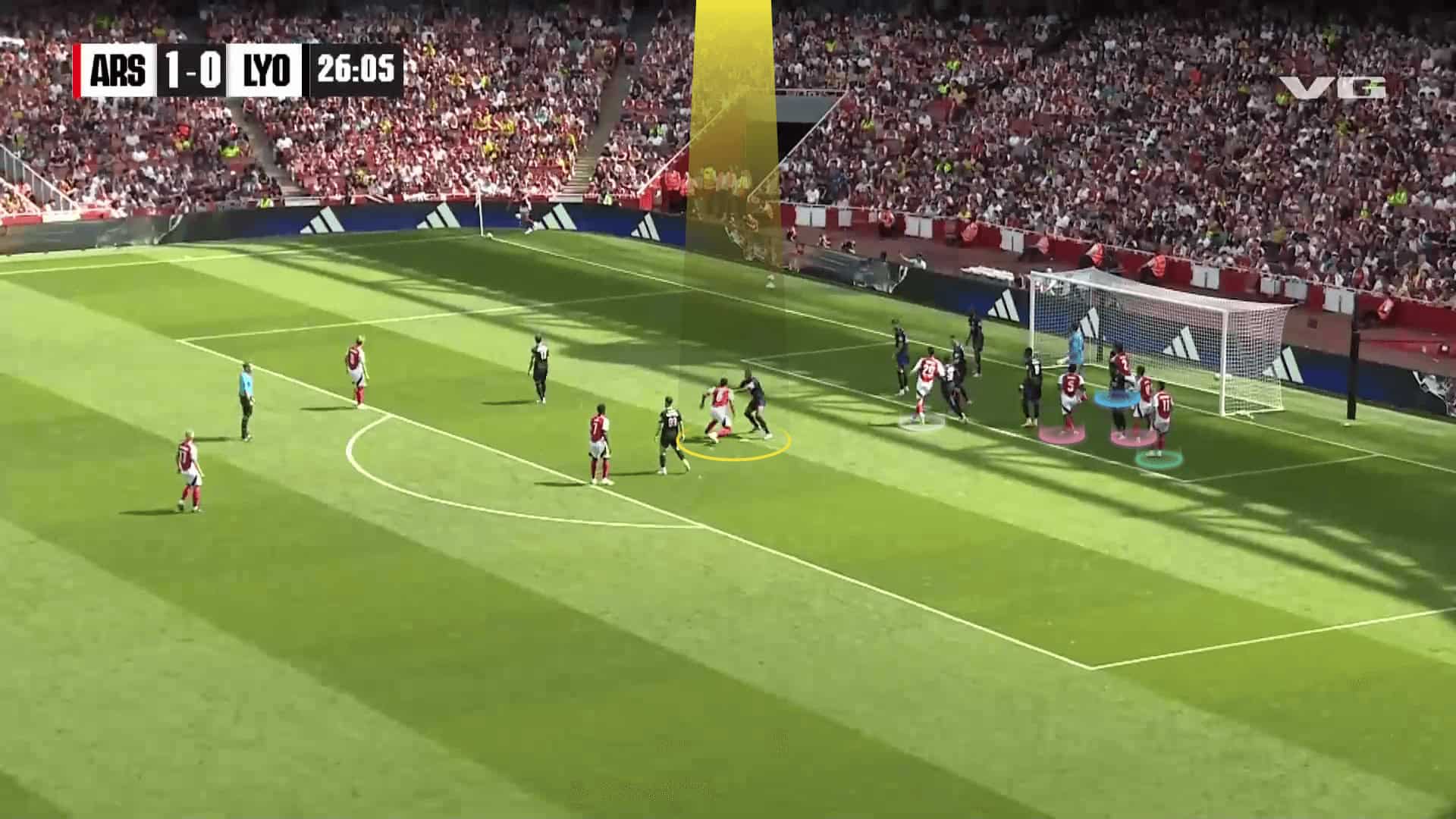
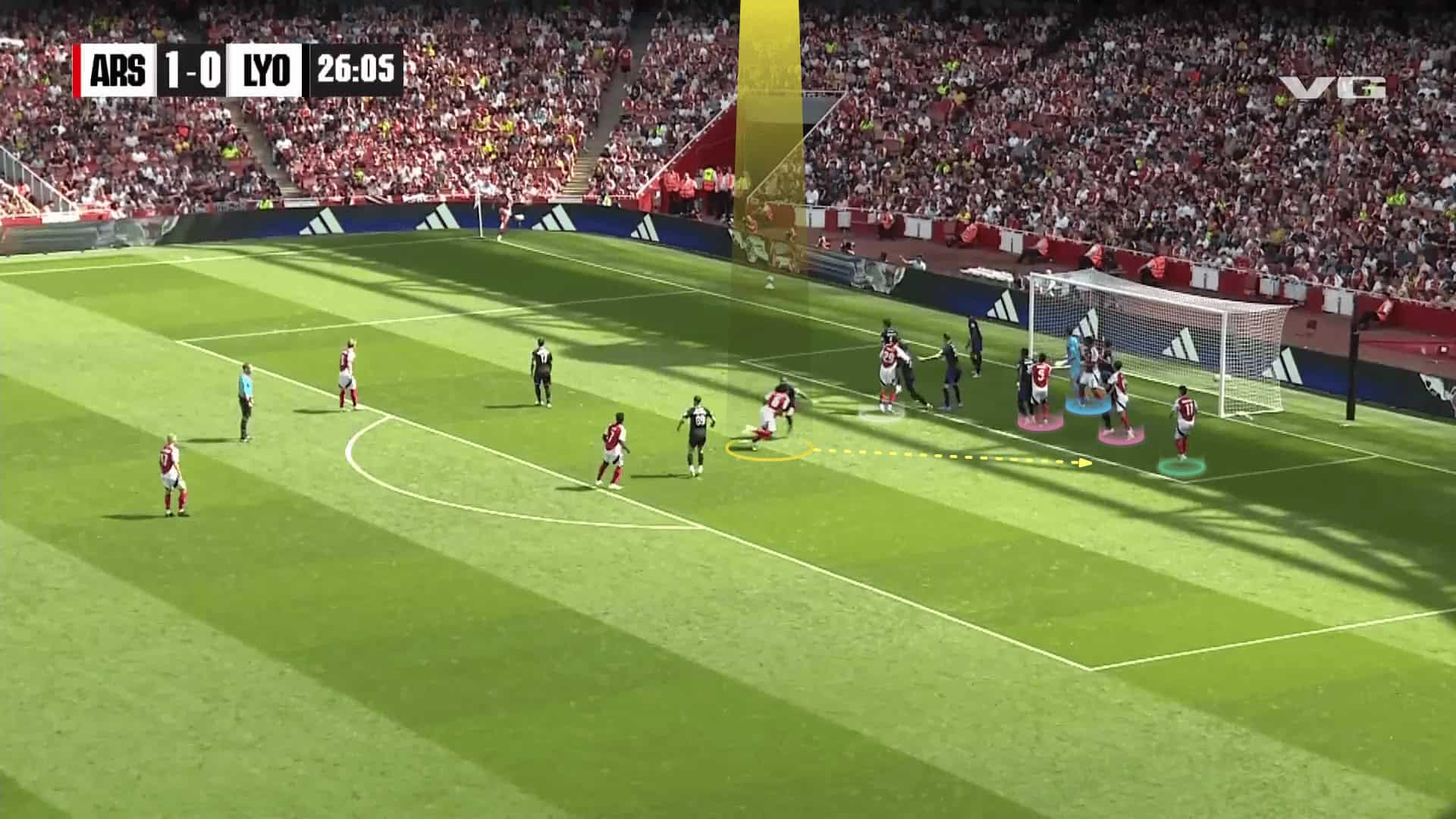
In the photo below, Gabriel Magalhães’ fake movement to the near post and then the far post gives his man markers two bad choices.
1- Turning around to keep tracking him and thus losing contact with the ball, as he did.
2- He keeps facing the ball, giving his back to Gabriel, losing contact with him.
This orientation problem gives Gabriel an advantage over his marker, but this isn’t the only advantage of this starting position.
Escaping from your man marker at this point means that he will run all that distance before reaching six yards, which means that he will have a dynamic mismatch over any stationary defender there.
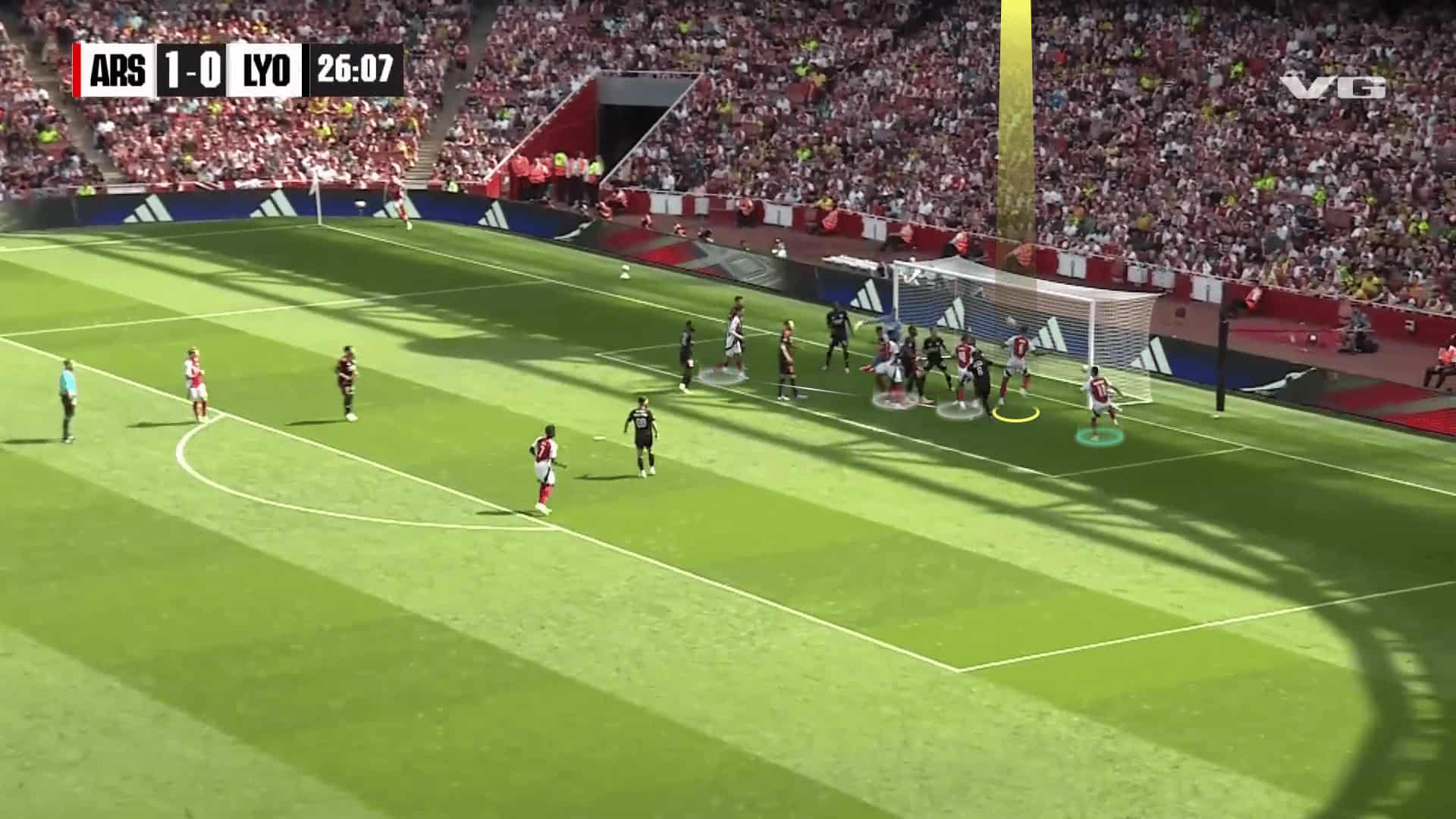
In the photo below, the plan was successful, and Gabriel scored.
However, I want you to consider the potential scenarios for a floated inswinging cross that is out of reach of the goalkeeper and defenders, allowing Gabriel to showcase his abilities.
Additionally, consider the goal’s framing: you can anticipate that Martinelli is ready in case the cross is higher than Gabriel’s.
Four players are positioned on the width of the goal in case Gabriel is unable to convert the cross or if the goalkeeper saves it, ensuring they are ready to capitalise on any rebound.
This scenario limits the possibilities of a threat to the goal, whether directly or through framing the goal.
The ball could pass everyone, resulting in a goal kick, or it could be miraculously touched by the goalkeeper or a defender, turning it into a corner kick.
They generally apply the same principles with a few changes according to the opponent’s defence system.
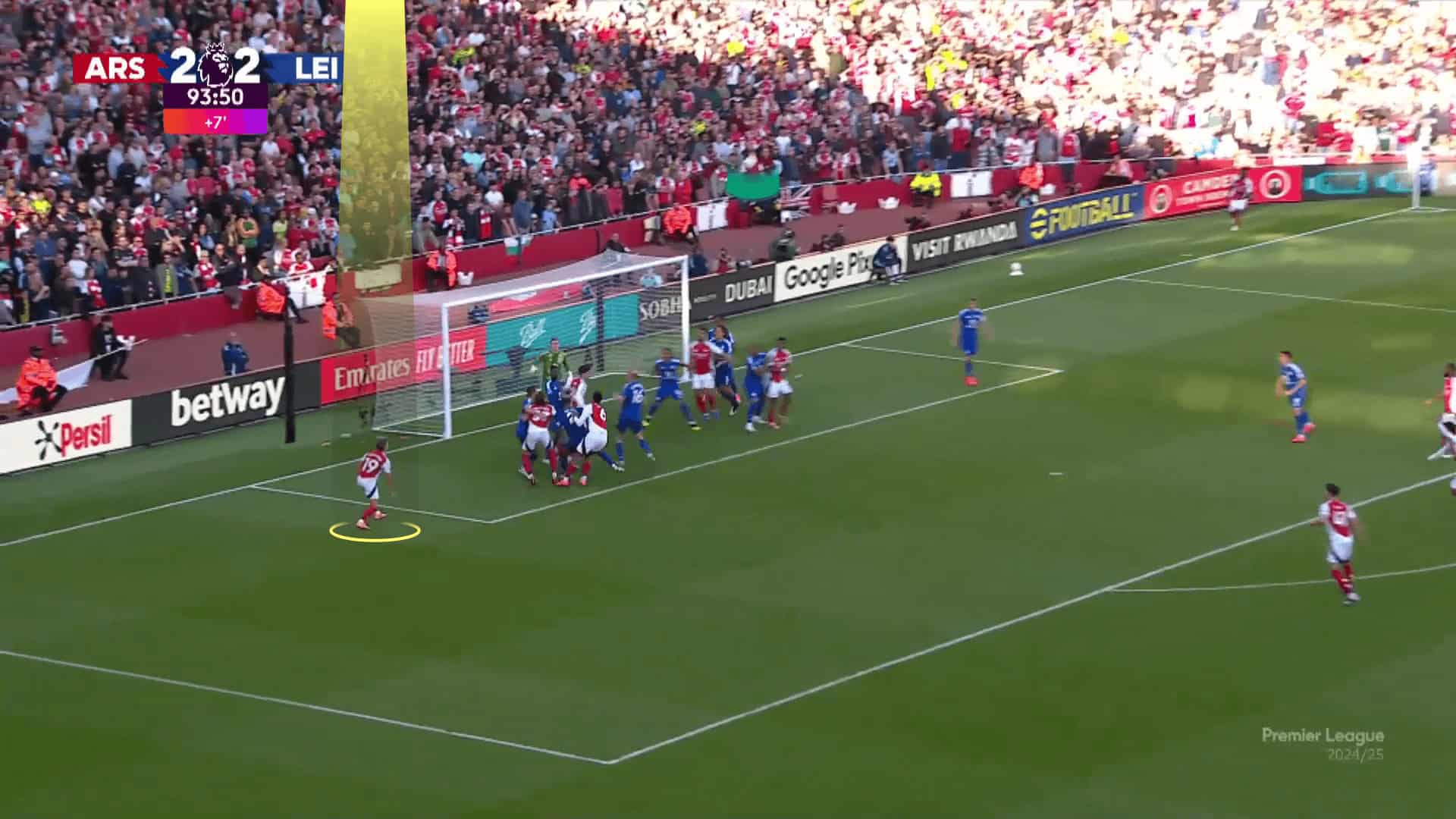
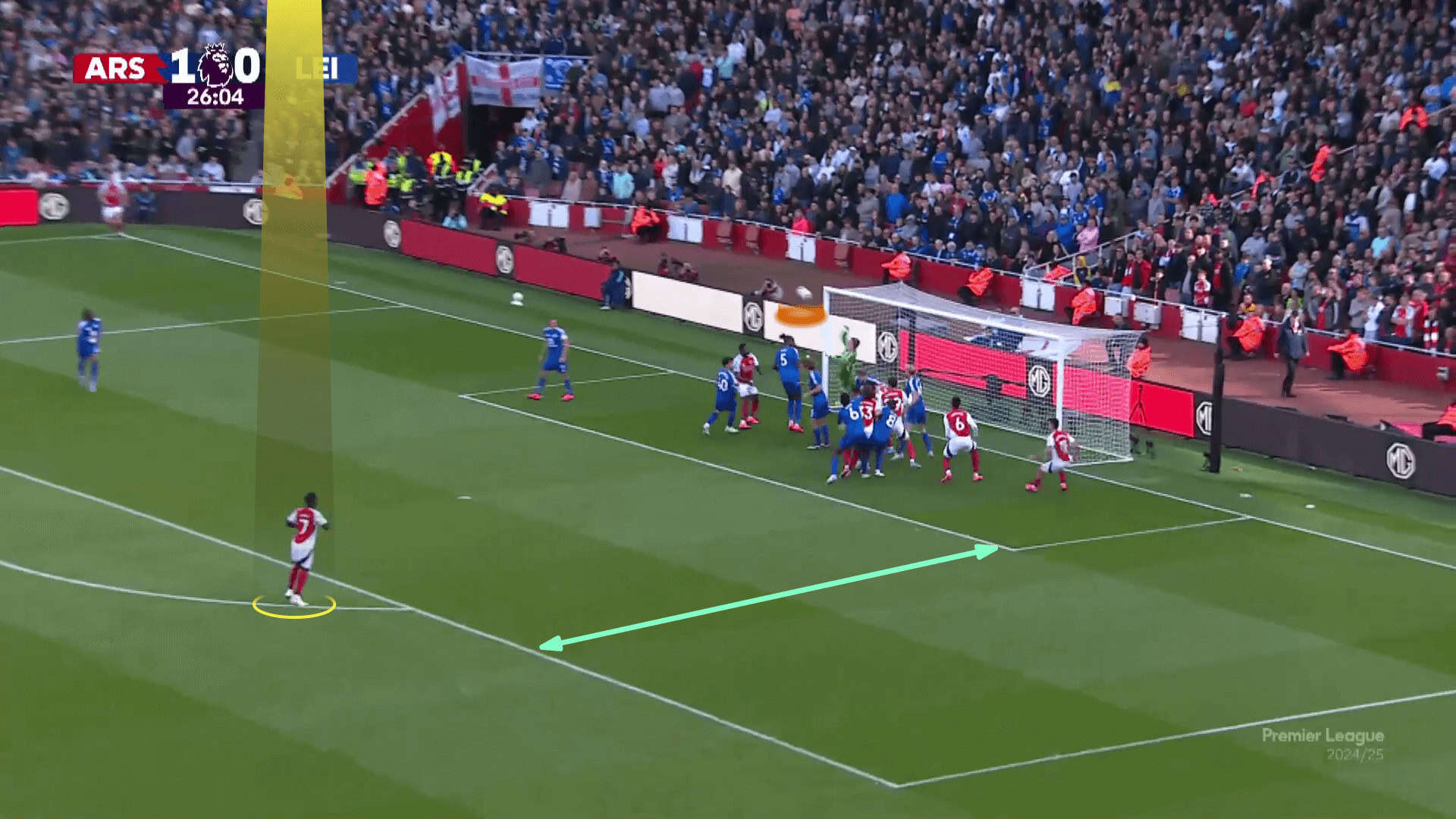
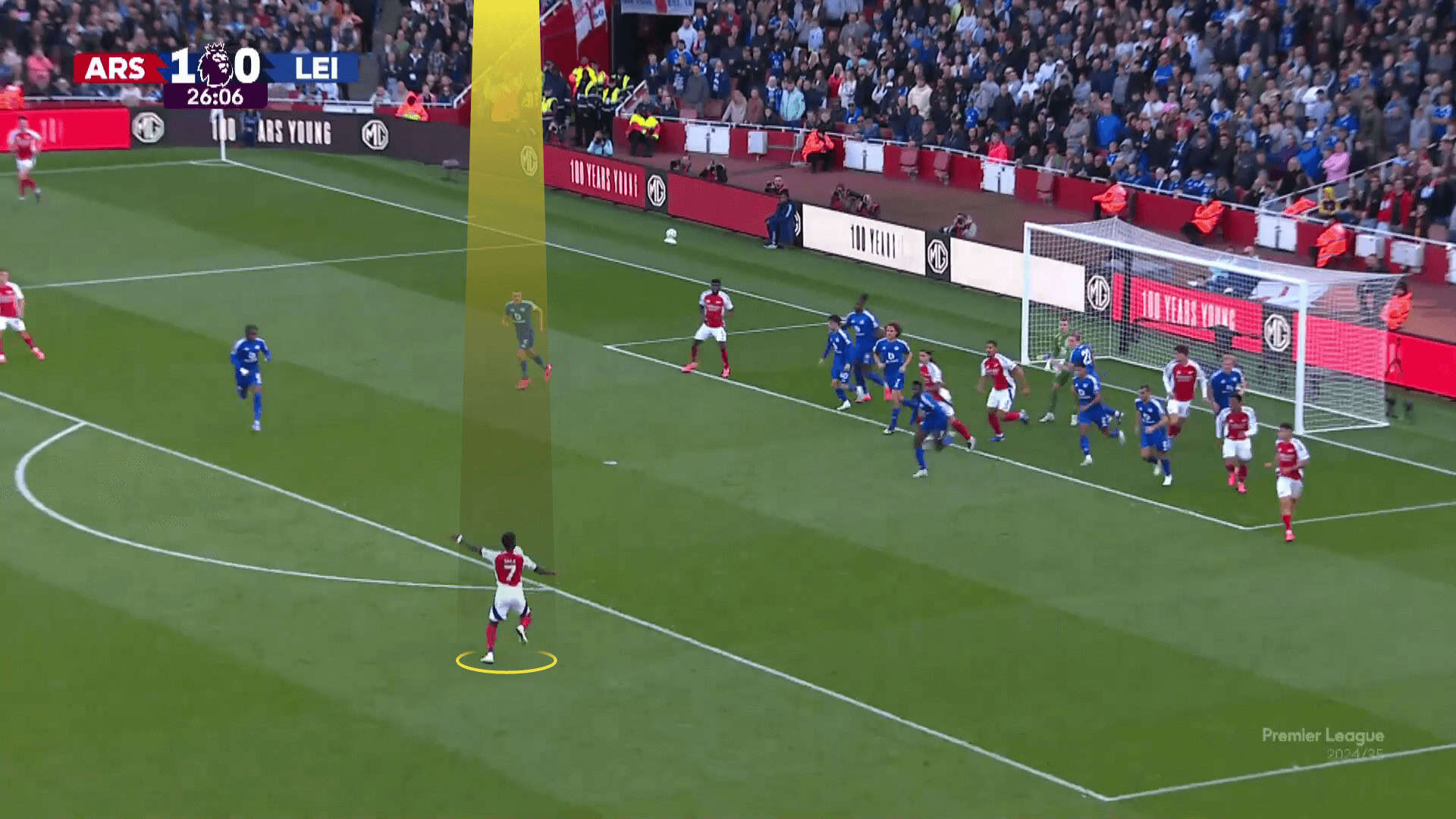
This small trick of framing the ball and the cross-flight helped them score many goals, including Leandro Trossard‘s crucial third goal against Leicester City.
As shown in the photo below, the ball (green) is overhit, but Trossard is ready to get the ball while his teammates frame the goal inside the six-yard line.
The result was an own goal because of the incredible pressure and traffic inside the six-yard box after Trossard’s touch.
To sum up, we want to highlight that they don’t allow a vertical rebound ball from the beginning.
They keep the horizontal rebound or overhit safe while reducing the probability of a vertical, dangerous rebound ball because of the floated, in-swinging cross.
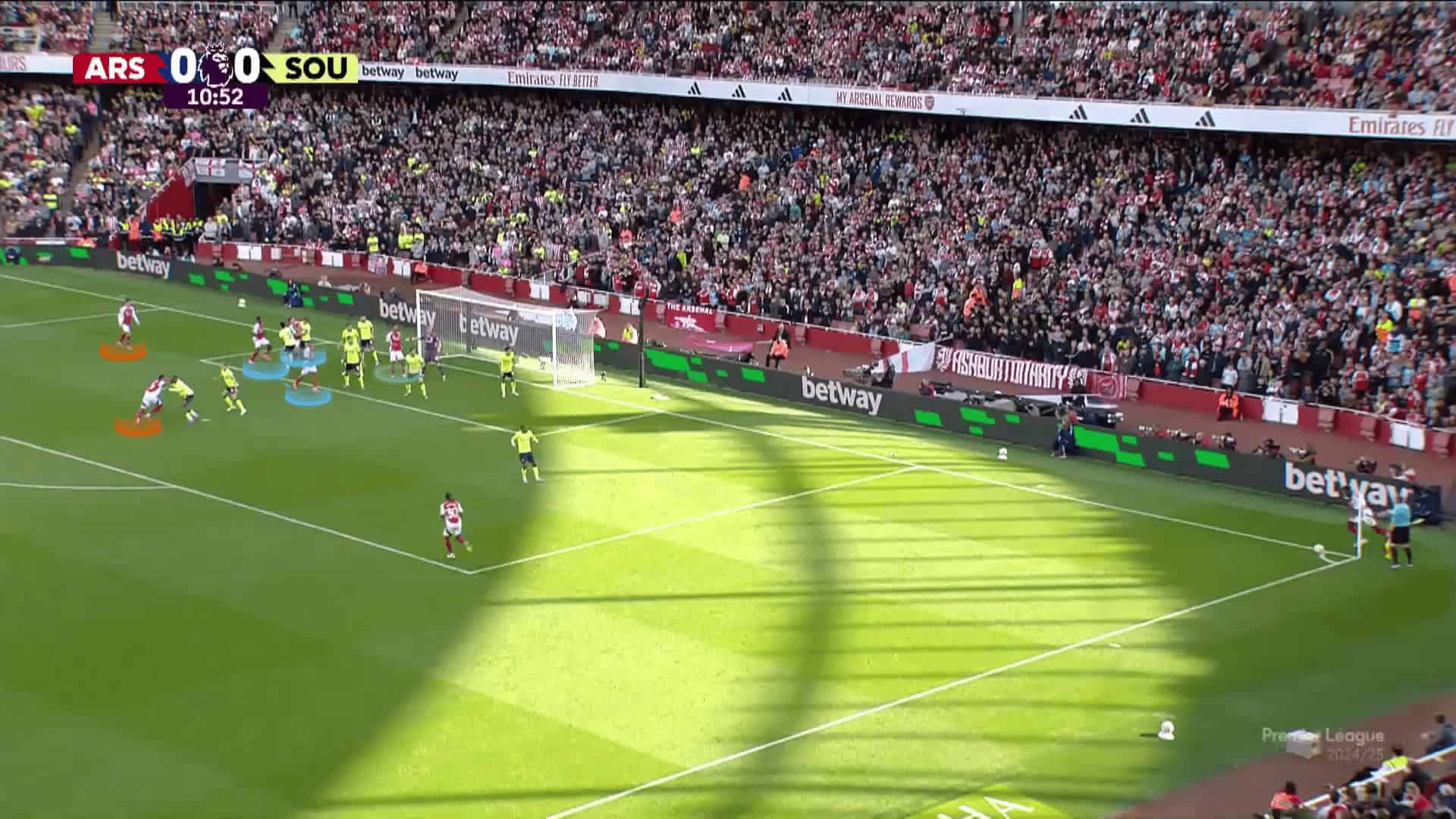
In the case below, we want to highlight how hard the goalkeeper can punch the ball into the ground to create a rebound.
Saliba (green) stands in his way to slow him down while the three blue players block the last zonal defenders, preventing them from stepping back to the targeted area beyond the far post for Havertz and Gabriel (Orange), who have a dynamic mismatch.
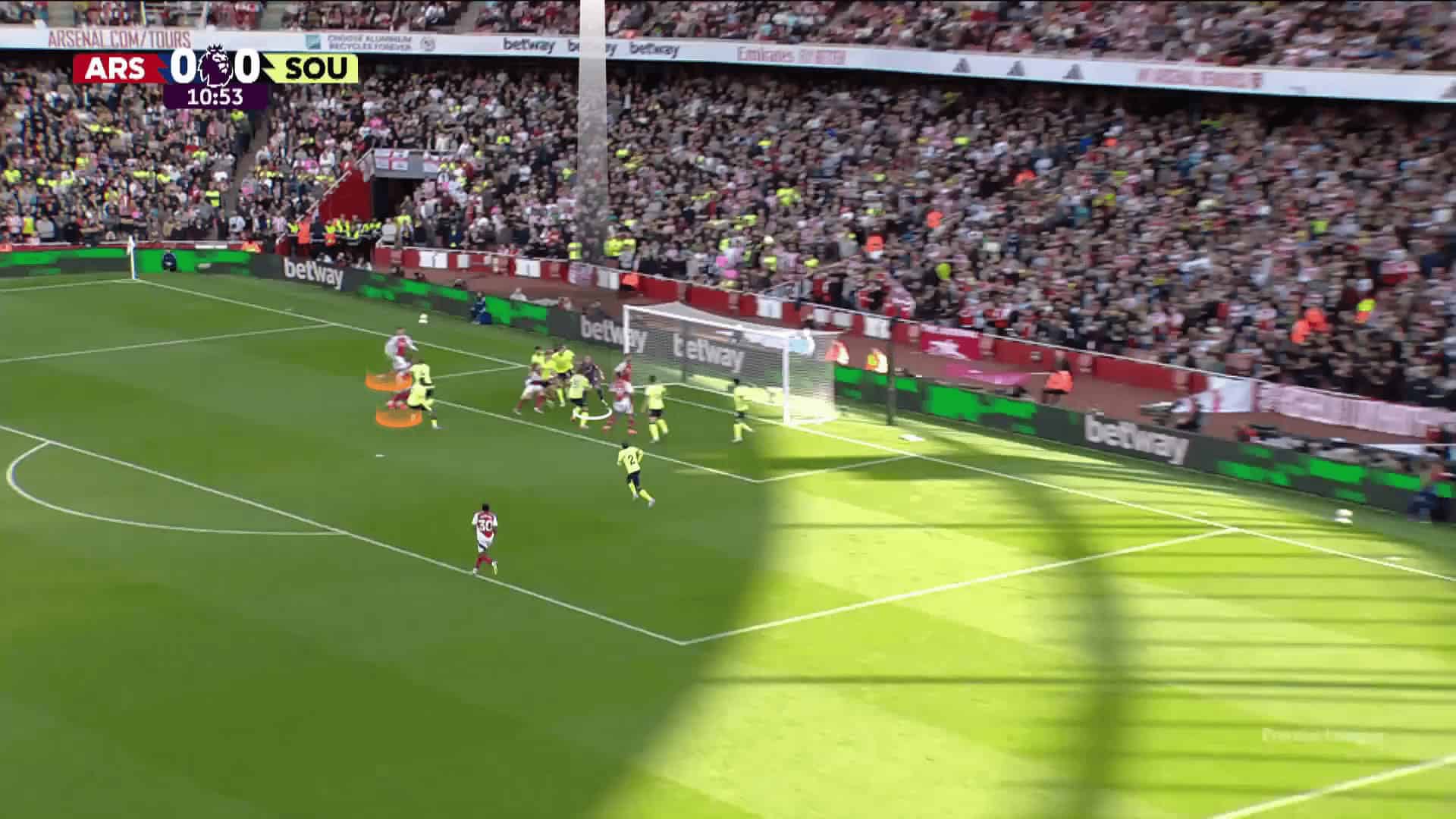
As shown below, the goalkeeper can push Saliba away, but there is still traffic between him and the targeted area.
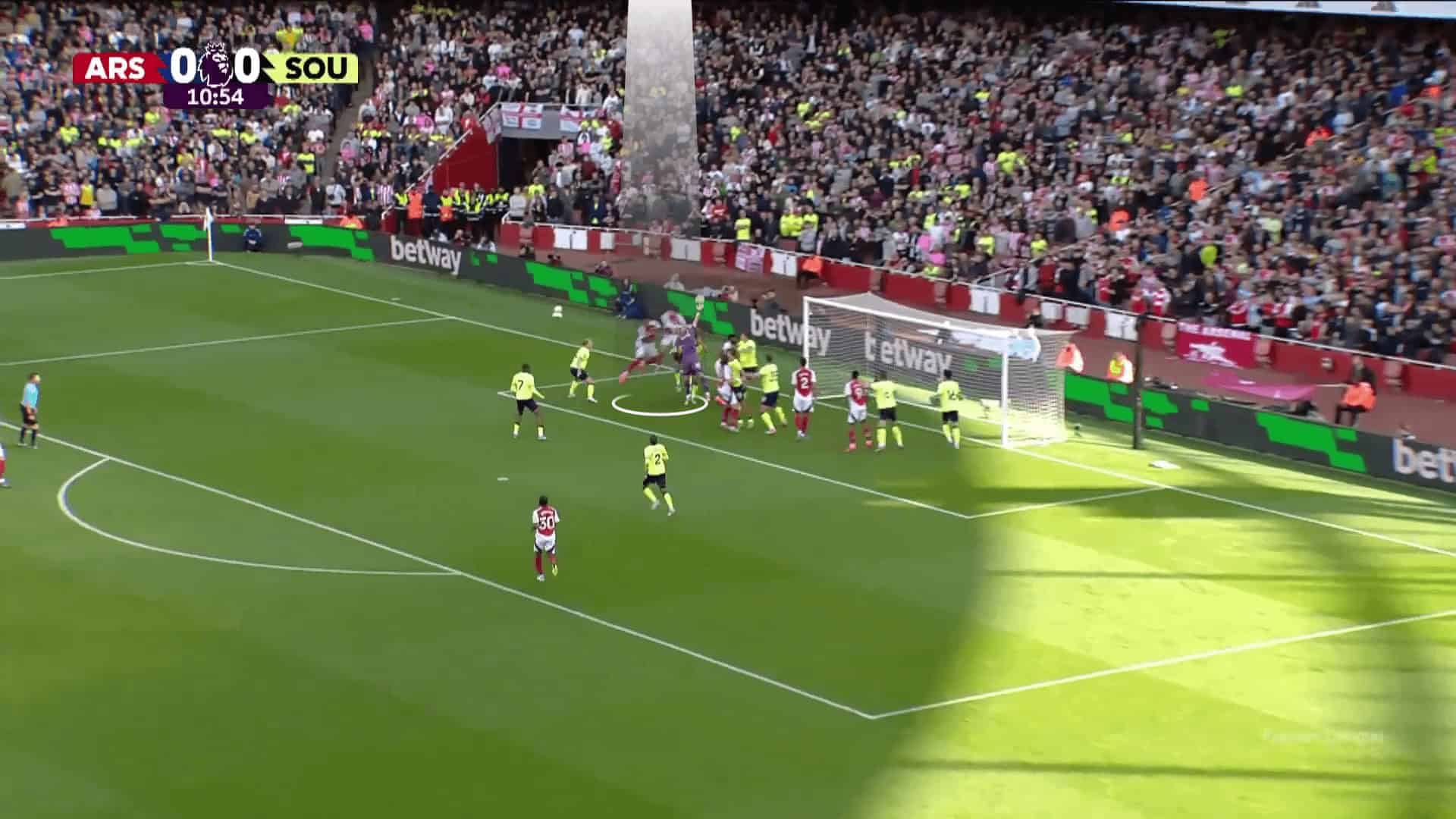
In the end, he hardly touches the ball, which is the maximum action he can take, resulting in another corner without a second rebound wave.
Targeting The Near Post With Overloading
As we have seen above, they aim to overload the targeted area with more than the targeted player; however, overloading is more evident when targeting the near post.
In the photo below, they target the near post, and the players are numbered according to their positions from the near post to the far post, while Saliba (green) goes to the goalkeeper as usual.
Their attacking strategy is to drag the first two zonal defenders inside the front of the six-yard box, thereby overloading the area behind them with the remaining three players.
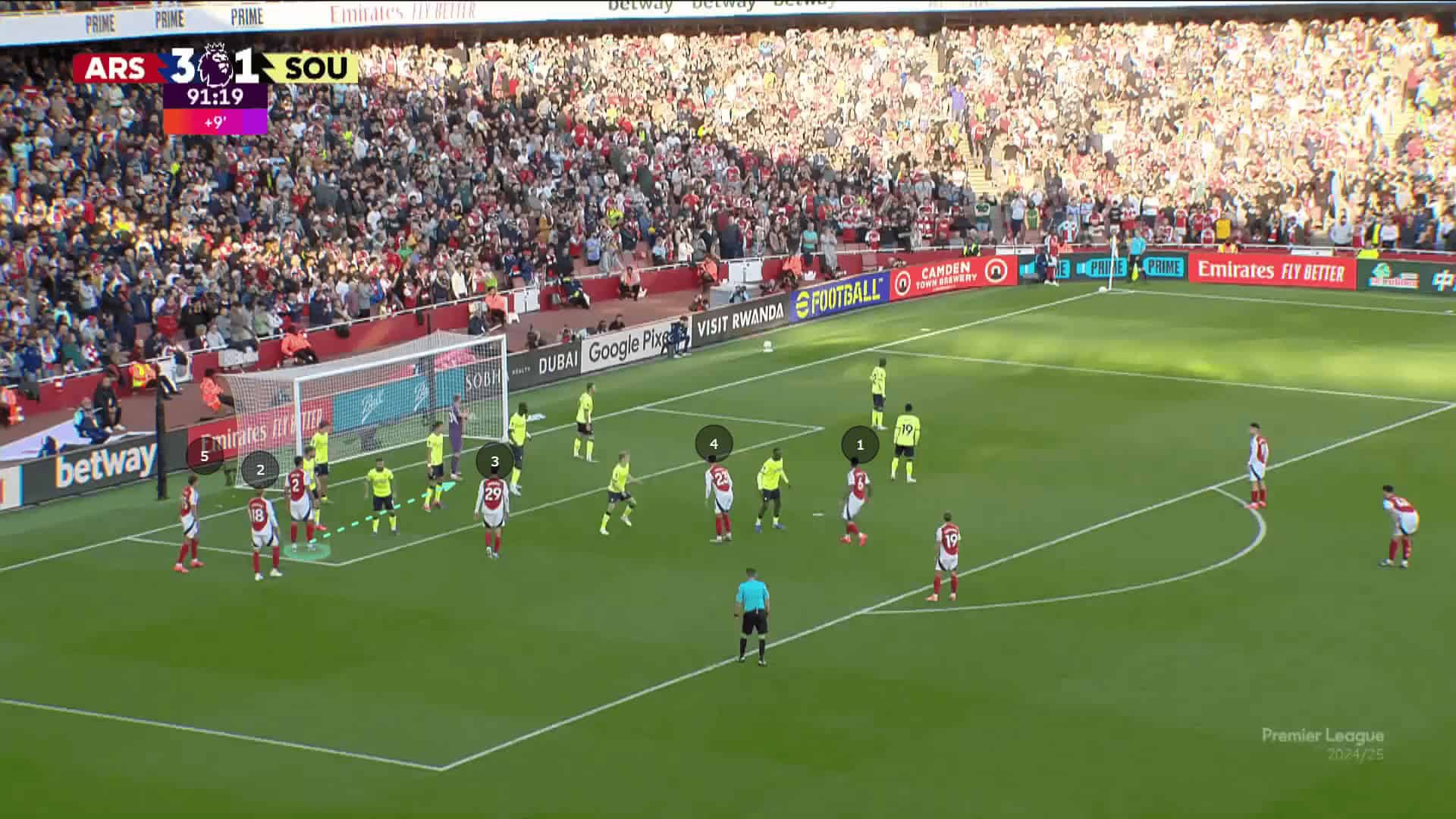
The plan works, and Havertz flicks the ball on, as shown below
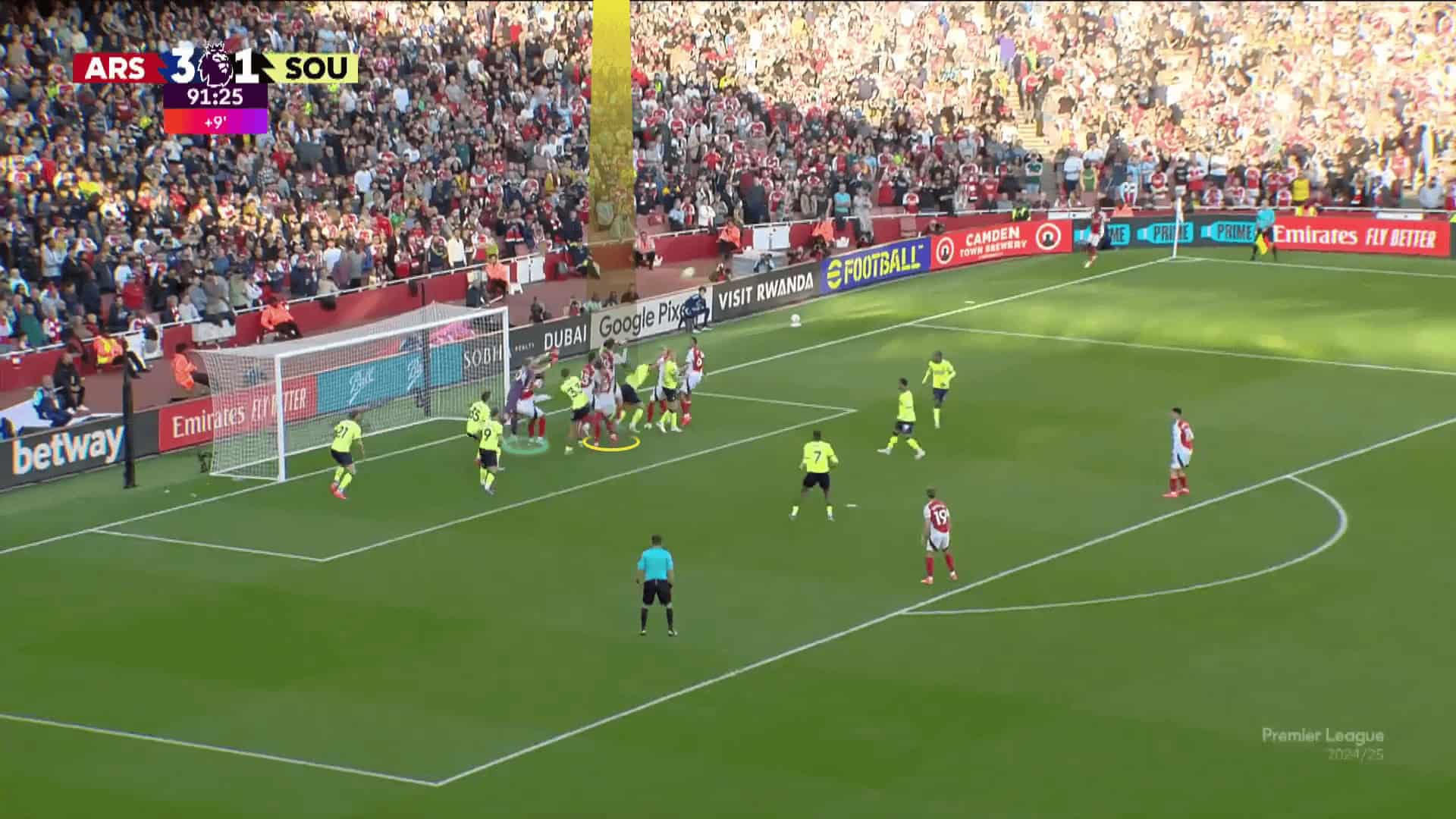
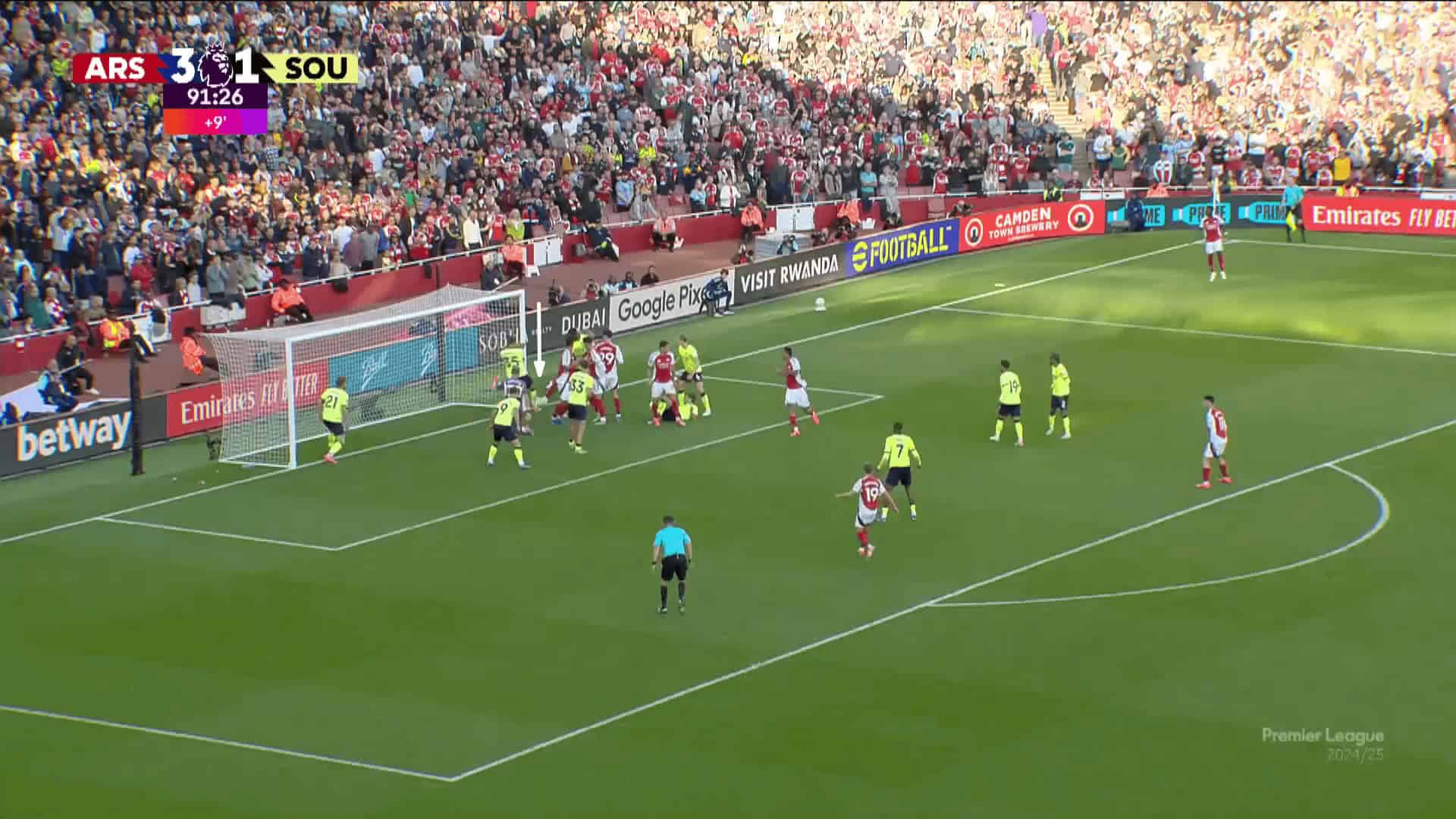
However, the goalkeeper saves it; then, the chaos begins in that overloaded area.
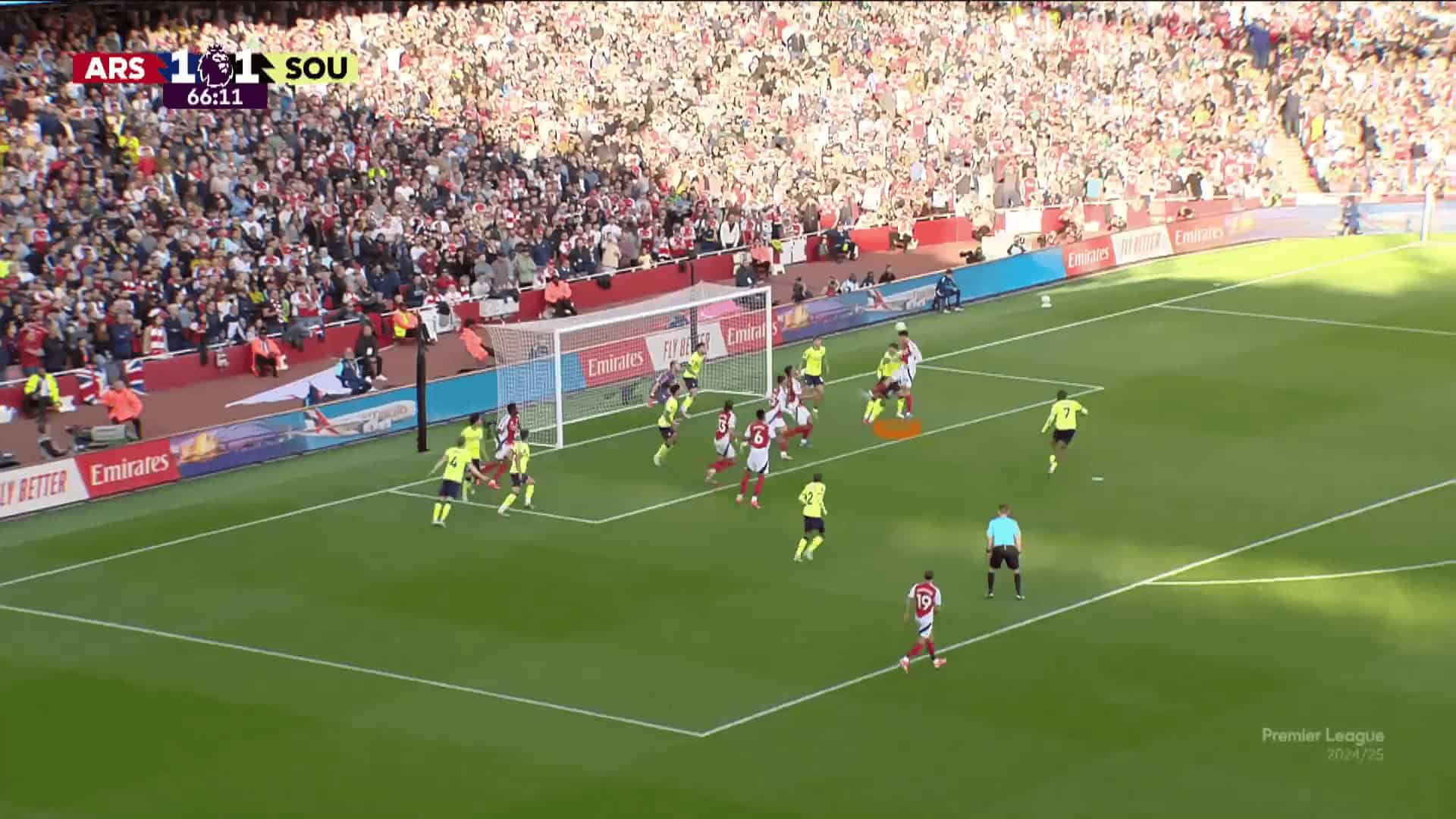
Below, you can see that Arsenal could score from a position near the post, as highlighted in the image, in a very dangerous area, thanks to their overloading, which causes the rebound ball to end up there.
They also use the same frame of the goal to secure the rebound horizontally.
As shown below, the opponent manages to get the first touch at the near post, but two players frame the rest of the goalmouth.
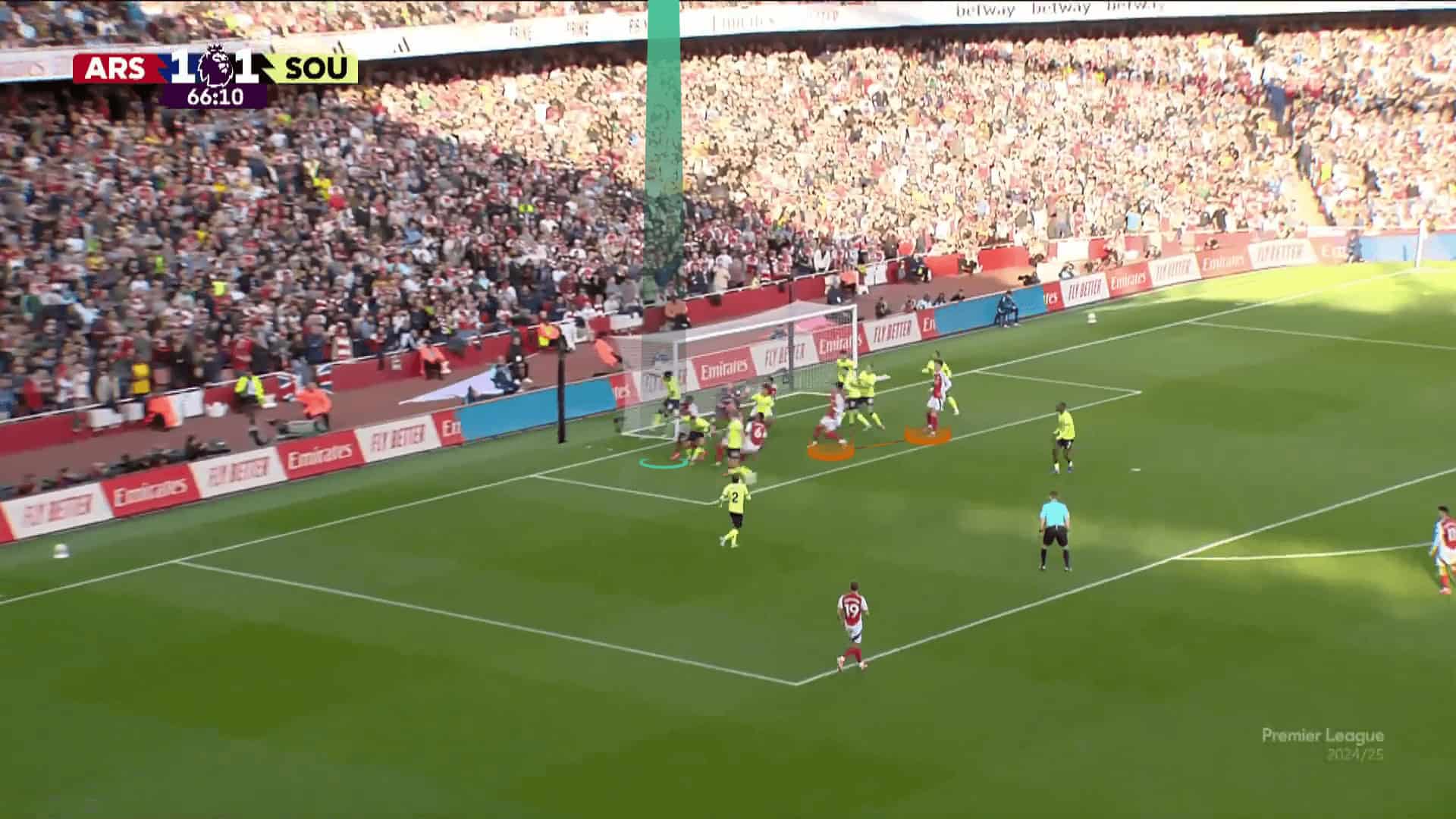
One of them, Havertz, manages to get the second ball and threatens the opponent’s goal.
Being Ready For The Rebound
You may be asking, what if the goalkeeper or defender manages to claim the ball inside the box?
As shown below, they can harm opponents from the rebound because all of the defenders are dragged into the six-yard box, leaving one defender responsible for the edge of the box.
This defender is coming from a distance because of a probable short option.
In the end, the area between the six-yard box and the edge of the penalty box is so empty, especially against teams that have man markers who can be dragged inside the six-yard line, not a second line or just blockers outside the six-yard line.
Saka can exploit this zone and harm the opponent with a shot.
You may now ask about their reaction when the opponent has enough players on the edge of the box or between it and the six-yard area, so there is no escape from a rebound ball.
Let’s see below how they react when they need to maintain pressure and counterattack from the start.
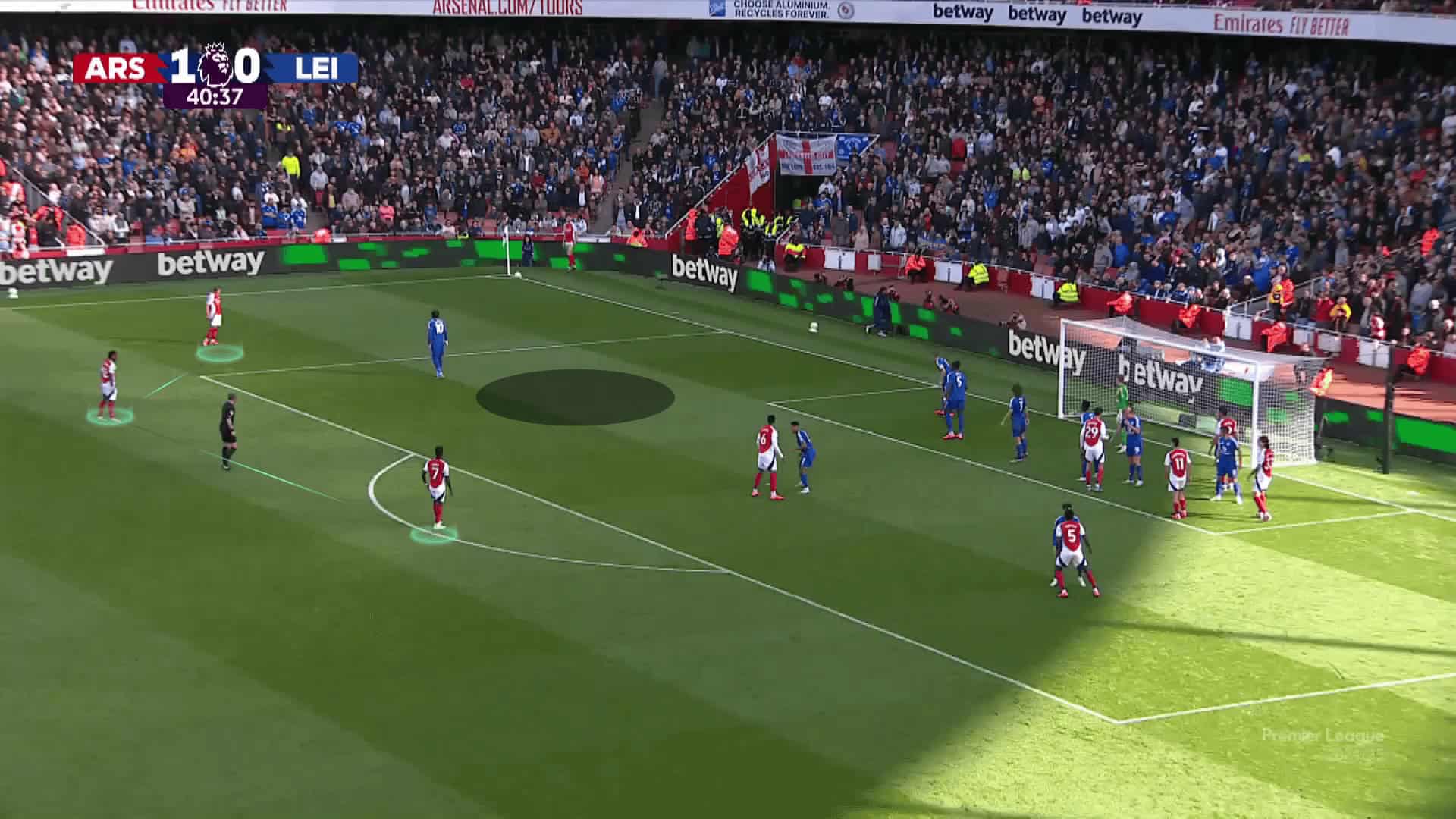
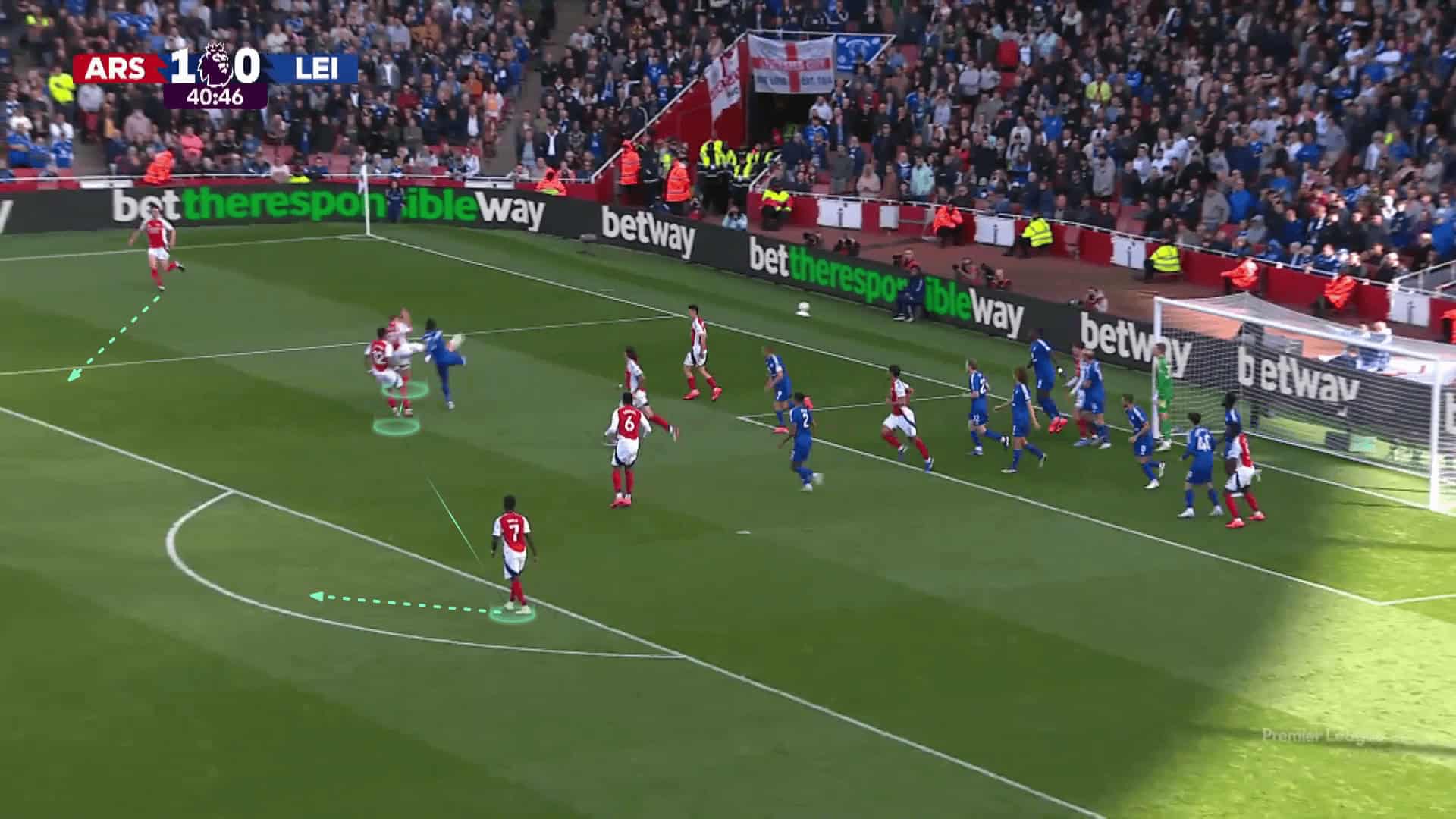
As in the case below, Arsenal’s two rebound players are standing very close to the edge of the box with a mentality of relentless pressure rather than retreating.
The player on the ball’s side goes into the box to press, preventing the opponent from setting up a good counterattack.
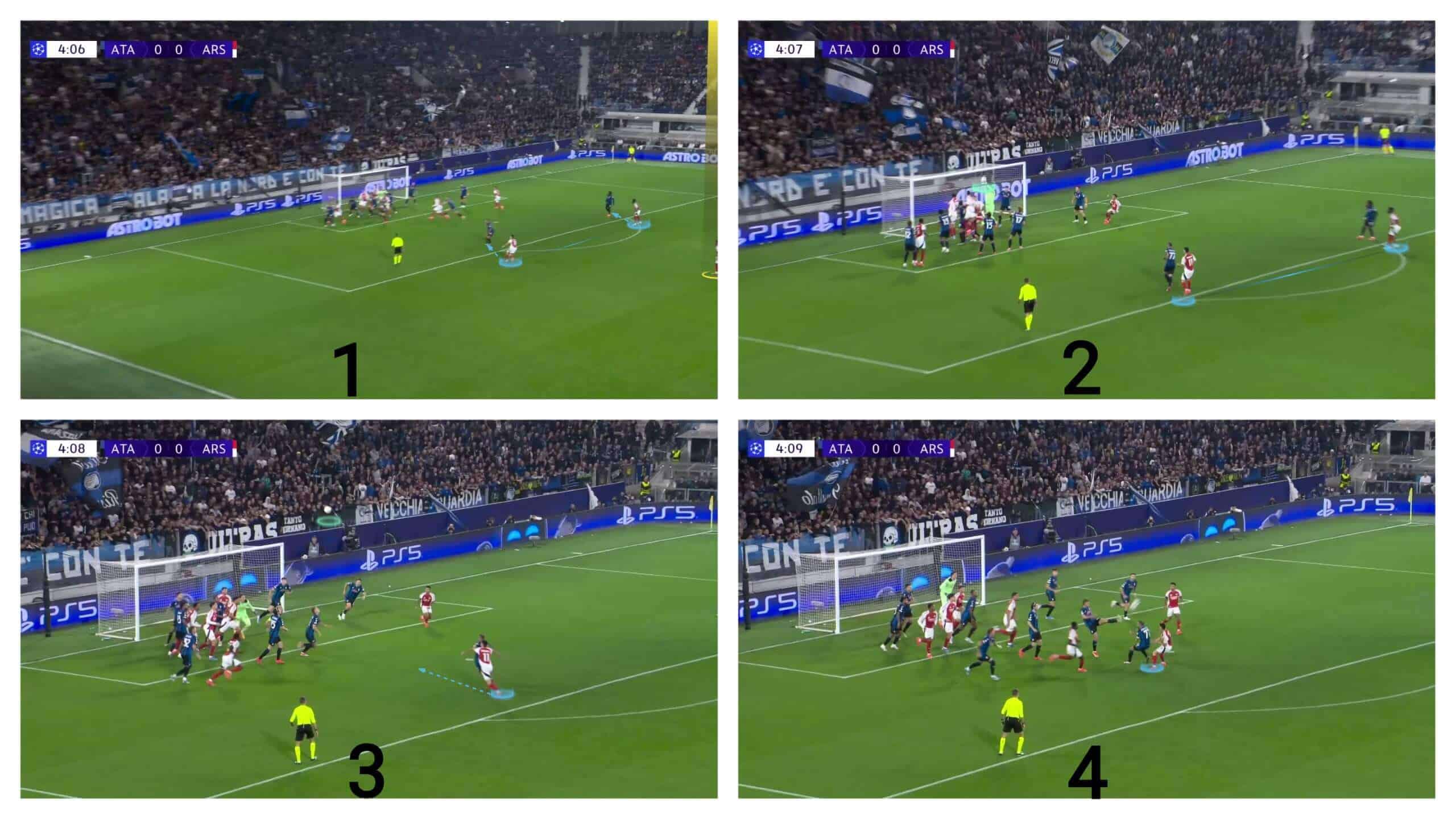
They also instruct these two players to adapt to the targeted area, meaning they stand toward the near post if the targeted area is there.
This allows these players to press in high positions and regain possession to prevent any counterattack, while also maintaining their own attack, as shown in the two photos below.
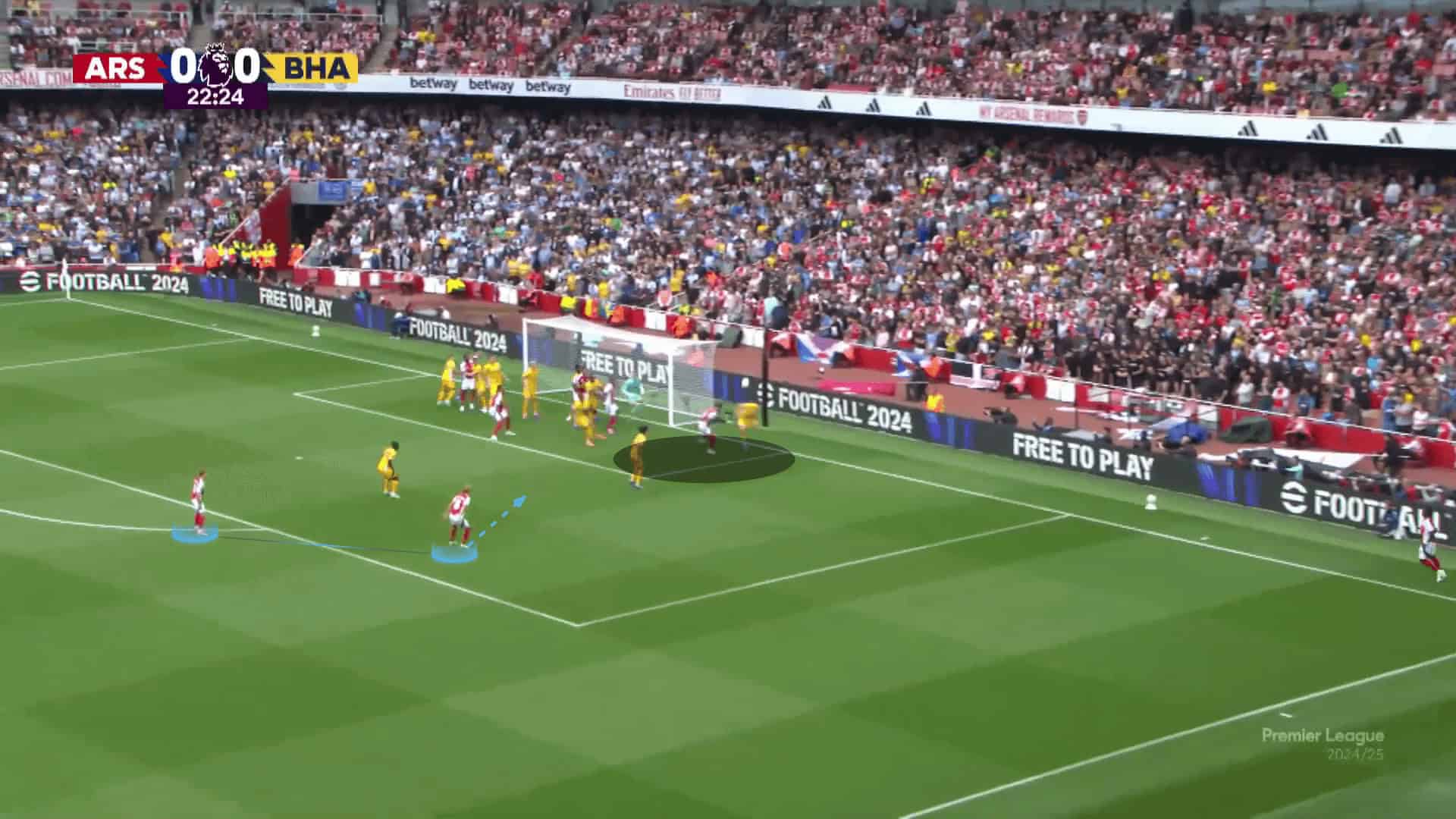
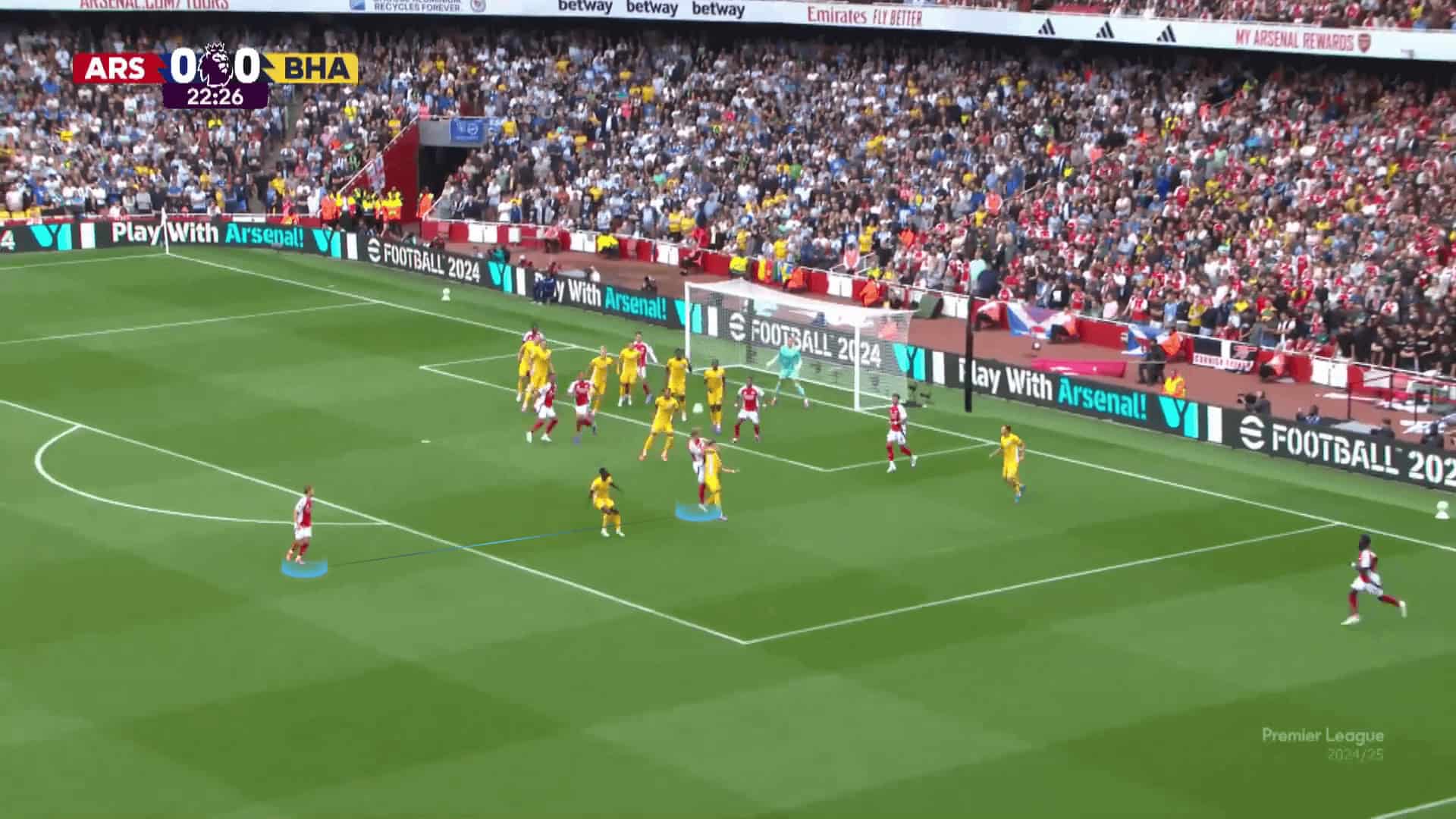
After the first two players are on the edge of the box, a ‘security player’ is positioned behind them, ready for counterattacks in case the goalkeeper catches the ball, which is rare.
Note: One of the rebound players may initially position themselves near the taker as a fake short option to draw the first zonal defender further forward or for other tactical purposes.
However, he goes back inside as the taker moves to maintain the same triangle.
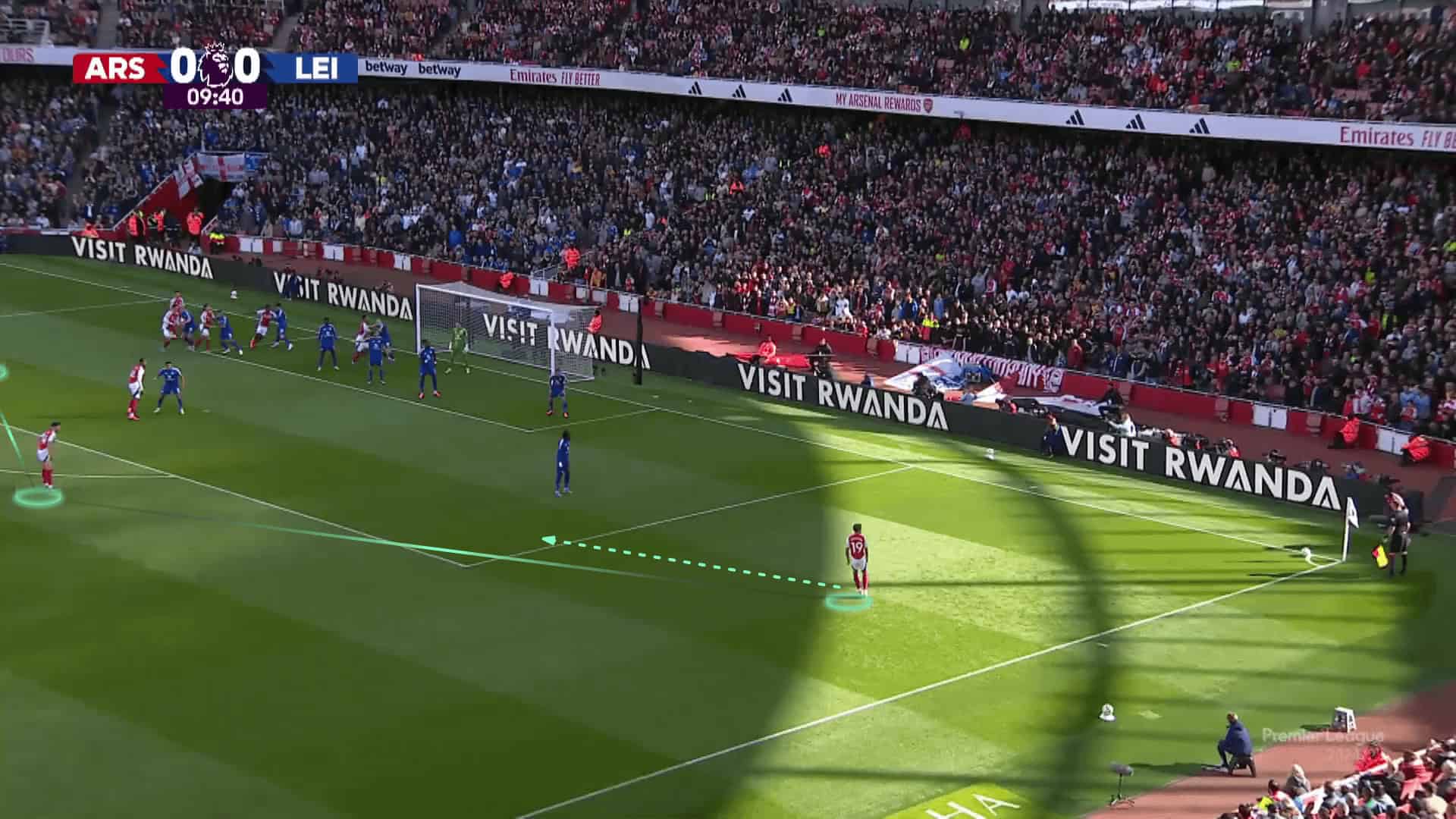
The goalkeeper manages to catch the ball and sends a long ball, so the security player in the middle will run back directly.
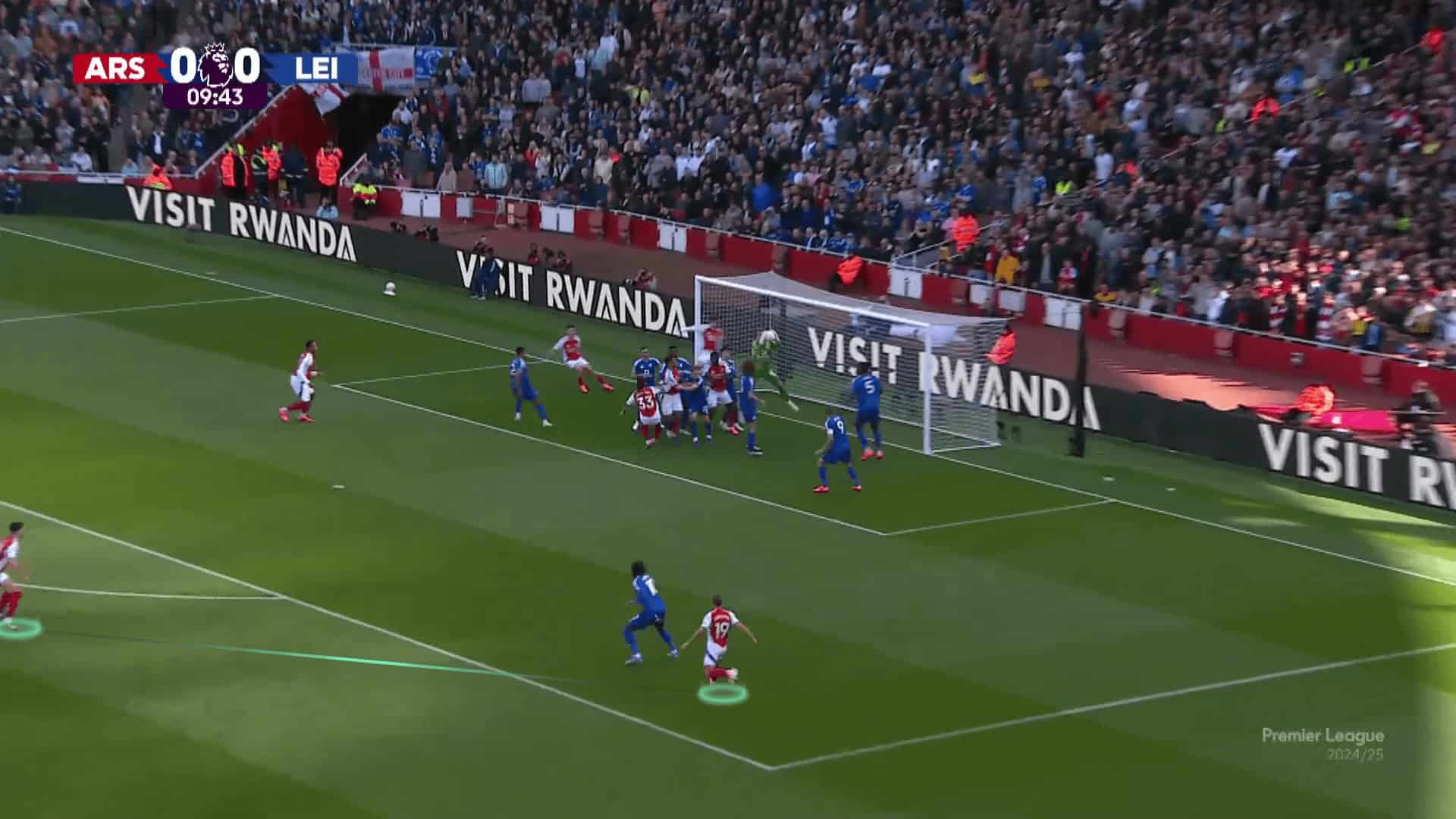
Below, we see the security plan being performed perfectly.
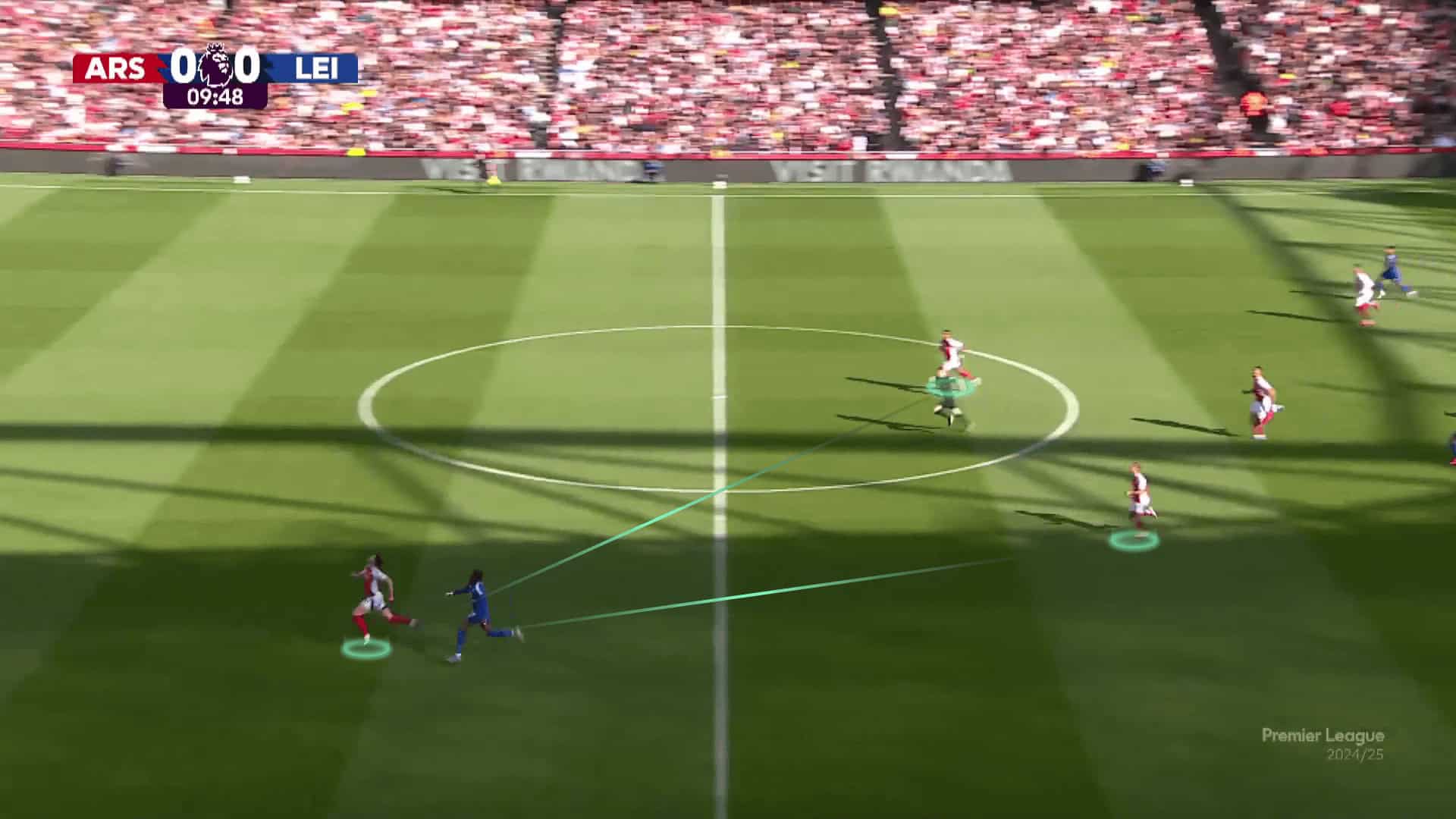
Even this security player in the middle can press roughly if the ball lands near him with the far rebound player and the taker covering behind him, as shown in the two photos below.
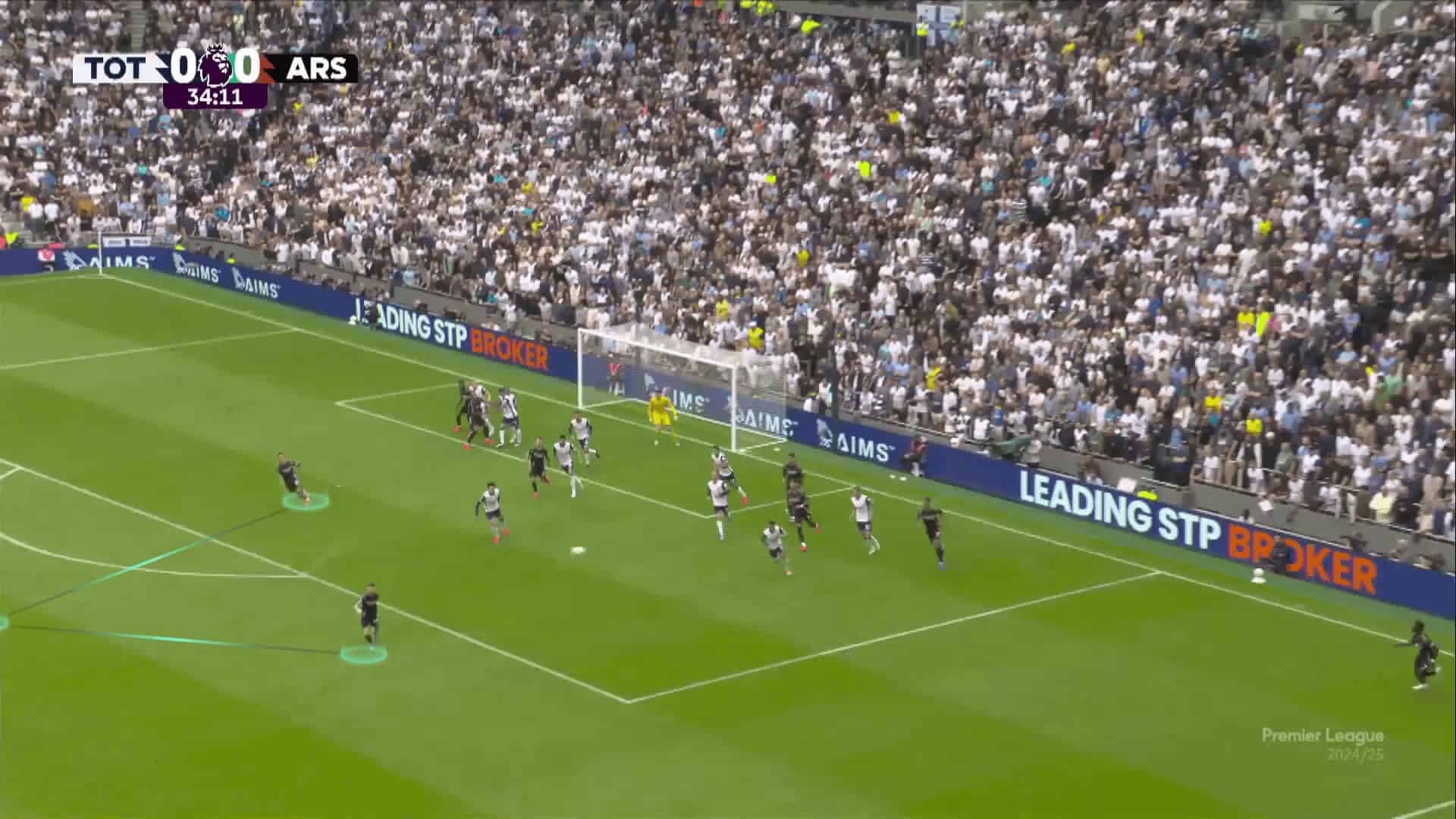
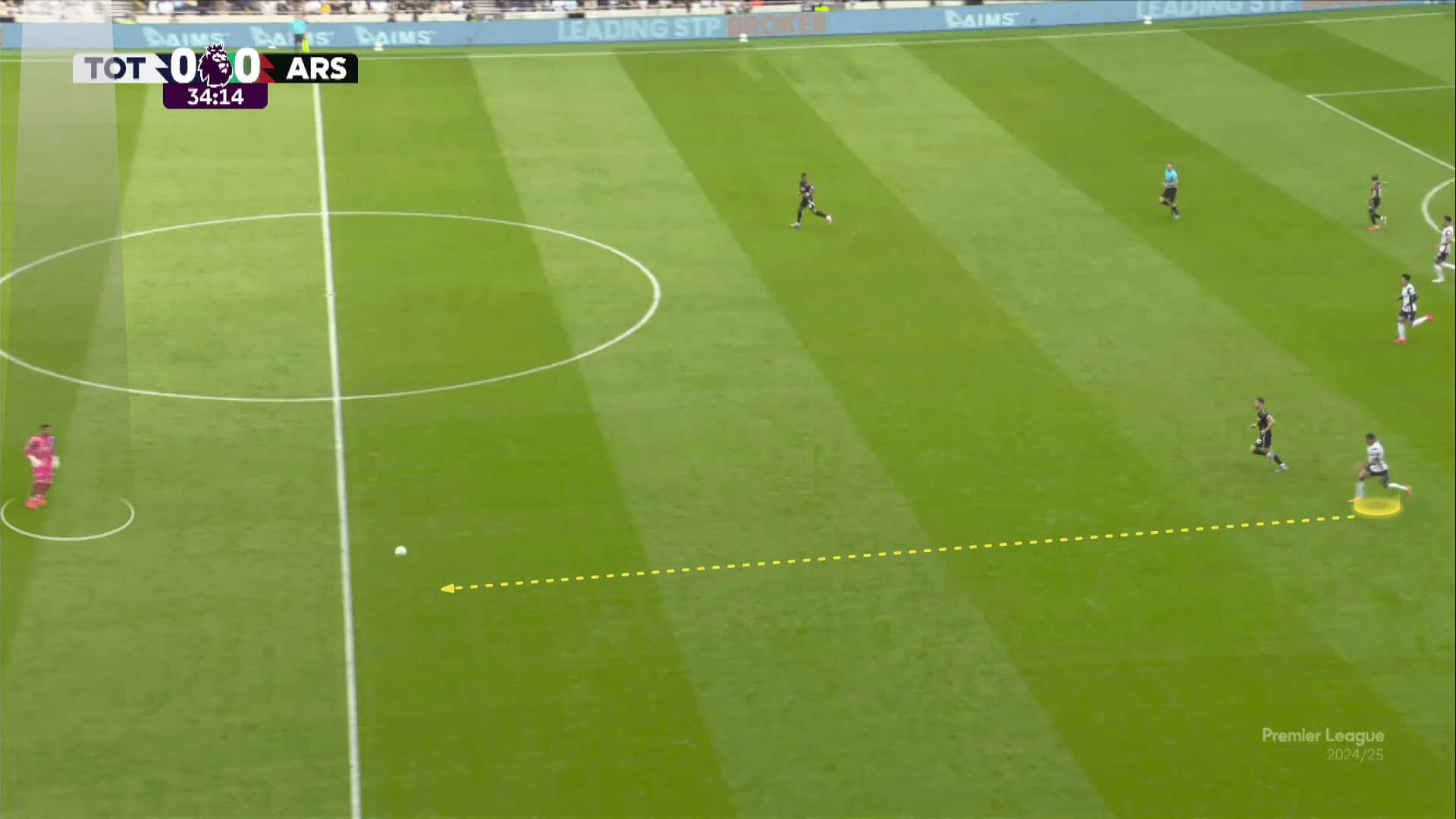
After all of that, the goalkeeper stands in the middle of the pitch trying to help in any probable counterattack, as in the two photos below.
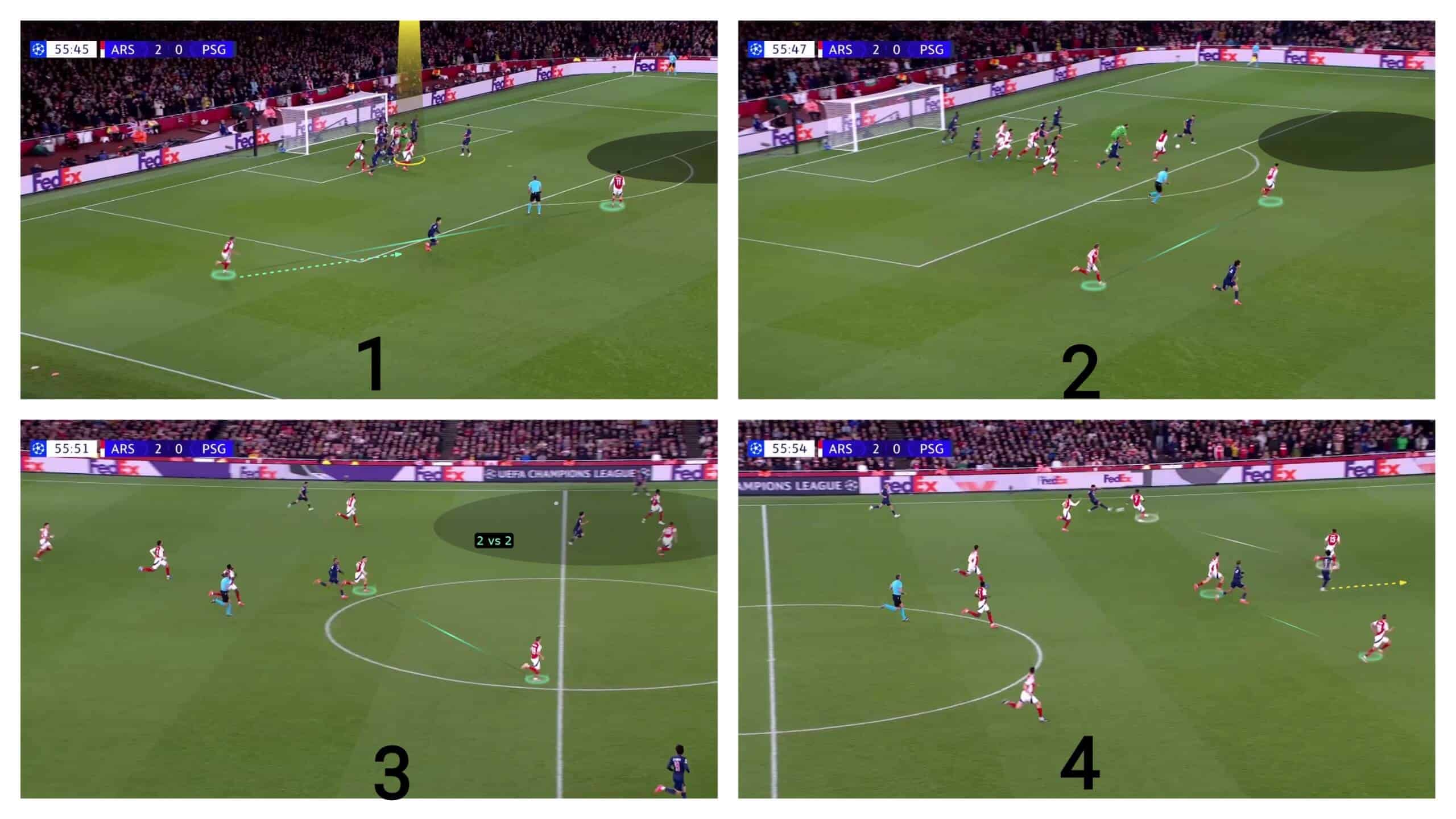
In terms of a weakness, against PSG, the French team deployed two attackers in the front during the corner, which may have been a prepared tactic or a reaction to being down 2-0; nevertheless, let’s examine the consequences.
In the first photo below, Gianluigi Donnarumma catches the ball, while we see two green rebound players, not three.
So, where is the third one on the right side?
In the second photo, he passes the ball to a player on the empty side who can dribble in a dangerous counterattack.
The answer is in the third photo, where Arsenal positions two players to create a 2-v-2 situation at the back, eliminating one of the six attackers inside the box and one of the three rebound players.
In the fourth photo, PSG’s player can perform a good through ball, but it isn’t accurate, so the goalkeeper gets it.
However, it is difficult to say that this is a weakness because they weren’t really troubled, and because it is challenging to sustain that strategy in the long term, leaving Arsenal’s monsters inside the box and dispensing with two defenders. Nevertheless, it is worth mentioning for probable future possibilities.
Conclusion
In this analysis, we aim to explain Arsenal’s excellence in attacking corners from a different perspective, highlighting that they consistently prioritise defensive security while attacking corners.
In this set-piece analysis, we have also shown how their attacking strategy has resulted in them not receiving a lot of counterattacks because they make it hard for the opponent to clear the ball comfortably, besides their rebound scheme, which makes them excellent at rest defence and ready to press aggressively, while being safe at the same time.
