
After captivating fans for a month, the newly expanded 32-team 2025 FIFA Club World Cup has ended.
Ultimately, Premier League giants Chelsea emerged victorious from the competition, defeating Paris Saint-Germain by three goals to nil in Sunday’s Final.
In a surprise to many, the 2024/2025 UEFA Conference League champions and fourth-placed Premier League side got one over on the newly crowned champions of Europe.
So, how did Chelsea manage to do it against a typically dominant PSG side, who had recently destroyed giants like Real Madrid (4-0) & Inter Milan (5-0)?
This Club World Cup Final tactical analysis will examine Enzo Maresca tactics in-depth and break down how Chelsea attack and high press were able to stump Luis Enrique PSG to lead the Blues to glory in Sunday’s World Championship showcase.
We will focus on Chelsea tactics both in and out of possession, emphasising the value of their high pressing defence and off-the-ball movement in attack.
Club World Cup Final Lineups & Formations
Before delving into our in-depth football analysis, we’ll provide an overview of how both teams set up, in terms of structure and personnel, for the Club World Cup Final.

Eventual CWC winners Chelsea played in a 4-4-1-1 formation.
Robert Sánchez started between the sticks for the Blues, with the backline comprising Malo Gusto (right-back), Trevoh Chalobah (right centre-back), Levi Colwill (left centre-back) and Marc Cucurella (left-back).
Reece James and Moisés Caicedo started in central midfield, with Cole Palmer (right) and Pedro Neto (left) lining up on the wings.
To complete the Chelsea starting XI versus PSG, Enzo Fernández played off centre-forward João Pedro.
Enzo Maresca made four substitutions in Sunday’s game.
Their first change came just after the hour mark when Andrey Santos was introduced for Enzo Fernández.
This sub was followed shortly after by the introduction of Liam Delap for João Pedro.
Finally, in the 77th minute, Chelsea made a double substitution, with Kiernan Dewsbury-Hall and Christopher Nkunku coming on for Reece James and Pedro Neto to see out the game with the Blues enjoying a healthy lead.
As for the silver medalists, PSG lined up in a 4-3-3 formation, which was almost identical to their starting XI from the UEFA Champions League Final against Inter Milan, with the exception of Lucas Beraldo at left centre-back in place of Willian Pacho.
Gianluigi Donnarumma was in the net behind Achraf Hakimi (right-back), Marquinhos (right centre-back), Beraldo (left centre-back) and Nuno Mendes (left-back).
Vitinha assumed the deepest of the three midfield positions behind João Neves and Fabián Ruiz.
2025 Ballon d’Or favourite Ousmane Dembélé led the line for Les Parisiens with Désiré Doué and Khvicha Kvaratskhelia on the wings.
Like his Chelsea counterpart, Luis Enrique also made four changes to his starting lineup before the 90 minutes had been played.
PSG’s first change saw Bradley Barcola come on for Kvaratskhelia just before an hour had been played.
Then, in the 73rd minute, Enrique made a triple substitution, bringing on Gonçalo Ramos, Senny Mayulu, and Warren Zaïre-Emery for Hakimi, Doué, and Ruiz.
However, the subs could do little to change the outcome.
Chelsea High Press Vs PSG
Chelsea were brave without the ball and prepared to press PSG’s backline high during Les Parisiens’ build-up.
In the 2024/2025 UEFA Champions League Final, Inter did not do this, and PSG was given too much space on the wings, which they exploited repeatedly through intelligent movement.
Chelsea didn’t allow this to happen on Sunday, shutting down many of PSG’s attacks before they got underway and forcing turnovers that allowed the Blues to initiate their own attacks, sometimes from dangerous positions.
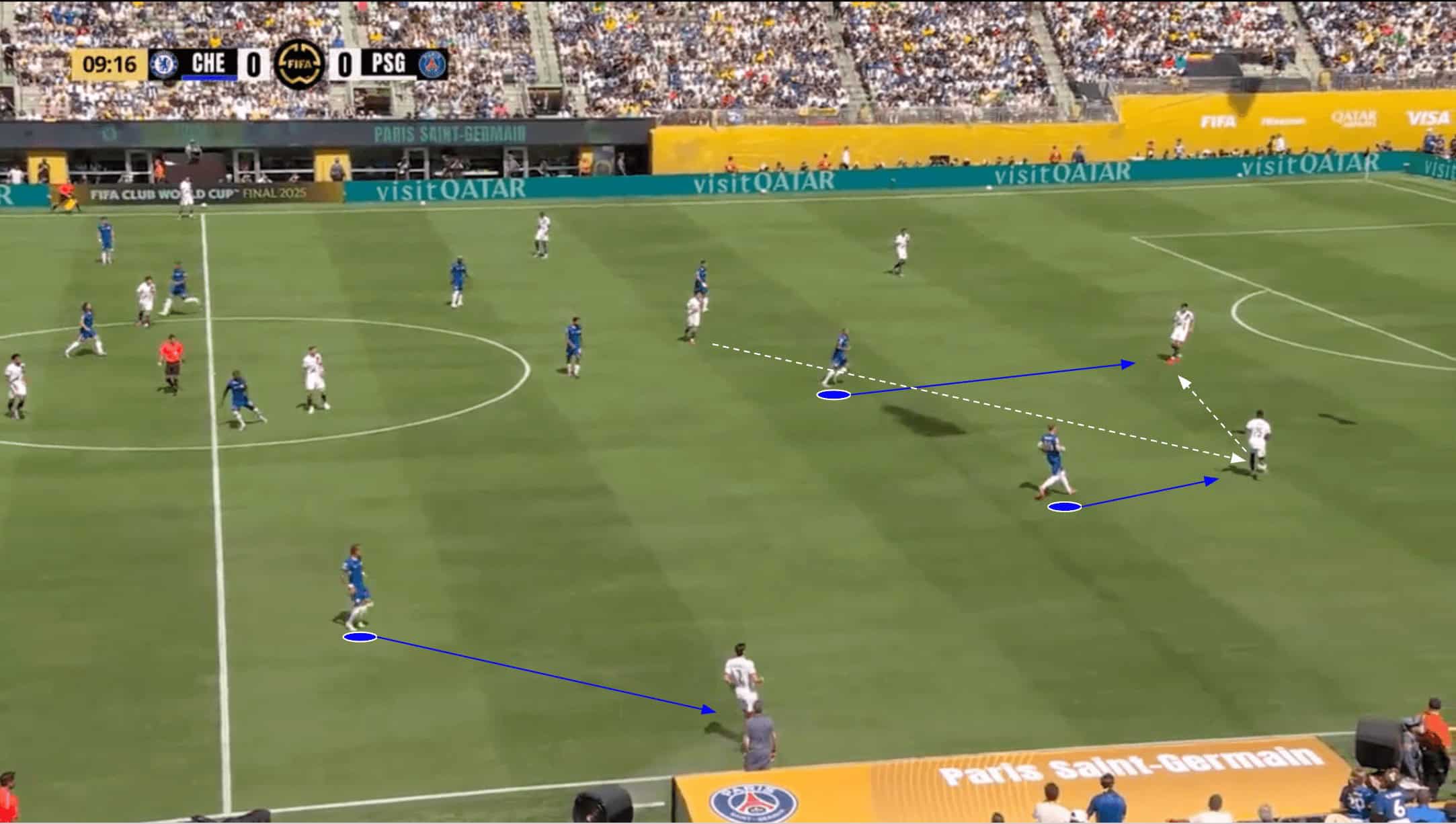
Chelsea’s high press generally relied on principles of zonal marking with a strong man-orientation.
Enzo Fernández typically joined João Pedro in pressing PSG’s centre-backs, while Chelsea’s wingers retained access to PSG’s full-backs.
These were the typical assignments for those players, which lines up with how we see Chelsea organised in Figure 2, with the centre-forward and ‘10’ retaining access to the PSG centre-backs, Palmer pressing Nuno Mendes and Neto having tracked Hakimi all the way into Chelsea’s half, leaving the Blues’ left-winger in something of a left-back position.
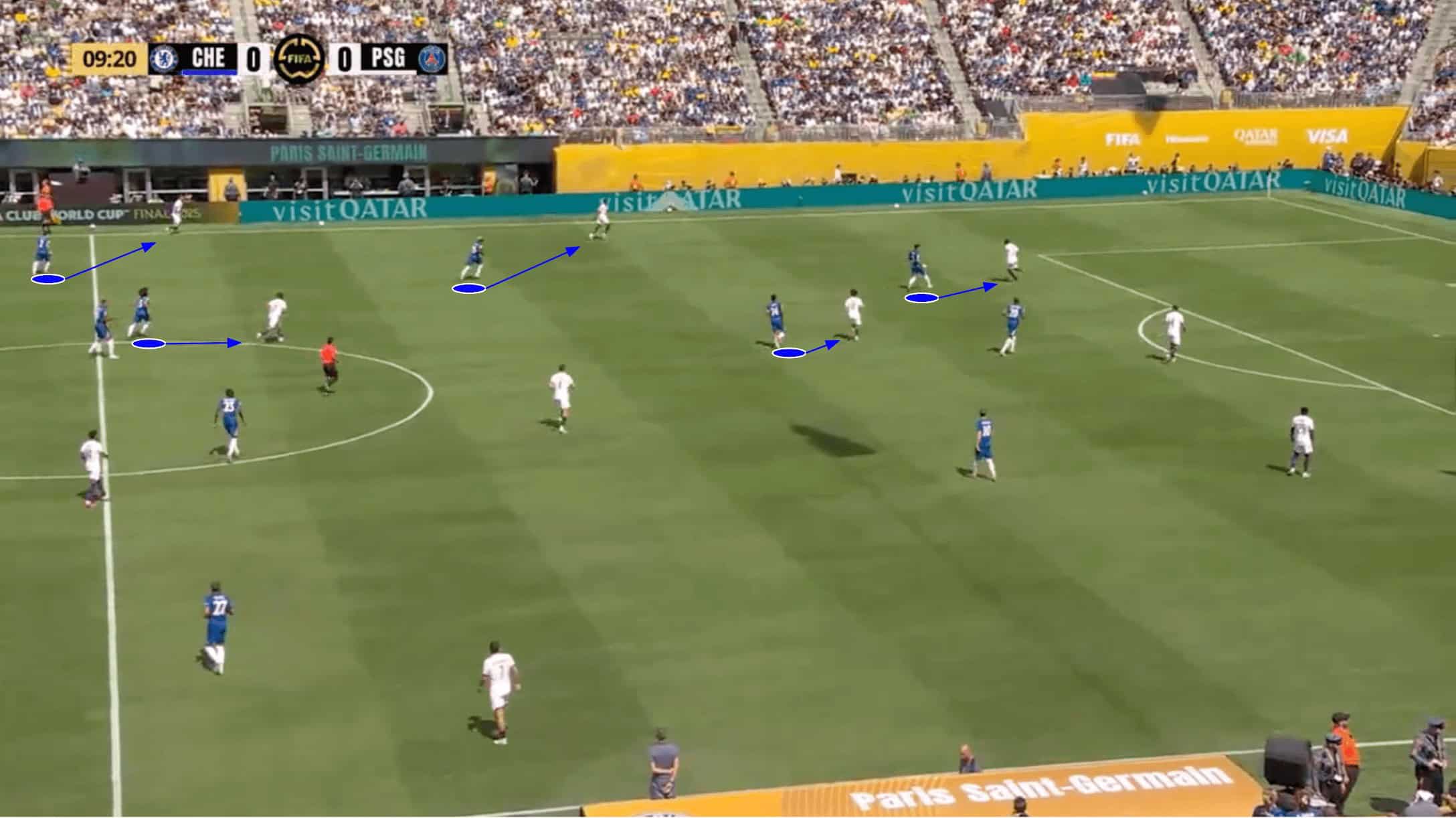
Reece James marked Vitinha as PSG’s deepest midfielder in this phase.
Interestingly, we also see Ousmane Dembélé in a right-back position—something Inter Milan struggled with in the UEFA Champions League Final.
Chelsea had a much more effective approach against the Ballon d’Or contender.
When Dembélé initially dropped deep, he was followed by the near-sided centre-back, Levi Colwill.
At an appropriate moment, Colwill and Caicedo quickly switched the responsibility of tracking Dembélé from the centre-back to the midfielder.
This leaves us in the position shown in Figure 3, with Caicedo being dragged out wide to cover Dembélé.
Chelsea does allow PSG some space centrally as a result.
Say the ball were to find its way to Fabián Ruiz here.
Either a centre-back would have to step out of defence to close the Spaniard down, or a higher Chelsea player, like Palmer, would have to track back in an instant to do so diligently.
They’d still be relying on their speed in executing that defensive action to prevent Ruiz from doing the damage before they got to him.
However, that wasn’t really a concern for Chelsea in this game because they focused on limiting the time and space PSG had on the ball in the first line of attack.
They closed down the PSG backline aggressively and marked the deepest PSG players’ immediate passing options well, which made progression from that first phase of possession very difficult for Luis Enrique’s side.
Chelsea were well prepared by Enzo Maresca and his coaching staff for dealing with PSG’s offensive tactics and the free movement of Dembélé, which tore Inter apart in the Champions League Final.
The players executed the manager’s defensive plan almost flawlessly, resulting in their clean sheet and high turnovers that put pressure on Donnarumma.
Along with the Chelsea coaches and their planning, Chelsea’s players really deserve credit for the work rate and laser-sharp focus they displayed to shut down PSG in the build-up phase.
Chelsea Deep Block Vs PSG
Of course, Chelsea also had to be prepared to defend deep at times, as every team needs to at some point in pretty much every game.
Chelsea became much more position-oriented when PSG progressed into the Blues’ half of the pitch.
They generally created a five-man backline, with the hard-working Pedro Neto assuming a left-back role.
This allowed the rest of the backline to shift over one space (Cucurella became a left centre-back, for instance).
Enzo Fernández would take up Neto’s place on the left wing, leaving the Blues in a 5-4-1 deep block.
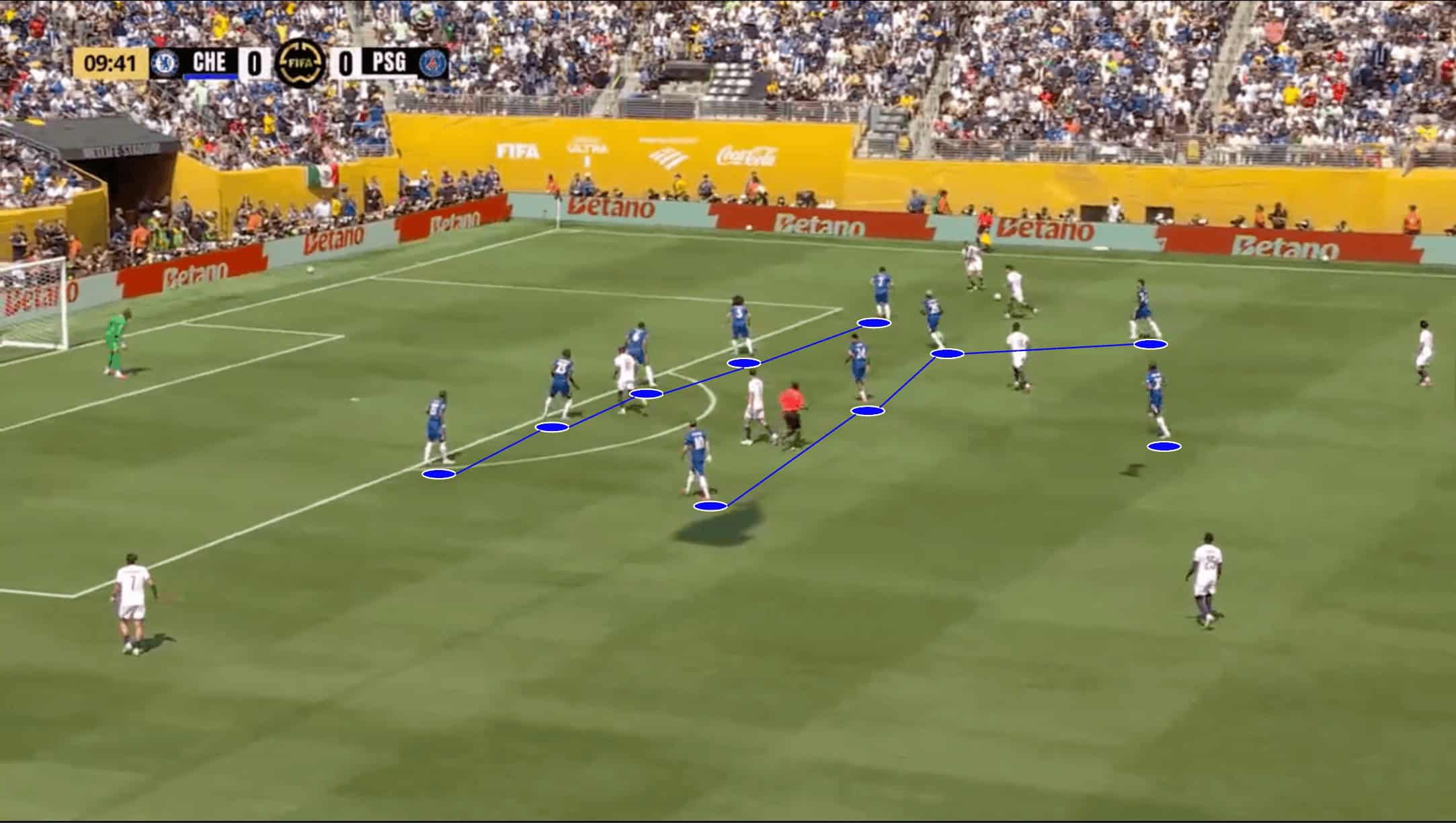
Chelsea’s five-man backline allowed their defence to get extremely horizontally compact, as did their four-man midfield.
João Pedro didn’t shirk his defensive duties, and he contributed diligently to the team’s efforts in the deep block.
Chelsea’s lines of defence were also very vertically compact, as seen in Figure 4, leaving Les Parisiens with very little space in the final third.
If PSG found space on the wings, crosses were generally dealt with well by either Sánchez in goal or the three central defenders.
Caicedo and James, in midfield, demonstrated excellent awareness of their surroundings and kept the space between themselves and the defensive line secure with their positioning and technical defensive abilities.
We see James keeping a close eye on Fabián Ruiz, for instance, in Figure 4.
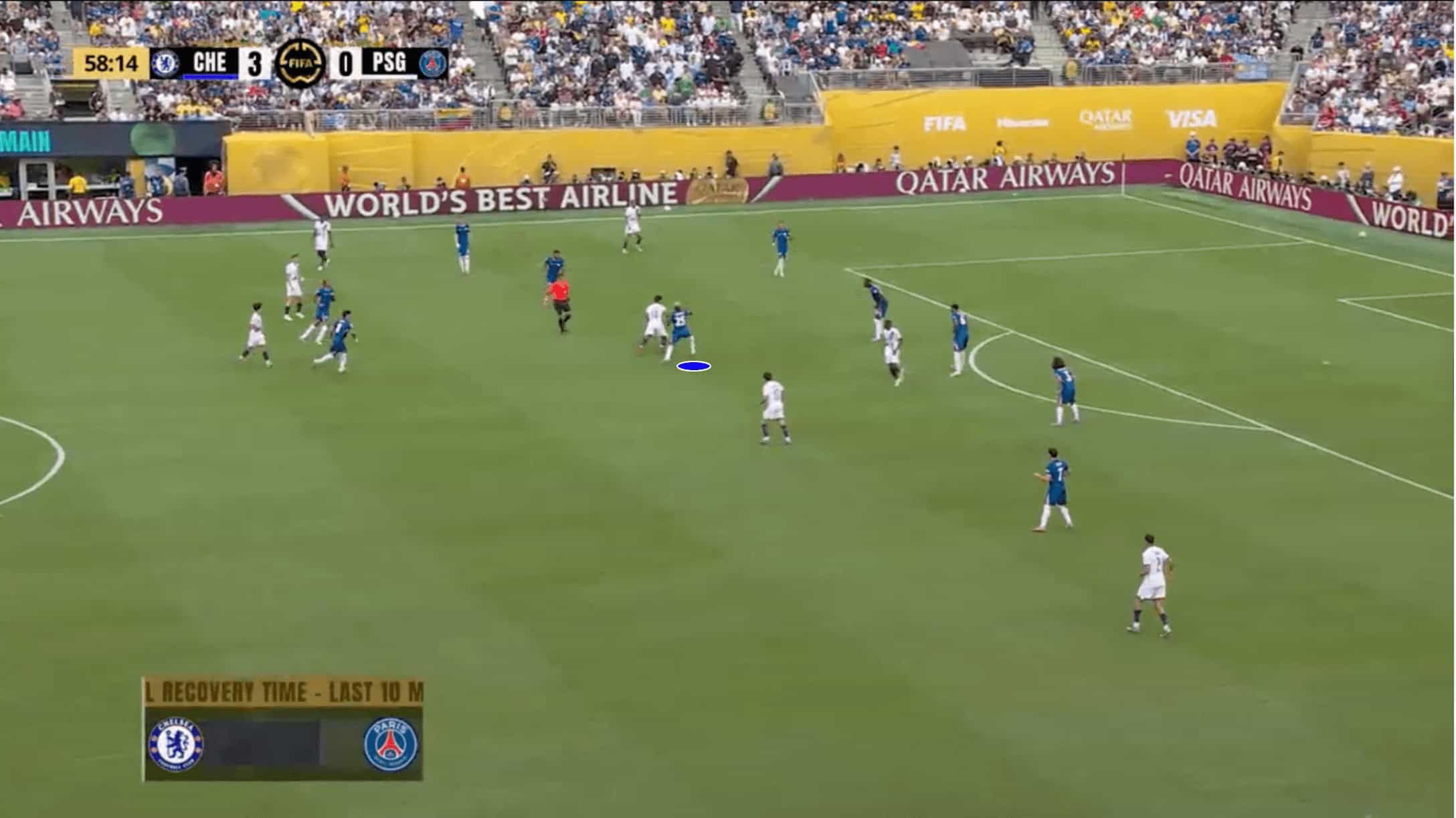
In this second-half example, Moisés Caicedo tackles Désiré Doué as he turns after receiving near the Ecuadorian midfielder on the edge of the final third.
As Doué received, Caicedo positioned himself well and prepared to perform the tackle.
When Doué turned, a split-second opportunity opened up for Caicedo to cleanly steal the ball, which he succeeded in doing.
This example perfectly displays how Chelsea set up to protect valuable space in and around their box in the deep block phase.
They had defensively strong players in a compact structure, which offered their opponents little space in those valuable positions.
The quality the Blues had in those positions was strong enough to ensure any space PSG did find was rarely put to good use.
This was consistent in the transition between the high press and the mid-deep block, too.
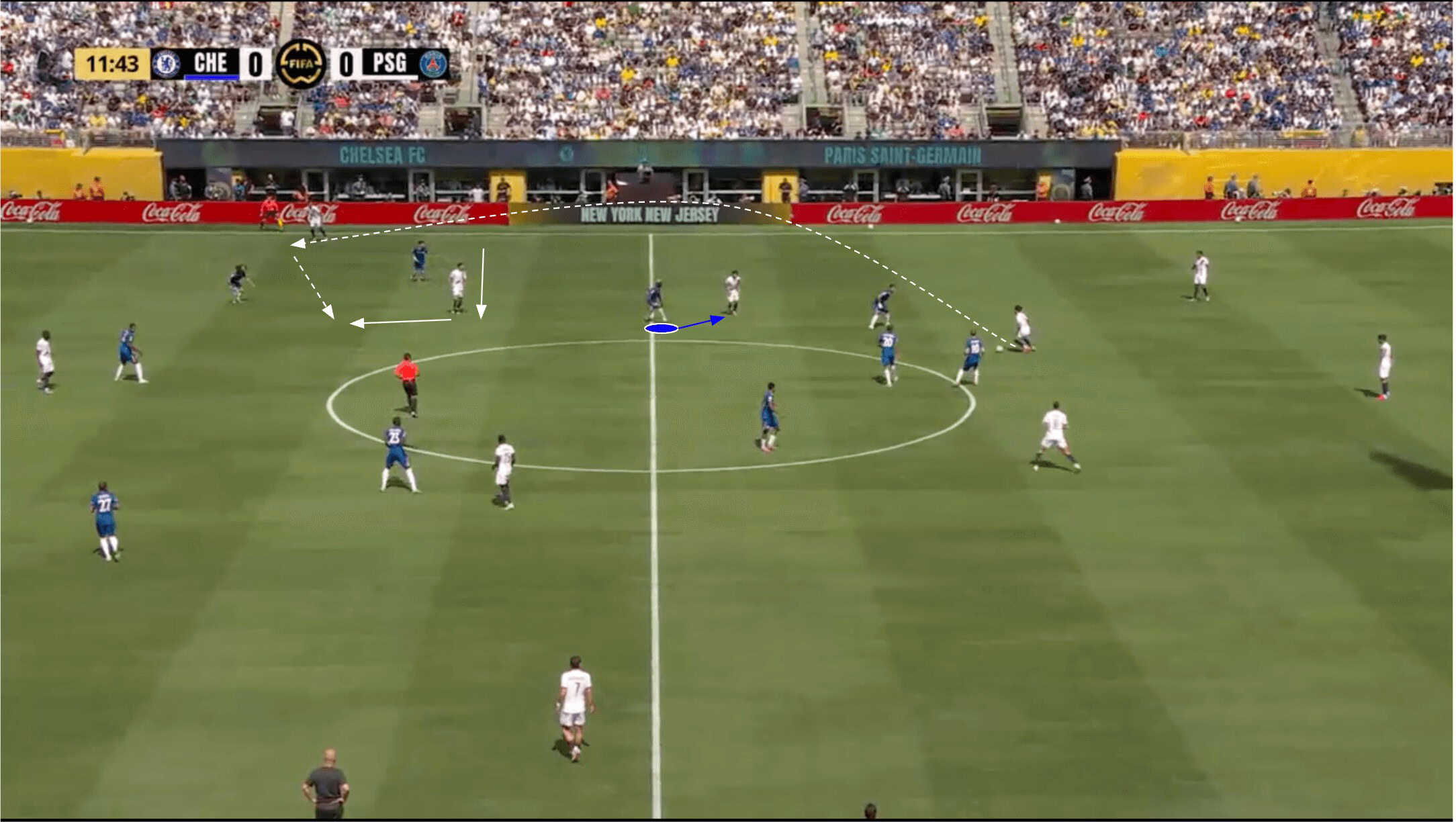
Here, PSG get the ball into some space between Chelsea’s midfield and backline.
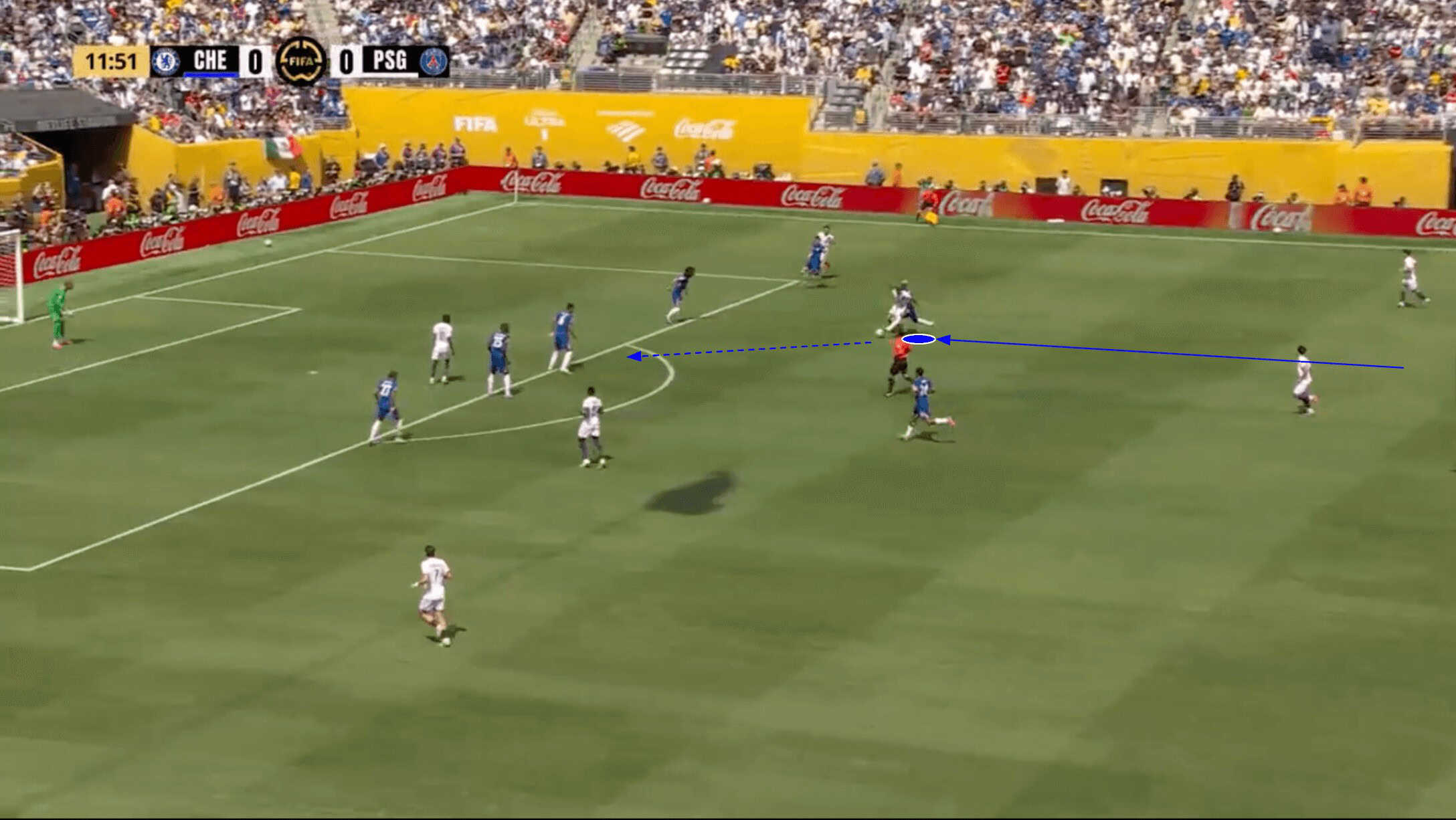
As PSG progressed into the final third, Caicedo had recovered to nick the ball back and shut down the attack before Luis Enrique’s men could convert it into a shot.
This game was incredibly frustrating for the French side because Chelsea denied them the ability to play their game in the build-up phase, progression phase, and chance creation phase.
PSG created just 0.74 xG on Sunday despite having 65.22% possession—a clear indicator of how Chelsea’s defensive tactics worked in denying PSG access to valuable areas from which those top-class chances could be carved out.
Chelsea Final Third Play Vs PSG
Under Enzo Maresca style of play, Chelsea are a highly positional side in possession.
Their structure in the chance creation phase, in particular, highlights this, as shown in Figure 8.
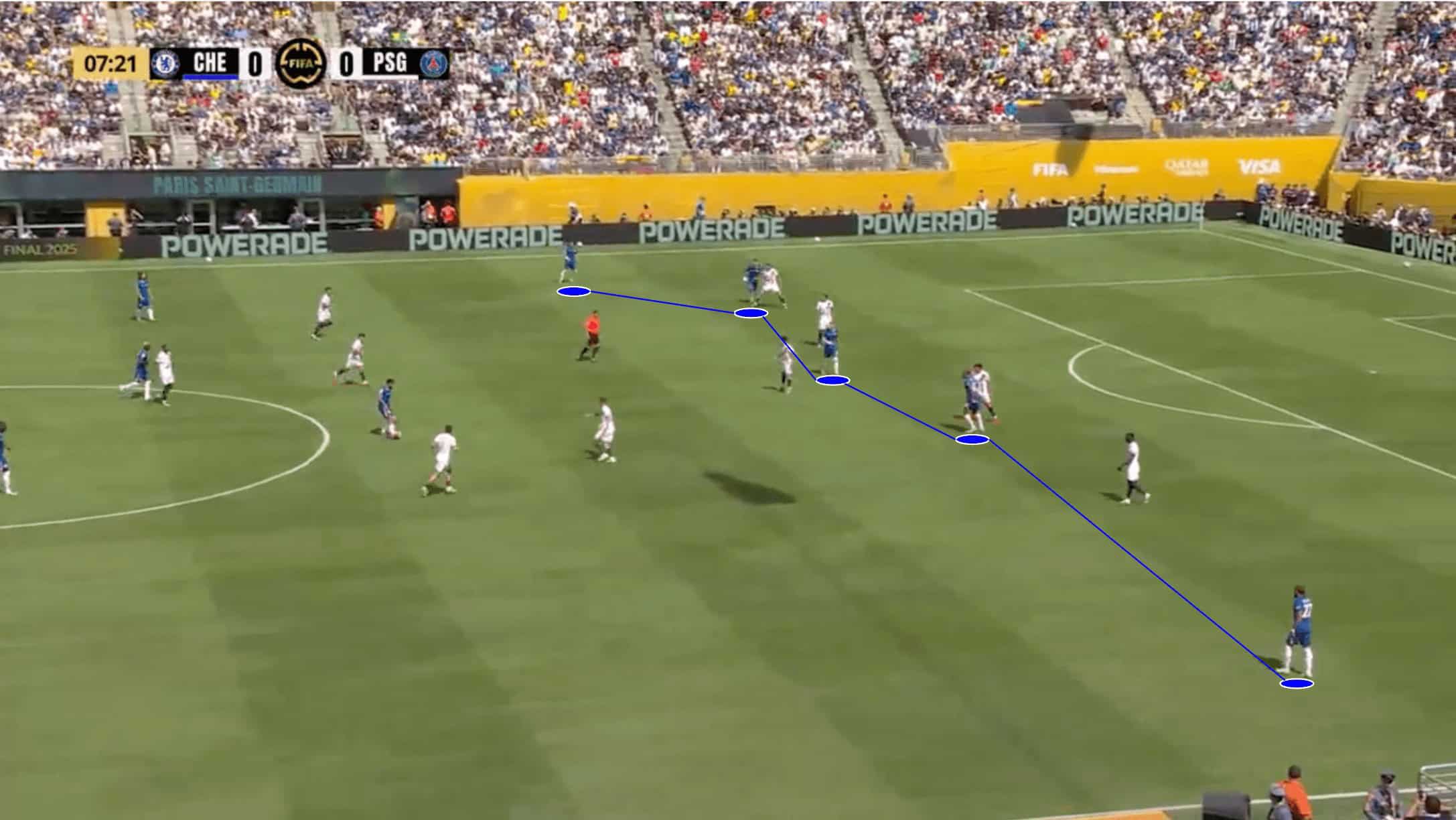
Left-winger Pedro Neto and right-back Malo Gusto provide width.
Then, the three more central vertical lanes are occupied by João Pedro, Cole Palmer and Enzo Fernández.
Deeper, Caicedo and James remain in midfield, with Cucurella, Colwill and Chalobah forming a three-man backline.
Figure 8 shows Chelsea demonstrating key principles of positional play: occupying five vertical lanes, maintaining width and depth, overloading PSG’s four-man backline with a five-man forward line, and, crucially, a solid rest-defence involving those deeper players, prepared to aggressively shut down PSG’s counterattack attempts.
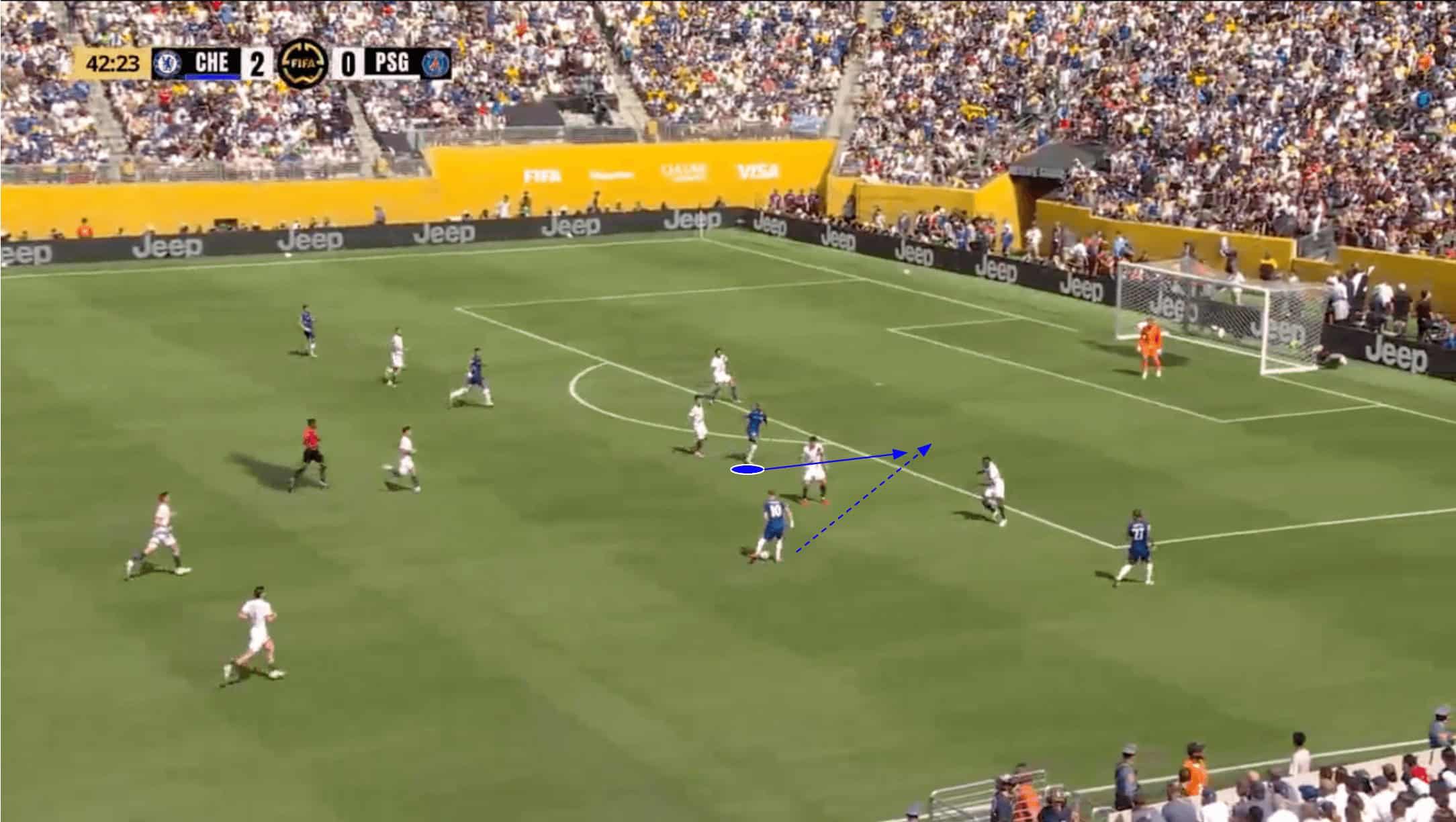
João Pedro’s off-the-ball movement, in particular, proved extremely difficult for PSG to deal with on Sunday.
Here in Figure 9, Palmer has possession of the ball in the right half-space.
Meanwhile, Pedro makes a run into the box, targeting space on centre-back Beraldo’s blind side, with the Brazilian having stepped out a little to close down Palmer.
The English playmaker slides the ball through for Pedro, setting him up to put the Blues three goals to the good before half-time.
This is just one of several examples of João Pedro’s lethal movement in the final third on Sunday to set up chances both for himself and his teammates.
The 23-year-old forward moved actively and intelligently to create space in the box for Chelsea to use.
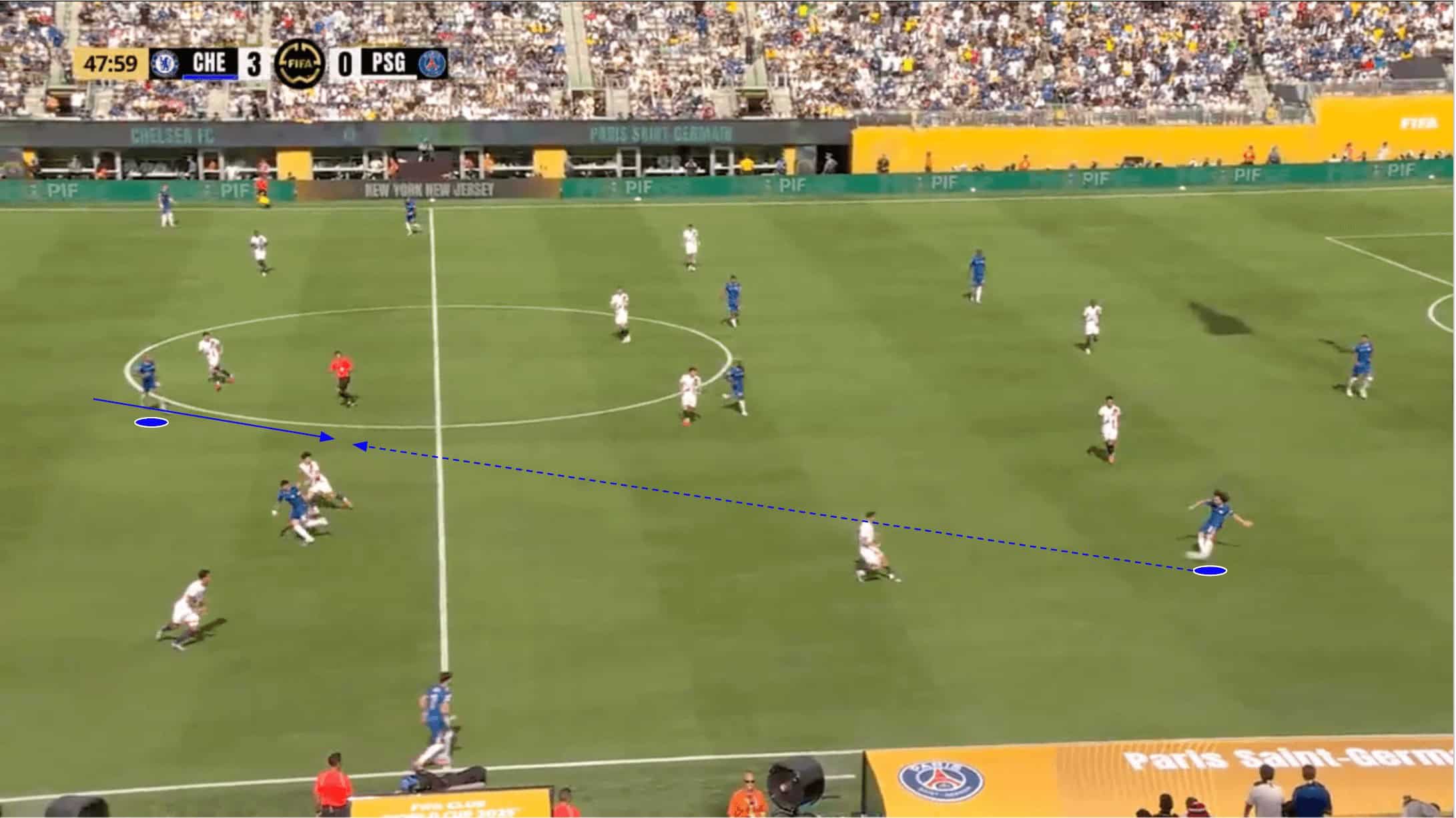
Pedro also sometimes dropped in between the lines.
This was especially effective during the progression phase, helping Chelsea make their way into PSG’s half.
The 23-year-old Brazilian was undoubtedly a handful for PSG’s centre-backs on Sunday, giving a very strong account of himself in his debut competition for the West London club.
Chelsea Ball Progression Vs PSG
Our final section of this analysis focuses on Chelsea’s ball progression.
Unlike Paris Saint-Germain, the Blues were able to find each other with passes in deeper areas.
This enabled Chelsea to progress the ball into more valuable central areas from where they could spring threatening passes into PSG’s half and the final third, thus setting up good goalscoring opportunities.
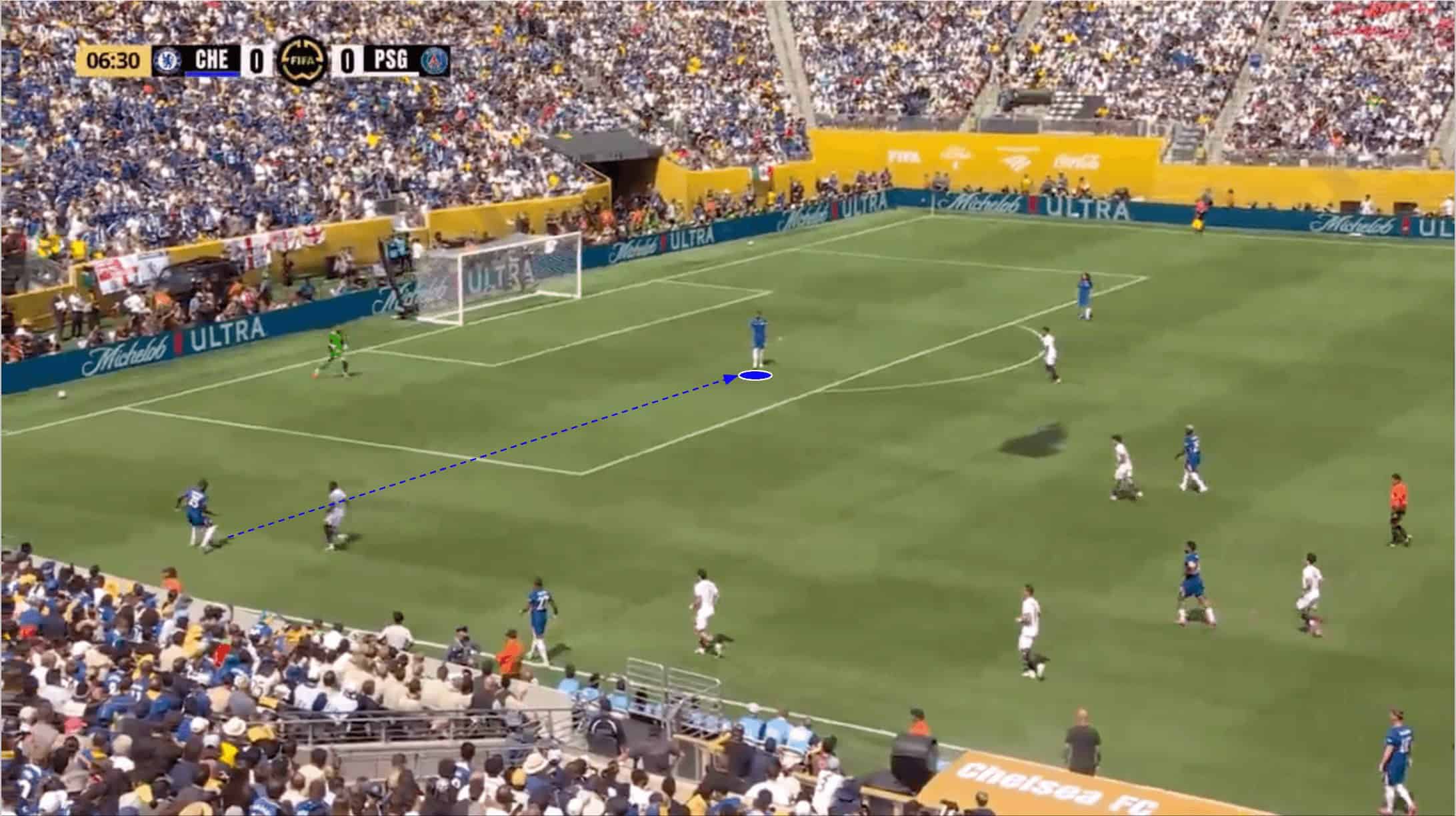
Here, Chalobah is able to find Colwill in a more central position before pressure builds on the centre-back, with a PSG forward looming to close him down.
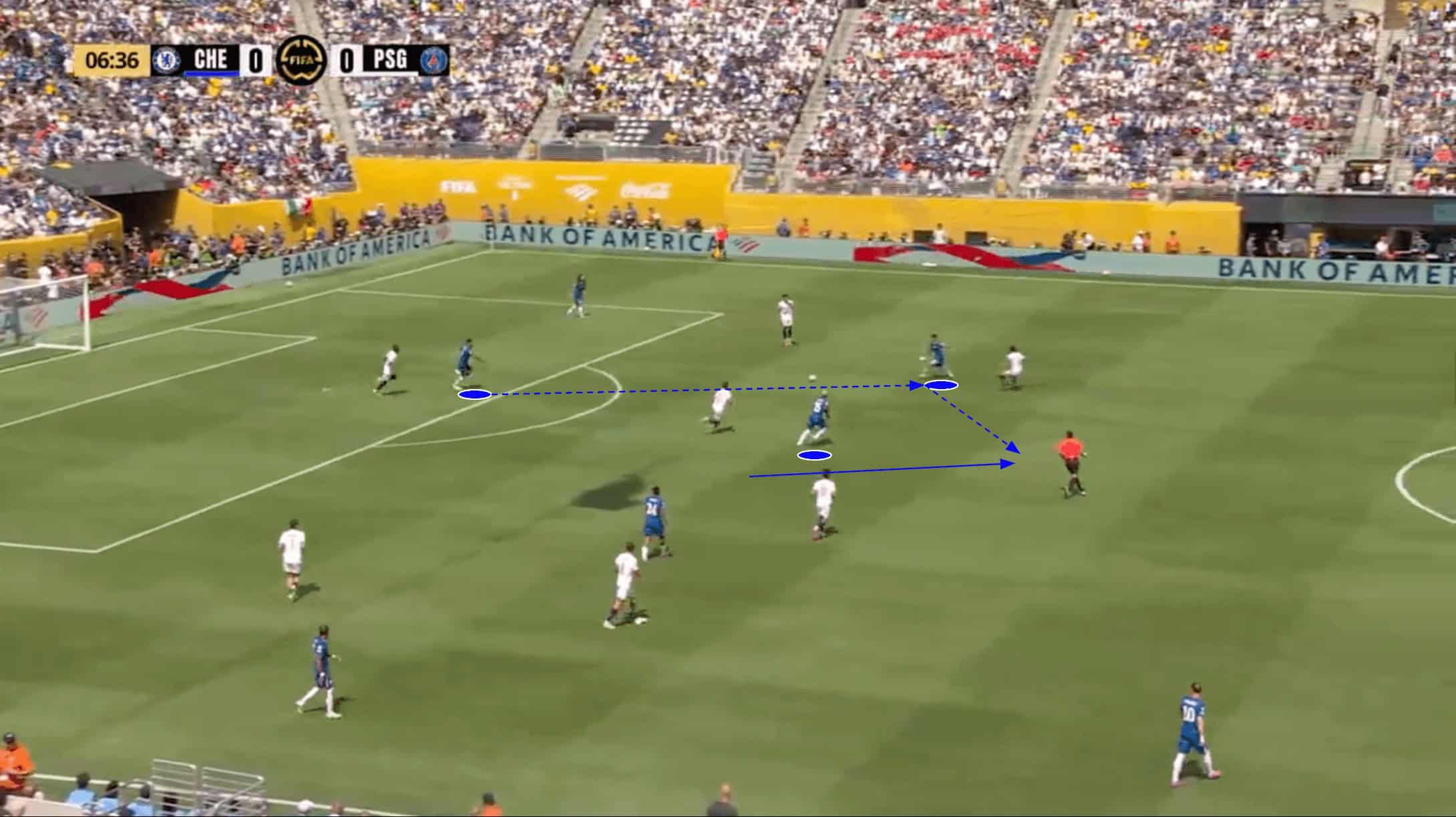
Colwill is then able to use his space to play the ball into midfield, where he finds Enzo Fernández, who can then lay the ball off to the third man, Moisés Caicedo, with space ahead of him to carry the ball forward.
Chelsea were better able to find players deep, which helped them to progress through central midfield more easily than PSG and thus set up better attacking opportunities than Les Parisiens.
Despite having far less of the ball, overall, than PSG and taking just one more shot, Chelsea generated more than twice as much xG as the Ligue 1 side did in this game—a testament to their efficiency in possession.
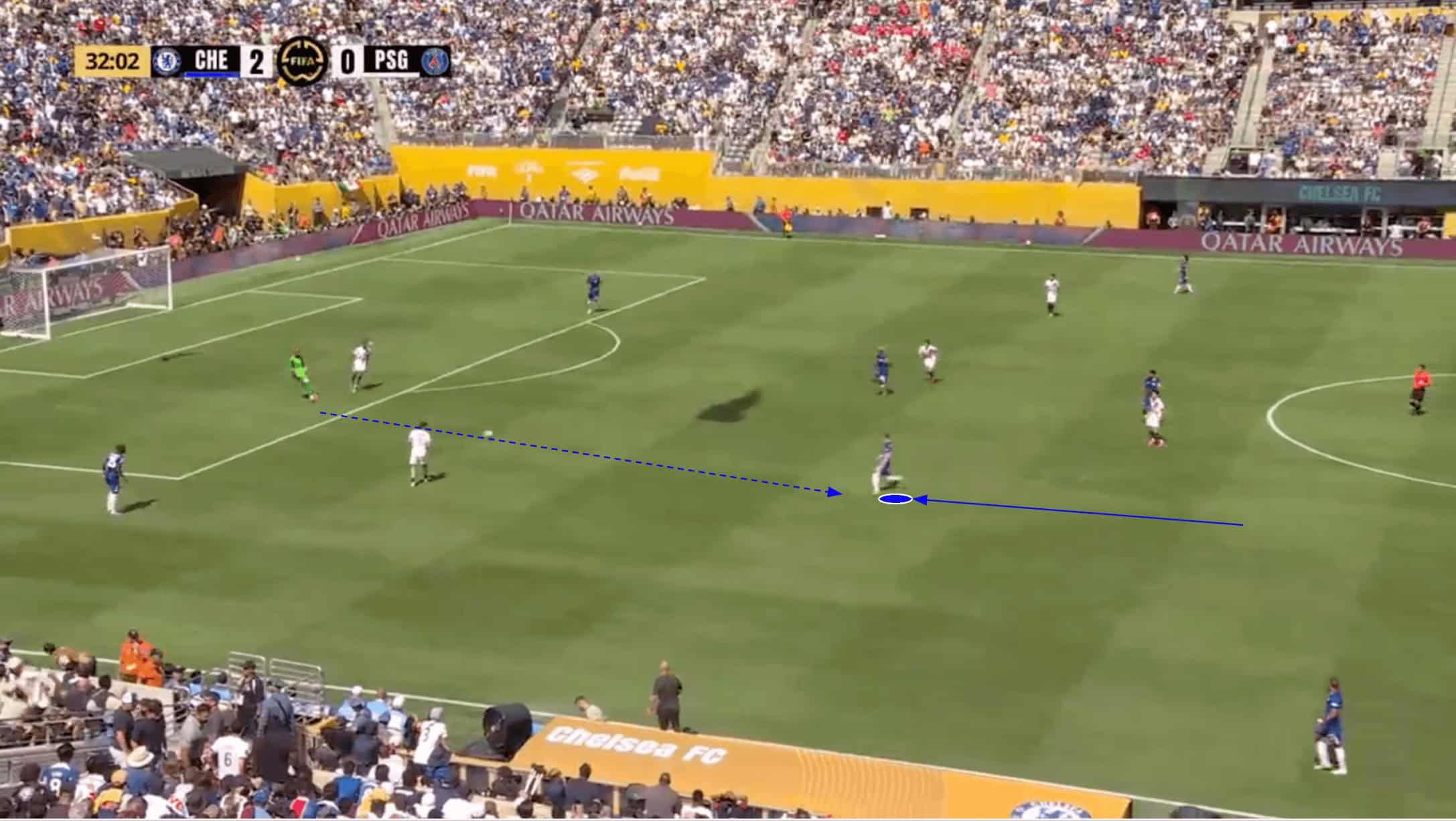
Lastly, Chelsea utilised long balls from Robert Sánchez quite effectively when they were unable to find players deep or when a good opportunity to create presented itself by playing the ball long.
Sánchez most frequently targeted space behind PSG left-back Nuno Mendes, who landed below average—in the 40th percentile—for defensive duel success percentage among left-backs from Europe’s top-five leagues this past season.
Chelsea wanted to test this area of his game against Palmer and Gusto, and experienced a lot of joy from their attempts.
By forcing Mendes into duels against quality dribblers, Chelsea were able to create a lot through their right wing, both from the build-up in settled possession play and in transition, as they also targeted the full-back space when Mendes was up the other end of the pitch, fulfilling his attacking duties for PSG.
Conclusion
To conclude our 2025 FIFA Club World Cup Final tactical analysis, it’s clear that Enzo Maresca and Chelsea vastly outperformed Luis Enrique and PSG from a tactical standpoint, both in and out of possession.
Chelsea’s high press was highly effective, while they also prepared well to defend valiantly in the deep block.
On the ball, Enzo Maresca’s positional play principles guided the Blues to success in chance creation versus PSG.
It was a very frustrating game for Les Parisiens because they were unable to display and exploit their quality against a well-organised and well-prepared Blues side.
Meanwhile, it was an excellent showing for Chelsea, which will give supporters encouragement heading into the 2025/2026 EPL campaign, especially following the showing from new signing João Pedro.
