
The competition for qualifying for the UEFA Champions League has reignited in the final stages of the Premier League.
While new champions Liverpool have already secured their place, another Champions League spot now hinges on a direct battle between Manchester United and Tottenham Hotspur in the UEFA Europa League final.
Four qualifying spots remain, spanning from second to fifth place.
A closer look at the Premier League table reveals an intensely competitive scenario:
-
Arsenal hold second place with 68 points,
-
Newcastle United sit third with 66 points,
-
Manchester City occupy fourth place with 65 points,
-
Chelsea round out the top five with 63 points
-
Aston Villa sit sixth with 63 points (level on points)
- Nottingham Forest follow in seventh with 62 points
Each team’s next two matches will effectively become Cup Finals, where the smallest details could prove decisive.
Set-pieces are among the most critical factors and could prove decisive in this tight race.
This analysis will focus particularly on The Blues’ approach.
At the end of the previous season, Chelsea reached an agreement with Brentford to acquire set-piece specialist Bernardo Cueva in a deal valued between £750,000.
The agreement stipulated his official transition to Chelsea at the start of the new season.
Chelsea’s set-piece statistics this season (Cueva’s first with the club) have been respectable, though hardly exceptional.
The team currently ranks:
-
Sixth in the Premier League for set-piece goals (11)
-
Seventh for expected goals (XG) from set-pieces (11.59)
We say that it is moderate and acceptable because the xG differential between Chelsea and the league-leading Gunners stands at approximately 4.3.
This pattern persists in corners, where Chelsea ranks eighth among top set-piece scoring teams with six goals, trailing Arsenal’s division-best output by five goals.
These metrics indicate competent but unexceptional performance to date.
Considering that this season is his debut season and that of Enzo Maresca’s entire technical staff, coupled with the team’s transitional phase and inflated squad size, these results appear reasonable.
However, deeper analysis reveals additional limiting factors that have prevented more pronounced success.
This tactical analysis will focus on attacking corner tactics, highlighting critical Chelsea deficiencies:
The absence of a specialist taker capable of executing Cueva’s signature Brentford preferred corner idea, which demands a specific crossing technique, besides a lack of luck sometimes.
Bernardo Cueva Corner Tactics At Brentford
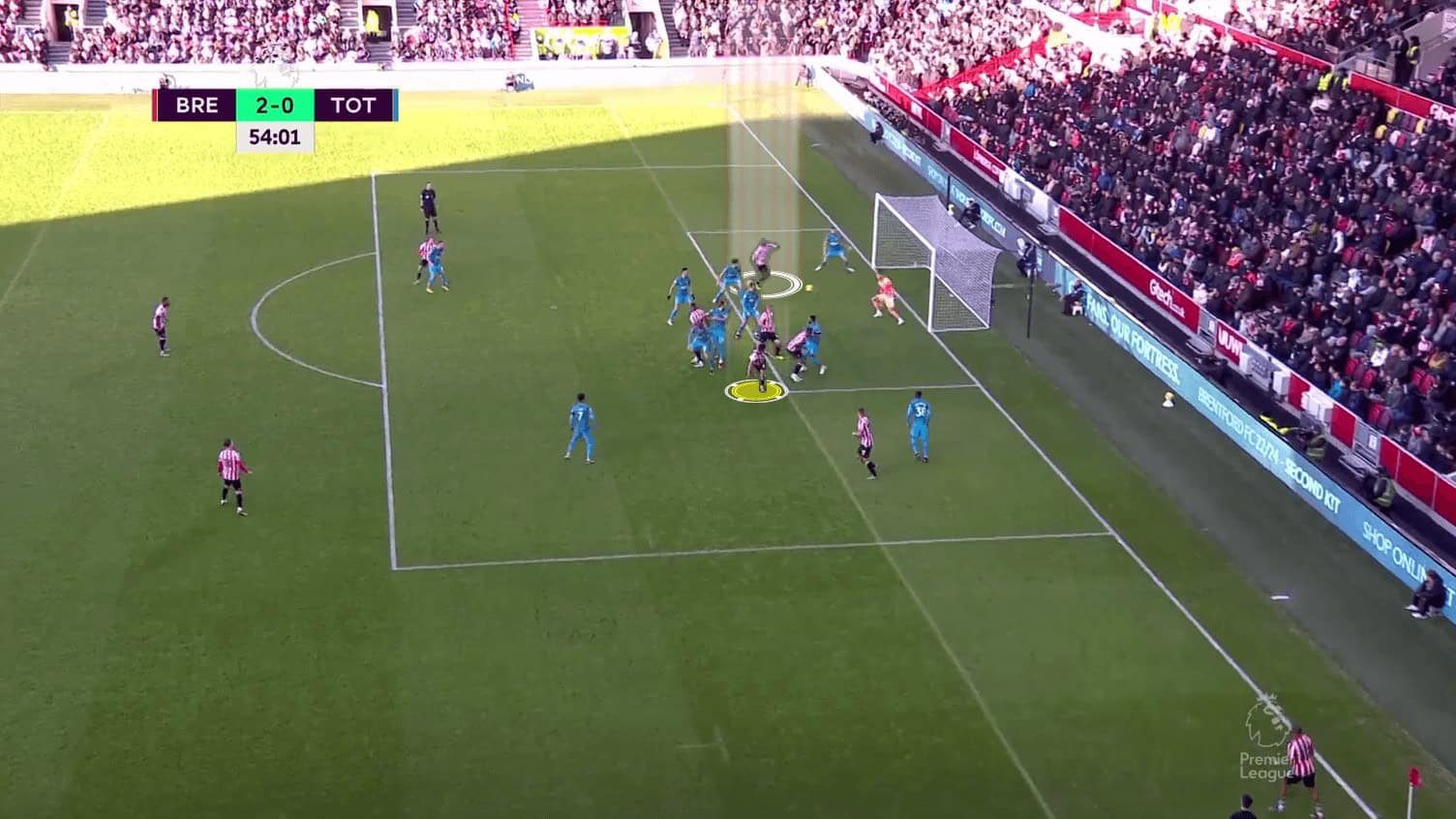
Starting with his preferred routine with Brentford, Bernardo Cueva loved to target the near post around the edge of the six-yard by an expected in-swinging cross, as in the photo below.
It is also important to mention that it is so different from targeting the near post more inside (the yellow cross below ), as usual, to flick the ball or hit it directly to the goal.
Targeting this outer area is important because most defending teams locate their zonal line closer to the post due to the expected trajectory of the in-swinging cross.
This includes the zonal defender standing on the near post.
They may also put an additional player standing near the vertical edge of the six-yard, as the Spurs did below.
Here comes the deception: Bryan Mbeumo will deliver an in-swinging cross with a moderate curve rather than a heavy whip, using the inside-of-foot technique to direct the ball toward the far-post zone instead of the near post.

Let’s explain the routine itself against Tottenham, who defended zonally.
As shown below, he preferred to ask all six box attackers to start in a pack together and then move to their assigned starting positions.
The seventh (outside the spot) will come back as a rebound player on the edge of the box.
This distracts the opponent’s attention, plants doubt in the defenders and leaves them without enough time to react when the attackers move to their real starting positions.
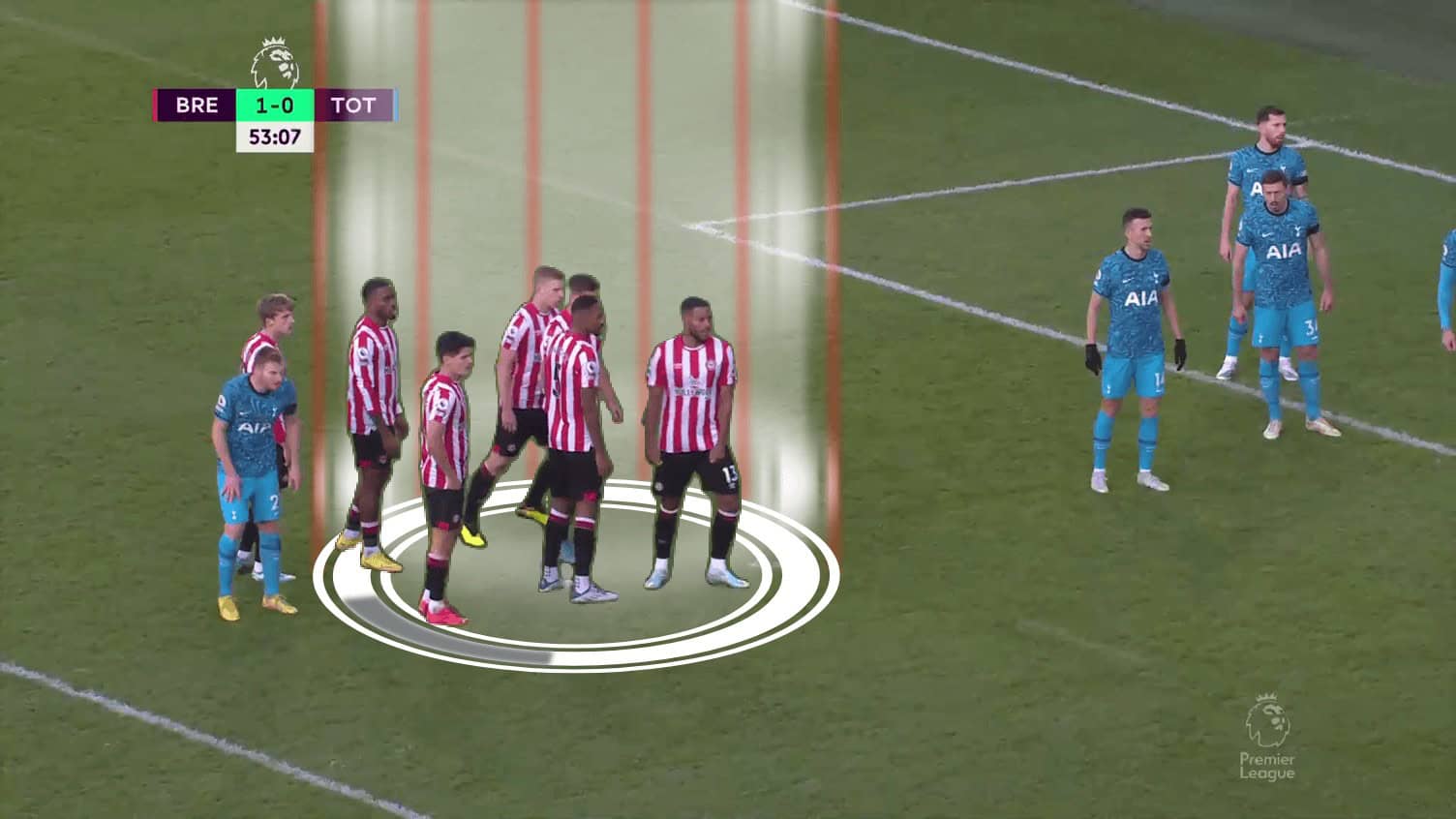
In the photo below, the yellow player is the targeted player who waits at the end, starting to move late after his mates.
To easily target the area mentioned, Brentford should ensure that the four defenders near the targeted area don’t move.
A player (white arrow) fakes a run to drag the first defender with him far away from the targeted area, while the other three attackers (green arrows) block the other three close defenders.
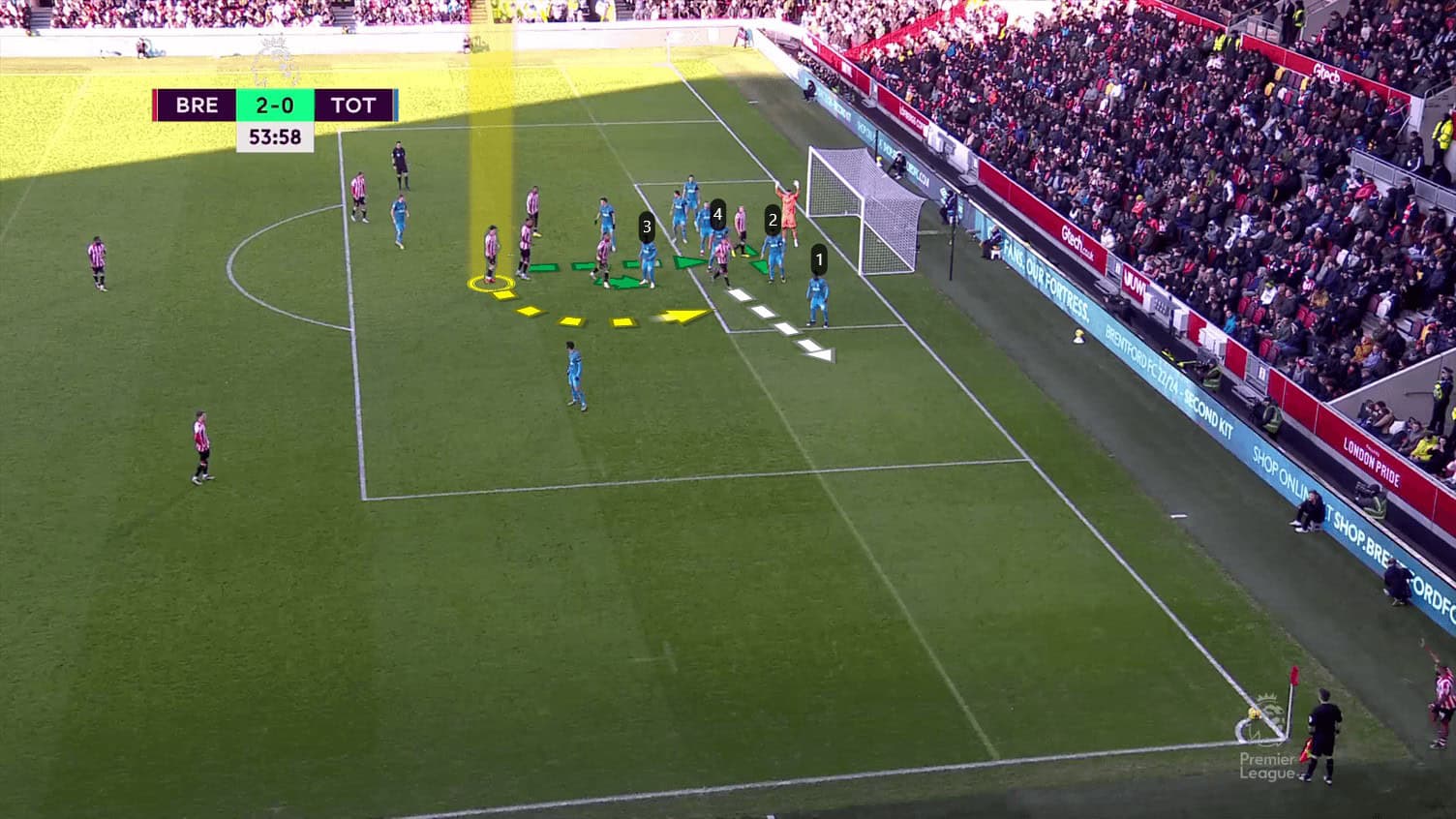
The plan works and is complete in the photo below.
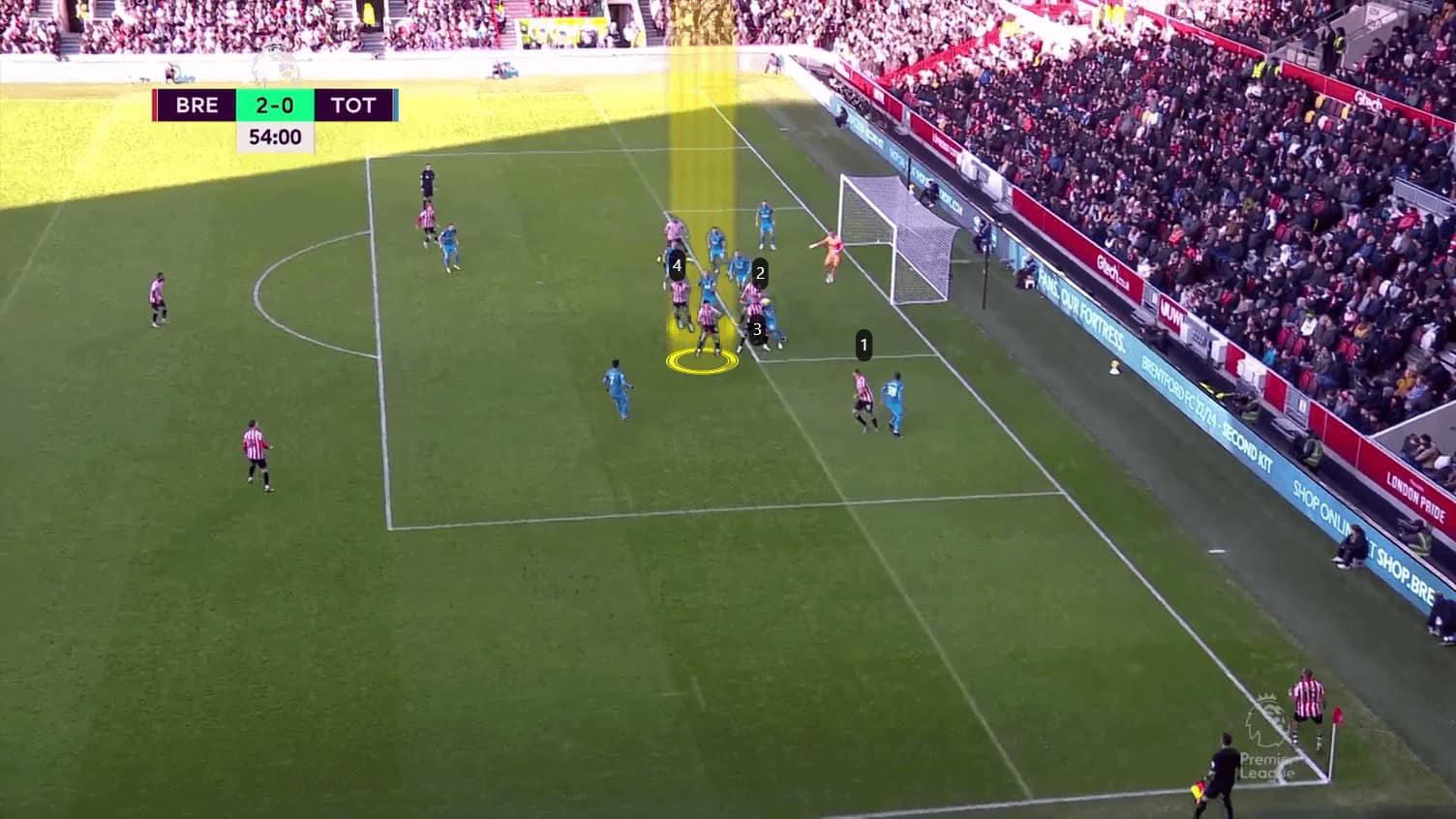
On the other side, an attacker starts to move late while the defenders focus on the ball and the moving attackers to the near post.
The attackers exploit the situation to go to the far post to frame the goal in case the first targeted player flicks the ball.
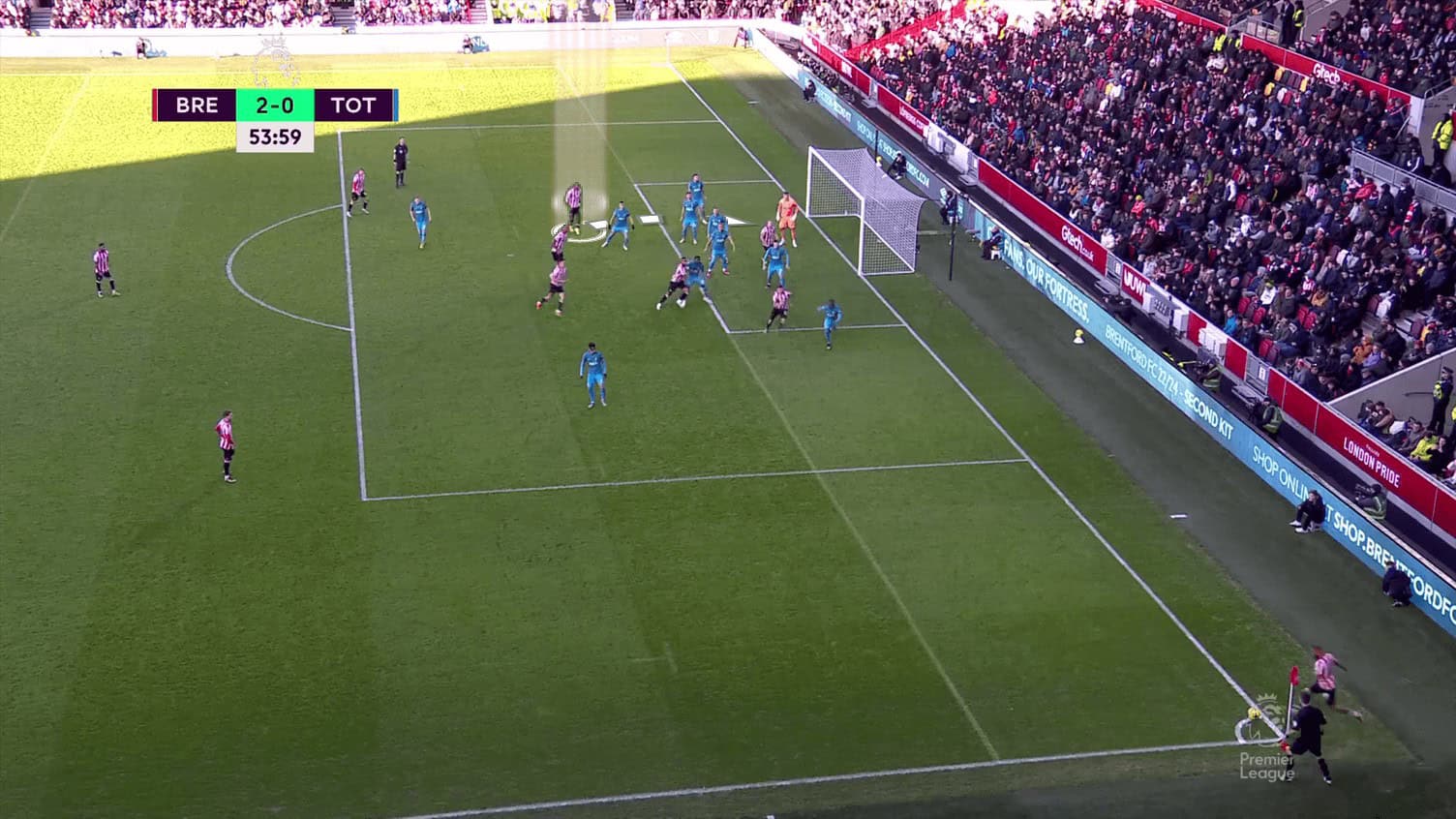
The plan works, and the result is a goal, as shown below.
Note: He is not offside because of the natural movement of the defender to go back defending the goalmouth.
Although elite teams depend on the offside trap in these situations, it is a complicated process after the first touch, and the chaos begins with all players focusing just on the ball.
Chelsea Taker Weaknesses On the Near Post
You can say that it is easier for the taker to implement the previous routine with an out-swinging cross, and you are right.
Chelsea did that this season and could score, as in the case below.
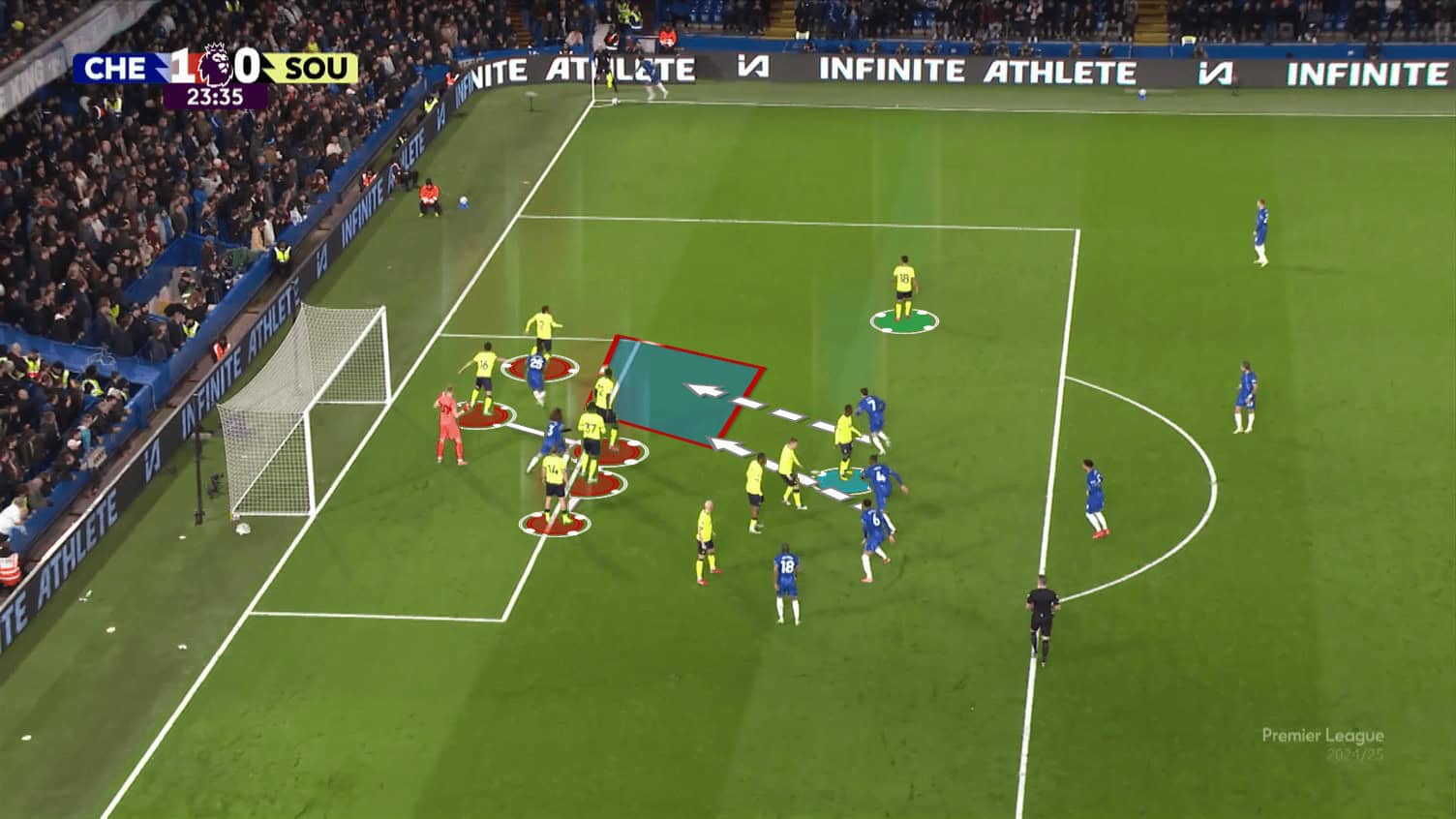
As shown below, Southampton defend with five zonal defenders (red), three-man markers, a short-option player and a rebound player (green)
Most teams defending with a hybrid system put their best defenders as zonal defenders, so Chelsea exploit that mismatch, especially against waiting man markers, as we will explain.
First of all, Chelsea usually have two players behind the zonal line coming from the blind side to block the two zonal defenders near the targeted area.
There are four remaining attackers inside the box against three man markers, which means that there is a free player who will go first to the targeted area (first white arrow).
We can notice that the man markers are not sticking to the attackers, having many steps waiting for them, and here the targeted player steps back to have this isolation from the marker and then runs quickly to the targeted area, running from a dynamic state.
In contrast, the man marker will start to run.
The other advantage is that the attacker can see the ball trajectory while running, unlike the marker who gives his side to the ball and needs to turn around.
The two players behind the zonal line go to block from the defenders’ blind side while the last attacker turns around to get the flicked ball.
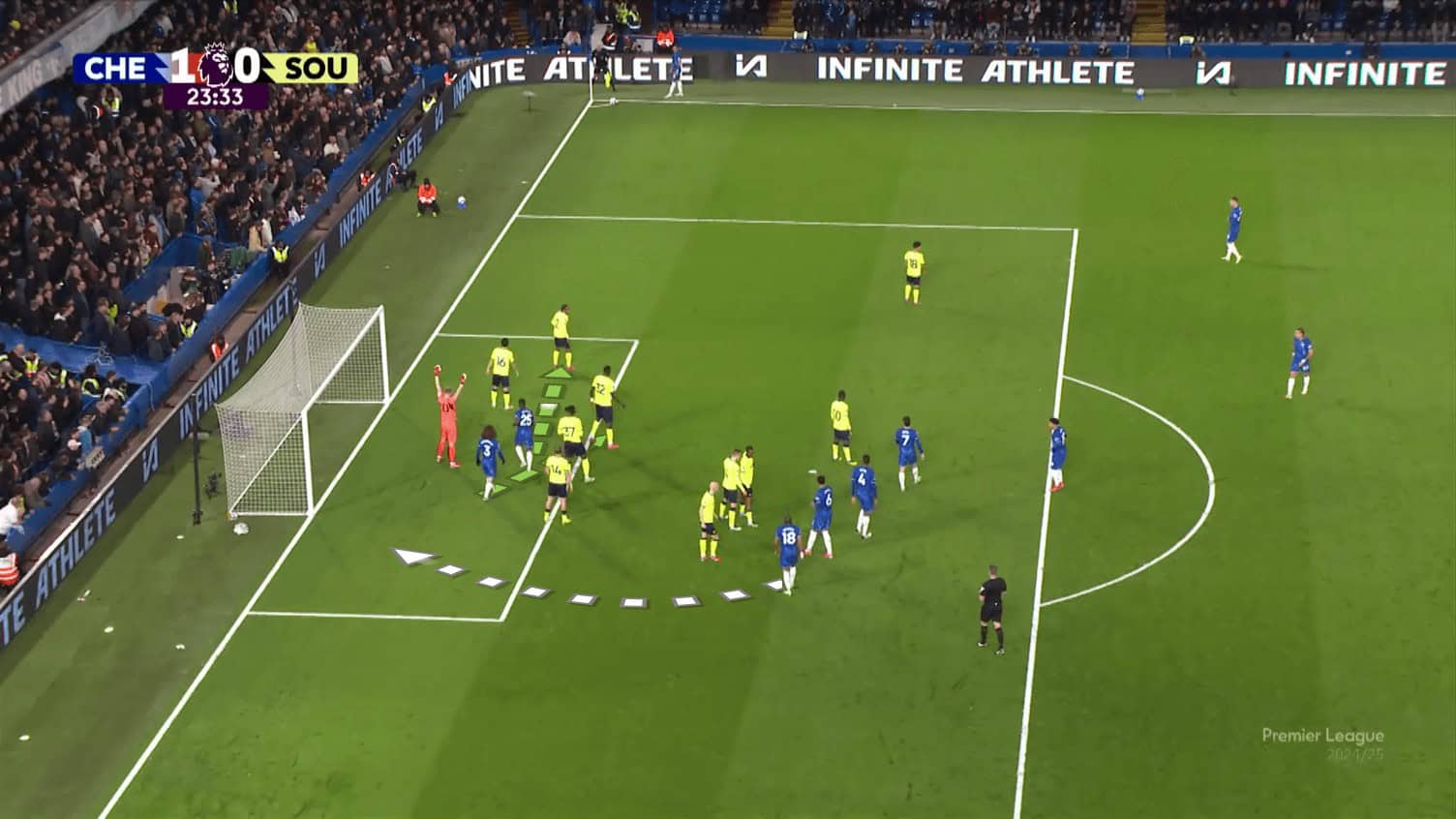
The routine works with the Blues, and the result is a goal, as shown below.

However, it has become common for most defending teams to push the zonal line a little bit forward against the expected out-swinging cross, as Man City did below.
You can notice that the first zonal defender is more forward, not sticking to the near post, while also adding an additional zonal player in that threatened area, which is Erling Haaland in this case.
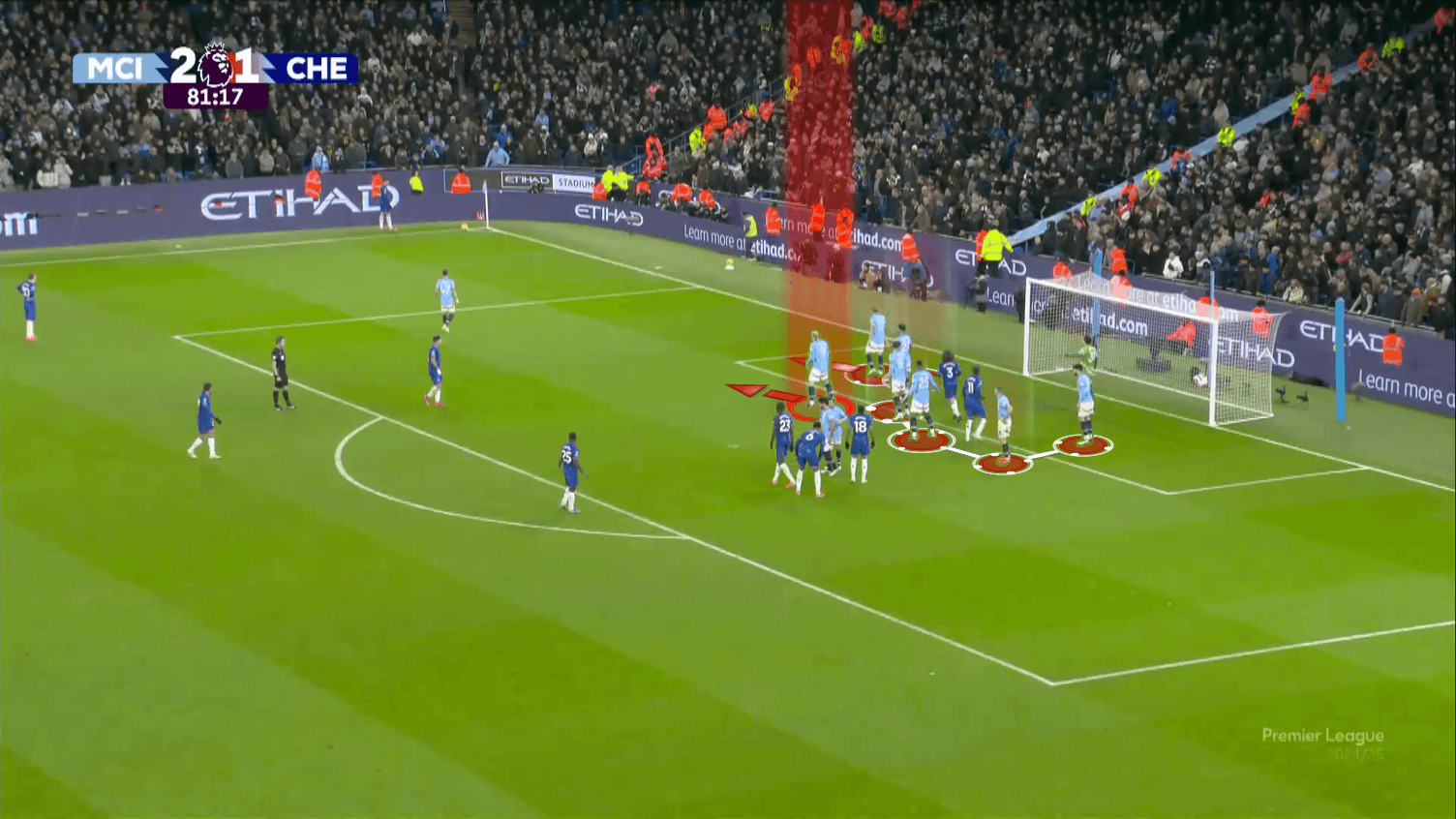
The result is that Haaland cleared the ball easily, while the zonal line is also closer to this area and can react quickly, as shown below.
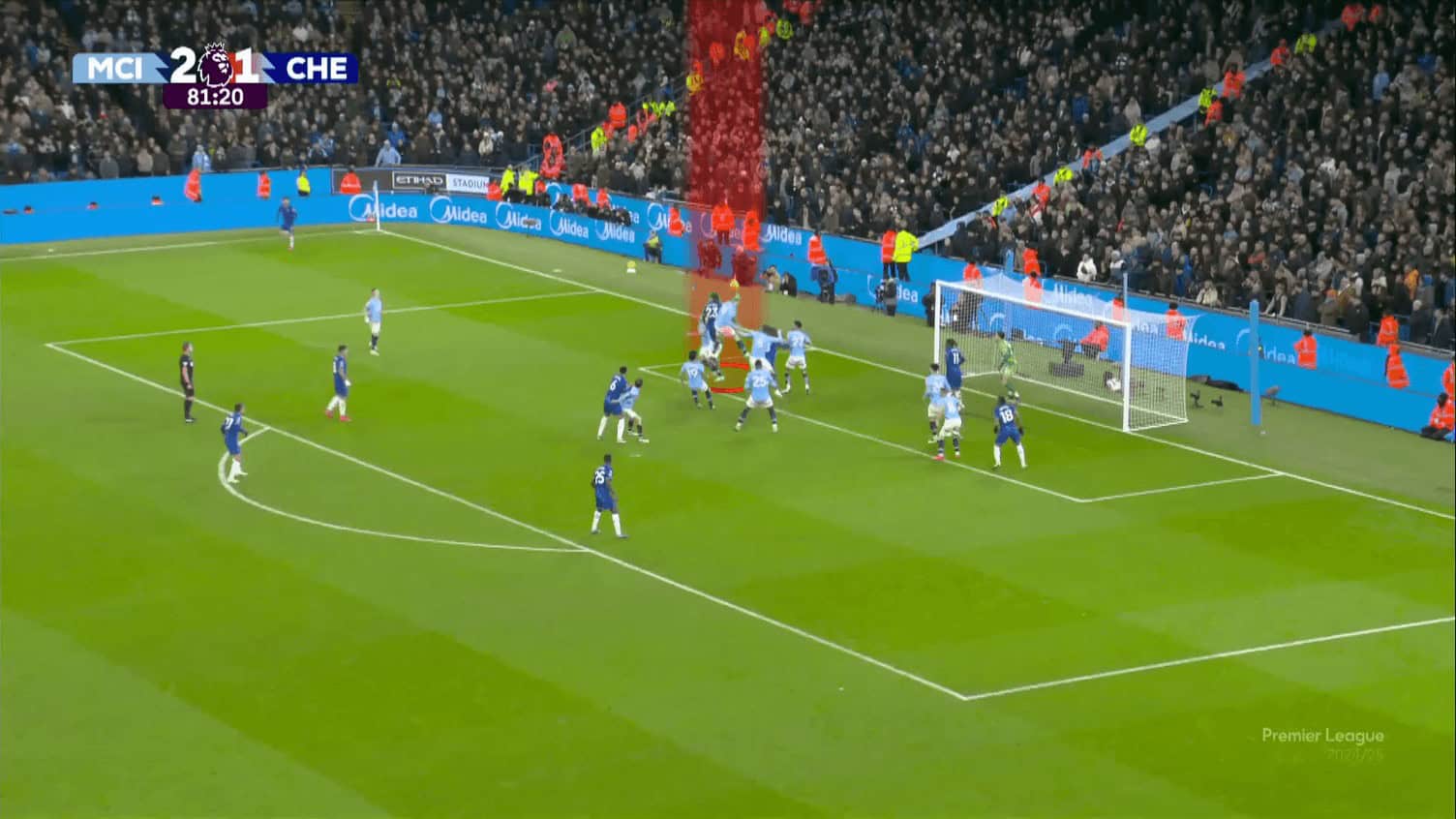
This brings us full circle to our initial discussion point: The surprise element in this routine relies on delivering an expected in-swinging cross when zonal defenders get more inside toward the post before playing outward around the edge of the six-yard.
Let’s examine the challenges Bernardo Cueva has faced implementing his set-piece philosophy at Chelsea, knowing that their in-swinging takers are Enzo Fernández from the left and Pedro Neto (sometimes Cole Palmer) from the right.
We should remember that we are talking about this specific kind of little swerved in-swinging cross to the outside, and that doesn’t mean that they are not good in general.
In set-pieces, there are amazing takers in one kind of out-swinging, in-swinging, or straight crosses, but they are not good at the other, so it is a complicated process.
Against LFC, the original in-swinging routine is implemented with a green block and green fake run to make the two targeted players reach a free area, as shown below.
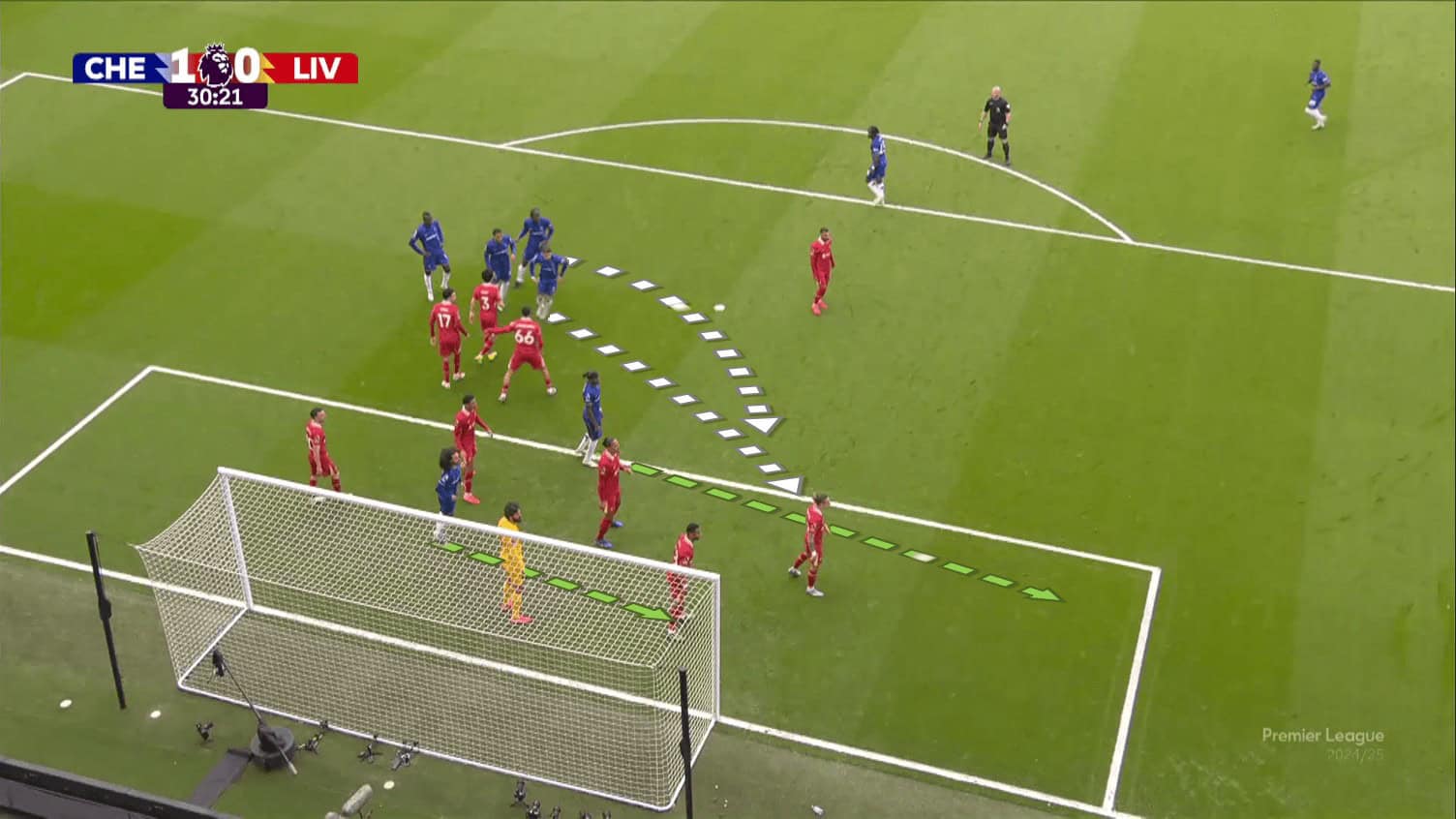
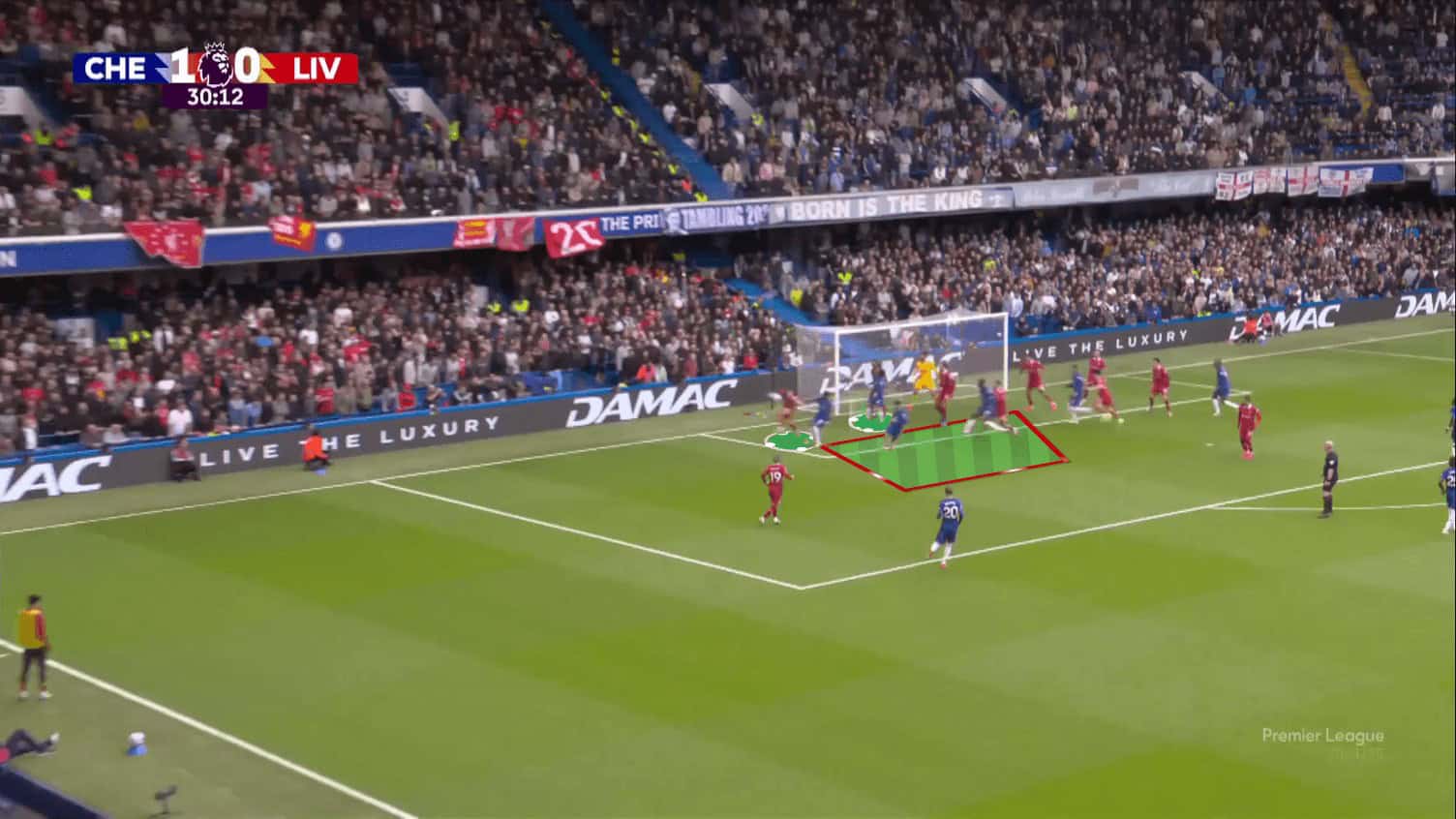
As shown below, the routine idea works, and the targeted empty is evacuated, but the cross is inside, where the first zonal defender is ready to clear the ball.
Against Ipswich Town, the same routine is tried with two green blockers, while they did a small extra step to free the targeted player, Levi Colwill.
As shown below, he suddenly pushes his marker and crosses routes with his mate behind him.
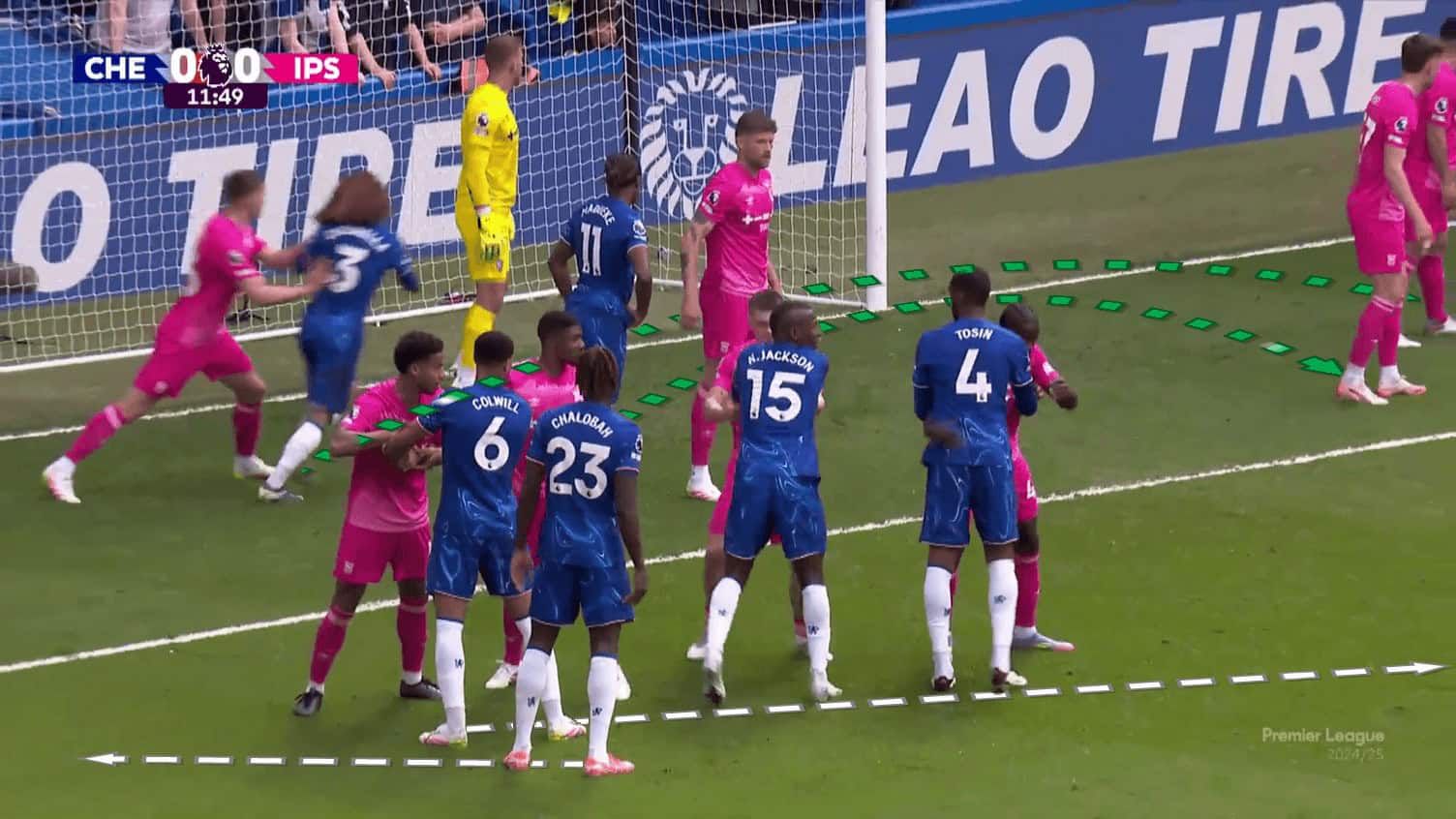
As shown below, this confuses his assigned marker, who can’t decide whether to follow him or switch with his mate and follow the other attacker who runs towards him.
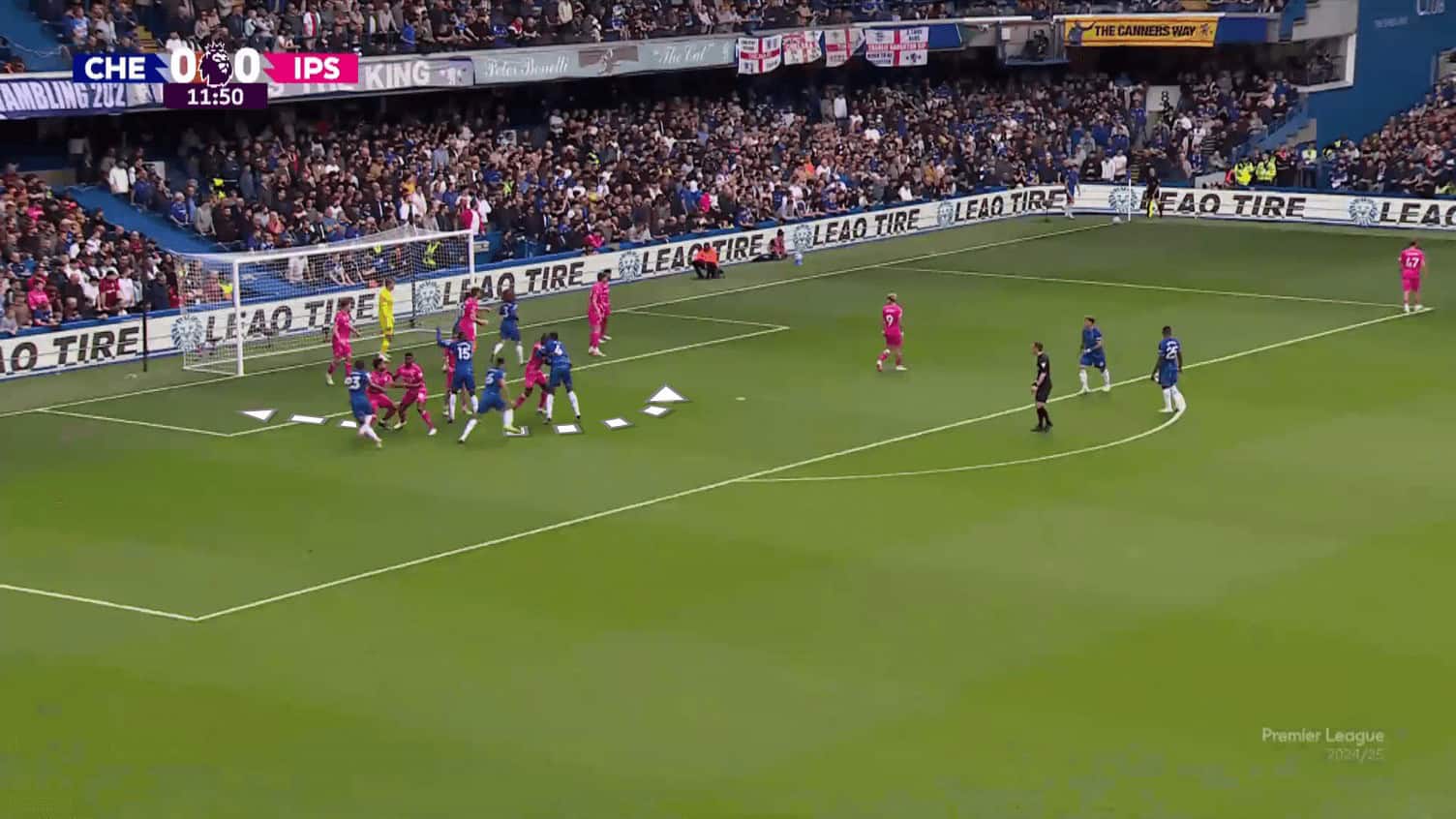
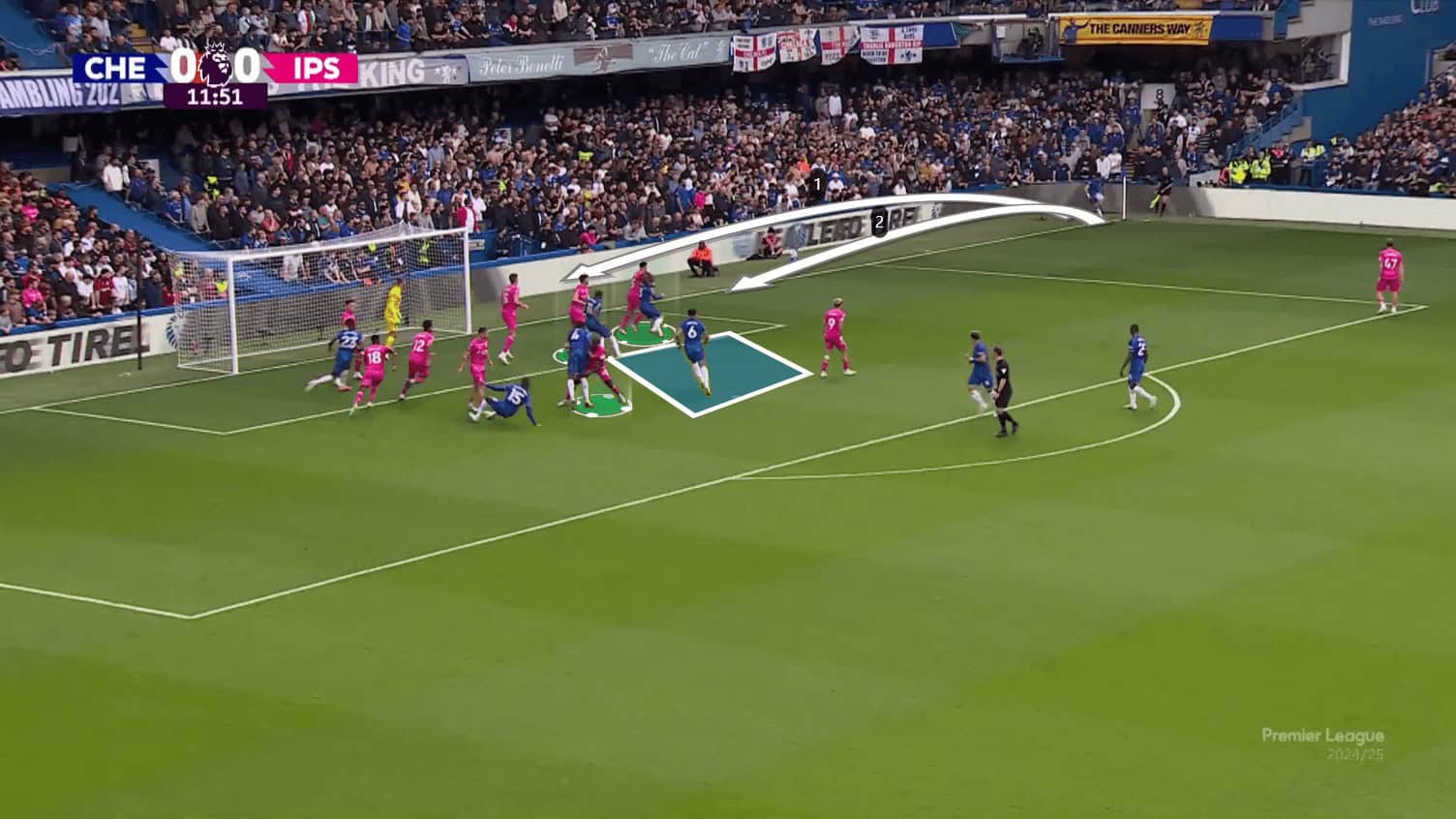
As shown below, the two blocks are done (green), while also the first attacker in the pack blocks his marker.
The routine is perfect, but the cross was the first one (1), not the optimal one (2).
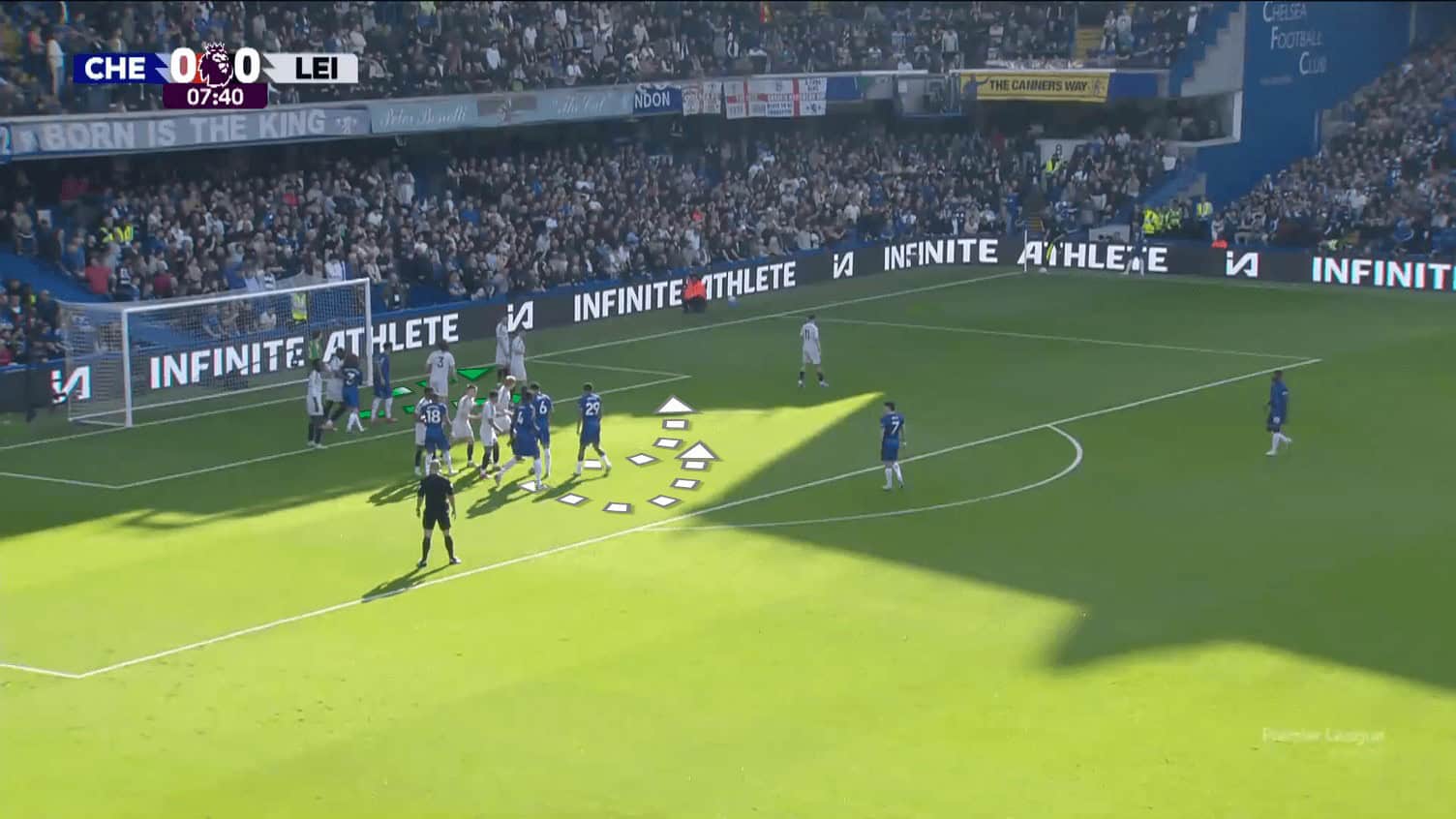
It’s not a coincidence, and you can see below a third example against Leicester City.
As shown below, the same two green blocks will be done from the zonal defenders’ blind side while the two target players will step back and take the same sudden curved run to the targeted area.
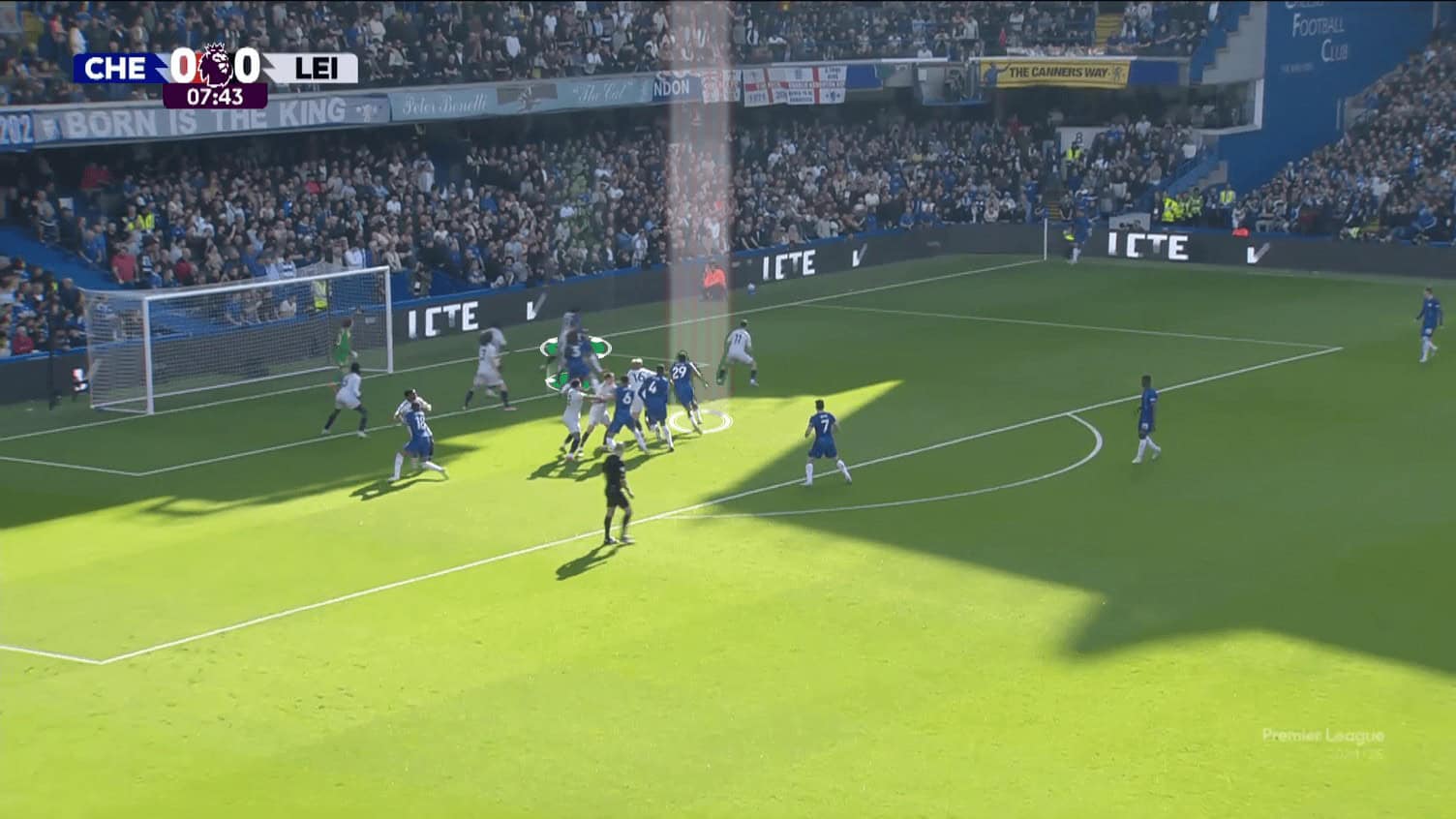
As shown below, all is set.
However, the ball goes inside again.
Chelsea Short Corner Tactics With Bernardo Cueva
Chelsea also have another common idea at short corners.
It could be more effective with better execution and some luck sometimes.
As shown below, a player comes from the edge of the box to have a wall pass, with the taker exploiting the two-versus-one situation over Fulham‘s only player.
The two players behind the zonal line (green) want to delay the reaction of the line, not to push up early, applying the offside trap.
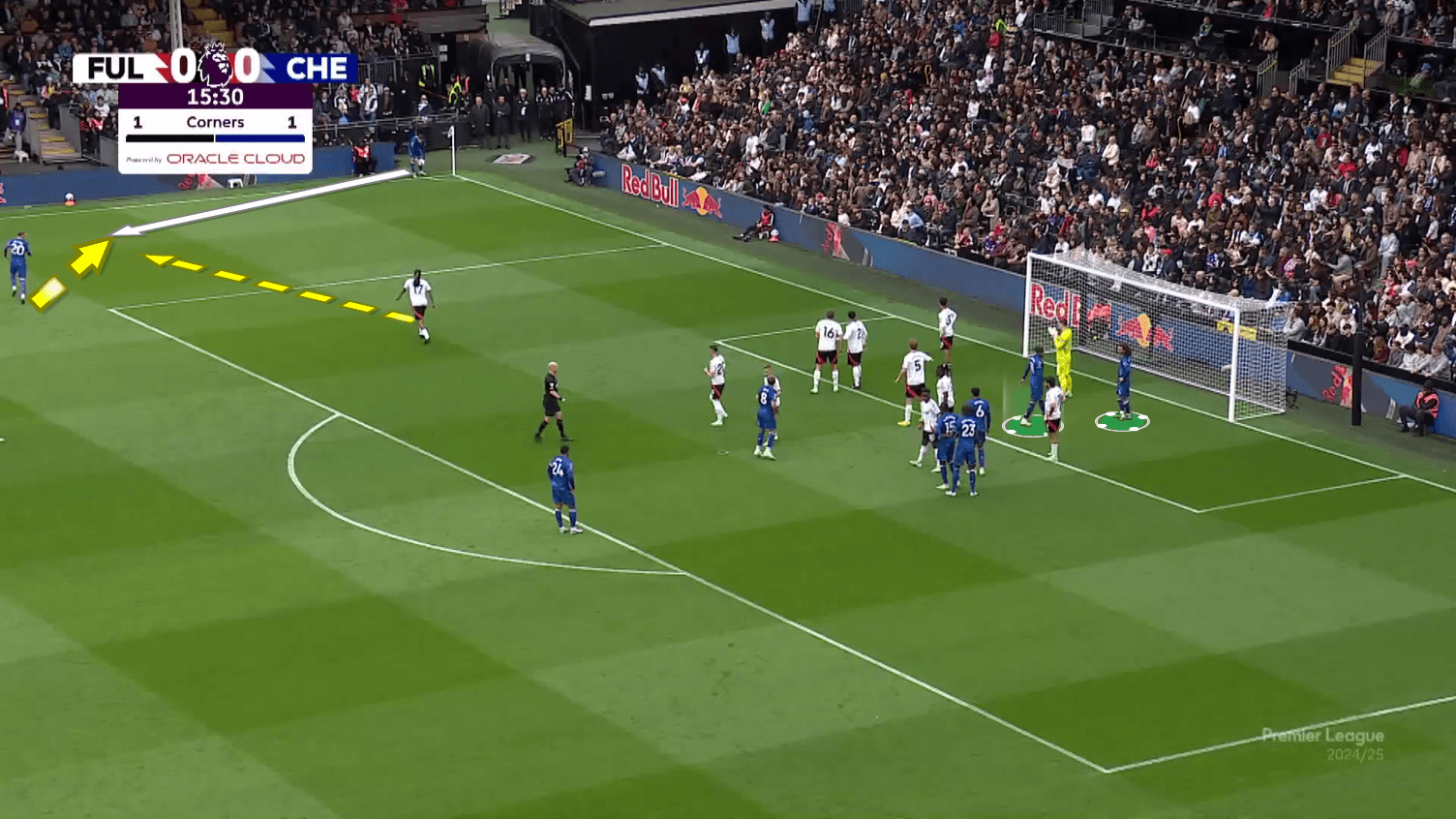
As shown below, this two-versus-one situation leads to an easy pass to the taker again, who drops in a curved run to avoid being offside.
Three attackers (yellow) run on the far post in the opposite movement direction of the line, which moves up and focuses on the ball.
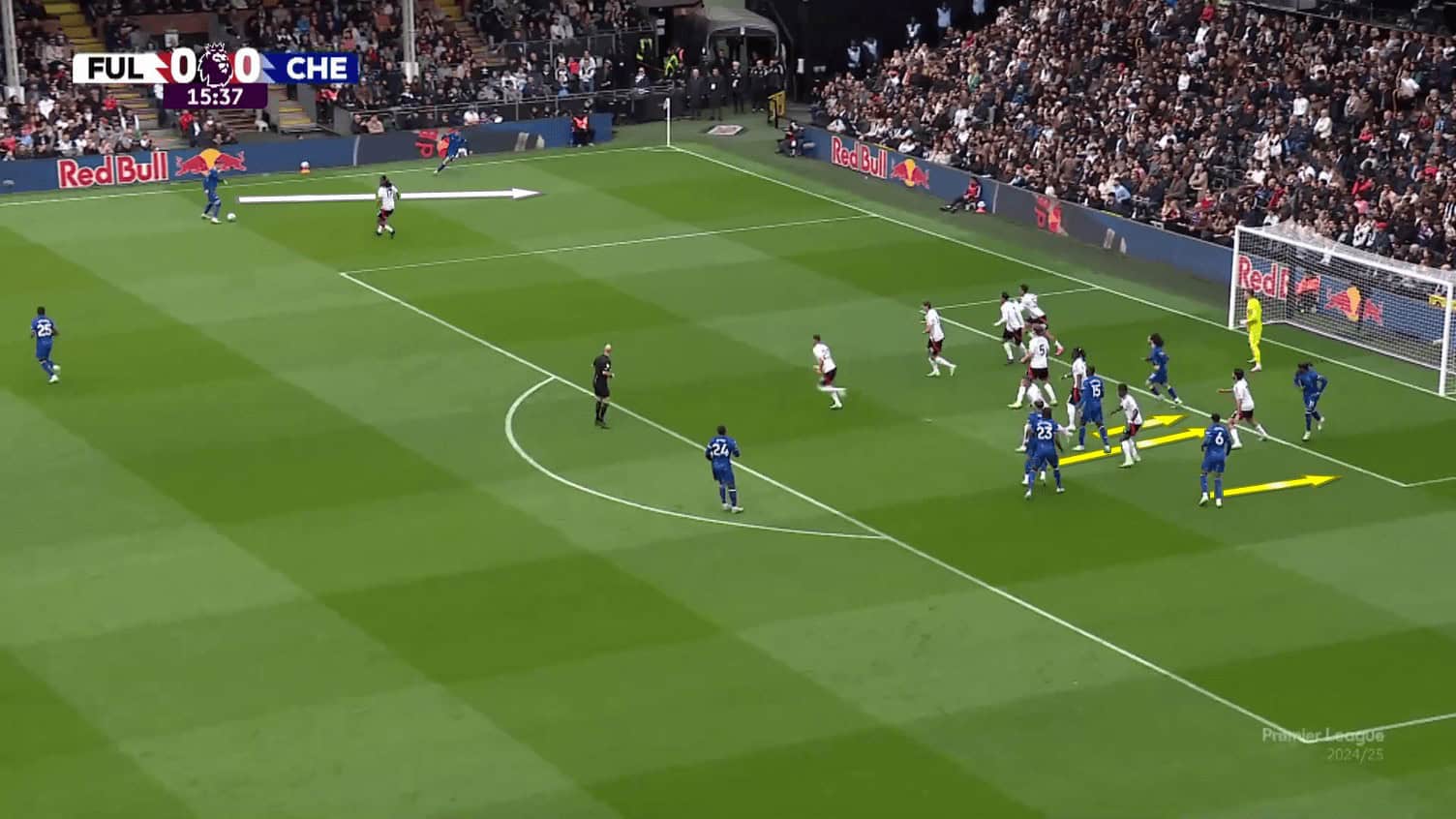
The plan works great, but the cross is strangely backwards to a Fulham player (not to the far free area), as shown below.
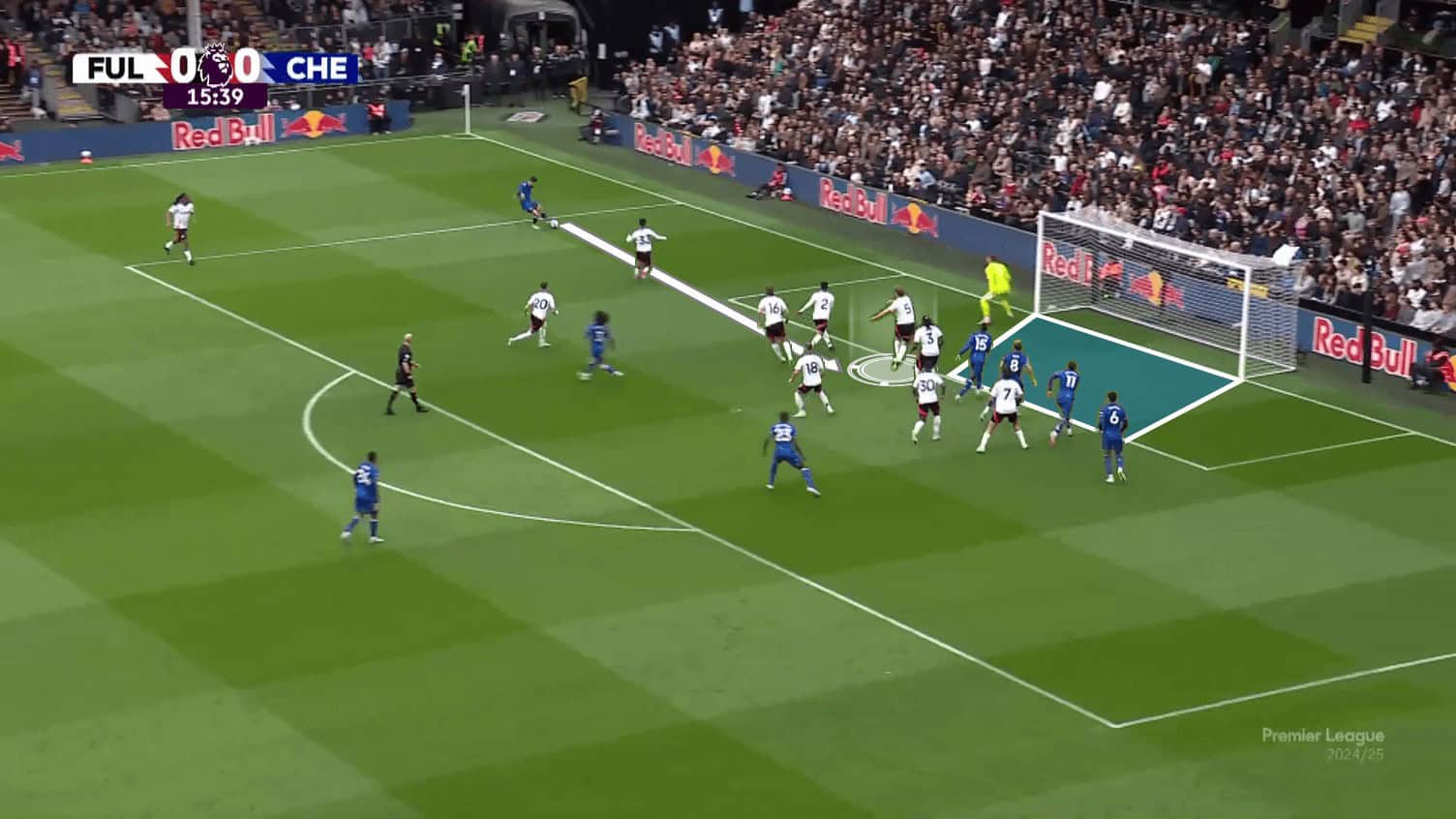
As shown below, they have four players near the ball in case the opponent has two short-option defenders.
This delays their reaction, making them unsure whom to press, which leads to an easy pass back to the taker.
One of the two usual blockers (green) goes back to receive a cut-back pass.
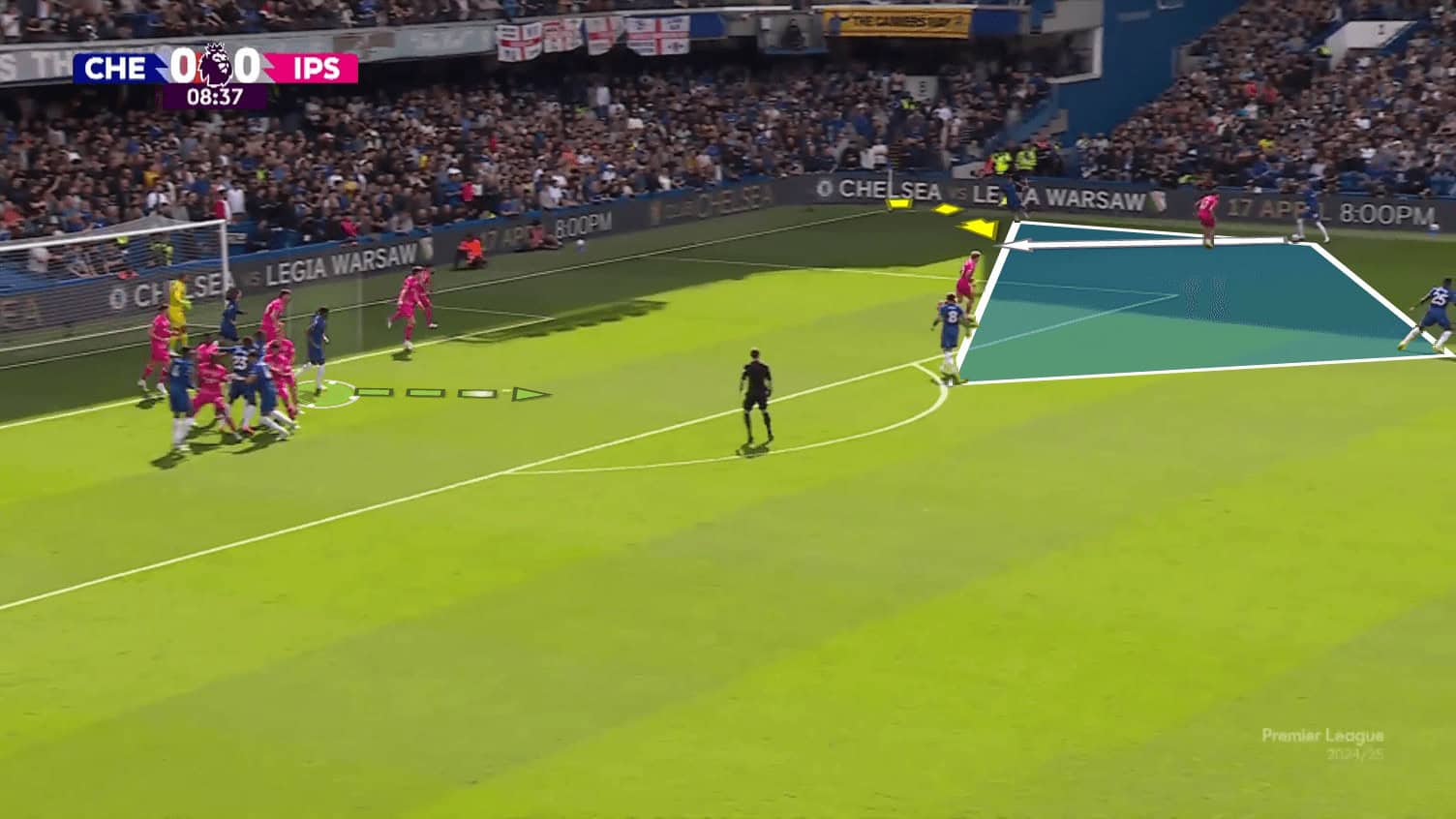
As shown below, the edge-of-the-box defender moves to be the second short-option defender.
Hence, the attacker behind him moves to be another option for the cut-back pass while four players are blocking the markers, pushing them towards the zonal line to avoid anyone going to the ball.
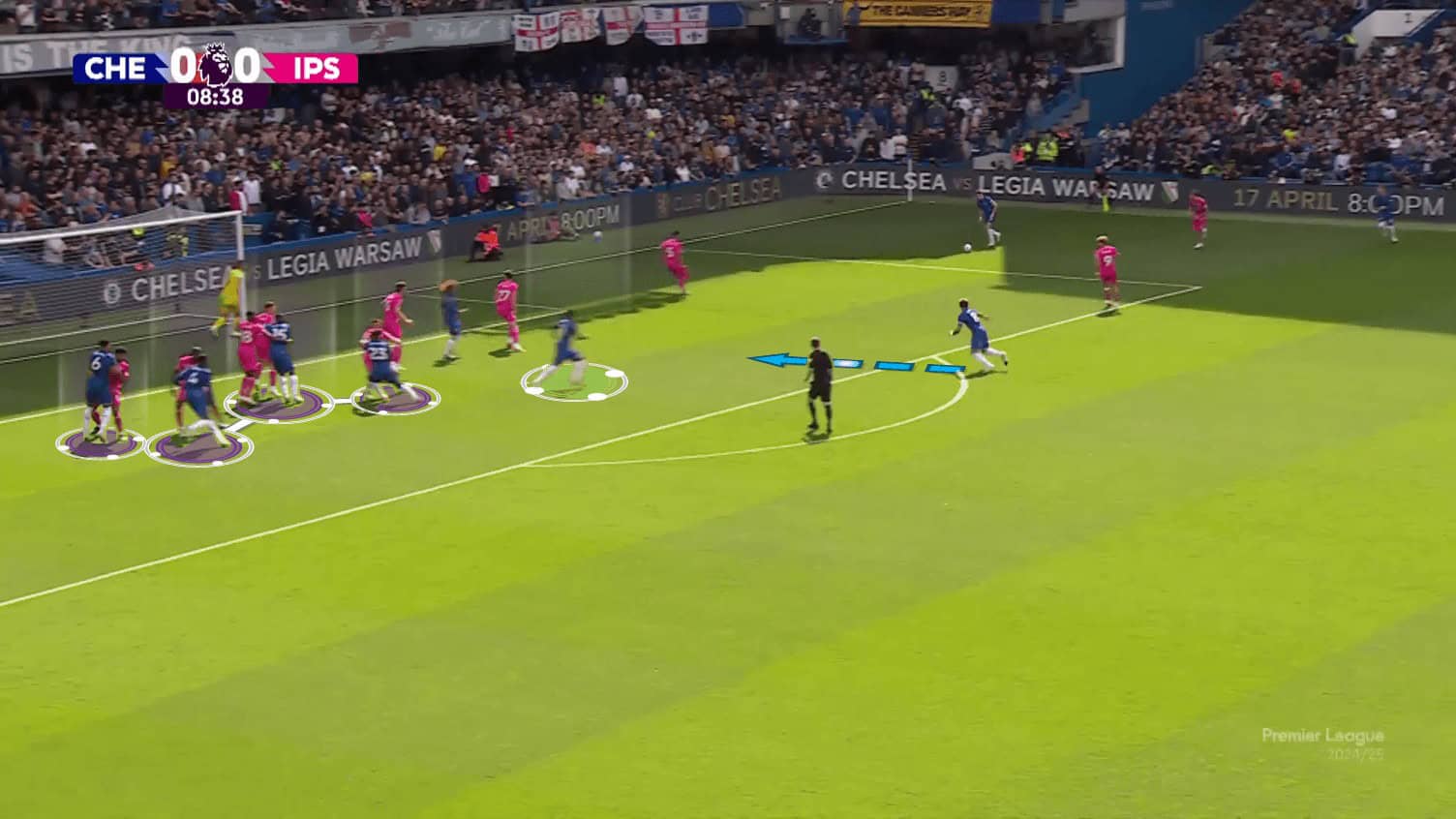
The routine works effectively, but the shot goes so far.
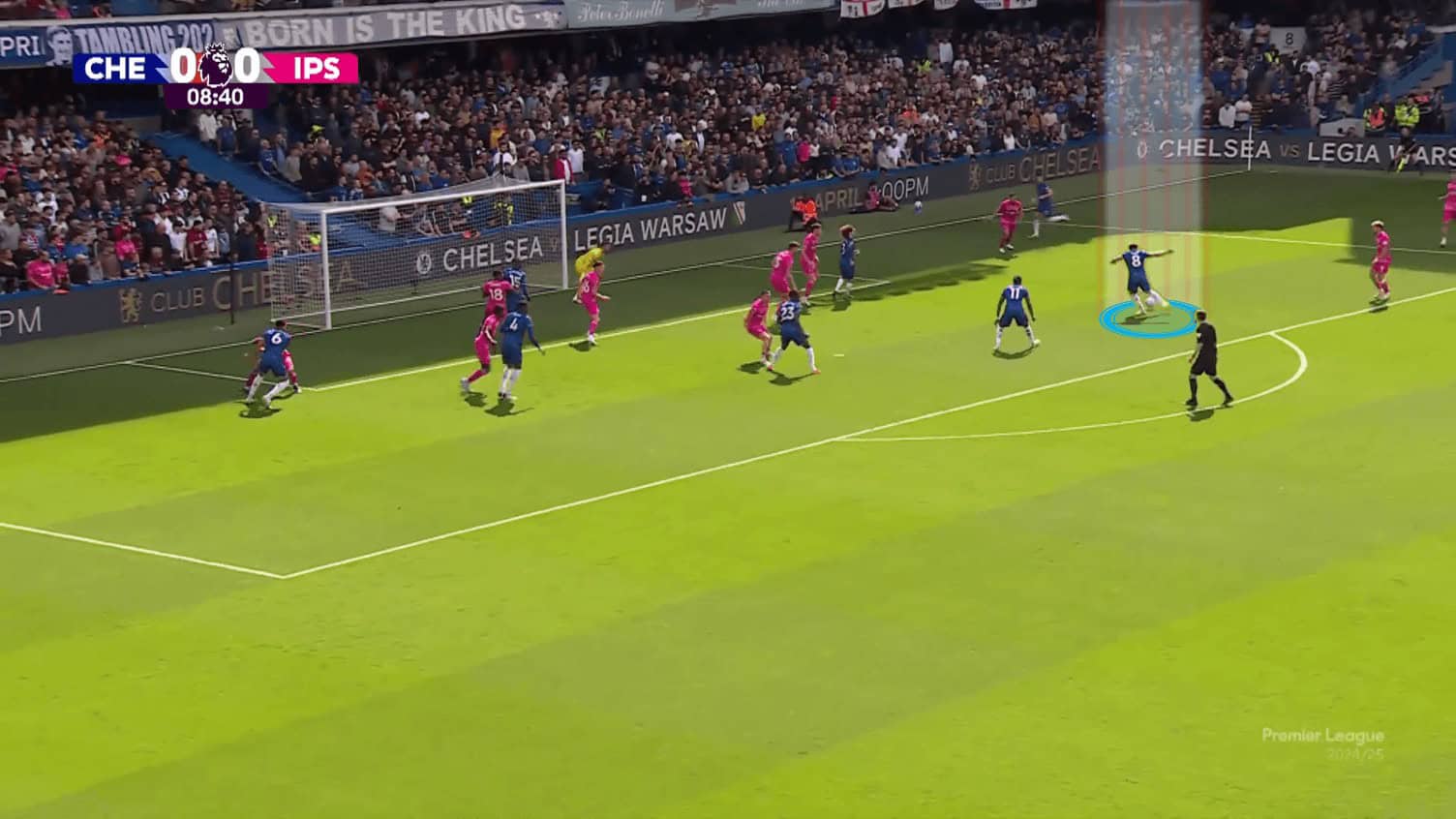
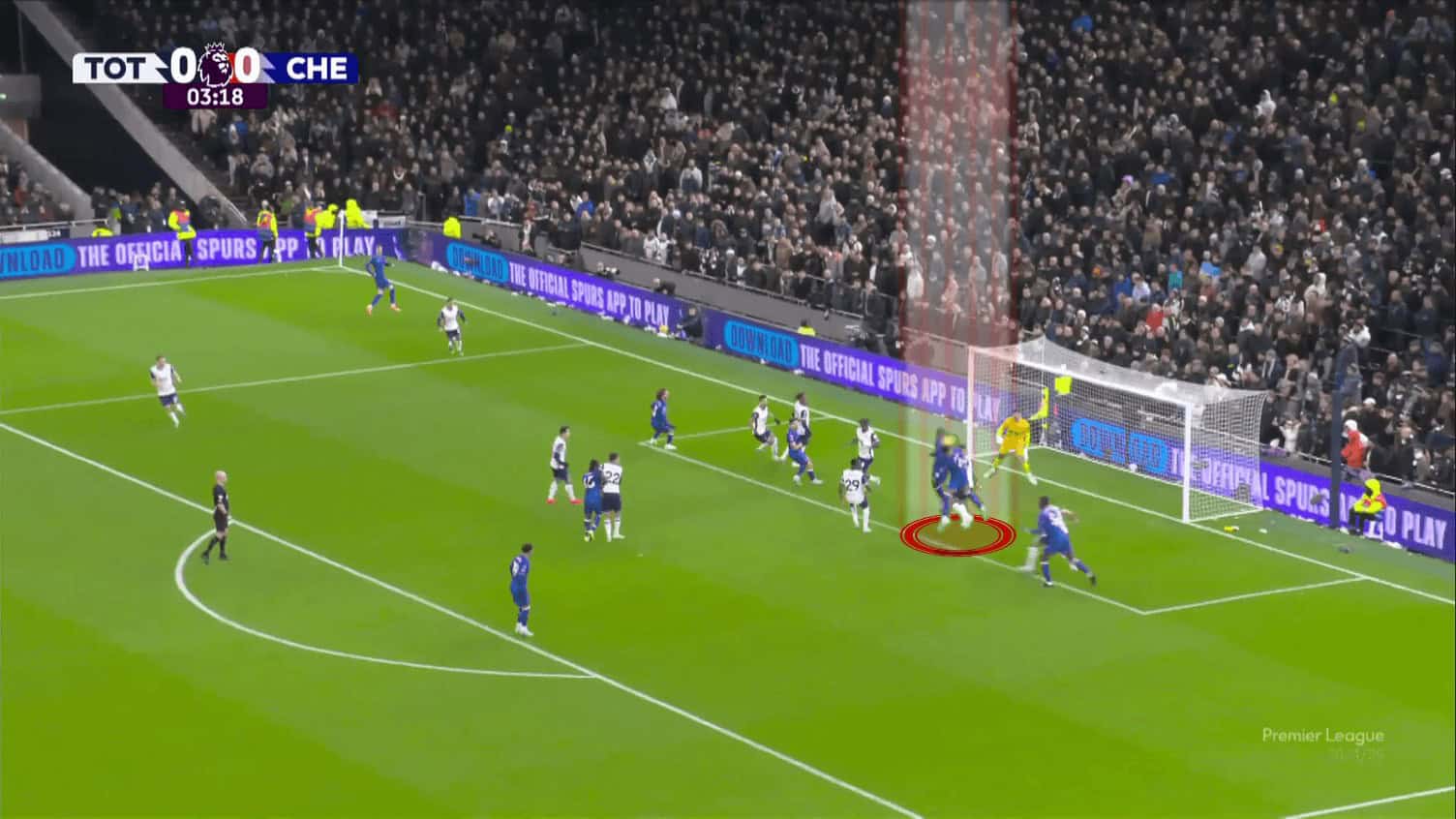
Our last case shows a good plan and good execution but a lack of luck.
As shown below, Tottenham Hotspur defend with three zonal defenders, a player near the edge of the box ready to defend short corners and six man markers.
The same sudden run causes a quick wall pass to the taker.
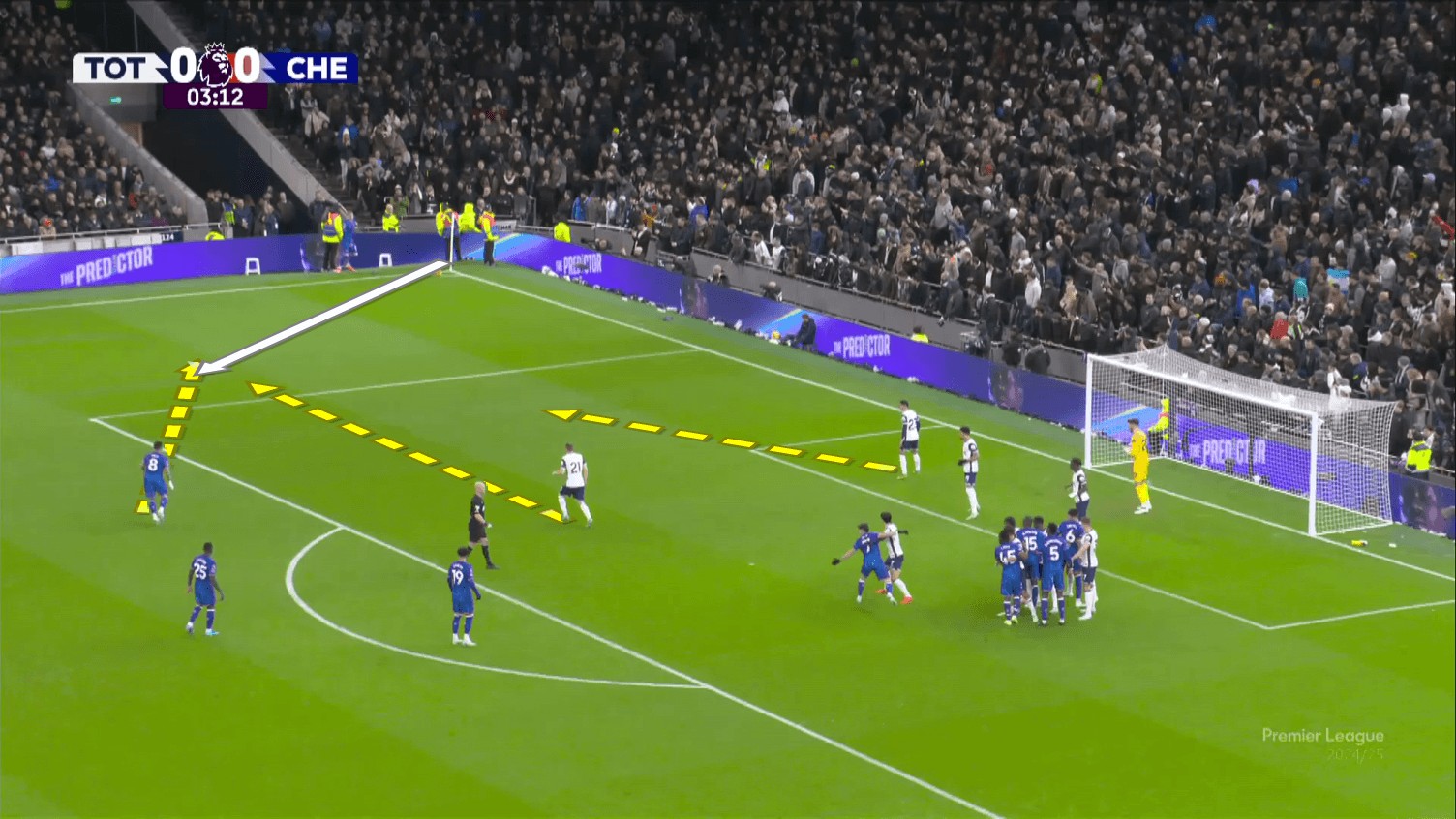
As shown below, the second-sort option defender comes a little late because he is the first zonal defender, enabling the taker to cross the ball.
Inside the box, the chaos begins with the short passes.
You can find that the markers left the attackers behind him, focusing on the ball without an accurate line, because an attacker (green) keeps pushing his marker to make sure that his targeted players are onside.
You can see that the targeted player checks his back to continue running without being offside.
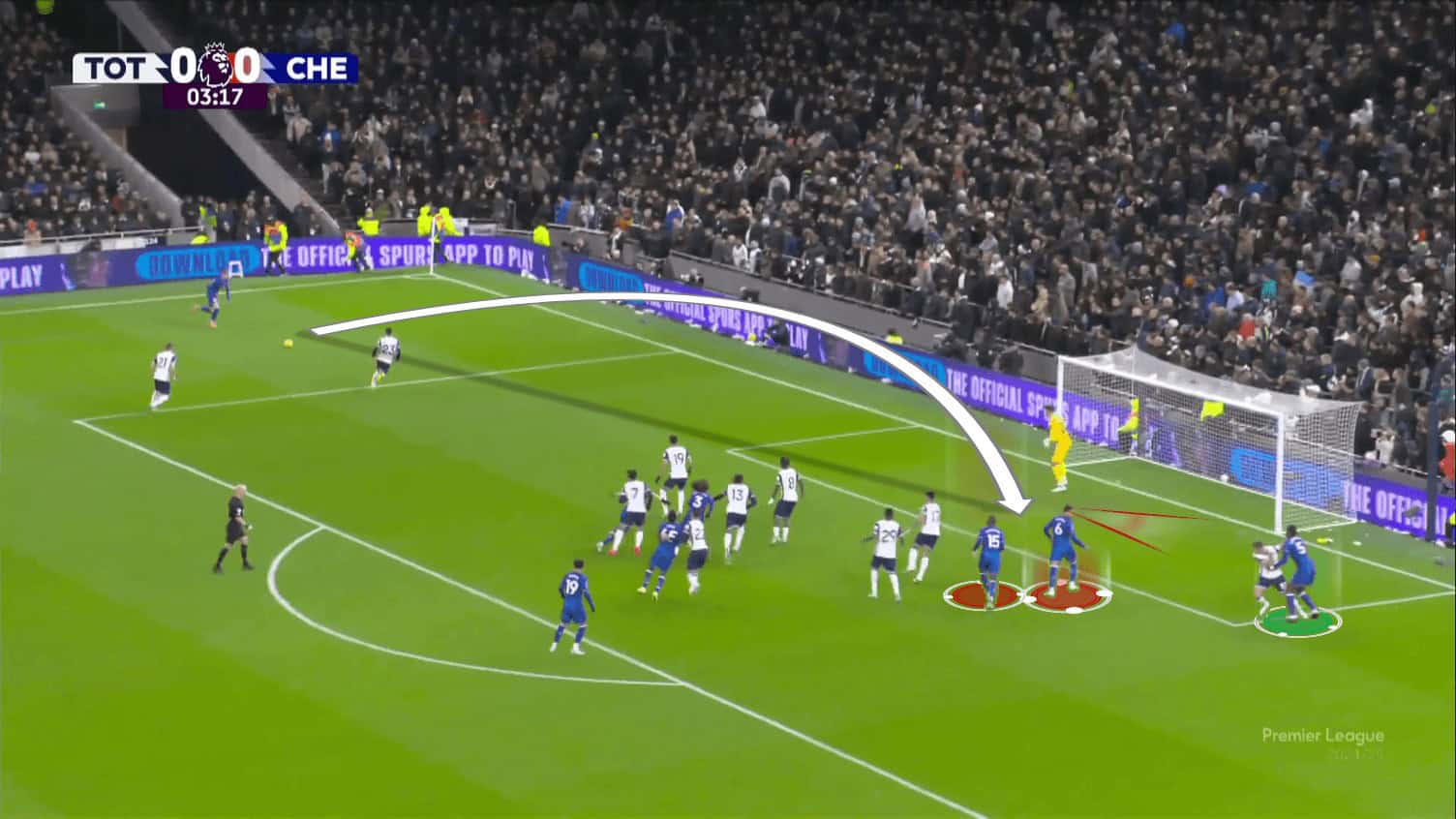
The targeted player gets a good cross, which leads to a chance, but unfortunately, he can’t control the ball well, and it goes outside.
Conclusion
This analysis demonstrates that Chelsea’s set-piece limitations stem not from conceptual flaws in their routines but rather from:
-
Execution Deficiencies: Lack of precision in delivery
-
Variance Factors: Occasional misfortune in critical moments
Our tactical analysis has detailed Bernardo Cueva’s core strategic concepts:
-
Near-Post Dominance: Systematic targeting of the front-post zone
-
Short-Corner Innovations: Multi-layered deception routines
While these designs showed theoretical promise, suboptimal execution significantly limited their transformative potential.
