
Whilst his career has been somewhat stop-start, there has never been any doubt that Emile Smith-Rowe is a player with immense talent.
During his loan spells at RB Leipzig and Huddersfield Town and following his breakthrough into the Arsenal first team, he continually demonstrated an ability to impact games and has earned plenty of praise for his efforts.
However, with Arsenal’s squad well-saturated in his area of the field, it had also become apparent that he would need to move on from his boyhood club if he was to secure regular game time.
With that in mind, it came as little surprise when he bid farewell to the Emirates Stadium last summer and joined Fulham, who parted with a club-record £27m in return for his signature.
Many at Craven Cottage felt that he could be the player they had been looking for to spearhead their charge up the Premier League standings, and there have been plenty of signs as the campaign has gone on that he has the potential to live up to that billing.
However, he has also experienced several quieter spells in which he has struggled to have the same impact on proceedings, and that has led to some debate over whether he can be classified as a successful signing overall for the club.
It is that debate that this tactical analysis will attempt to reach a verdict on.
The scout report will examine different aspects of his play, both in and out of possession, and suggest ways that he can continue to improve as his career progresses.
The analysis will then use the points made to see whether he has justified the money spent to acquire him or if he has fallen short of expectations.
Emile Smith-Rowe In Possession
When watching Emile Smith-Rowe play, his ability with the ball at his feet has always been apparent.
It was this part of his game that Arsenal particularly liked about him and tried to encourage whenever he was on the field, and it is telling that Fulham, too, have looked to incorporate that part of his game into their own tactics.

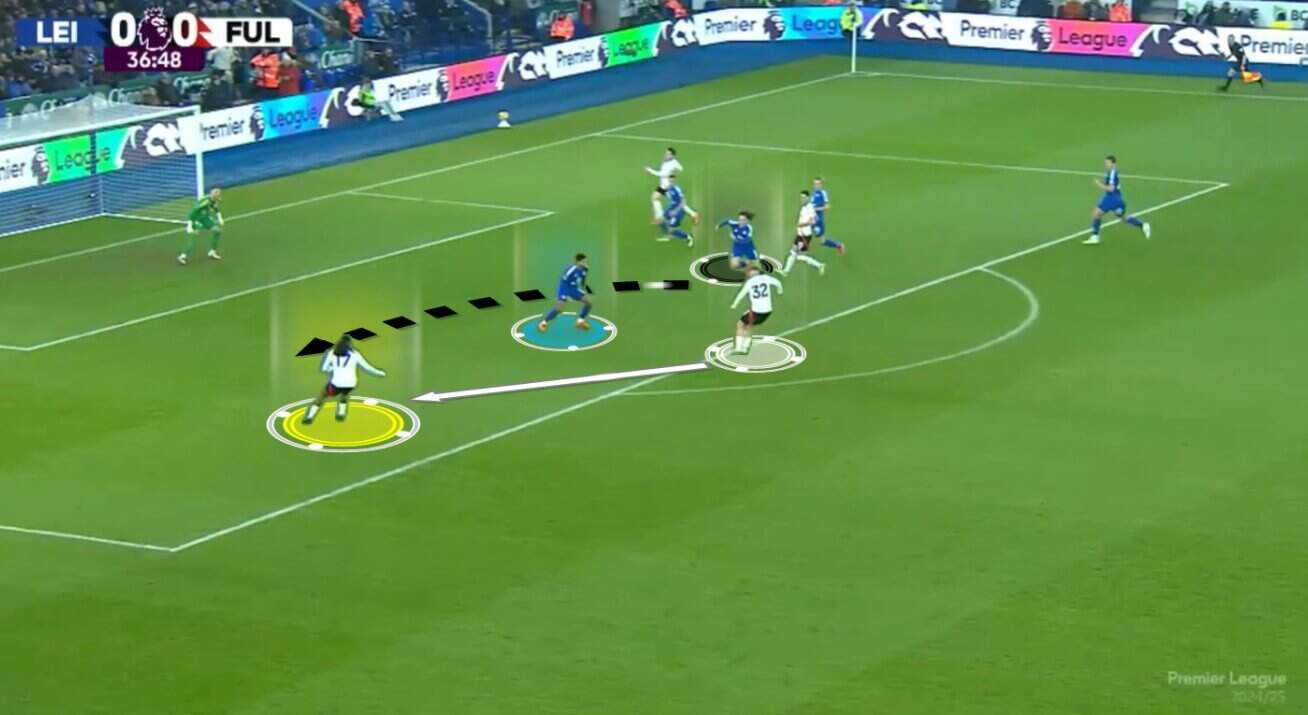
As a result, it has been common to see him in situations such as this, with him inside the half-spaces and attempting to move the ball between different areas of the pitch.
In this case, he is positioned between the Leicester City lines and is attempting to help his team find a way through or around the home team.
What allows him to play such a key role in that here is his control of the ball and speed of thought, which is shown by the way that he already knows when Antonee Robinson sends the ball into his path that he has teammates behind him to work with.
Because of that, he receives the ball with his outer foot here, knowing that doing so will automatically put him on the half-turn and, therefore, make it easier to shift the ball towards Harry Wilson before Boubakary Soumaré can close him down.
This is not to say that he would be unable to make the same pass if he had controlled the ball with his other foot, but it is simply the case that doing so would entail him taking more time to get the ball out of his feet, which would have only played into Leicester’s hands.
This situation led to a one-two between Wilson and Smith-Rowe before the latter got a shot away at goal, demonstrating how important these details have been in his effectiveness in Fulham’s attack.
The other reason Smith-Rowe has proven so critical when Fulham moves up the field is that he can speed things up and slow them down.
That alternative side to his game is shown here, with Saša Lukić sending the ball into his path and Leicester once again getting numbers back to make his route to goal as difficult as possible.
However, his intention is not to shoot at goal himself but to set up a chance for fellow former Arsenal player Alex Iwobi, who he knows is positioned to his left-hand side here.
He could have simply sent the ball towards the Nigerian forward in the same way as he did in the previous situation, but he instead opts to hold onto the ball for a fraction of a second longer.
By doing so, he entices James Justin into moving out of line and pressing him, which then hands Iwobi additional space from which he can set himself up to shoot at goal.
Whilst it might not have led to anything this time, with Wout Faes making a good recovery to thwart Iwobi as he connected with the ball, it was another sign of the intelligence that Fulham have added to their ranks through signing Smith-Rowe last summer.
Add to that the precision that he has shown when moving the ball between teammates, with 90.2% of his passes finding their intended target, and there is no denying that he has the quality needed to be a key player in Marco Silva’s team.
Emile Smith-Rowe Statistics At Fulham 2024/2025
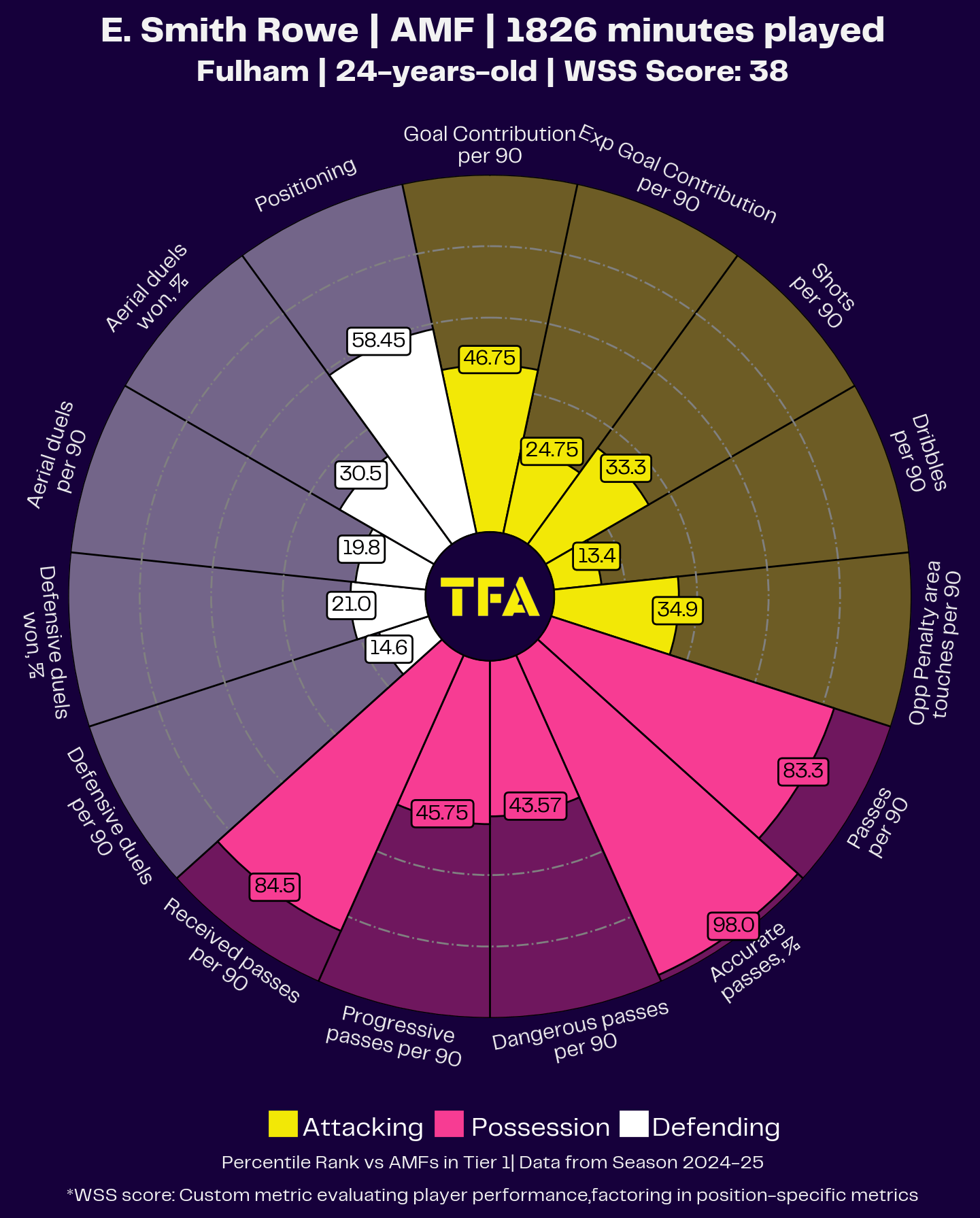
This is highlighted further when breaking down Smith-Rowe’s percentile statistics for this season, with it clear to see in this graphic (which compares him to all others in his position in Tier 1 leagues) that he ranks especially highly for passing accuracy and passes received per game.
Therefore, he has the trust of his teammates, who know they can rely on him to find spaces and keep the momentum on their side.
Couple that with the fact that he is currently outperforming his expected goal contributions for the campaign (despite only registering one assist), and he has been able to translate that into chances when in promising areas of the field.
There might be some concern that he doesn’t rank as highly in the bands for progressive passes, dangerous passes or touches in the opposing penalty area (with him only averaging 2.32 of the last of those per game).
However, that reflects how his role is to operate further back and help move the ball around the field, rather than to be a predominant outlet inside the final third.
Emile Smith-Rowe Out Of Possession
There has been just as much to enjoy about what Emile Smith-Rowe offers out of possession, too, with that awareness that has already been apparent in this analysis once again evident whenever he doesn’t have the ball as well.
As a result, this too has been something that Fulham have really benefitted from as the current Premier League campaign has gone on.
The obvious awareness to mention here is Smith-Rowe’s ability to find space, which he has always done well.
However, his game also reveals an innate awareness of what individual opponents are doing, with him capable of locating gaps in opposing lines and punishing mistakes.
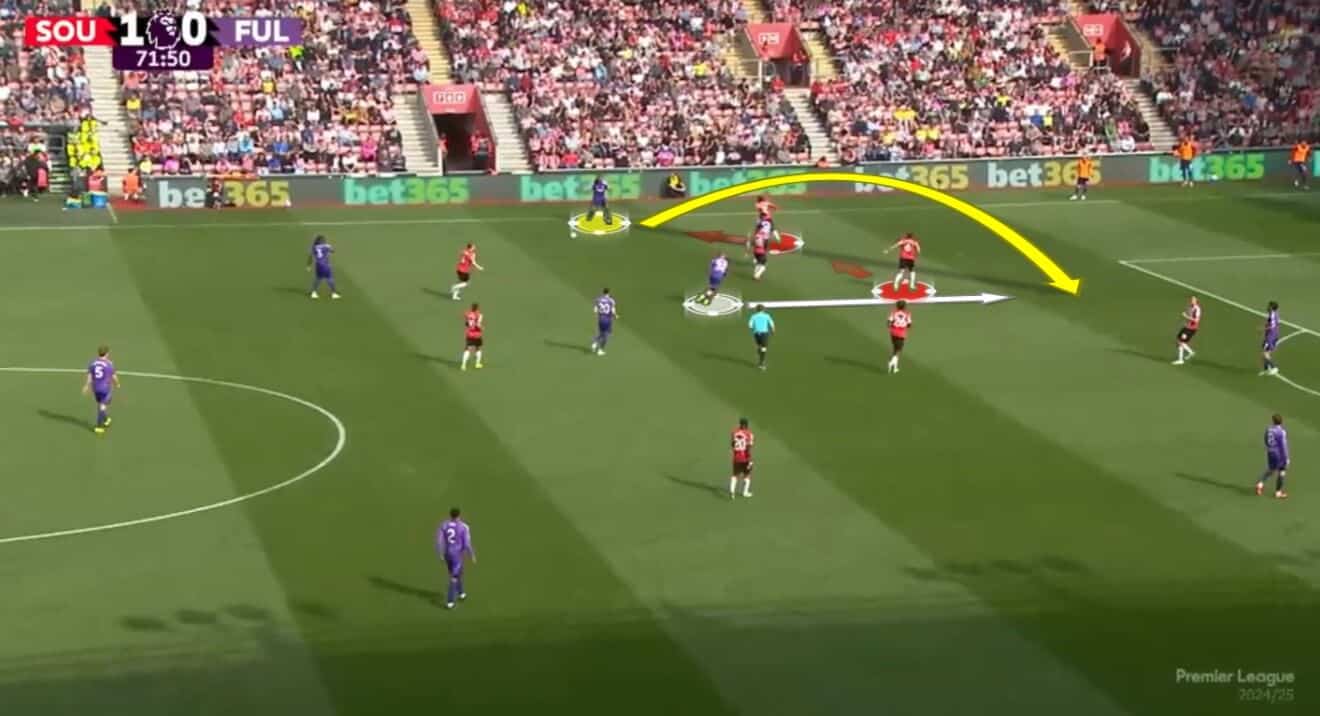
This situation perfectly demonstrates that, with Fulham visiting relegated Southampton and knowing they would have chances to penetrate a defensive line that has proven particularly leaky over the weeks and months.
However, that is not to say that the visitors arrived at St. Mary’s Stadium expecting to have things all their own way.
Evidently, they had a clear game plan to manipulate the Southampton players into leaving spaces open.
That revolved around shifting the ball towards the wing and trying to force the defenders nearest it to move towards the ball, before then moving into the spaces that would subsequently open up further inside the pitch.
It worked out well for Marco Silva’s team.
Calvin Bassey’s pass into Iwobi saw Kyle Walker-Peters move towards the ball to close it down.
At the same time, Taylor Harwood-Bellis adjusted his own position to cover for Walker-Peters and attempt to guard the space he had left open.
This then increased the chasm between Harwood-Bellis and central defensive partner Jan Bednarek, and it was there that Smith-Rowe targeted with his run.
With him now ahead of the ball, all Iwobi needed to do was to loft a pass in his direction, and Fulham would be able to test Southampton’s goal.
On this occasion, it worked to perfection, as Smith-Rowe scored from an acute angle (one of six goals he has netted this term), with a deflection from Bednarek helping it on its way.
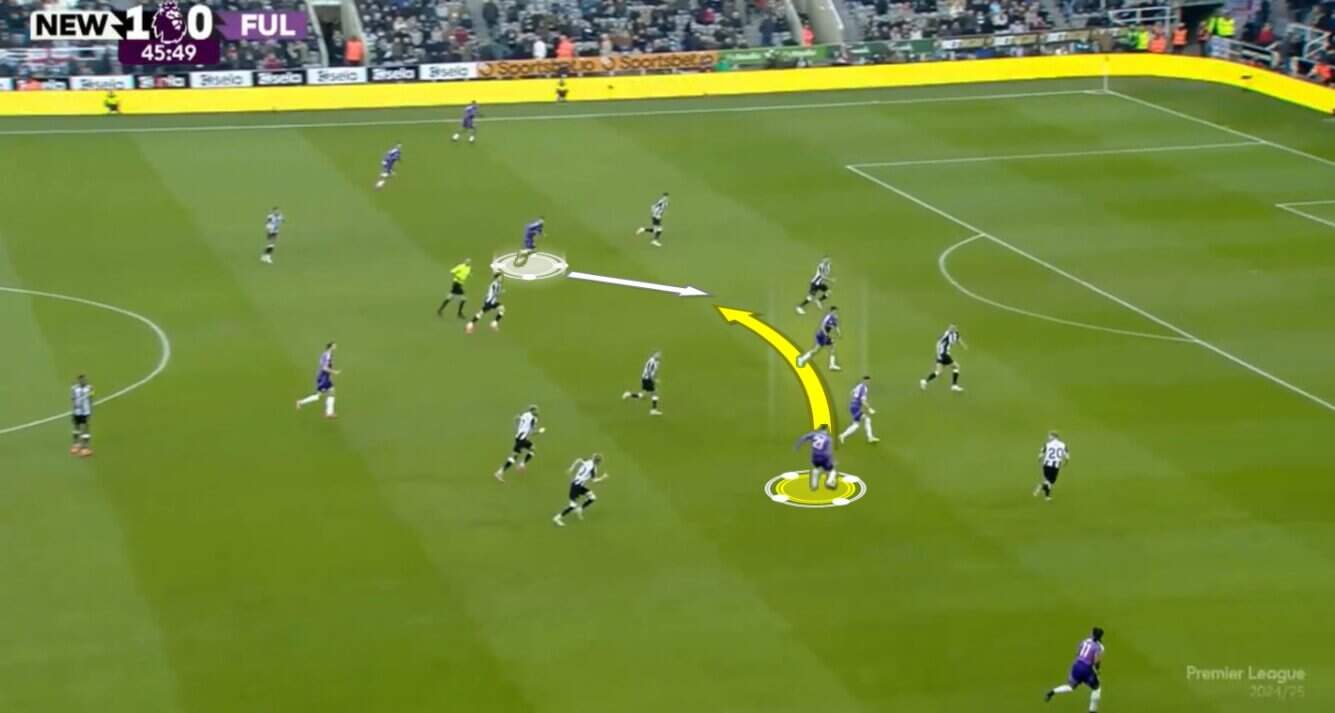
The other thing that aids Smith-Rowe in catching opponents out is his speed and ability to increase or decrease his individual pace instantaneously, linking back to what was referenced in the previous section.
In this case, Fulham are once again on the front foot and Newcastle United are doing their best to retreat into shape.
Joachim Andersen has progressed the ball forward, and Timothy Castagne is now searching for a way to retain the momentum built up.
At this stage, Smith-Rowe is positioned on the edge of the gap between the Newcastle ranks and is watching events unfold with great interest.
However, what happens next really shows how critical his speed can be to making Fulham a tough side to defend against.
As Castagne’s pass comes off the back of Lukić and travels in Smith-Rowe’s direction, the former Arsenal player is forced to readjust the angle of his run in order to meet the ball, which he does through using the same agility that has been evident throughout the scout report.
His effort on goal might not have led to anything on this occasion, with the distance the ball needed to cover meaning that it was a simple save for Martin Dúbravka to make.
However, his ability to get into the right position and then switch on the afterburners at the right time to react to what is happening around him is another reason that he has, at times, been a tricky player to contain.
That sense of positioning has also helped Fulham when they have been defending.
Silva’s tactics demand that all players track back if they are able to do so to make the team as watertight as possible.
As a result, Smith-Rowe tends to operate as either a central attacking midfielder or a wide forward, so it has been common to see him in deeper areas, trying to make life as difficult as possible for teams that make significant territorial gains.
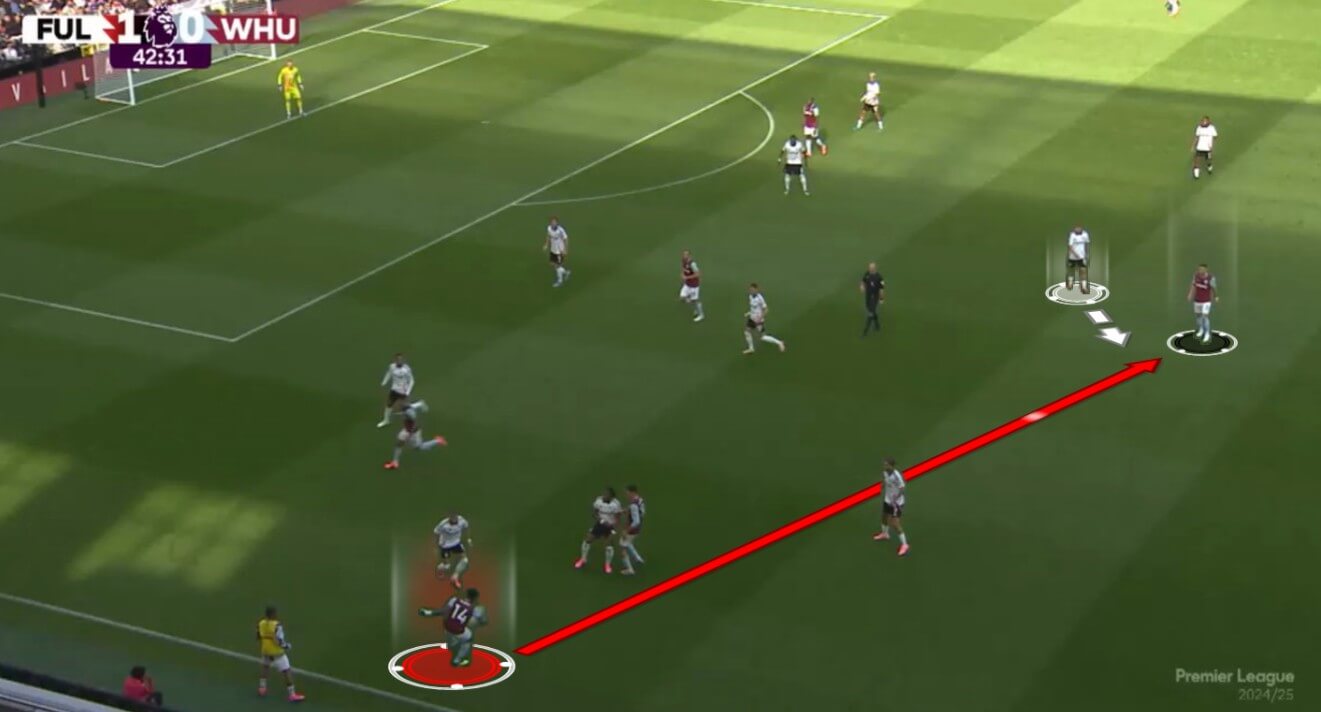
In this situation, he has been able to get behind the ball and close it down.
However, that does not mean that he simply engages in a 1-v-1 duel against West Ham United’s Guido Rodríguez, following Mohammed Kudus’s pass towards him.
Instead, he takes up a position that blocks the Argentina midfielder from getting any further up the pitch.
It is a tactic that works well for Fulham, as they do succeed in dislodging the ball here.
The fact that Smith-Rowe has won 53% of his defensive duels and has made 50 interceptions to date (an average of 2.07 per game) shows how he can be just as vital in this aspect of their play as he can be when they are moving up the field.
Therefore, it is another reason that Fulham have benefited from having him in their squad.
Where Can Emile Smith-Rowe Improve?
The points made so far in this analysis have been positive ones, but to assume that Emile Smith-Rowe is the finished article at this stage in his career would be an incorrect one to make.
Instead, as mentioned at the beginning of the scout report, there is still plenty of room for him to grow and develop, with a number of areas that he can look at to become the best version of himself.
The first of those is his occasional poor decision-making.
It has already been mentioned that he can assess his surroundings and be aware of what is happening around him, but there have been times when that has not been present, and it has let both him and Fulham down.
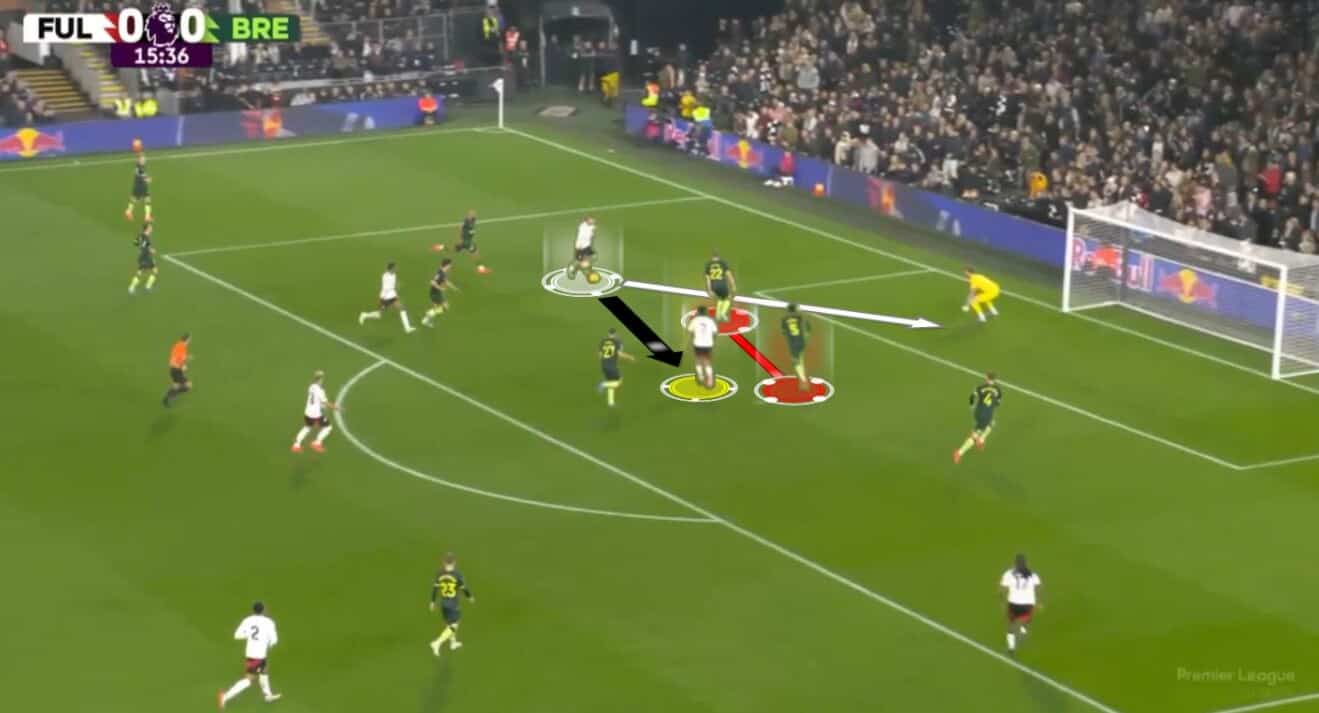
This was one moment when that was evident, with good combination work by Robinson and Reiss Nelson seeing the ball arrive at his feet inside the Brentford goal area.
At this stage, he has the chance to shoot at goal, but he also has Raúl Jiménez inside him.
The Mexico striker has stepped back from the Brentford back line to give himself space to receive the ball and turn it into the back of the net.
Add to that the gap he has in front of him, created by Nathan Collins and Ethan Pinnock focusing their attention on Smith-Rowe, and the fact that goalkeeper Mark Flekken is off his line, and the smart decision here would have been to cut the ball back for Jiménez to score here.
However, Smith-Rowe doesn’t make that pass and instead opts to take the chance on himself, which only results in Collins blocking the effort and putting it behind for a corner.
Whilst the game did ultimately end in a win for Fulham, it was a hard-fought one, and situations like this will definitely have been the subject of their post-game debrief as they tried to look at where they could have done better.
The other problem that can arise from Smith-Rowe’s occasional poor decision-making is that it can sometimes make the game much more complicated than it needs to be.
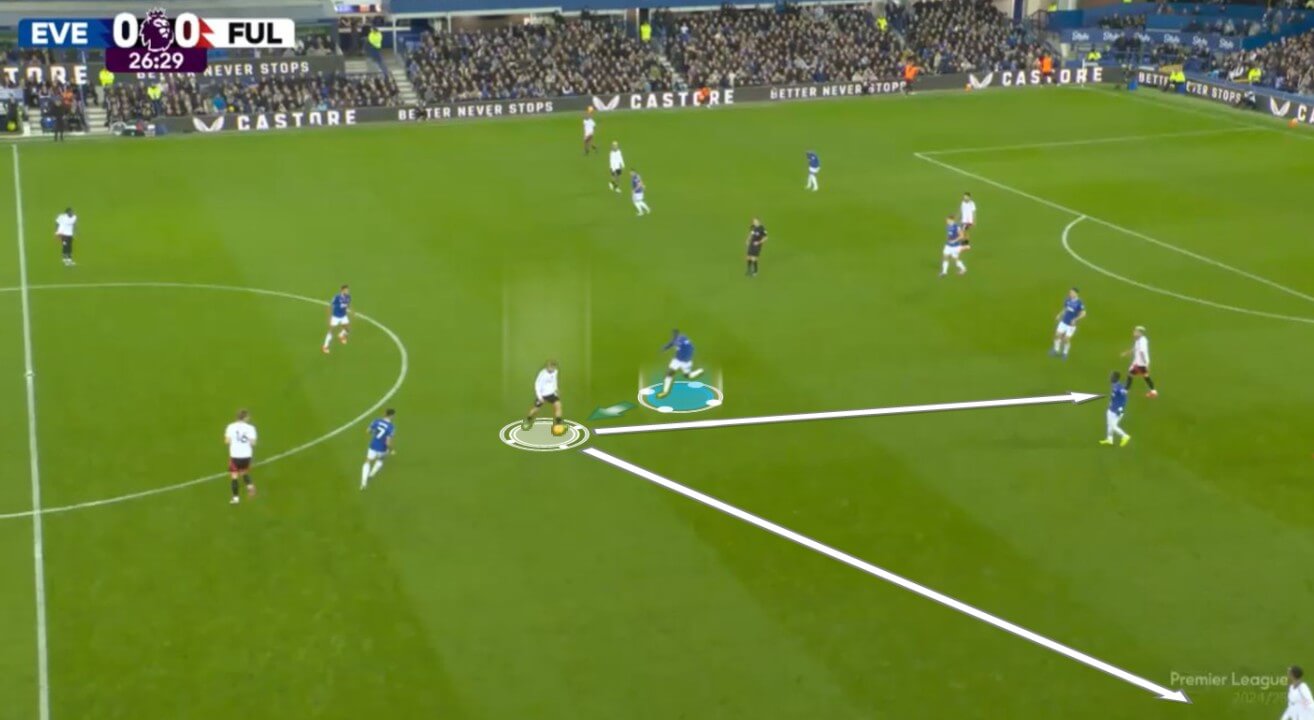
In this case, Sander Berge worked the ball well before feeding it into Smith-Rowe’s feet, and opponents Everton set up with the defensive shape that they tended to favour at this stage of the campaign.
As a result, it was never going to be easy for Fulham to break them down, and they needed to use the spaces available to them without taking too many risks.
That, though, is exactly what Smith-Rowe did her.
He had both Kenny Tete and Andreas Pereira available as passing options but decided not to use either.
Instead, he looked towards the far side of the field and had to keep the ball longer than he needed to.
That invited pressure from Abdoulaye Doucouré, and Everton succeeded in winning possession and abruptly ending the attack.
There is nothing to say that a pass in that direction would not have led to the attack progressing as Fulham would have hoped it could.
Still, it certainly made it harder for Fulham when both Tete and Pereira could have controlled the ball and then carried on the verticality in their play with more ease.
Therefore, making better decisions in these situations is something Smith-Rowe does need to look at.
Aside from that, the other thing that has been noticeable about Smith-Rowe is that he has a tendency to concede unnecessary fouls.
He might have only given away 17 in total, at an average of 0.7 per game, but they have tended to come in areas where Fulham have not been under pressure and so have not needed to give their opponents chances to clear their lines.
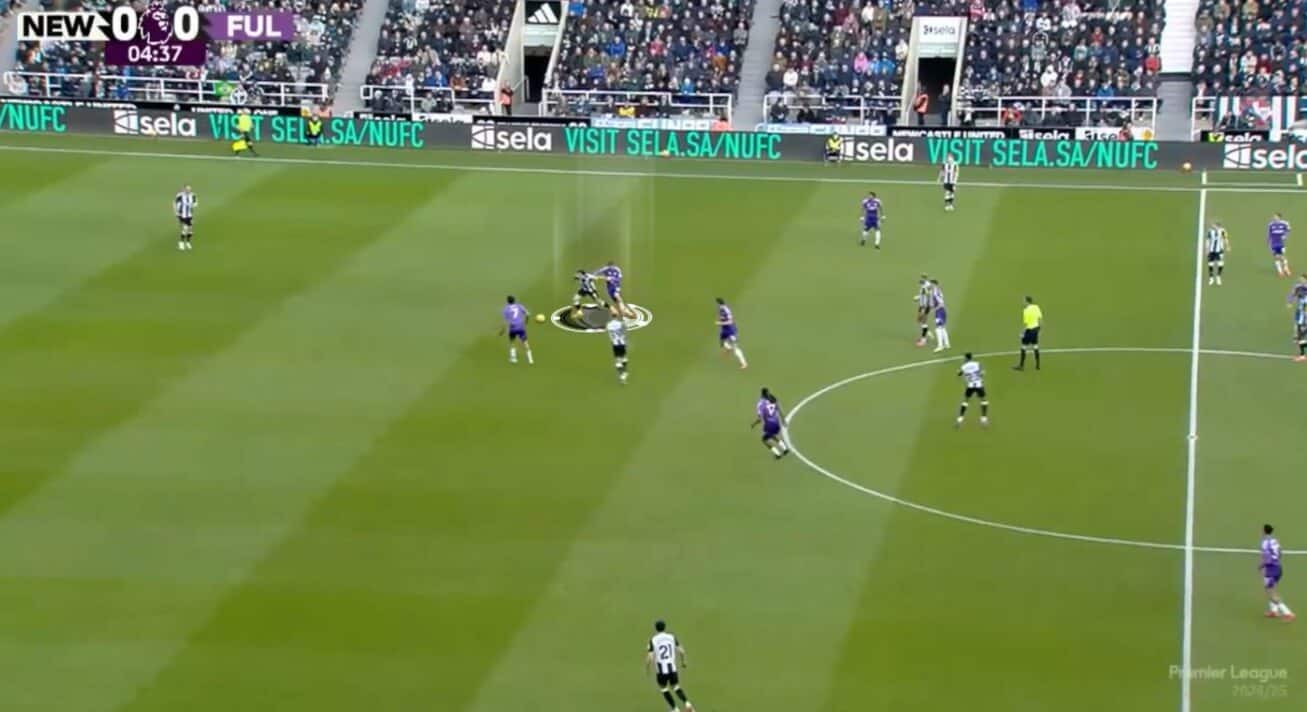
This was a really good example of that, with Smith-Rowe getting tight to Newcastle’s Sandro Tonali inside the home side’s half.
All he needed to do here was to shadow and block him, in a similar way to how he dealt with West Ham’s Rodríguez earlier in the analysis.
However, he instead used his arms and pulled Tonali to the ground, which led to a clear free kick and handed Newcastle a chance to relieve the pressure that they had been under up until this moment.
This is not the only time that Smith-Rowe has been guilty of poor discipline in areas where his team has not been under significant strain.
This could also hamper him in the future from really living up to the potential that so many know he is capable of.
Conclusion
In conclusion, this tactical analysis has taken a closer look at Fulham midfielder Emile Smith-Rowe, assessing his impact on the field for them since arriving last summer, examining what he offers both in and out of possession, and identifying where he can continue to develop.
As the scout report has indicated, there is a lot to like about Smith-Rowe as a player.
Fulham clearly have a player in their ranks who is capable of connecting the dots and of both creating and converting promising opportunities.
His ability to make quick decisions (although not always the right ones) should certainly be commended.
In the coming years, he can consider working on eradicating those moments when he doesn’t make the right call, a progression stage.
At the beginning of this analysis, it was stated that a verdict would be reached on whether Fulham had signed a good player.
Given the overall positivity of the report and the variety of ways that Smith-Rowe can affect the game for them, that verdict favours his signing.
However, there should be some caution attached to it, with it clear that what he is missing this season is consistency.
He and Fulham now need to consider dispensing with those quieter spells when he can go missing as they attempt to further integrate him into the team, but there is certainly enough there to suggest that he has the raw ability to thrive at Craven Cottage.
