
Football is an ever-changing sport, with no two seasons ever being the same, and the game constantly evolving.
As each year passes, new players are discovered, teams alter their appearances, and emerging coaches seek to add their stamp to the game.
The other aspect that changes year-on-year is the tactics that enter and leave favour, with new ideas constantly being developed as each side attempts to find innovative ways to achieve success.
The current season has been no different in that regard, and one tactical trend to have emerged this time around has been the deployment of wingers in interior spaces.
Whilst it is not a novelty to see those on the wings cut inside the pitch when the opportunity arises, not many coaches have sought to keep them there for extended periods of play.
This campaign, though, has seen a change in that mindset, which is what this tactical analysis will explore.
The scout report will highlight three teams—Crystal Palace, Liverpool, and PSG—that currently use this strategy and show what each gains from including it in their game plan.
Ismaïla Sarr Scout Report At Crystal Palace
The first and arguably best way to enable a winger to stay inside the field is undoubtedly to select a formation in which they start in a central position.
The most common way to do this is to select either a 3-4-2-1 or a 4-3-2-1 formation.
Both create a tight front three in which the striker is flanked by two inside forwards instead of two wingers who hug the sidelines.
In the Premier League, one side who have continually favoured the former is Crystal Palace, and there is no doubt that having inside forwards has been a key factor in Oliver Glasner’s side enjoying a strong but largely understated campaign.

However, whilst the likes of Eberechi Eze and Romain Esse (and, until his departure last summer, Michael Olise) have always had a natural instinct to operate further inside the field, Ismaïla Sarr is a winger by trade.
As a result, the inside forward role is not something he would ordinarily play in, yet this season has shown that he has had no problem acclimatising to it.
With Sarr in these central areas and largely remaining in them, Crystal Palace have been able to use his ability to pass the ball at speed and scan for opportunities to create shots on goal.
In this case, he has picked up the ball and is now driving towards the Southampton backline, with striker Jean-Philippe Mateta running ahead of him to offer a forward passing option.
This, though, is not the important point; instead, it’s the options that Sarr now has.
He has Eze moving into the space to his left, allowing him to set up a shot for his side. His 72.9% passing accuracy indicates that he could find him successfully.
However, he also has enough of a gap to his right to take the chance on himself, and the fact that he is a proven goal scorer (having netted eight times in all competitions this season and scored twice in the weekend’s FA Cup semi-final win against Aston Villa from a similar position) means that this, too, is an option for him to consider.
This then presents Southampton defenders Jack Stephens and Jan Bednarek with a quandary, as they have to guard against multiple possibilities, and that is the key point here.
Having Sarr in these central spaces increases Crystal Palace’s options when they get on the attack.
On this occasion, he did opt to set up Eze (one of 25 shot assists he has registered so far this season), but that unpredictability has troubled plenty of teams this season and has made Sarr a useful player to have further inside the pitch.
Sarr’s other key trait is his speed, which has been evident throughout his career and was a major reason for his success in England during a four-year spell with Watford.
With Glasner asking his players to employ a high-pressing strategy whenever possible, having a quick player in the middle of the attack has allowed Crystal Palace to target the heart of opposing backlines and force mistakes.
That is, therefore, another benefit they have gained from using their summer recruit in this alternative role.
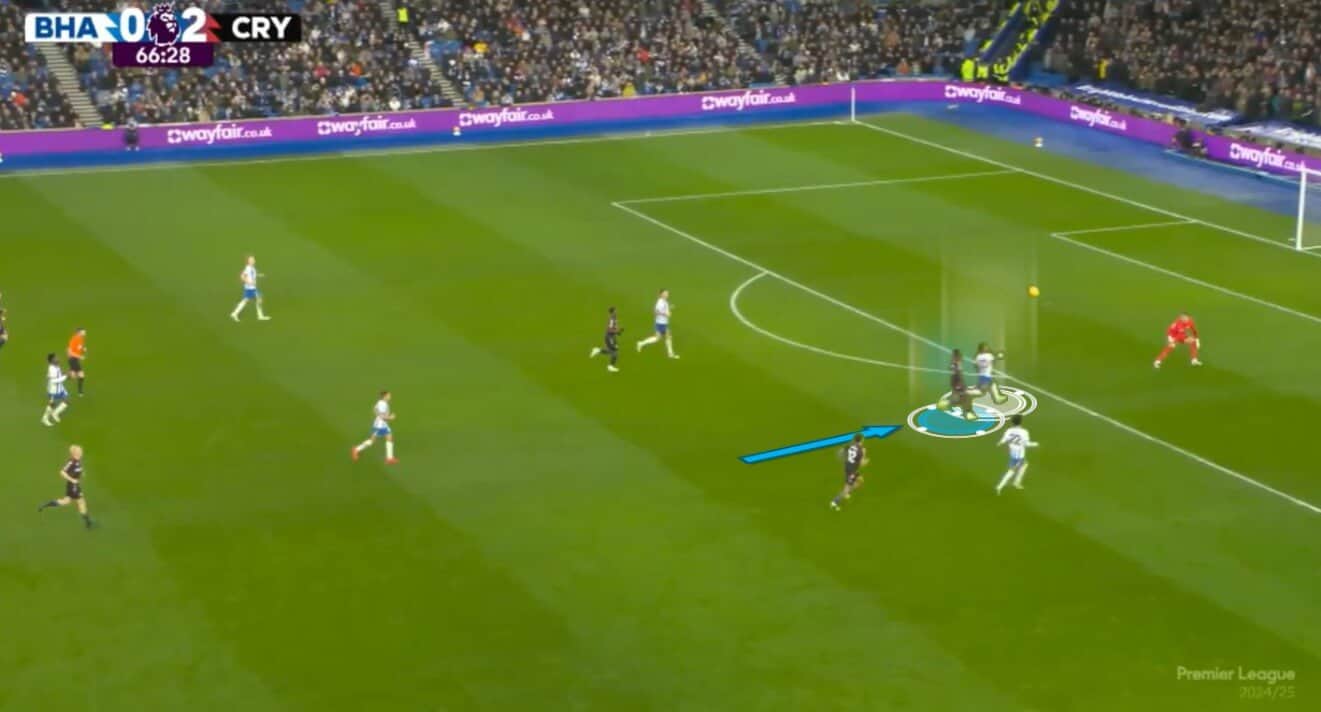
In this case, a long pass into the Brighton and Hove Albion third has arrived in the vicinity of Pervis Estupiñán, but the Ecuador full-back has made the mistake of allowing the ball to bounce rather than simply heading it away from danger.
In doing so, he has presented Sarr with an opportunity to close him down from behind, putting Brighton under more pressure and making life increasingly difficult for them.
On this occasion, Sarr succeeded in winning the duel and set up right wing-back Daniel Muñoz to score, with only the officials preventing the goal from counting.
It should be mentioned that Sarr has only succeeded in 37.1% of his aerial duels this season, which is perhaps one reason he chose not to fight for the initial ball and instead waited for it to hit the ground. This is something for him to improve in his game.
However, there is no doubt that his intelligence in pressing at the right time and unleashing the speed for which he is known has been instrumental in Crystal Palace applying pressure against almost all their opponents and ensuring that mistakes are regularly punished.
This is not to say that Sarr has not drifted out to the wing at times, and there have been occasions when this has been necessary to create overloads against opposing full-backs.
However, this has not hindered Crystal Palace in any way and has, in fact, allowed another key aspect of their play to be demonstrated.
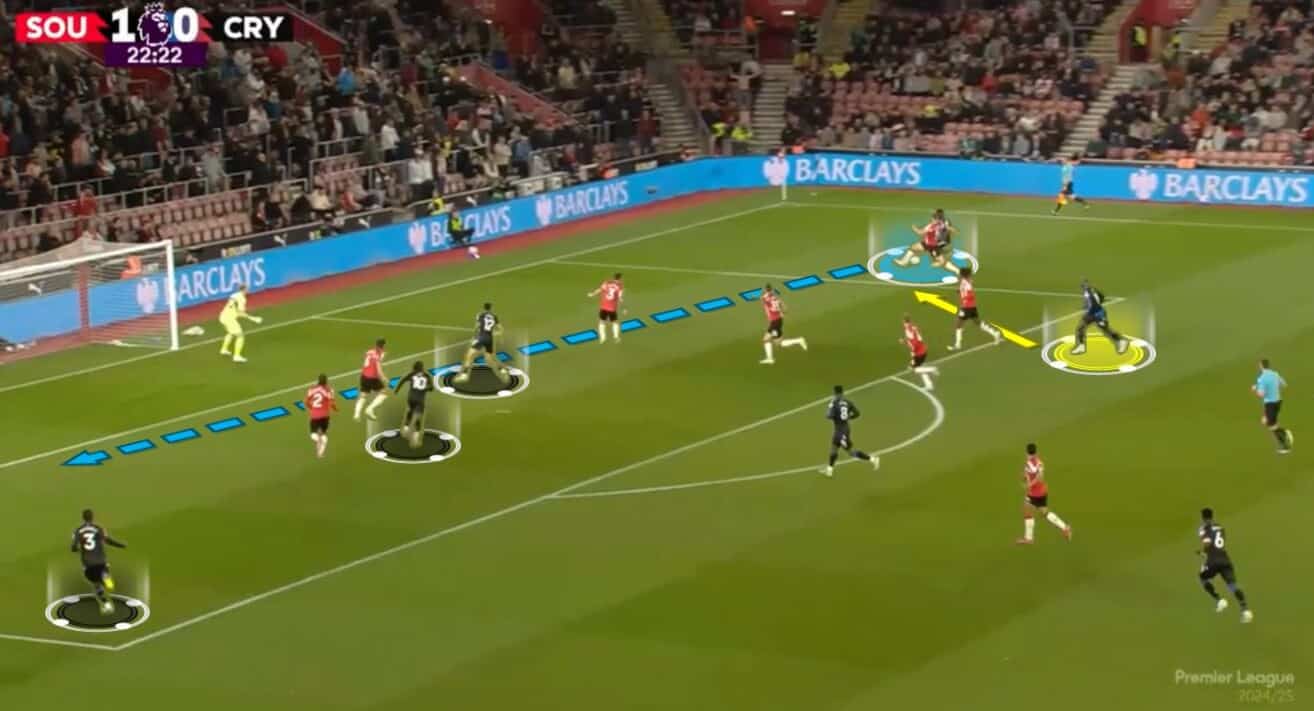
As can be seen here, Southampton are once again attempting to stave off an attack, but have come under threat from a four-player forward advance here.
This is what comes from having inside forwards and wing-backs on the field, which enables teams to flood numbers forward as soon as they have the ball and makes it as hard as possible for opponents to keep them at bay.
When it comes to Crystal Palace, though, there is an added layer of complexity to this, with it not always being the wing-backs who stay wide and the forwards who operate inside the pitch.
Instead, as has happened here, Sarr has moved out to receive the ball from Mateta (who is now providing secondary support to the attack), while Muñoz has moved inside him to join Eze.
Left wing-back Tyrick Mitchell is providing a backstop on the near side of the goal area.
Whilst this chance fails to materialise into anything, with Kyle Walker-Peters reaching the cross before Mitchell does, the positional rotation here needs to be highlighted.
Through it, Crystal Palace have constantly made themselves a tough opponent, and there is no doubt that Sarr epitomises their flexibility.
Although he is a winger by trade, he can offer a threat through the middle, too.
Therefore, deploying him in the central channel has certainly benefitted his team this season for a multitude of reasons.
Luis Díaz Scout Report At Liverpool
This is not to say, though, that teams who wish to move their wingers inside the field have to start them there.
One tactical trend present in the men’s and women’s games in recent campaigns is the usage of a floating winger who shifts from one wing to the other to create gaps in opposing defensive lines.
Liverpool, the next team to be examined in this analysis, has taken elements of that theory and built them into its own game plan under Arne Slot tactics.
It has undoubtedly been pivotal in their securing Premier League glory this season and adding a 20th top-flight title to their club tally.
Unlike Crystal Palace, Liverpool have tended to set up in a more conventional 4-2-3-1 system, which means that the wingers have not been starting in the central positions and have instead needed to compete in order to find ways into the middle.
This, though, has rarely proven to be a problem for Luis Díaz. The Colombian winger is known for his one-on-one ability and is tasked by Slot with taking players on, using his quick feet and decisiveness to move the ball around them.
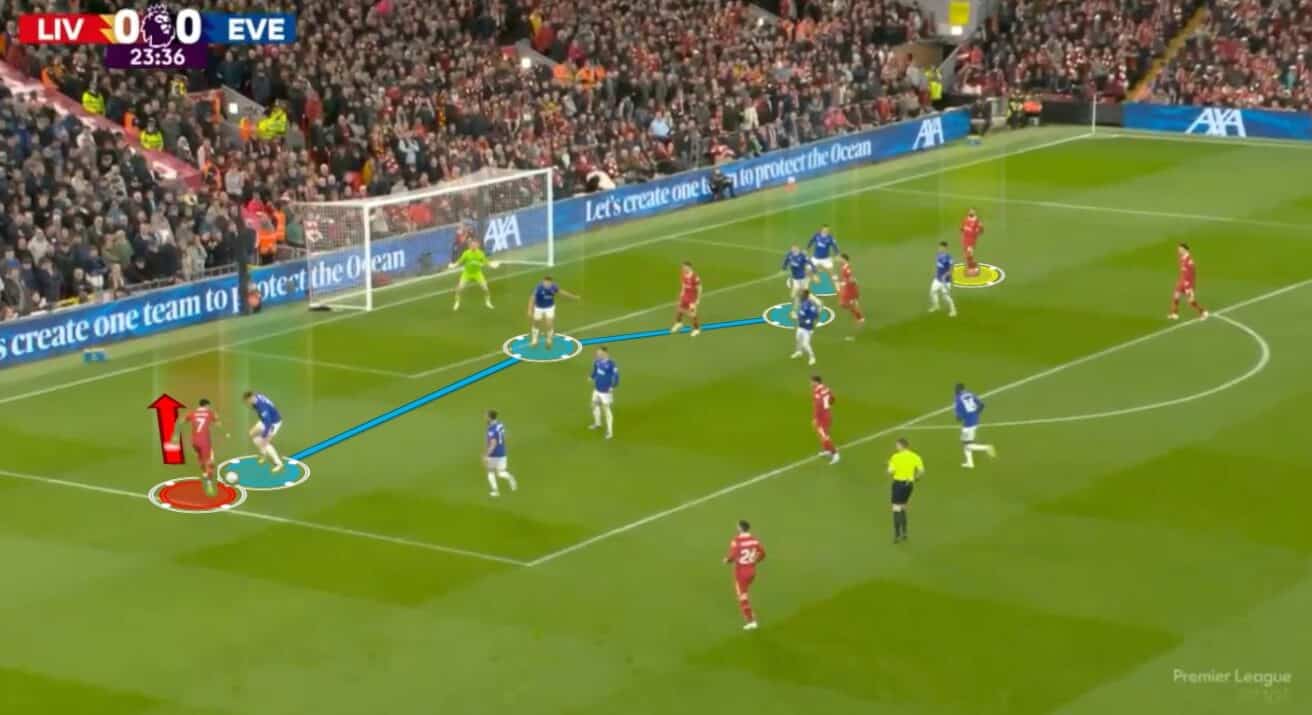
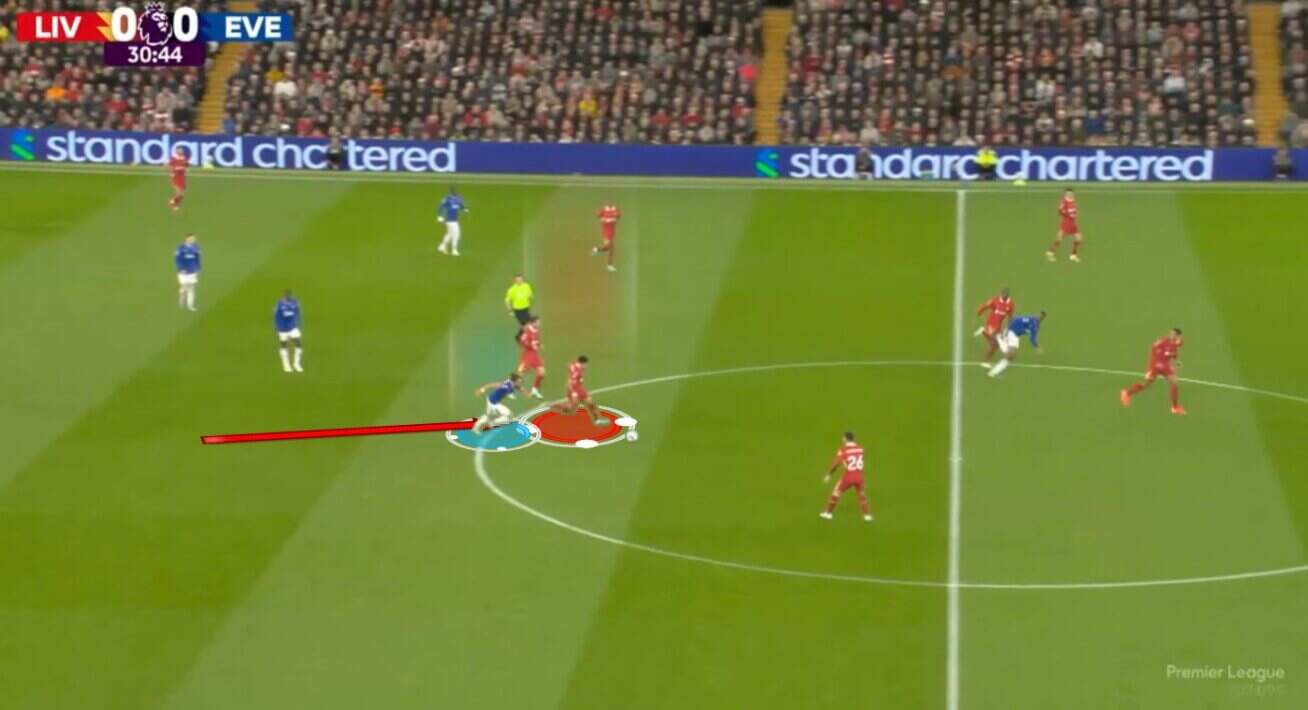
In this case, he is taking on Everton’s Jake O’Brien in a duel and is seeking to make a diagonal run inside the pitch.
Whilst he was thwarted here by O’Brien and the attack came to nothing, the fact that Díaz has contributed 57 shot assists to date this season is evidence of the fact that he has been a key threat in Liverpool’s attack and someone who can bring the same threat as Sarr when he does get into central areas.
Slot has not sent him further inside the pitch despite wanting him to be there because he wants to create space on the opposite side of the pitch where the ball is.
In this case, the effect of Díaz dribbling the ball towards the goal area is highlighted by the Everton backline shifting once O’Brien moves to close the winger down.
That then leaves Mo Salah free behind them here to get on the end of any delivery that might come his way.
This has also worked the other way too, with Salah at times holding play up and cutting inside, meaning that Díaz or another player has been left unguarded and in space.
When Díaz does access those interior spaces, those same quick feet once again come into use, and it is them that have made him such a key player in Liverpool’s playmaker role this season (and allowed him to score 16 goals in all competitions, more than the 13 he managed last time out).
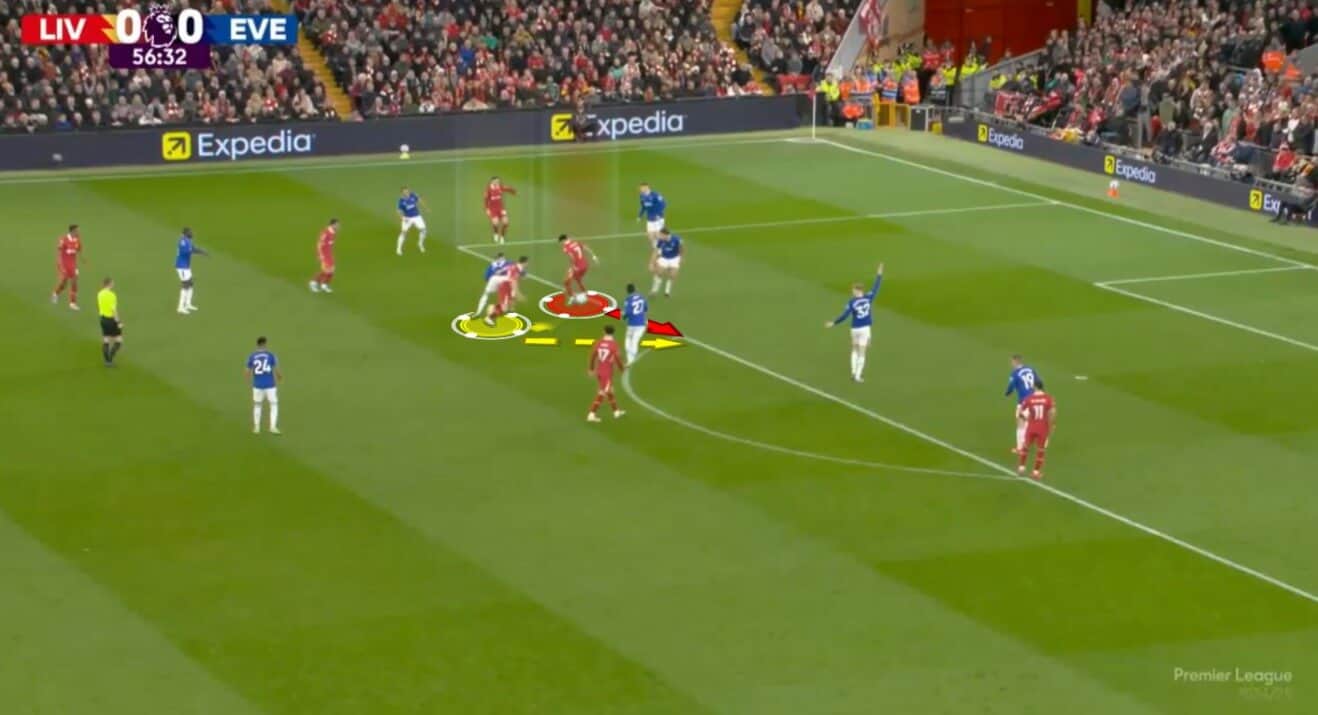
Everton have attempted to build a solid wall between the ball and the goal, and Liverpool has been forced to work hard to break it down.
The presence of Díaz was undoubtedly instrumental in them doing just that.
As can be seen, he has moved into a position between the Everton lines and is now acting as a playmaker in the Liverpool attack.
At this stage, Diogo Jota has come under pressure from Jarrad Branthwaite and so needs to move the ball out of danger, and Díaz now provides that option before setting up the shot for Jota to dispatch beyond the reach of Jordan Pickford.
There is nothing to say that this goal would not have come about had another player been where Díaz was here, but what is certain is that the winger’s clarity of thinking made him the perfect player in this moment to allow Liverpool to take the lead.
With his 85.3% passing accuracy, it is undoubtedly that asking him to move infield whenever he can has given the Premier League champions another strong connector when they have been in possession.
It has led to Díaz having a strong campaign overall.
Slot’s team has benefitted from having Díaz play in the middle of the field, though, not only in attack.
Instead, like Sarr, there has been much to admire about what he offers without the ball, too.
However, Díaz’s off-the-ball contributions also involve plenty of defensive work, with this being one situation in which that was apparent.
As can be seen, Everton are in the midst of launching a counter-attack, and Beto has nodded the ball into the path of Jack Harrison on the edge of the centre circle.
While Harrison did not gather the pass cleanly, it did appear that he would have enough space and time to regain the ball and build momentum for his side.
What he had not banked on, though, was the pace that Díaz possesses, with the former FC Porto player identifying the momentary breakdown in the attack and turning on the afterburners to halt Harrison’s progress.
Díaz succeeds in 51.1% of his defensive duels and averages 1.53 interceptions per game, which is undoubtedly just as big a strength of his game as his offensive threat.
This is yet another reason why deploying him in central areas has been critical to Liverpool’s success.
Ousmane Dembélé Scout Report At PSG
This trend has not only been seen in England, though; many teams in other leagues and countries have adopted it.
Paris Saint-Germain have been one such outfit, with head coach Luis Enrique attempting to make his team as structurally flexible as possible, in and out of possession.
His decision to deploy wingers across his forward line has helped that vision become a reality.
This has led Ousmane Dembélé to become a key threat for the Ligue 1 giants this season, with his second season in Paris arguably even more productive than his first.
Following his struggles at Borussia Dortmund and Barcelona, his reputation as one of Europe’s most dangerous attackers has been firmly restored.
Unlike with Sarr and Díaz, though, the decision to play Dembélé in central areas did not appear to be an immediate change made by Enrique.
Instead, it was tested out a few times before becoming a permanent aspect of their play, and Enrique is clearly looking to take advantage of that aforementioned reputation for being so effective when the ball is at his feet.
As a result, while he has asked the France forward to lead the line this season, he has also tasked him with dropping into deeper positions, with the aim of manipulating defenders and causing them constant headaches.
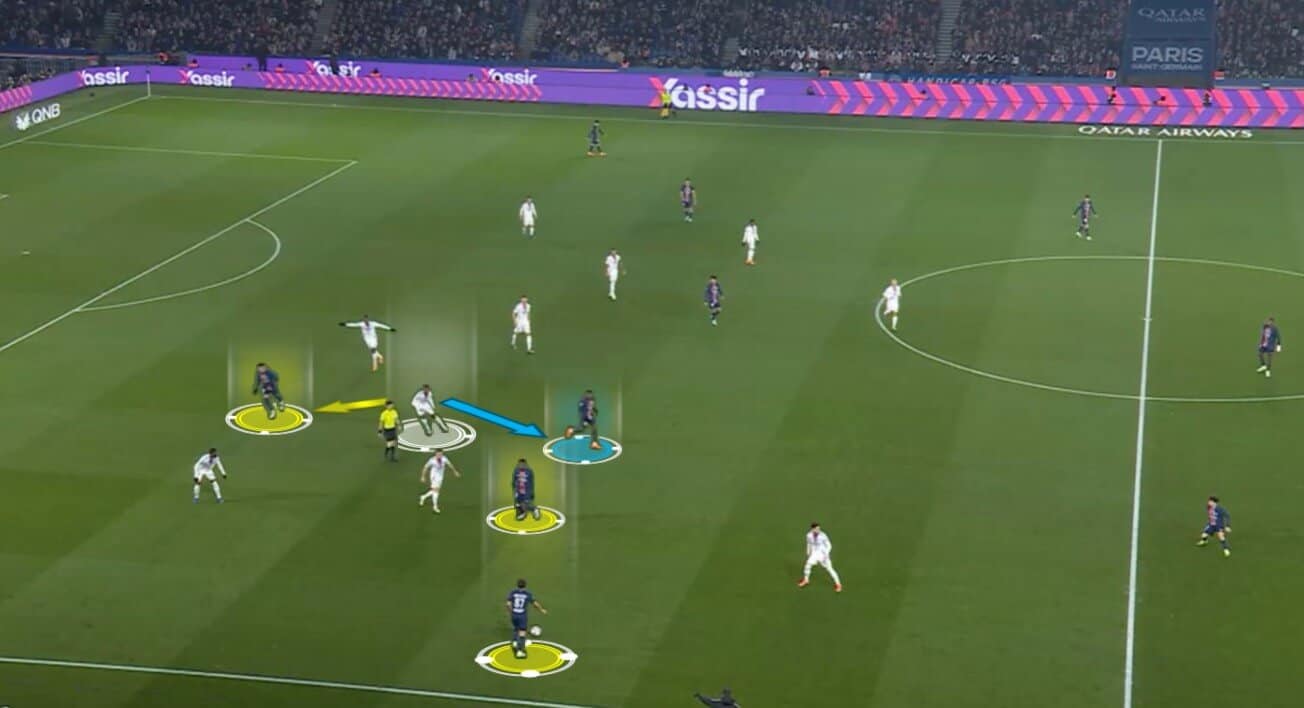
This is one situation that was indicated, with Lyon forced into deciding who they perceive as the greater threat.
Clinton Mata initially thought it was Dembélé and followed him up the field, but his mindset changed as soon as Désiré Doué (who had been equally dangerous) made a run behind him. Mata then found himself in two minds and got caught out of position.
PSG wants this to happen, with Dembélé making runs that create gaps for those around him to exploit.
That ability to ask questions of defenders has made him such a reliable player to have in central positions despite being another wide player by trade.
It is not only the ability to rotate around the field that has made Dembélé such an effective player in the middle channel, though; another reason for his presence there is his quick feet and passing skills.
Under Enrique, PSG have sought to instil a Spanish-influenced style of play that sees them make a series of shorter passes in the same areas of the field, moving the ball up the field without risking it being given away needlessly.
Having Dembélé drift into central spaces has been key to those transitions’ success, with him constantly finding space and connecting play for his side.
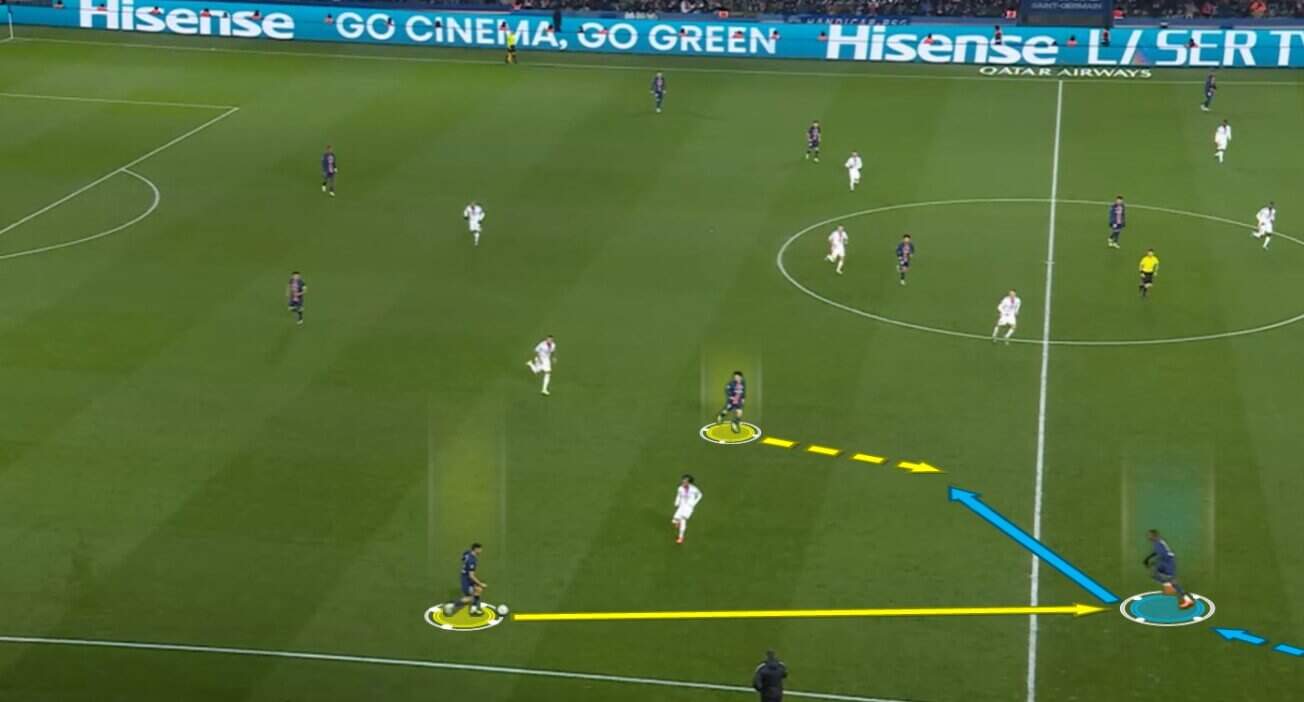
In this case, he made an angled run inside the pitch to receive the ball from Achraf Hakimi, then knocked it towards Vitinha with his first touch.
The control and composure he exercises here are one of the main reasons he has registered a 79.3% passing accuracy so far.
He has racked up nine assists to date (as well as setting up 88 shots for his teammates), which indicates that he can bring that into the final third, too.
Thus, he has been critical to PSG lifting yet another Ligue 1 title.
Like with Sarr and Díaz, it highlights why deploying wingers as attacking midfielders or second strikers could really catch on in the coming years.
Another similarity Dembélé has with Díaz, in particular, is that he can start in wider areas and then move inside.
This was present in the early stages of PSG’s season when Enrique was experimenting with getting him inside the pitch.
The opening match of the season at Le Havre was one game in which this was apparent.
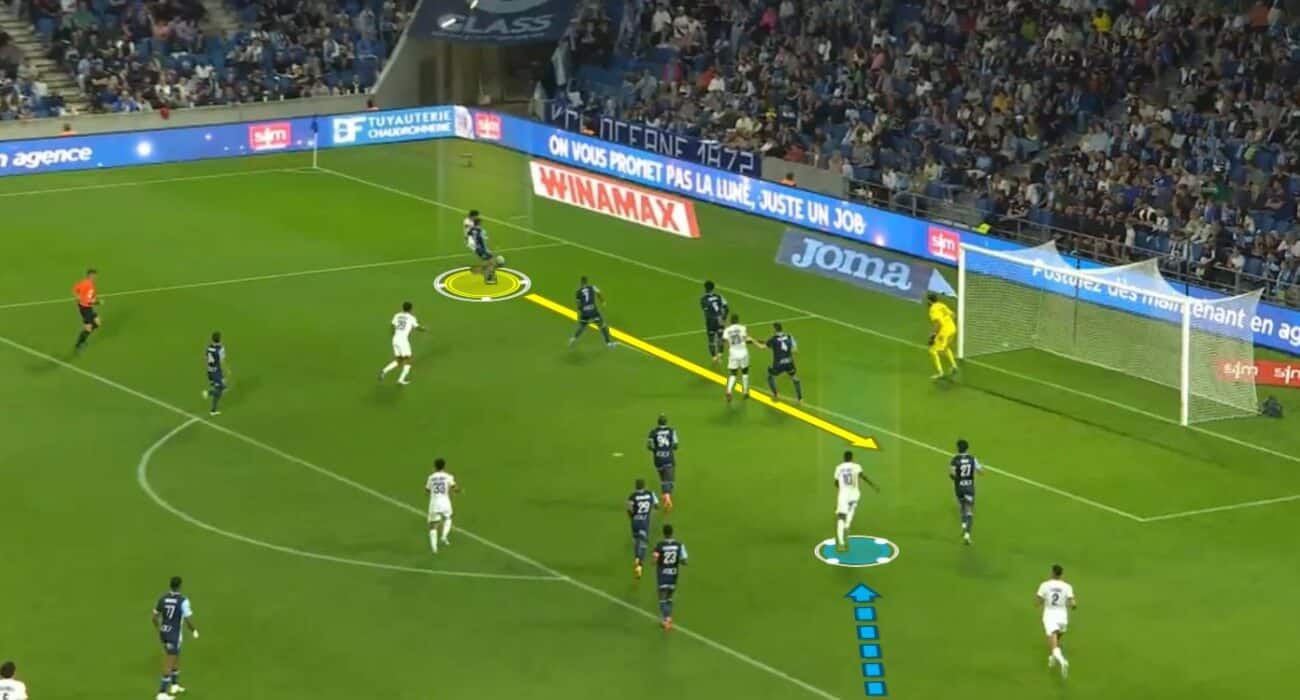
It was clear that Enrique had asked Dembélé to start on the right-hand side but to break into the goal area whenever there was an opportunity for him to do so.
Once again, that sharp mindset and pace aided the forward in succeeding, and here, the agility to exploit the gap left open by Abdoulaye Touré and now-İstanbul Başakşehir left-back Christopher Operi was also evident as he moved into a position from which he could try his luck in front of goal.
At this stage, all he needed was a precise cross from João Neves on the far side of the wing, and he would score, which was exactly what happened here.
Not only was this a sign of what PSG could gain from using Dembélé in central spaces, but it was also an early indication of how aware opposing teams had to be of marking him tightly in order to minimise his impact.
With him scoring 31 times to date this season in all competitions, his threat is evident.
That reputation has led Enrique to ask him to stay in the middle more often, attracting the attention of defenders and creating space for others to run into.
Conclusion
In conclusion, this tactical analysis has sought to explain why the trend of playing wingers inside the field has caught on this season.
Several coaches and managers have sought to implement this strategy in their own game plans and have used it to test opponents.
What is important to note is that this tactic is not limited to one formation.
This scout report shows how Crystal Palace, Liverpool, and Paris Saint Germain deploy different team shapes, yet all find ways to make it successful.
Therefore, it is not beyond any team to introduce it into their own game plan, which is why it could well be something that more sides attempt to implement in the future.
Previous tactical innovations have included playing out from the back, deploying a false nine and pushing a full-back into midfield.
This could well be the next big thing on that list.
