
If we are talking about the most important and historical clubs in Spain, we are obviously talking about Real Madrid, Barcelona and Atlético Madrid, but also about Valencia.
The club from the southeastern Mediterranean coast of Spain has had many great squads and managers in its history.
Their peak was at the start of the 2000s when they reached two UEFA Champions League finals and won the UEFA Cup and La Liga in 2004.
The club fell into deep trouble because of a series of bad financial decisions and the 2008 financial crisis.
However, it never managed to recover and, therefore, was sold to investor Peter Lim.
In the early stages of the takeover, things seemed on an upward trajectory, with the club qualifying for the Champions League multiple times.
Under manager Marcelino, the team finished fourth in La Liga in back-to-back seasons, 2017/18 and 2018/19, and even reached the semi-final of the UEFA Europa League in 2019, as well as winning the Copa del Rey that year.
After that, Marcelino was fired by Peter Lim himself, and the club found itself in a downward spiral, being forced by ownership to sell players like Carlos Soler, Ferran Torres or club legend Dani Parejo and only being able to replace them for cheap or through their academy, which is one of the best in Europe.
At the end of 2024, Valencia hit a new low.
After only winning two out of their last 24 league games, legendary Valencia midfielder Rubén Baraja was relieved of his duties as manager.
On Christmas, the club triggered the release clause of Carlos Corberán, a young Spanish manager at West Brom.
Under Corberán, Valencia managed to recover and leave the relegation zone after a very desperate situation at the end of the year.
Now, they’re looking back on track.
In this tactical analysis and team report, we will take a look at the tactical changes that Carlos Corberán brought to Valencia, how his team plays and how he managed to turn around one of the worst teams in the top-five leagues in mere weeks.
New-Found Defensive Stability
In 14 games since Carlos Corberán took over, Valencia have conceded 25 goals, so you probably had to do a double-take reading the header of this paragraph.
While this is true, we have to look a bit beyond the surface.
Since the Spanish coach took over at his dream job, Valencia have lost just four out of 14 games, against Real Madrid, Atlético Madrid and twice against Barcelona.
In these four games, Valencia conceded a combined 17 goals, 12 of which were in the two games against Barca.
This does not just mean that in the remaining 10 games, Valencia conceded only eight goals; it also means that Valencia are currently unbeaten against every other team outside of the top three in La Liga under Corberán.
At the start of his term in Valencia, Corberán played with a pretty standard 4-2-3-1 formation, but he quickly abandoned it for the most part.
There was a transition phase, during which he had one of his wingers drop back out of the 4-2-3-1 to form a back-three with two wing-backs early on.
For the last couple of games, Corberán had his men line up in a 3-4-2-1 formation from the start.

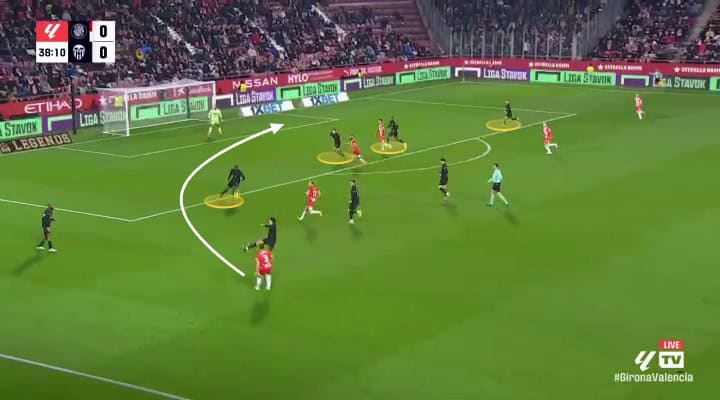
In this picture, we can see their defensive shape in the game against Girona.
The five defenders are forming the defensive line, with the three centre-backs crowded in the middle of the field.
The two wing-backs are staying outside to man-mark Girona’s wingers.
André Almeida and Diego López, the attacking midfielders, are dropping to the height of the two central midfielders to create another four-player line in front of the defensive line.
This line is focused on defending the centre of the field and is aligned to cover the gaps in Valencia’s backline.
Umar Sadiq has been the lone striker these last couple of games.
He is the only player not dropping back into the deep block for Valencia, staying up front as a target man for counterattacks.
This shapes up as a 5-4-1 against the ball for Corberán’s men.
Their biggest strength is their control of the centre of the field.
With three centre-backs, two central midfielders, and a very narrow second line, Valencia are often able to force its opponents towards the wing or at least the half-spaces.
From there on, they manage to control the last line of play; they are not dropping back deep into their own box but rather push forward to prevent the opposing teams from combinations back to the centre and force crosses out of these positions, which are hard to play.
While Valencia’s squad’s overall level of play has dipped over recent years, their centre-backs are still incredibly talented and especially great in the air, particularly Spanish under-21 international César Tárrega.
This allows Valencia to defend against weaker teams with ease, and therefore, they are always able to get at least draws out of these games.
Still, they struggle against teams that are able to exploit their positioning, as FC Barcelona proved.
Aggressiveness In The Attacking Press
Carlos Corberán had a very interesting start to his coaching career.
After failing to establish a professional career himself, he started out as an athletic coach from a very young age and ended up at Villarreal and in Saudi Arabia.
After unsuccessful first steps in Cyprus as a head coach, Corberán became the coach of Leeds United U21 team and just one year later was promoted to assistant manager.
The head coach at the time was Marcelo Bielsa, one of the most prolific managers over the last couple of years and a manager with very strong opinions about the football he wants to play.
While Corberán is his own man, he definitely learned from Bielsa and established these principles everywhere he has coached since then.
One of these tactical measures is a very aggressive attacking press.
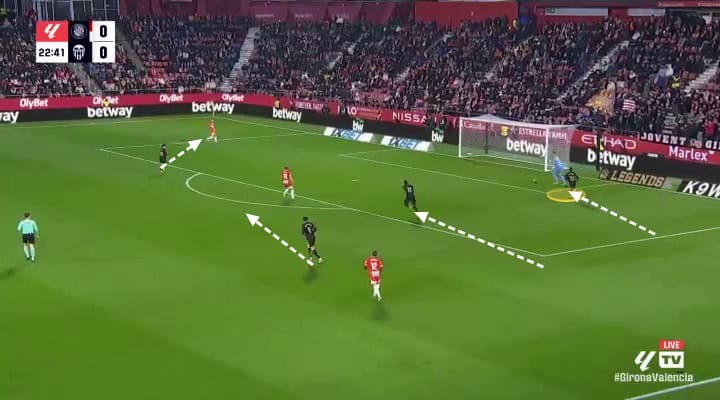
Corberán has proven to be very adaptive in the way his teams pressed over the last couple of years, and he has implemented a hybrid press between zonal and man marking at Valencia over the past couple of months.
As we can see in the picture above, Valencia starts out in a zonal marking, cutting off the passing lanes towards the middle of the field and forcing a backward pass to the goalkeeper from Girona.
This acts as their trigger to actually check forward and cut off play towards one side of the field.
The entire frontline and Javi Guerra are not moving towards that side with López already engaging in a man marking towards the far-sided centre half of Girona.
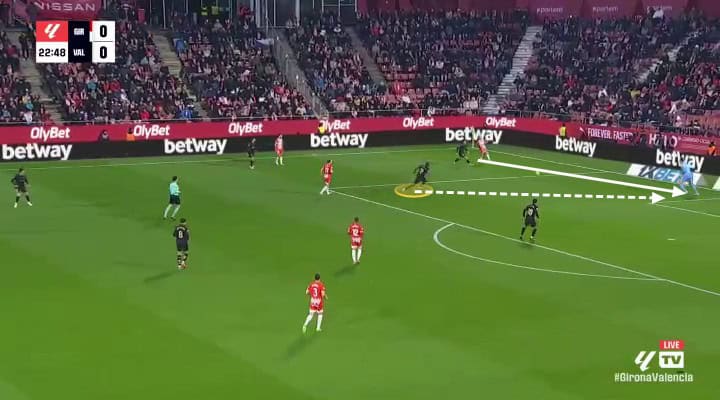 From there on, Valencia are in control with Girona backed off against their own baseline and is able to cover off all passing options but the goalkeeper with man marking.
This ends up forcing another pass to the goalkeeper, and again, Sadiq is already waiting to trigger the press again and is pouncing on the ball as soon as the pass is played.
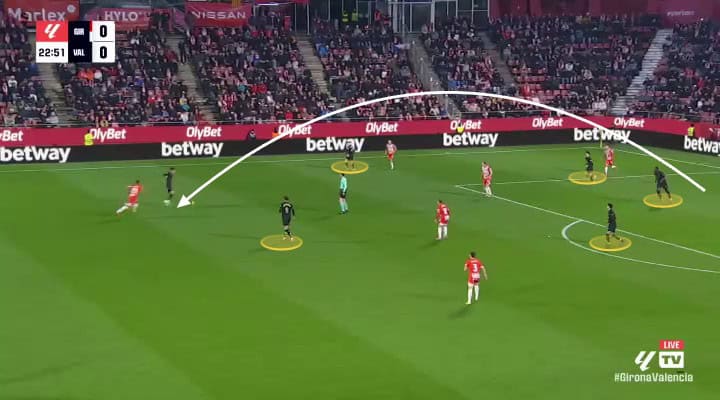
This forces Girona to play an uncontrolled long ball, and the double pivot of Valencia is just waiting for this, being backed off behind Girona’s midfielders and, therefore, in an easy position to move forward to intercept the ball.
In this situation, Barrenechea easily picks up the ball, resulting in a high recovery for Corberán and his men.
Also, Valencia now has five players forward, ready to counterattack instantly, and Barrenechea has multiple passing options to keep the ball moving instantly.
They end up with a decent opportunity for Sadiq, who is not able to get past Gazzaniga in this situation.
This situation is a blueprint for Valencia’s press under Corberán, and it often works.
If the attacking pressing attempt fails, Corberán has his men fall back into the deep block we looked at earlier, there is rarely something in between these two things against the ball for Valencia at the moment.
More Ball Progression In The Build-Up
Fixing the defensive side of things is incredibly important in the relegation battle, but Valencia’s troubles had their roots in their play with the ball.
In the last months of Baraja’s reign, the team was barely able to play out the back, had no ball security and lacked ideas in the final third.
Overall, the team was just not good enough with the ball, and it cost them the most in crucial situations over the year 2024, resulting in Baraja losing his job.
While things are not perfect under Corberán, the new manager also improved the team’s play with the ball.
Unlike in the games before he took over, the team have the confidence to try to play out the back and are finding way more solutions with the ball everywhere on the field.
This approach has already cost them, with the team losing to Real Madrid in a close fight because of two mistakes in the build-up, but it has proven to be more successful for them in the long run.
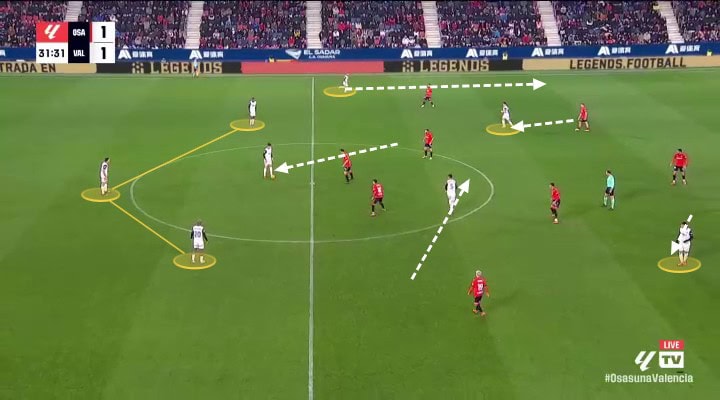
Here, we can see the structure Corberán has his men create in the build-up phase of play.
The back three stays very narrow, with Tárrega in the centre falling back a bit to receive and switch play at all times.
The wing-backs stay very wide and move forward, dragging the opposing team’s defensive line to the outside and providing runs behind the defending team’s last line.
The two attacking midfielders are dropping back into the half-spaces and in the space between the defensive and the midfield lines to allow for line-breaking solutions in the passing game.
The double-pivot moves to counterrotate, with Guerra dropping back towards his centre back to receive the ball and making a run right behind the first line of press that he has attracted now.
Sadiq stays up front as the lone striker and target man in these situations, as well as he does when defending.
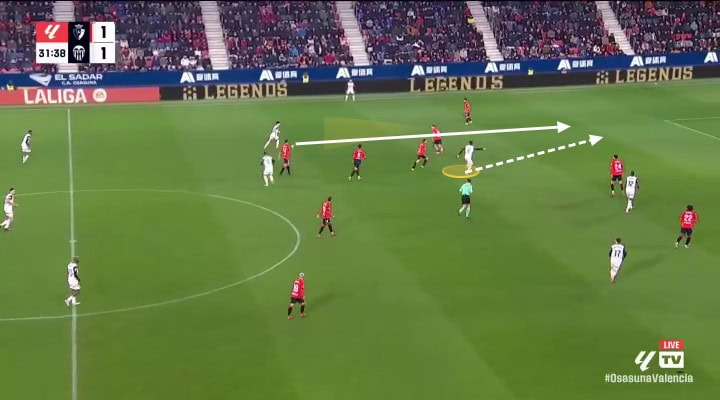
Under Baraja, Valencia often struggled with progressing the ball from the back and played many long balls.
Under Corberán, the team is encouraged to find solutions with short passes, and they have enough individual class to do so.
Here, they break the first line of pressure with a simple pass to Barrenechea, who then holds the ball well and plays it to López, who was dropping back into midfield.
Now, with the centre-backs orienting themselves forward towards the ball, Guerra starts his run from deep in the midfield right in the back of the forward-moving centre-half and is able to receive the through ball.
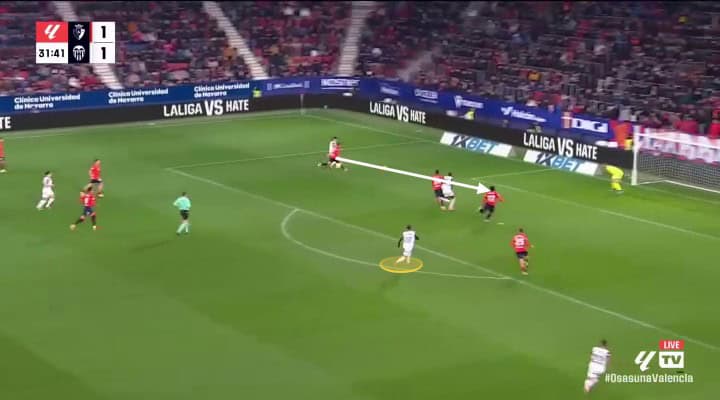
From there on, Guerra simply uses his pace to beat his man, gets in the box and puts a cross in for Sadiq, who finishes and gives Valencia the lead against Osasuna.
Looking at the other players, he even had another option in Jaime at the edge of the box, wide open, another area where Corberán improved Valencia immensely.
Overall, this situation just shows how much Carlos Corberán has worked with the team and restored their confidence, resulting in beautiful and quick attacking patterns like this one.
Attacking The Space Behind The Backline
Corberán has valued the short passing game in every club he has worked at.
Valencia are still a backmarker in La Liga, and therefore, he has not completely let go of their long passing game.
It would be a waste anyway.
Winter signing Sadiq has made an instant impact.
While his technical ability is more than questionable, his physicality and his ability as a target man are very good.
Diego López and José Gayá are two of the best players with deep runs in the entire league.
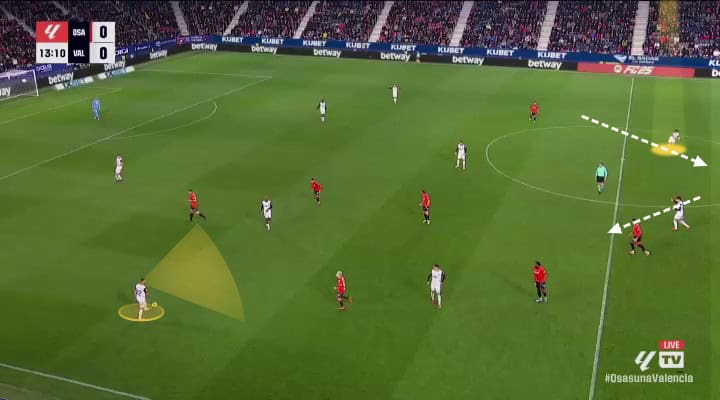
The game against Osasuna also had a beautiful example of that, as seen in the picture above.
Osasuna was able to get a grip on Valencia’s midfield with their press.
Valencia is forced to play a backwards pass to Rioja here, and looking at his head, he never even thinks about anything else but playing the ball long.
He looks up before and after receiving the ball and tries to find a way to play the ball behind the defensive line.
What he sees up front is Sadiq blocking a centre-back and López and Jaime making counterrotating movements again, with Jaime dropping back and dragging the other centre-back out of position, allowing López to make a run for it.
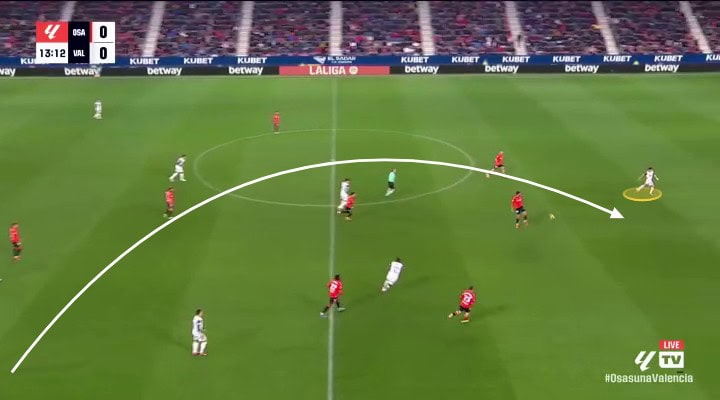
Rioja now play the long ball and with the centre-backs both occupied, both fail to recover in time to intercept the ball.
López now makes a run for it, gets past the goalkeeper, and finishes for one of his three goals in the last three matches.
The Spanish U21 international has been in top form lately, and Corberán has no reason not to allow him to use his pace by using long balls behind the backline in his tactical playbook.
Conclusion
Valencia were in a dire situation at the end of 2024 and took a big risk by paying a lot of money for a young but experienced manager in Carlos Corberán.
The young Spanish coach had never coached at this level and knew what troubles he would face coming to Valencia, but he still decided to take the opportunity at his dream job.
After 14 games, the decision has proven to be a good one for both sides.
Corberán is doing a fantastic job, completely reviving Valencia in their relegation battle and gaining 16 points in eleven games for the club, which currently has them out of the relegation zone in La Liga.
While their attacking play is still lacking finesse and their play in possession is sometimes iffy, Corberán managed to stabilize the Valencia defence with good ideas and is trying to get his team to play liquid football again, which sometimes ends up bad, but it has proven to be the better way for the team already.
The relegation battle is not over yet, but Valencia seem to be on track for another season in La Liga.
With their quick development, talented squad, and good academy, it will be interesting to see where they will end up with their new coach.
