
The play-off round of the new Champions League format has conjured up some mouth-watering ties.
None more so than Real Madrid vs Manchester City.
The last two winners of the competition will have been disappointed that they did not automatically qualify for the Round of 16.
This fixture was an unwelcome duty, as both have significant work to do domestically.
The first leg saw late drama.
Man City had gone 2-1 up against the reigning champions.
However, two late goals from Brahim Diaz and Jude Bellingham gave Los Blancos the lead going into the second leg.
An injury-ridden Man City turned out to be no match for the Spanish giants.
A Kylian Mbappé hat-trick extended Madrid’s aggregate lead to 6-2.
City did manage to pull one back late on.
Yet this one was one of the most complete displays by Real Madrid in recent memory.
This post-match analysis will examine four key areas of Real Madrid’s game that led to their dominating performance under Carlo Ancelotti’s tactics.
Real Madrid’s defensive structure, build-up play and attacking prowess will all be analysed.
Man City’s flaws will also be discussed as they struggled to handle Madrid’s quality.
Real Madrid Vs Manchester City Lineups
Real Madrid lined up in their classic 4-2-3-1 formation.
Belgium keeper Thibaut Courtois was behind a back four of skipper Federico Valverde, Raúl Asencio, Antonio Rüdiger and Ferland Mendy.
A double pivot of Dani Ceballos and Aurelien Tchouaméni was at the base of the midfield.
Bellingham had a relatively free role in possession and operated as the 10.
Vinícius Júnior, Kylian Mbappé and Rodrygo made up the front three.
Pep Guardiola had some real concerns injury-wise going into this game.
Long-term absentees such as Rodri were unavailable.
However, Erling Haaland was suffering from issues prior to the match and was unable to start.
Ederson started in net.
The back four that began the game consisted of Champions League debutant Abdukodir Khusanov, John Stones, Rúben Dias and Josko Gvardiol.
Ilkay Gündoǧan and Nico Gonzàlez played as the two sitting midfielders.
In front of them was an interchanging front of four: Bernardo Silva, Phil Foden, Savinho, and Omar Marmoush.
Real Madrid’s Defensive Discipline
In a team full of attacking talent, defensive discipline isn’t always the first thing that will come to your mind.
Nonetheless, this was key to Carlo Ancelotti’s Madrid getting the better of City.
Lining up in a disciplined 4-4-2 shape, Madrid’s attacking talent had to fulfil their roles diligently.

As seen from their setup,
Bellingham takes up a position as a left midfielder.
Vinícius Júnior and Mbappé operate as a front two.
Rodrygo also drops deep and fulfils his role as the right midfielder in the 4-4-2 shape.
Madrid predominantly were positioned in a mid-block.
They only made three tackles in the attacking third of the pitch.
Their watertight structure provided little room for City to penetrate consistently.
The English Champions didn’t manage a single through ball all night.
City made this easy for Madrid.
They played with a lack of width and were obsessed with occupying the half space on the right flank.
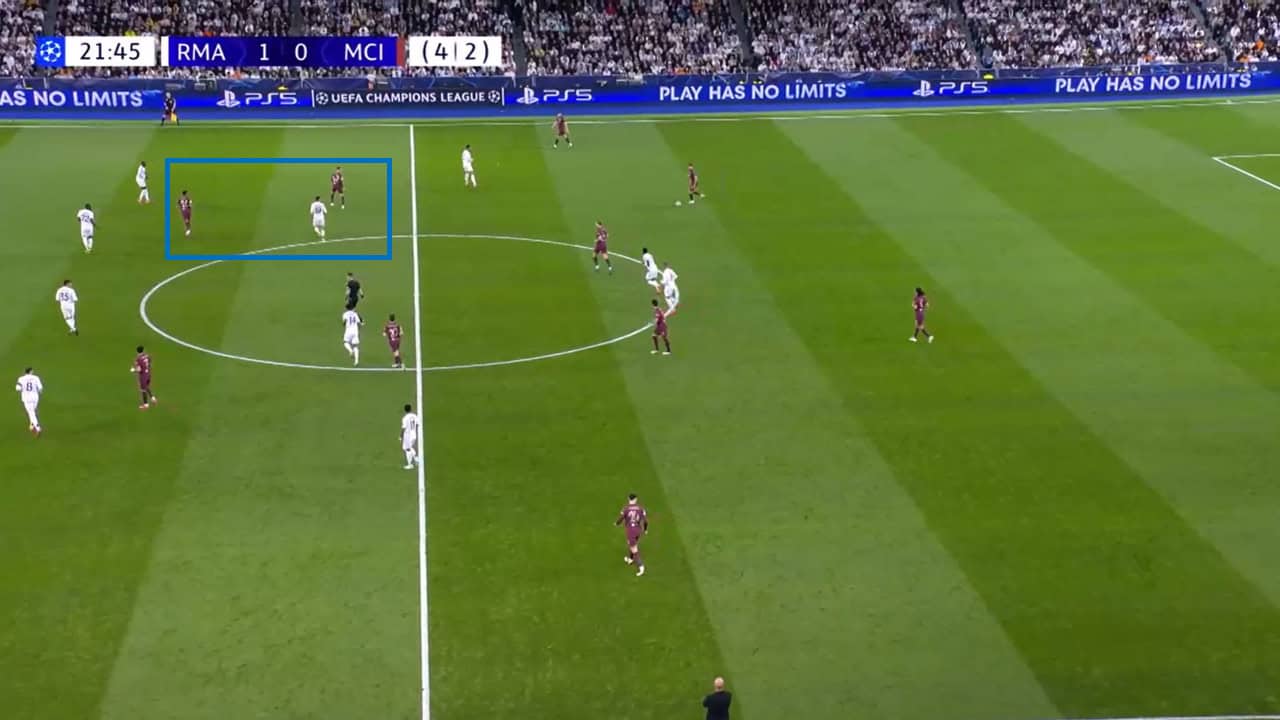
In this situation, Savio and Foden are almost standing in the same spot.
Despite cramming their attacking players into a tight area and creating somewhat of an overload, it made it significantly easier for Madrid to defend against.
City’s lack of width meant Real Madrid were rarely stretched defensively.
City did manage to penetrate Madrid.
They completed almost double the number of progressive passes Madrid did.
Yet Madrid’s ability to recover when City did penetrate their midfield line limited their attacks.
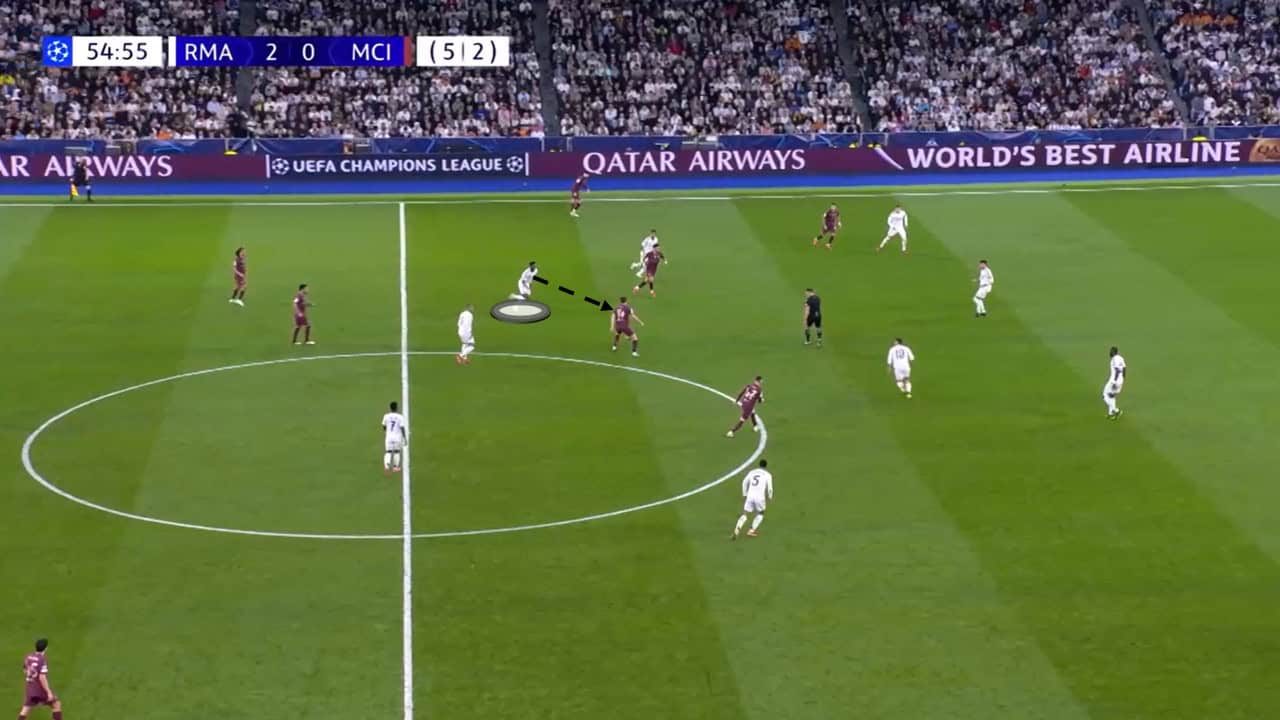
Here, Bernardo Silva receives a pass between the lines.
Due to there being little space between Madrid’s midfield and defence, he doesn’t have much room to operate in.
Tchouaméni recovers to prevent him from progressing and forcing him backwards.
Switch Of Play During Madrid’s Build-Up
Man City were brave in their approach to pressing Real Madrid.
Pep Guardiola style of play operated with a high press, which gave the Citizens some success.
They made a total of seven tackles in the attacking third.
However, Madrid were prepared to face City’s aggressive press.
Utilising the switch of press, they had a number of ways to bypass City’s attack.
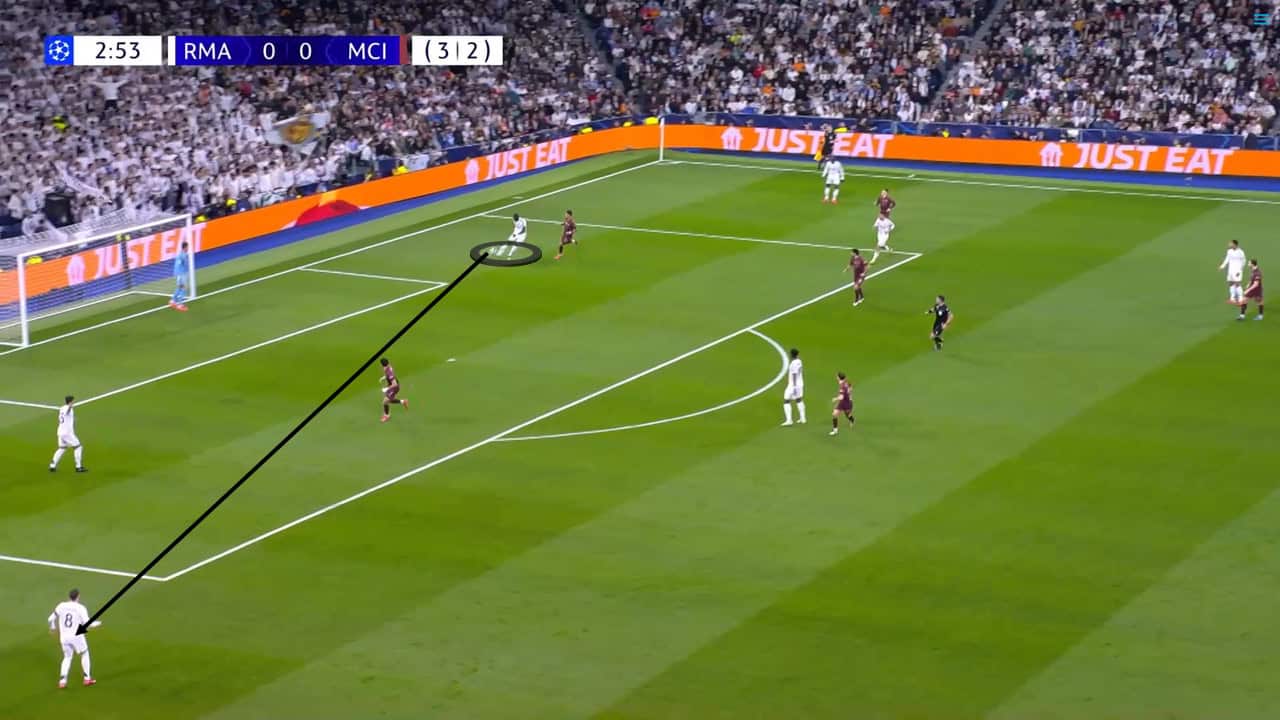
This example shows the most direct method of Madrid switching play during the build-up phase.
City has just lost the ball and has begun to counter-press Madrid.
Los Blancos string a couple of passes together under pressure.
Rüdiger looks for an outlet and plays a long ball to the opposite side of the pitch, allowing Madrid to progress freely up the pitch.
Switching the ball as directly as this wasn’t the most common method to switch play.
Often, a supporting player would provide an option before the switch was eventually made.
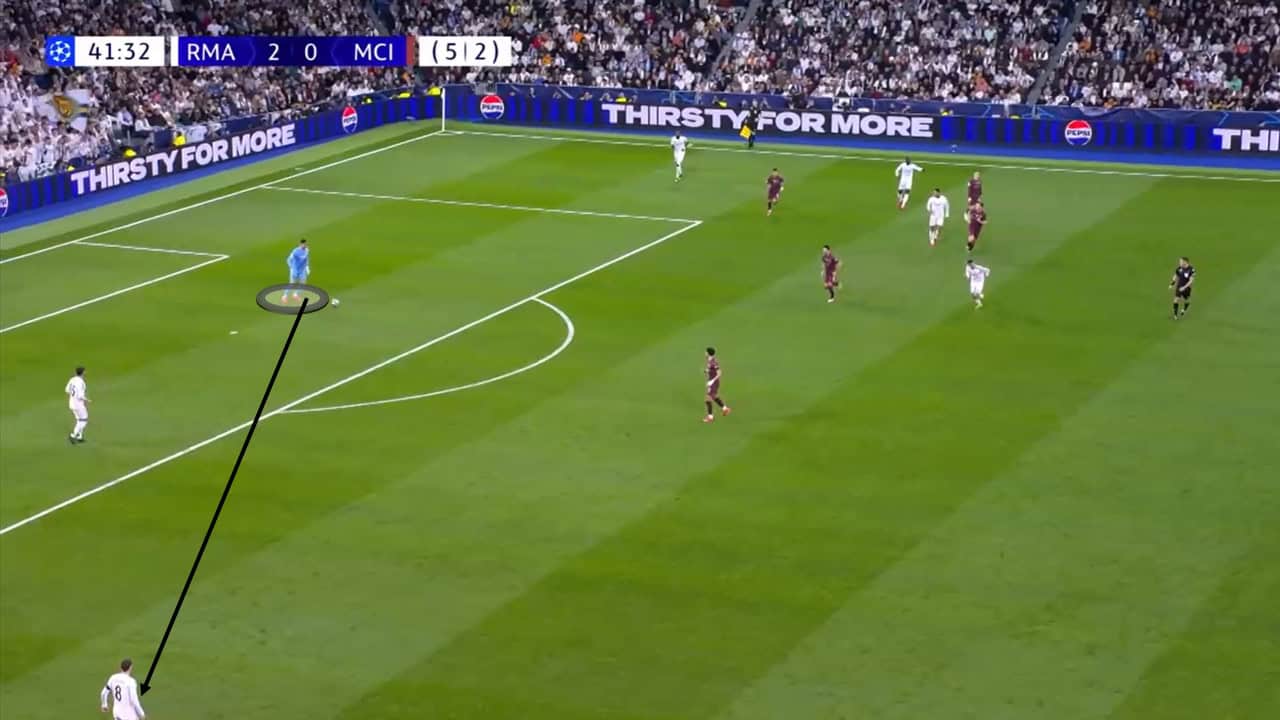
In this scenario, City are again pressing incredibly high.
Courtois offers a supporting angle.
He then plays a lovely driven pass to switch the play.
The great architect of many of these switches of play was Tchouaméni.
He would pick up pockets of space before playing a variety of passes to the opposite flank.
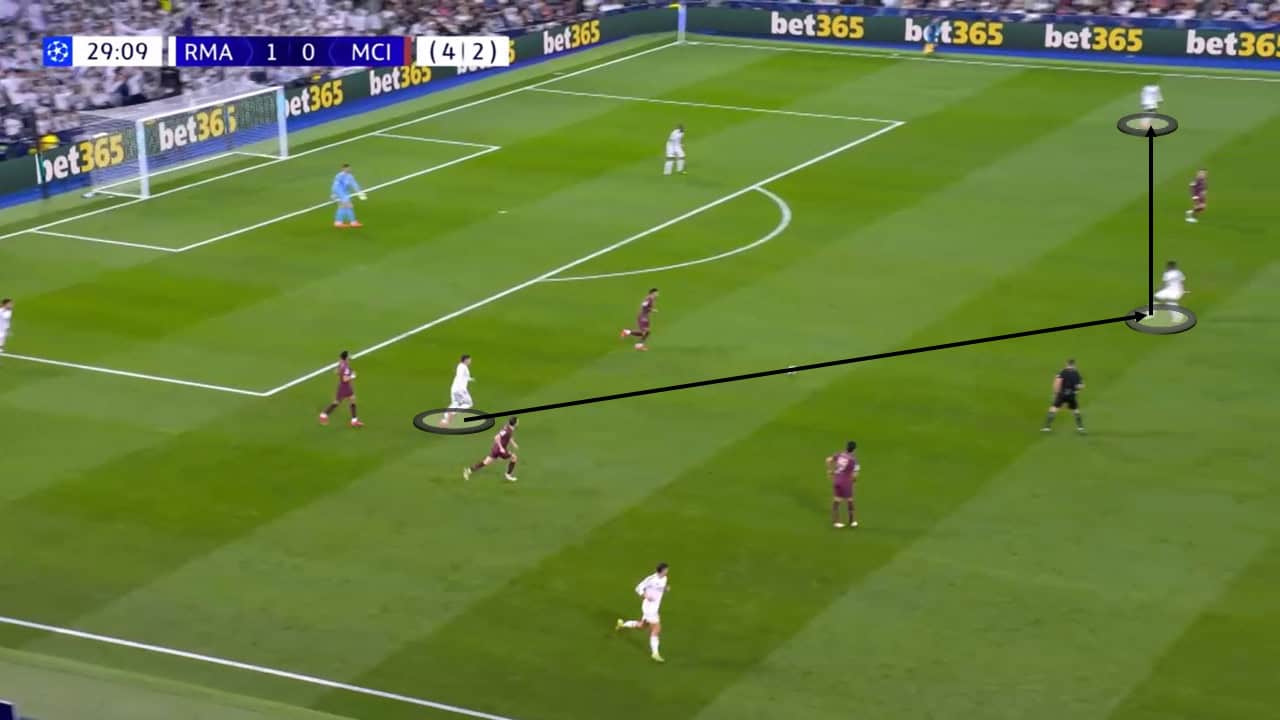
Here, he receives the ball from Valverde before passing the ball onto Mendy.
Real Madrid Attacking Width
As City tried to penetrate through the eye of the needle, Madrid played with an expansive shape.
It was their clear aim to make the pitch as big as possible.
Their attacking threat was always likely to be no match for the likes of the inexperienced Khusanov.
During the attacking transition, their intention was evident.
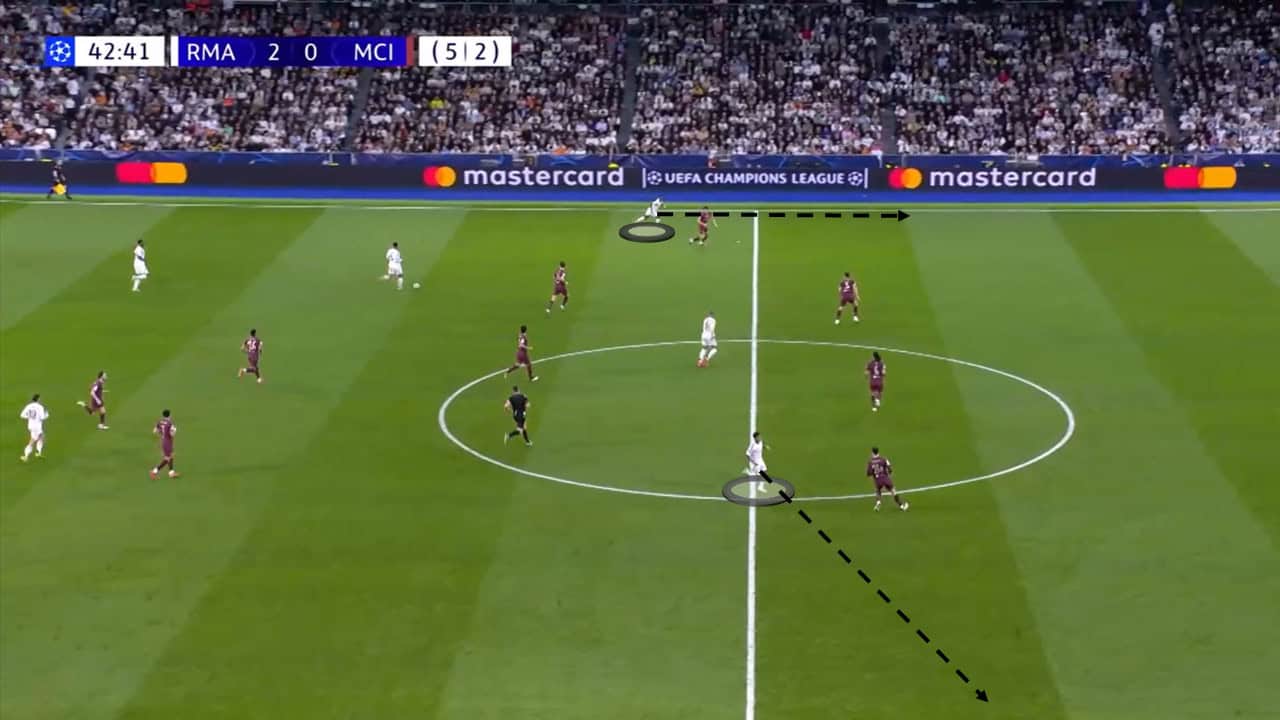
Bellingham has driven forward with the ball after Madrid have just won back possession.
The attacking three all initially make straight runs.
As Bellingham holds onto the ball and elects not to play to one of the forward runs, Rodrygo and Vinícius move as wide as they possibly can.
As highlighted previously, Madrid were exceptional at switching play during the build-up phase.
They also used this tactic effectively in the opposition’s half.
As they moved the ball from side to side, it opened up attacking opportunities.
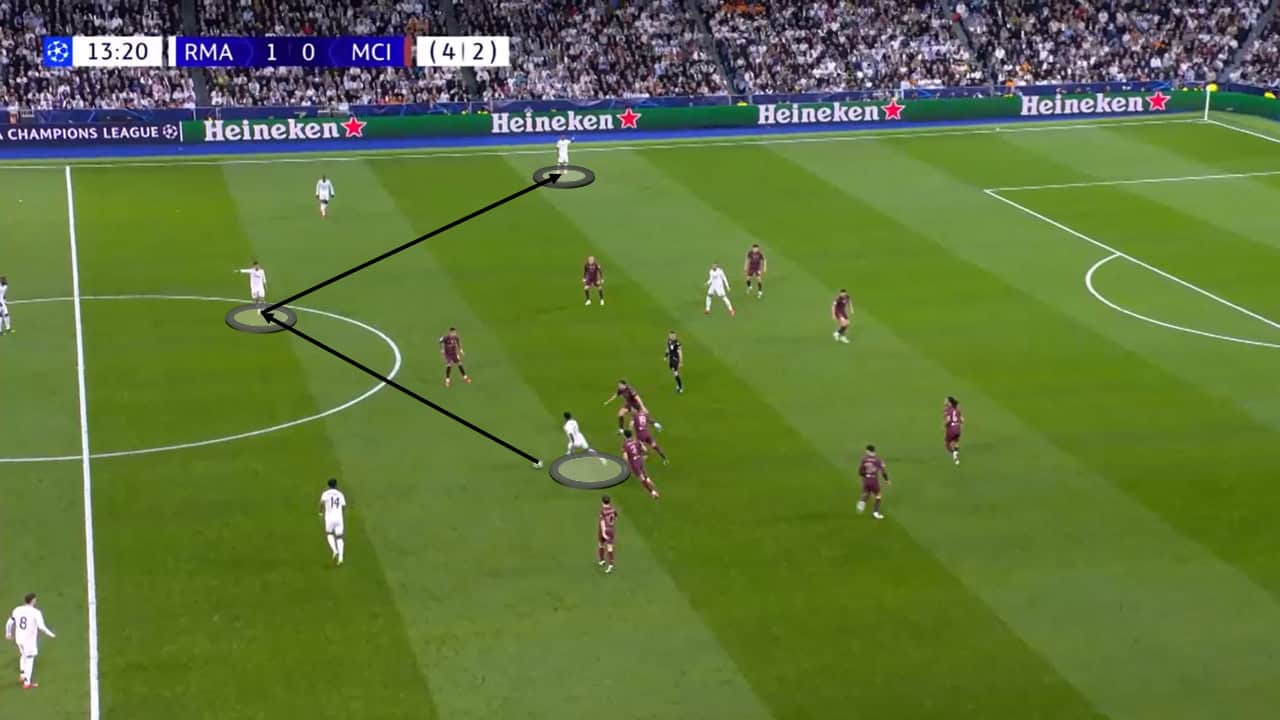
In this example, City have already moved across the pitch a couple of times as Madrid switched the ball.
Los Blancos eventually work the moment they’ve been looking for.
Rodrygo plays the ball off quickly to Bellingham, who then finds Vinícius Júnior.
The Brazilian has a 1v1 against Khusanov, who is no match for his speed and trickery.
Between them, Rodrygo and Vinícius Júnior had a total of eight take-ons.
They also completed the most progressive carries in the match.
Both players have a tendency to drift inside to cause havoc.
However, Madrid maintained their width through the forward runs of Mendy and particularly Valverde.
The Uruguayan was immense and created a significant number of chances when he was in the final third.
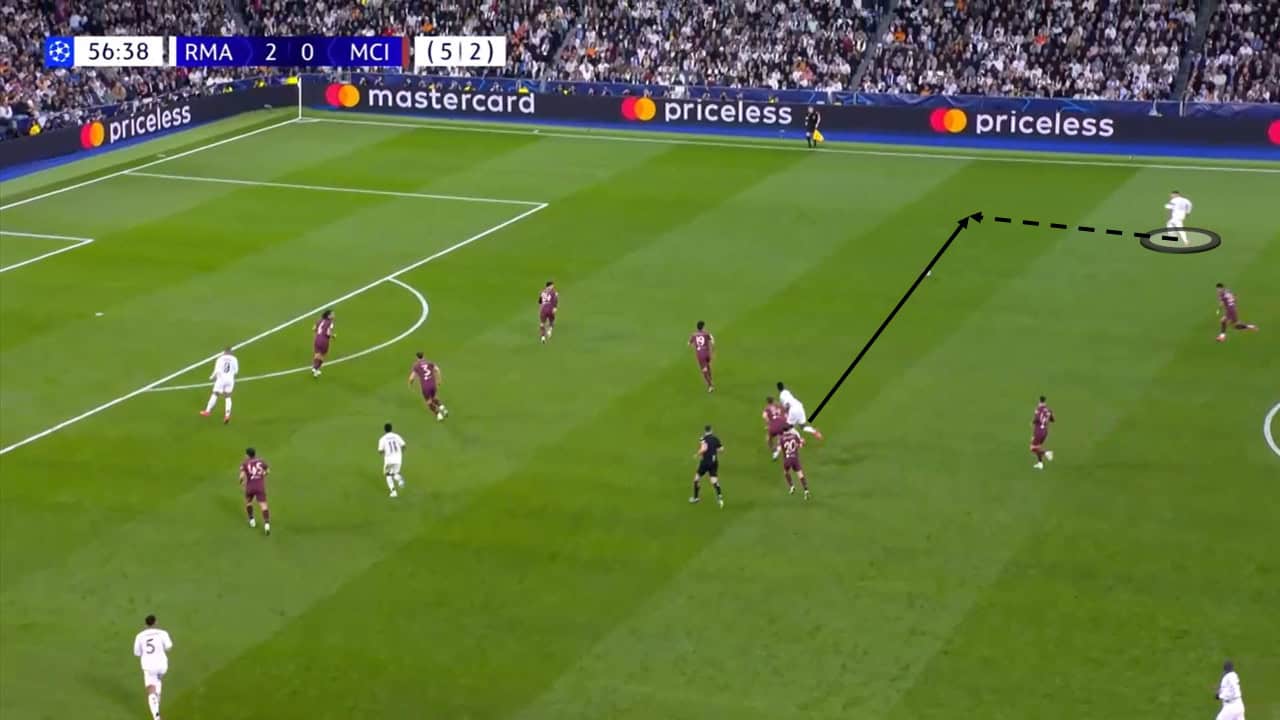
Here, Valverde makes a run down the line.
Vinícius Júnior plays the ball out to the advancing full-back.
He eventually whips in a beautiful cross that Mbappé manages to get on the end of.
Valverde’s creative output is demonstrated by his having five shot-creating actions throughout the match.
Real Madrid’s Relentless Forward Runs
City were no match for Madrid from the off.
A huge component of this dominance was City’s inability to deal with the forward runs that Madrid made time after time.
The athletic nature of the Spanish Champion’s front line constantly put City on the back foot.
As previously mentioned, their willingness to attack and break forward could be clearly seen during the transition.
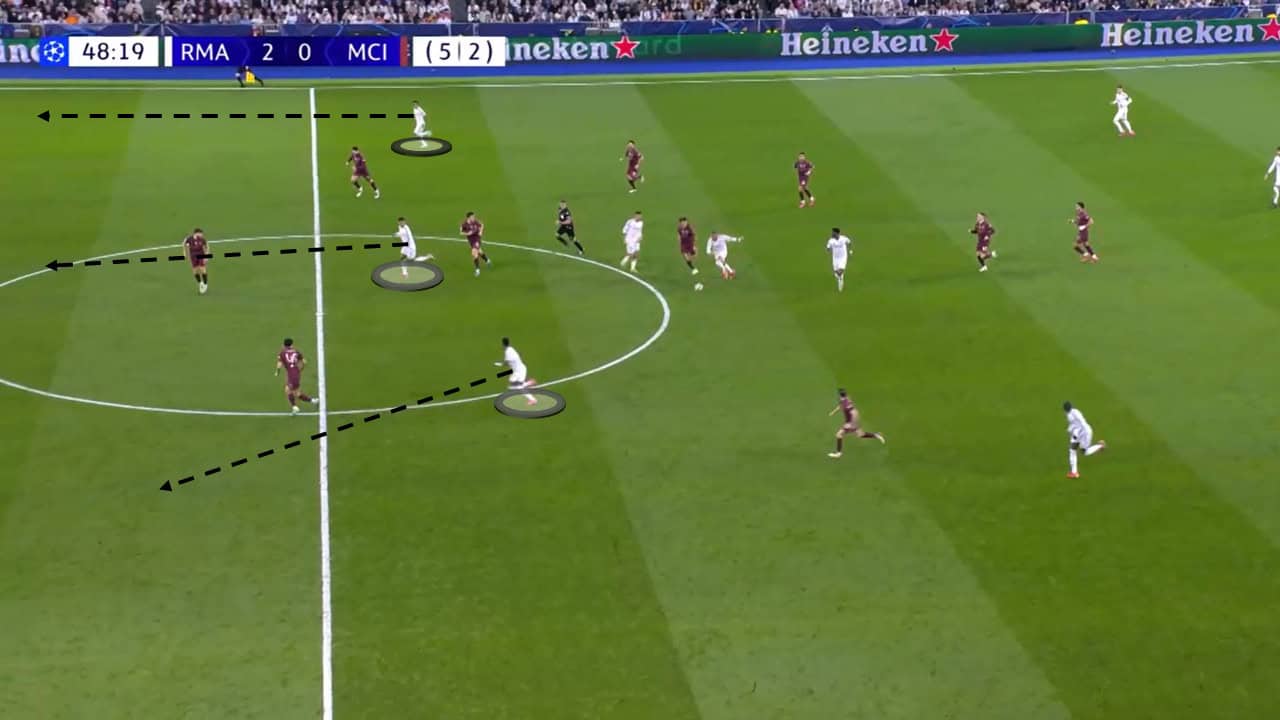
In this situation, as Madrid begin an attack, Mbappé has the ball at his feet.
The other three members of Madrid’s attack quartet making bombing runs beyond him.
This directness and ability to penetrate through forward runs was seen from the very start.
Mbappé’s opening goal highlighted Madrid’s comfort in going long in behind the opposition’s defence.
However, City made some basic errors in this situation.
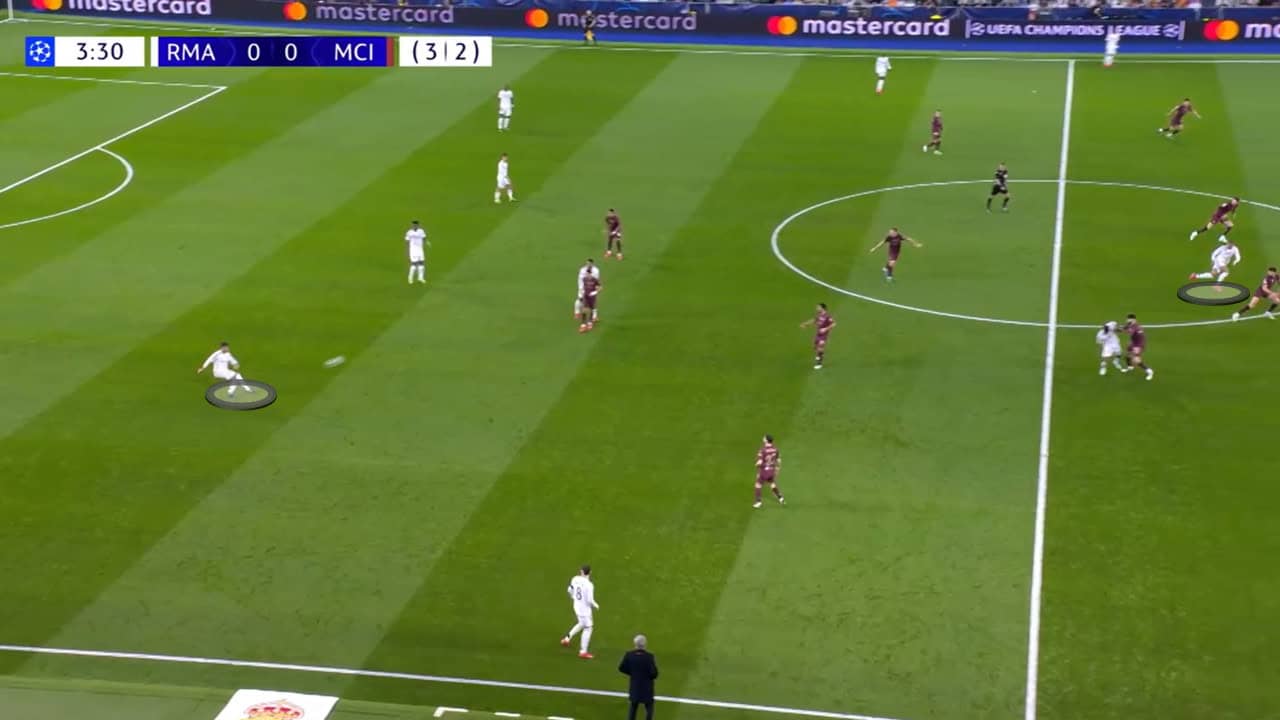
As there’s no pressure on the ball, City’s defenders need to drop deeper.
Yet they stay in line with the French forward, allowing him to outpace them in a foot race.
This refreshing desire to attack with speed made Madrid a joy to watch.
They constantly looked to play forward at every opportunity.
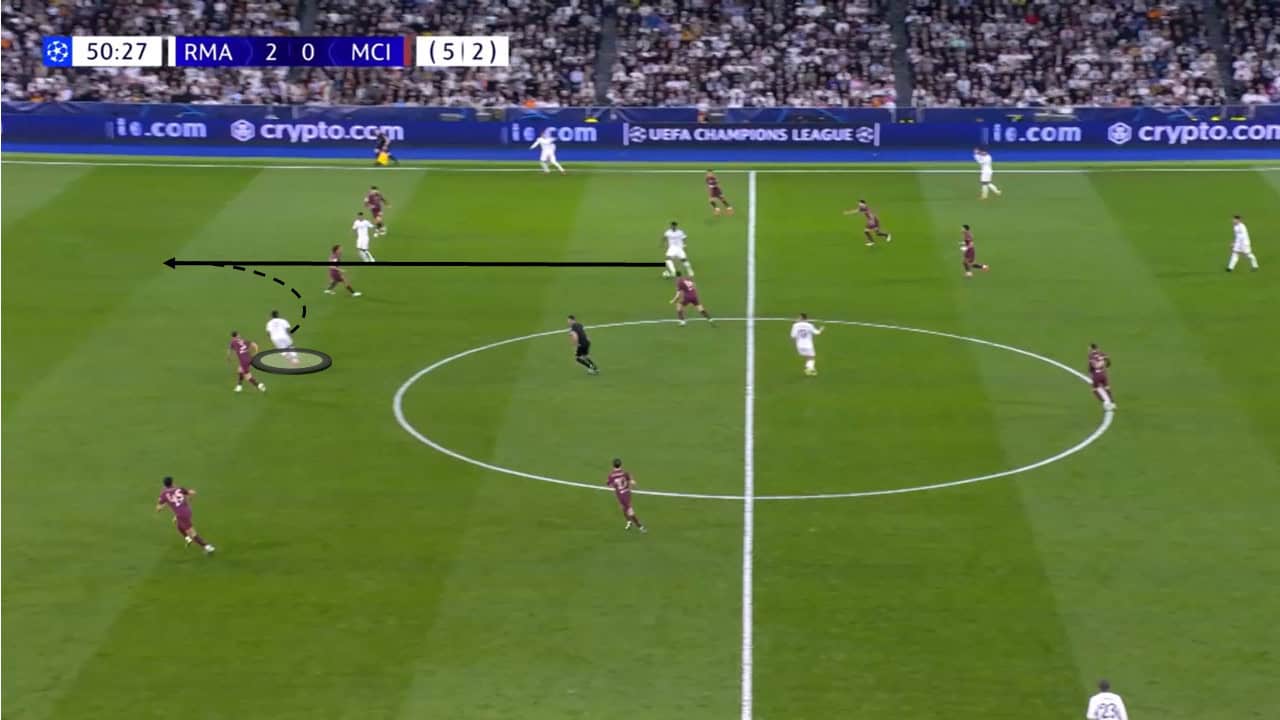
Here, Tchouaméni receives the ball between the lines.
Instead of being content with their progress and looking to maintain the ball, Madrid look to get in behind City once again.
Vinícius Júnior makes a darting run in behind to receive the ball once again.
Conclusion
Madrid were incredibly exciting throughout this match.
They possessed the perfect combination of defensive robustness, precision when constructing and a clinical edge when finishing.
Key players appeared to be at their best.
Ancelotti has turned this team of superstars into a well-oiled machine.
It’s not the first time that City have been well beaten this season.
However, they didn’t look for one moment in this match that they could win this tie.
Madrid, despite their early season struggles, look to be once again Europe’s best.
No team will want to face them in the next round.
Madrid are the team to beat.
