
Pep Guardiola has made a revolution at Manchester City with his distinguished tactics and drive for success.
After winning the Premier League back-to-back in 2017/18 and 2018/19 and dominating in the internal cups, The Citizens started struggling last season and gave away their leadership to Liverpool.
Although Manchester City finished as runners up it was noticeable that they were struggling in certain areas and starting to lose their consistency.
This made them unable to defend their title but also pushed them away from one of their main goals – the Champions League title.
One of the reasons for their inconsistency was the absence of their captain Vincent Kompany who left the club after 11 years as part of their defensive set-up.
But they didn’t miss him only defensively.
As a ball-playing centre-back, Kompany was a key figure in their build-up actions and in executing Guardiola’s possession-based style of play.
They failed to find a replacement in the 2019/20 season and the whole team performance was affected by it.
The Sky Blues invested in bringing in a defensive midfielder in the face of Rodri but his arrival wasn’t enough to improve the connection between the lines and fill in the gap in the backline.
They were lacking a leading figure that will support both their defensive and attacking actions.
After missing on both the Premier League and the Champions League, Manchester City immediately made a move for a ball-playing centre-back that fits their profile.
Little did they know that their new signing, Rúben Dias, was about to transform the team completely.
“It wasn’t expected, honestly. We knew his quality, but you never know what is going to happen.” underlined Pep Guardiola quoted by The Independent.
“If a defender plays for himself it’s a problem but he is thinking always about his central defensive partner, his holding midfielder, even the wingers. He’s so generous, he’s a complete professional.”
With these words, the Spaniard described the 24-year-old who fits their strategy like a glove and turned into one of their key players that led them to the 2020/21 league title and also to reach the long-awaited Champions League final.
This Rúben Dias scouting report in the form of tactical analysis examines the Portuguese centre-back’s main traits and how he improved the Citizens’s performances by fitting to Manchester City tactics perfectly.
Rúben Dias Strengths & Weaknesses
Rúben Dias Heat Map

Dias is equally important for both the defensive actions and the build-up play.
While he shows great composure and anticipation skills in defence, the former SL Benfica centre-back also shows confidence on the ball and strong work under pressure.
Rúben Dias reads the game well and shows intelligence in his movement and actions.
His awareness often allows him to win the ball through his positioning and anticipation skills and his smart pressing movement is often beneficial for the team.
The Portuguese doesn’t dive into many ground challenges and his concentration helps him to avoid committing fouls.
While he doesn’t often dive into risky duels, Dias does use his physical strength to recover the ball and gain back possession which he could then use to start the team’s offensive movement.
As the Guardiola mentioned, the 24-year-old always looks out for his centre-back partner and supports his actions.
Rúben Dias was most frequently paired with John Stones who also saw a huge improvement in his form, partly thanks to the leading figure that Dias is.
What he lacks defensively is a distinguished aerial presence.
Rúben is rather successful in the air but simply doesn’t contribute with many efforts which is unlikely for a centre-back.
He also sometimes has difficulties defending in transitions against pacey players but does compensate with the right timing of his interventions in the defensive third.
While the Portuguese is an important part of the defensive set-up, his biggest contribution is to the build-up play and retaining possession.
The 24-year-old is confident on the ball and helps in circulating the ball at the back and his solid work under pressure is very beneficial against teams that employ a high press.
Dias passing abilities and spatial awareness are crucial in building up from the back where he often has to find the holding midfielder or the wide players in aim to progress the ball.
Rúben Dias Player Profile
We extracted both defensive and offensive data for the Premier League centre-backs with 25+ games this season aiming to compare Dias to the best individual performers.
We narrowed the list down to ball-playing defenders with a similar profile and then filtered based on different indicators to find the best individual performers in each.
Premier League Centre-backs Comparison

Among the regular starters, Dias expectedly showed up among the best performers, followed by Manchester United’s Harry Maguire and surprisingly by Arsenal’s Rob Holding.
Despite the Gunners’ unsatisfying team performance, it turned out that Holding’s individual performance was excellent compared to the best central defenders in the league.
We focused on their contribution to the ball progression and to the attacking ventures but also included some defensive stats.
As shown in the graph above the first indicator we picked was their Passes per 90, where we could see that Dias excels.
The Portuguese completed 77.2 passes on average per game which is the best record for a centre-back in the league.
This shows his importance for Manchester City’s possession-based tactics.
Maguire and Holding have completed 56.72 and 56.09 passes respectively in efforts to retain possession.
Rúben Dias Pass Map Against Tottenham Hotspur

The Portuguese international also excels in his accuracy.
His 94.4% pass accuracy is crucial for the team’s efficient build-up and attacking movement.
For comparison, Maguire and Holding have been less efficient in their passing efforts which could be a sign of poorer work under pressure.
Dias has completed the most progressive passes per 90 too, which shows his constant aim to progress the ball and find his teammates in the advanced areas.
Of course, his success in this might be a result of City’s more advanced positioning and their extended time on the ball.
For example, teams are more likely to play more aggressively against Manchester United and Arsenal, which often forces the players to send lateral passes or even send the ball back.
All three players have almost similar numbers in terms of passes to the final third.
The centre-backs’ involvement in delivering ball directly to the final third underlines the importance of their role in the team’s attacking actions.
When it comes to successful defensive actions, we can see that Dias has the lowest numbers among the three players.
This does not necessarily mean that he is less efficient defensively compared to Maguire and Holding.
The 24-year-old’s defensive contribution is often narrowed to his off-the-ball movement and pressing efforts.
Rúben completes 6.05 PAdj interceptions on average, which is less than his fellow defenders, but that’s where the whole team performance should be considered.
The Citizens usually spend less time defending and more time in possession which makes him more efficient compared to Holding for example, who had a higher number of efforts due to Arsenal being pinned at the back more frequently.
Rúben Dias’ role at Manchester City is focused on supporting the build-up play rather than on the defensive actions.
This is also underlined by the former SL Benfica player’s Recoveries per 90.
He recovers the ball 8.05 times on average, fewer than Holding (9.55) and Maguire (11.91).
Defensive Anchor
City ended the Premier League season with the best defensive record in the league, conceding 32 goals and Dias has been an integral part of their efficiency at the back.
He added to The Sky Blues’ defensive performance not only technically but also mentally.
At only 24 years of age, Rúben accepted Kompany’s role as a leader in their defensive set-up and is very vocal on the pitch, supporting his teammates and boosting their confidence.
His vision and his anticipating skills allow him to give instructions and complement his fellow players’ movement and actions.
Dias’ ability to play both as left and right centre-back, depending on who he is paired with, is very beneficial for the The Citizens as it allows more defensive variations.
Anticipating the opposite players’ movement as well as being aware of his teammates’ positioning is one of the strengths that make him successful in defence, especially against positional attacks.
The Portuguese International rarely gets his men out of sight and constantly moves in efforts to mark them and not allow any runs to the box.
His awareness is very beneficial Manchester City’s ability to recover the ball in their own half.
Rúben Dias is important for gaining back possession and slowing down the tempo while the The Citizens move into attacking positions again.
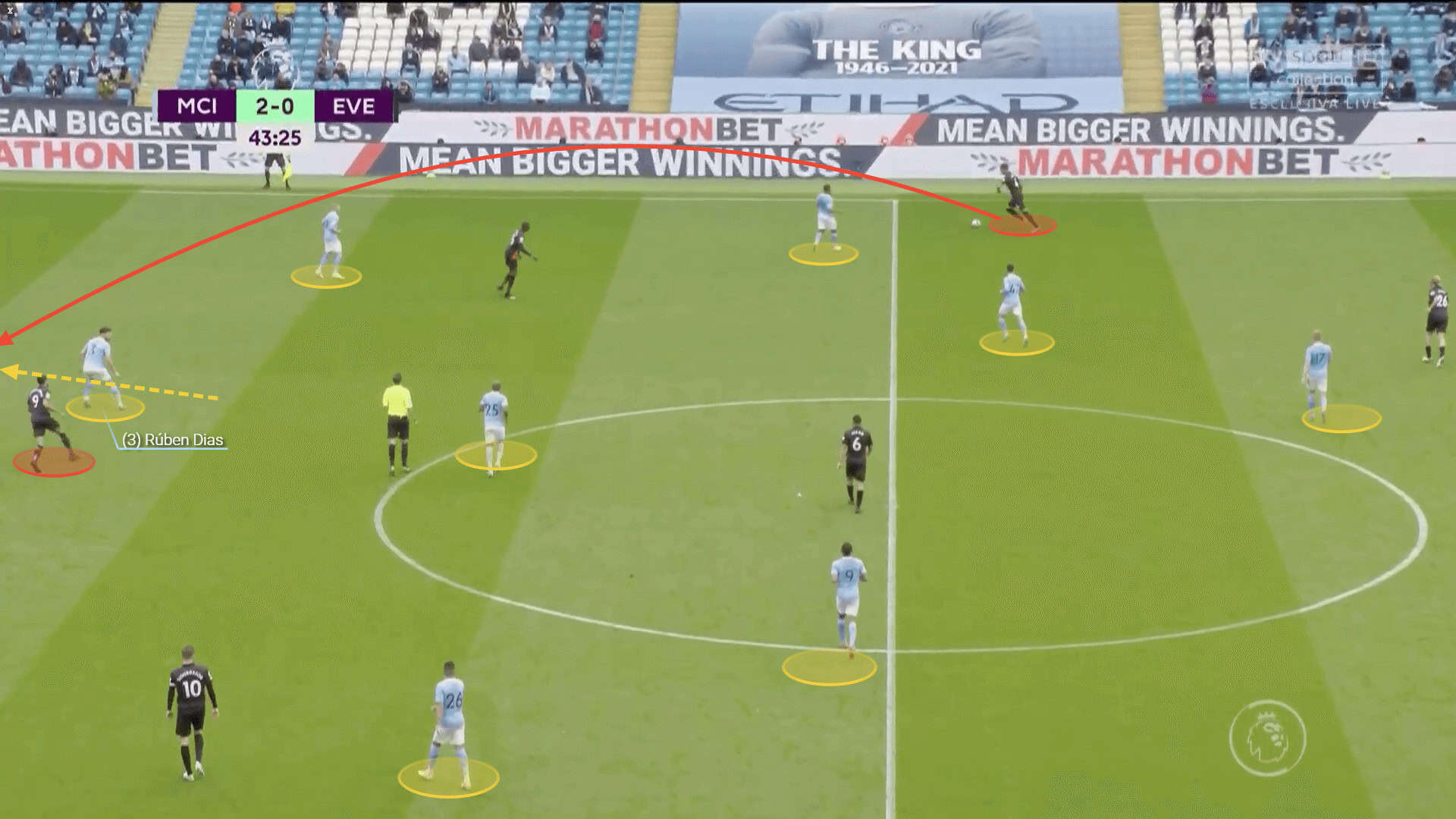
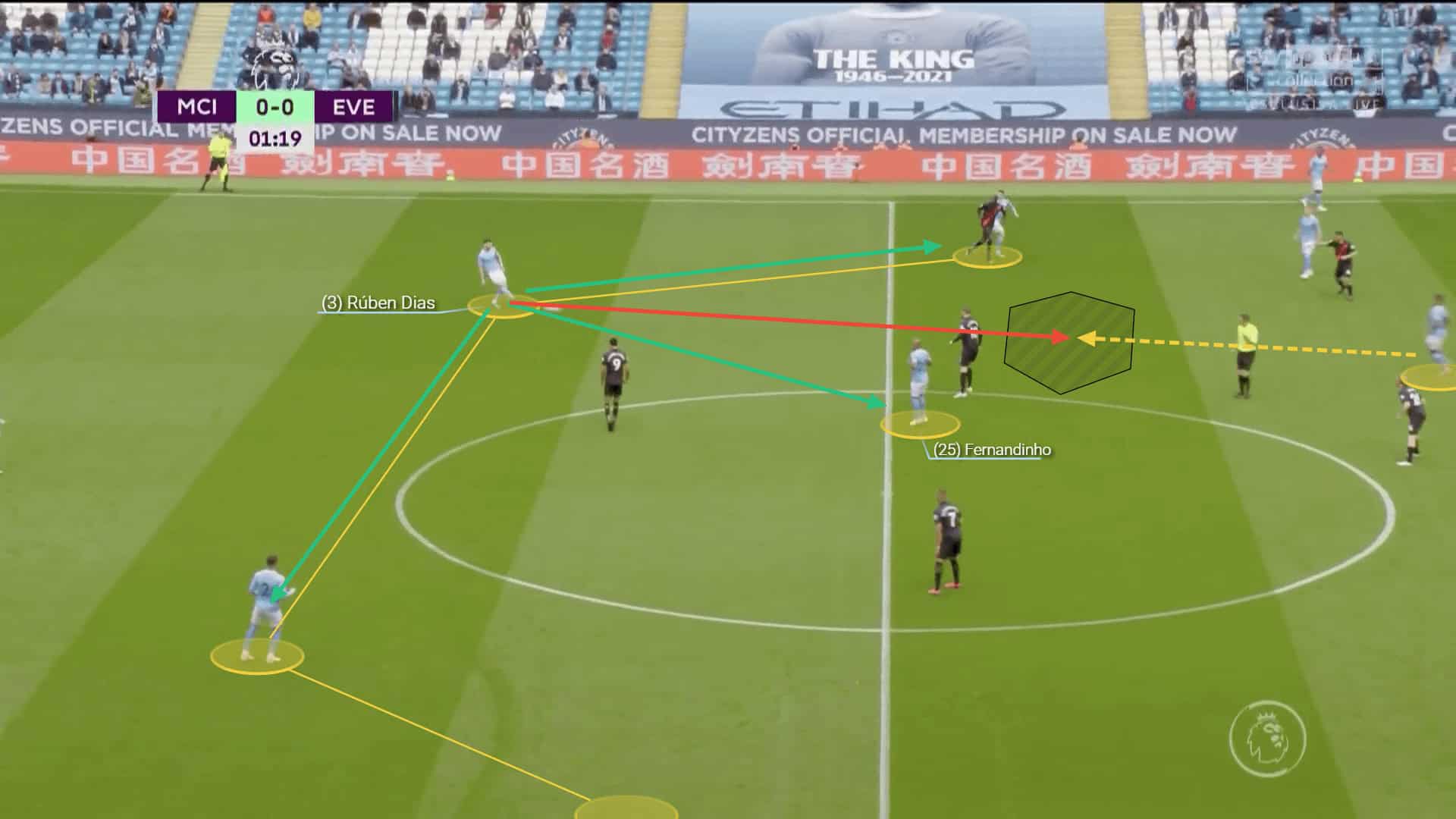
As seen above, Rúben was constantly following the Everton player Dominic Calvert-Lewin and anticipated the long-range pass towards the striker, which allowed the Portuguese to start his movement before the ball attacker.
Dias then eventually recovered the ball.
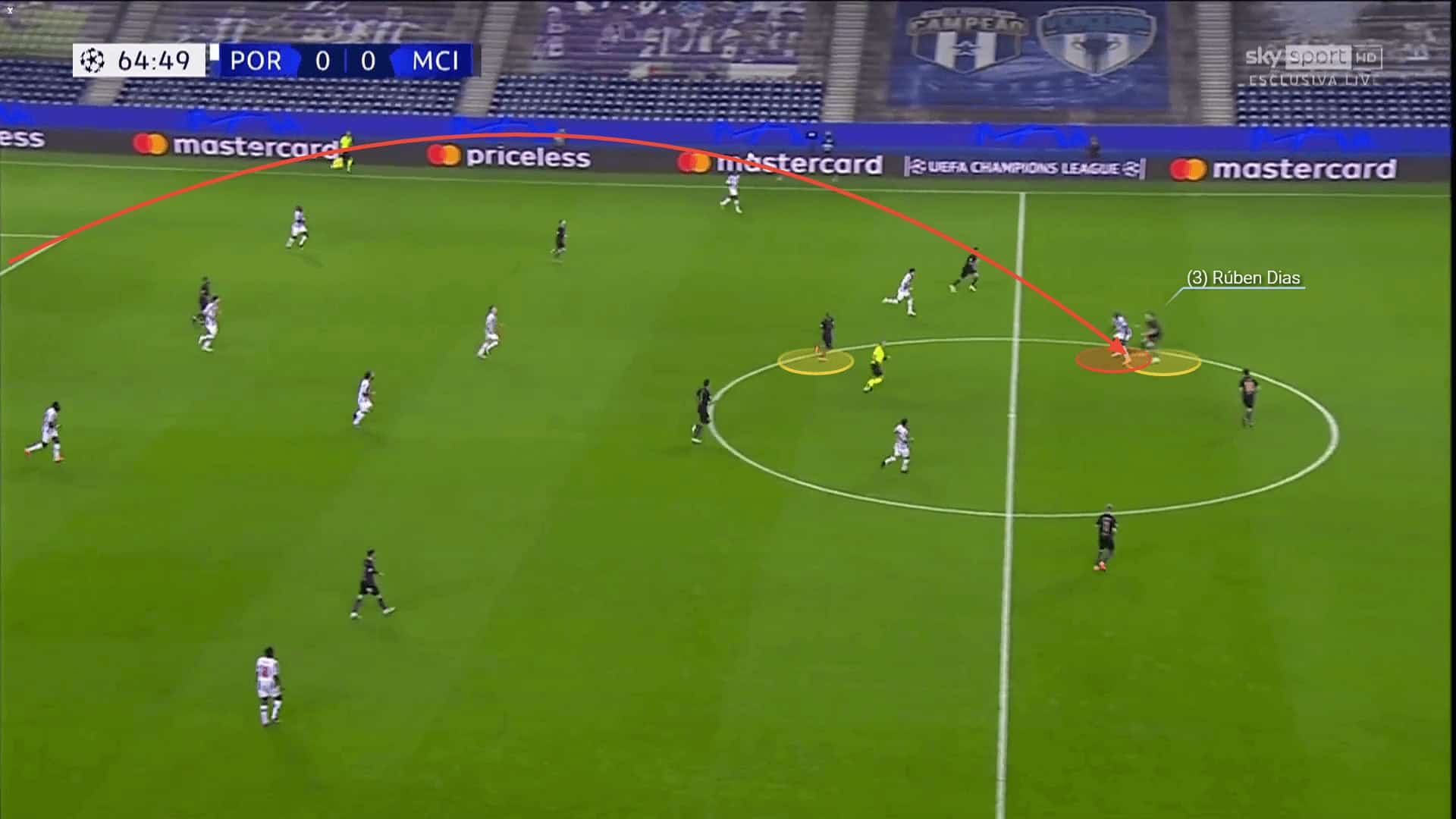
Dias’ anticipation skills allow him to defend efficiently.
In this case, against FC Porto, he anticipated the pass and stepped out so he could recover the ball.
One of Rúben Dias’ weaknesses is his movement in defensive transitions.
The former SL Benfica player is often unable to close out spaces against fast players who try to exploit open spaces behind the backline.
This most frequently happens either when caught on a counter or when the opposition rely on a direct play or long balls.
Luckily, his actions rarely result in conceding dangerous chances due to the whole team’s pressing efforts.
Both the attack and the midfield are involved in pressing and supporting the backline which rarely leaves the defenders exposed.
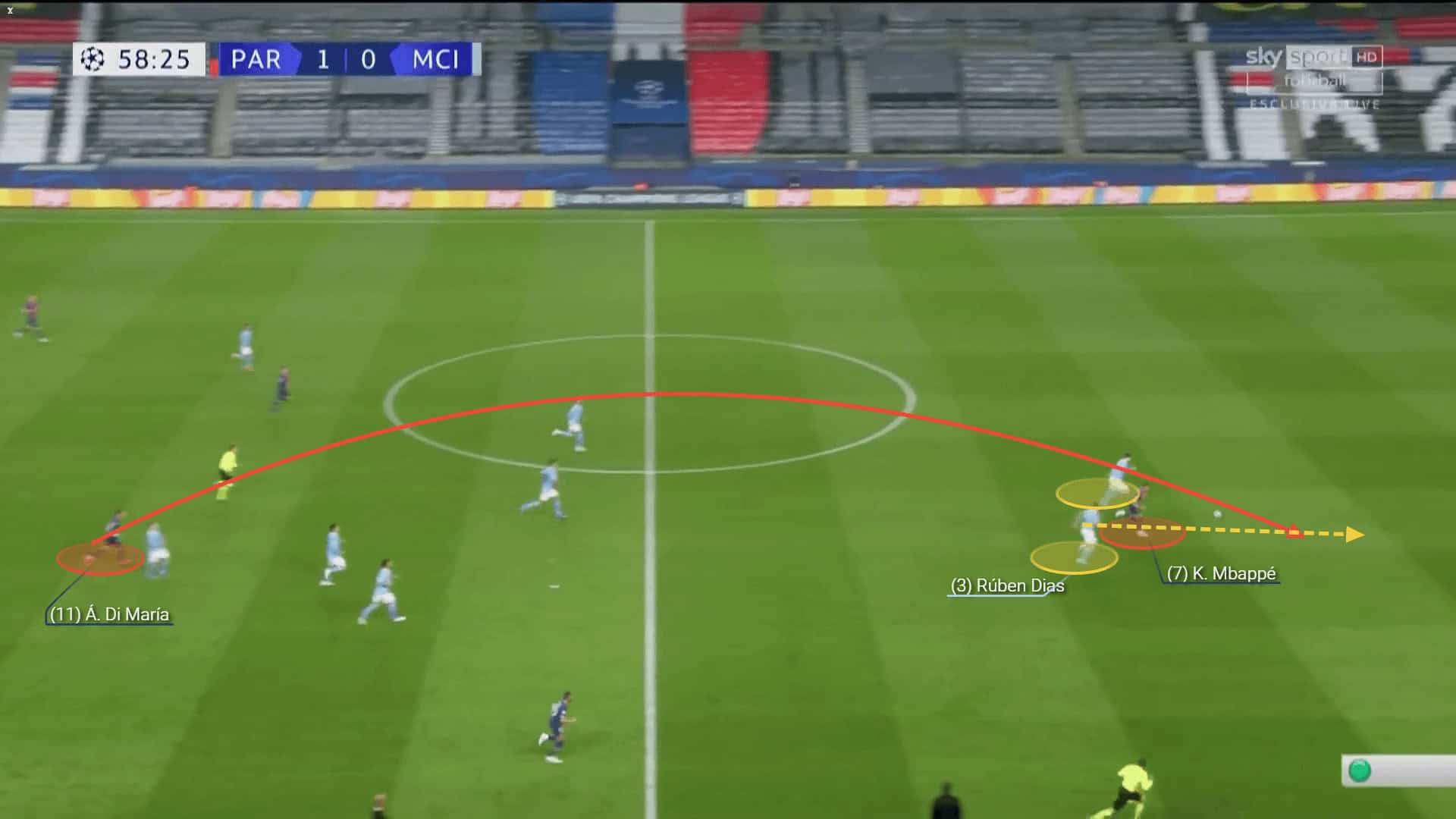
In the example above, in a Champions League match against Paris Saint-Germain, Ángel Di María initiated a counter-attack and sent a long ball to Kylian Mbappé who managed to outrun both Dias and Stones and reach the ball.
Rúben Dias Offensive Role
City’s favoured formation is 4-3-3 although Guardiola often switches to 4-2-3-1.
This set-up often transforms into a more attacking 3-2-5 in possession which allows the team to occupy the advanced areas and retain possession in the opposition half.
Forming a back-three helps them in maintaining their advanced positioning and in involving more players in their ball progression and attack.
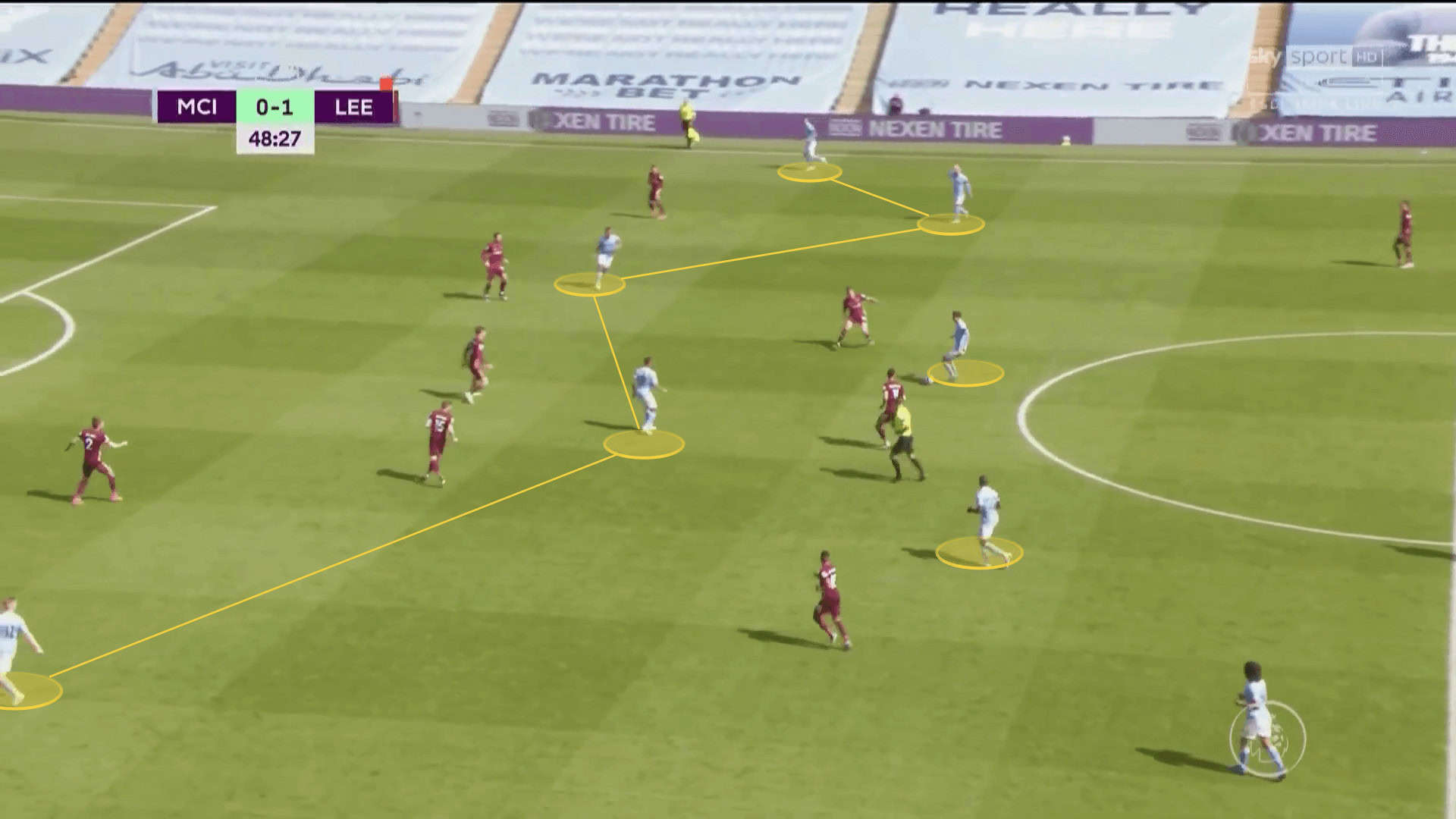
This way the opposition are forced to cover the more advanced players that threaten the goal which releases the pressure from the centre-backs and allows them to circulate the ball at the back unbothered for longer periods.
This allows The Citizens to move around the midfield to open the passing lanes and provide the defenders with quality passing options for ball progression.
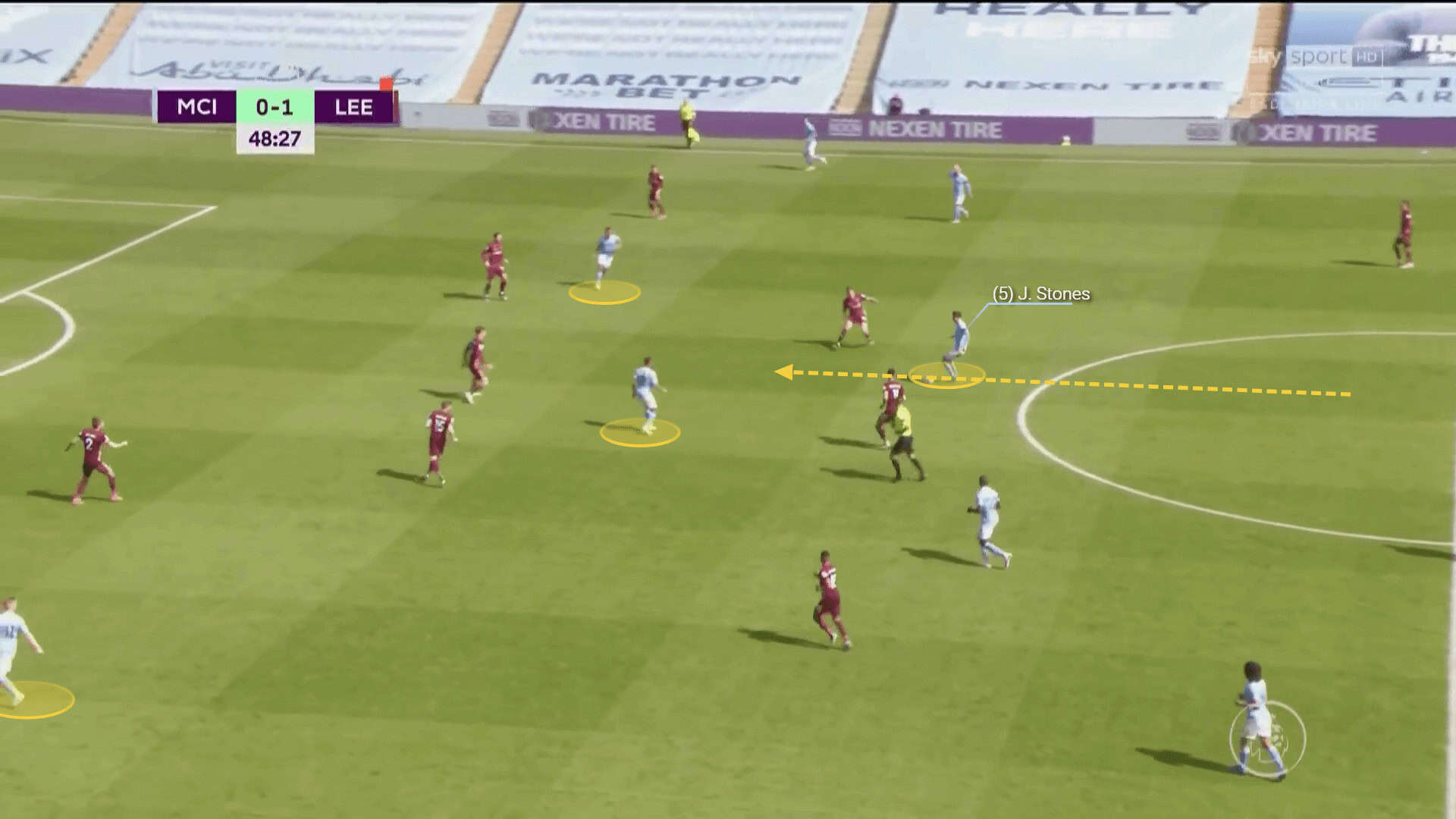
Dias is rarely out of position and is the less risky centre-back compared to John Stones, which is why this partnership proved to be this successful.
He provides the Englishman with additional support and gives him more freedom to move into a more advanced position and complete line-breaking passes.
We’ve seen Stones in a much more advanced position throughout the season, where he is way more suitable for City’s risky attacking approach than Dias.
This though is beneficial for The Sky Blues as they use Dias’ confidence on the ball and work under pressure to retain possession and support his fellow defenders’ riskier movement.
Although Rúben Dias prefers to rely on the safer options, his spatial awareness is very important for ball progression since he is able to pass the ball to the midfielders accurately and in zones that allow quick one-touch pass combinations that disrupt the opposition.
The Portuguese’s awareness allows him to complete long-range passes directly to the attacking players and bypass the opposition’s pressing structures.
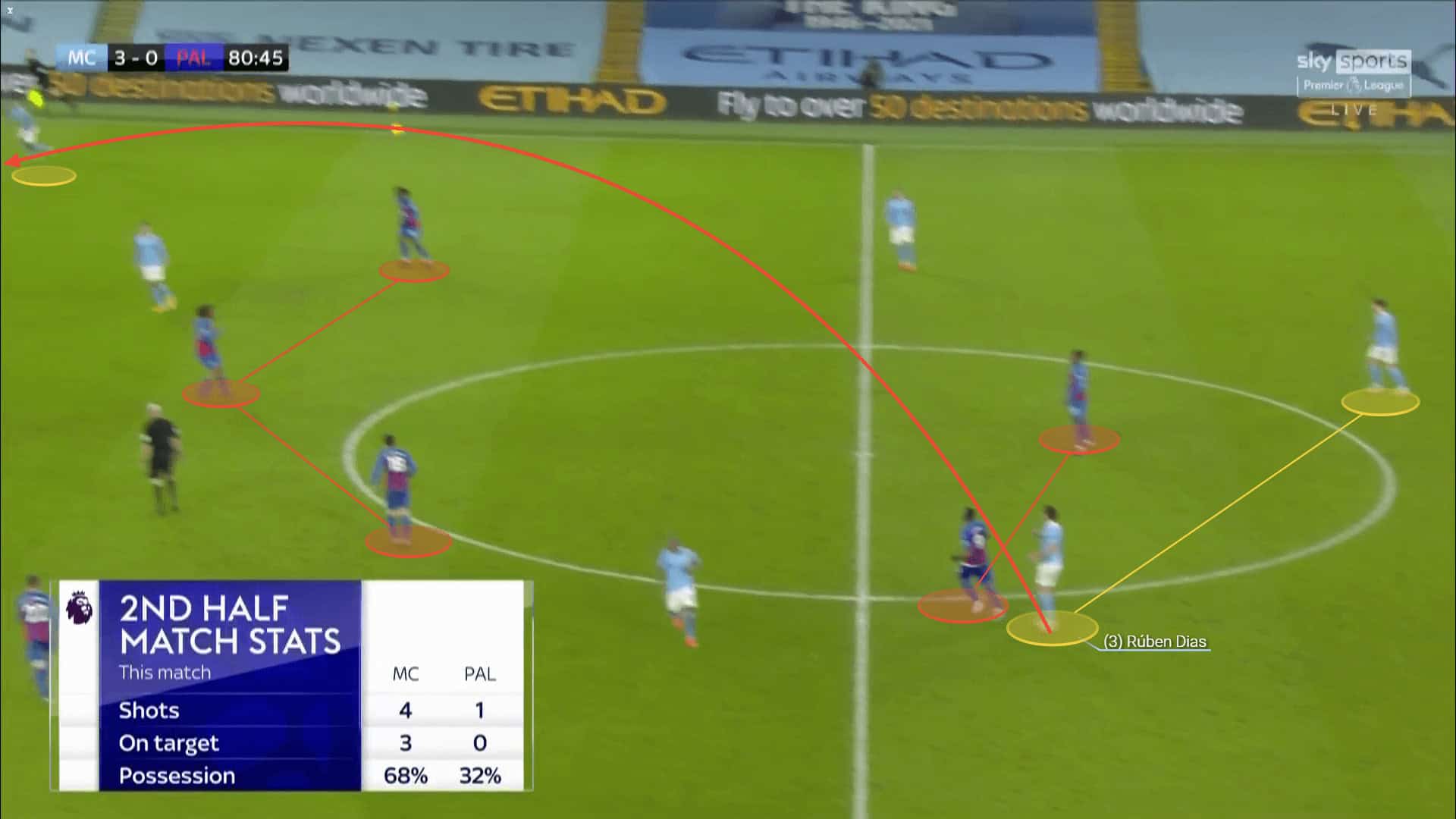
As seen above, Crystal Palace was blocking the passing lanes and he saw an opportunity in sending a long-range pass to the winger who was free.
Conclusion
As our Rúben Dias scout report showed, the 24-year-old has helped Manchester City in implementing Pep Guardiola’s tactics on the pitch.
Furthermore, the Portuguese international provides defensive solidity as well as support to The Citizens possession-based style of play.
The former SL Benfica centre-back brought balance and defensive consistency that The Sky Blues have lacked before and most importantly became the leading figure in defence that the team were missing after Kompany’s departure.
