
Everton’s 1-0 defeat at Bournemouth might not have been the greatest surprise, given the campaigns both teams were having at the time.
However, it would surely have given many visiting fans a sinking feeling that this might finally be the season their time in the Premier League ended after a number of years of flirting with relegation.
As it turned out, though, that game marked a turning point in their season.
It was the final one in which Sean Dyche would be in charge, as the club replaced him with former manager David Moyes.
It is safe to say that the decision to do so has so far proven successful.
The former West Ham United coach has won three of his four league matches in charge, creating a nine-point buffer between his side and the bottom three.
The results have not been the only thing lifting the mood, though.
Moyes also altered the team’s playing style on his return to Goodison Park.
This tactical analysis will focus on this, highlighting how he has tweaked things tactically to make Everton a much more effective unit in all areas of the pitch and identifying where they can still improve between now and the end of the campaign.
Everton Under Sean Dyche Tactics
To get a clearer picture of Everton’s progress since David Moyes returned to the side he left in 2013, it is important to first examine what they were doing before his arrival.
Therefore, this scout report will begin by highlighting some key aspects of their tactics under Sean Dyche, highlighting what was going well and where they consistently fell short.

The key thing to note about Dyche’s style of play is that it focuses very much on defence first and attack second.
He wants his teams to be solid at the back and hit opponents on the break whenever the opportunity arises.
That was apparent whenever Everton stepped onto the field, and it is one of the main reasons for their average of just 42.42% possession per game so far this season.
This was not a bad thing for Everton to have as their mentality when the former Burnley manager first came in, with them leaking plenty of goals beforehand and severely in need of patching up the holes that other teams were constantly exploiting.
As time passed, it became apparent that simply focusing on defending and not scoring enough goals was not working.
This season, the limitations of this brand of football have become increasingly apparent.
In particular, its one-dimensional nature has been clear.
James Tarkowski had the option of feeding the ball into the midfield but instead decided to send a long aerial ball up the pitch simply because that is what so much of Everton’s play revolved around.
While it is not a bad thing for a team to have in their arsenal, it should not be the only way of playing they can use.
Yet, in Everton’s case, it was and meant that they became very predictable and easy to win the ball back from.
Fulham knew that Tarkowski would make this pass, so they had time to get underneath it and ensure they won it first when it came back to the ground, just as Issa Diop did here.
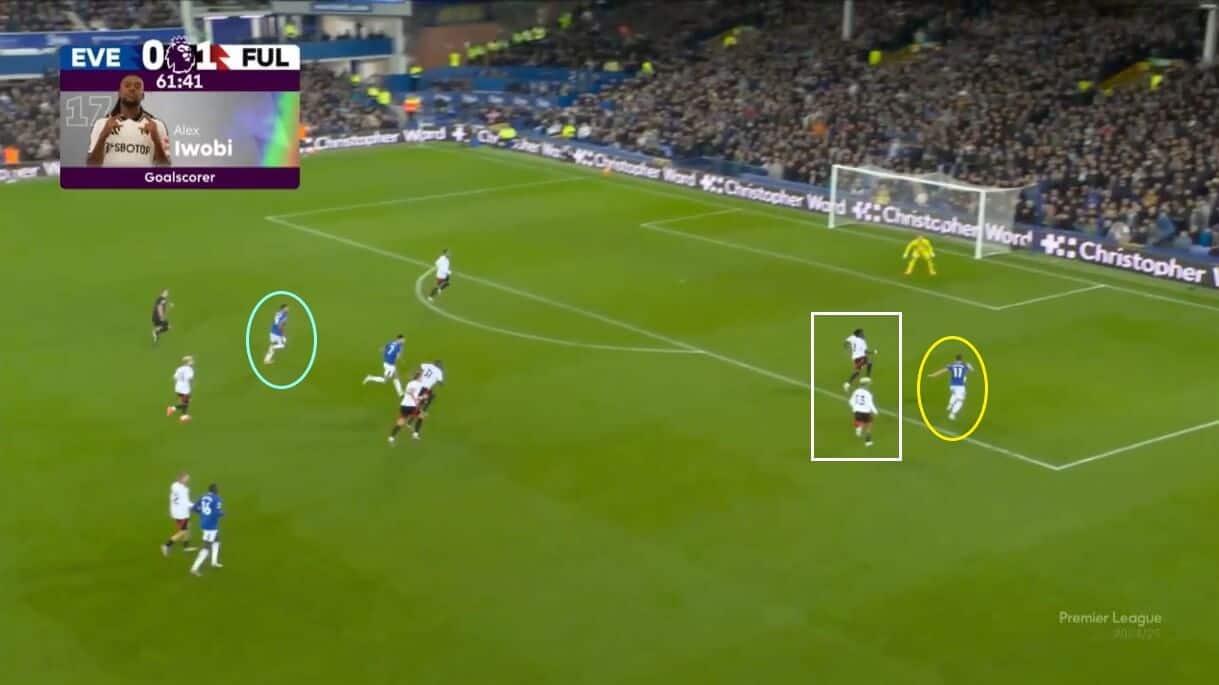
It is not remotely surprising, given that Everton’s biggest problem under Dyche this season had been scoring goals, with long passes of that nature always going to favour defenders.
However, it is not the only reason they have experienced such woe in front of the goal, with another being the lack of a central threat in the final third.
This is where the striker’s positioning comes into question.
They are often isolated at the top of the field and tend to drop back to involve themselves in matters further back.
This, though, is exactly what Everton doesn’t want, with the issues it creates apparent here.
Dominic Calvert-Lewin has dropped into the playmaker role to win the ball and has sent it forward for on-loan Leeds United forward Jack Harrison to run onto.
However, the latter has both Calvin Bassey and Antonee Robinson for company, so his angle is becoming increasingly narrowed.
Therefore, it is no surprise that his shot, whilst hit well, fails to find the target.
The issue comes in where Calvert-Lewin positions himself.
On this occasion, he had dropped back when he didn’t need to, with Dwight McNeil in a position to make the same linking contribution that he did here.
Instead,, he needed to stay high up the field to eithergived Harrison a crossing option or at least remove some of the defensive pressure the winger has nowexperiencedr.
By dropping back, he plays into Fulham’s hands, which is one key reason why Everton has been so lacking in goal threat this season.
As mentioned, though, Dyche’s main focus has always been on the defensive side, which Everton mastered during his time in charge.
In the current campaign, they have proven to be tough to beat overall, winning 62.1% of their defensive duels and 45.5% of their aerial duels to date.
The 4-4-2 structure that Dyche has always favoured has been paramount to this.
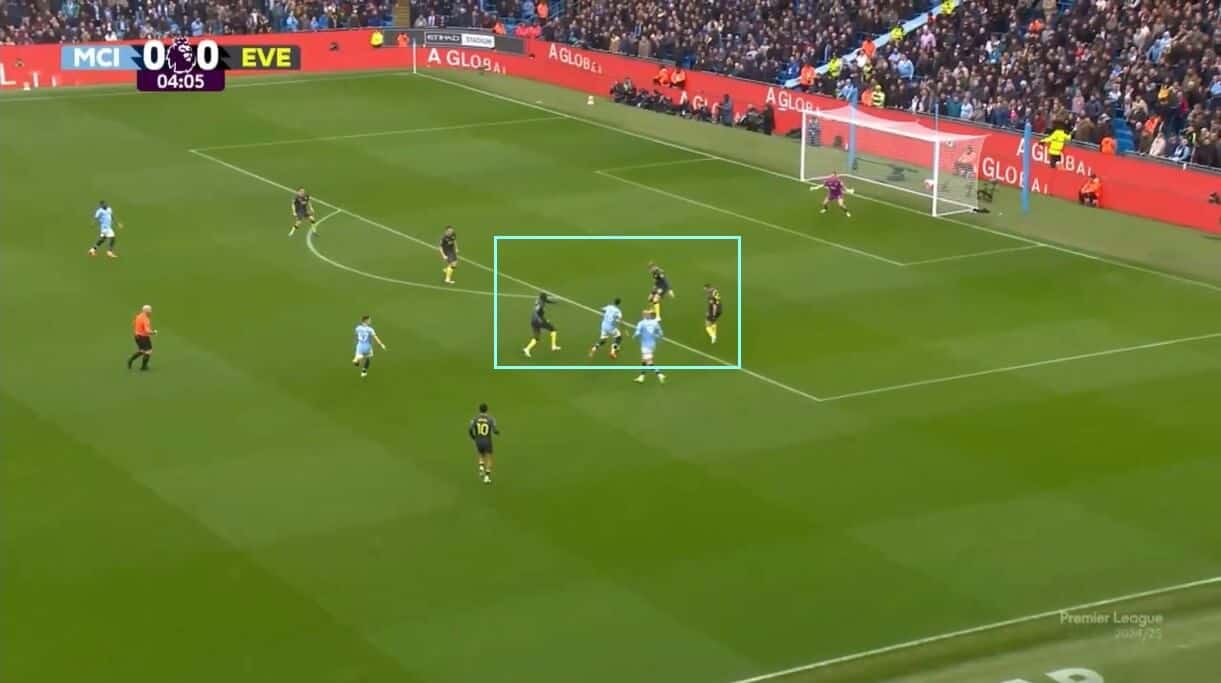
It allows players to team up all over the pitch and squeeze opponents into tight spaces whenever the ball comes to them.
That is evident here, with Manchester City on the attack and Mateo Kovačić finding Savinho on the nearside of the field with a neat diagonal pass.
However, the Brazil winger instantly found himself surrounded by Jarrad Branthwaite and Vitalii Mykolenko.
Abdoulaye Doucouré tracked back to add further defensive security and prevent Savinho from making one of his usual mazy runs towards the goal area.
This type of defensive rigidity should be commended, and many have done just that.
However, it should not be the case that teams seemingly focus solely on that and sacrifice their offensive threat, and that was the general feeling about Everton this season.
This, combined with the fact that they were still leaking 1.19 goals per game, made a change seem inevitable if they were to stave off the threat of relegation.
Everton’s Changes Under David Moyes Tactics
Enter David Moyes, who has returned to the club he left nine years ago with one immediate task in mind: to keep the club up and ensure that they compete in the Premier League in their first season at their new Everton Stadium home at Bramley-Moore Dock.
It is safe to say that he has had an immediate impact in that regard and that the players have responded to his methods.
This section of the analysis will show how he has changed the mood around the place and restored optimism that the club can stay above the dotted line.
Since his return, Moyes has implemented a greater sense of invention whenever his team is in possession.
Their play is now more unpredictable, making it much harder for opponents to set up a structure that limits their attacking threat.
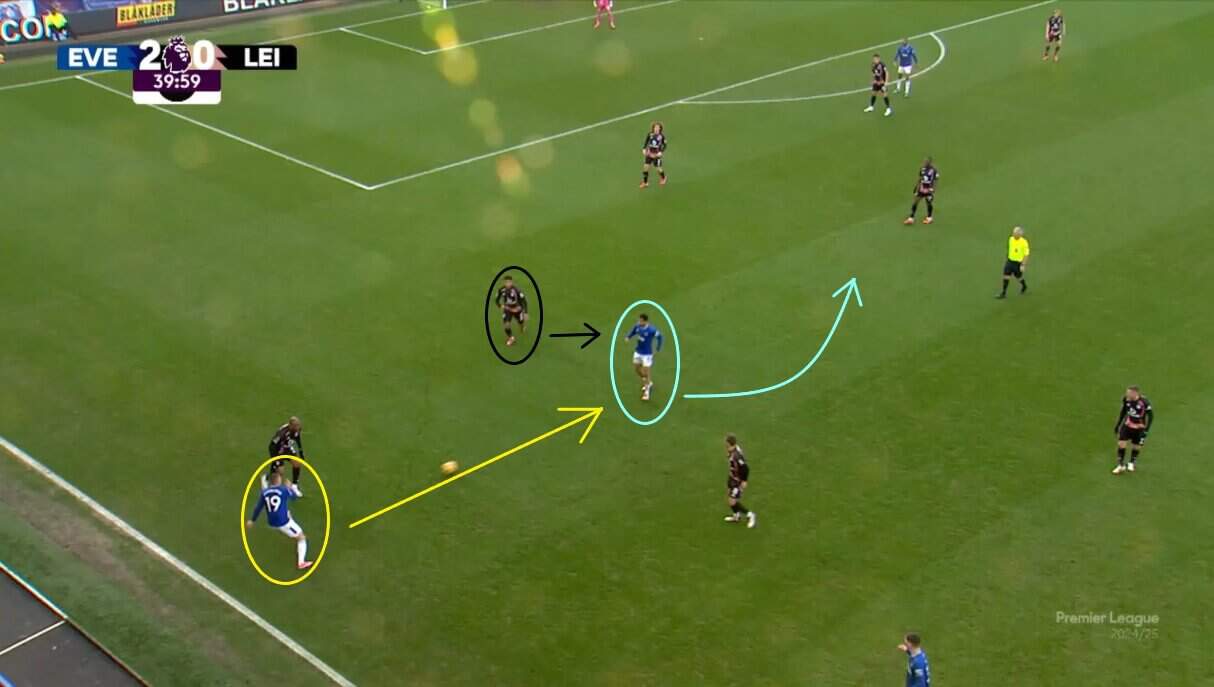
This situation is a perfect example, with Mykolenko making a typical run-up on the field and allowing Iliman Ndiaye to play in the half-spaces, where he has always been at his best.
However, that is not the key point here; what happens next indicates Moyes’s implemented changes.
Under Dyche, Ndiaye would have likely played a rapid one-two with Mykolenko and would have sent the ball forward for the latter player to run onto.
Still, he did something different this time as he initially kept hold of it and instead spun around before feeding it into the gaps behind the Leicester City defenders.
By doing so, he has made it harder for Leicester to close down Mykolenko.
Jordan Ayew marks the Ukraine international, but James Justin is now unable to assist him.
He needed to follow Ndiaye to prevent him from having free territory that he could use to his advantage.
It has also forced Wout Faes to hold his position and not move out to close the cross down, which, too, gives Mykolenko more time to pick out a teammate in the middle than he might have otherwise enjoyed.
Therefore, while combination play like this occurred frequently during Dyche’s tenure, Moyes has improved it and given his players more freedom to express themselves in these areas of the field.
It undoubtedly gives them a greater offensive threat, which has led to them scoring eight goals in their four league matches so far (compared to the 15 they netted in Dyche’s 19 matches at the helm this campaign).
The other thing that Moyes has introduced is a greater tactical flexibility.
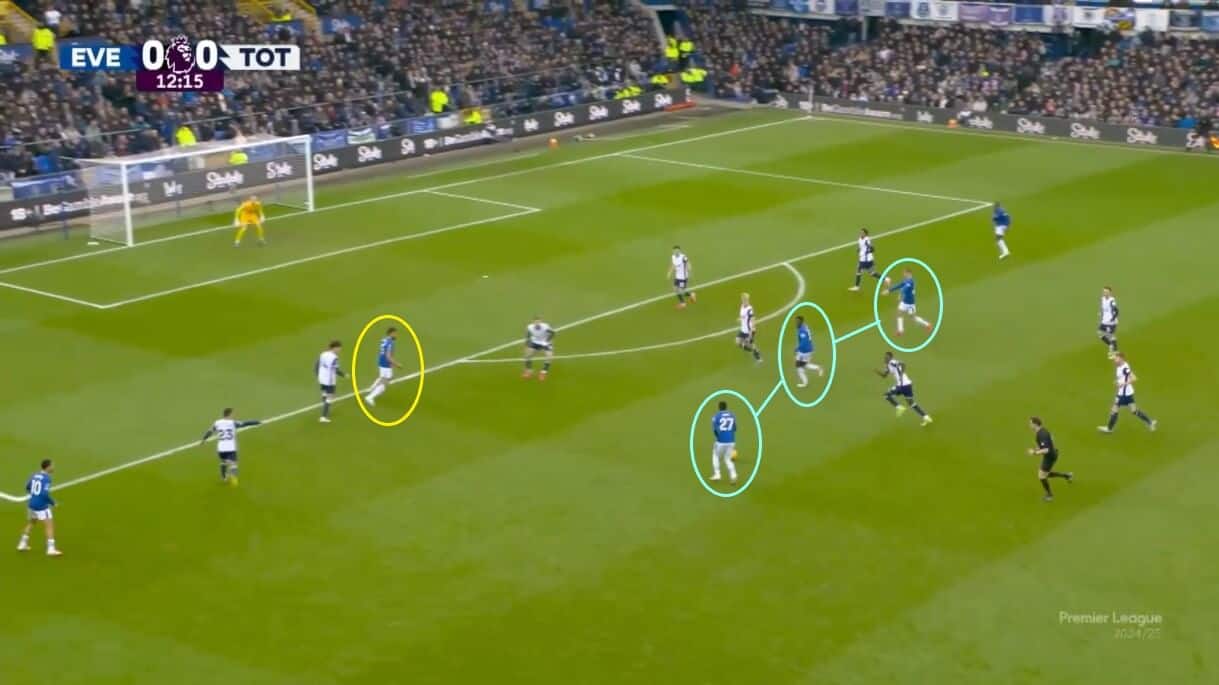
In the match against Tottenham Hotspur, he changed to a back three and started Mykolenko and on-loan Denmark winger Jesper Lindstrøm as wing-backs.
This not only gave Everton an additional player at the back but also gave the midfielders greater licence to push forward and increase their numbers in promising areas of the field.
The result of that change was that Everton were able to apply greater pressure on the Tottenham back line, which has been fragile at best this season.
In this case, it can be seen how the trio of Lindstrøm, Idrissa Gueye and Orel Mangala are in close proximity to each other and have successfully regained the ball high up the field, following yet another error by Ange Postecoglou’s team.
Another positive aspect of this enhanced threat is that the striker does not need to drop back as they did beforehand.
That is shown clearly here, with Calvert-Lewin on the shoulder of the Tottenham defensive line, giving Everton the target at the top of the field that they were so often missing under Dyche.
This game led to him ending a personal goal drought that stretched back to September, and it was a match in which he looked much more comfortable and got back to his best.
There is no doubt that Everton will stay up if they can replicate this offensive presence in each of their Premier League matches between now and the end of the campaign.
Whilst the attacking improvements under Moyes’s coaching style have been apparent to all, it is not the case that he has abandoned the defensive side of things.
On the contrary, he has paid just as much attention to that part of the game, and Everton has been able to find the right balance between scoring goals and being solid at the back.
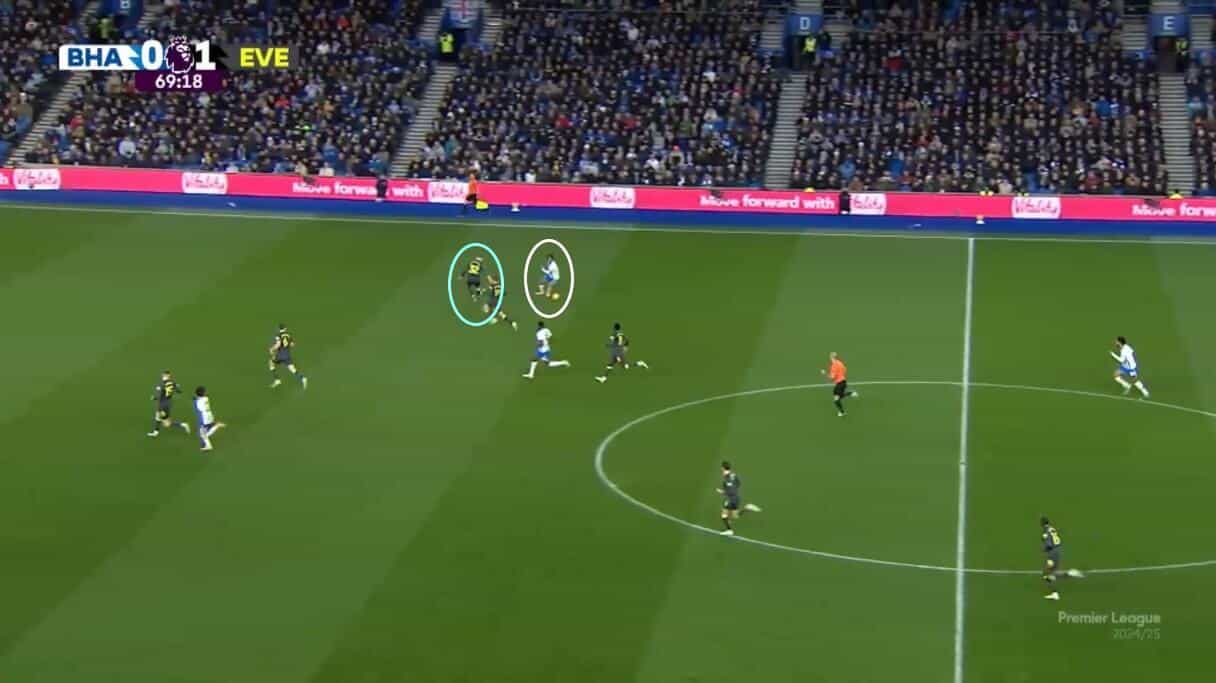
One thing that Moyes has changed out of possession, though, is the need for his team to take the game to their opponents, as he has asked them to do whenever they have the ball.
That has seen situations like this become increasingly common, with Brighton and Hove Albion pushing forward and João Pedro trying to get his team on the front foot.
Under Dyche, the mentality would have been to take a passive approach and work on surrounding the former Watford striker.
However, Moyes wants his team to be more proactive, so Branthwaite has stepped out of line and halted his opponent’s run.
The key point, though, is that this doesn’t mean he dives in and attempts to tackle the ball straight away; Instead, he shows patience and simply slows Brighton’s progress.
By doing so, he gives his teammates time to get back into shape before attempting to regain possession once the Brazil international begins to move horizontally.
Therefore, as with their offensive play, Everton now look more confident and tougher to come up against, and it is yet another example of how Moyes is having the desired effect when it comes to keeping the team in the Premier League.
Everton’s Areas To Work On
This is not to say, though, that everything Everton is doing at the moment is perfect, but it is worth remembering that they are still among the teams fighting to stay up and that David Moyes is only four league games into his second spell in charge.
Given this, there is absolutely no room for complacency, and they must keep working hard to retain their top-flight status.
There are a few areas of their play that still need to be looked at as the campaign continues.
The first is ensuring that they don’t overplay their way through passing sequences and give the ball away unnecessarily.
There have been times when they have enthusiastically sought to move the ball around the field as Moyes demands (leading to their 81.2% passing accuracy to date) but have sometimes made one pass too many.
This has meant that some of their attacks have broken down prematurely, which they must be aware of as they continually adapt to this new way of playing.
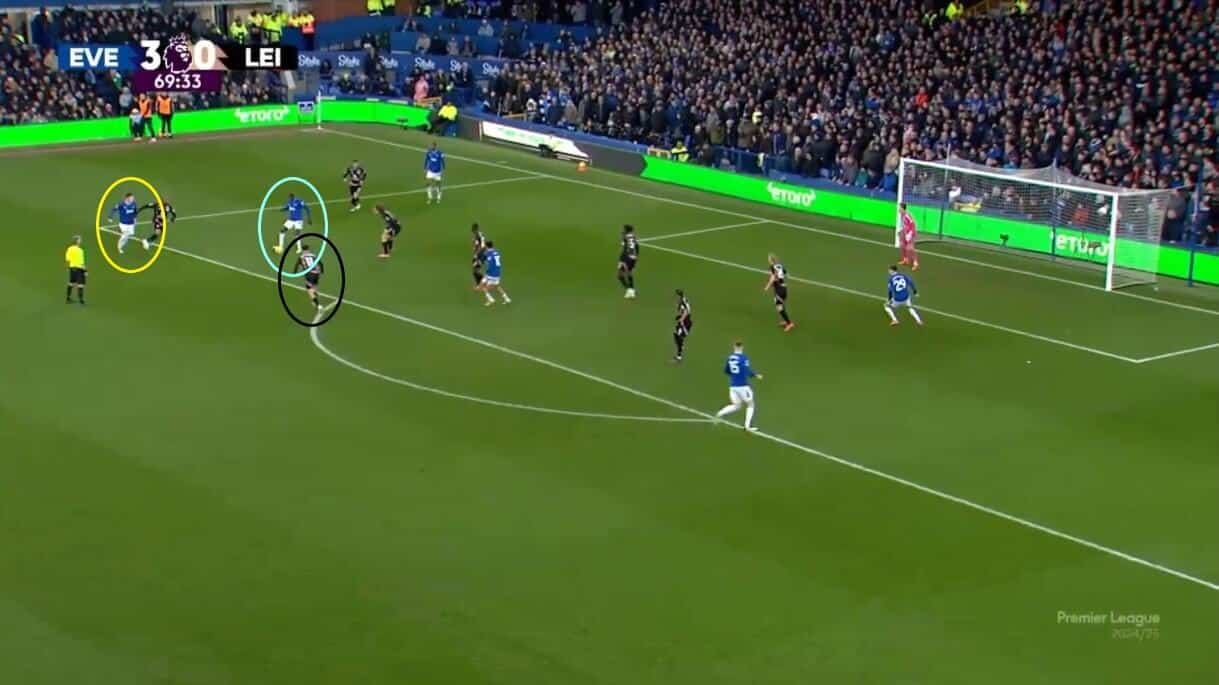
This was an example of when that happened, and it cost Everton a chance to shoot at goal.
Everton worked the ball well and got themselves into a position where they could try their luck in front of the goal.
However, Doucouré here sees his attempt to feed the ball into the path of fellow midfielder James Garner fail to come off, with it instead rolling towards Leicester’s Bilal El Khannouss and allowing the Morocco international to clear his lines easily.
Therefore, while Everton’s desire to implement a more possession-orientated style of play under Moyes tactics should be praised, there are times when they need to avoid crafting too many passes together and overcooking things.
They are clearly still getting used to it, but they need to be as productive as they are capable of being when they access spaces such as this.
Another risk that has arisen is the choice of who starts at wing-back when Moyes opts to deploy them.
As mentioned, he has tended to play Lindstrøm on the right wing most of the time in that formation, and it has worked well on the attacking side.
His crossing quality and combination play are key to Everton’s increased offensive threat.
However, there is no getting away from the fact that Lindstrøm is not a defender by trade, and that has shown at times whenever Everton have been out of possession and under pressure at the back.
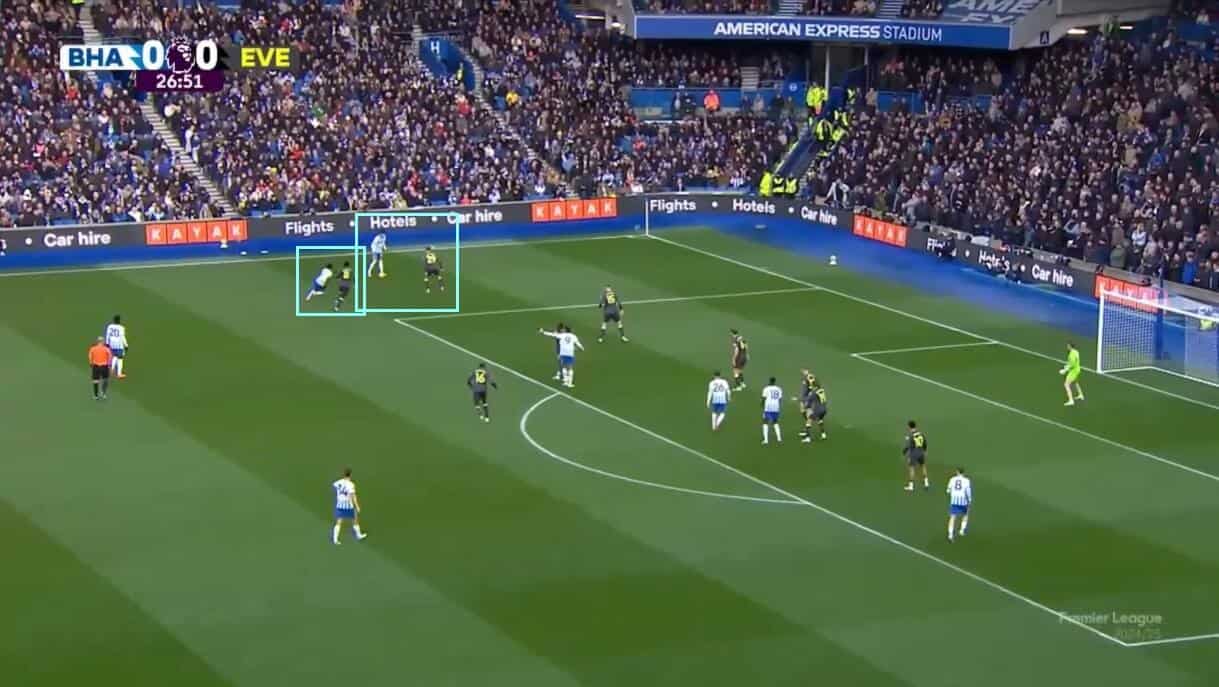
In this instance, Brighton made its way up the field, and the wing-back was expected to stop the ball from getting past him.
However, Tariq Lamptey and Kaoru Mitoma easily manoeuvred behind Lindstrøm and Mangala, which could have led to Everton conceding a disappointing shot on goal.
In the end, Lamptey’s delivery was well blocked by former Lyon player Jake O’Brien, so it didn’t come to anything, but Moyes might need to consider this if he persists with his wing-back setup.
Everton Crossing Zones Map In Premier League 2024/2025
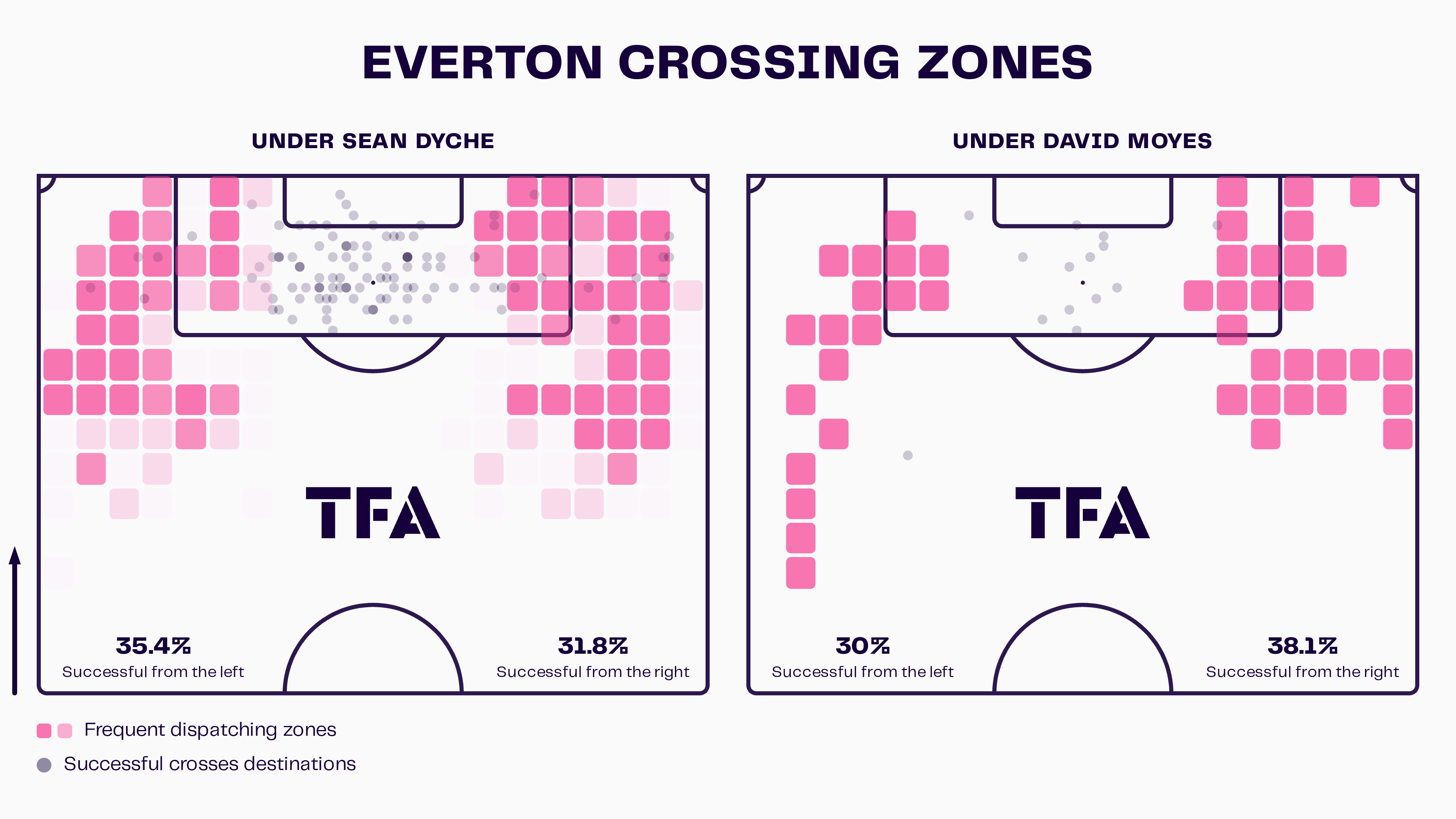
The other thing worth noting is the crossing zones that Everton have sent balls into the middle from.
Under Dyche, they became known for making crosses from deeper positions, as was typical in his long-ball strategy, and it was another reason that they became such a one-dimensional outfit.
It was expected that this would change under Moyes to see Everton take the ball higher up the field before sending it in, and there has been evidence to suggest that he is trying to encourage that aspect of their play.
However, as this graphic indicates, plenty of crosses have still entered the goal area from further back on both sides of the field.
It is worth noting that just 33.1% of their deliveries have found their intended target.
Therefore, with opponents having time to get back and to ensure they meet the ball first once it does enter their airspace, this has not been a worthwhile strategy for Everton to pursue.
Instead, they should tend to cross the ball into the middle from higher up the field whenever possible.
This will likely give them a greater chance of success and, therefore, the best possible opportunity to avoid the drop.
Conclusion
In conclusion, this tactical analysis has examined Everton more closely, highlighting the differences between their operation under previous manager Sean Dyche and how David Moyes has reinvigorated their play.
This has allowed them to be more dangerous in attack while retaining the same defensive rigidity that has typified their season so far.
As the scout report indicates, Moyes has not started from scratch.
Instead, it has simply been about refining what is already there and ensuring that they can balance the need to be solid with being productive once they get the ball into promising areas of the field.
So far, he has managed to achieve that, and the result is that Everton are putting some distance between themselves and the bottom three.
Whether they can maintain their positive form of late is not an easy question to answer, but the players have now given their fans and analysts alike a reminder of what they are truly capable of.
If they can retain the newfound sense of confidence that has been injected into them by their returning manager, then anything will be possible.
It will certainly be interesting to keep an eye on them as the campaign goes on.
