
Major international tournaments can always be relied upon to provide anticipation and excitement, allowing fans to watch some of the best players around lock horns in the search for glory and for clubs to scout potential future targets, with a number who have featured at Euro 2024 the subject of intense rumour and speculation.
When looking at those who have stood out as the action has gone on, it is easy to simply list the biggest names in the tournament and the usual headline-grabbers.
However, Euro 2024 has been as much about the lower-ranked sides and the underdogs as it has been about the giants of the European game, and there have been plenty of individual performances from some of those in the former group that have perhaps gone under the radar.
With that in mind, this tactical analysis will identify five players who have performed well but may not have garnered the attention their efforts have merited.
The scout report will highlight the roles they have played in their teams’ tactics and explain why they deserve to be celebrated now and after the tournament.
Barış Yılmaz Scouting Report
One player whose stock has risen significantly at Euro 2024 is Turkey winger Barış Yılmaz, who shows plenty of pace and skill with the ball at his feet and a constant desire to make things happen.
Capable of operating as either a winger or in a line-leading role, he is reportedly the subject of strong interest from Liverpool, with Arne Slot’s side seemingly huge admirers of the attacker and having had conversations with his club side, Galatasaray, regarding acquiring his services.

When watching Yılmaz play, it is not hard to see why he could be set for a big move this summer, with his skillset matching what so many value most.
His ability to dribble at speed has proven to be particularly challenging for opponents to deal with, and it has allowed him to fit really well into Turkey’s fast-paced style of play under Vincenzo Montella.
Their tactics revolve around constant movement and playing at a high tempo as they look to control the flow of their matches.
However, Yılmaz does not simply run up and down the wing vertically; instead, he is often seen making inverted runs and driving into the half-spaces or the central channel when he can.
This is facilitated by Turkey deploying full-backs who naturally play in advanced positions, freeing up their forwards to operate closer together, and it has allowed Yılmaz to play with a significant degree of unpredictability whenever he has had the ball.
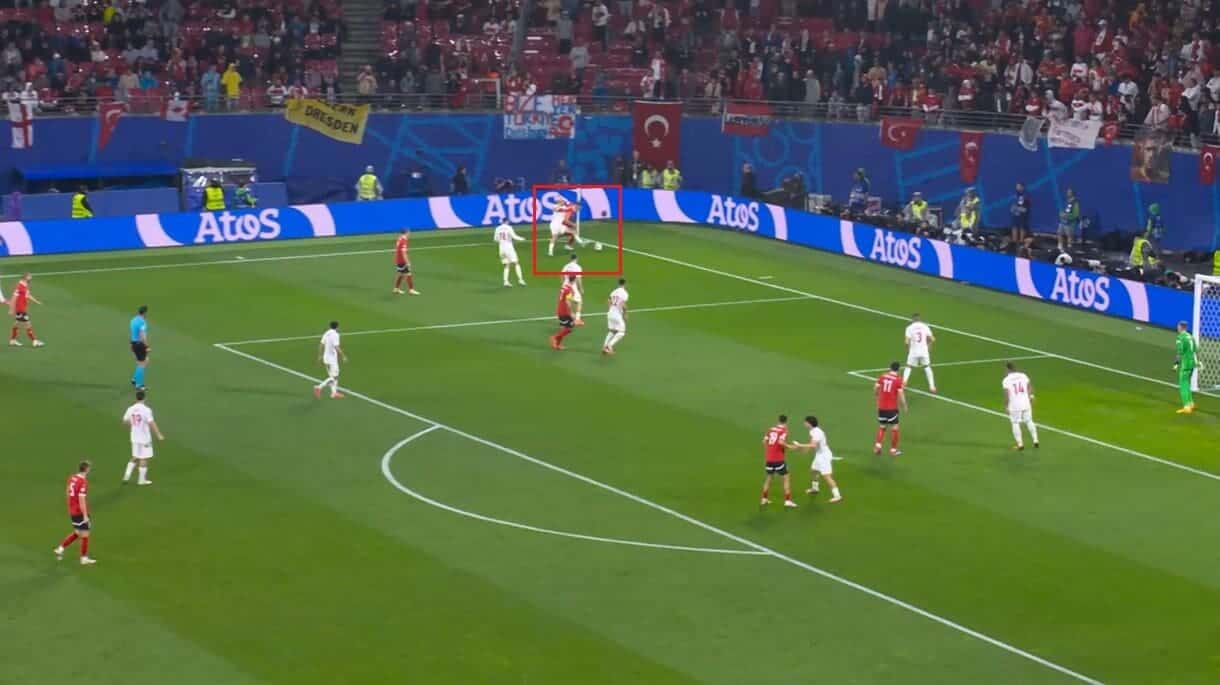
In this case, he has received a pass and has been instantly closed down by Austria defender Philipp Lienhart, but the Freiburg player does not know whether Yılmaz will look to stay wide or cut inside him, so he cannot eliminate all available options.
On this occasion, he opted for the latter and delivered the ball towards teammate Arda Güler.
It didn’t come off, and the attack broke down.
That is where he needs to improve, as only 36.4% of his crosses reached their intended target (1.96 per game) at Euro 2024.
However, this should not detract from the offensive threat that Yılmaz possesses.
It is clear that he has many key attributes that teams will admire.
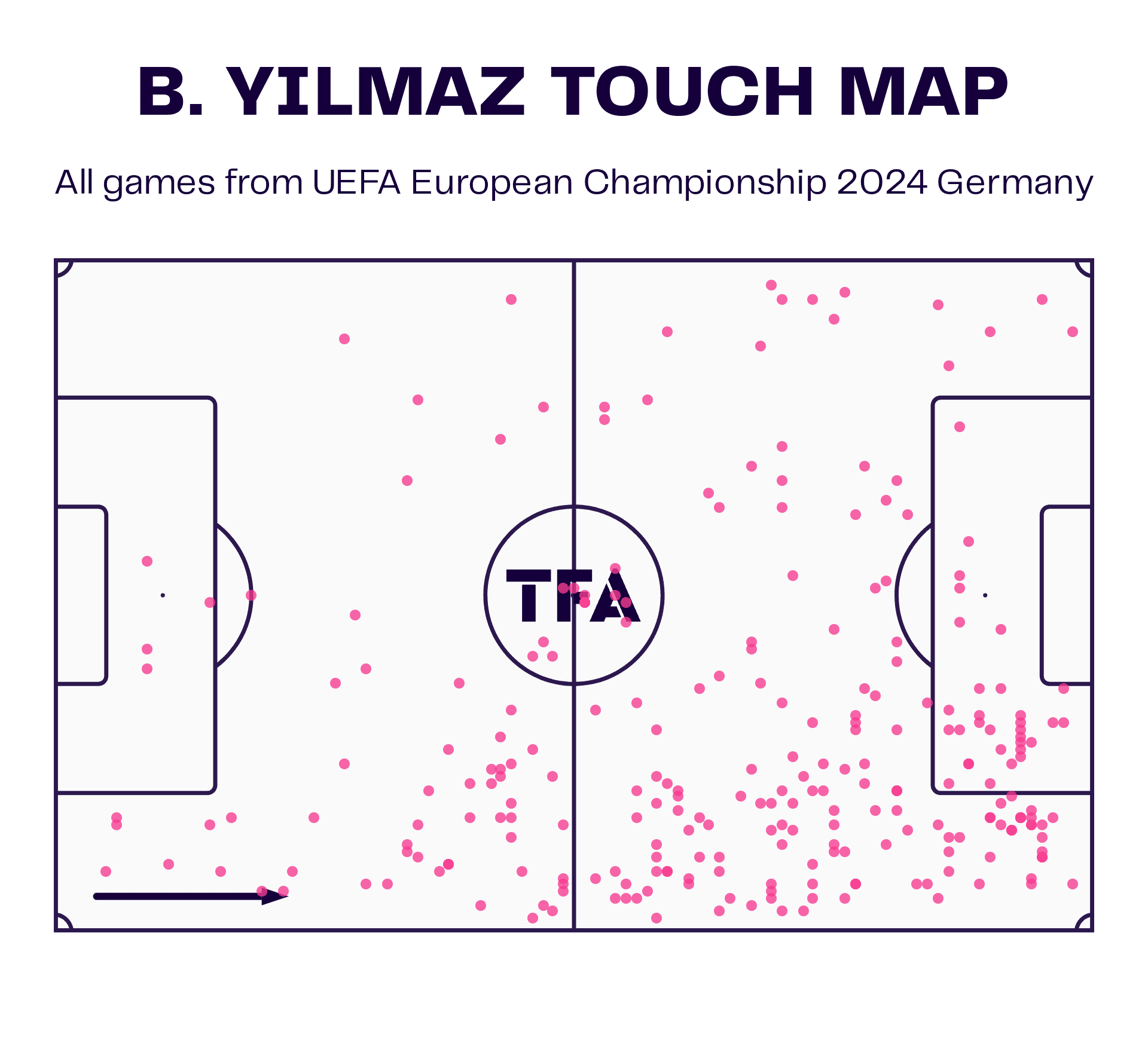
When looking at this graphic, it becomes apparent just how dynamic a player he is when in top form and how much of the pitch he covers.
Many of his touches of the ball come on the right-hand side, but a high concentration of them are in the central channel and on the opposite wing.
When you add that he averaged 3.25 touches inside the penalty area per game at Euro 2024, there is little doubt that he is a very well-rounded attacker who can operate with quality in several positions.
That versatility will always appeal to coaches as they look to build squads capable of competing in the modern game.
However, Yılmaz is not purely an attacking player; he can also drop back to assist his team in defensive situations.
There have been several times when he has been seen in deeper areas, working with those around him to protect his goal.
On this occasion, he has followed Austria’s Alexander Prass all the way back to his own goal line, working hard and never relenting in his desire to prevent the ball from being delivered into the central spaces by the Sturm Graz player.
What really stands out about his defensive play is that he tends to close opponents down from their blind spots, looking to give them as little warning as possible of his intentions and thereby increasing the chances of either winning a duel or limiting the other team’s options on the ball.
It is this that led to him succeeding in 77.3% of his defensive duels whilst in Germany, and this again provides another layer to his game and shows why he is being linked with a move to a major club this summer.
Davide Frattesi Scouting Report
One name that many will be more familiar with is that of Davide Frattesi, and it might surprise some to see the Inter midfielder’s name included in this list.
However, whilst he is not necessarily an under-the-radar player, he is when it comes to standing out in an Italian team that largely disappointed at Euro 2024, meaning he has perhaps not earned the praise his efforts merited.
Italy’s game plan at the tournament revolved around retaining the ball and avoiding risks, and previous analysis of that approach has indicated the benefits it can bring, such as dominating possession and making it harder for opponents to launch attacks.
However, Italy’s issue was that they ended up too conservative and passive with the ball, never looking like they could create anything, and that sealed their fate as they exited stage left in the Round of 16.
This is not to say that some players didn’t try to inject some energy into their play, though; Frattesi was undoubtedly one of those.
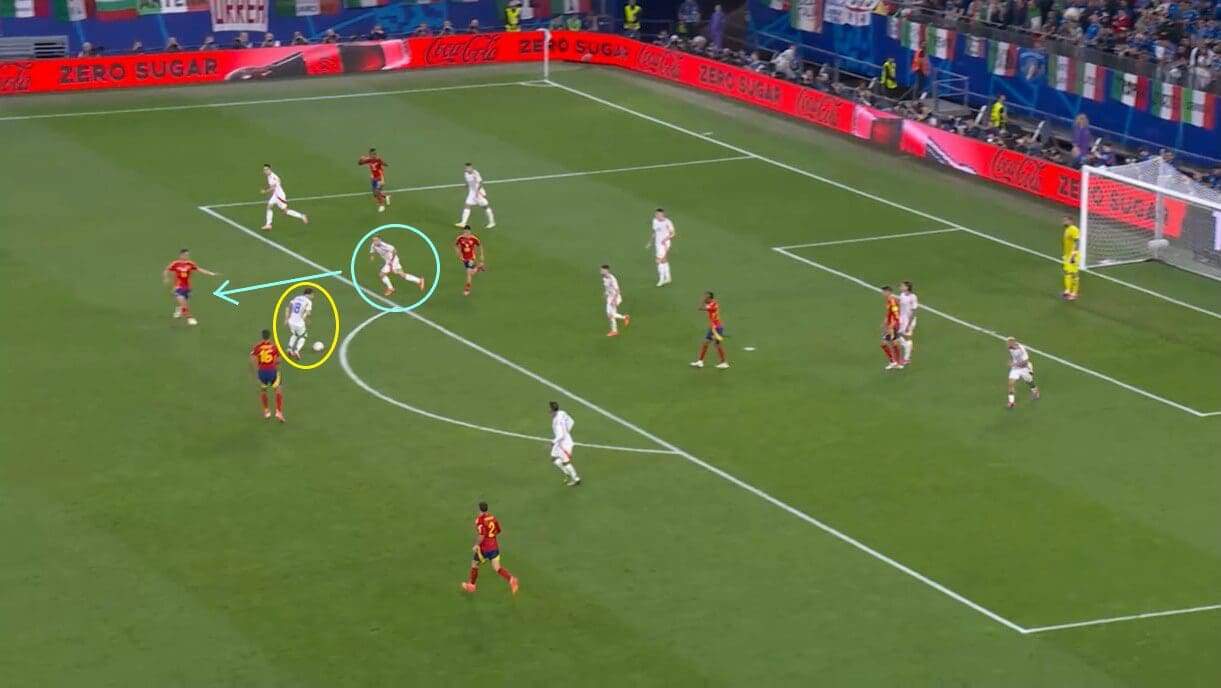
In this case, he has sat back in the defensive shape that Italy head coach Luciano Spalletti demanded, but it can be seen how he is looking for a way to break out and to get his team onto the front foot, with his one-two pass with Nicolò Barella intended to catch Spain out and to try and allow Italy to attack the unguarded territory behind them.
It might not have led to anything on this occasion, but the intent was there, and it showed how Frattesi seemed to have a different mindset from his teammates, who were a shining light in an otherwise disappointing team.
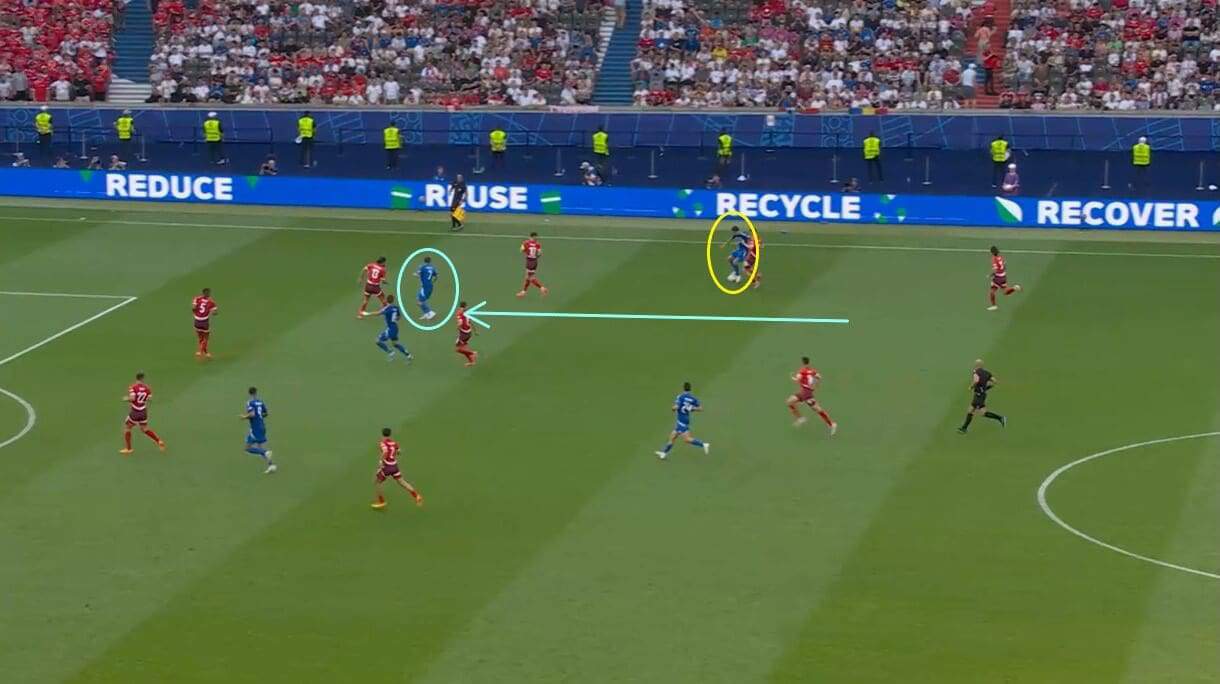
That theme of being proactive and trying to play forward earlier continues here, with Juventus winger Federico Chiesa in possession and having taken the ball into Switzerland’s half, and he has now stopped and is assessing his options.
Frattesi has recognised this and so has made an underlapping run to give his teammate a way to retain the momentum that they have built up until now.
Still, Chiesa either doesn’t see him or doesn’t think he is a viable passing option, so he holds onto the ball too long, allowing Michel Aebischer to close him down.
As a result, Frattesi is left frustrated, and it was a situation in which he could have run through to shoot at goal, with the fact that he averaged 4.37 touches inside the penalty area per game and won 50% of his offensive duels (including three out of four against Croatia) showing that he constantly wanted to get into forward areas when on the pitch.
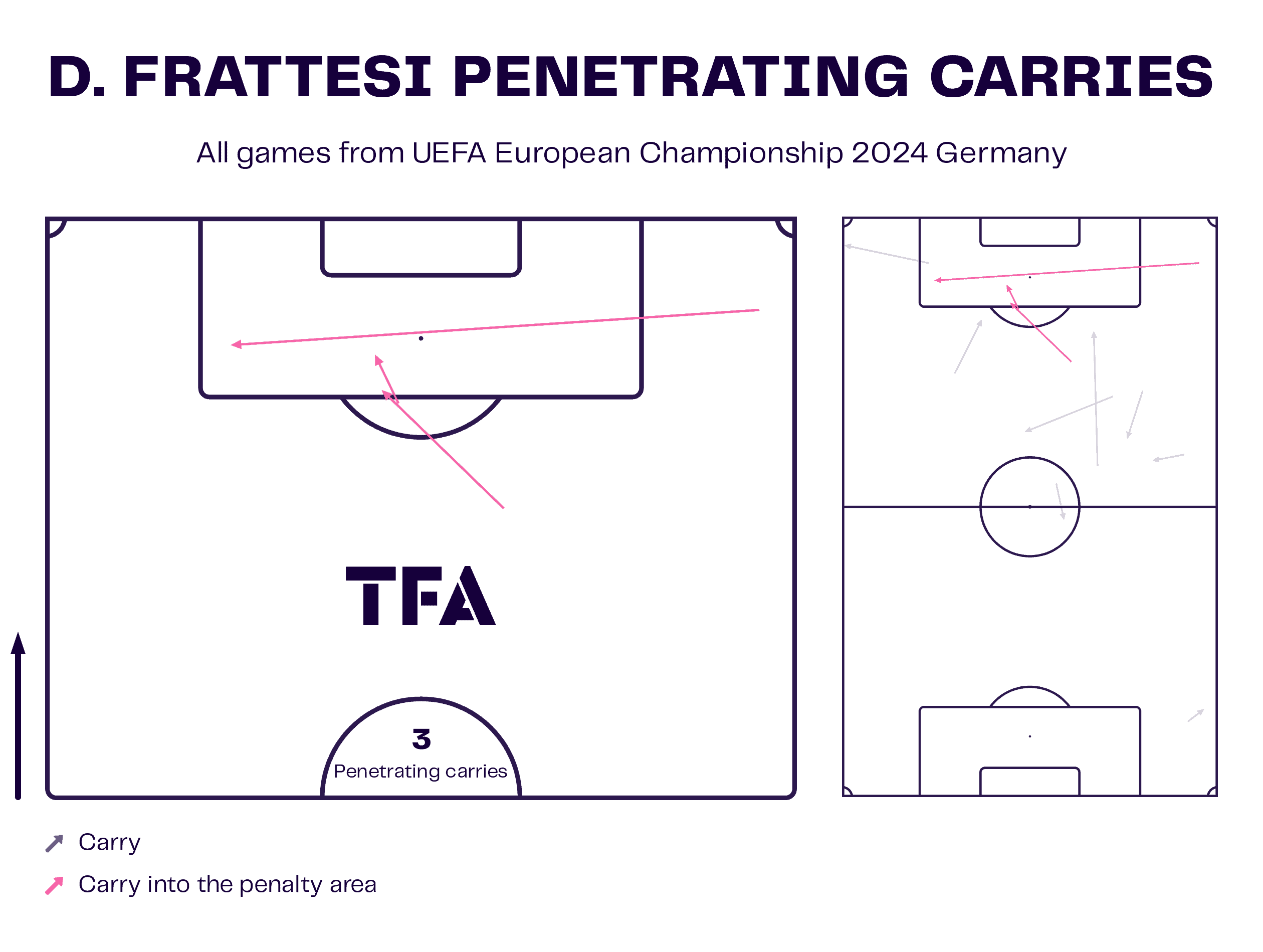
This is clearly highlighted by the penetrating carries he made, with not many for various reasons, but enough to show that Frattesi’s instinct was always to play forwards and to try to instigate attacks.
For this reason, not including him for longer periods of Italy’s time in Germany raised a few eyebrows, and the fact that they were largely bereft of any quality and desire meant that his individual performances might have gone slightly unnoticed.
Kristjan Asllani Scouting Report
It is no revelation to say that Inter Milan have a wealth of talent available to them at this moment in time, and another who has really caught the eye at Euro 2024 is Kristjan Asllani.
Turning out for his native Albania, he might have seen his time in the competition end at the conclusion of the group stage, but there is no doubt that he made an impact and played a crucial role in ensuring that Sylvinho’s side was not there to simply make up the numbers.
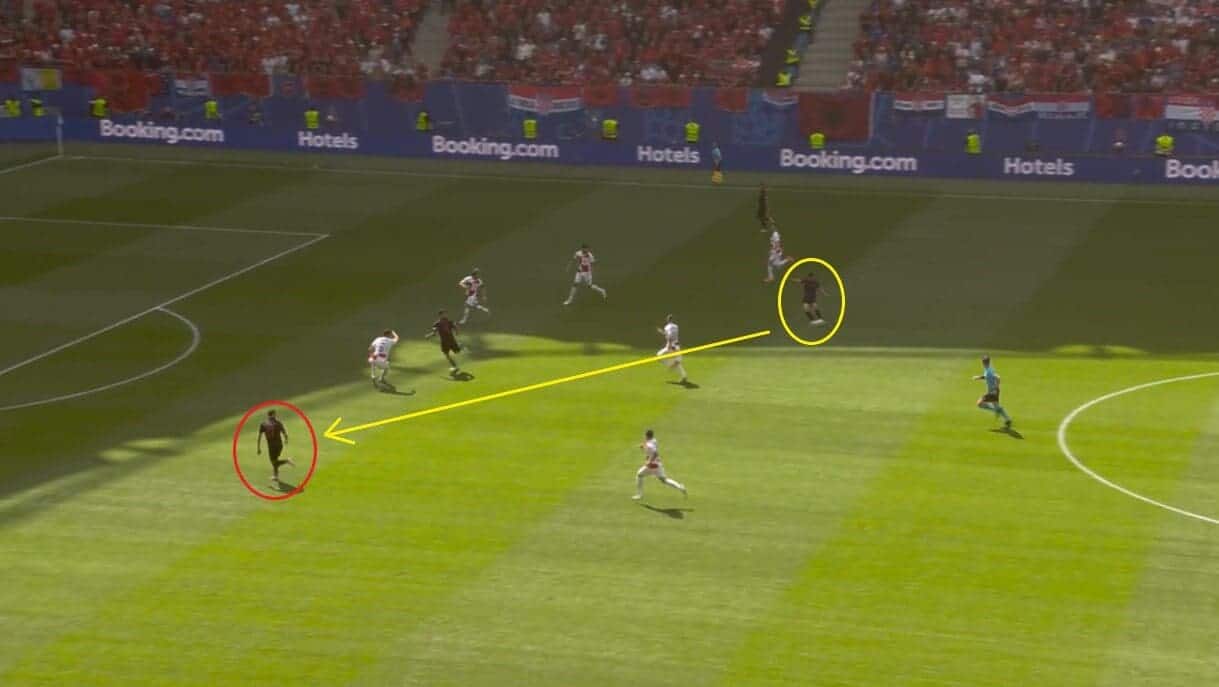
It was clear from the outset that Albania would base their play around absorbing pressure before hitting their opponents with well-executed counterattacks, and this strategy proved difficult to set up against and dangerous to underestimate as the games went on.
What made it so compelling was the way their players alternated between roles, with the midfielders and forwards, in particular, rotating whenever they were in promising positions, ensuring they never became too predictable.
Therefore, they saw their attacks cancelled out prematurely.
In this case, Asllani has taken up the role of the outlet at the top of the field, having got forward and spotted the open space on the near side of the Croatian defensive line, which shows he has good awareness of his surroundings and can react to chances to exploit opposing weaknesses.
With him now in a position to punish Croatia for not getting back quickly enough, all that remains is for Jasir Asani to send the ball into his path in a typical diagonal fashion, and he is then able to get a shot away at goal.
It might not have led to anything on this occasion, but the decisiveness that he demonstrated and the desire to help his team here highlight why he was so important to Albania during their time in Germany.
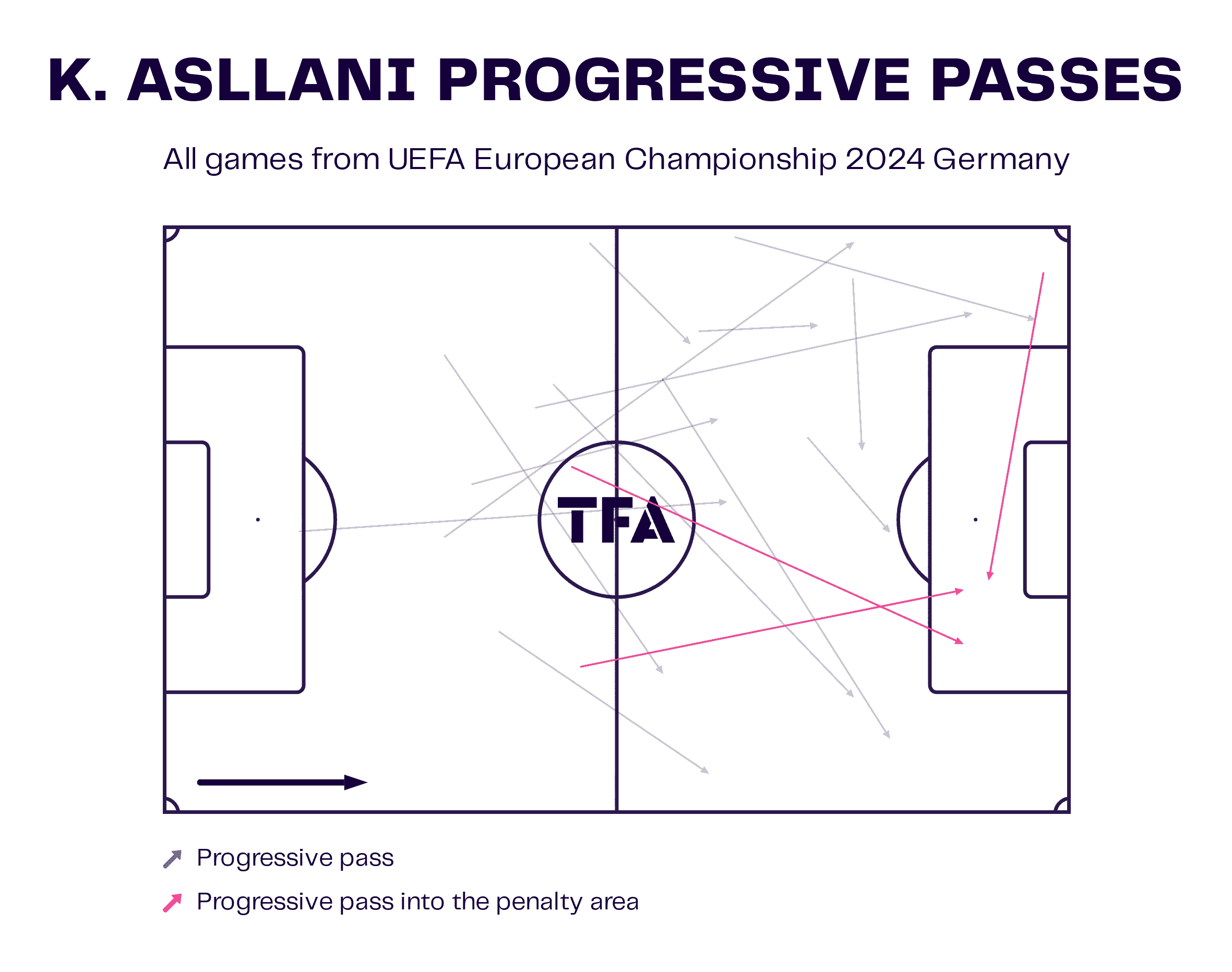
It was mentioned that Albania wanted to play with a degree of role rotation, meaning there would be times when Asllani would need to be the creator rather than the finisher.
However, as this graphic highlights, this has rarely been an issue for him and has instead enabled him to demonstrate another side to his game.
It is evident that he is capable of making precise passes and connecting the dots for his team (his passing accuracy in the tournament was highly commendable at 87%).
Therefore, regardless of the role he was required to perform, Asllani demonstrated the qualities needed to help his teammates play as effectively as possible, and that is why he was so critical to their hopes of making it into the knockout stages.
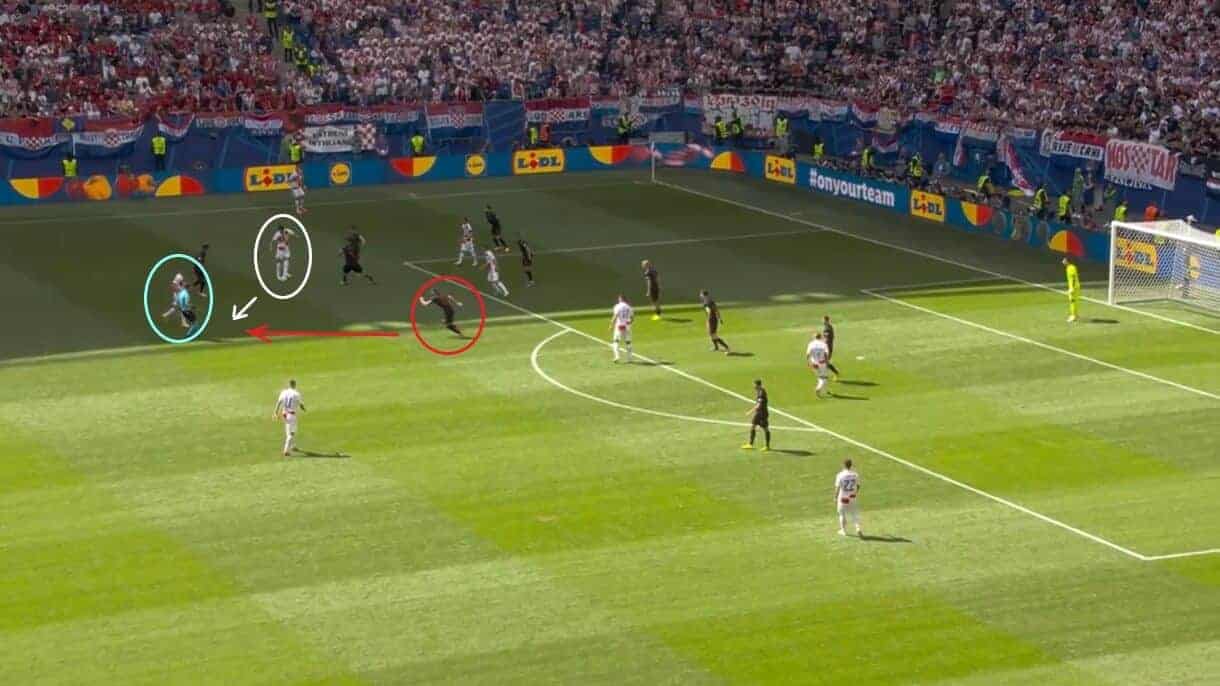
That desire has been shown in other ways, too, such as earlier in the build-up to those chances before Albania looked to break out of their third.
In this case, they have numbers behind the ball, and it appears as though they are being passive and allowing Croatia to have possession, but what is actually happening is that they are continually watching and waiting for a chance to make an interception.
Asllani really typifies that through his anticipation.
He spots a chance here to instigate a press, with Manchester City duo Joško Gvardiol and Mateo Kovačić playing a one-two, but unaware of what is happening ahead of them.
As a result, Asllani wins the ball, and Albania has a chance to get on the front foot and relieve some of the pressure they had been under.
It is no surprise that, given how he timed his run here, he recorded 2.44 interceptions per game during his team’s time at the tournament and succeeded in 55.6% of his defensive duels.
This is another reason he should be included as a player who stood out but perhaps didn’t gain the notice his efforts merited.
Jaka Bijol Scouting Report
One team that did gain a lot of positive attention was Slovenia, which made life constantly tough for opponents by sitting back and limiting clear-cut chances to score against them.
That solidity was epitomised by the central defensive duo of Jaka Bijol and Vanja Drkušić, and the former is certainly one to keep an eye on this summer as he, too, has been subject to some transfer speculation as a result of the quality of his performances.

What made Bijol such an immovable object was his ability to read the play and constantly react to what was happening around him.
This was most prominent during his team’s Round of 16 match against Portugal, when he worked tirelessly to thwart the former European champions’ attacking opportunities.
This situation highlights how difficult he was to beat at times, with him recognising the threat posed by João Cancelo and seeing that Panathinaikos midfielder Adam Gnezda Čerin has moved out to close him down.
As a result, his attention has now turned towards the next phase of the attack and what might happen next, with him waiting to see if the ball will go loose when Portugal look to move it inside the pitch and into a position from which they can shoot at goal.
On this occasion, he gets out to the ball as soon as it travels infield and wins it before it can reach the feet of Liverpool forward Diogo Jota, giving his team an opportunity to clear their lines.
He might not have gotten too far this time, with Jota quickly recovering to tackle him early in his run up the pitch, but there is no doubt that Bijol’s presence and ability to disrupt Portugal’s play was critical in the game going all the way to a penalty shoot-out.
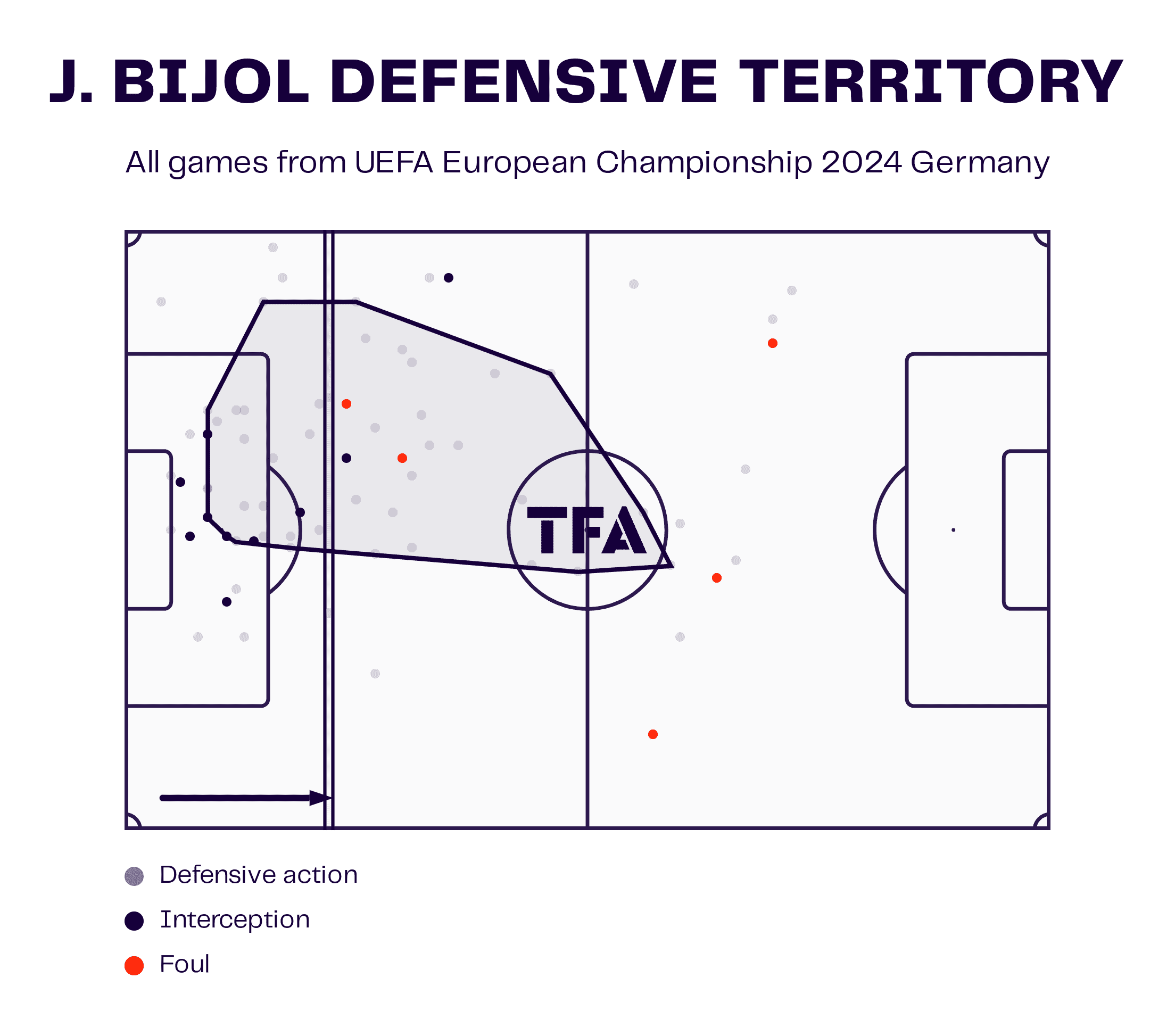
This graphic clearly indicates his role in making Slovenia so watertight.
It is clear that Bijol made a number of contributions further up the pitch, but there is a high concentration of defensive actions and interceptions in his own goal area.
It is also worth noting that he didn’t commit a foul inside his own goal area; the goals were conceded further out, which again shows how everything he did was based on timing and being in the right place to break the opponents’ play up.
Considering that he succeeded in 77.4% of his defensive duels, 50% of his aerial battles, and intercepted the ball 4.86 times per game as the tournament went on, Slovenia certainly benefited from having the Udinese player in their ranks.
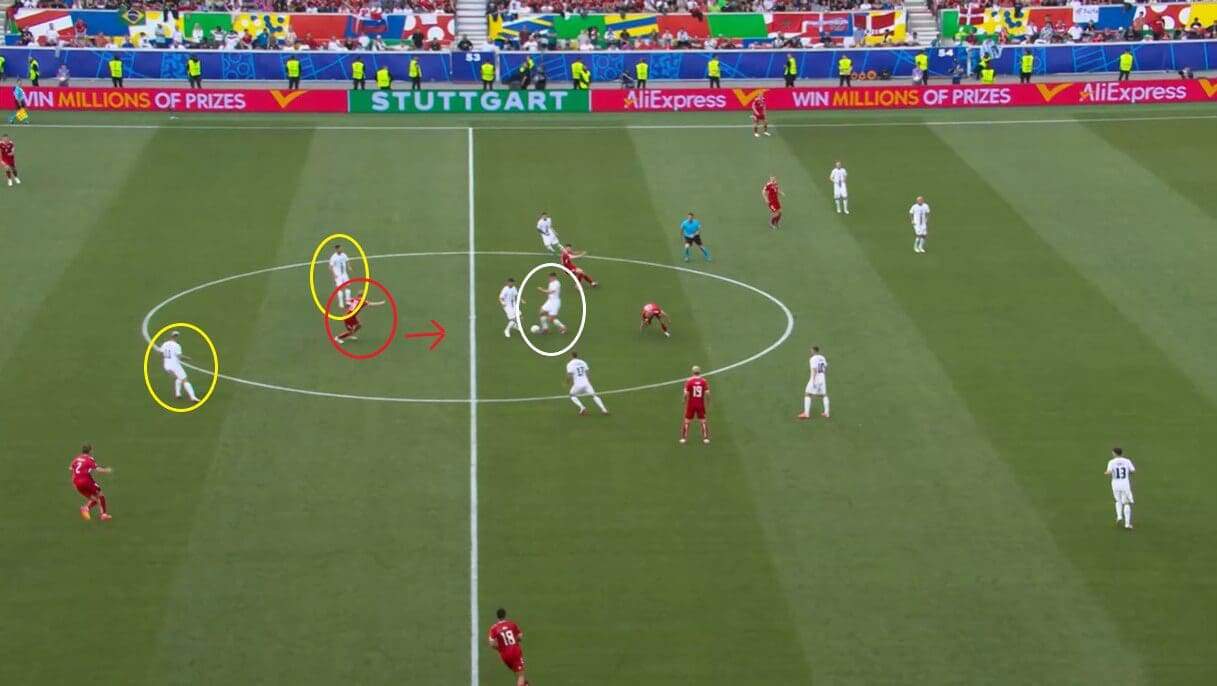
This is not to say that everything in Bijol’s game is perfect, though.
One thing he perhaps needs to improve on is the next phase once he regains the ball.
When he has time to pick out a pass, he generally plays with precision, and the fact that he registered an impressive 82.9% passing accuracy shows how he can find teammates in different areas of the pitch whenever the ball is at his feet.
It is the moments when space has been more constricted that he has occasionally struggled in, with him intercepting the ball here as Denmark forward Yussuf Poulsen tries to find Christian Eriksen and having both Benjamin Šeško and Andraž Šporar ahead of him, and all he needed to do was to poke the ball forward towards either of his teammates.
However, he holds onto the ball for a fraction of a second too long, allowing Poulsen to close him down, which meant that a chance to get Slovenia onto the front foot was squandered.
With Inter Milan and Nottingham Forest reportedly interested in signing him this summer, Bijol will need to tighten up on this aspect of his play if he is to become a more complete defender.
However, there is certainly a lot to like about what he did at Euro 2024, and he fits the category of those whose efforts perhaps have not been discussed as widely.
Georges Mikautadze Scouting Report
When major tournaments come around, the main conversation tends to centre around key names who could stand out as the matches go on.
However, whilst there was the inevitable debate over whether France’s Kylian Mbappé or Portugal’s Cristiano Ronaldo would have the more prosperous tournament this time around, it is another striker in Georgia’s Georges Mikautadze who has stepped up to be one of the leading marksmen.
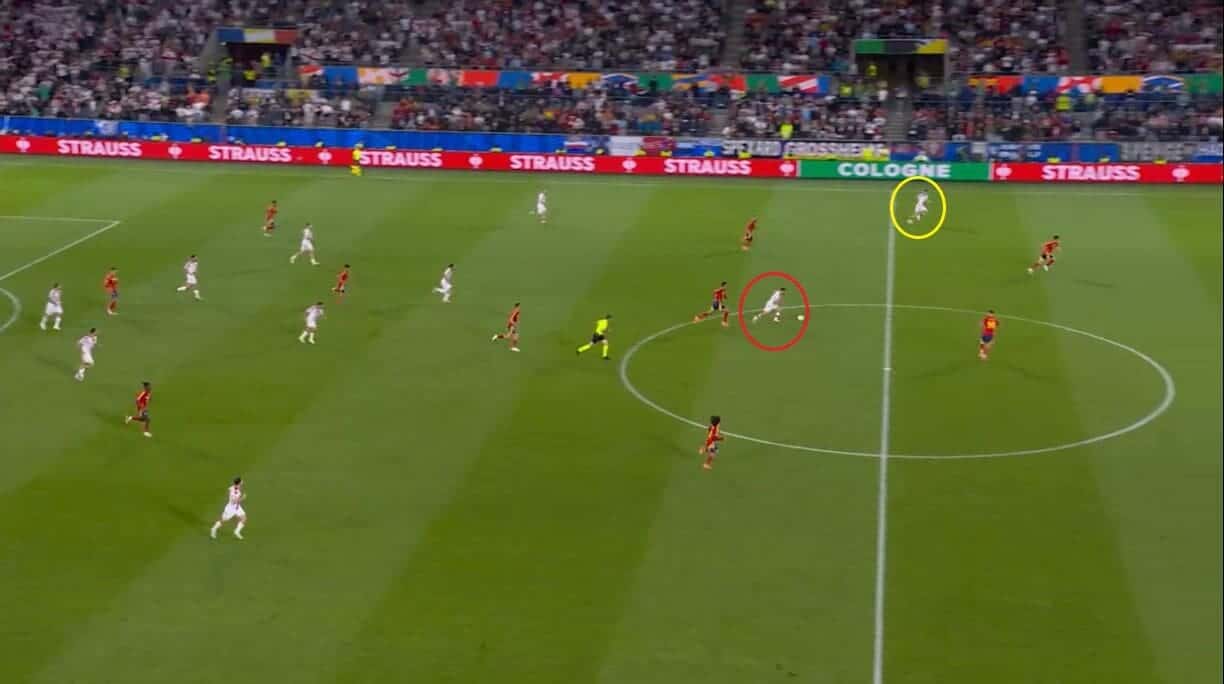
The key thing about the Metz striker, though, is that he has not often appeared to be the main focal point for his team.
Instead, he operates in a more mobile role and works hard to allow others to flourish.
This is because Georgia wants to get Napoli winger Khvicha Kvaratskhelia on the ball as often as possible and use his trickery to turn opposing defenders inside and out.
This has created quite a fluid dynamic in Georgia’s attacking play, and this situation against Spain highlights it well.
Kvaratskhelia is ahead of Mikautadze and serves as the main outlet, while the latter drops back to get the ball and move it into his path, playing a supporting role and giving Georgia an element of unpredictability in the final third.
However, this is not the only way in which Mikautadze has worked to give those around him the chance to get into areas where they can work their magic, with there also being situations when he has made runs off the ball that have manipulated defenders into leaving gaps open and giving the likes of Kvaratskhelia opportunities to play more centrally.
It is this that has made him such a key player for Georgia to have on the field, and yet someone who has not often got the credit that he has earned.
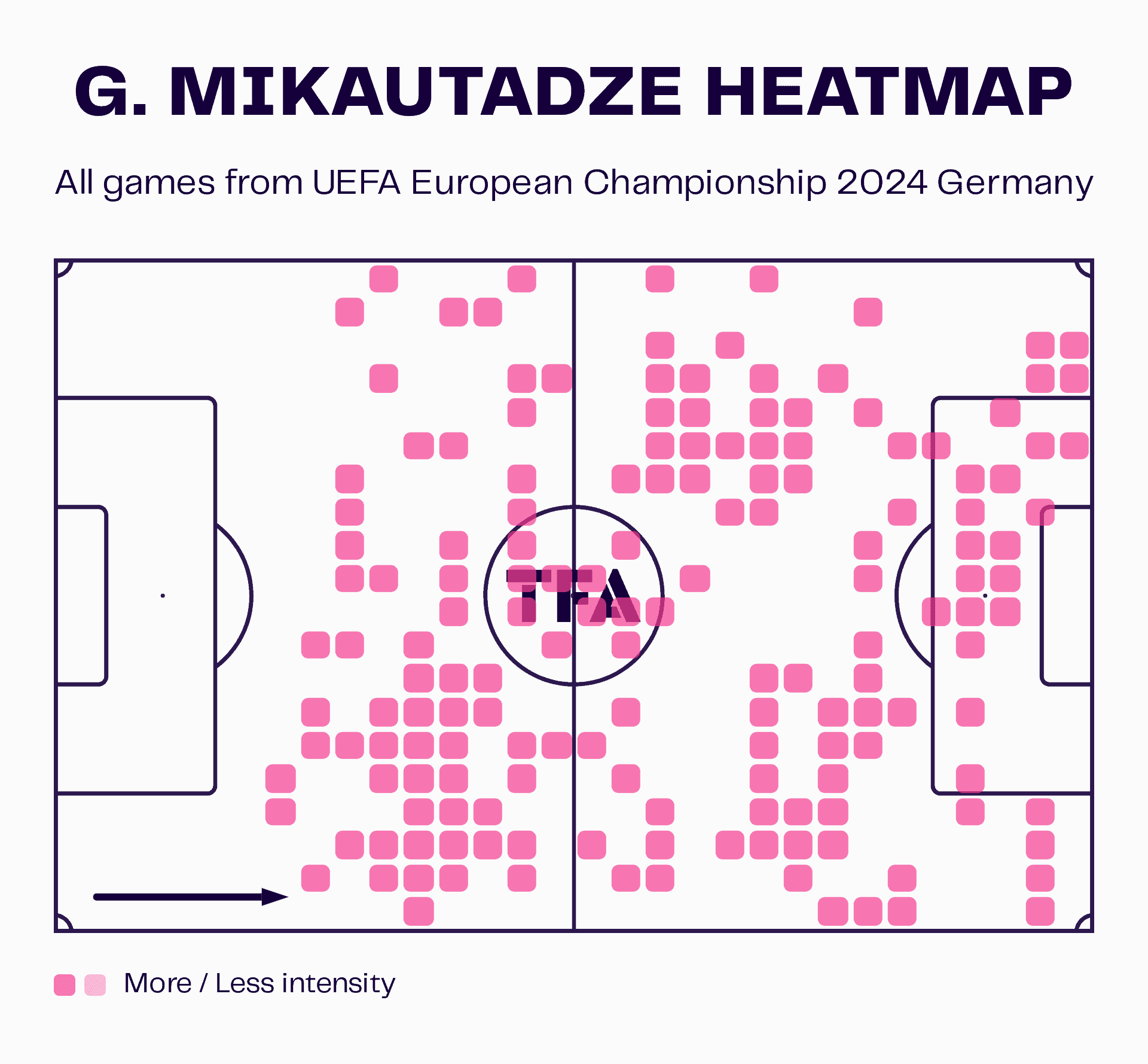
This graphic shows how much of the pitch the striker covered as Georgia’s time at Euro 2024 went on, and it is immediately apparent how he is far from being just a target player.
In fact, he has averaged only 1.94 touches inside the penalty area per game whilst in Germany, which highlights how little time he has spent in the leading goalscoring positions and how often his role has been to create space for others to move into.
With him registering an 83.1% passing accuracy, his teammates knew that he would be able to find them whenever he got on the ball in deeper areas, and they moved around him.
This, therefore, highlights how crucial he was to Georgia, implementing their free-flowing style of play and consistently testing opponents.
This does not detract from his ability to take matters into his own hands, though.
The fact that he still sits joint-top of the goal standings at the time of writing with three goals (as well as one assist) shows that his threat should not be looked down on.
When breaking down what has made him so dangerous to leave in open spaces, it comes down to the same anticipation and ability to read the game that has been apparent with all of the players listed in this scout report.
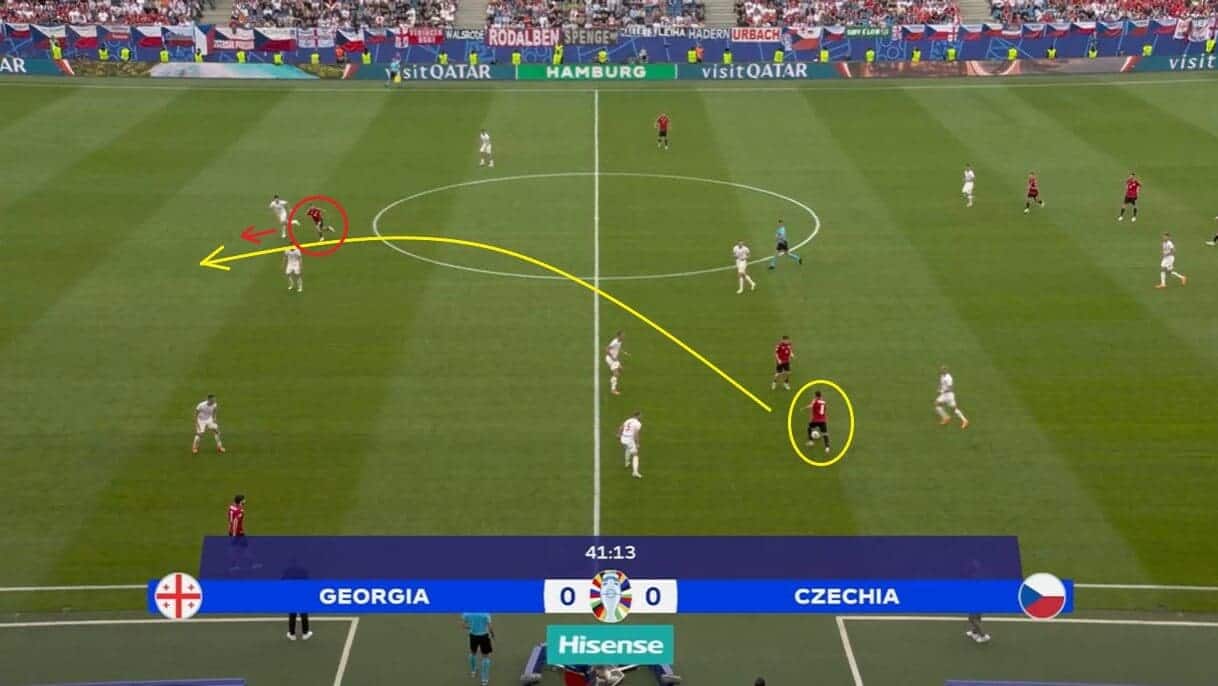
Here, he has seen the amount of unprotected territory that the Czech Republic have left open behind their high backline and so has moved to exploit it for his own gain.
It then comes down to him timing his run to perfection to ensure that he doesn’t waste the well-weighted long ball sent towards him by Levante’s Giorgi Kochorashvili.
It might not have led to a goal on this occasion.
Still, it highlights that Mikautadze is just as important a player for Georgia when running through on goal as he is when dropping into pockets of space to connect the play.
He does more than some might credit him with, which is why he has been included in this analysis.
Conclusion
In conclusion, this tactical analysis has looked in detail at five players who have starred at Euro 2024, even though they did not necessarily go deep into the tournament, and who have been crucial to their teams’ play as the weeks have gone on.
Whilst all five have put on some very strong performances, what they share is that they are likely to have gone unnoticed at times, performing thankless roles for their teams or offering qualities that have not been as well utilised as they could have been.
Undoubtedly, major tournaments are about watching the best of the best clash in the quest for silverware, and seeing the highest-ranked sides face off against each other will always attract swathes of attention.
However, they are also about marvelling at the abilities of those who perhaps haven’t attracted as much attention before the tournament began, and yet have put on performances to remember.
Euro 2024 has certainly provided plenty of those, with fans having great memories of outstanding displays and an idea of who to look out for in future outings.
