
Germany started their FIFA World Cup qualifier campaign with a disappointing defeat away to Slovakia.
However, they bounced back with a 3-1 victory against Northern Ireland.
Julian Nagelsmann altered his lineup and formation from the previous game, which ultimately yielded him the three points.
Going from a back four to a back three was beneficial for the hosts as Serge Gnabry broke the deadlock only after seven minutes.
There was a period of distress as Northern Ireland equalised through Isaac Price in the 34th minute.
The introduction of Nadiem Amiri played out in Nagelsmann’s favour, as the attacking midfielder scored in the 69th minute to put his side ahead.
This was right before Liverpool star signing Florian Wirtz scored a wonder free kick at the 72nd minute mark.
This win means that the Germans are back on track in their World Cup qualification hopes.
Through this tactical analysis, we aim to understand Julian Nagelsmann Germany tactics to defeat Northern Ireland.
Germany Vs Northern Ireland Lineups & Formations
Let us have a look at how Julian Nagelsmann and Michael O’Neill fielded their squads.

The ultimate winners, Germany, played in a 3-4-3 formation.
Oliver Baumann started between the sticks, with a back three of Antonio Rüdiger (right centre-back), Waldemar Anton (central centre-back), and Robin Koch (left centre-back).
Rüdiger was replaced by Jonathan Tah after 82 minutes.
The midfield had Jamie Leweling (right wing-back) and David Raum (left wing-back) as the wide players, and skipper Joshua Kimmich and Pascal Groß as the centre-midfielders.
Groß was taken off for Leon Goretzka at the 66th minute.
The front three consisted of Serge Gnabry (right winger), Florian Wirtz (left winger), and Nick Woltemade (striker).
Gnabry was subbed off for Maximilian Beier, and Woltemade for Nadiem Amiri, both at the 61st minute.
Northern Ireland, meanwhile, played in a 3-4-2-1 formation.
Bailey Peacock-Farrel started as the goalkeeper, right behind a back three of skipper Trai Hume (right centre-back), Paddy McNair (central centre-back), and Eoin Toal (left centre-back)
Toal was taken off for Ruairi McConville after 88 minutes.
The midfield had Conor Bradley (right wing-back) and Justin Devenny (left wing-back) as the wide players, and Shea Charles and Alistair McCann as the centre-midfielders.
McCann was subbed off for George Saville at the 76th minute.
Ethan Galbraith and Isaac Price were the two attacking midfielders.
Both were replaced by Callum Marshall (76′) and Jamie McDonnell (88′), respectively.
Jamie Reid played as the lone striker and was replaced by Dion Charles for the last 20 minutes.
Germany Attacking Tactics
In this section, we will look at the attacking features of Germany’s play.
Germany Build-Up: Shape & Positioning
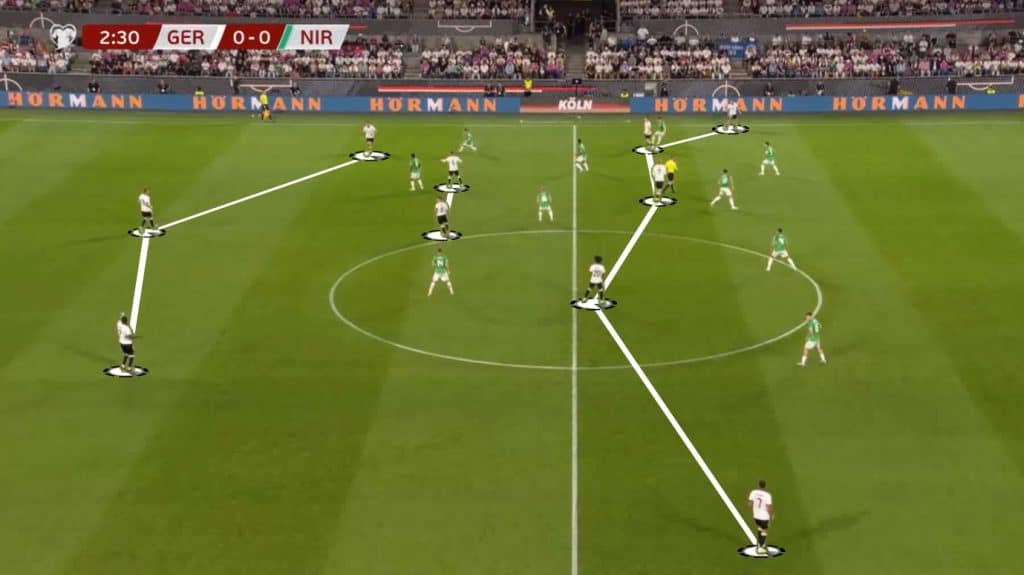
Germany carried out their build-up in a 3-2-5 shape.
Kimmich and Groß stayed as pivots, while Leweling and Raum pushed high to make a front five.
Meanwhile, Gnabry and Wirtz played more centrally.
Since Northern Ireland had a narrow frontline in the press to prevent passes to the German pivots, this allowed ample space in the wide areas for Germany’s wide centre-backs.
This setup also naturally opened the passing lane from the wide centre-backs to the wing-backs.
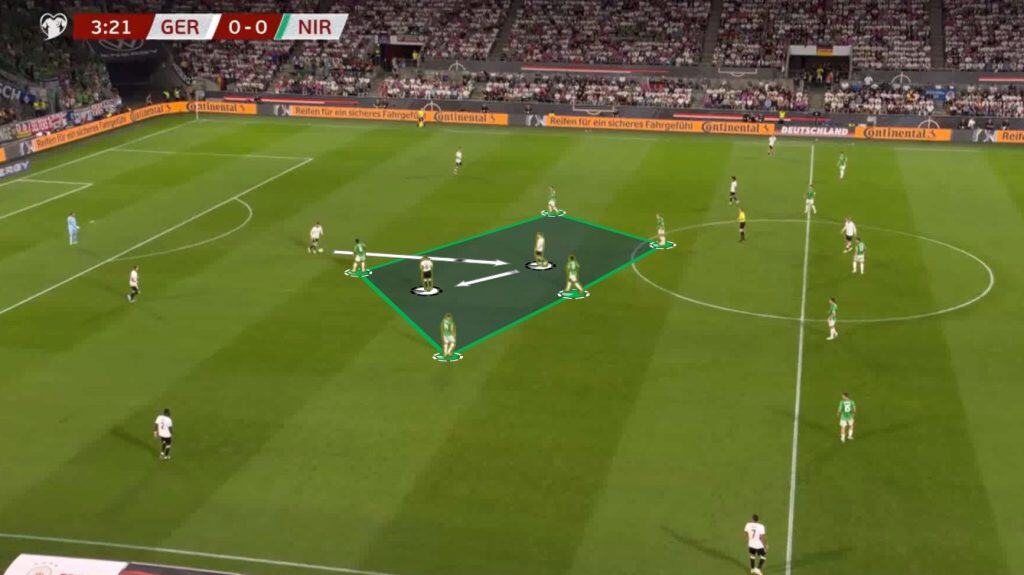
The pivots (Kimmich and Groß) positioned themselves staggered to ensure the passing lanes were open.
This also helped them set the ball for each other at times when there was not enough space and time to receive on a half-turn.
In the example shown above, Groß receives from the centre-back and sets it for Kimmich, who is facing the play.
Both of them are inside the opponent structure; however, positioning in this way in relation to each other helped them in progression.
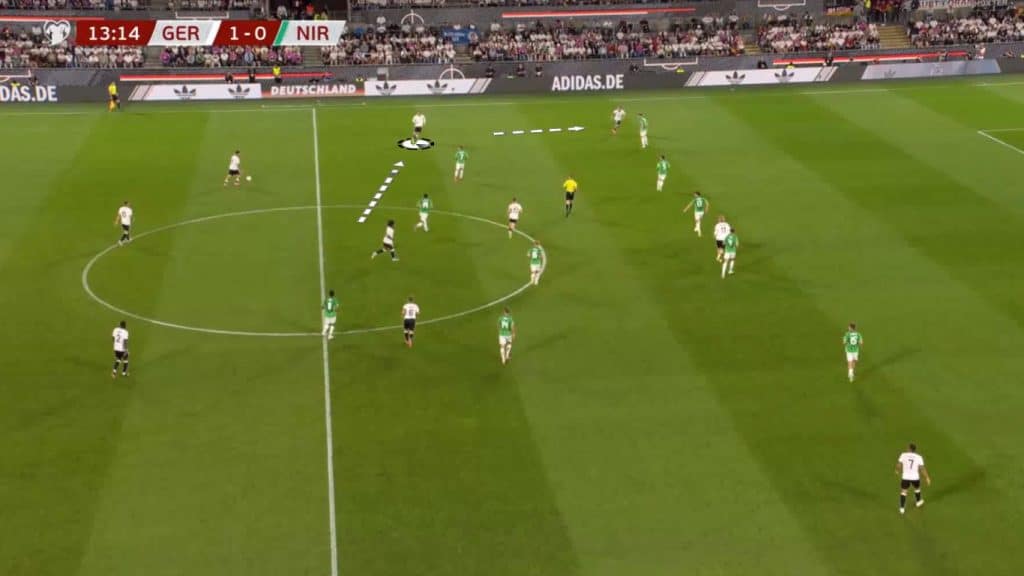
On occasion, one of the pivots (usually Groß) would drift wide to receive outside the opponent’s structure.
This also allowed the wing-back on that side to push higher without the wide centre-back stepping up to leave his position.
In the image above, Groß peels out to receive from Koch (left centre-back).
This allows Raum (left wing-back) to position himself higher.
The more the pivots dropped outside the opponent’s structure, the more they got on the ball and controlled the tempo.
As a result, Germany had 80% of the ball possession and completed 679 passes, compared to just 115 by their opponents.
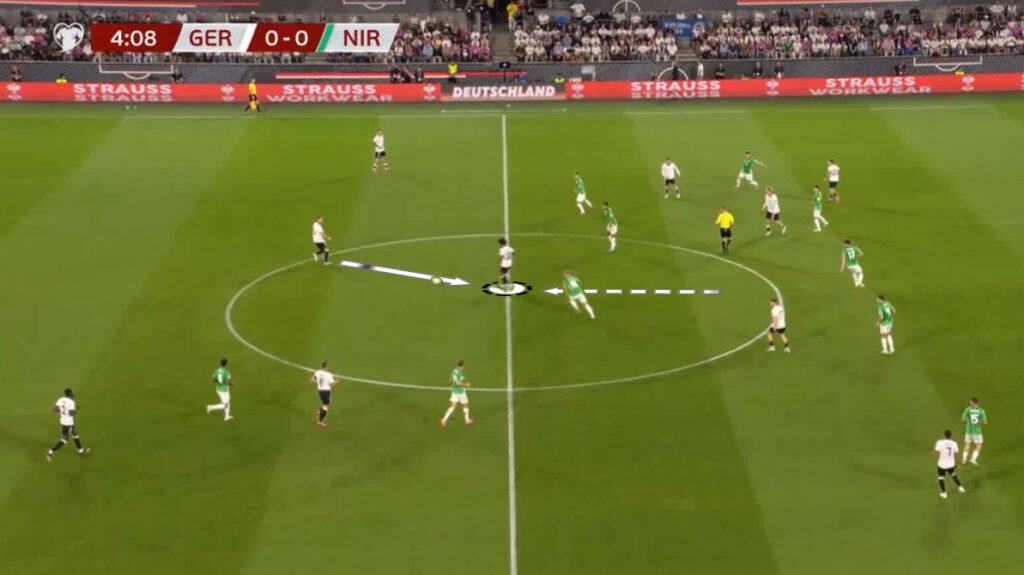
There were situations where the opponents closely followed both pivots, and the pivots had to move higher to open space for other players.
This is when the attacking midfielders Gnabry and Wirtz stepped in.
The duo took turns to drop outside the opponent’s structure to receive from the centre-backs.
Because of this, it was exhausting for the opponents to track the German midfielders.
Nagelsmann’s side, in turn, were able to take control.
Beating The Waves Of Pressure
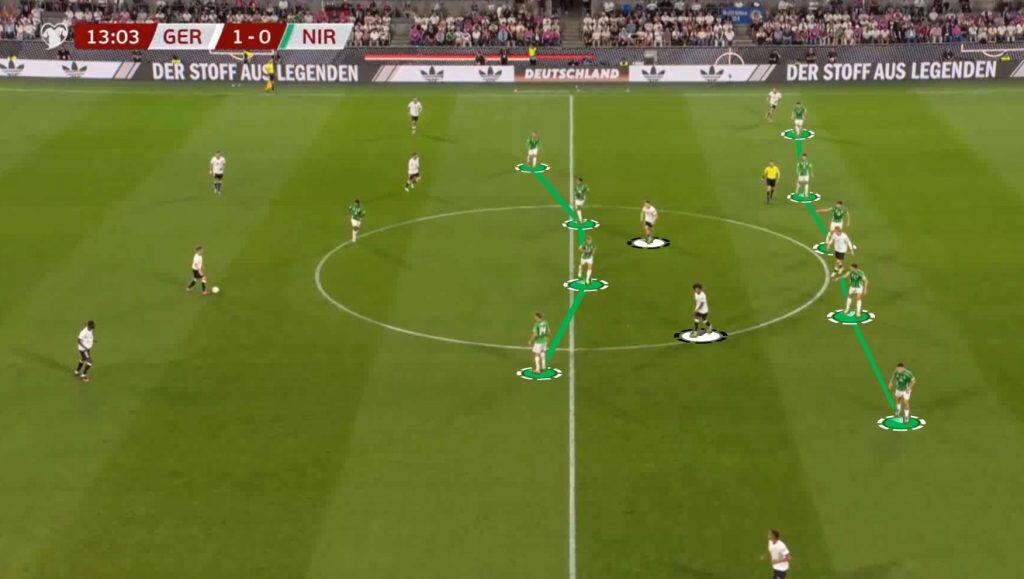
Germany were efficient in beating the first two lines of Northern Ireland pressure.
The attacking midfielders were a significant force contributing to this.
In the image above, we can see Gnabry and Wirtz positioned between the opponent lines of midfield and defence.
They frequently receive passes to create layoffs to wide players or central players.
There were also moments when they received on the half-turn and carried the ball forward.
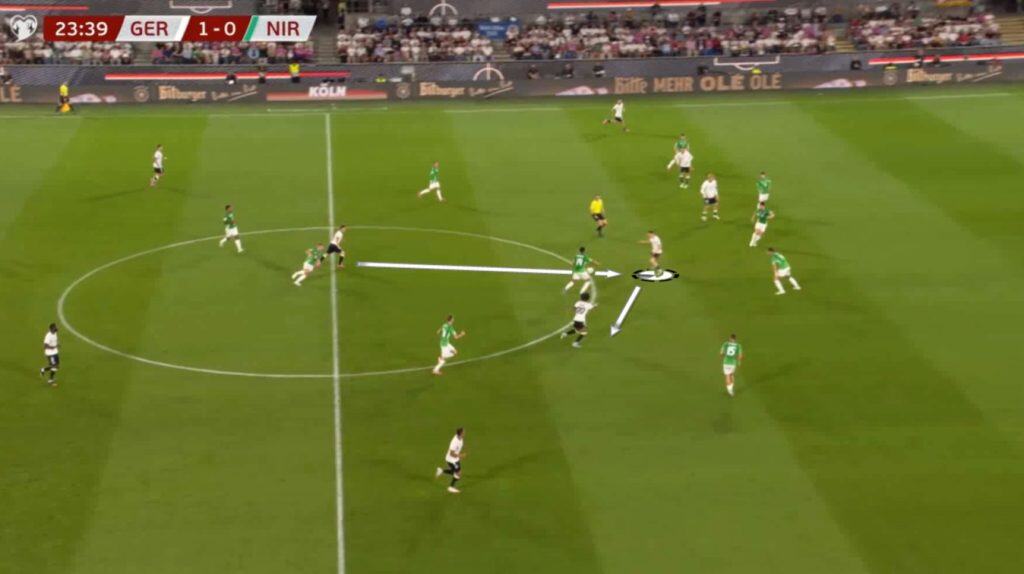
Here is an example of Wirtz receiving between the lines.
As he is receiving with his back to goal, he sets it to Gnabry, who is facing the goal.
These are situations when Germany can hurt their opponent with killer passes.
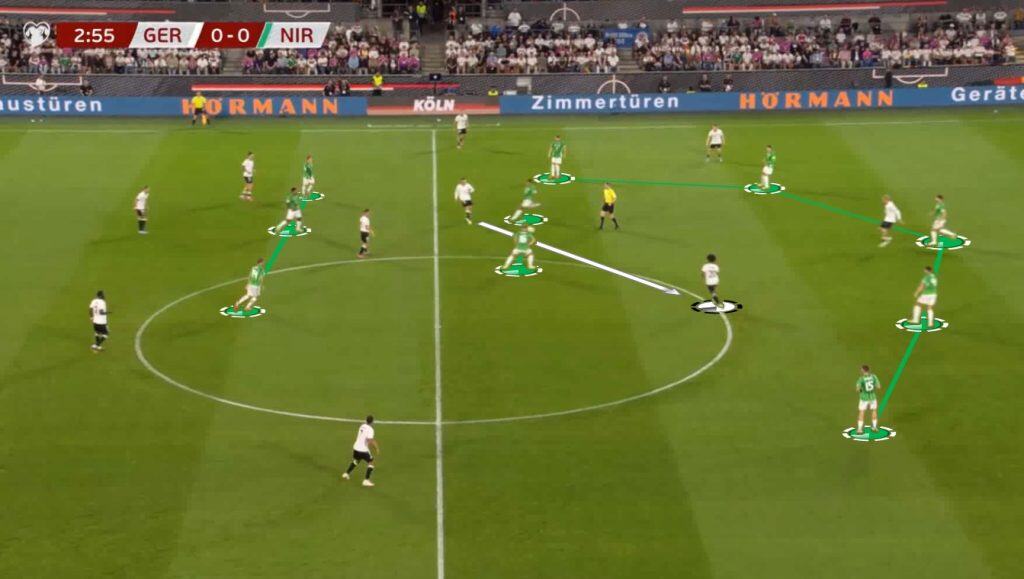
Here, Northern Ireland leave plenty of space between the lines.
Gnabry receives with an open body shape and starts driving at the Northern Irish defenders.
Actions like this create opportunities for link-up play in the attacking third.
Nagelsmann’s side have reasonable potential to exploit these situations in the upcoming games.
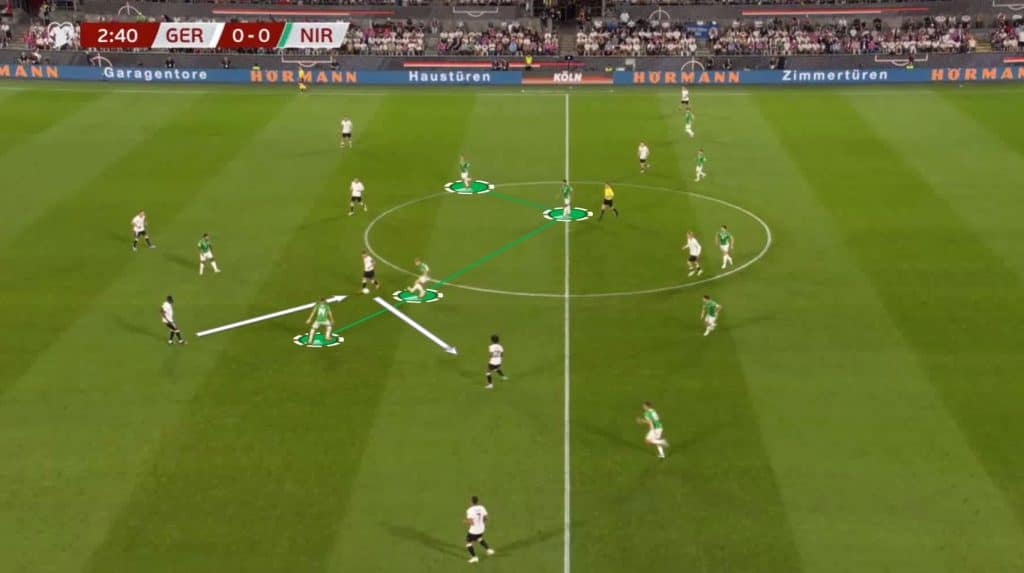
Germany were also seen playing clever third-man passes to break lines.
Here, Kimmich receives a pass from Rüdiger and connects to Gnabry on one touch.
This pass breaks the Irish midfield and enables Gnabry to immediately drive at the defenders.
Germany Half-Space Occupation
Once they reached the attacking half, the Germans showed notable action in the half-spaces.
The attacking midfielders in particular were active in these channels.
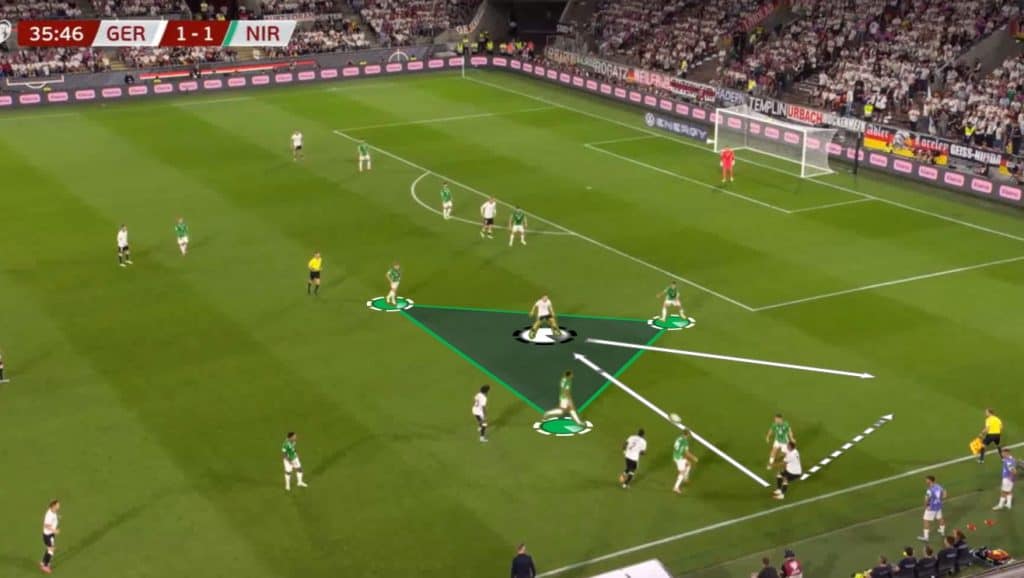
Here, we can see Wirtz combining with Leweling.
Although three opponents surround him, he is able to set the wing-back for a cross on one touch.
The hosts created these situations multiple times to either exit tight spaces or create overloads and attack in numbers.
This was the case for their own half as well.
The attacking midfielders dropped deep to help out in build-up moments.
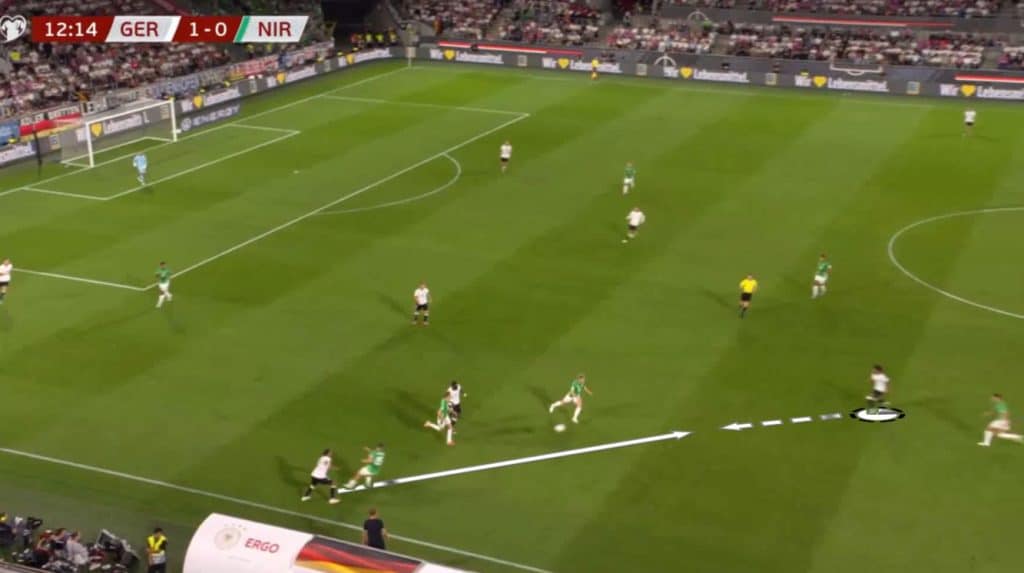
Here, Germany have the ball on the right flank.
Leweling is cornered by the opponents as Northern Ireland have a 3-v-2 overload.
Gnabry steps in to offer support.
Leweling plays the ball into the half-space, which Gnabry lays off towards Kimmich.
Through this simple combination, Germany get out of the tight area.
On occasion, Gnabry and Wirtz were seen operating in the wide areas.
During these moments, the wing-backs had the space to drift infield.
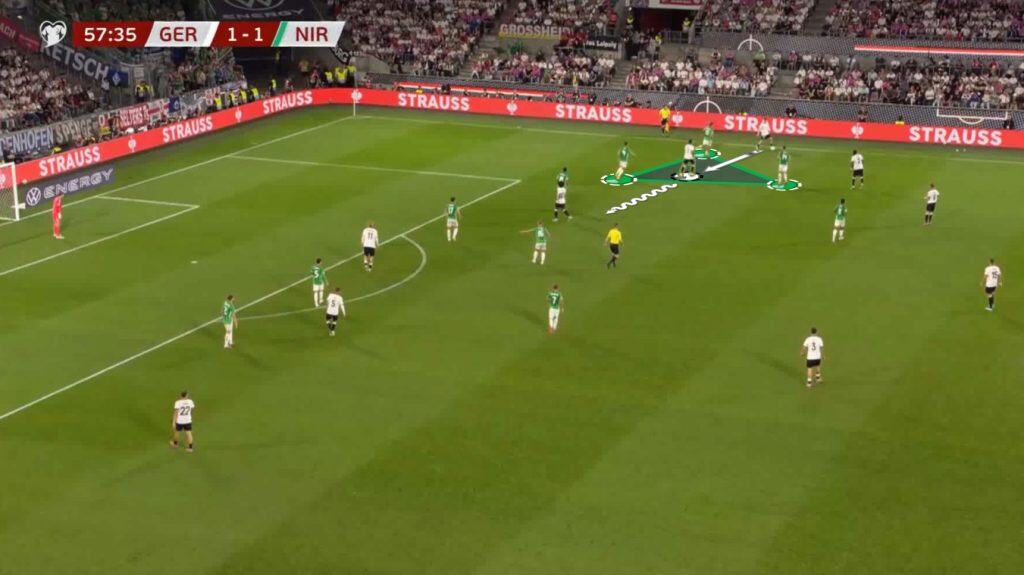
Here is an example: Wirtz receives on the right flank.
Meanwhile, Leweling occupies the half-space.
On this particular occasion, he receives to come inside and have a shot away.
These momentary positional rotations helped the German attackers lose their markers and exploit space.
This feature has considerable potential, even against stronger opponents.
Germany Runs In-Behind
The hosts were patient in the progression throughout the pitch.
They frequently shifted play before entering the final third.
There were multiple opportunities to exploit the space behind the Irish backline, which Nagelsmann’s attackers noticed.
The attacking midfielders and the wing-backs made sure to make runs to receive in-behind.
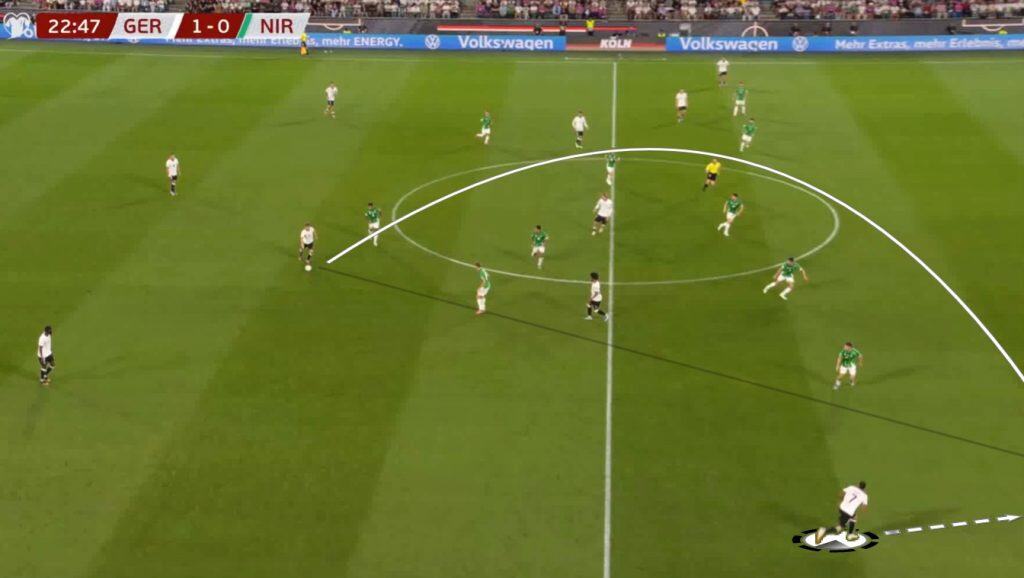
Here, we can see Leweling making a run in-behind.
As Germany shift play from the left to the right, space opens up behind Northern Ireland’s left wing-back.
This is quickly exploited as Kimmich plays a ball over the top into Leweling’s stride.
The move ends up in the wing-back playing a cross.
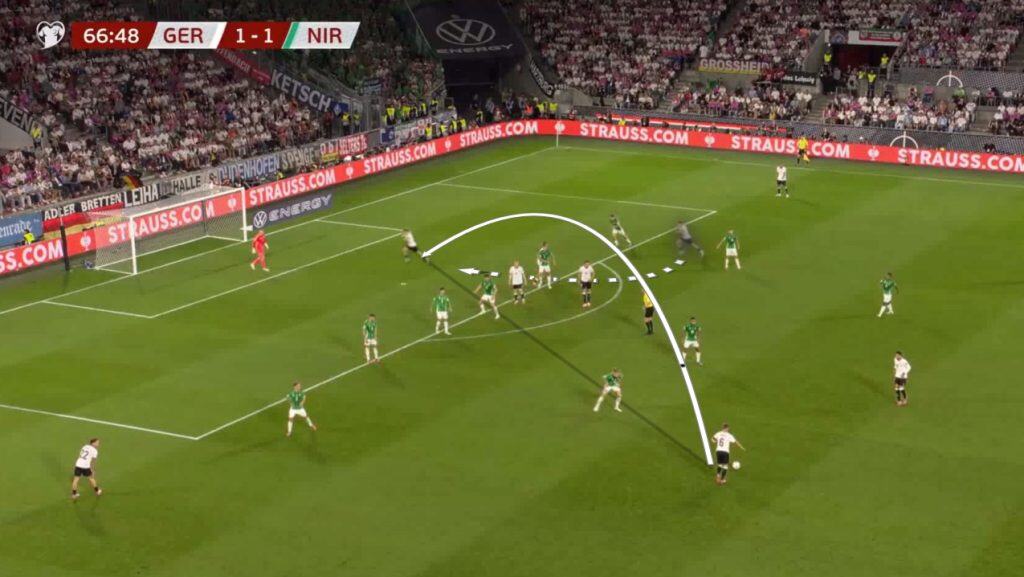
Here is another example of a run behind the backline.
This time, Wirtz makes a clever, curved run on the Irish centre-back’s blind side.
An inch-perfect chipped pass from Kimmich meets him.
This ends up in a shot, which the goalkeeper saves.
The goal scored by Nadiem Amiri also came from a run in-behind.
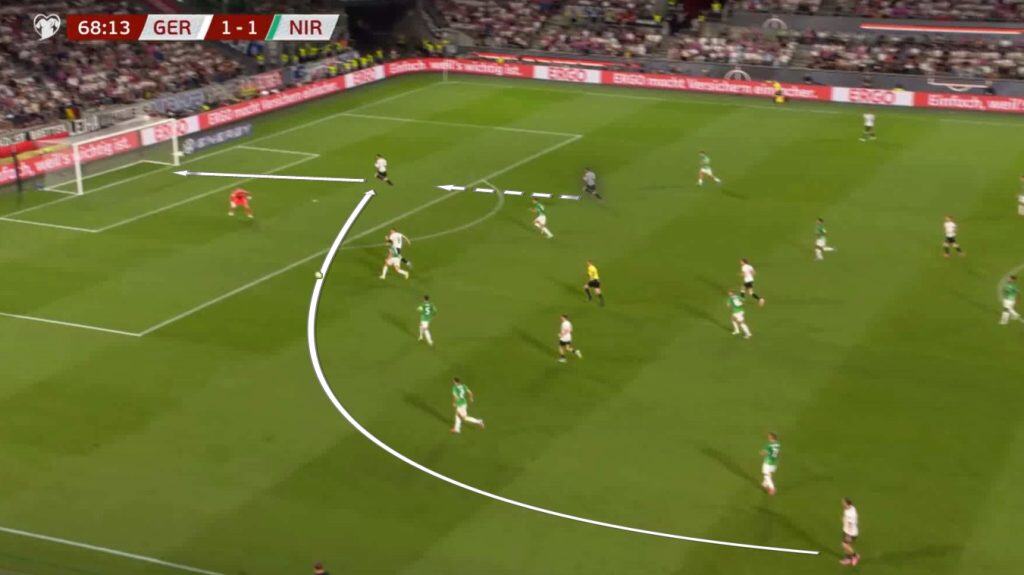
Raum played an early cross, exploiting the space behind Northern Ireland’s defence.
The goalkeeper misjudged the trajectory of the cross and was caught off guard.
Amiri, who ran onto his direct opponent’s blindside, reached the end of the cross to perform a comfortable one-touch finish.
Germany Defending Tactics
In this section, we will look at the defensive features of Germany’s play.
Defending In Opponent’s Half
One of the reasons why Germany allowed Northern Ireland only 20% of the ball possession was their tendency to counterpress as soon as they lost the ball.
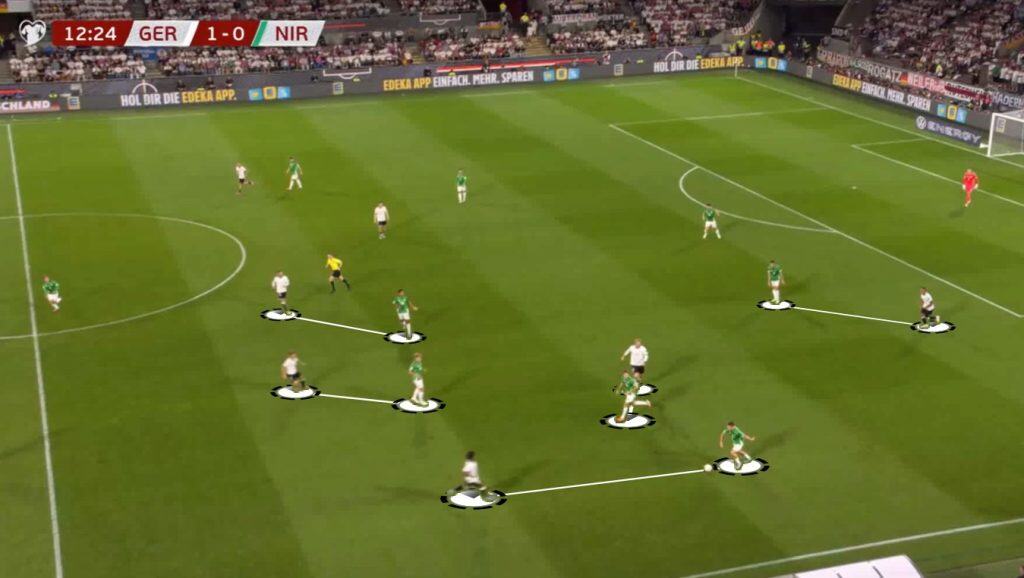
Here is a situation where Germany lost the ball in the attacking phase.
They immediately engaged numbers to counterpress and cut out all short options, forcing the Northern Irish side to play long.
Most of these situations forced the opponents to either play long or get dispossessed.
The Germans won 78% of their tackles and made 36 ball recoveries in total.
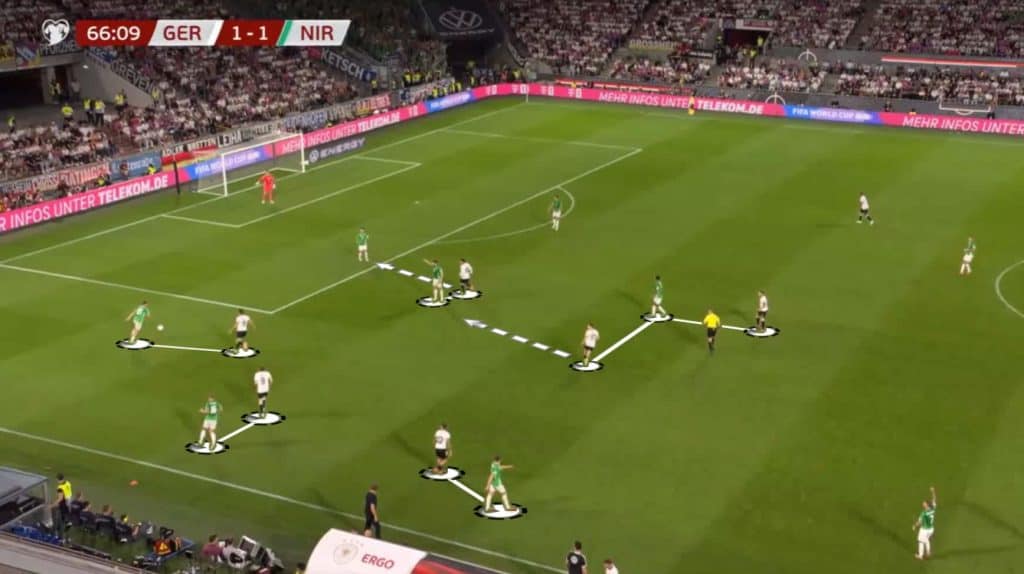
When pressing high from static starts, Germany made sure to press Northern Ireland with man-orientations.
In the image above, we can see that the hosts have blocked all short options, and are ready to higher if necessary.
During organised pressing actions, the wing-backs would push high and engage the opponent wing-backs.
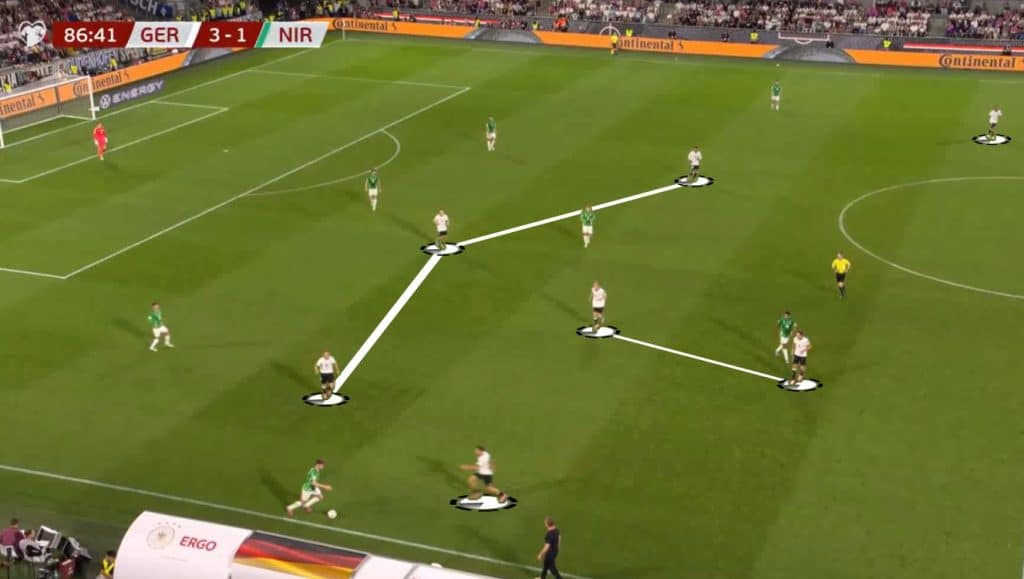
Here is an example for the same: The 2-3 shape is visible with the wing-backs stepping high.
In this particular situation, David Raum is pressing the opponent in the wide area.
The opponents were not able to exploit Germany in wide areas.
This was because they were proactive in sending numbers there.
In most situations, Germany had Northern Ireland outnumbered whenever the latter tried to attack from the flanks.
Defending In Own Half
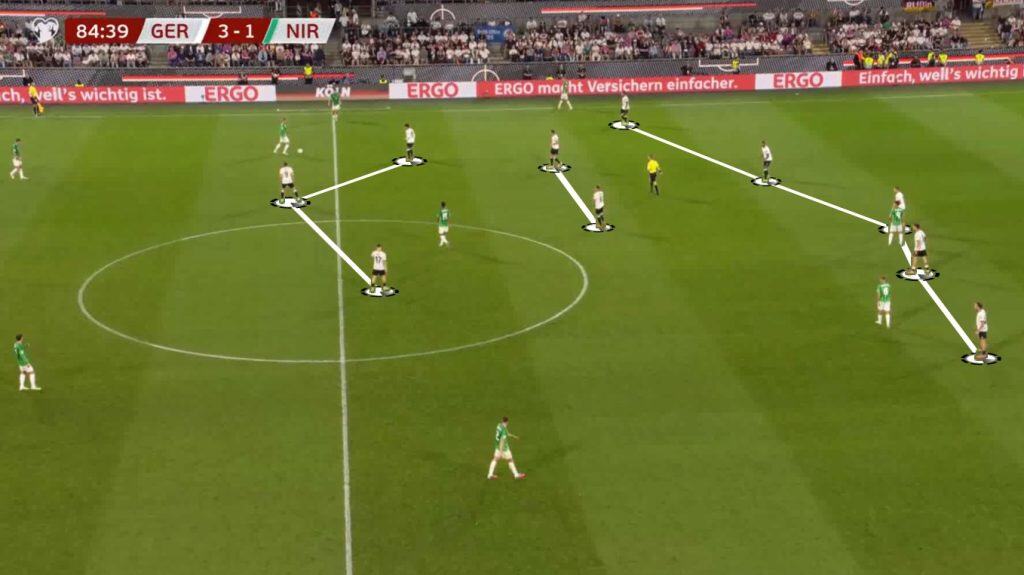
The moments of Northern Ireland carrying out an organised build-up were numbered.
However, when that happened, Germany defended in a 5-2-3 in their own half.
The wing-backs dropped to form a back five.
They locked the central channel by staying compact to block passing lanes.
Therefore, the opponents had to try to go around them.
However, whenever Northern Ireland got the ball high and wide, Germany squeezed them with numbers, forcing them backwards.
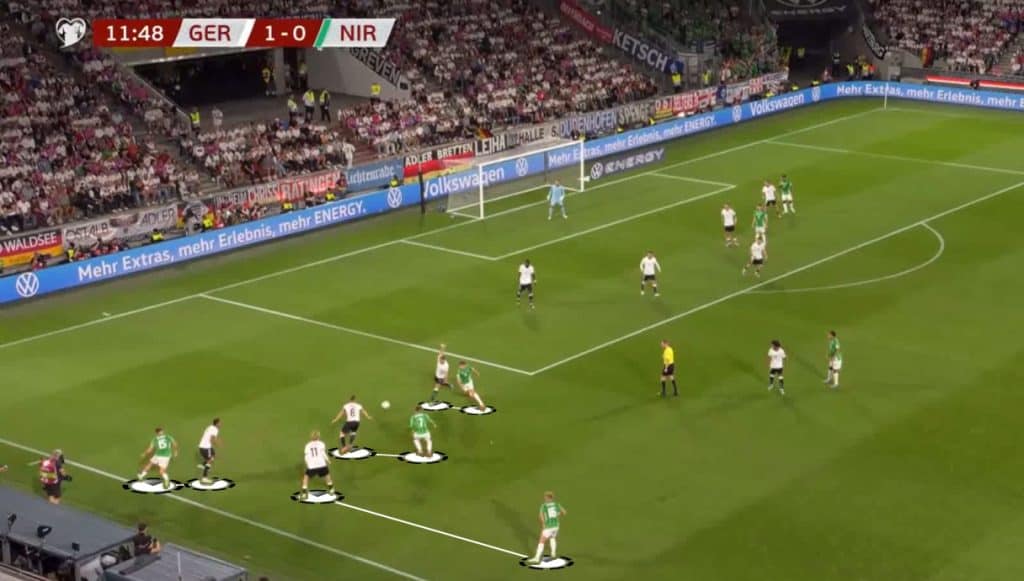
Here is an example of the same.
The Irish side are in possession in the wide area.
As they attempt to overwhelm the flank, the Germans match them in numbers.
Since the opponents fail to move the ball out of the tight area, Germany end up winning the ball.
Situations like these highlight Germany’s dominance in all areas of the pitch.
Conclusion
Germany were dominant in possession, moving the ball quickly to control the game.
They had superiority in build-up, operating with a back three and two pivots.
They beat the first two lines of press through staggered double pivot positioning, midfield rotation, and third-man passes.
On other occasions, they shifted play to release wing-backs in-behind.
In the attacking third, they found penetration through, crosses, runs in-behind, and cutting inside to shoot.
Defensively, the Germans were proactive, counterpressing as soon as they lost possession of the ball.
They squeezed their opponent in the wide areas to force mistakes, and were compact while defending in their own half.
Overall, they showcased dominance across multiple areas of the pitch, which indicated that the change in formation and personnel made a difference for Julian Nagelsmann.
