
During the 2019/20 season, Werder Bremen found themselves in deep trouble in the Bundesliga.
After a rough start to the campaign, the team struggled with numerous injuries and, consequently, struggled to achieve results.
They ended up in the relegation battle and did not have a lot of players healthy enough to train.
Then, coach Florian Kohfeldt needed to bring youth players from the academy into training.
He decided to bring up a German youth international, Nick Woltemade, to fill out his practice squad.
Woltemade, born in Bremen, has been in Werder’s academy since he was eight years old.
He impressed the coach and got his first Bundesliga start in February 2020 against Augsburg, making him the youngest player to play for Werder Bremen at that point in their rich history.
However, the young attacker struggled with injuries and getting playing time at Werder for the coming years, which is why the club decided to loan him to 3. Liga to SV Elversberg.
Woltemade’s ascent began in Elversberg.
With 27 goal contributions in 35 games, Woltemade was one of the main reasons for Elversberg’s promotion at the end of the season.
After returning to his boyhood club, Woltemade was still not happy with the playing time and trust Ole Werner gave him.
In the summer of 2024, his contract expired, and he left his home to sign with VfB Stuttgart.
The 1.98m tall Woltemade’s start was bad, however.
He was left out of the UEFA Champions League squad and struggled to secure playing time again, but since November, he has been a starter for Stuttgart, currently boasting 11 goals and three assists in 23 games for the Swabians.
In this scouting report and player analysis, we will examine what makes Woltemade so special, identify his strengths and weaknesses, and outline areas where he needs to improve to become a senior international for Germany.
Who Is Nick Woltemade?
Watching Nick Woltemade play is a sight to behold.
Watching VfB Stuttgart games is worthwhile anyway, but the U21 international for Germany definitely sticks out immediately, simply because of his size.
Woltemade stands at 1.98m and 90kg, and with his slender build and incredibly long legs, he sometimes seems even taller than that.
Funnily enough, when Woltemade was starting out his career at Werder Bremen, he was primarily used as a substitute for the last couple of minutes of the games, and the German TV commentators and pundits always talked about him as this big target man with great aerial ability just because of his size.
In reality, this could not be further from the truth.
While Woltemade is a tall human being, his aerial ability was one of his biggest weaknesses for most of his career, and finishing was something he nearly never managed to reach a Bundesliga level until this season; it took him 49 games to score his first goal for Werder at the senior level.
But why did VfB Stuttgart decide to sign Woltemade after finishing as the runner-up in the Bundesliga last season?
Because Woltemade is amazing at pretty much everything else you’d want in an attacker.
Woltemade moves incredibly well for his size.
He is quick and has great timing in his runs behind the defensive line.
Another thing that sticks out is his dribbling ability; the ball seems to be glued to his feet, and ever since he was 17 years old, he has glided through opposing defences like it was the easiest thing ever.
His vision is also elite for a striker.
His feel for space allows him to receive the ball in favourable positions at all times, and from there, his link-up play and orientation are just so great that he always finds solutions with his passing game.
While he struggled in the air frequently and his tension was not always present, Woltemade made massive improvements over the course of the last 12 months, becoming a starter at Werder and for Sebastian Hoeneß at VfB Stuttgart.
Now, he is even at least decent in the air and uses his body way better for hold-up play and shielding the ball compared to his early days.
This makes Woltemade a very interesting player, a tweener between a striker and an attacking midfielder, to be exact.
In some situations, he plays like a striker, providing presence and physicality in the box, while in other situations, he drops back into midfield and transitions attacks on his own from the box to the box.
 Here, we can see a typical situation for Woltemade in the last couple of weeks.
VfB is building up and being pressed by a high line from Holstein Kiel.
Woltemade realises that instead of staying in his striker position, he drops back between the lines, right in the sweet spot behind the pressing midfielder and in the gap between the midfielder and the wing-back.
This allows him to receive the ball in space, instantly turn towards goal, and use his pace to threaten Kiel’s defensive line.
One of his biggest problems is shown in the picture above.
Looking at his stance, Woltemade tends to close off his body even in space instead of receiving in at least a half-open stance.
This causes him problems while turning; it takes him longer, and his size already hinders his short-area quickness and mobility a bit, so he needs to optimise his movements in these situations.
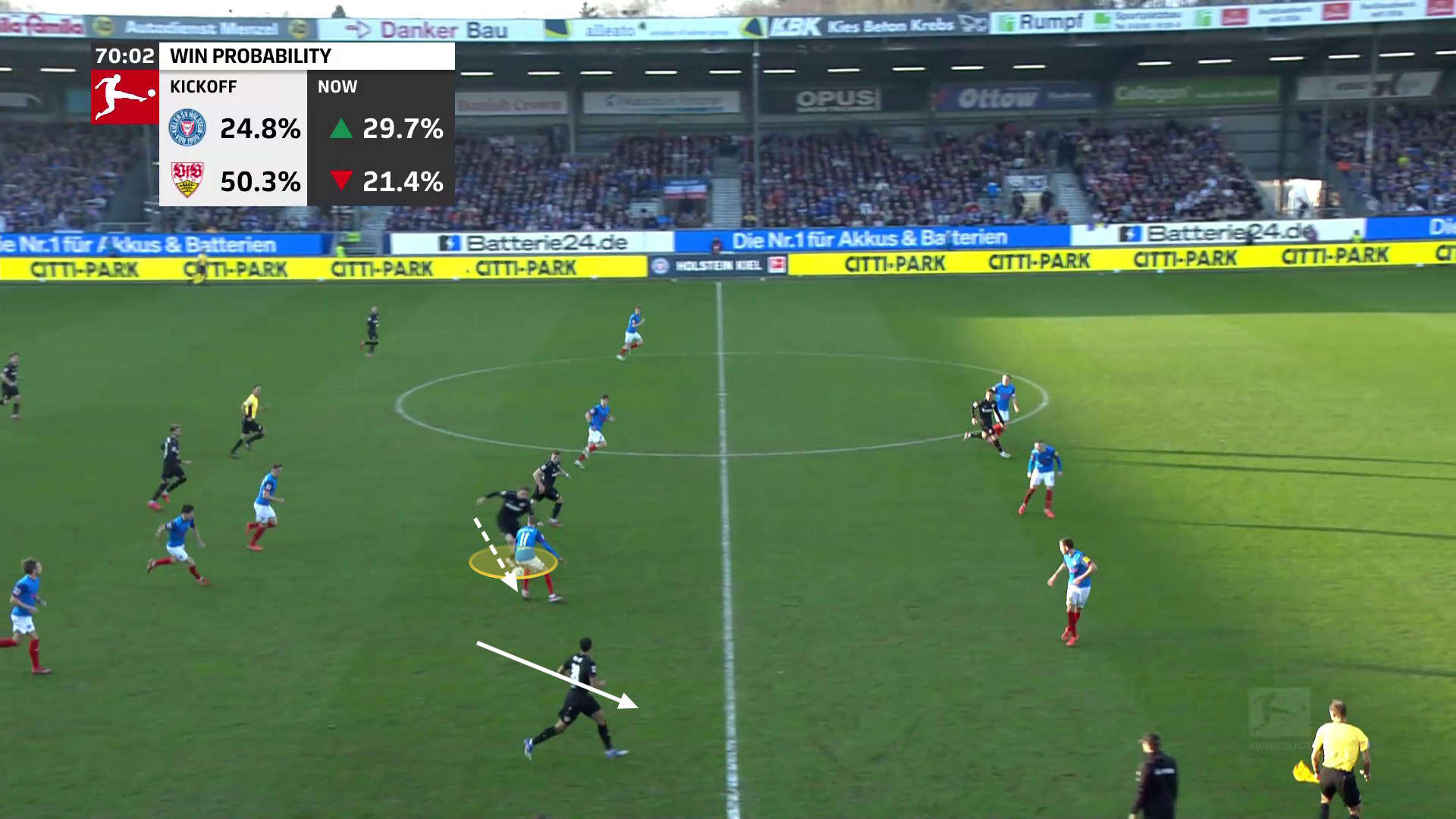 With his closed stance, his first touch is not as effective as it should be, and he tends to turn towards the outside instead of the inside, which causes him problems now.
Still, his individual class in dribbling gives him the edge here, and he will ultimately get out of the situation fine.
With a great body feint and a good first step, he gets past the defender and plays a ball towards his wingback in space, who can then move forward.
These situations demonstrate that Woltemade is more than just a typical striker; he possesses many qualities that enable his team to play fluid football, a style valued by coaches like Hoeneß when it comes to their possession play.
Nick Woltemade Quality In The Box
As stated previously, Woltemade struggled significantly with efficiency and scoring goals to begin his Bundesliga career.
He never had problems with that in 3. Liga when he was on loan at Elversberg, and the quality he possesses in the final third flashed there multiple times, even though his efficiency and finishing could and should have been better there as well.
Examining Nick Woltemade style of play, which initially struggled during the start of his career, reveals that it was primarily due to the physicality of defenders at the highest level.
He just got pushed around in the box and could never establish a position or leverage in these situations.
Therefore, his actions in the box were mostly off-balance, and for a player with his length, it’s just nearly impossible to actually do well then.
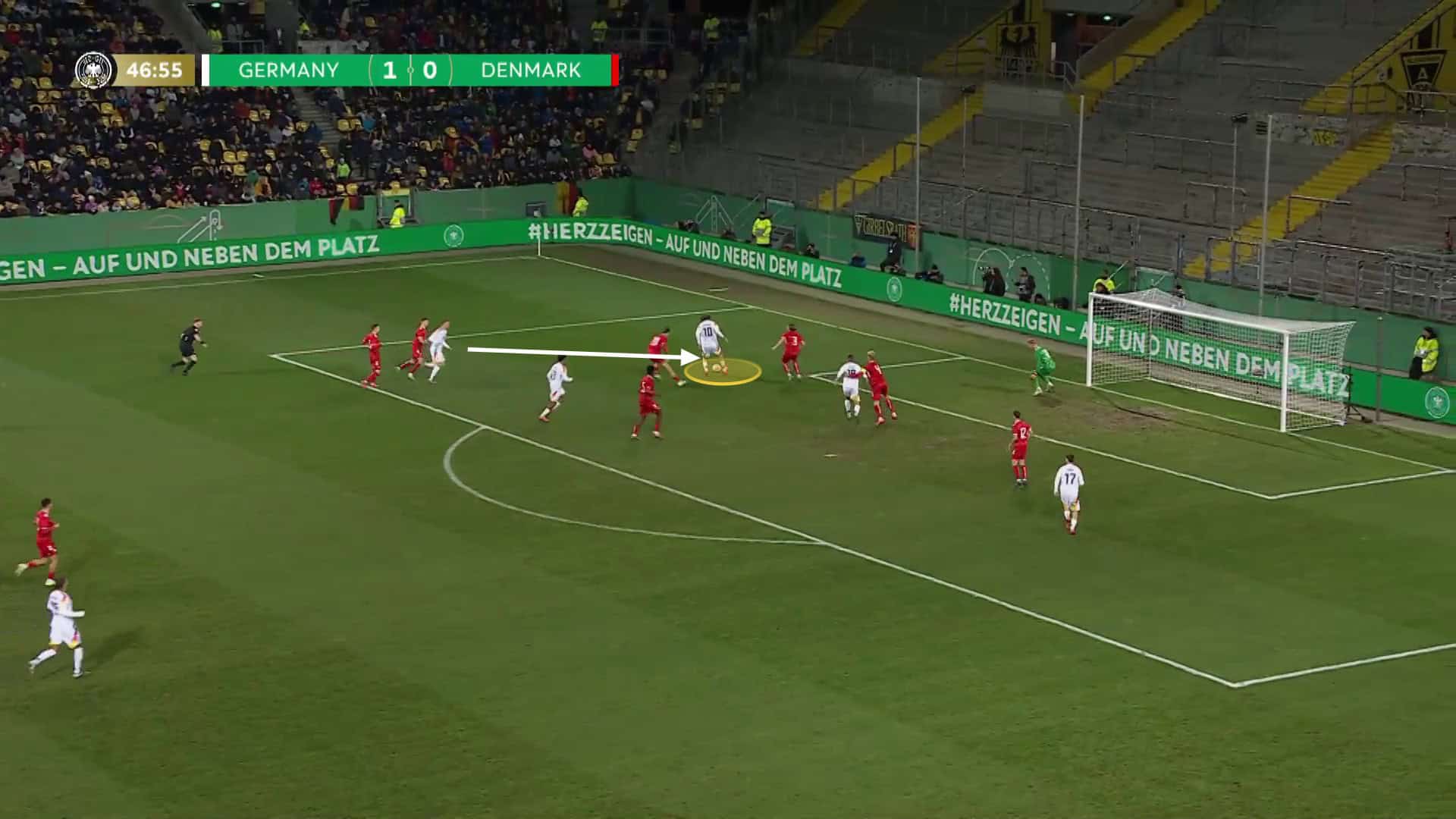 One thing stands out first when one looks at Nick Woltemade’s improvements: his hold-up play.
Looking at the situation above, Woltemade receives the ball in the box but is not in a position to move towards the goal instantly.
At this point in his development, he can easily use his big body to shield off the ball and keep the ball at his feet in the box, even against the double team he is facing here.
Considering how much he struggled with that in the early stages of his career, it’s impressive how far he has come already, and there is still potential for improvement.
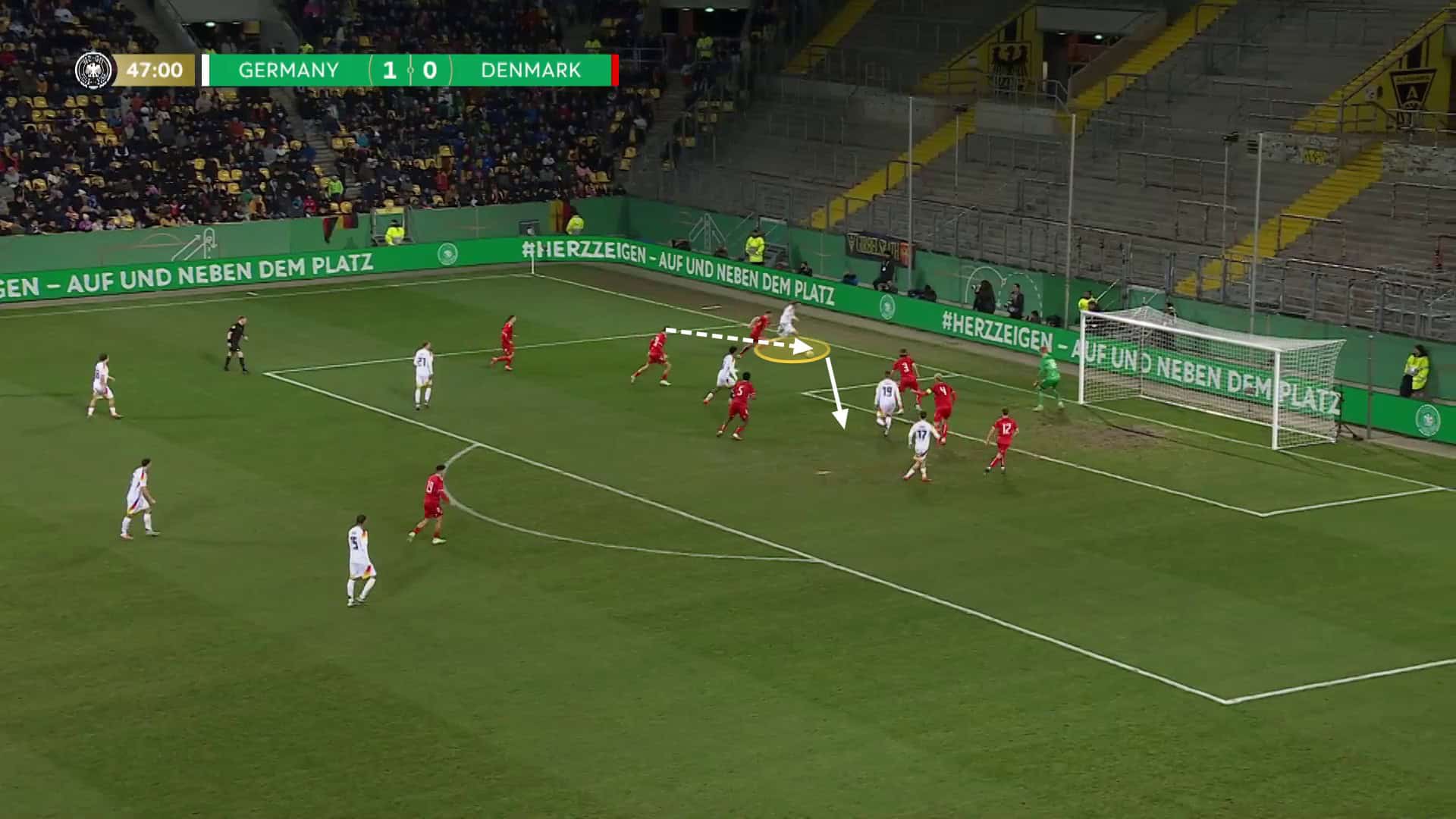 This progress in his game now enables Woltemade to utilise his strengths in the box and midfield.
In the situation above, he shields the ball, uses a quick feint towards the inside, and then uses his pace to reach the baseline, where he wins the take-on against the last defender following him.
Then, his vision shows as he cuts the ball back perfectly into the hole in the defence where his teammate is making his run.
This resulted in Germany’s U21 national team scoring its second goal against Denmark.
By utilising his body more effectively and efficiently than at the start of his career, Woltemade managed to become a more well-rounded player.
This also enables him to utilise his strength more effectively in the final third and in the box, resulting in significantly more goals and assists over the last couple of months than he had during his time at Werder.
Still, he takes only 1.72 shots per game in the Bundesliga this season.
While he manages to put 74% of those shots on target and creates 0.51 xG from those rare shots per game, he needs to get more aggressive in the box in terms of getting his own shot.
That will be the next step in his development.
Why Nick Woltemade Is Something Special
While Nick Woltemade was not a good player for most of his time at Werder Bremen, and therefore, Ole Werner was probably right not to play him more out of a pure performance-based perspective, Woltemade always had something special about him and the way he played the game.
The combination of size, pace, and technical skills is rare.
Players at this size rarely play in a top-five league as outfield players, and most are physically dominant centre-backs or strikers.
Funnily enough, out of the nine outfield players who are 1.98m or taller and playing in the top five leagues in Europe at the moment, three of them are playing for Udinese in Italy—just a little trivia tidbit.
The fact that a physical outlier like him now has a playing style that completely distinguishes him from other players his size makes watching Nick Woltemade something hard to compare to other players.
A couple of weeks ago, against VfL Wolfsburg, Woltemade showcased exactly that once again.
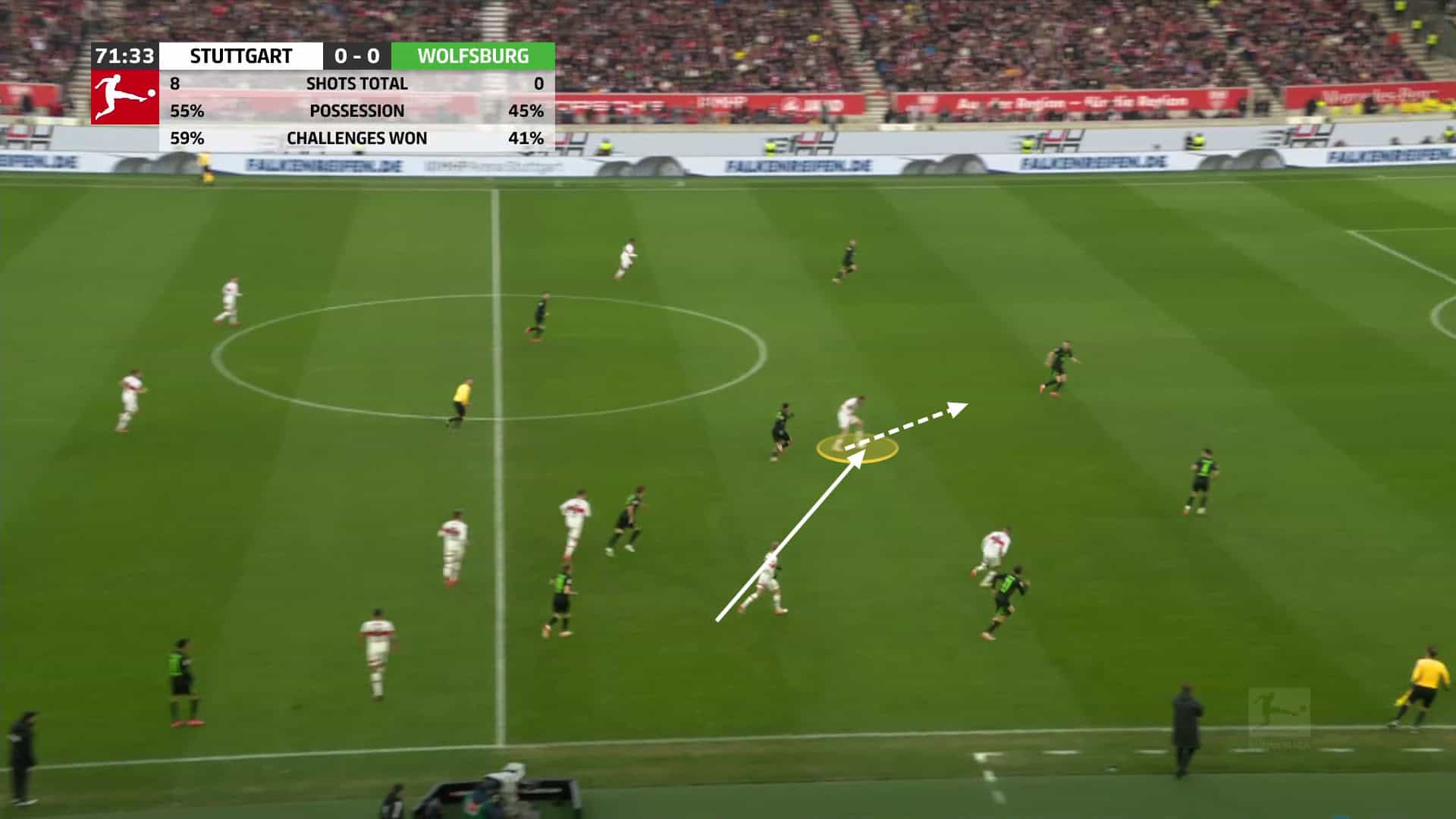 Here, we can see the start of the situation in a game in which VfB Stuttgart completely dominated the second half but was unable to score against an excellent Wolfsburg defence.
Hoeneß’s men won the ball back on their right defensive side and managed to control it, while Woltemade was once again dropping back in space just in front of the defensive line and was able to receive the ball in space.
Again, his body position was not ideal, and his turn took an unacceptably long time, but he managed to shield the ball well and was able to pick up the pace quickly after regaining control.
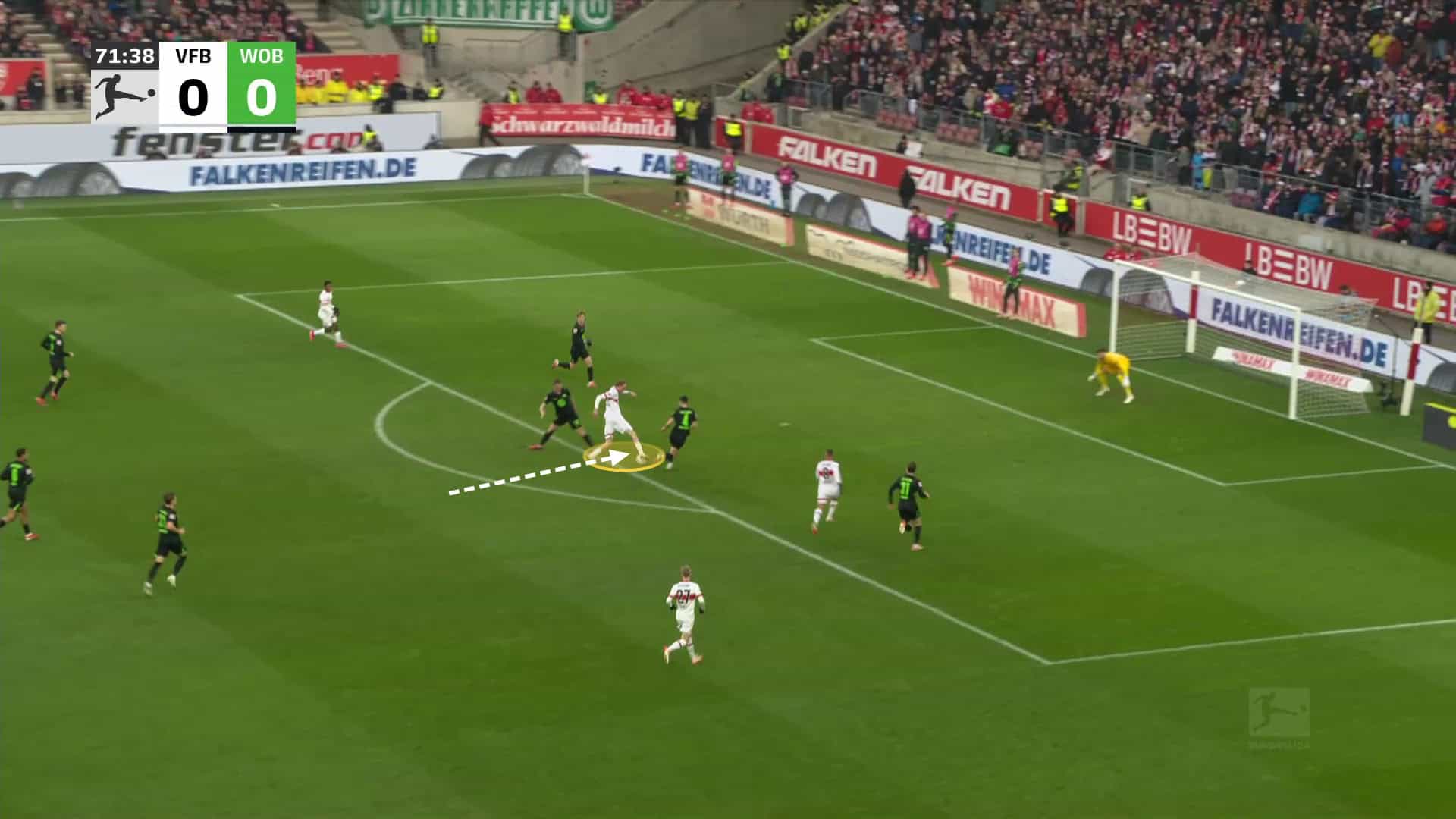 Woltemade then covered the space from the midfield to the box in just about three seconds with his long strides, which allowed him to be so fast in space and just run past defenders with ease at times.
Now the real special part starts.
The Wolfsburg defenders start attacking him at the edge of the box, but Woltemade glides past the first defender with a feint.
The moment the second defender tries to tackle him, he plays the ball between his feet twice to get past the defender’s extended leg and into the box, shielding the ball again against the first defender.
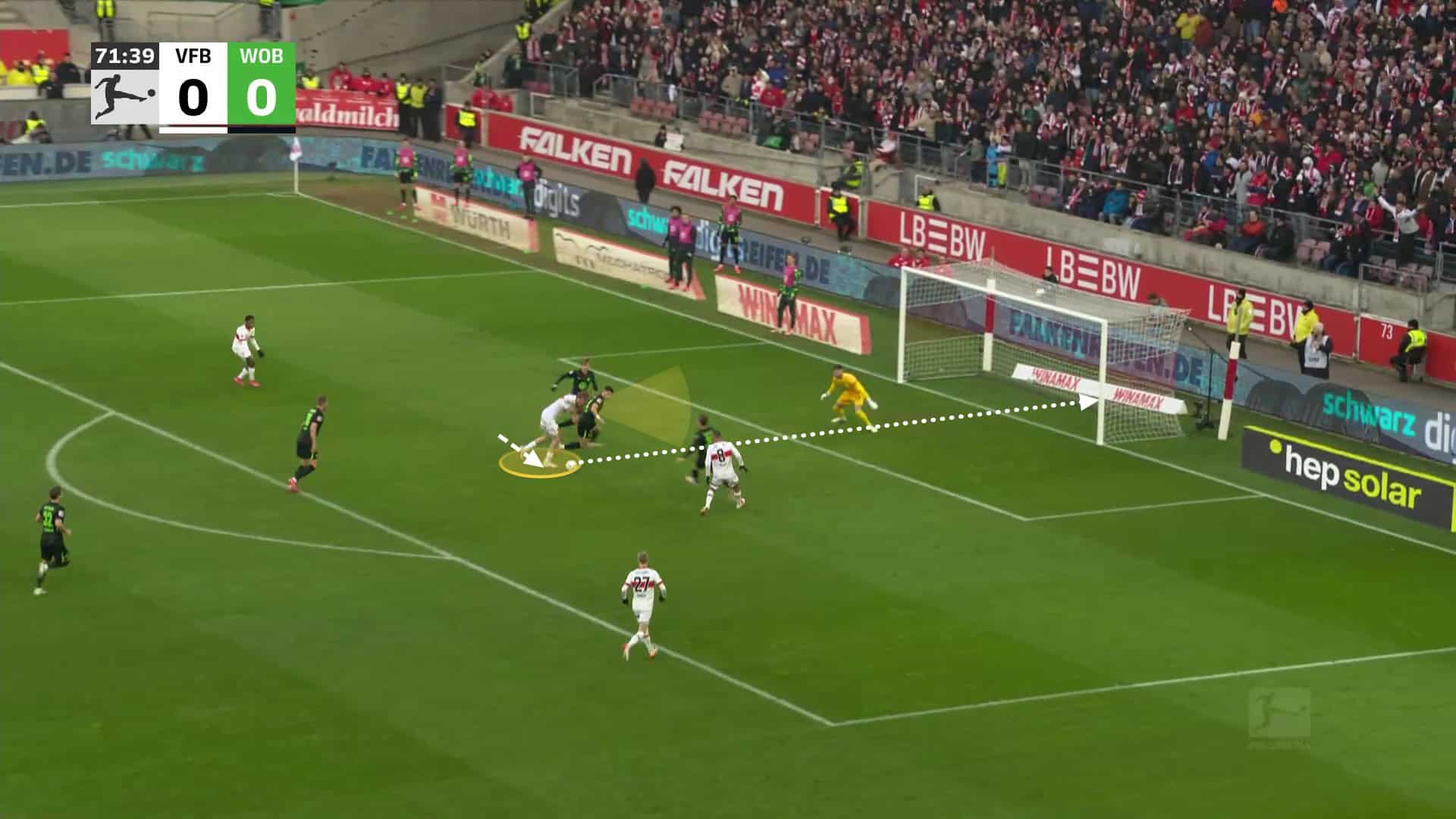 The situation is getting tight now with three defenders collapsing on Woltemade near the penalty spot, but instead of losing his composure, he quickly moves to his left foot and then executes a quick ball roll back to his right foot, opening up a window for a shot.
Woltemade then shows that while finishing is not his biggest strength, he has massively improved his shooting technique over the last month and places the ball well through the defender’s legs next to the post, scoring one of the best solo goals of the Bundesliga this season.
In such situations, he looks like a two-metre Jamal Musiala, which is a sight to behold.
Overall, his shooting technique still needs improvement.
He needs to place the balls better and hit them with more power from the edge of the box to become an actual big goalscoring threat, but considering he isn’t one right now and still scores many goals, the potential here is sky-high.
If we examine Woltemade’s weaknesses, his body positioning and coordination require improvement, but he has shown significant improvement over the last few weeks, and I do not doubt that he will take the next step here as well.
The only thing holding him back right now is his work against the ball.
He has a great motor and moves well in the block and press, but overall, he lacks the timing and core strength to win defensive duels, and he does not utilise his long legs to his advantage most of the time.
Woltemade is not a liability against the ball, but he isn’t a plus player either.
Another thing is his aerial ability.
Woltemade was a horrible player in the air for most of his time.
While he has improved his timing in the air and is now at least average, with good scenes in the air, winning only 34.7% of his aerial duels at his height is not satisfactory.
Conclusion
Looking at the NBA, there is a huge buzz surrounding Victor Wembanyama.
The Frenchman is one of the tallest players in the league, but he moves around like a much smaller player.
He has the skill set of a guard rather than a big man.
Nick Woltemade is somewhat akin to Wembanyama in football right now.
The rare combination of size and movement skills makes him a unicorn in today’s footballing world.
In terms of playing style, no other player is similar to him.
His vision and dribbling skills are elite, allowing him to be effective in midfield and the box.
While he struggled with the physicality of the game for a long time, his development over the last year has been exceptional.
He can be a deciding factor in Bundesliga games now while still having much of his potential unlocked.
This also means that Woltemade’s game has edges that need to be rounded out a bit.
He needs to improve his core strength and work against the ball.
Still, Woltemade will be a regular starter for Hoeneß to the end of the season and will play an essential role at the U21 Euros this summer.
After that, it is likely he will receive the call-up from Julian Nagelsmann to the A-squad.
Until then, tune in and enjoy watching one of Europe’s most special players right now.
