
Paris Saint-Germain arrived at the Parc des Princes on Wednesday night with the intention of confirming their direct qualification to the Round of 16 and maintaining their momentum following a historic domestic run.
The context, however, was far from simple: awaiting them was a Newcastle United side that, despite a gruelling fixture list, had prepared a meticulous defensive plan to disrupt the reigning European champions.
The outcome was a tense 1-1 draw that felt like a tactical arm-wrestle.
While Paris Saint-Germain dominated possession and territory, the Magpies prevailed through extraordinary structural resilience and a clear plan to exploit the hosts’ defensive vulnerabilities in the air.
Not even a masterclass from Vitinha, who acted as the structural node of the Parisian side, was enough to break down an Eddie Howe side that defended their box with heroic discipline.
This tactical analysis examines how Newcastle United’s hybrid block neutralised Paris Saint-Germain’s positional play and how the hosts’ “positive chaos” failed to translate into a scoreboard advantage.
PSG Vs Newcastle United Lineups & Formations
Luis Enrique set the home side up in a typical 4-3-3 shape, which operated as a 3-2-5 during the build-up.
Matvey Safonov started in goal, with a back four of Achraf Hakimi, Marquinhos, Willian Pacho, and Nuno Mendes.
Following Khvicha Kvaratskhelia‘s early injury in the 20th minute, Désiré Doué entered as a relational connector.
Vitinha and João Neves controlled the engine room, while Ousmane Dembélé and Bradley Barcola provided the threat from the flanks.

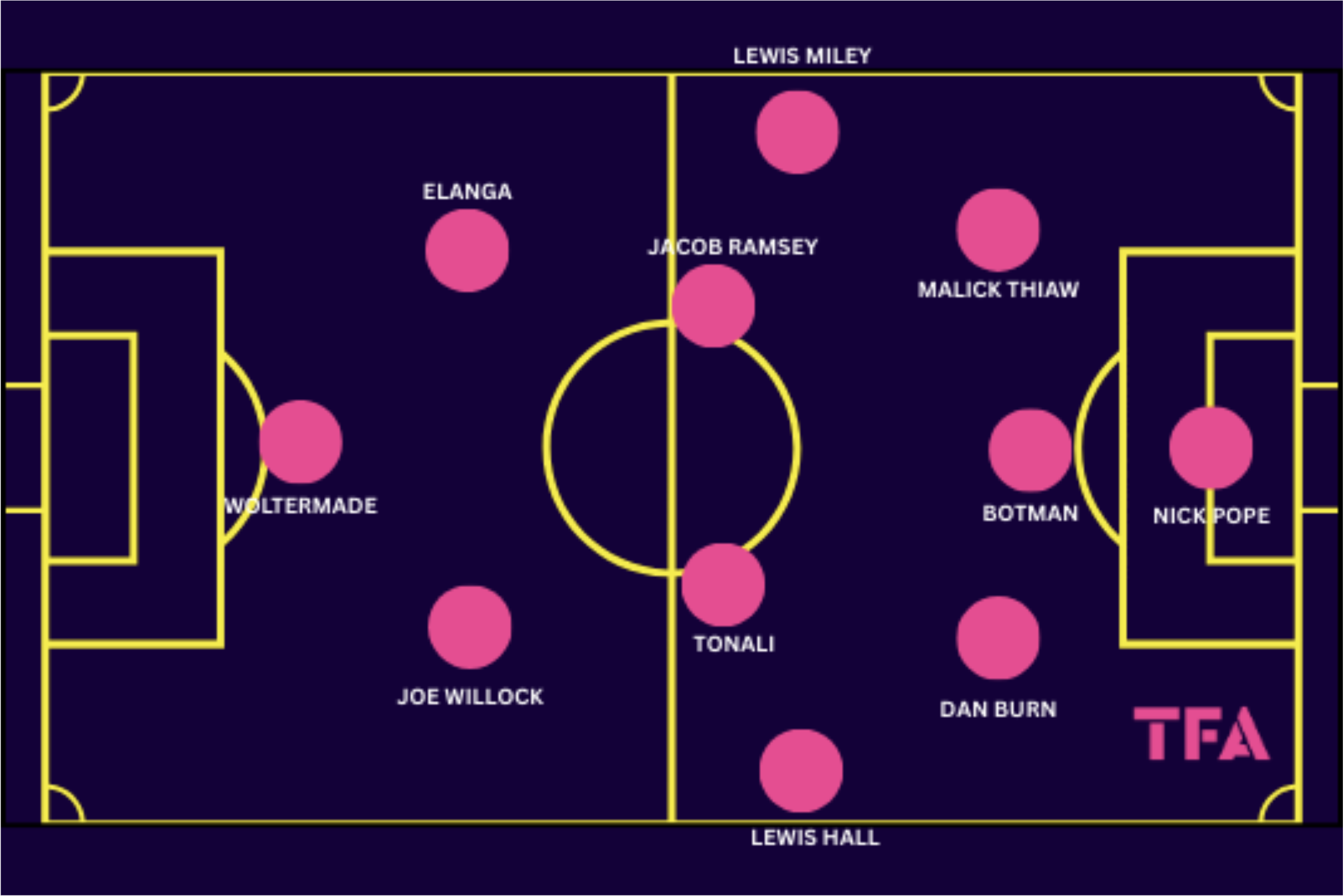
Eddie Howe opted for a significant structural shift, positioning Newcastle United in a 5-2-3 out-of-possession formation that collapsed into a 5-4-1 low block.
Nick Pope returned to the goal behind a back five featuring Dan Burn, Sven Botman, and Malick Thiaw as the central trio, with Lewis Hall and Lewis Miley as wing-backs.
Sandro Tonali and Joe Willock anchored the midfield, with Nick Woltemade leading the line as a primary physical reference.
Paris Saint-Germain Build-Up Logic: Goal-Side Triangulations & Relational Diamonds
The Paris Saint-Germain offensive plan was structured around generating numerical superiority from the very first line of progression.
To achieve this, Matvey Safonov acted as an auxiliary centre-back, a key tactical instruction from Luis Enrique to bypass the initial pressure.
While the centre-backs provided width, the structural breakthrough in these sequences arrived through technical combinations on the left flank involving Nuno Mendes.
Instead of a static 3-2-5, the hosts utilised “relational triangles” to bait and then eliminate the Newcastle United high press.
By keeping the full-backs in lower positions initially, Paris Saint-Germain induced the opposition wingers to jump.
Once the press was triggered, Nuno Mendes would drop to receive, immediately initiating a one-touch “wall pass” with an interior midfielder, typically João Neves or Vitinha, to exploit the space vacated by the pressing defender.
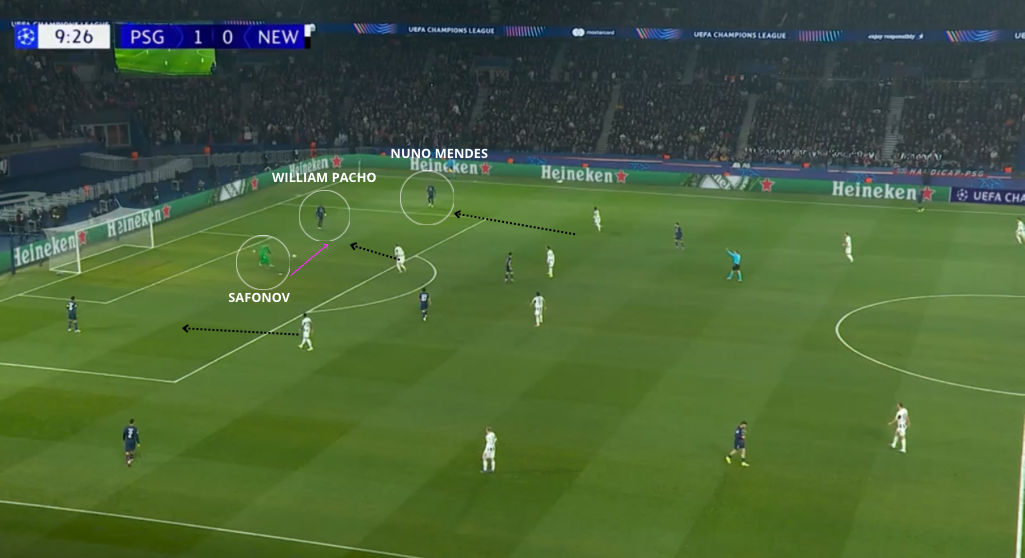
In the initial build-up phase, Matvey Safonov takes a high position between the centre-backs to create numerical superiority.
This positioning forces the Newcastle United first line of pressure to commit, intentionally baiting the wingers to leave their defensive zones.
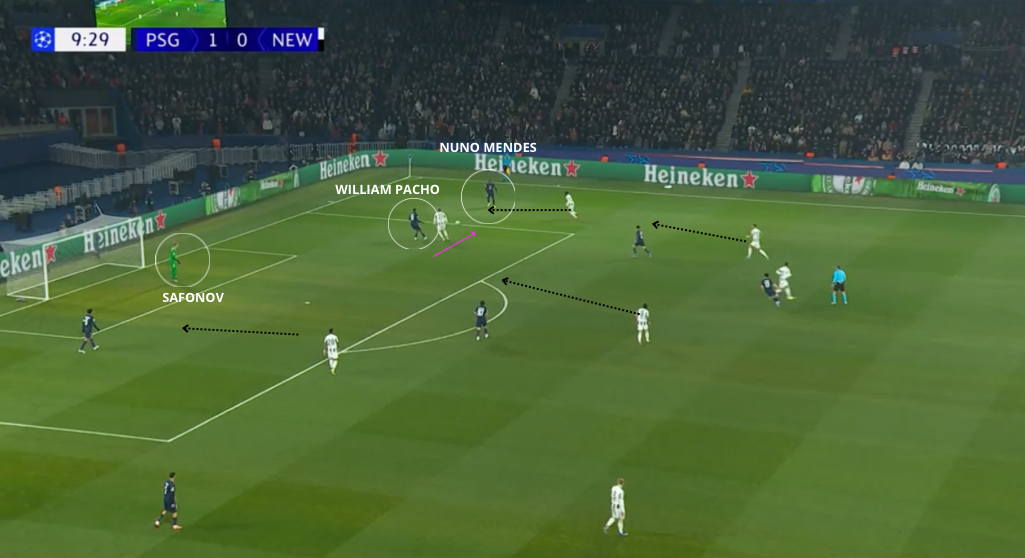
In the initial build-up phase, Matvey Safonov takes a high position between the centre-backs to create numerical superiority.
This positioning forces the Newcastle United first line of pressure to commit, intentionally baiting the wingers to leave their defensive zones.
Asymmetric Progression: Diversifying The Outlets
While the left-sided combinations involving Nuno Mendes and Willian Pacho help consolidate possession and deflect initial pressure, Paris Saint-Germain maintains a highly asymmetric structure to remain unpredictable.
When Newcastle United overcompensates to the left, the hosts rapidly shift the point of attack to the right flank.
This is where the structural role of Achraf Hakimi becomes decisive, moving from a low, wide base into a high-intensity vertical threat through relational chemistry with the interior nodes.
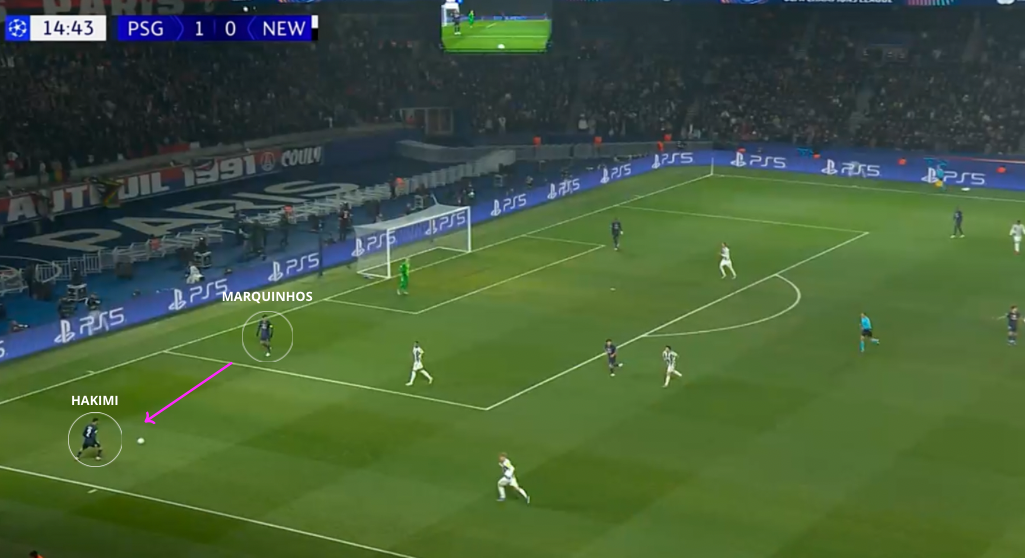
The sequence begins with Marquinhos switching the play to Achraf Hakimi.
The Moroccan full-back maintains a wide, low position during the initial phase, a tactical instruction designed to stretch Newcastle United’s first line of pressure and create a clean passing lane for progression.
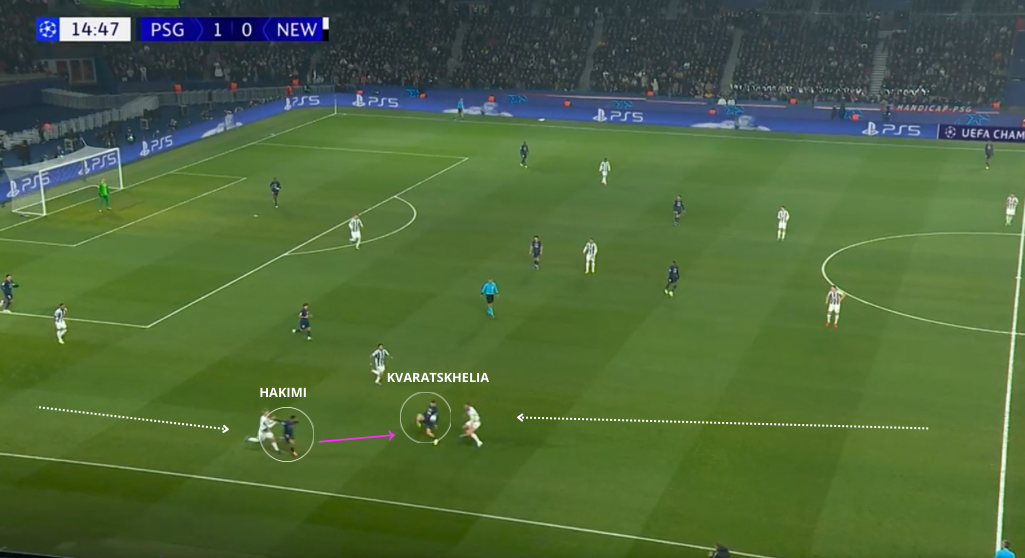
After gaining territory through a vertical carry, Hakimi engages Khvicha Kvaratskhelia, who has drifted inside to offer central support.
This connection triggers the relational combination, drawing the opposition’s defensive focus toward the interior corridor.
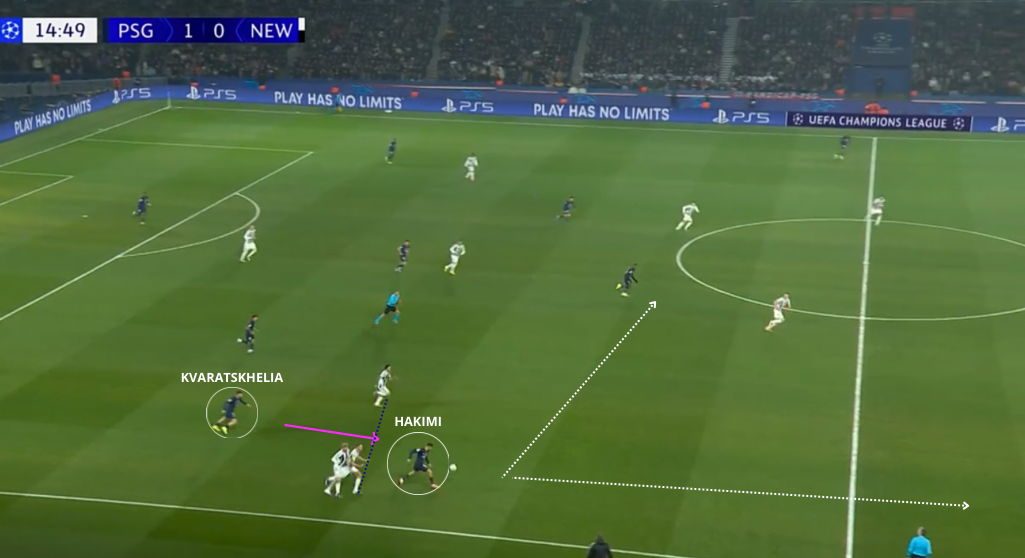
The combination concludes with a clinical one-touch return pass.
By utilising the ‘up-back-through’ logic with Kvaratskhelia, Achraf Hakimi effectively bypasses the Newcastle United defensive block.
This allows Paris Saint-Germain to penetrate the final third with high ball speed and numerical advantage.
Newcastle United Defensive Adjustment: Central Density & Structural Resilience
One of the most solid aspects of the Newcastle United approach was the ability to reduce the “useful space” within the central lane.
Realising that Paris Saint-Germain’s main imbalance lay in the technical quality and gravity of their interior, Eddie Howe implemented a “man-oriented” pressure in the intermediate zones.
Whenever a Paris Saint-Germain player received the ball between the lines, they were immediately pressured by two Newcastle United players, forcing them to receive with their backs to goal.
Newcastle United accepted the Paris Saint-Germain circulation on the outside but remained highly effective at closing the half-spaces.
By maintaining a minimal vertical distance, often less than 12 metres, between the defensive and midfield lines, the visitors restricted the Ousmane Dembélé and Bradley Barcola interior movements.
This compact low block forced the hosts into a “U-shaped” circulation, significantly limiting their effectiveness in the final third despite sustaining high levels of possession.
Vitinha As The Relational Hub: Dismantling The Newcastle United Press
In this high-friction scenario, the primary source of progression for Paris Saint-Germain was Vitinha.
The Portuguese midfielder operated at a superior creative level, repeatedly breaking down Newcastle United pressure through feints and deceptive passing sequences that exploited gaps in the opposition midfield.
The opening goal was a masterclass in “pausa” and timing.
Before striking the ball, Vitinha utilised a subtle feint to freeze the recovery runs of the Newcastle United double pivot, creating the split-second window required to pick his spot from the edge of the box following the Khvicha Kvaratskhelia assist.
This moment highlighted the socio-affective chemistry within the Paris Saint-Germain attacking unit before the Georgian winger’s early injury forced a tactical reshuffle.
Even after Ousmane Dembélé missed the penalty, which could have led to a collapse in morale, Vitinha acted as the structural node, ensuring the hosts maintained their technical floor and dominated the half-spaces.
His ability to hide the ball through body orientation remained the most effective tool for bypassing the Eddie Howe defensive block in the first half.
Conclusion
Ultimately, a draw was a pretty fair reflection of this contest.
The match was characterised by a rigid structure more than spontaneity and moments of magic.
PSG’s positional play helped them control territory and advance into danger zones, but, especially after Kvaratskhelia’s injury, their attack lacked the bite to really break down a disciplined Newcastle defence.
Eddie Howe’s side were comfortable going long phases of play without possession while retaining their disciplined shape, which herded the opposition away from the most damaging areas of the pitch.
For Eddie Howe, this match emphasised his side’s defensive maturity.