
Did Ousmane Dembélé Deserve To Win Ballon D’Or?
Ballon d’Or season always brings debate among football fans and pundits.
There has never been and will never be a Ballon d’Or winner that everyone agrees on.
For years, the argument over who was most deserving of being called the best footballer in the world centered around two giants of the game, Lionel Messi and Cristiano Ronaldo.
Last year, Manchester City midfielder Rodri edged out Real Madrid star Vinícius Júnior for the award, prompting backlash from all associated with Los Blancos.
The 2025 edition has, in fairness, been less controversial than last year.
Following PSG’s dominant win in the UEFA Champions League Final, Ousmane Dembélé was a somewhat predictable recipient of football’s most prestigious individual accolade.
Still, strong arguments could be made in favour of others.
Dembélé’s biggest threat came in the form of Barcelona sensation Lamine Yamal, who finished as a worthy runner-up to the 28-year-old ex-Barça boy.
This data analysis contextualizes the 2024/2025 season for the Ballon d’Or top two by examining Dembélé vs Yamal stats.
We’ll use statistics to help compare and contrast the 2024/2025 season for Ousmane Dembélé at PSG and Lamine Yamal at Barcelona, respectively, outlining how they earned the right to battle it out for the Ballon d’Or trophy last week.
The Ballon d’Or isn’t just about numbers, however.
Narrative also weighs heavily on those entrusted with selecting the winner.
Therefore, this Ballon D’Or analysis also aims to tell the story of what the 2024/2025 campaign meant to both players, in conjunction with the player performance data.
Ousmane Dembélé Scout Report At PSG 2024/2025
Let’s start with the man who ultimately collected the honours last week in Paris, Ousmane Dembélé.
On the night when he was prevented from helping his teammates avoid defeat to arch-rivals Olympique de Marseille in Ligue 1 due to a hamstring injury by which he’s currently sidelined, Ousmane Dembélé at least didn’t have to travel far to attend the Ballon d’Or ceremony.
Before 2024/2025, you’d have to go back to 2016/2017 for Ousmane Dembélé’s most prolific season.
Dembélé was entering what would ultimately be his only season as a Borussia Dortmund player, following his move to BVB from Stade Rennais for €35 million.
The Frenchman made 30 goal contributions that term and helped his team to the DFB-Pokal title.
In the summer of 2017, the then-20-year-old player moved to Camp Nou for a whopping €148m and seemingly lost his way, partially due to injuries, before receiving the lifeline of a move back to where it all started in Ligue 1 in 2023, this time in Paris instead of Rennes.
Ousmane Dembélé Pizza Chart 2023/2024 (Left) & 2024/2025 (Right)

Dembélé and Luis Enrique got to know each other in 2023/2024, when Dembélé made 21 goal contributions for PSG.
These numbers equalled his most productive campaign in Catalonia (2018/2019) but ultimately still failed to match the heights he’d reached as a teenager in Germany.
Then came 2024/2025, and Ousmane Dembélé’s productivity in the final third shot up to produce a spike season that few who came before him could rival.
Looking at the data from both 2023/2024 and 2024/2025 in Figure 1, we can see changes in Dembélé’s attacking metrics (yellow), which are far from insignificant.
Luis Enrique found a way to get Dembélé taking more shots, which snowballed into more expected goal contributions and, ultimately, more goals and assists.
Dembélé started getting more involved inside the box and began making fewer dribbles, both symptoms of the tactical changes Enrique made to accommodate Dembélé as the centrepiece of his PSG team.
Ousmane Dembélé Heat Map 2023/2024 (Left) & 2024/2025 (Right)

The above heat maps illustrate the changes in Dembélé’s main area of involvement from 2023/2024 to 2024/2025.
In his first season with Les Parisiens, Dembélé mainly got on the ball out wide on the right wing.
Of course, he carried the ball towards goal, hence the big numbers for ‘dribbles per 90’ in the 2023/2024 pizza chart, but he was primarily responsible for providing width for PSG on the right-hand side.
This change occurred in 2024/2025, allowing Dembélé to reach his full potential, as his goal contribution numbers increased from 21 in 2023/2024 to a career-best 51 in 2024/2025, surpassing his previous personal best.
Last season, Dembélé was far less involved out wide, though he did drift there at times.
He enjoyed a fair amount of freedom within Luis Enrique’s PSG tactics, playing as a ‘false 9’ centre-forward in a lot of games, as well as his more traditional right wing position.
Dembélé was now more involved in ‘zone 14’ and the right half-space, as well as around the penalty spot.
This, along with the dynamics provided by his PSG teammates and Luis Enrique’s attacking tactics, provided Dembélé with the platform and environment necessary to explode on the biggest stage in a beautiful way, finally fulfilling the potential he’d promised years ago.
We’d categorise 25.5% of Dembélé’s goal contributions last term as having come in ‘big games’, with ‘big games’ defined as: the UEFA Champions League Round of 16 onwards, the Coupe de France Final and Ligue 1 games versus AS Monaco and Marseille who, along with PSG, made up the top-three in the league at the end of the season.
Dembélé’s case for the Ballon d’Or was built on the fact that he played a crucial role in helping PSG to their treble, and first UEFA Champions League title, by making a notable contribution in big moments.
He pulled off a career-best season at 28 years of age, putting the disappointment of his time at Barcelona well and truly behind him and proving those who’d lost faith in the one-time Bundesliga wunderkind wrong.
Luis Enrique deserves a lot of credit for inspiring and engineering a remarkable turnaround in Dembélé’s career trajectory through clever tactics and, undoubtedly, brilliant man management.
Ousmane Dembélé’s 2025 Ballon d’Or win is a stark reminder that development and growth are not linear.
Lamine Yamal Scout Report At Barcelona 2024/2025
Ousmane Dembélé’s main competitor for the Ballon d’Or, and the winner of the ‘Kopa Trophy’ (essentially, the U21 Ballon d’Or equivalent) was Lamine Yamal, who amazingly just turned 18 back in July.
Yamal had been pegged as a major rising star in world football, debuting for Barcelona at the age of 15 back in 2023.
The youngster enjoyed his first full La Liga campaign in the 2023/2024 season, playing in 37 of Barcelona’s 38 league games and making 10 UEFA Champions League appearances.
He consolidated himself as a key component of Barça’s starting XI last season, however, making an outstanding 43 goal contributions across 55 appearances in all competitions.
Lamine Yamal Pizza Chart 2023/2024 (Left) & 2024/2025 (Right)
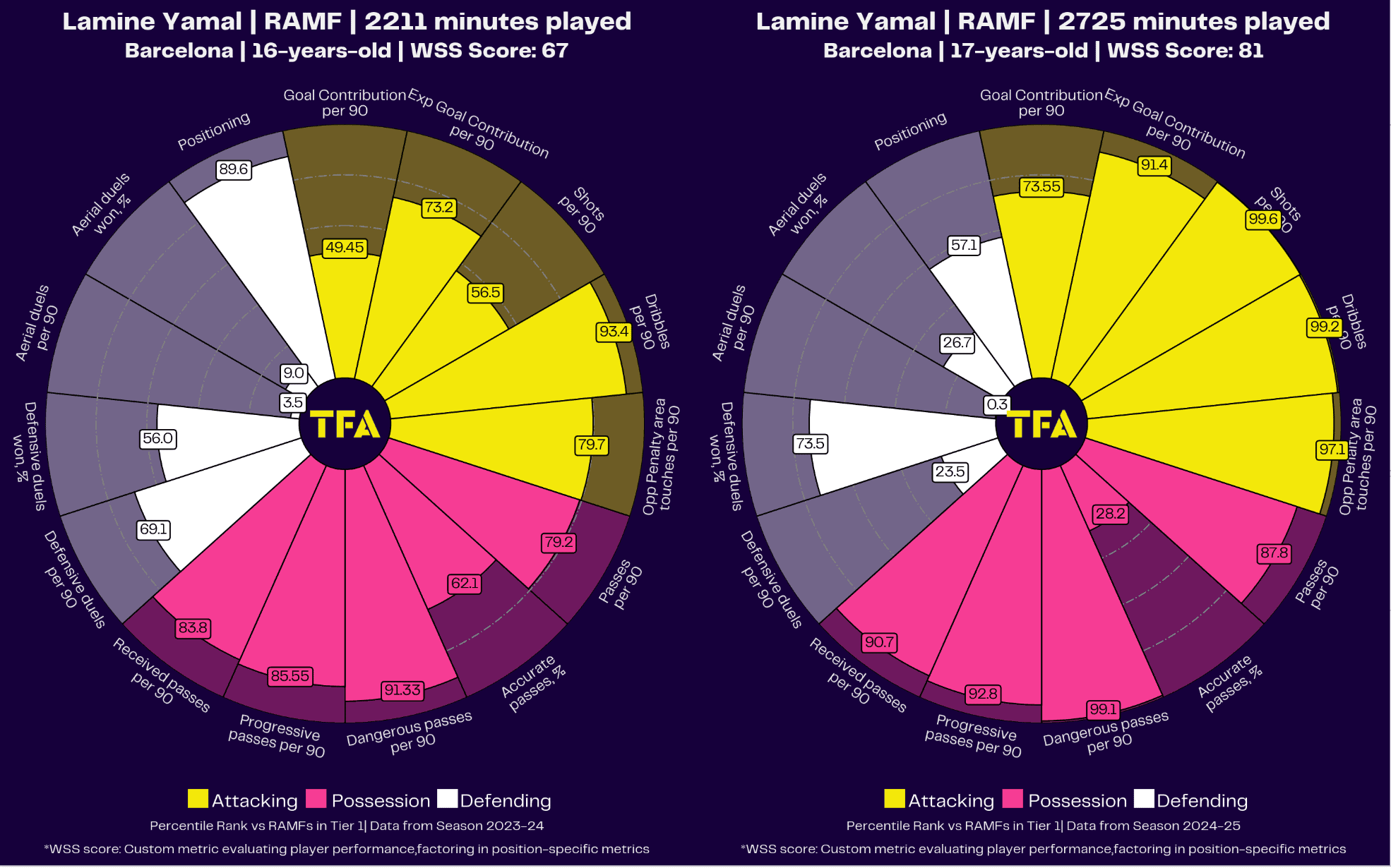
Looking at his pizza charts for the past two full seasons above, we can see that while Yamal had already been producing substantial numbers in most of the key categories we’ve selected in 2023/2024, he really upped his attacking and creative contributions to elite standards last term, earning himself a lot of recognition, which led to his Ballon d’Or surge.
All attacking and creative metrics on the pizza chart improved for Yamal relative to his positional peers from Europe’s top-five leagues, bar pass accuracy.
The winger’s increase in dangerous passes at the same time as that drop in pass accuracy points to Yamal becoming increasingly confident in taking risks at the top level, which I’d generally see as a positive for a playmaker.
I think anyone would see that as a positive, considering the jump in goal contributions, both expected and actual, that Yamal demonstrated from 2023/2024 to 2024/2025.
Lamine Yamal Heat Map 2023/2024 (Left) & 2024/2025 (Right)
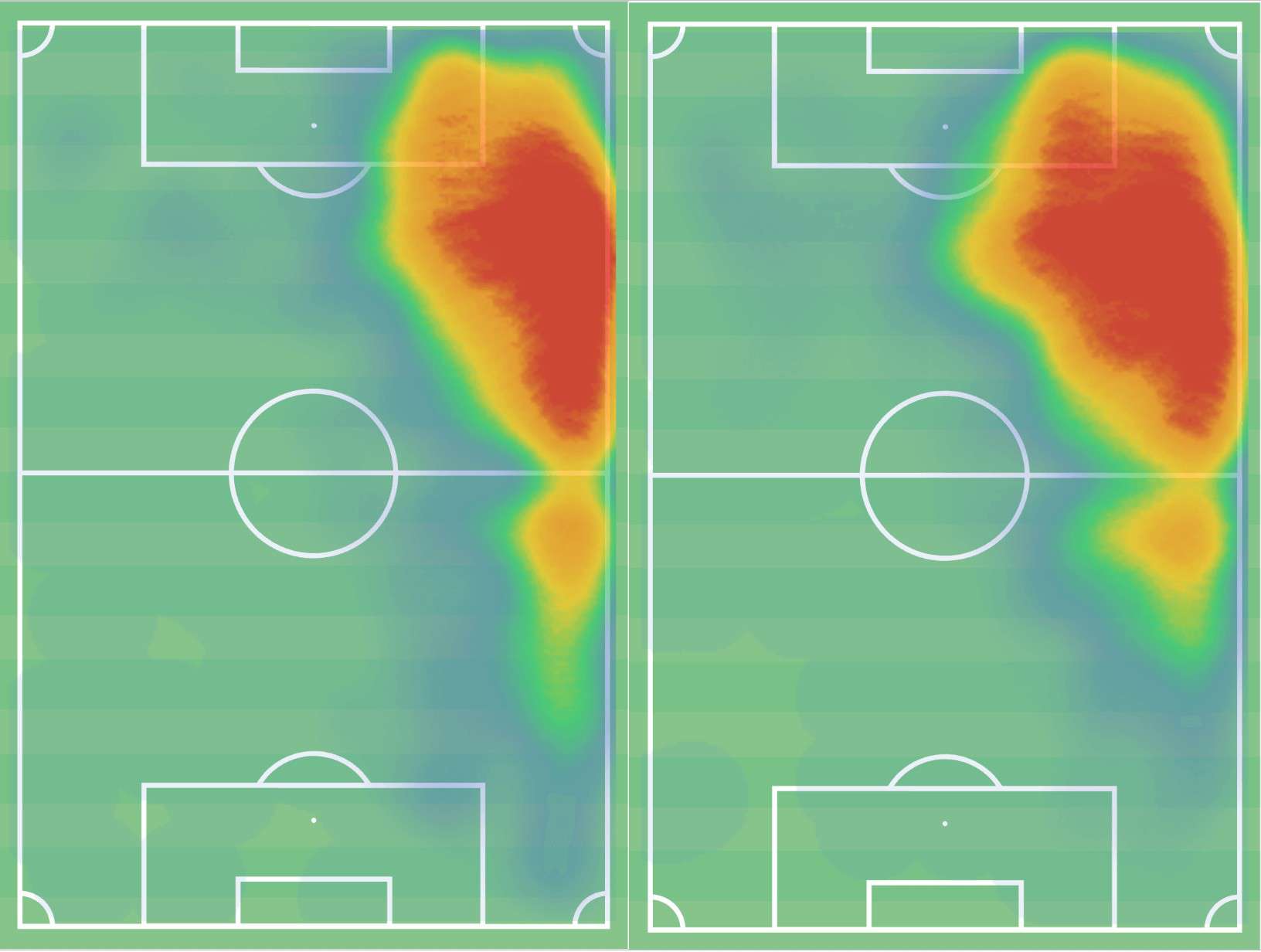
Like Dembélé, Yamal’s heat map indicates that the player was more involved in central positions and the half-space last term than he had been the year before, though the difference is much more subtle for the Barcelona man compared to Dembélé.
Still, it’s quite indicative of the growing responsibility the teenager is already shouldering for one of the world’s biggest and most demanding football clubs.
Like Dembélé, Yamal was not one to shy away from the spotlight in big games.
Using the same definition of ‘big games’ as before (UCL knockouts from the Round of 16 on, the Copa del Rey Final, and La Liga games versus other members of the top three, Real Madrid and Atlético Madrid), we find that 20.9% of Yamal’s 43 goal contributions came in ‘big games’.
That’s not quite as high a proportion as Dembélé, so Yamal’s contribution was distributed a little more evenly across ‘big games’ and the rest.
Nevertheless, a significant portion of the Barça prodigy’s contributions came in those most demanding fixtures, which is further testament to how Lamine Yamal is really taking the pressures that come with playing for Barcelona in his stride.
It’s not just Yamal’s numbers that went into his case for the Ballon d’Or, but also the fact that he’s putting up those numbers as a teenager under an enormous microscope.
At 17 years of age for the 2024/2025 campaign, Lamine Yamal acted as the backbone for Barcelona’s attacking output all season long.
Yamal’s volume of output, consistency across the campaign and contribution in ‘big games’ at such a young age is very rare, and provided he keeps the head down, stays grounded, surrounds himself with the right people and, crucially, avoids injury, this clearly won’t be the last year we see Yamal vying for recognition on the biggest stage as far as individual accomplishments are concerned.
The Barça youngster truly announced himself as one of the modern game’s top talents last term, though he could well learn a lot from the man he finished as runner-up to in terms of how quickly things can change for a young talent when certain habits and environment are not right.
Yamal’s talent doesn’t come along often, and it needs to be managed carefully to ensure the player continues producing his best for years to come, so he can keep making a case for himself to win this award.
Conclusion
Ousmane Dembélé’s 2023 move to PSG will ultimately go down as a massive success.
The 2023/2024 campaign warmed him up and set the stage for the history-making 2024/2025 season that was to come.
Luis Enrique helped Dembélé put his Barcelona years behind him and finally produce the output that had to that point inaccurately been predicted of him almost a decade ago.
His role in PSG’s success and, now, his Ballon d’Or win represent redemption, in a sense.
He got back to his best and earned the recognition that has now come his way.
Decisive peaks in clutch moments throughout the season also played a massive role in Dembélé’s win.
The Ballon d’Or has historically rewarded those who excel in big games and those who help their teams achieve major achievements, such as the Champions League; whether or not this bias is justified is another debate.
Though some will disagree with the results, it’s difficult, really, to argue against Dembélé deserving the award for 2025.
However, this year’s Ballon d’Or battle appears to be a clash between the present and the future of the award.
Yamal’s output, under the pressure of the spotlight, is scary for a teenager, as is his trajectory, so it seems reasonable to say his time is very likely to come.
In Paris, Ousmane Dembélé finally arrived.
In Barcelona, Lamine Yamal is just getting started.
