
Ayyoub Bouaddi arrived at the 2026 FIFA World Cup with a profile that sits somewhere between genuine first-team player and elite prospect – a tension that makes his performances all the more instructive. According to supplementary reports, he was born on 2 October 2007 in Senlis, France, and is listed at 185 cm. Reported as a central midfielder, he had reportedly accumulated 50 Ligue 1 appearances for Lille before his 19th birthday. According to reports, FIFA approved his one-time nationality switch to Morocco on 15 May 2026, and Morocco reportedly named him in their World Cup squad on 26 May 2026. This scout report examines the tactical qualities that make Bouaddi a credible World Cup contributor rather than a squad passenger, drawing on per-90 metrics benchmarked against central midfielders across Europe’s top five leagues aged 21 and under.
Ayyoub Bouaddi Statistical Profile 2025/26
For this analysis, we benchmarked Bouaddi against under-21 central midfielders across the Premier League, Ligue 1, Bundesliga, Serie A, and La Liga in 2025/26. His progressive passes per 90 and progressive carries per 90 both rank highly within his peer group, which immediately signals a player willing and able to advance the ball through midfield rather than redistribute laterally.
The defensive metrics are equally telling. On this analysis, Bouaddi registers strong numbers for pressures applied per 90 and ball recoveries – figures that sit comfortably above what most high-volume creative midfielders produce. The profile that emerges is a box-to-box midfielder with a passing range and defensive engagement rate that would function at elite level within a structured pressing system – precisely the context Morocco provide.
Where the numbers soften, in this assessment, is in aerial duels won and direct dribble success rate, both of which are areas he is yet to impose consistently at senior level. At a reported 185 cm, the physical tools are present, but the aerial and dribble contest numbers suggest these are aspects of the game still developing. That is an unremarkable finding for an 18-year-old in his first World Cup; it becomes relevant when assessing where his ceiling sits.
Ball Progression and Spatial Awareness
The quality that has drawn sustained attention from European clubs is Bouaddi’s ability to progress the ball through congested midfield channels without relying on the dribble as a primary mechanism. At Lille, operating in a system that frequently demanded midfielders to receive between the opposition’s first and second lines and immediately face pressure, he developed the habit of scanning before receipt and selecting the forward pass under contact.
That specific skill – receiving in a half-turned body position, identifying the progressive option, and committing to it before the press fully arrives – is what separates technically capable teenage midfielders from those with genuine first-team futures at high-pressing clubs. According to supplementary reports, Bouaddi reportedly became Lille’s youngest-ever player in European competition at 16 years and 3 days, and then reportedly started a Champions League match against Real Madrid on his 17th birthday in October 2024, giving early evidence that the habit translated beyond domestic competition.
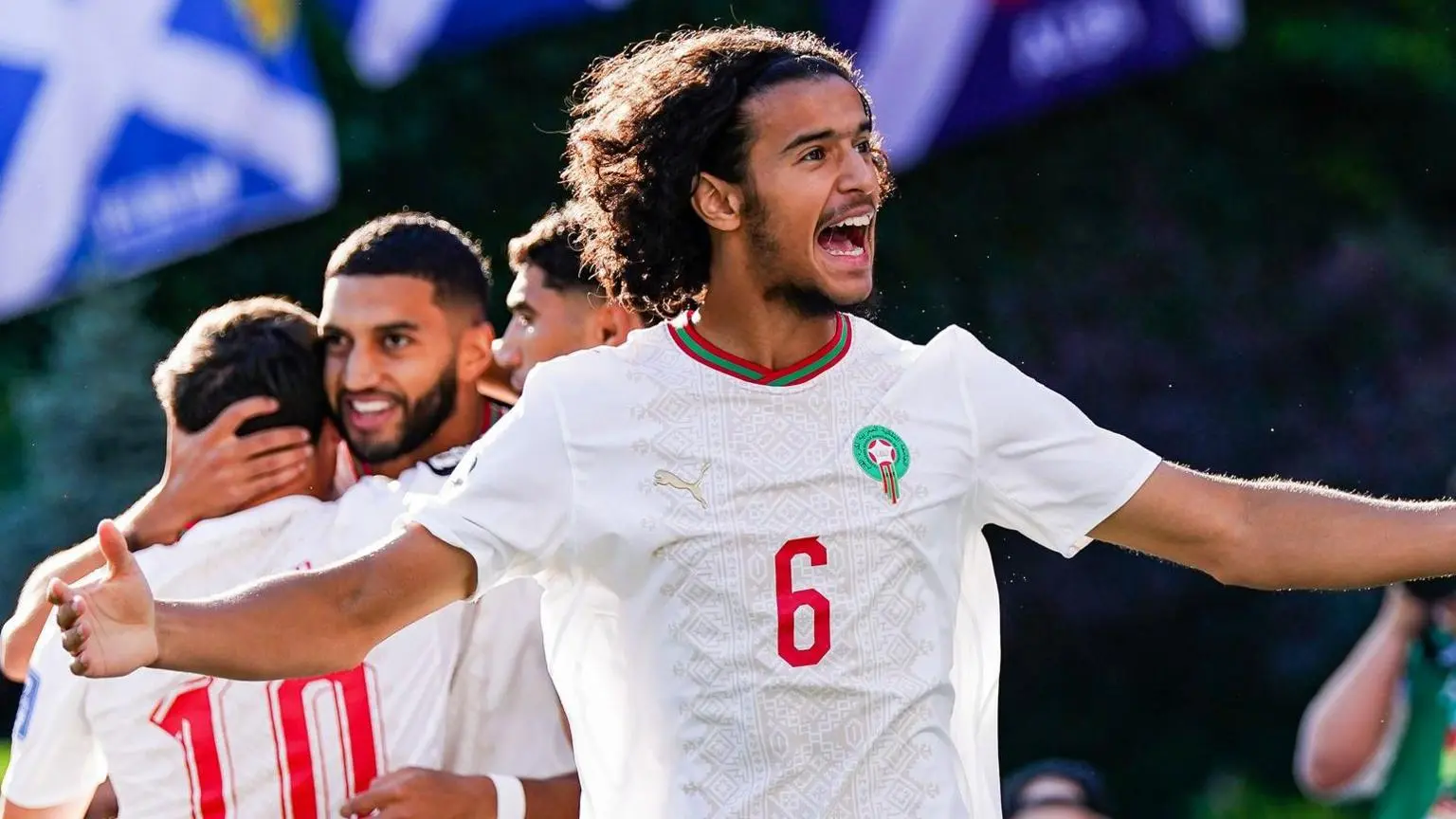
At the World Cup, Morocco’s structure in possession asks their central midfielders to carry the ball into the opposition’s defensive mid-block rather than always playing through it. Morocco’s group stage campaign demonstrated a consistent willingness to commit runners and use the midfield as a transitional platform rather than a recycling station. Bouaddi’s progressive carry numbers – among the highest in his age cohort by this analysis – fit that requirement directly.
Pressing Behaviour and Defensive Engagement
Morocco’s defensive shape in the 2026 tournament has, on analytical assessment, been built around a mid-to-high press that triggers on the opposition’s back-four, with the midfield trio responsible for cutting off horizontal passing lanes before the ball reaches the pivot. For this to function, the central midfielders need to combine a high press-trigger rate with the positional discipline not to leave gaps in behind when the press is beaten.
On the available evidence, Bouaddi’s pressing behaviour at Lille reflects a midfielder who initiates pressing actions frequently rather than waiting for the press to be called by teammates. At club level, that intensity operated within Lille’s coordinated pressing structures, which demanded coordinated pressing from the front three and midfield simultaneously. The same principle applies at international level, and his conditioning to press as a proactive rather than reactive behaviour is a structural asset.
The caveat is that pressing coordination at club level, developed over months of repetitive training, does not transfer automatically to a tournament environment where squad togetherness is compressed into weeks. According to supplementary reports, Bouaddi entered the World Cup with only three senior caps for Morocco, all in warm-up matches. His pressing geometry within the international system will therefore represent adaptation rather than deep habit – worth monitoring across the later rounds as Morocco look to progress through the knockout stage.
Physical Profile and Structural Role
Listed at 185 cm according to reports, Bouaddi occupies a physical tier more commonly associated with a defensive midfielder or a deep-lying playmaker than with the kind of box-to-box profile his statistics describe. That combination – the frame of a positional anchor, the progressive instincts of an eight – creates a structural ambiguity that well-resourced clubs find attractive. It allows a coach to deploy him as a single pivot in a 4-3-3, as the more advanced of two central midfielders in a double pivot, or as the highest midfielder in a 4-2-3-1 depending on what the game state demands.
Scoutedftbl, whose post on X in July 2026 drew more than 96,000 views, framed Bouaddi’s emergence at the World Cup as a transfer of generational expectation – from a player France youth football had flagged as the next significant midfield talent to one who now represents that billing for Morocco. The framing is pointed because it captures a real shift in how his career trajectory is being read by the industry.
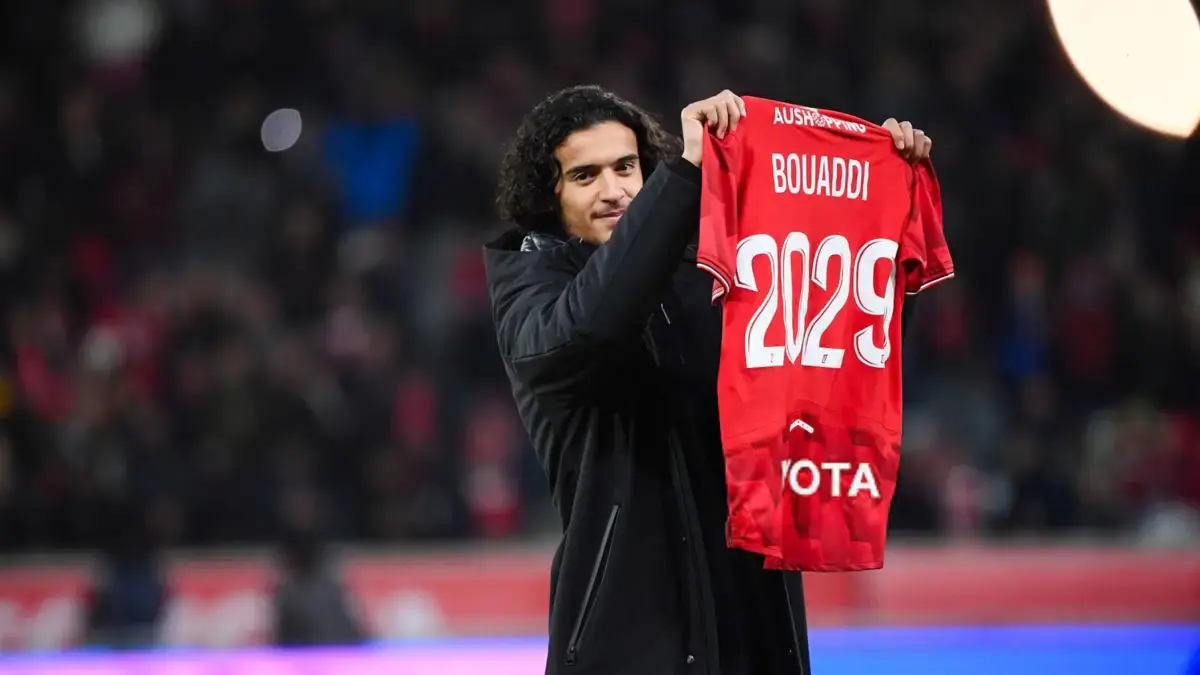
Reports around the tournament placed Lille’s asking price in the range of €70 million to €100 million, with Premier League and Bundesliga clubs reportedly identified as among the primary monitoring parties. According to supplementary reports, Lille reportedly extended his contract in December 2025, locking him in through June 2029, which gives the club significant leverage and removes any urgency from their side. The asking price, in this analysis, reflects Bouaddi’s potential ceiling as much as his current output – a distinction that will narrow or widen depending on what the World Cup knockout rounds produce.
Systemic Fit Within Morocco’s Structure
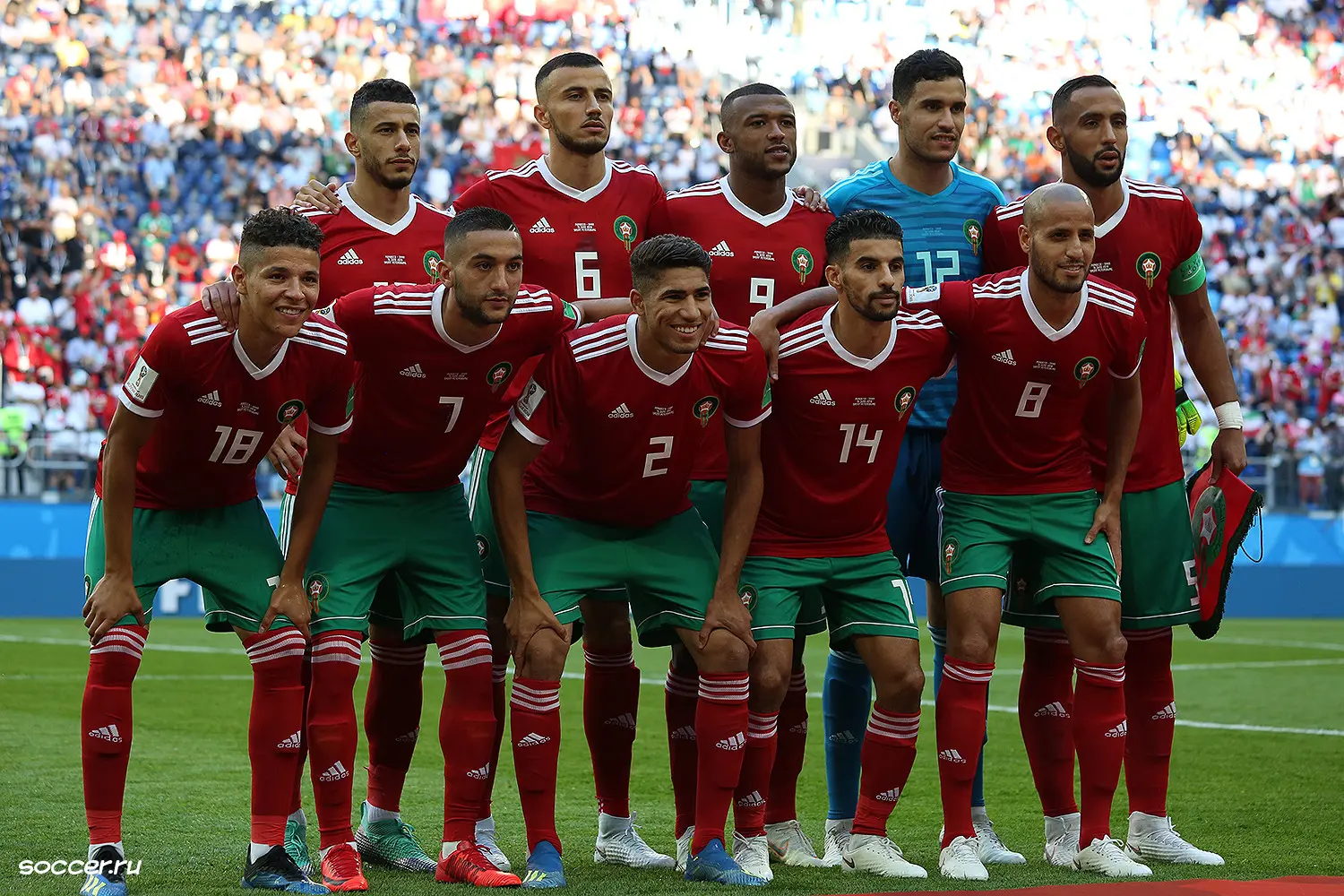
Morocco’s squad-building model has become one of the more studied examples of how a national federation can harvest elite dual-national talent developed in European academies. The Atlas Lions’ core is built around players who have come through primarily French and other European youth systems but were either overlooked or chose to represent Morocco at senior level. Bouaddi’s late switch – with FIFA approval reportedly arriving shortly before the tournament, according to supplementary research – follows the same pattern established by players who are now senior figures within the squad.
The tactical question is where Bouaddi fits within the midfield hierarchy, particularly with Morocco’s knockout stage matches requiring their midfielders to perform across multiple tactical scenarios. His profile suits a system that wants to press aggressively in the defensive phase and carry the ball into space in the attacking phase – which describes Morocco’s preferred operating mode under their current structure.
The risk is that a reported three senior caps offer minimal positional understanding with the players around him. Automatic combinations – the kind that allow a midfield to function as a coordinated unit rather than a collection of individual decisions – take time to develop at international level. Morocco’s experienced midfield options provide the structure around which Bouaddi can operate; the tactical demand on him is to fit the system’s requirements rather than impose his own preferences.
Limitations and Development Priorities
Aerial contest consistency and dribble reliability are specific developmental areas still to be resolved, on this assessment. Listed at 185 cm, Bouaddi should be a more dominant presence in aerial duels than his current output reflects – the physical tools exist, but the timing and commitment in contact situations is inconsistent. This matters in tournament football, where set-piece situations and second-ball contests in midfield become decisive in tight knockout matches.
When Bouaddi does attempt to beat a man directly, the outcome is unreliable enough that it should not be a primary mechanism in his game. His better instinct – pass before the press, carry when space exists, dribble rarely – is borne out by the available data, but developing that one-versus-one dimension would expand the range of situations in which he can influence a match.
A reported three senior international caps before the World Cup began remain the most obvious structural limitation. His reading of club football’s pressing and spatial demands is well-developed for his age; his reading of how individual opponents and national systems differ from what he faces in Ligue 1 is still being formed. That is, to be precise, a description of a very good young player still becoming excellent rather than a fundamental flaw.
Verdict
Bouaddi’s World Cup emergence confirms what his Ligue 1 record had already signalled: this is a central midfielder with first-team credentials, not a squad decoration. His progressive passing and carry numbers, combined with an above-average pressing rate, make him a structurally coherent player in Morocco’s system rather than a passenger elevated by tournament occasion. Morocco’s deep run in the tournament provided the stage for that confirmation to reach the widest possible audience of club scouts.
The transfer valuation – reportedly €70–100 million according to reports around the tournament – reflects a market pricing in the ceiling rather than just the floor, and Lille’s reported contract leverage through June 2029 means that transaction, when it happens, will happen on the club’s terms. His development priorities are clear: aerial contest consistency, dribble reliability under pressure, and the accumulation of senior international experience that converts individual quality into coordinated team function. The foundation is substantial; the distance to elite-tier central midfielder is measurable rather than speculative.
