
On a crazy and hectic final night of the UCL league phase, Luis Enrique’s PSG confirmed their place in the playoff round with a resounding 4-1 victory over Stuttgart in Germany.
Sebastian Hoeneß’s side had enjoyed a bright start to 2025, but their defeat at the hands of the Parisian outfit meant that their slow start to proceedings in Europe resigned them to an unfortunate 26th place in the overall table.
While the opportunity to continue their continental adventure was certainly on the cards before kick-off, it became quickly apparent that the Ligue 1 champions were looking to put another UCL opponent to the sword, having now scored eight Champions League goals in the space of a week.
This youthful PSG team just exudes confidence at the moment, especially when you consider their frightening attacking lineup, which has been bolstered further by the arrival of Khvicha Kvaratskhelia from Napoli.
But with the Georgian unable to play until the knockout rounds, Paris Saint-Germain leaned on the technical prowess and physical capacity of their all-French front three to glide into the next stages of the competition, which has eluded them to date.
This tactical analysis will highlight some of the key factors which allowed PSG to comfortably see off VfB Stuttgart, including key positional roles and how Enrique’s tactics could mitigate Stuttgart’s greatest strengths.
PSG Vs Stuttgart Starting Lineups
Sebastian Hoeneß set up his Stuttgart side in a more traditional 4-2-3-1 formation when in possession.
This formation could then seamlessly transform into a high-pressing 4-4-2 and offer a more conservative defensive presence by dropping another player into the backline to create a 5-3-2.
The key personnel change for the home side came between the sticks.
Fabian Bredlow played just his third competitive match of the season, deputising for Alexander Nübel, who missed out due to illness.
Stuttgart’s defensive line consisted of Ameen Al Dakhil and Jeff Chabot as the two central defenders, with Josha Vagnoman and Maximilian Mittelstädt filling in their positions at right and left back, respectively.
The double-pivot of Atakan Karazor and Angelo Stiller looked to continue their impressive partnership and nullify PSG’s threat in the midfield, with Jamie Leweling and Chris Führich offering a threat on the wings.
Enzo Millot lined up as Stuttgart’s key creative talent between the lines, just behind Deniz Undav as the lone striker.
For the away team, Luis Enrique set up in his usual 4-3-3 formation, with key personnel switches to help boost their rest defence and promote the frequency of passing sequences within the wider areas of the pitch.
Gianluigi Donnarumma started in goal for PSG, protected by a defensive line of Achraf Hakimi, Willian Pacho, Marquinhos and Lucas Hernández.
João Neves, Vitinha, and Warren Zaïre-Emery comprised their midfield.
They were all fluid in their roles, adding further confusion to the opposing defence and expressing their unique qualities in and out of possession.
Finally, Bradley Barcola and Désiré Doué offered PSG a significant attacking threat from the left and right wing, with hat-trick hero Ousmane Dembélé leading the line in a more centralised position initially.
Achraf Hakimi Attacking Influence
Heading into the match, it was clear that Luis Enrique would continue to focus on PSG’s effectiveness in deploying wide overloads and allowing their full-backs to advance into the final third.
This was a crucial factor in their impressive comeback victory against Pep Guardiola’s Manchester City last week.
Still, this time, a key personnel change influenced their ability to deploy this strategy on both flanks.
With the high-flying Nuno Mendes unavailable for selection, Enrique opted to play Lucas Hernández at left-back.
The Frenchman failed to match his Portuguese teammate’s natural attacking desire.
But crucially for PSG, Hernández instead offered a much more resolute defensive figure to bolster their best defence and protect against any Stuttgart moves in transition, whilst also dropping into a back three in their early build-up.
This placed the attacking responsibility on Hakimi’s shoulders, with PSG immediately targeting wide overloads on the right flank to release the Moroccan in behind with his overlapping runs.
Achraf Hakimi Heat Map

With PSG enjoying spells of possession in the right channel, they could effectively use the third-man principle due to Dembélé‘s and Doué’s deeper movement in the half-space.
Neves, acting as the key playmaker, lofted passes to stretch the Stuttgart defence.
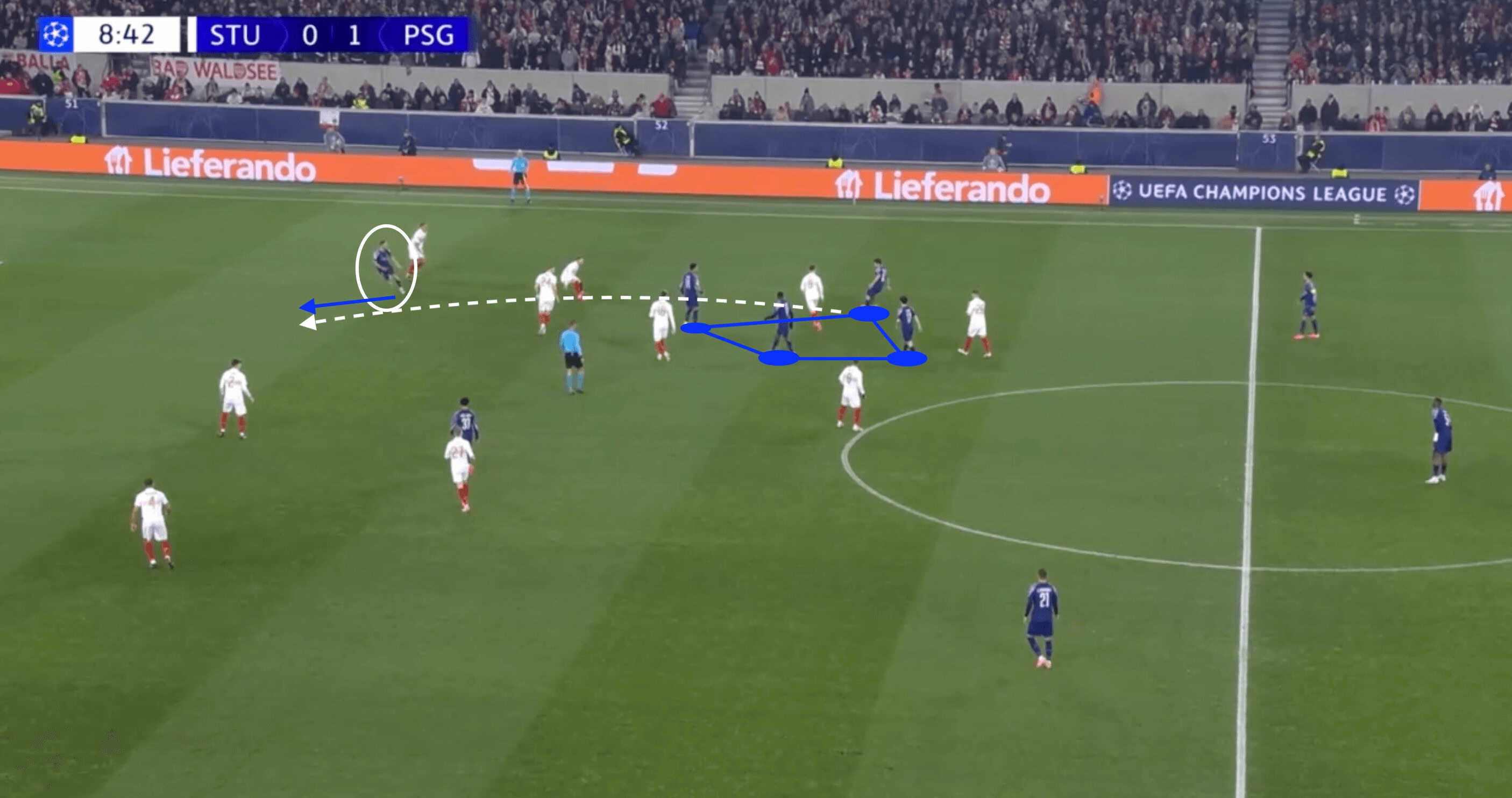
It became a constant battle for the Stuttgart backline to try and anticipate Hakimi’s attacking movement when PSG would attack in the 3-2-5 formation, with the right-back holding their width and, in turn, occupying Stuttgart’s greatest creative threat, Mittelstädt.
We will delve deeper into Dembélé’s positional versatility later in the analysis.
Still, in the second half, it became apparent that he and Hakimi could effectively combine by creating crucial pockets of space for one another.
In this example, we can see how Dembélé’s shift towards the left half-space provided an excellent opportunity for Hakimi to make a darting inverted run and occupy the traditional striker role whilst Doué held PSG’s width on the right.

It was apparent that Dembélé was becoming too much of a handful for the Stuttgart defence.
In this instance, a decision to operate closer to Barcola posed too great a threat for the defence to ignore, allowing Hakimi to move into the space that the central defender had vacated in pursuit of Dembélé.
Even when Stuttgart were established in their low block with the double pivot looking to minimise space between the lines, PSG could still combine through the use of short, intricate passing sequences which featured inventive flicks to bypass any defender who found the confidence to step up and engage.

Hakimi used this centralised position to initially receive the pass from Dembélé before accurately teeing up the Frenchman to complete his hat-trick.
The 4-0 scoreline allowed PSG to almost guarantee a well-earned victory in the 54th minute.
VfB Stuttgart High Defensive Line
On their journey to a second-placed Bundesliga finish last season, Sebastian Hoeneß’s side became synonymous with an energetic, high-pressing style, which has certainly reaped its rewards when facing some of the strongest opposition.
However, the height of their defensive line seemed far too detrimental to their overall collective strength, especially considering the physical aspects of PSG’s forward trio.
VfB Stuttgart Defensive Territory Chart

Both teams sought to effectively execute a man-to-man pressing style during the opposition’s initial phase of build-up play, with Stuttgart shown below to be pressing in a more 4-4-2 formation.
This limited both PSG and Stuttgart from utilising longer distribution when looking to play out from their own third, but the key difference for PSG would have to be how they could find space through the middle of the pitch to create a threat on the counter.
PSG looked to move into more of a 2-3-3-2, as shown in the present example, with Vitinha sitting slightly deeper and Dembélé dropping into midfield.

Whilst Stuttgart’s man-oriented press could limit short distribution initially, we saw how a lack of cohesion left one Stuttgart player accounting for both Dembélé and Zaïre-Emery, with the hat-trick hero able to peel off and make the first contact as the ball was played into the central zone.

PSG could then flex their attacking muscles against an unsettled Stuttgart defence, with even a 2v2 scenario representing a clear advantage for the Parisians when both Doué and Barcola are running at you in space.
When referencing Bradley Barcola, it was clear that the lack of offensive support on the left wing didn’t dampen his attacking output.
At various points within the match, Barcola looked to interchange in some wide overloads of his own to then release the Frenchman into space behind the advanced Stuttgart defensive line.

He has emerged as an impressive and direct ball carrier.
His explosiveness and technical quality allow him to fly past Vagnoman and drive towards the opposing penalty area.
After flying by his marker, he easily set up Dembélé’s first goal.
Ousmane Dembélé Positional Versatility
But on the night in Stuttgart, Ousmane Dembélé stood out the most, of course, with his impressive goalscoring ability and ability to affect the game both on and off the ball.
Having mentioned how his movement as the central striker allowed Hakimi to find space in more central areas, it became quite clear that he offered an atypical striking presence, which seemed to work incredibly well for PSG.
While Dembélé is often associated with his speed and running power, even in transitional moments, we saw how he would drop deeper, almost demanding possession, to help link play and pick out PSG’s wingers, stretching play.
It would appear that Dembele clearly recognised that he would be unable to effectively tussle in a physical battle with Stuttgart’s central defenders.
So, he frequently moved between the lines to further unsettle the opposing defenders at a distance.

We see how once Neves can find Dembele in acres of space through the middle, he intelligently opts to pass the ball back to the Portuguese midfielder, who can then find Doue in space towards the touchline.

It could be perceived as unusual that a player of his calibre didn’t jump at the chance to be direct and terrorise the Stuttgart defence.
Still, we see how, as the sequence progresses, Chabot is clearly affected by Dembele’s presence, which creates more space for Doue.
Doue was once again the beneficiary of Dembele’s intelligent movement, but this time when acting quickly in that traditional striker role.
It was impressive to see how Dembele could shape his run as Barcola progressed along the left flank, almost stopping on a dime to not only offer a cut-back passing option but also to draw some defensive attention away from the back post where Doue was sliding in.

Dembele affected play across the entirety of the front line and could even maintain his attacking threat when shifted across to the left wing after Enrique had made some substitutions deep in the second half.
Ousmane Dembélé Penetrating Carries Chart
In this example, we can see that as Beraldo is looking to carry the ball forward, Dembele maintains his width to draw in the Stuttgart full-back and reduce their defensive solidity through the centre.

Beraldo could then pick out an excellent threaded pass through the half-space to meet the darting run of Fabian Ruiz; with the Spaniard able to find another way of breaching the Stuttgart defence before breaking into the box.
It was an issue that Stuttgart had yet to encounter in the match, but with Ruiz’s 3.21 penalty area touches per 90 minutes in Ligue 1 this season, it was clear that Enrique could modify the roles of his advanced midfielders to fit nicely with varied personnel.
Conclusion
Overall, it was clear that PSG deserved the victory on the night.
They appear to have found an effective rhythm and overcome previous struggles, which had limited their ability to achieve results in the early matchdays of this season’s Champions League.
The French champions are certainly growing in confidence on the continental stage, and with the arrival of further attacking firepower, the question is, how far can they go this year?
On the other hand, a defeat marks the end of the road for Sebastian Hoeness and Stuttgart on the European stage.
It was always going to be an uphill battle, but we saw how quickly their confidence dropped after shipping goals in the first half.
Other results ultimately prevented the German side from qualifying for the playoff round, but fans will hope that Champions League football returns to the MHP Arena soon.
