
The UEFA Champions League is known for delivering match-ups of the greatest teams in world club football.
If you want to see English top teams like Manchester City and Spanish top teams like Real Madrid battle it out on the pitch, the competition to claim Europe’s footballing throne is a must-watch for every football fan.
However, there are different matchups that are as interesting, if not more interesting, than these games, and yesterday, we had one of these showdowns in Stuttgart, Germany.
At the end of the 2023/24 campaign, VfB Stuttgart qualified for the Champions League for the first time in over 12 years in dominant fashion.
From the get-go, the team that was mere seconds away from getting relegated in the two seasons prior was dominating the league and getting comfortable in the top positions.
Within just a couple of months, young head coach Sebastian Hoeneß turned around the team with astonishing attacking football.
The team ended up finishing as the runner-up to the invincible Bayer Leverkusen team, ahead of teams like FC Bayern and Borussia Dortmund.
Their opponent this Wednesday night is Atalanta of Bergamo, the biggest riser in Italian football over the last couple of years.
Ever since Gian Piero Gasperini took over the team, the club has been on the up and managed to break into the top four of Serie A with a clever recruitment strategy and a beautiful style of play.
Their biggest success of these years was beating Xabi Alonso and Bayer Leverkusen in the UEFA Europa League final in 2024, qualifying themselves for the UEFA Champions League again.
Two teams with limited budgets, great coaches, attractive playing styles, and a philosophy of developing young talent in their squads were facing off in the MHP Arena in Bad Canstatt.
In this tactical and match analysis, we will examine how the game developed, what the teams did well, and how the game was decided in the end.
Formations & Players Used
First, we are going to take a look at what formations and players the coaches used, respectively.
VfB Stuttgart Formation & Lineup
For the home team, Sebastian Hoeneß’s formation did not change much for VfB Stuttgart, lining them up in their usual 4-4-2 formation.
Alexander Nübel started in goal with a back four consisting of Mittelstädt, Chase, Rouault, and Vagnoman in front of him.
In midfield, Angelo Stiller and Atakan Karazor formed the usual double pivot, with Führich and Millot flanking them on the left and right sides of the field.
In attack, Atalanta loanee El-Bilal played up front next to star striker and fan-favourite Deniz Undav, with the German international occasionally dropping into attacking midfield.
Atalanta Formation & Lineup
Things were a bit different for Atalanta, with Gasperini using his 3-4-2-1 formation this game.
Carnesecchi started in goal, with Hien, Djimsiti, and Kolasinac forming the back three.
The latter was replaced early by Koussounou after an injury.
Captain Marten de Roon and Éderson played as central midfielders, with Bellanova on the right and Zappacosta on the left wingback.
In Attack, Marko Pasalic and Ademola Lookman were playing as roaming attacking midfielders behind striker Retegui.
Stuttgart‘s Press Dominating The First Half
With both teams playing a dominant style of football, many expected this game to be decided by the teams’ attacking play.
However, the first half was relatively calm but not slow.
The main reason for this development in the game was the plan both teams had against the ball.
Both teams were very well prepared coming into this game and it showed.
In the first half, Atalanta played a very effective midfield press and defended well in a deep block, preventing Stuttgart from actually creating many chances.
What was the dominating factor in the first half was something different: Stuttgart’s attacking press.
Hoeneß had his men play a very similar style of press against Juventus a couple of weeks ago, and it worked out against another Italian team this time, too.
If we examine Stuttgart’s actions, we need to examine what happened when Atalanta’s goalkeeper started the build-up for the Italians.

Here, we can see a typical situation in the first half of the game.
Atalanta started the game with slightly more possession, but Stuttgart was still able to control the game with its work in the attacking press.
As we can see, Atalanta is starting their build-up with a pass from their goalkeeper towards their middle centre-back, who dropped back into his own box.
The two outside centre-backs were pushing towards the sideline, both wingbacks were pushing up the field, and the two central midfielders were dropping back into the defensive line to help with the build-up.
Stuttgart is triggering its press regardless of triggers. El-Bilal starts attacking the centre-back or even the goalkeeper while the other Stuttgart players are pushing forward, especially Karazor, who moves way up the field from his holding midfielder position.
This results in Stuttgart man-marking the Atalanta players, with El-Bilal having to control two men.
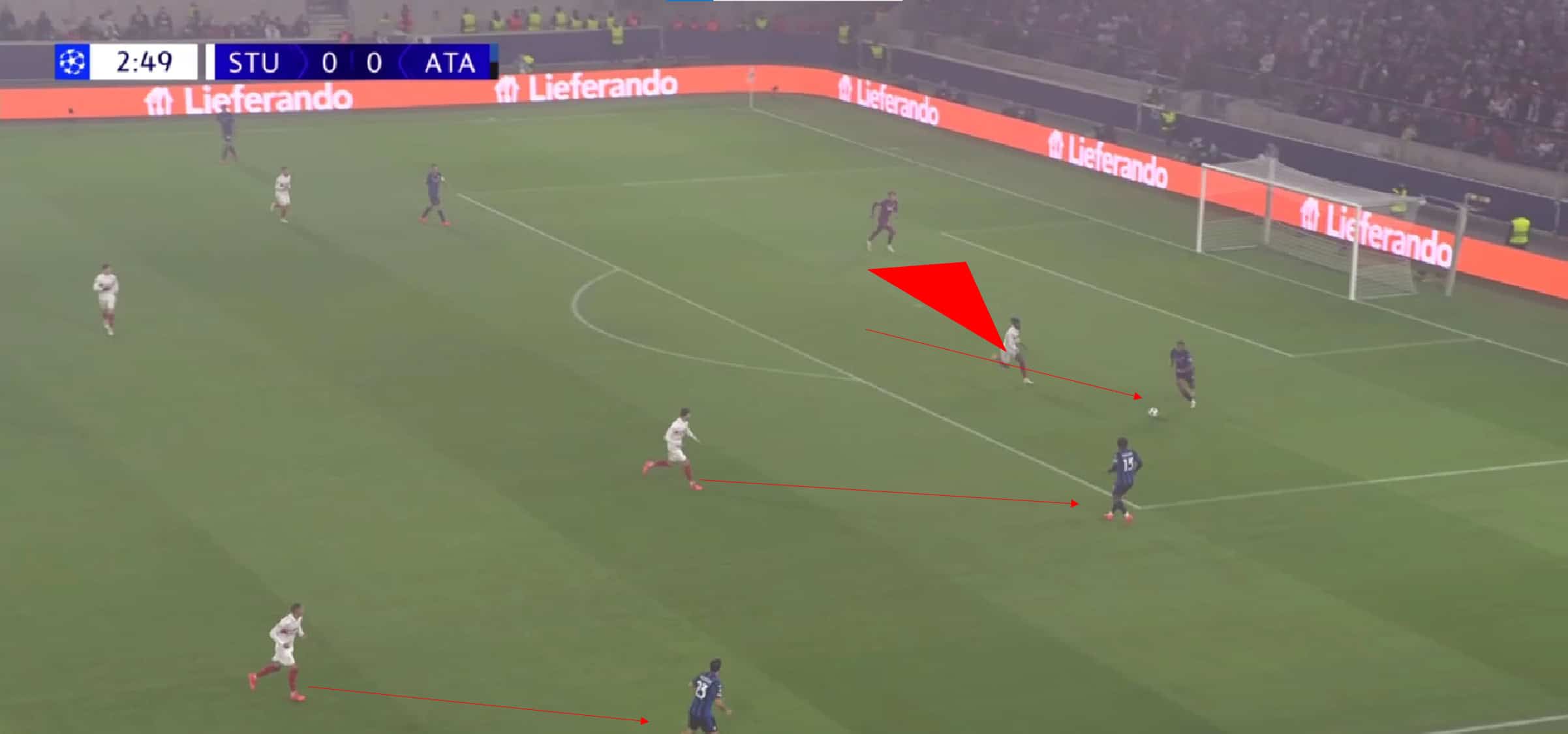
El-Bilal then starts attacking the ball at a very high pace.
Instead of moving in the direct path towards the Atalanta centre-back, El-Bilal curves his movement a bit so he can use his shadow to cut off the passing options towards the left side of the pitch.
Atalanta has no option but to pass it to the right side, where Millot and Karazor are already closing in on their men after El-Bilal triggered the press with his run.
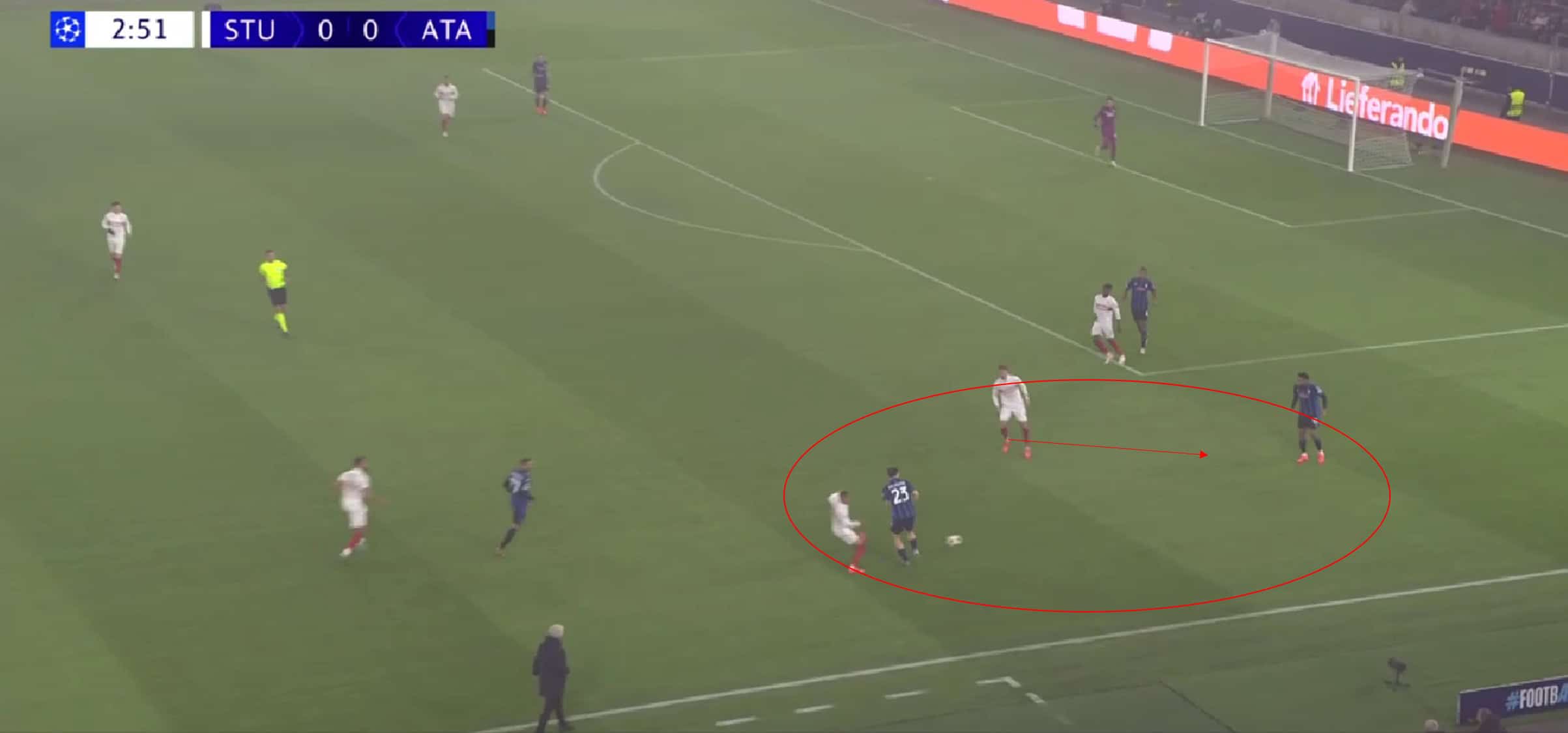
Therefore, Stuttgart can create a 3v3 situation in a condensed space.
Atalanta was rarely able to find solutions in these types of situations.
Here, the left wingback Zappacosta tries to drop back and help his teammates, but Vagnoman is easily able to follow him and man-mark him as well.
Atalanta tries to find solutions with quick passes, but Kolasinac is under instant pressure and plays a bad backwards lay-off that Karazor is easily able to intercept.
Stuttgart then tries to play themselves out of the tight space as well, but Atalanta is able to recover with their counter-press, and Stuttgart is only able to collect a throw-in.
This situation happened at the start of the game but pretty well encapsulates the first half of the match: Atalanta has the ball but struggles to find solutions in the build-up.
Stuttgart’s attacking press is working well, but they are not able to capitalise on their recoveries and lose the ball quickly again.
While the game was very interesting from a tactical perspective and was very intense, there were not many goalscoring opportunities during these 45 minutes.
Atalanta Pressing More Aggressively In The Second Half
While Atalanta had a tad more possession in the first half, they also struggled to create goalscoring chances.
With their build-up struggling against Hoeneß’s men’s attacking press and their counterattacks not being precise enough, they needed to make a couple of changes.
Gasperini made two of those at half-time.
Firstly, Atalanta was now also pressing way more aggressively and in a more effective manner.
Secondly, Gasperini brought on De Kaetelaere for Pasalic, a change that proved itself to be very important.
While Atalanta alternated between an attacking and a midfield press in the first half, they were not entirely committed to their press for multiple reasons.
For one, Stuttgart was playing a lot of long balls over the midfield in the first half.
Secondly, Stuttgart is very good at playing against an attacking press.
Thirdly, Stuttgart heavily involved their goalkeeper, which is rather dangerous for a completely man-oriented press like Atalanta’s.
In the second half, things changed a bit, however.
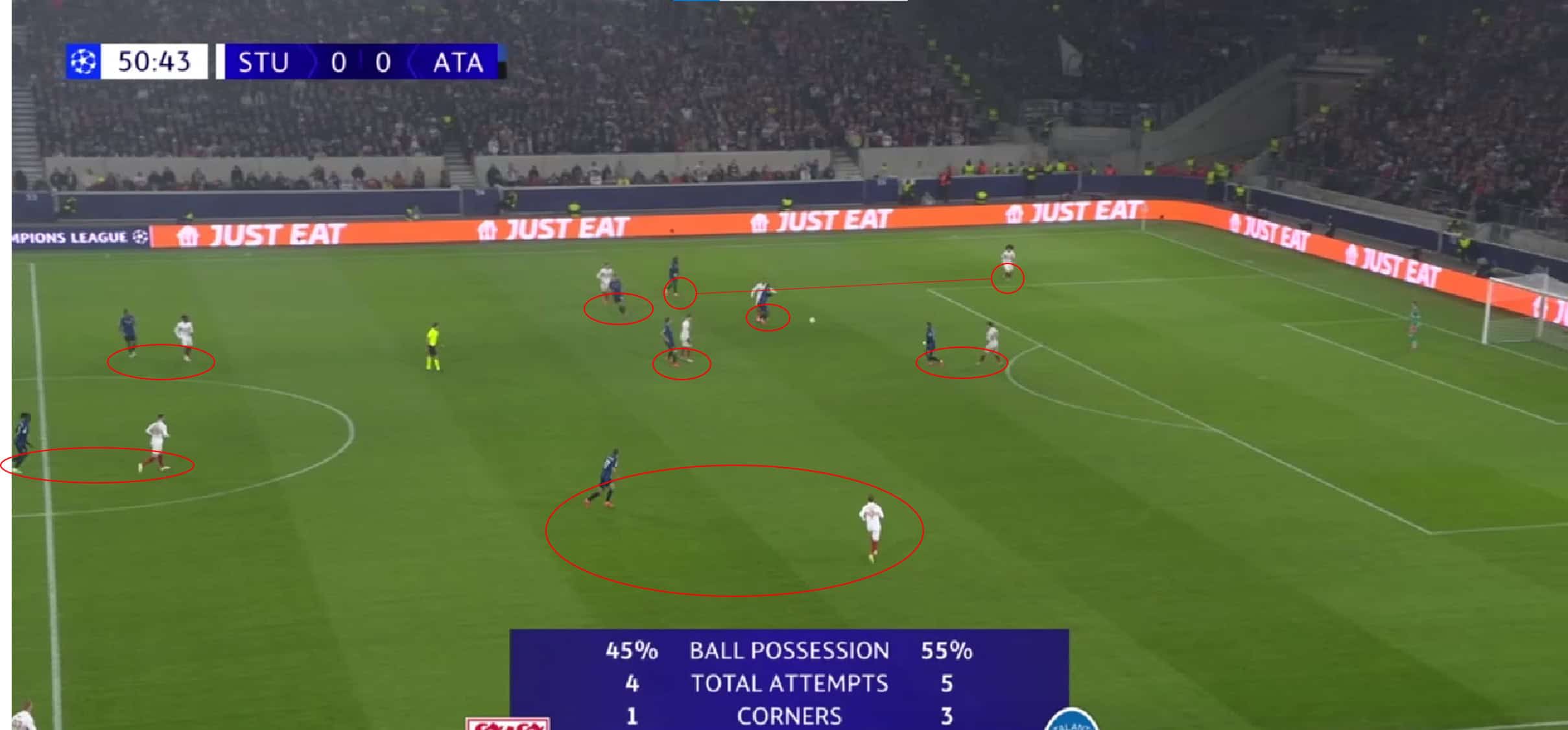
Here we can see the press of Atalanta in its full effect.
Stuttgart tried to build up from the back to start the second half, probably because they also realized that their long balls were hampering their ability to keep possession in the first half.
Atalanta created man-to-man situations all over the field; every Stuttgart player had an Atalanta player directly assigned to him.
This allowed Atalanta to put immediate pressure on Stuttgart in their build-up phase because Stuttgart was never able to create numbers advantages anywhere on the pitch.
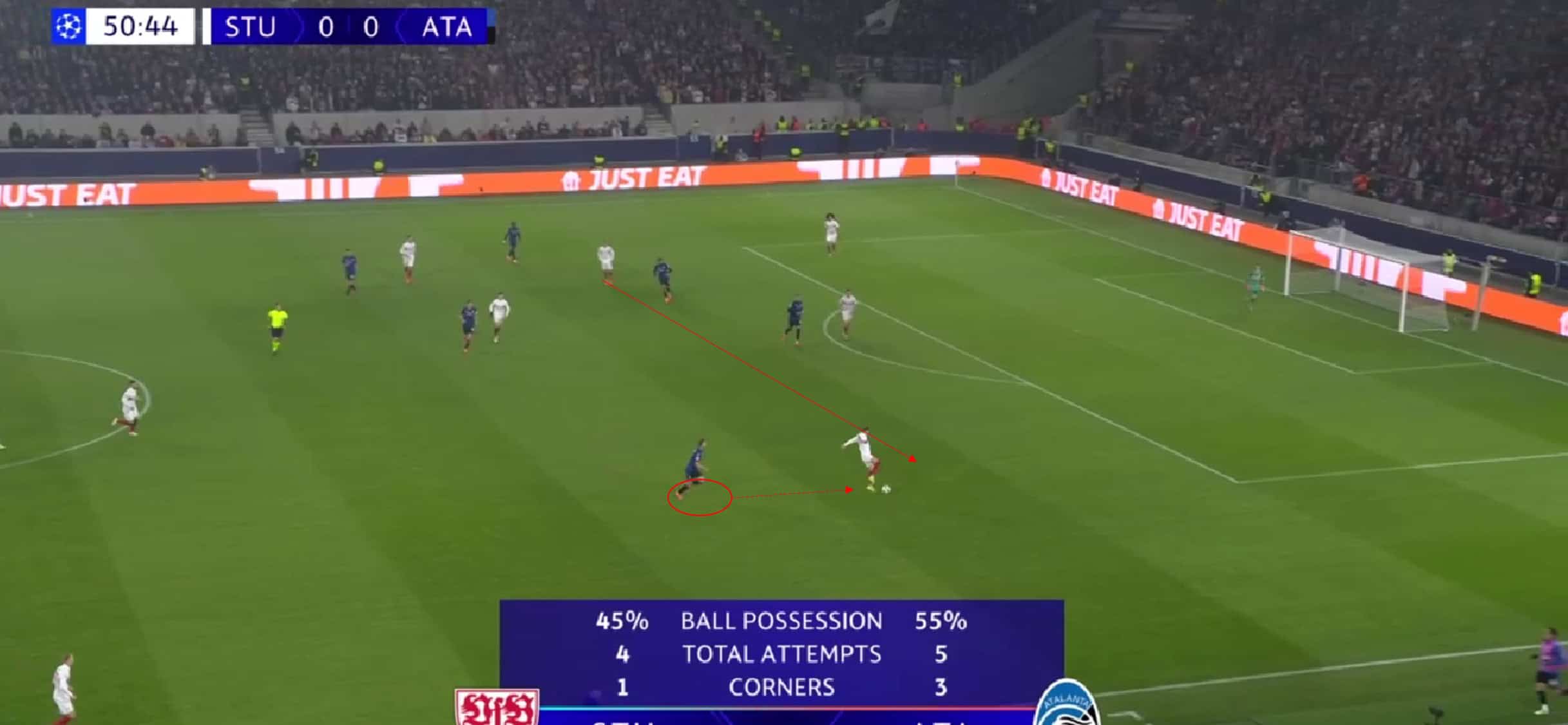
Here, Gasperini’s men were able to tighten up the space to a minimum and forced a bad pass from Stuttgart trying to switch play to the other side.
Therefore, Bellanova was able to move forward instantly and put pressure on the Stuttgart player while he was facing his own goal.
This led to more pressure on the Stuttgart players, and in the end, Mittelstädt was not able to control the ball properly and had to play another uncontrolled pass to prevent losing the ball in the 1v1 duel.
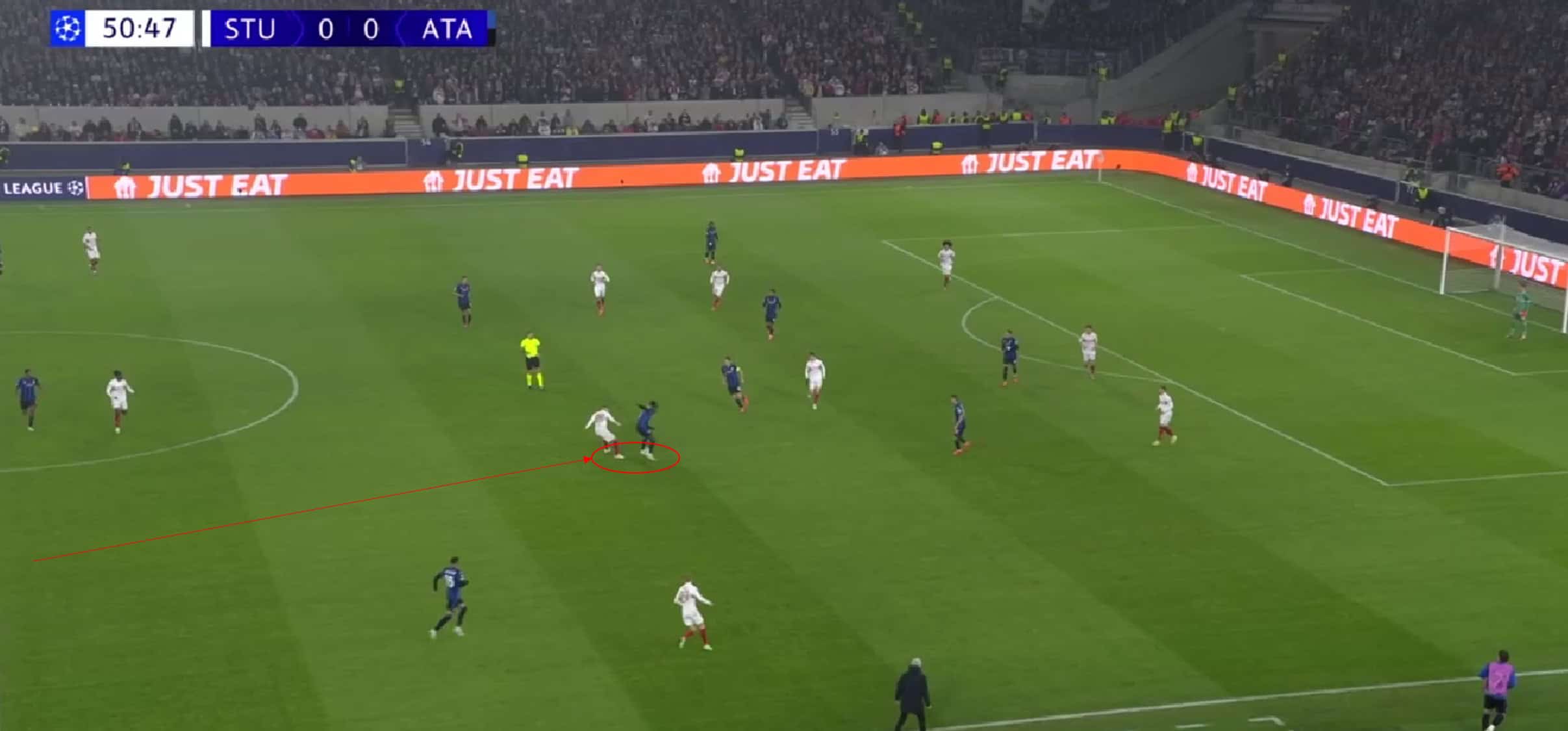
Deniz Undav tries to help out his teammates and drops back into midfield to recover the ball.
Still, because of the 1v1 situations all over the pitch, Koussounou is able to follow Undav and force him into a tough duel, and the Atalanta player is able to win and recover the ball in this situation.
In this case, Koussounou plays a simple pass to his Belgian super-sub, who manages to break through into the Stuttgart box and squares the ball to Lookman, who scores the opening goal of the match.
After struggling in possession and their press not getting a lot of grip against Stuttgart in the first half, Gasperini’s halftime adjustments and subs managed to get Atalanta into the lead within just six minutes.
Stuttgart Trying To Overcome The Deficit
From then on, Stuttgart was tasked with finding solutions to overcome their deficit in the remaining 40 minutes of the game.
Atalanta was not dropping back into a deep block.
However, Gasperini still had his men pressing Stuttgart’s build-up aggressively after gaining the lead.
With their long balls not working out, Hoeneß had to give his men new ideas to overcome the tactical measure that even managed to hand Bayer Leverkusen their only loss last season.
Stuttgart tried to find solutions with changes in their positional play.
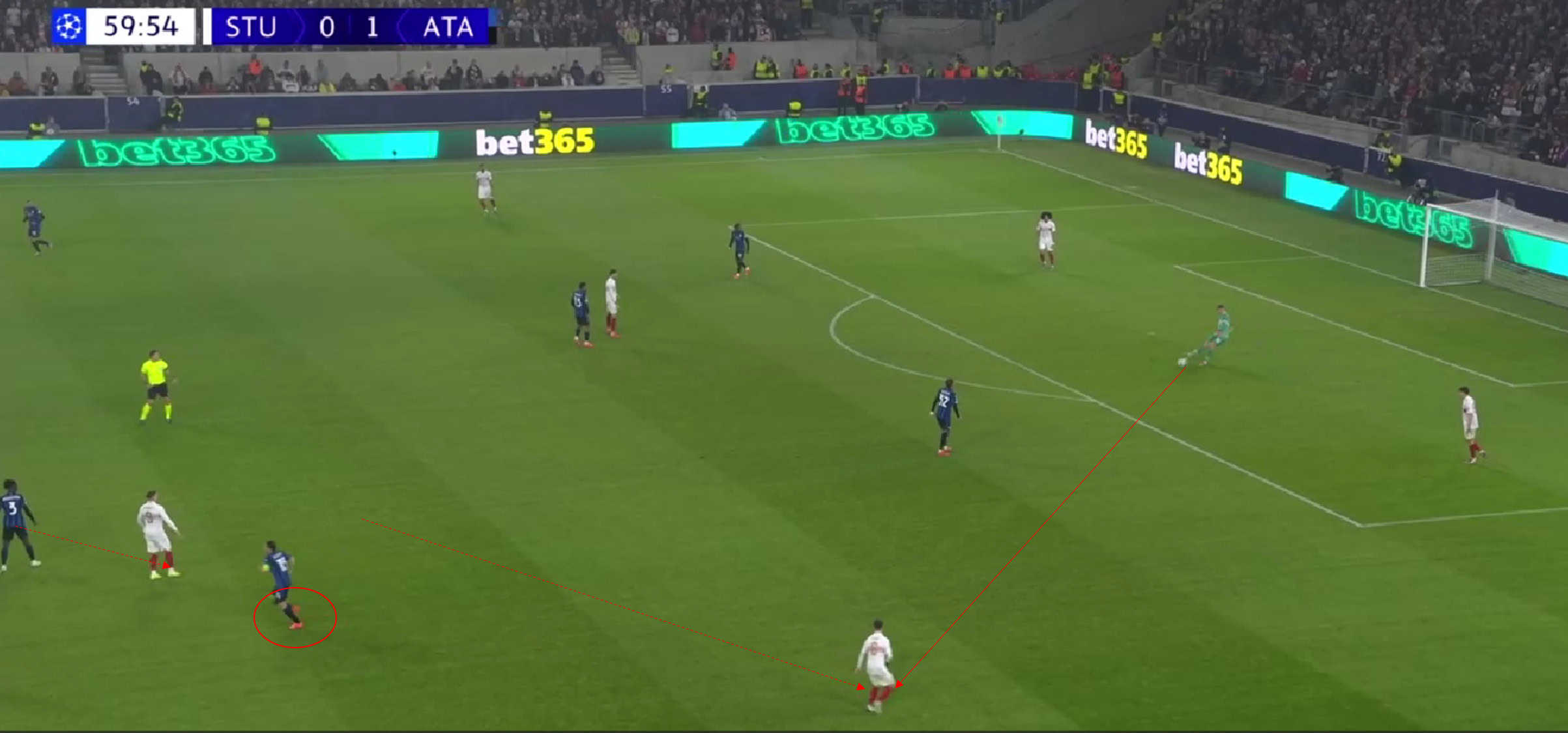
Here, we can see a situation where Stuttgart once again was in man-to-man situations all over the pitch.
This time, they pushed their left-back Mittelstädt high up the pitch, letting their holding midfielder Stiller drop out into the left-back position and striker Ermedin Demirovic drop back into the midfield.
This forced Atalanta to cover a lot of ground, push their wingers far back, and drag their central players, De Roon and Koussounou, far out of position.
Looking at De Roon, he understands that they have just vacated their defensive centre, the most important basic principle while defending and is turning around, aborting the pressing attempt and trying to recover space in the middle.
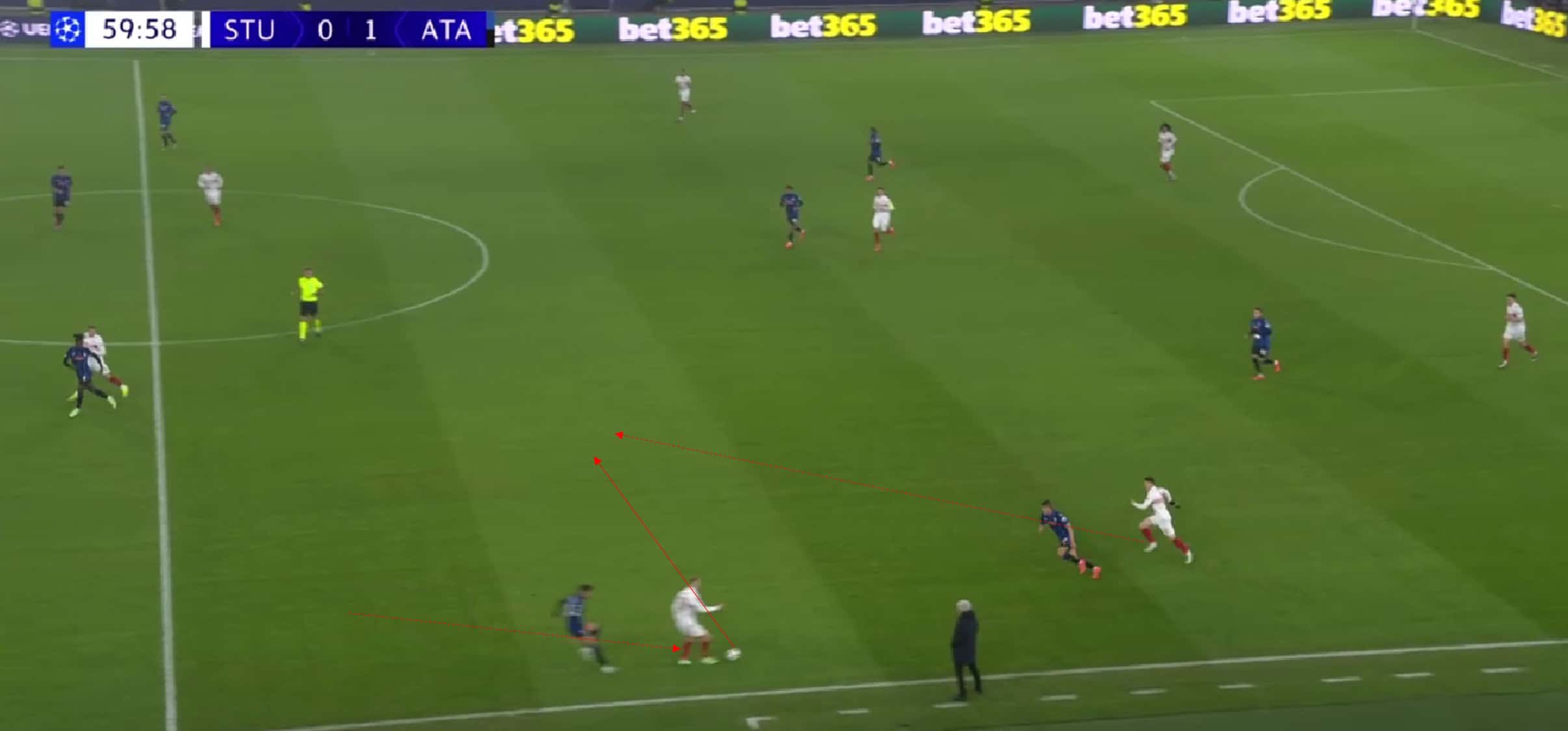
It’s already too late for that, however; Führich drops deep as well and plays a quick pass towards the centre, where Stiller is moving in the space behind his man-marker.
This creates a lot of dynamic in the attack and uses the space Atalanta was not able to cover with their man-marking.
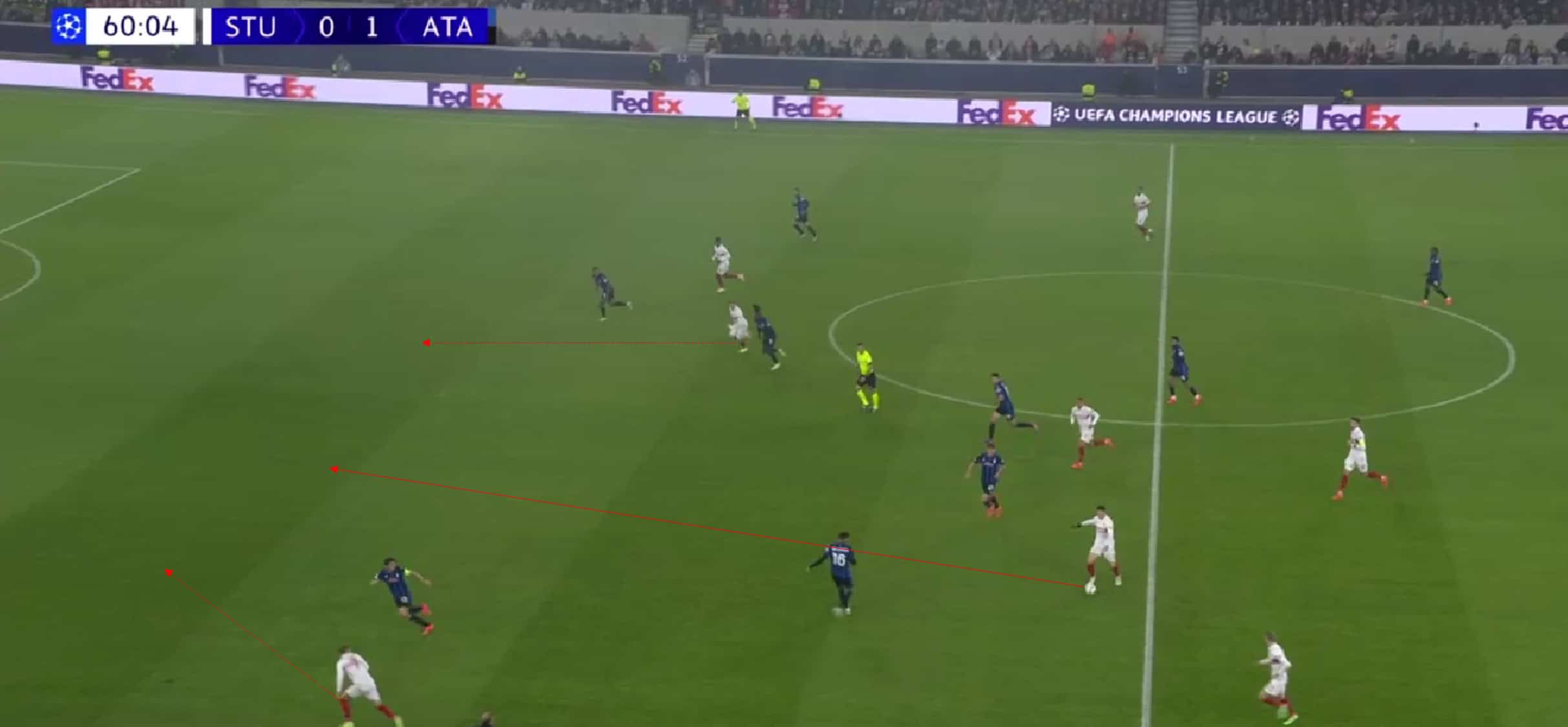
From then on, Atalanta are scrambling to recover, but it’s already too late.
Stiller has the ball again and is under no pressure at all.
The Atalanta defenders are in horrible positions, and the gaps between them are way too big.
Koussounou is running around somewhere in midfield.
The slow De Roon has to go into a sprinting duel against the quick Mittelstädt, and the Stuttgart attackers are all in favourable positions to make runs behind the defensive line.
Stiller plays an excellent through ball to Mittelstädt here, who is able to beat De Roon and cross the ball in easily but fails to find a teammate in the box.
Stuttgart was not able to create these types of situations too often, which led to them losing the ball to Atalanta’s press way too frequently.
They had two more breakthroughs this way, but they wasted these opportunities too carelessly and, therefore, were not able to score a goal.
Gasperini’s men finished the game with a deciding counterattack in the 89th minute and won a tough away game in the south of Germany.
Conclusion
VfB Stuttgart and Atalanta Bergamo are two of the most interesting teams in European football right now.
With their young squads, proactive approach to the game, and great managers, the two teams impressed last season and this season so far.
It was the expected close game with many interesting tactical tweaks to observe, but not for the reason most people expected.
In the first half, Stuttgart controlled the game with their press, giving up on possession to avoid falling victim to Gasperini’s men-oriented press.
This resulted in very few goalscoring chances in an intense game.
In the second half, both teams tried to be more aggressive, but Atalanta was able to control Stuttgart’s build-up and take the lead after a high recovery resulting from their man-to-man press.
Hoeneß and his men did not find enough solutions against this high press while trailing, resulting in only a few good opportunities for the German vice-champion.
They failed to capitalise in these situations, which resulted in Atalanta capping off the game with a counterattack.
Both teams showcased their strengths, and it was a game at a very high level, but Atalanta was just a bit more decisive and managed to convert their biggest strength into a goal.
Both teams still have decent chances to get into the knock-out rounds of the UEFA Champions League.
However, with this result, Stuttgart faces a lot more pressure in the remaining games than Atalanta, who are still unbeaten in the competition this season.
