
It is easy to lose track of the number of players Chelsea have purchased since the new ownership took control at Stamford Bridge.
The club’s model has focused on the pursuit of high‑ceiling youth, banking on contracts of extraordinary length and the potential of later resale value.
Among that recruitment drive was Carney Chukwuemeka, a central/attacking midfielder who, despite his obvious ability, seemed to slip from the mainstream conversation.
For some Chelsea supporters, he blended into the club’s crowded intake of new signings.
However, for those who had tracked his career from Aston Villa’s youth academy, Chukwuemeka represented one of English football’s brightest emerging midfielders.
His permanent transfer to Borussia Dortmund, following an initial loan spell, presents an opportunity for him to prove to the masses why he was touted as a big talent.
Who Is Carney Chukwuemeka?
Carney Chukwuemeka’s story begins in Austria, where he was born before his family moved to Northampton during his childhood.
He was signed to Aston Villa’s academy and stood out among a generation that also produced Jacob Ramsey, Louie Barry, and Jaden Philogene.
While each of those players had attributes that made them promising, Chukwuemeka carried an intangible difference.
He combined his height (6’1″) and frame with a fluid, gliding style of movement, making him appear both elegant and inevitable when carrying the ball.
His confidence in possession had a sense of not conforming to the usual stylistic profiles of English midfielders.
Chelsea’s £20m move for him in 2022 was divisive.
It appeared to be a clever move that aligns with the club’s policy of acquiring players in their teens and early twenties before they reach their peak.
It was an unnecessary risk for others, given the club’s congested midfield.
Both arguments contained grains of truth.
Chukwuemeka certainly provided flashes of brilliance when given the chance for Chelsea.
He showed the ability to glide past markers, to pick out the right vertical passes, and to link with forwards through combinations in tight central zones.
But injuries interrupted his rhythm, coaching instability limited his chances, and the weight of a chaotic and bloated squad denied him the continuity every young player needs.
As a result, Chelsea loaned him to Borussia Dortmund, who, for more than a decade, have been Europe’s most reliable environment for young players.
The Bundesliga club quickly recognized the raw potential he carried and moved to secure his services on a permanent basis for £24 million.
For Chelsea, it represented closure, the drawing of a line under another developmental gamble.
But for Dortmund, it was an opportunity.
The move leaves Chukwuemeka with an essential question about how far he can go in a system that maximises his abilities.
To answer that, it is necessary to examine Carney Chukwuemeka in detail.
Carney Chukwuemeka Style Of Play
Carney Chukwuemeka’s natural position is somewhere between advanced central midfielder and attacking midfielder.
He is most comfortable as the left‑sided number eight in a 4‑3‑3 or as “the number ten” in a 4‑2‑3‑1.
The common thread in both positions is his occupation of the half‑spaces and his preference for receiving between the opposition’s defensive and midfield lines.
He is not a wide player and is not maximised when asked to initiate play from deep.
His profile is that of an in-between-the-lines player who becomes dangerous when trusted to receive under pressure, turn into pockets of space, and drive vertically into the final third.
This makes him a good fit for Dortmund.
They encourage progression in central areas, and their playing model rewards midfielders who can receive with their back to goal, manipulate a marker, and link with advancing forwards.
Jude Bellingham performed this function superbly before his move to Real Madrid, albeit with a style that was relentless in energy, aggression, and constant movement.
Chukwuemeka is cut from a different cloth.
He is a glider rather than a bulldozer, an elegant carrier rather than a relentless presser.
Carney Chukwuemeka Position At Borussia Dortmund
When Kovač arrived in early 2025, Dortmund were mid-table and conceding at an unsustainable rate in the 4-2-3-1 shape.
Within the double pivot, there was no competent midfielder to protect the backline, and with full-backs who naturally pushed up, the team became too open in defensive transitions.
After the March international break, Kovač recognised that a third centre-back was needed and began using the 3-4-2-1 formation.
It is within this shape that Carney Chukwuemeka’s qualities can be showcased in the best possible way.

The two advanced midfield roles sit behind the striker and are designed for players who can play between the lines.
They are asked to receive the ball under pressure, to pivot into space in one or two touches, and then to release teammates into forward channels.
In the league match against Freiburg, Chukwuemeka demonstrates his close control by escaping pressure in tight spaces, utilizing his long stride to manipulate the ball without losing composure.
He then releases a well‑timed pass into Julian Brandt’s path, allowing the midfielder to attack the goal from a better position.
These are the areas of the game where Carney Chukwuemeka excels.
When playing as the left attacking midfielder, Chukwuemeka enjoys both structural safety and creative licence.
The double pivot behind him provides constant security; one midfielder can always balance while the other steps deeper to offer a passing option.
He is free to remain higher between the opposition’s full-back and centre-back, receiving the ball in the half-space with minimal defensive burden (third line occupation).
Chukwuemeka becomes the nexus of a left-sided triangle with Daniel Svensson and Serhou Guirassy from this zone.
Svensson’s willingness to overlap allows Chukwuemeka to occupy narrower spaces.
This draws defenders inside before releasing angled passes into the wing.
The triangle functions dynamically: Svensson offers depth and width, Chukwuemeka gives angle and stability, and Guirassy provides the vertical option.
Equally important is his diagonal relationship with Karim Adeyemi, who acts as the right attacking midfielder on the opposite side.
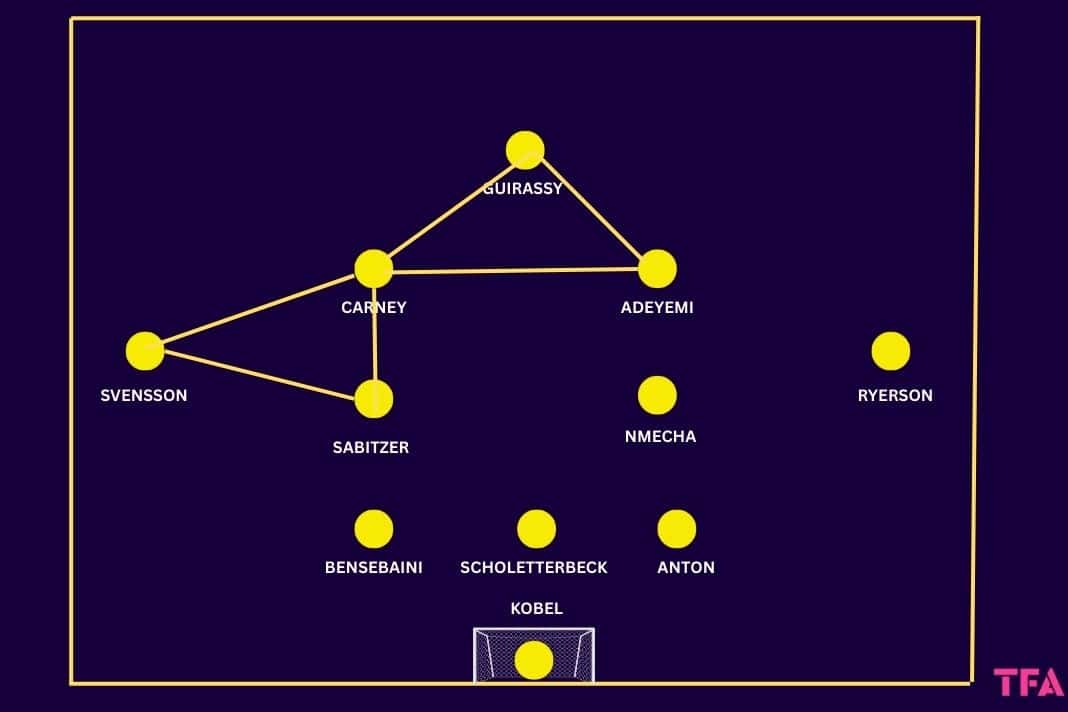
Adeyemi’s ability to burst inside from the right creates a “cross-stagger” with Carney Chukwuemeka.
When one drops to receive at the feet, the other runs behind the line.
This interdependence simultaneously stretches both centre-backs and the pivot line because any attempt to compress one side leaves the opposite channel vulnerable.
This relationship provides the functional balance of the 3-4-2-1: one advanced midfielder acts as a connector and carrier, and the other as a depth runner.
When he is selected on the left side of this pair, he naturally creates a triangle with Svensson and Guirassy.
He develops linkages that draw Adeyemi across the pitch into inside-to-out rotations.
If Svensson is blocked and Adeyemi is tightly held, Chukwuemeka has the technical quality to bypass both reference points.
His ball-carrying relieves the team of pressure.
In the league fixture against Wolfsburg, a throw‑in from Svensson to Guirassy initiates a left‑side triangular pattern.
Guirassy cushions the ball into Chukwuemeka’s path, allowing him to carry forward.
He uses body feints and quick one‑two combinations to bypass his marker comfortably.
He then regains possession and creates additional space to continue driving into the next third.
In the 6–0 win over Union Berlin, Chukwuemeka operates from the right and showcases his deceptive movement.
By shaping as if to carry inside, he drew his defender towards the central channel before accelerating down the line instead.
The misdirection forces his opponent into a desperate challenge, which results in a foul that prevents him from progressing further.
He can occupy and impact the same areas Jude did, and Niko Kovač has noticed his potential.
Carney Chukwuemeka As Number 10
Kovač has also explored using Carney Chukwuemeka centrally as the sole number ten.
The demands here are slightly different.
Instead of leaning wide to connect with overlaps, he positions himself directly behind the striker and becomes the specialist in second-line receptions.
By drawing the attention of the opposing holding midfielder, he opens pockets of space for the centre-forward to receive into feet or for the wide midfielders to move into gaps on the outside shoulders of defenders.
He can also become the third runner at other times, arriving late and unmarked into the penalty area to attack cut-backs or recycled crosses.
Defensively, Kovač has laid down non-negotiables for his attacking midfielders.
They initiate the press as soon as the ball travels into the middle third.
For Chukwuemeka, this needs consistency and concentration.
He will need to close passing lanes by curving his pressing run to block both the passing angle to the pivot and the ball-carrier himself.
His challenge lies in sustaining this behaviour because Dortmund’s system depends on collective synchronisation during transitions.
Conclusion
What Dortmund gain in Carney Chukwuemeka is not a direct Bellingham replacement but more of a playmaker.
Whereas Julian Brandt can be seen as a pure connector (so can Marcel Sabitzer), Salih Özcan adds stability, and Carney Chukwuemeka provides that progressive penetration through dribbling and passing.
Carney Chukwuemeka now steps onto the UEFA Champions League stage with Dortmund, a platform that both elevates his potential and amplifies his responsibility.
On Kovač’s side, he has the safety to develop and the structure to refine his decision‑making.
If he continues to add consistency and control to his game, this move could be the launching point that defines his career.
