
The 2024/2025 Premier League season has become a tactical battleground where vertical progression and transitional threat are redefining success at the top level — this data analysis explains exactly how.
In this data analysis report, we focus on how Liverpool, under new coach Arne Slot, have reclaimed their dominance with a bold, direct style of play marked by quick transitions and vertical passes, representing a clear evolution from Jürgen Klopp tactics.
Arsenal, led by Mikel Arteta, continue to refine their balance between structured build-up and purposeful progression, establishing themselves as serious title contenders.
Meanwhile, Pep Guardiola and Manchester City — long celebrated for their control and possession-based play — are facing new tactical challenges from teams embracing aggressive, forward-thinking football.
This data analysis report breaks down the key statistics behind these shifts, including progressive passes, switches of play, through balls, and passing accuracy.
Examining these Premier League stats reveals how verticality and transitional play shape team identities, offensive creativity, and the Premier League table itself.
Premier League Progressive Pass Distance 2024/2025
Progressive pass distance remains among the most insightful indicators of a team’s intent and tactical approach in the Premier League.
In the 2024/2025 season, it is clear that teams with a greater commitment to verticality are often reaping tactical rewards.
Progressive Pass Distance Per Team – Premier League 2024/2025

Liverpool top the charts with a remarkable 93,682 metres in progressive pass distance, reflecting Arne Slot’s focus on directness and purposeful transitions.
This aggressive style complements their pressing structure and front-foot mentality.
Chelsea follow closely with 90,167 metres, underlining their shift to a more assertive passing model.
Manchester City, despite their renowned possession-heavy style, still rank highly at 87,972 metres, showing that control and verticality are not mutually exclusive.
Fulham (87,883 metres) and Tottenham Hotspur (86,672 metres) also demonstrate strong upward momentum in their build-up patterns.
Interestingly, Brentford outperform expectations with 84,201 metres, suggesting their directness and adaptability in both settled possession and counter-attacks.
Brighton and Newcastle United, often lauded for their technical structure, also maintain progressive intent, both exceeding 81,000 metres.
At the other end, Nottingham Forest record the lowest progressive pass distance at 65,376 metres, followed by Ipswich Town and Crystal Palace.
This highlights their limited ability — or tactical choice — to play forward early, which may be impacting their threat in transition or final-third entries.
Crucially, teams with both high progressive distance and solid pass completion rates — such as Manchester City, Arsenal and Liverpool — show the strongest correlation with sustained attacking pressure and territorial dominance.
On the contrary, lower-table sides combining low completion rates with modest verticality often struggle to escape pressure or mount consistent attacks.
In short, progressive pass distance not only quantifies vertical intent but also provides a key tactical fingerprint of how teams are evolving — from possession conservatism to controlled risk-taking across the Premier League hierarchy.
Premier League Switches Vs Final Third Passes
The balance between lateral switches and vertical entries into the final third offers a revealing glimpse into each team’s attacking philosophy in the 2024/2025 Premier League campaign.
Switches Vs Final Third Passes – Premier League 2024/2025
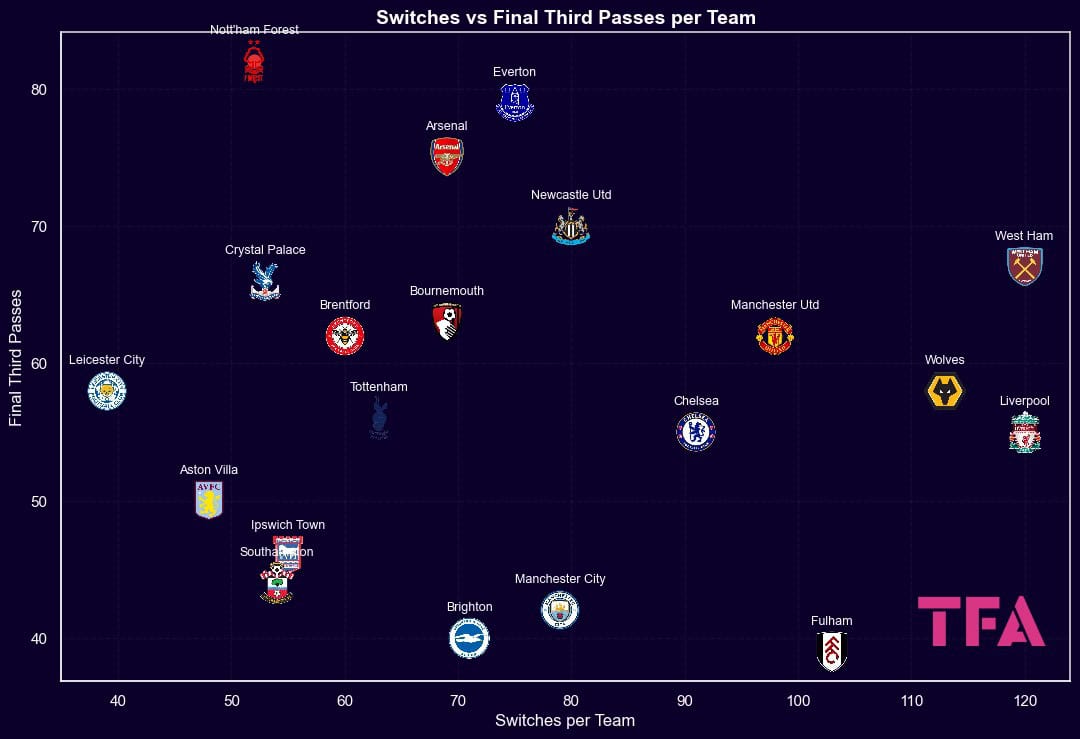
Manchester City and Arsenal stand out not only for their overall passing volume but also for their efficient progression into dangerous areas.
City executed 79 switches and an impressive 1,495 final-third passes, reflecting Pep Guardiola’s use of width to stretch defences before slicing through the central channels.
Arsenal, similarly, delivered 1,253 passes into the final third, using 69 switches, indicating a greater reliance on compact interplay and interior progression.
Chelsea, Tottenham and Liverpool exhibit a more blended approach.
Chelsea’s 91 switches and 1,374 final-third passes suggest a dynamic reshaping of play across both flanks before initiating incisive forward movement.
Liverpool, with 120 switches and 1,427 final-third entries, have embraced both direct vertical play and wide circulation under Arne Slot, enabling rapid transitions and flexibility in attack.
Teams like Fulham (103 switches, 1,207 final-third passes) and Newcastle (80 switches, 1,016 final-third passes) also reflect this dual strategy, contributing to their solid offensive numbers, particularly in transitional phases.
Conversely, clubs such as Nottingham Forest and Crystal Palace show lower figures in both metrics — 52/828 and 53/813, respectively — aligning with their conservative build-up and reduced creative output.
This hesitance or tactical rigidity may limit their ability to destabilise opponents or consistently threaten high-value zones.
Ultimately, the most successful sides strike a strategic equilibrium: using switches to disorganise defences and final-third passes to capitalise.
When executed fluidly, this combination enhances chance creation, increases expected assists (xA) and raises the overall attacking ceiling.
Premier League Pass Completion Rates For Short, Medium & Long Passes
Pass completion rates offer valuable insight into how teams progress play and manage risk.
On average across the league, short passes are completed at a highly efficient 89.4%, medium passes at 87.1%, while long passes see a noticeable drop, averaging only 51.7%.
These disparities highlight both the mechanical complexity and tactical risk associated with longer-range distribution.
Pass Completion Profile Per Team – Premier League 2024/2025
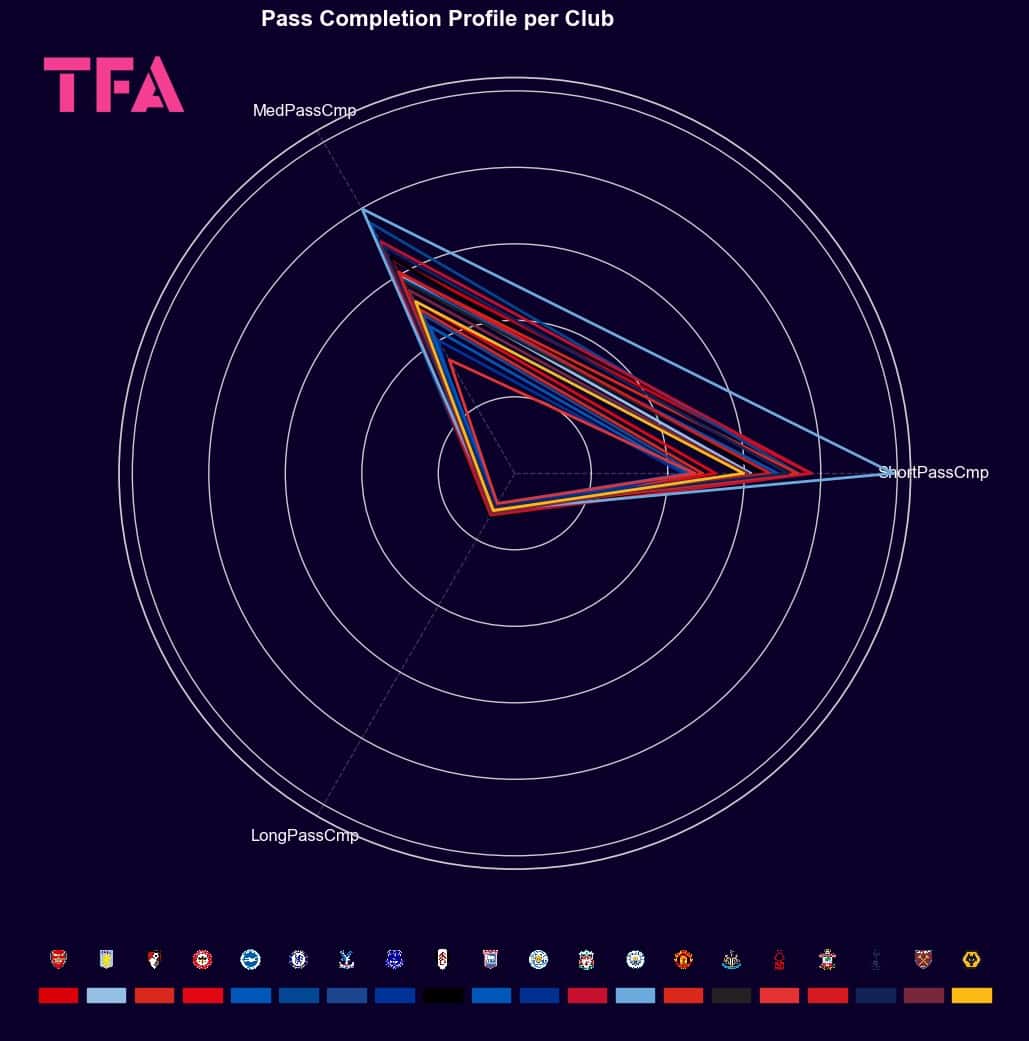
Manchester City lead the league with outstanding efficiency across all distances — an incredible 92.8% for short passes, 91.8% for medium, and 62.5% for long.
Their technical proficiency underpins their possession-dominant model.
Arsenal and Chelsea also feature prominently.
Arsenal averaging 91.7% for short passes and 89.1% for medium passes reflects its commitment to a controlled build-up style.
In contrast, Nottingham Forest and Crystal Palace lag behind, particularly in long pass completion, posting 43.8% and 44.7% respectively.
These numbers hint at either technical limitations or a more direct, high-risk approach.
Notably, Everton and Bournemouth both have sub-87% short pass completion, indicating struggles with ball retention even in low-risk zones.
The data suggest that top-performing sides maximise short and medium-range accuracy, which builds the foundation for sustained pressure and territorial control.
Meanwhile, lower-ranked teams often sacrifice possession stability in favour of quick transitions, which may yield sporadic success but lack consistency.
Teams like Liverpool and Fulham, which combine decent long pass efficiency with high short pass completion, seem to effectively straddle both styles.
Ultimately, the range and accuracy of passing remain a key differentiator in attacking sustainability and defensive risk exposure.
How Switches Of Play Shape Final Third Entries
Switches of play are vital for stretching defences and creating space in the final third.
The metric not only reflects tactical versatility but also correlates with how well teams destabilise compact defensive units.
Switches Of Play Per Team – Premier League 2024/2025
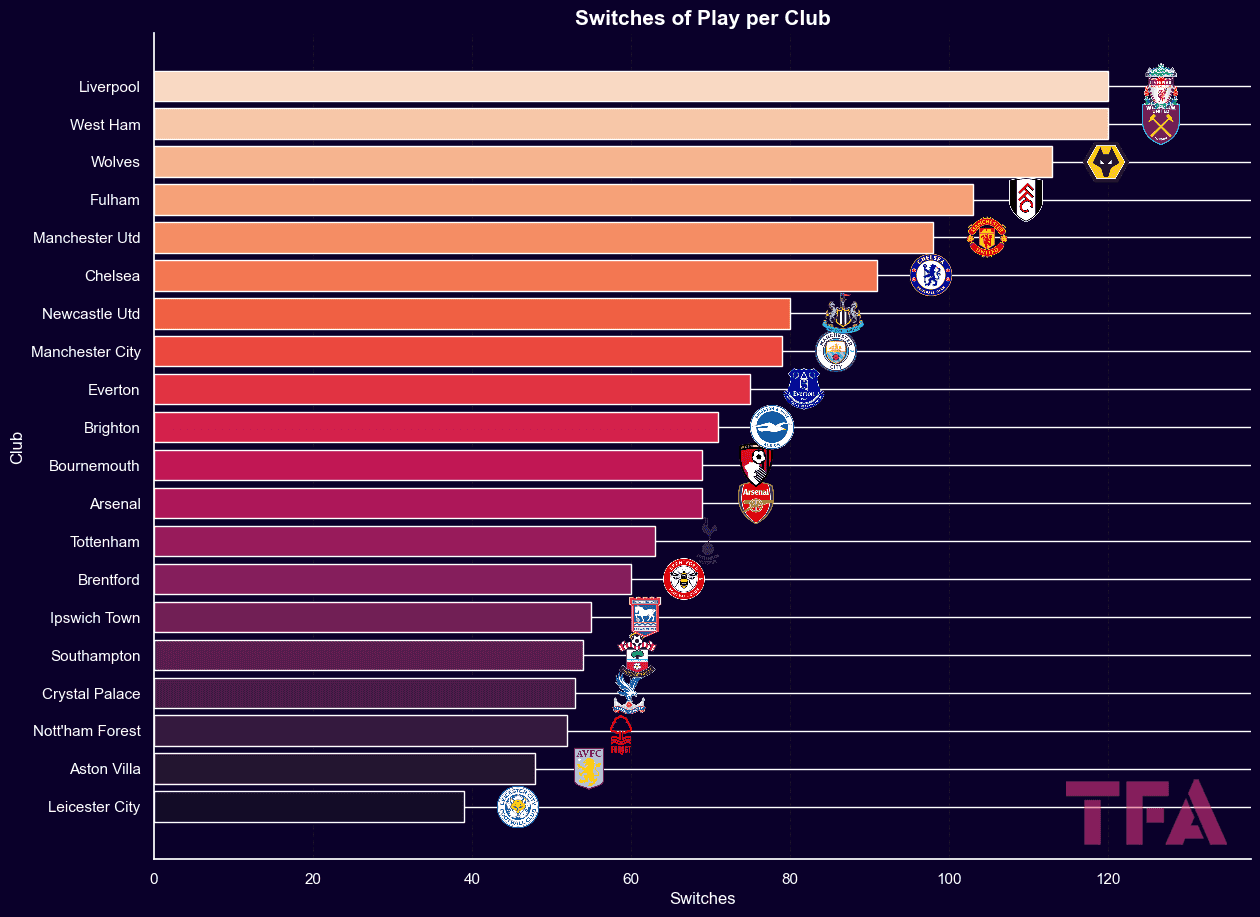
This season, Liverpool and West Ham top the charts with 120 switches each, showing a clear inclination to alter the point of attack frequently.
Wolves (113), Fulham (103), and Manchester United (98) also rely heavily on horizontal ball circulation.
For Liverpool, this complements their wide overloads and rapid flank-to-centre transitions.
West Ham’s numbers are especially notable, given their more counter-attacking style, suggesting that when they do dominate the ball, they attempt to unbalance opponents rapidly.
In contrast, Leicester City (39) and Aston Villa (48) register the fewest switches, possibly reflecting a more vertical or centrally-focused attacking build-up.
This may limit their width exploitation and can be particularly problematic against low-block defences.
Teams with higher switch counts often register more successful final-third entries through wide areas, creating overloads and drawing full-backs out of position.
A switch-heavy strategy is also closely tied to cross-dependent attacking units, such as Tottenham and Brighton, who combine high switch counts with above-average cross frequency.
Interestingly, Manchester City, despite their dominance, rank mid-table in switches (79), perhaps indicating their preference for tight combinations over expansive shifts.
Yet, their precision compensates for the lack of lateral movement.
Overall, switches are a hallmark of teams looking to manipulate defensive shape proactively.
Their judicious use often correlates with shot-creating actions and deeper territorial incursions, which are essential in high-level transitions and unlocking set defences.
Premier League Through Balls As Predictors Of xAG
In the 2024/25 Premier League season, through balls have once again emerged as one of the most incisive and high-reward passing actions in the final third.
These vertical, line-breaking passes are closely linked to chance creation quality, and this season’s data confirms their importance in driving expected assisted goals (xAG).
Through Balls As Predictors Of xAG – Premier League 2024/2025
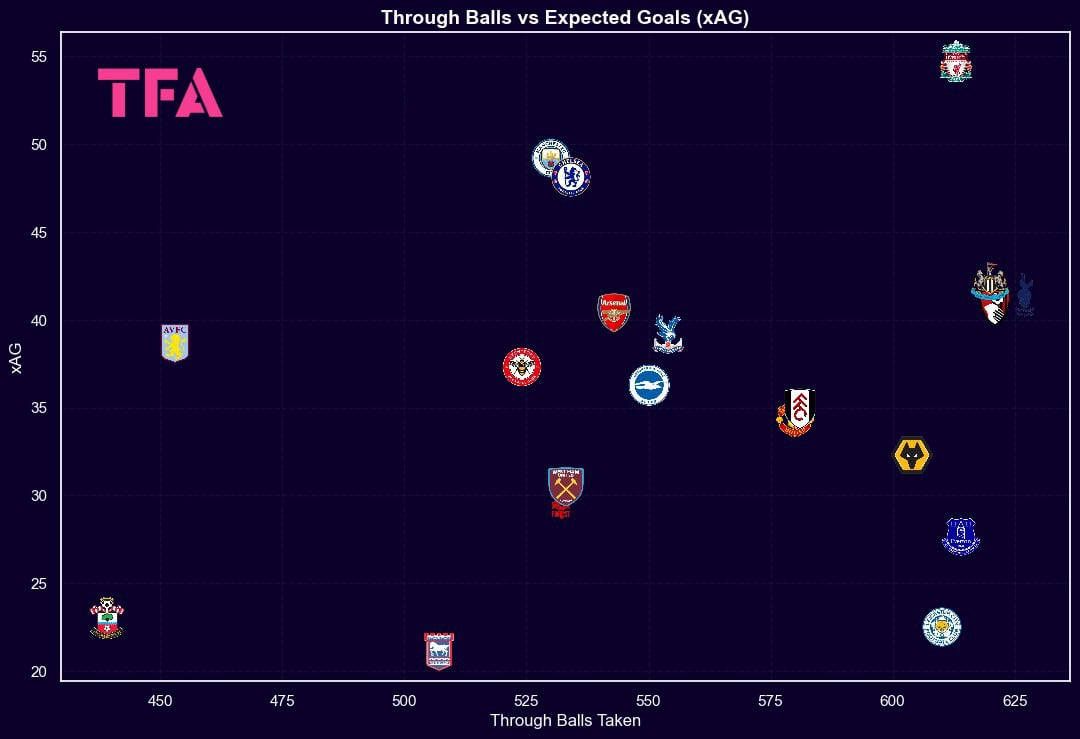
Clubs like Liverpool (60), Manchester City (80), and Tottenham (50) stand out with high volumes of through balls, and correspondingly, all three rank among the top sides in xAG — 54.7, 49.2, and 41.4 respectively.
This underlines the direct correlation between through ball frequency and the quality of chances a team produces for its forwards.
Manchester United and Aston Villa also feature respectable through ball counts (83 and 83 respectively).
Yet, their xAG (34.4 and 38.6) lags slightly behind, suggesting that while the intent is there, execution or conversion may be falling short.
On the other hand, Arsenal, with a more balanced approach (68 through balls, 40.8 xAG), demonstrates how efficiency in vertical delivery rather than volume alone can yield a high xAG return.
In contrast, Ipswich Town (42) and Nottingham Forest (49) attempt fewer through balls, and their xAG figures (21.1 and 29.9 respectively) remain modest.
This further supports the idea that teams who thread more passes between defensive lines often generate better quality chances.
Ultimately, through balls continue to be a critical tool for progressive attacking teams.
Their impact on xAG reflects their value not just in breaking lines, but in producing high-probability scoring opportunities.
In essence, high through ball counts are closely tied to higher xAG values.
Teams that actively attempt these passes are often those most capable of generating consistent, high-quality chances — making through balls not just a stylistic choice but a statistical marker of elite attacking intent.
Premier League Cross Accuracy & Creative Output
Crossing remains a cornerstone of many teams’ attacking arsenals, especially those who use width to destabilise opposition shapes.
Cross Accuracy Vs xA – Premier League 2024/2025
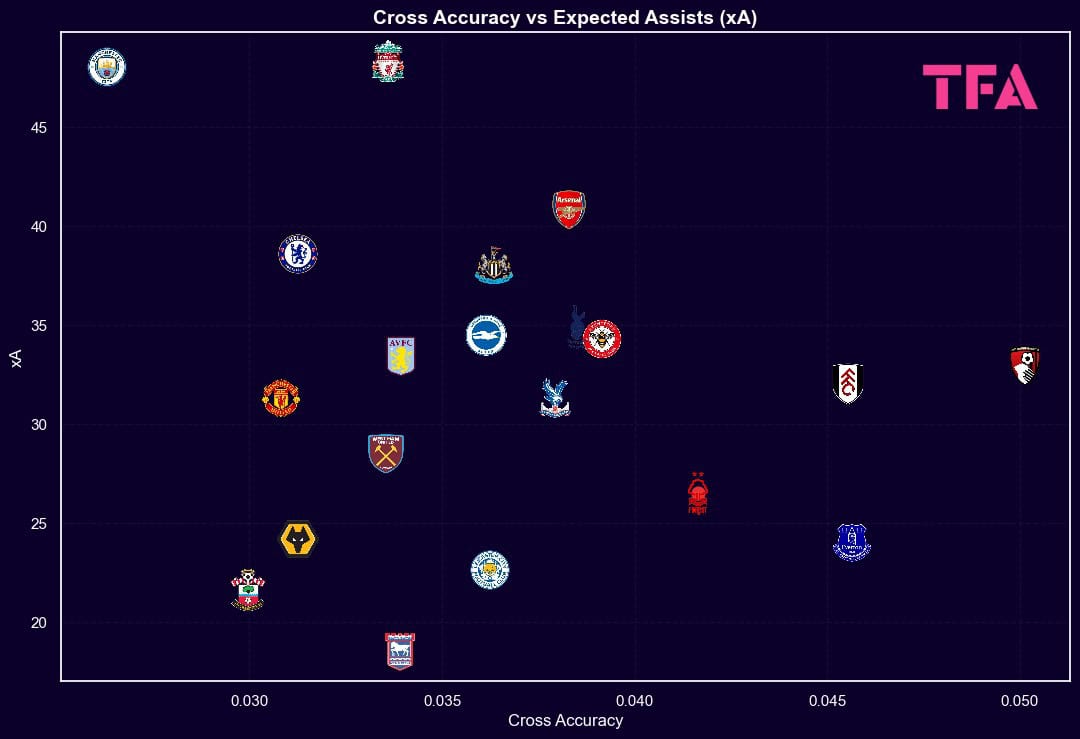
Fulham top the crossing charts with a staggering 812 crosses, followed closely by Bournemouth (746), Tottenham (714), and Arsenal (700).
This highlights their structural use of width — whether through overlapping full-backs or inverted wingers finding space to deliver.
Liverpool (654) and Brighton (623) also feature prominently, consistent with their high-possession and wide rotation models.
Interestingly, Manchester City (574) and Manchester United (561) appear relatively conservative in cross volume, likely because they favour central combinations or pull-backs from the byline.
At the bottom, Ipswich Town record the fewest with just 442, possibly indicating a more compact or transition-based approach, avoiding speculative deliveries into the box.
The volume of crosses alone does not equate to quality, but high-output teams often do so with clear structure, such as Tottenham, who pair wide switches with near-post runs.
In systems where wide play is heavily integrated, the contribution to expected assists is significant, especially when paired with aerial presence or cut-back models.
Ultimately, crossing remains a blend of volume and variance.
However, its sustained use across the top half of the table underscores its enduring value in breaking down organised defences and producing final-third creativity.
Premier League Radar Comparison Of xAG & xA Per Team
The 2024/25 season data highlights significant variation in attacking identities across Premier League sides, particularly when examining expected assisted goals (xAG) versus expected assists (xA).
While xAG reflects the underlying quality of passing that could lead to goals, xA measures the execution—passes that directly contribute to clear-cut chances.
xAG Vs xA Per Club – Premier League 2024/2025
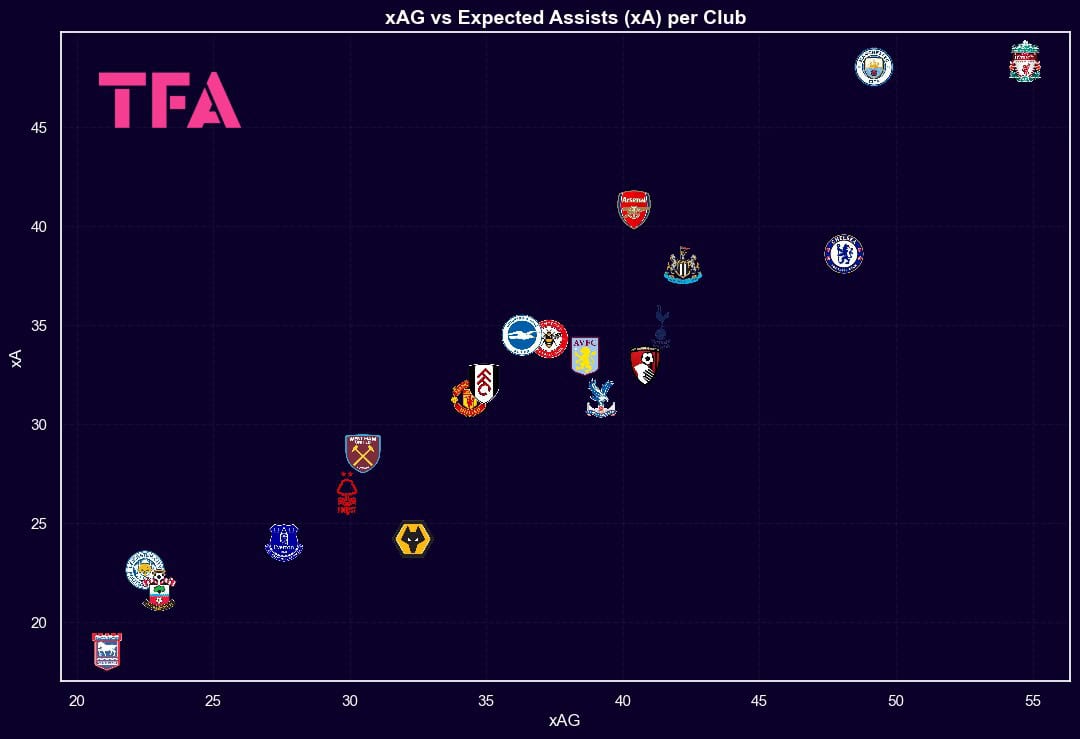
Liverpool emerge as one of the most balanced and productive attacking units, boasting an xAG of 54.7 and an xA of 48.3.
This suggests not only a high volume of incisive passes but also efficient chance creation from dangerous areas.
Manchester City similarly maintain an elite standard, with an xAG of 49.2 and an xA of 48, underlining the precision and rhythm in their positional play.
Elsewhere, Chelsea display a notable gap between their xAG (48.1) and xA (38.6), hinting at promising build-up play that doesn’t always translate into high-value chances.
The most pronounced disconnect appears with Manchester United, whose xAG of 34.4 outweighs their xA of 31.3—suggesting issues with timing or movement in the final third that may be limiting actual threat creation.
On the other end of the spectrum, sides like Nottingham Forest and Wolves punch above their weight in terms of efficiency.
Forest, for example, record a modest xA of 26.5 but an xAG of 29.9, indicating fewer passes overall but with higher quality—possibly driven by swift transitions or accurate vertical balls from deep areas.
Ultimately, the balance (or imbalance) between xAG and xA provides insight into each team’s offensive identity—whether they rely on volume and pressure or on select moments of incisive, high-quality playmaking.
Premier League Top Five Teams By Progressive Pass Distance
Progressive passing distance is a strong indicator of territorial dominance and the ability to carry play into advanced zones.
Top Five Teams By Progressive Pass Distance – Premier League 2024/2025
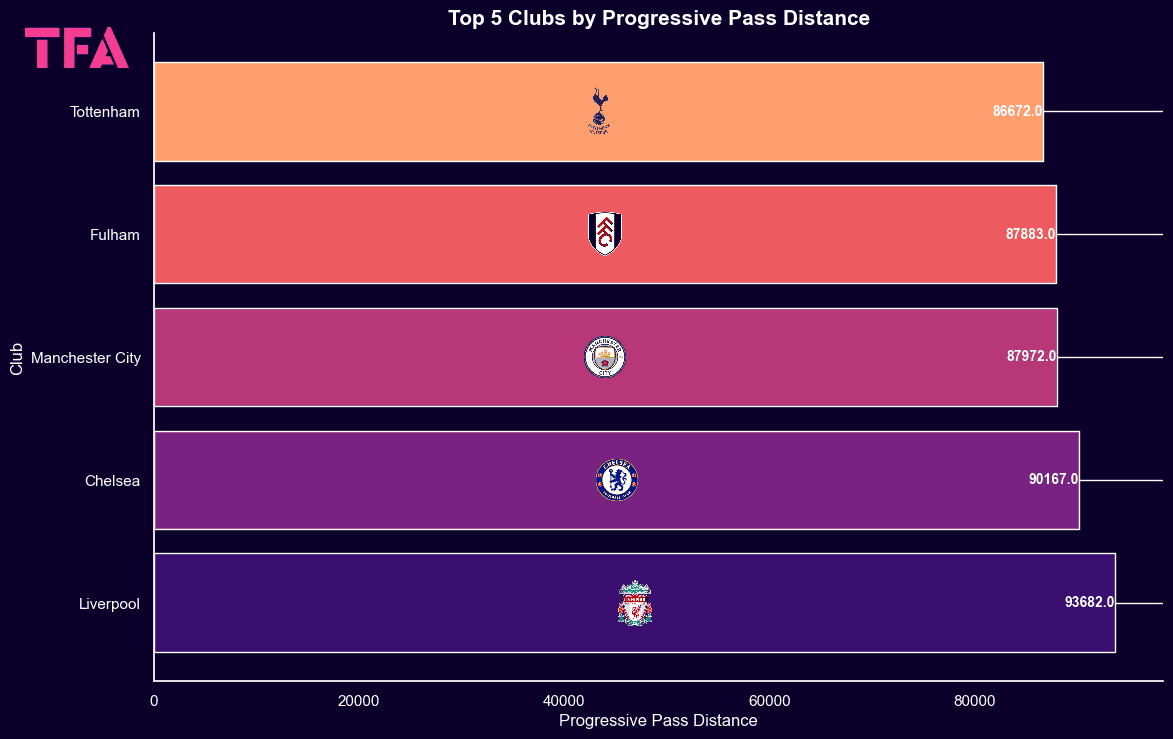
Liverpool (93,682 metres) and Chelsea (90,167 metres) lead this metric, showcasing their consistent territorial progression and ball movement into threatening areas.
Manchester City (87,972), Fulham (87,883), and Tottenham (86,672) complete the top five — all teams known for their ability to dominate possession and utilise progressive passing, either via central lanes or wide movements.
These numbers not only reflect volume but also system intensity.
For City, shorter but frequent passes accumulate progressive value, while for Tottenham, the progression often comes through fast central ball movement and switches of play.
The differential between these and lower-ranked teams in this metric points to varying capabilities in controlling space and tempo.
Bournemouth, Crystal Palace, and Nottingham Forest, for instance, rely more on reactive rather than proactive transitions and have shorter overall progressive footprints.
Possession without progression yields little value.
Hence, these top teams excel not just in retaining the ball, but in using it to advance meaningfully and destabilise opponents.
Clustering Premier League Teams By Pass Types & xG
By examining the ratios of short, medium, and long pass attempts, we can infer team identity and link it to attacking productivity (here approximated via through balls).
Team Clustering Pass Types & xAG – Premier League 2024/2025
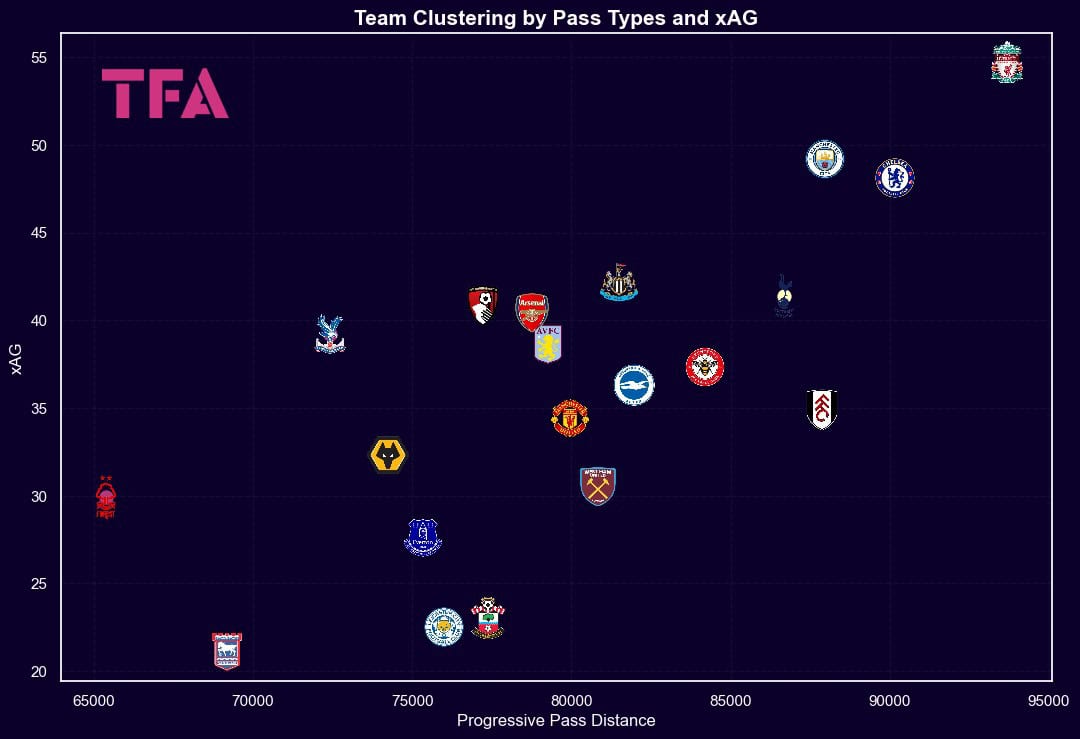
Manchester City stand out with the highest short pass percentage (50.4%) and the lowest reliance on long passes (8.5%), underlining their methodical possession-based approach.
Everton represent the opposite extreme, with only 40.9% short passes and a league-high 20.8% long passes — indicative of a direct, territory-first philosophy.
Bournemouth, Brentford, and Crystal Palace similarly lean towards long-range distribution.
Tottenham, Chelsea, and Liverpool display a more balanced distribution, combining around 45% short passes with approximately 12% long passes — offering adaptability and improved attacking transitions.
These sides also rank highly in through balls, supporting the theory that balanced pass types often yield greater offensive fluidity.
Meanwhile, teams such as Nottingham Forest, with low medium pass usage (36.4%), may struggle with structured transitions, impacting their chance quality.
Clustering teams by pass type uncovers hidden tactical nuances.
High short-pass teams often control games but risk bluntness without verticality.
Long-pass-heavy sides can bypass midfield but suffer from possession loss.
The most effective blend lies in variance — the ability to switch pace, length, and angle according to the situation.
Conclusion
As this Premier League data analysis reveals, vertical progression and transitional threat have become decisive tools in shaping modern Premier League football.
Teams like Liverpool, Tottenham, and Newcastle have embraced directness and swift movement to great effect, combining through balls, switches, and progressive passes to unlock defences and create high-value opportunities.
In contrast, Manchester City and Arsenal maintain their methodical approach but have had to adapt to the growing pace and unpredictability of opponents who weaponise transitions.
The data suggests that success no longer lies in possession alone but in how dynamically teams convert possession into territorial gains and threats.
Switches of play continue to stretch and dismantle compact blocks, while through balls emerge as key predictors of expected assisted goals.
Moreover, the variation in passing DNA — whether short, medium, or long — reveals the tactical identity and risk appetite of each team.
Ultimately, verticality has become a cornerstone of attacking success in the Premier League, no longer an option but a necessity.
Switches of play and through balls are not just stylistic preferences — they are fundamental to unlocking modern defences and generating high-quality chances.
Passing profiles, in turn, clearly reflect each team’s tactical identity, whether built on sustained possession, rapid counter-attacks, or a flexible hybrid approach.
