
Now it’s finally official: Carlo Ancelotti’s second stint as Real Madrid manager has come to an end, and former Real Madrid midfielder Xabi Alonso will replace him.
It has been an open secret for over a year that Florentino Perez wanted his former player to be the next Real Madrid manager.
With the current season ending without any silverware for the club from the Spanish capital, it was time to move on.
Ancelotti’s second stint as manager for Real was very successful overall.
In four years, the experienced Italian won La Liga twice, the Copa del Rey once, and the UEFA Champions League twice.
Still, Los Blancos felt like it was time to move on to the next generation of star coaches and set their eyes on their former holding midfielder, Alonso, early.
Alonso was a very successful player for Liverpool, Real Madrid and FC Bayern.
He played at the highest level for approximately 15 years as a player and was a key part of Spain’s legendary run from 2008 to 2012, when Alonso was part of the Spain team that won two European Championships and one World Cup.
Xabi Alonso began his coaching career as a coach in the Real Madrid academy before becoming the manager of Real Sociedad’s B-team, another of his former clubs.
With impressive work in three years there, the struggling German club Bayer Leverkusen decided to make him Peter Bosz‘s successor in October 2022.
After struggling in his first season, Leverkusen played a historic season in his first full season at the club, going ‘invincible’ domestically and winning the Bundesliga, the DFB-Pokal, and making it to the 2023/2024 UEFA Europa League Final, where Atalanta managed to hand them their only defeat of the season.
With these feats, Real locked onto Alonso as their successor to Ancelotti, and the Spaniard never hid his interest in the job.
In this tactical analysis and head coach analysis, we will examine Xabi Alonso tactics he will bring to Real Madrid, what made him so successful in the Bundesliga, and how he will shape the next generation at Real Madrid.
Listen to this article free on the Total Football Analysis Podcast via Spotify, Apple Podcast, or RSS.
Cutting Through The Lines Quickly
Overall, Xabi Alonso and Bayer Leverkusen were a complete success story over the past two years.
Yes, this season was a step back from the unbelievable campaign they enjoyed a year prior, but you can’t expect a club like Leverkusen to play at that level consistently.
Examining what made Leverkusen so special over the last couple of years reveals a couple of key factors, including their late goals, which often resulted from their exceptional conditioning and confidence.
However, what really sets them apart from other clubs is their play in possession, which we will examine in this article.
Xabi Alonso formation implemented a 3-4-2-1 at Leverkusen starting in his second season and has stuck with it ever since.
One thing that really stands out for Leverkusen under Alonso is their ability to dissect opposing pressing attempts easily and create dynamic attacking patterns from anywhere on the pitch.
Therefore, Leverkusen’s key part is their attacking press, which we won’t examine in this piece.
However, Leverkusen were elite at putting pressure on the opposing team’s build-up phase and forcing many long balls.
One of these long balls is now the starting point of a situation we will examine here.

Edmond Tapsoba easily picks the long ball out of the air to start this phase of possession for Alonso’s men.
The first thing we can see in the picture above is that both central midfielders are very close to the defensive line, and the attackers are also in their own half.
Leverkusen do not stretch out opposing defences from the get-go; instead, they keep the distances between the players low to enable short passes.
Another thing this positional play does for them is to attract the opposing team’s press or counter-press.
Looking at the FC Augsburg players in the picture, all of them are moving forward, trying to win the ball back quickly.
Leverkusen use that to get their players into open space.
Both attacking midfielders, especially Florian Wirtz, are now moving forward in the half-space, right into the space between the lines, behind the forward-moving midfielders.
The full-backs are also moving into open space to allow for more passing options.
Alonso’s central midfielders now have many passing options, but they do not even have to take those.
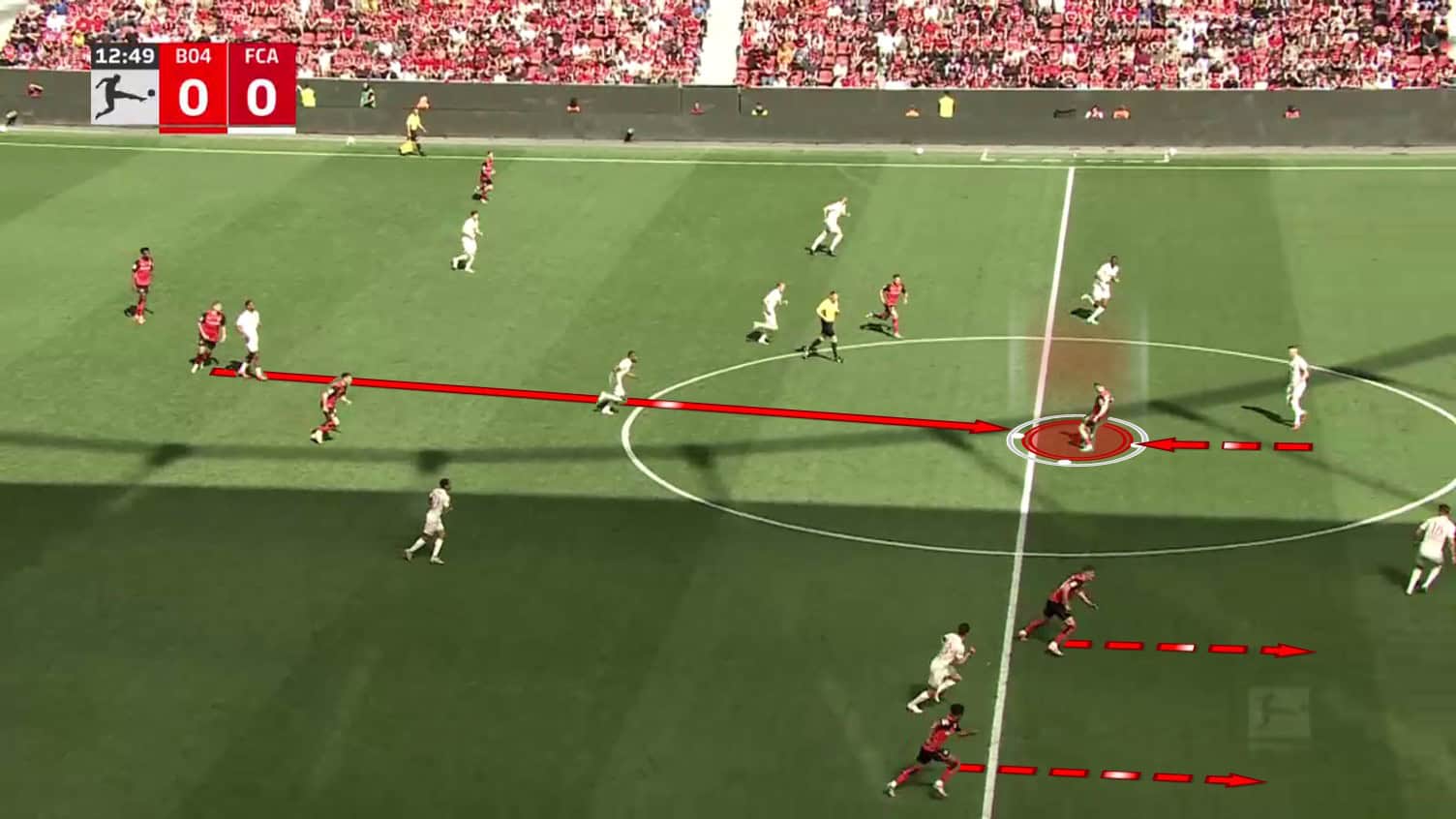
With the Augsburg midfielders pressing forward, Leverkusen easily exploits the space behind them right in front of the backline.
All of Leverkusen’s defenders and midfielders are exceptional passers, and Robert Andrich finds the right angle for a line-breaking pass here, cutting right through the midfield line into the feet of Wirtz.
Leverkusen has a plan to attack from there on out as well.
Looking at their right side, Patrick Schick and Nathan Tella already anticipated the pass and are now moving a couple of metres in front of their nearest defender.
This allows Wirtz, who has become a world-class player under Alonso’s coaching style, to play a pass to the right side into the path of Tella without any Augsburg defender having a chance to reach the ball.
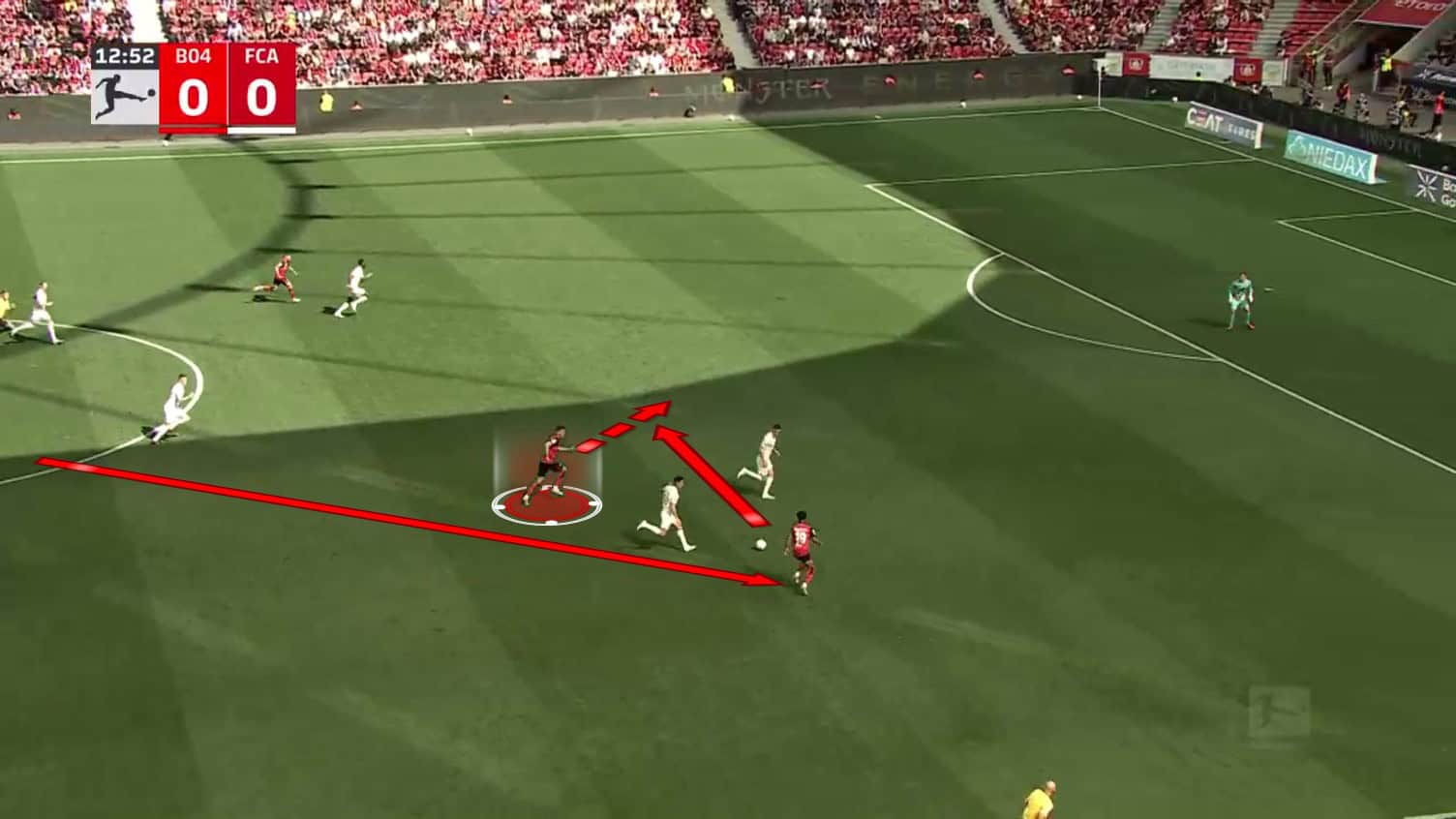
And they still know exactly what to do.
Schick adjusts his run to the inside, moves diagonally into the back of the last Augsburg defender, and allows Tella to square the ball into his path easily.
Schick then dribbles to the edge of the box and hammers it into the net, giving Leverkusen the early lead in this game.
Once again, this highlights the squad’s individual class.
Still, from Tapsoba collecting the ball to Schick finishing, Leverkusen picked apart Augsburg’s defence with just three passes.
They covered nearly the entire length of the pitch and showcased clear principles in every single movement and pass they played, which shows their class in possession.
Building Up With Purpose
Looking back at Xabi Alonso’s time as a player, we must discuss his role in the Spanish national team and the Tiki-Taka style of play they employed.
The former holding midfielder prefers his team to cut through the lines quickly, as we showcased above; however, there is also a very obvious pattern of play that originated from his time under Vicente Del Bosque.
Leverkusen has demonstrated great patience and ball security in their build-up over the last couple of years, which sets them apart from pretty much any other team in the Bundesliga, outside of perhaps FC Bayern under Vincent Kompany this season.
This ball security in their own third is crucial for them to set up their transitional and attacking phases in possession; they actively want to be pressed by their opponents to exploit the space created by their forward-defending opponent.
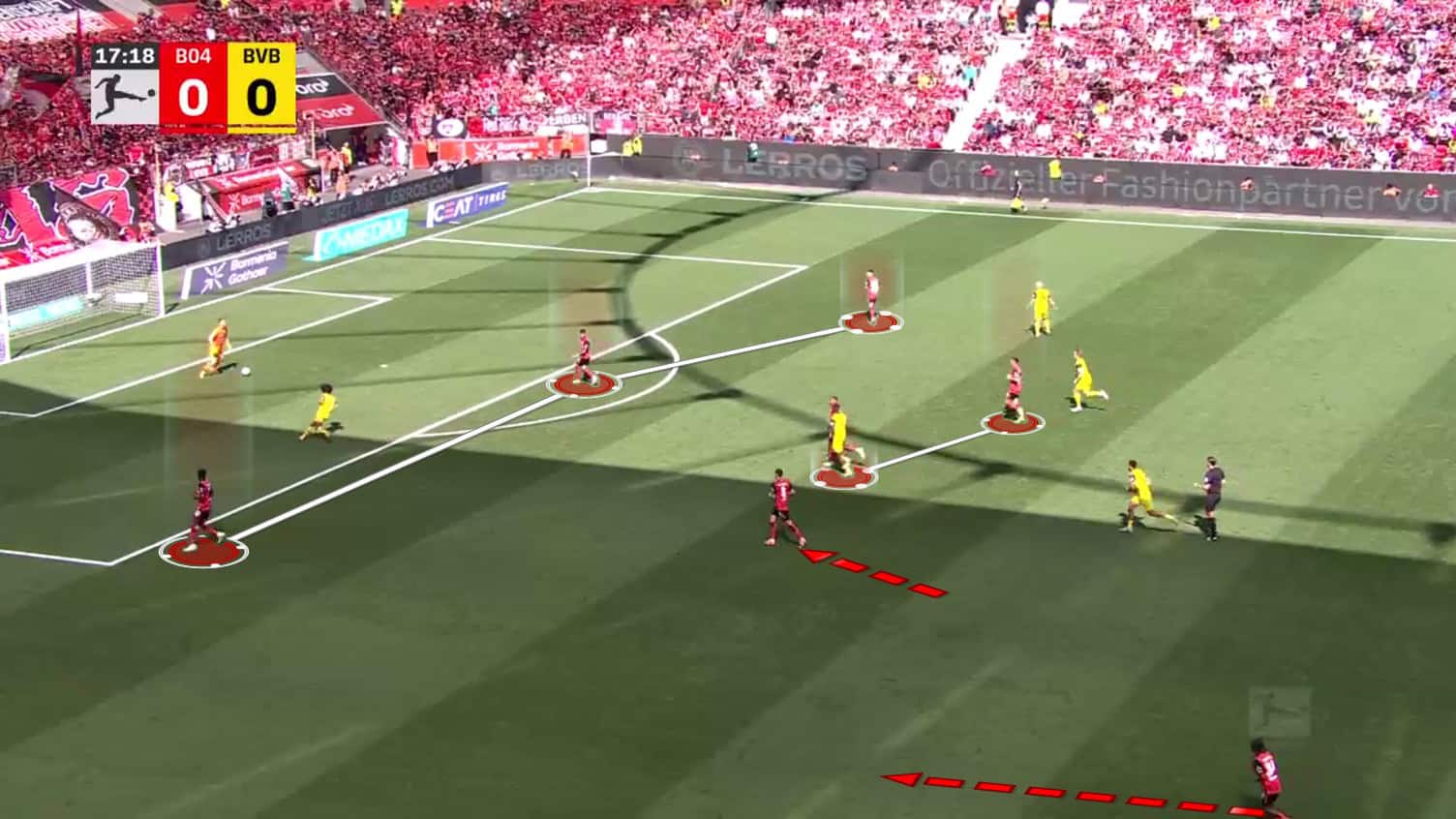
We can see their shape in the build-up phase of play in the picture above.
Their back three is very easily visible, and they heavily involve their goalkeeper in their passing game when pressed to create a numerical advantage for them in the first line.
The double-pivot moves backwards and closer to the backline, staying pretty close and moving to the side where the ball is played.
The other players also move backwards to keep the distances low.
Xabi Alonso has consistently applied this principle at all stages of play for Leverkusen.
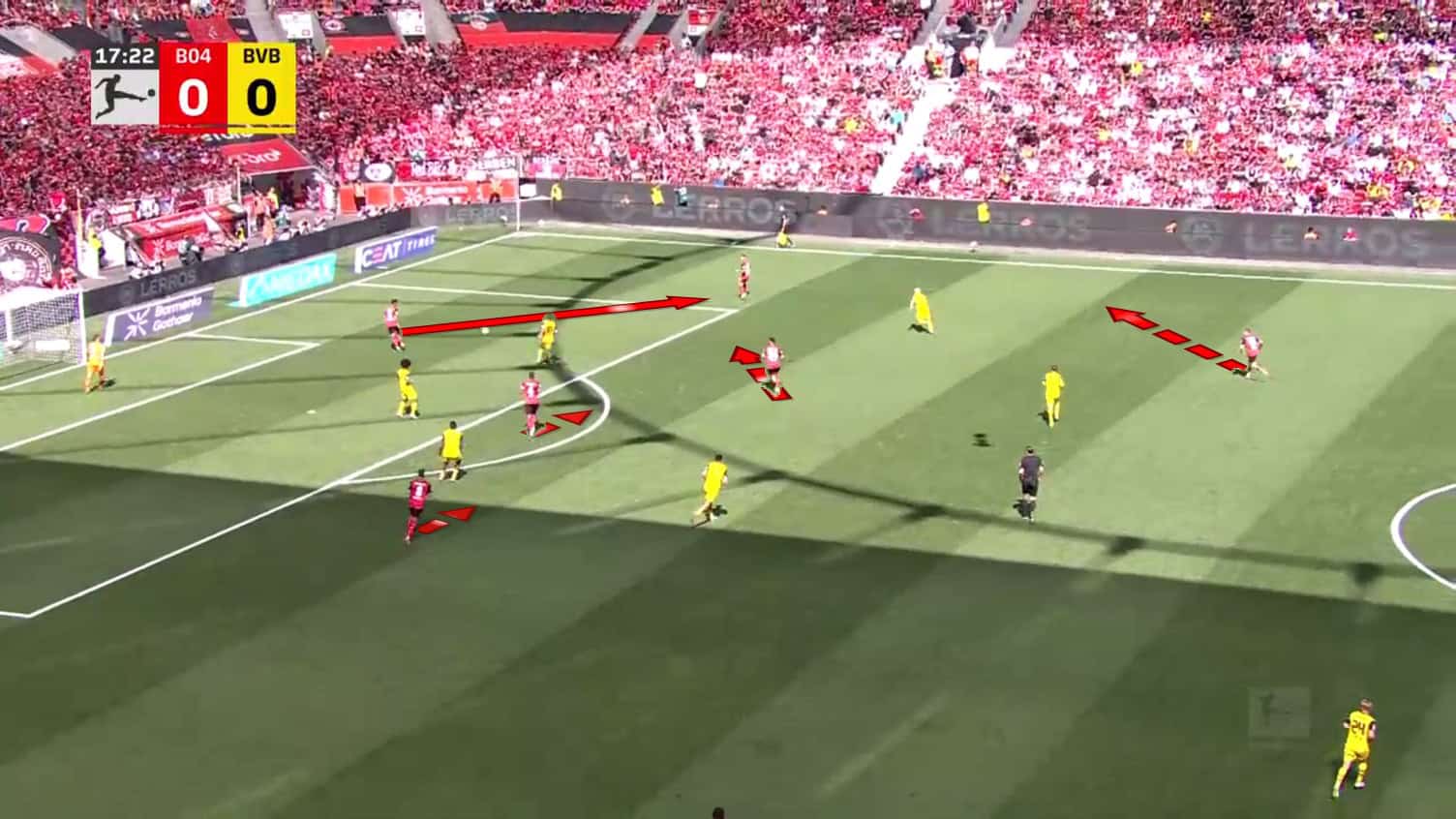
Karim Adeyemi now cuts off play towards the left side of Leverkusen, where they now have to play the ball.
Borussia Dortmund are now in complete pressing mode, with six players committing forward and to the near side.
Looking at the movement of Leverkusen’s midfielders now, Alonso has them all move to the near side as well, with the near-sided central midfielder leading the way and the other central midfielder moving in the space behind him.
Wirtz, as the near-sided attacking midfielder, is now also moving into the back of the Dortmund player, moving forward, right in front of him, and therefore finds himself in a lot of open space.
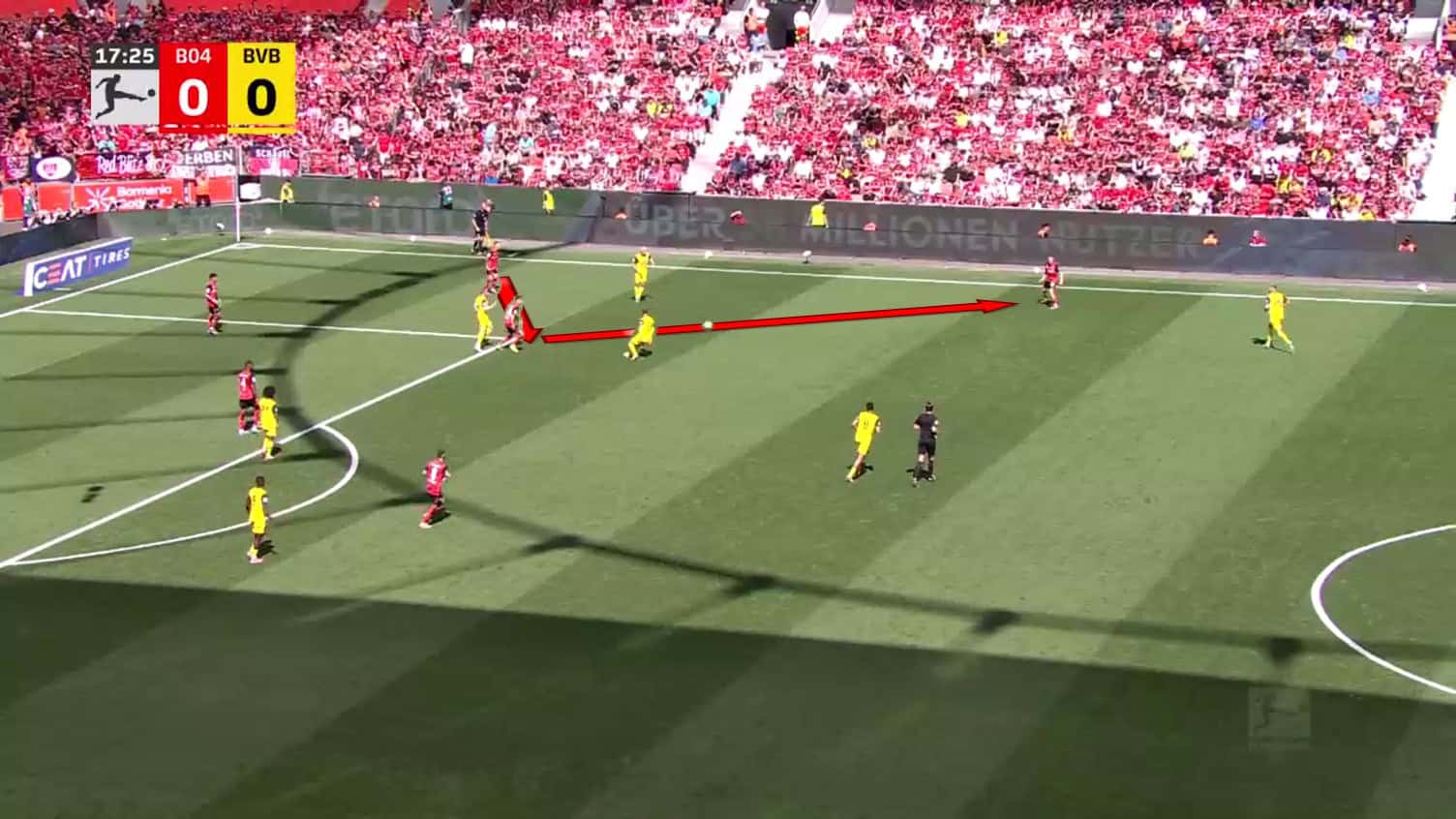
The centre-back is under pressure now, but can play a first-time pass towards his central midfielder, who is very close to him because of the movement early.
The central midfielder can play a first-time pass towards Wirtz on the outside, who is in a lot of open space.
Alonso has a very clear plan for when and where his players have to move and play their passes to be successful.
His players know exactly what to do on and off the ball, allowing them to play through attacking presses with ease.
All Leverkusen players know where to move and what they want to achieve in their assigned space, which helps them keep the ball moving and be quicker than their opponents.
Considering how Real Madrid struggled to create space and break through the high-pressing attacking formation this season, Alonso’s ideas will be instantly welcomed by the club’s defenders.
Attacking With Patience & Intensity
As we saw in the last paragraph, Leverkusen under Xabi Alonso has excellent decision-making in their build-up play and the ability to cut through the lines.
What really makes this Leverkusen team special is how they connect these two things into dynamic attacking patterns.
Just like Alonso the player, Alonso the coach values patience on the ball and wants his team to pick the right situation to transition into the attacking phase, rather than blindly trying to attack and running into counterattacks.
Looking at how the situation against Dortmund unfolded, we can see that Leverkusen showcase these abilities exactly.
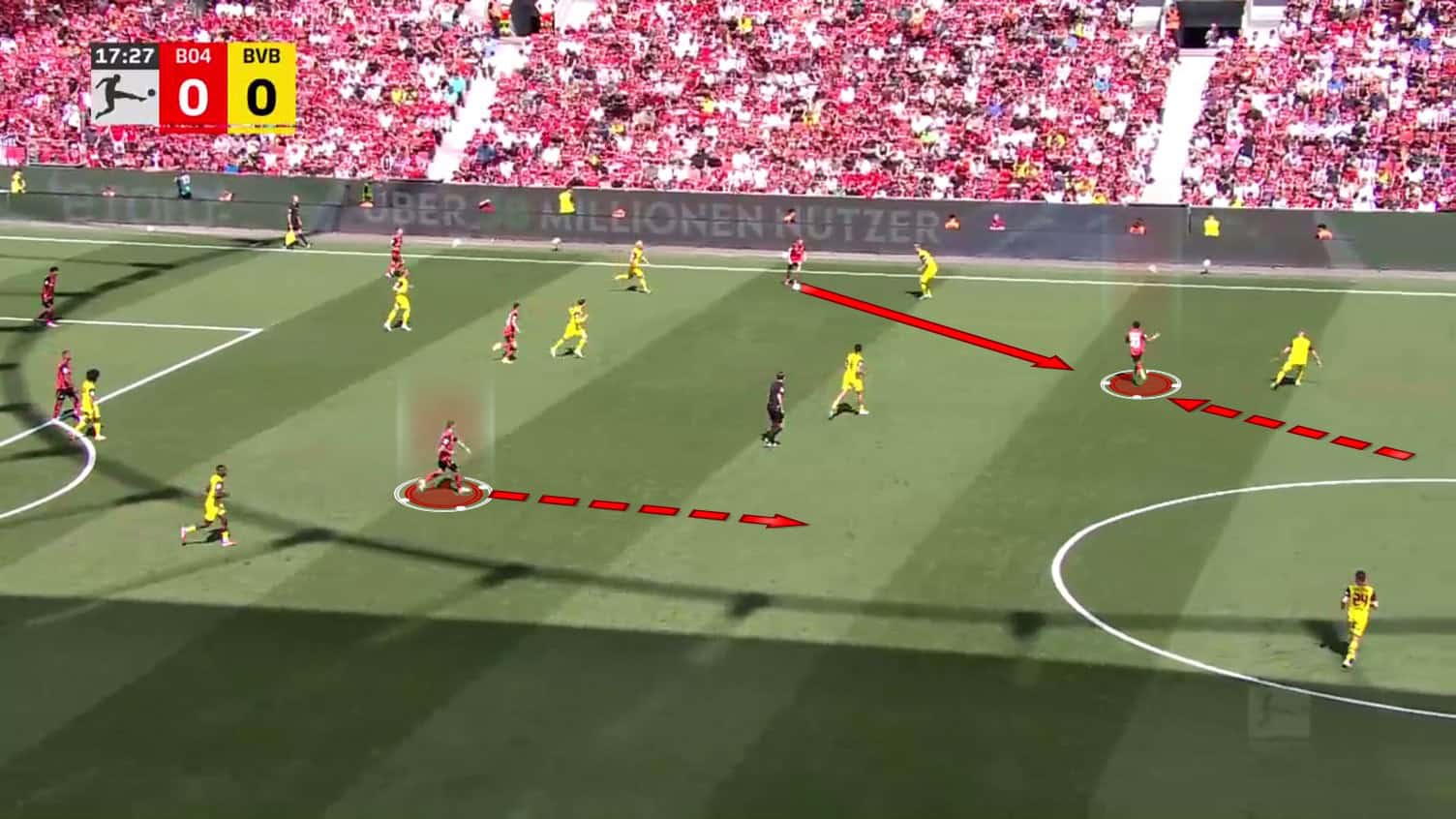
Wirtz receives the ball near the sideline and plays it to the half-space from there on.
This is another key principle for Leverkusen.
They always try to play diagonal passes, starting with the first one to the outside, then back inside, and then to the outside again, and so on, until they can pass into dangerous areas.
With striker Tella dropping back, the far-sided central midfielder Andrich is now moving forward into open space.
Leverkusen tries to get the ball to him, but Dortmund recovers in time and has many players committed to that side, so Leverkusen decides to abort the attacking attempt and plays a backwards pass.
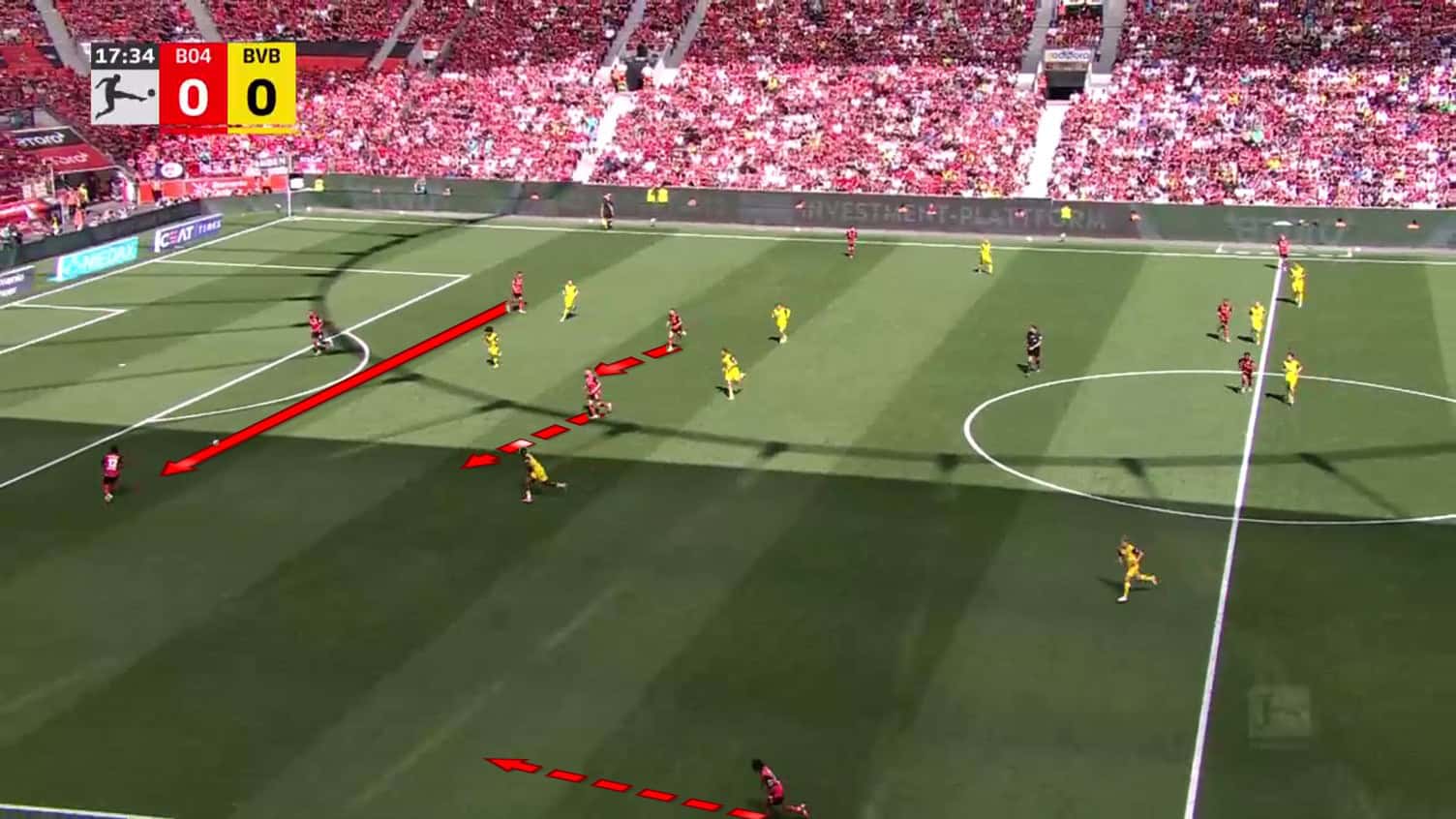
Now, they quickly switch play through their two outside centre-backs in their backline, forcing the entire Dortmund team to shift towards the other side of play.
Now, the right wingback, Jeremie Frimpong, moves closer to the backline, and the two central midfielders also shift towards the near side.
This play switch once again forces Dortmund to move; if they make a mistake in their collective movement, Leverkusen could capitalise on it.
Alonso’s men play the ball to Frimpong, who is pressed by Dortmund’s left back here.
This opens up the possibility of a long ball behind the defensive line, but Frimpong does not like the look of it and aborts that attacking attempt as well.
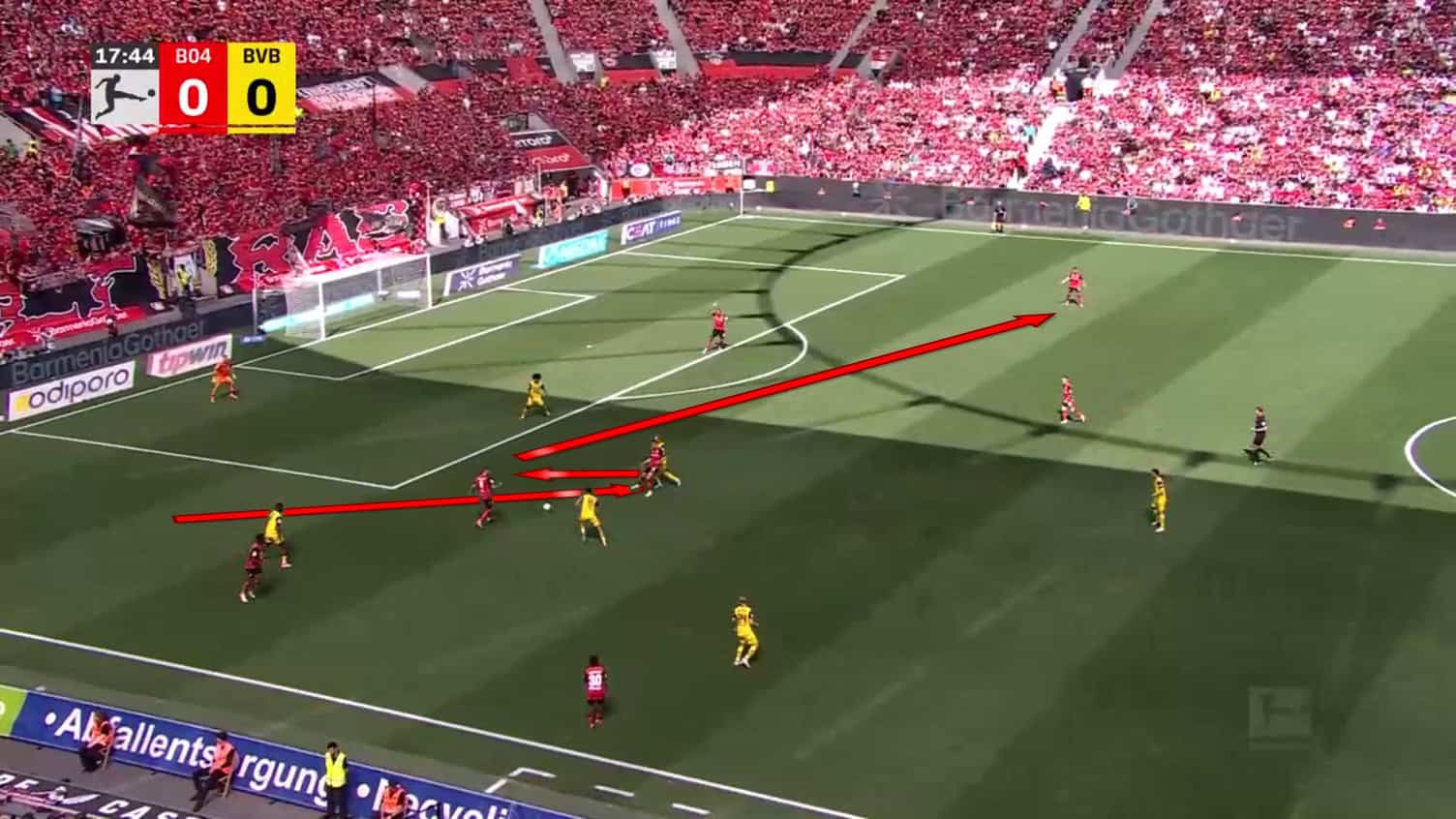
Dortmund is now committed to the other side of the field, and Leverkusen has to show their ball security once again.
They show another pattern of play to find a solution here.
Once again, they are looking to play to their near-sided central midfielder, but instead of going to the outside again, this time Andrick just plays the ball backwards again, allowing Leverkusen to switch the side of play once again.
They now have an isolated player on their left side and can easily carry the ball forward behind Dortmund’s first line of press.
Alonso has his players’ confidence in these situations at an all-time high; they stay patient and calm when pressed and wait for these opportunities.
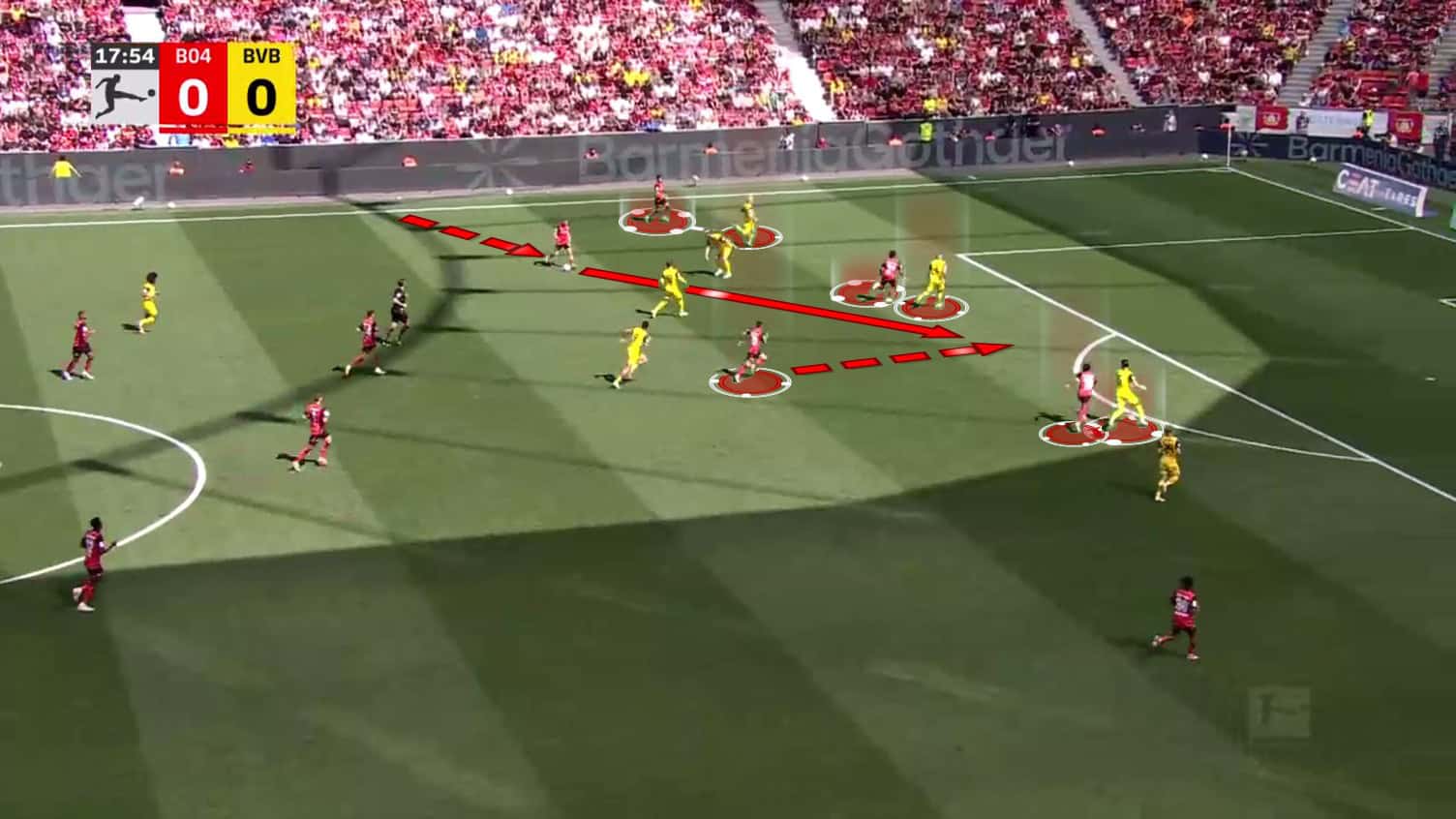
Leverkusen now shows once again how they can quickly play through their midfield.
In this situation, they managed to isolate Wirtz near the left sideline, right at the edge of the final third.
With no defender in his area, Wirtz again shows Alonso’s outside-inside principle and cuts inside with his first touch.
Alonso now has his men “open the gates“ metaphorically to keep the dynamic of the attack high.
One overlapping run behind Wirtz prevents the right-back from defending the attacking midfielder, and two players in the middle of the field are making runs behind the defensive line, occupying the two centre-backs as well.
This opens up a channel right in the middle of the backline, and with a delayed run, their central midfielder can make a wide-open run into the box.
With all his class, Wirtz threads the ball through the four remaining defenders right into the path of his teammate, creating a huge opportunity for his men.
With their ball security and patience in build-up, Alonso often puts his team into favourable situations.
The way they connect their calm build-up with their fierce attacking play makes them one of the best-attacking teams in world football.
315 goals were scored in 140 games under Xabi Alonso, and Leverkusen excels at picking apart teams in this manner.
With players like Trent Alexander-Arnold and Kylian Mbappé at Real Madrid, this attacking style will be lethal.
Conclusion
Xabi Alonso’s reign at Leverkusen was a huge success for both the club and the coach, who established himself as one of the brightest stars in coaching at just 43 years of age.
Real Madrid have faced numerous struggles under Ancelotti, particularly in their approach to the game.
The Italian played more results-focused football, and not all fans were happy with that.
Considering what Alonso achieved at Leverkusen and how his team performed there, there should be no concerns about the new manager in Madrid.
With his clear principles in the build-up phase and his team’s ability to connect those into dynamic attacks, Xabi Alonso’s playstyle is one of the most attractive in Europe right now.
And now imagine these dynamic attacks with the pacey attackers that Real Madrid have under contract, the quality on the ball of Alexander-Arnold, and the Real midfielders.
There is a lot to look forward to for club fans.
We will get our first look at an Alonso-shaped Real Madrid team at the 2025 Club World Cup, and it will be exciting to see how his star players fit into his playing style.
