
Massimiliano Allegri has been officially appointed as AC Milan’s new head coach following last week’s negotiations.
I Rossoneri started their summer reconstruction phase to try to fix what went wrong last season by hiring Igli Tare as the sporting director.
This was an attempt to avoid the mistakes made last season in terms of decision-making, whether concerning head coach appointments or player assessments and choices.
As soon as he got hired, Tare started working concretely on the head coach dilemma.
After analysing the available footballing market, the choice was made for Allegri.
In fact, Allegri is an experienced head coach who knows Milan very well, having coached the team from 2010 to 2014.
During his tenure, he won the 18th Serie A title for Milan in 2010/2011, in addition to winning the Supercoppa Italiana in 2011.
Therefore, no one can deny that Allegri’s period at Milan was positive, even though the seasons that followed were more complicated and did not share the success of the first one.
This was mainly due to the team’s financial issues, which led to the sale of prominent players such as Thiago Silva and Zlatan Ibrahimović, and their inability to replace them with quality players.
Despite succeeding during his second season at Milan in battling until the last rounds for the Serie A title against Juventus, the end of the 2011/2012 season marked the end of a cycle for numerous Milan legends at that time.
This greatly impacted the team and prevented them from competing seriously for the Serie A title or the UEFA Champions League during the coming seasons.
In the 2012/2013 season, Allegri helped Milan improve from 16th place in the Serie A standings initially to clinching a third-place finish at the end of the season, which was crucial for qualifying for the playoff round of the 2013/2014 UEFA Champions League.
Overall, Allegri’s first spell at AC Milan was successful, especially in the first two years.
This leads us to question whether his second spell would be as successful as his first one.
He arrives after a season in which AC Milan finished eighth in the league with 63 points.
This tactical analysis article will present Allegri’s footballing ideas and principles, explaining how these ideas and tactics can suit Milan’s players and style of play.
The analysis will also explore the transfer market needs that Allegri would benefit from to build a stronger squad than last season.
Listen to this article free on the Total Football Analysis Podcast via Spotify, Apple Podcast, or RSS.
Massimiliano Allegri Tactics & Principles
To begin, we should stress that the choice of Allegri received a lot of criticism from some.
This, however, does not mean that Allegri is a bad head coach.
On the contrary, Allegri has been criticised by many who adhere to different footballing principles, and these opponents are not necessarily wrong.
Football has never been about right or wrong, as it is not only based on data or mathematics but also on tactics, form, mental and psychological management, team chemistry, intelligence, creativity, and more.
That’s why, whether one likes Allegri’s coaching approach and footballing principles or not, it’s fundamental to respect them, as nothing in football is constant.
In other words, no playing systems or tactics allow you to win forever.
There are tactical and ideological trends in football that can work for certain teams and with specific head coaches at a particular time, but not necessarily for others.
There are many examples: Arrigo Sacchi’s AC Milan, José Mourinho’s Inter Milan, Pep Guardiola’s Barcelona, and recently Hansi Flick’s Barcelona.
At the same time, we cannot say that Allegri is a failing manager simply because he is a winner.
He proved his ability to win titles on numerous occasions with Milan and Juventus.
Allegri believes in a realistic and somewhat simplistic style of football, relying on players’ individual talent, intelligence, and movement instead of predetermined combinations, especially when it comes to attacking tactics.
On Italian television, he stated that he appreciates the creativity of certain players, especially those who have the skills and dribbling abilities needed to surpass anyone.
In the context of the current Milan squad, Allegri has already stated that he likes Rafael Leão a lot and considers him one of the best players in the world, particularly in terms of dribbling rates and winning offensive duels.
It will be interesting to see how Leão develops under Allegri’s management, as Allegri is also known for imposing discipline on and off the pitch.
The discipline that Allegri will add to this team will be crucial, especially for Leão, who needs some behavioural adjustments and guidance on the pitch.
Allegri will definitely work with Leão on improving movement when the team doesn’t have the ball and defending more effectively when the team loses possession.
Some Milan players’ tendency to be indifferent whenever the team loses possession of the ball should be addressed before next season.
Allegri is the type of manager who focuses a lot on such details, as he knows that these details are the factors that determine the results of games.
Defensively, Allegri has been one of the best in Italy in terms of conceding the fewest goals per season, thanks to his teams’ typically strong defensive performances, both as a unit and in a very disciplined manner.
Under Allegri’s management, teams tend to defend using all possible means, including utilising strikers to defend on the wings when necessary and when they have sufficient players to do so.
The examples are many, and the most notable one to apply this role in an Allegri team was Mario Mandžukić.
Applying this method to the Milan team would be greatly appreciated, as the team conceded a high number of goals last season and struggled to finish the first half without conceding.
Therefore, the first step to performing better next season would be to address the issues that went wrong in Milan’s defence.
Allegri Defensive Values & What To Fix In The Milan Defence
In this regard, Allegri has previously proven himself to be intelligent enough not to rebuild everything from scratch but rather to utilise what is available at his disposal with a few adjustments that help improve the team’s defensive performances.
We saw this during his first spell at Juventus when he found Antonio Conte’s famous 3-5-2 formation.
Allegri was adaptable enough to maintain that same formation throughout his first season with the team while adjusting it to suit his tactical needs.
He only started changing it to his preferred 4-3-3 formation and 4-4-2 formation during the following season.
In the current Milan context, Allegri is expected to maintain the successful 3-4-3 formation that Sérgio Conceição established in the latter part of this season while also experimenting with and possibly adapting it to a 3-5-2 formation at times to suit his philosophy.
He knows that he has the time needed to apply this change and let the team get accustomed to it.
In the defensive phase, Allegri tends to play with a compact defensive line, forcing opponents to attack from the wings rather than the middle, as he intensifies his players’ presence in a condensed area.
Instructing the wing-backs to retreat to the defensive line and block any penetration attempts is fundamental to Allegri’s defensive system, as he usually avoids defending with only four players.
In order to be much more secure from a defensive perspective, Allegri’s midfielders always follow the ball and use zonal marking to create numerical superiority against the opponent, even when these midfielders would lean towards the right or the left wing.
Occupying Spaces Inside The First Third
That said, playing with three midfielders suits Allegri better than using two.
He prefers to have two midfielders cover on the wing as soon as the opponents progress from that specific side and leave one midfielder ready to intervene on the other side.
Therefore, the notion of moving as a cohesive defensive unit that always follows the ball is essential for Allegri to be as secure as possible in defence and prevent any penetration attempts from the middle.

Switching To The 5-4-1 Formation When Defending
In addition to this strict defensive organisation, Allegri is known for switching his formation when defending to form a 5-4-1 formation when out of possession.
This formation could also help Milan avoid conceding chances.
It requires one of the two strikers to retreat to defend on one of the flanks alongside the midfield defensive line, leaving a single striker upfront.
The striker’s role would be to wait for backwards passes and try to intercept them since the team’s defensive aim in those cases is to oblige the opponent to resort to a backwards pass.
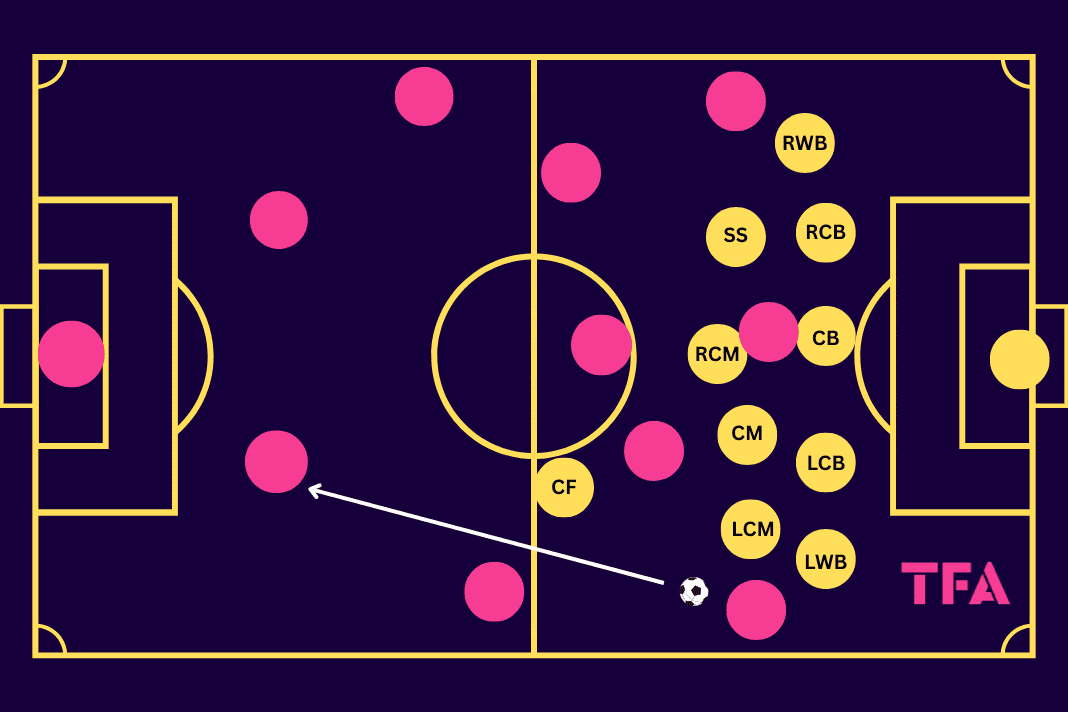
Having players like Strahinja Pavlović, Matteo Gabbia, Malick Thiaw and Fikayo Tomori, who are already accustomed to playing as three defenders or as two centre-backs, will help Allegri shape his new defensive organisation.
In the meantime, a few reinforcements in this area would be appreciated, especially if one of these players were to leave the team.
Attacking Ideas: Adjustments To The Current Milan & Market Needs
In the context of Milan, it would be beneficial to play Rafael Leão as a second striker with defensive duties, positioning him closer to the opposing goal to exploit his dribbling skills and shooting abilities in a more effective manner.
This way, he will have the opportunity to be in more dangerous areas, allowing him to lean towards the left wing whenever needed, as that’s where he can become even more creative.
However, ensuring that he becomes more disciplined in the defensive phase will be crucial for Allegri’s Milan to find the right balance and avoid the defensive weaknesses that plagued them last season.
For the striker position, Tammy Abraham (if he remains at Milan) and Santiago Giménez can battle for a starting position, as they have the potential to improve significantly.
This is because both players did not reach their full potential last season and still have a lot to prove.
It is important to note that Allegri also believes in the attacking contribution of wingers and encourages them to advance and have the freedom needed to penetrate towards the box and go for crosses as often as possible.
Théo Hernandez and Christian Pulisic would be the preferred options for the wings if no unexpected transfers would occur for these two players.
With both players being assigned more defensive duties, the two wingers will be crucial to Milan’s organisation under Allegri’s management in both phases, especially during the transition phase.
Upgrading The Theo Hernandez-Rafael Leão Duo Impact
It is true that Allegri does not impose a specific attacking plan and does not oblige his players to adhere to certain positions when the team is in possession, which would allow creative players like Pulisic and Leão a great deal more freedom.
Moreover, the suggested formation would encourage having dangerous plays closer to the opposing goal, with the Theo-Leão combinations becoming much more dangerous than when Leão used to play as winger.
The following simulation of such a scenario illustrates the efficiency and attacking danger that such combinations could result in when Leão plays in an advanced role, given his previous experience as a second striker under the management of Stefano Pioli and alongside Zlatan Ibrahimović, who was the main striker at that time.
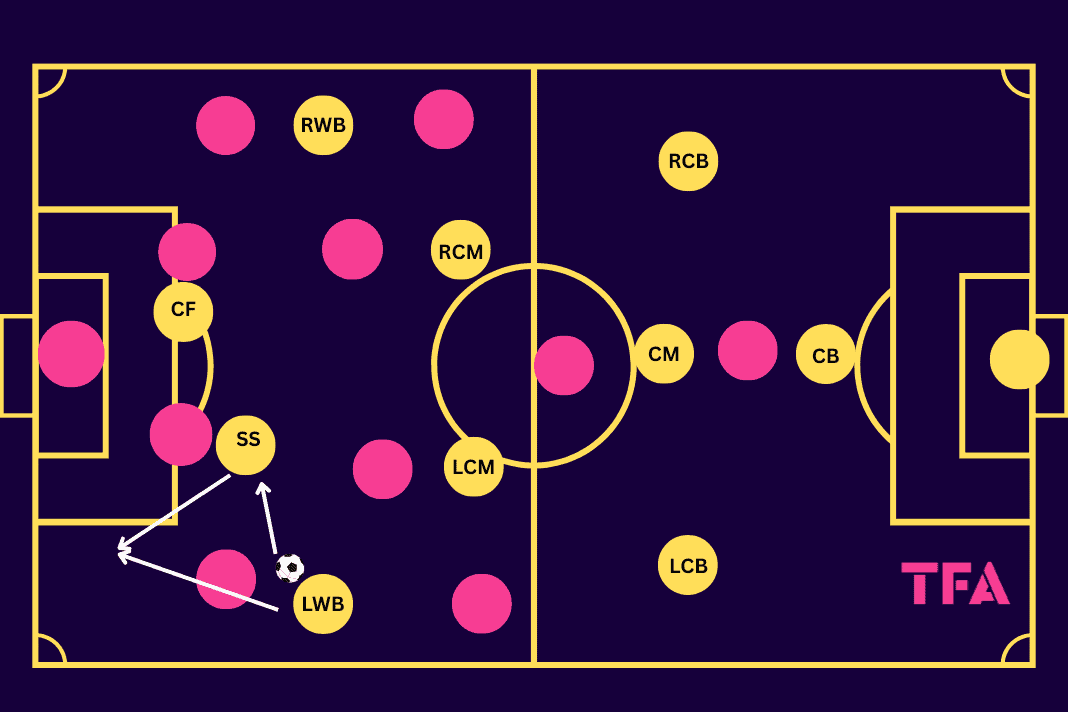
This can be one of many ideas that Allegri could adopt since he is not a manager who bases his tactics on a single attacking idea.
Moreover, the 3-5-2 formation is an emergency solution that can applied by Allegri in the short or the long term.
However, at the same time, he can stick with the same 4-2-3-1 formation initially while still applying his defensive ideas and allowing more positional freedom in attack.
The summer transfer window will decide many things in midfield, such as the possible departure of a key player like Tijjani Reijnders.
However, knowing Allegri, it will be crucial for him to have three solid midfielders with diverse characteristics.
This means that having at least two solid defensive midfielders with reliable passing abilities will be the minimum needed for Allegri to succeed in re-building a good enough midfield.
At the same time, he will be unlikely to use an advanced playmaker since he prefers a third central midfielder to help in the defensive phase and have more freedom to advance and support the attack when out of possession.
Similar Players To Tijjani Reijnders In Serie A
That said, some names have been on Milan’s radar recently, and these players can all be very useful to Allegri’s Milan as replacements for Tijjani Reijnders or in addition to him and Youssouf Fofana.
This list of players highlights the players most similar to Reijnders in Serie A.
Although some of them might be complicated to get to Milan at the moment, some of the names deserve the attempt to negotiate, as they can add a lot to Allegri’s Milan, knowing that he has always relied on influential midfielders like Andrea Pirlo and Mark van Bommel.
Furthermore, numerous midfielders, including Manuel Locatelli, Rodrigo Bentancur, and Miralem Pjanić, became much more powerful and impactful under Allegri’s management.
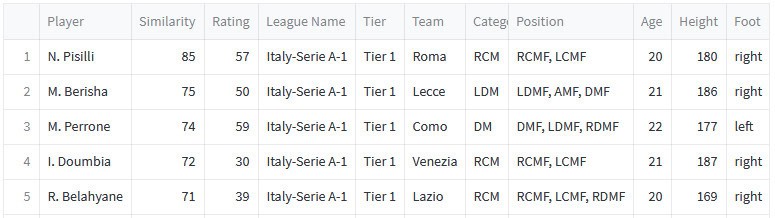
Therefore, most of these listed names have the potential to succeed at Milan, in addition to Samuele Ricci, Nicolussi Caviglia, and Nicolò Rovella, who have all been linked with Milan.
Another crucial defensive signing can do a lot of good for Milan ahead of next season, especially if they plan to continue using a back-three defence.
Signing someone like Riccardo Calafiori will be highly beneficial to Milan, especially if they capitalise on the fact that he is currently not getting enough playing time at Arsenal.
The deal seems somewhat unrealistic because Milan will not be participating in European tournaments next season. However, if all parties agree to this transfer deal, Milan will most likely guarantee a significant improvement in defensive quality while also capitalising on Calafiori’s crucial key passing role.
Overall, if Allegri plans to use a back-three defence formation, the team will need an additional solid defender, a central midfielder, and a striker (especially if Milan does not intend to buy Tammy Abraham after the end of his loan).
If he decides to switch back to a back-four formation, a reliable right-back to replace the loaned Kyle Walker and a solid backup option for the left-back role will be needed, in addition to a central midfielder and an inverted right-winger, to make an upgrade in comparison to Samuel Chukwueze.
However, even with this type of formation, Milan will still need an additional striker to replace Abraham.
Conclusion
Overall, Allegri will surely add more organisation and stability to Milan in the coming season, ensuring better defensive compactness and a lower number of conceded goals per match.
Opting for the most suitable formation for the players’ abilities will be crucial to save time and energy and get the players accustomed to the most adequate playing system.
Based on Milan’s current squad, a back-three-based formation would be the most suitable system to adopt, especially at the start of next season.
That said, Allegri’s challenge will be to determine how to rectify the issues with attacking play, ensuring more freedom in terms of attacking movements while also keeping a close eye on his players’ movements without the ball after losing possession.
