
In the modern Premier League, success is no longer defined solely by goals and points.
Tactical intelligence, data-led planning, and structural clarity have become essential in differentiating genuine progress from surface-level performance.
This data analysis report utilises a combination of progressive metrics, possession models, and underlying performance data to examine the evolution of England’s top flight between the EPL 2023/2024 and EPL 2024/2025 seasons.
Progressive carries and passes are at the heart of this analysis—two crucial indicators of a team’s attacking philosophy and ability to control territory.
By comparing these metrics across two seasons, we can uncover subtle yet significant shifts in team dynamics, shape, and build-up strategies.
Did Manchester City truly decline, or have they rebalanced their approach?
Was Liverpool’s drop in progression a tactical trade-off or a structural issue?
How did Fulham and Bournemouth quietly enhance their positional play?
The investigation goes beyond individual teams and aims to evaluate broader league trends.
Are Premier League sides becoming more carry-reliant?
Has the verticality and tempo of build-up play increased or faded?
And how do these trends intersect with each club’s xGD, final points, and overall performance trajectory?
By answering these questions, the Premier League analysis offers a more nuanced perspective on tactical evolution in the Premier League, one that acknowledges the complexity of the modern game.
Readers will gain a clearer understanding of how structure and progression underpin team identity and why these elements are just as vital as goals in building long-term success.
Whether it’s a top-four side managing transition or a mid-table team redefining their style, this piece will shed light on the processes shaping the game’s future in England’s elite competition.
Listen to this article free on the Total Football Analysis Podcast via Spotify, Apple Podcast, or RSS.
EPL Point Swings Across Two Seasons
The Premier League standings from the 2023/2024 to 2024/2025 season tell a compelling story of tactical evolution, surprising regression, and emerging resilience.
At the forefront of the decline are Man City and Arsenal, both of whom dropped more than fifteen points compared to the previous campaign.
Premier League Point Swings Across 2023/2024 & 2024/2025

Manchester City
Manchester City’s fall from 91 to 71 points reflects a combination of fatigue, tactical predictability, and a noticeable drop in attacking sharpness.
Although their structure remained intact, the decrease in goals and expected goals suggests a lack of efficiency in the final third, possibly due to diminished individual brilliance or less incisive movement.
Arsenal
Arsenal also experienced a significant dip.
Mikel Arteta‘s side appeared more cautious throughout the season, and the trademark high-pressing system lacked its former intensity.
The Gunners struggled to assert control in crucial fixtures and conceded more frequently against mid-table opponents, pointing to defensive lapses and a loss of concentration under pressure.
Manchester United
Manchester United continued to struggle despite appointing Ruben Amorim as their new manager.
Their drop to 42 points, an eighteen-point decline, revealed deep structural flaws.
The team consistently failed to generate quality chances and were often exposed in midfield transitions.
Amorim has yet to establish a stable identity that balances possession with vertical progression.
Nottingham Forest
Meanwhile, Nottingham Forest showed remarkable improvement, climbing from just 32 points to 65.
Their tactical cohesion and resilience transformed them into a formidable side capable of challenging higher in the table.
Tottenham Hotspur
Tottenham’s fall to 38 points highlighted similar issues to United’s.
Spurs looked chaotic defensively and lacked cohesion in the attacking third, with Ange Postecoglou’s once-dynamic system becoming increasingly disjointed.
Liverpool
Amidst this turmoil, Liverpool emerged as the biggest success story under new manager Arne Slot.
Climbing to 84 points and finishing above both City and Arsenal, Liverpool showcased tactical refinement and control.
Slot introduced a more composed buildup, enhanced positional play in midfield, and a more disciplined defensive block.
The team looked well-drilled, balanced, and ready to transition from Jürgen Klopp’s legacy into a new, structured chapter of competitive dominance.
xGD: A Tactical Mirror To Team Evolution In The Premier League
In the landscape of modern football analytics, Expected Goal Difference (xGD) has emerged as a crucial metric in dissecting tactical evolution.
Calculated as the difference between a team’s xG (Expected Goals) and xGA (Expected Goals Against), xGD provides a process-oriented insight into how well a side generates high-quality chances while suppressing the opposition’s opportunities.
Crucially, it bypasses the noise of luck, refereeing decisions, and finishing variance to reveal the structural strengths and weaknesses of a team’s approach.
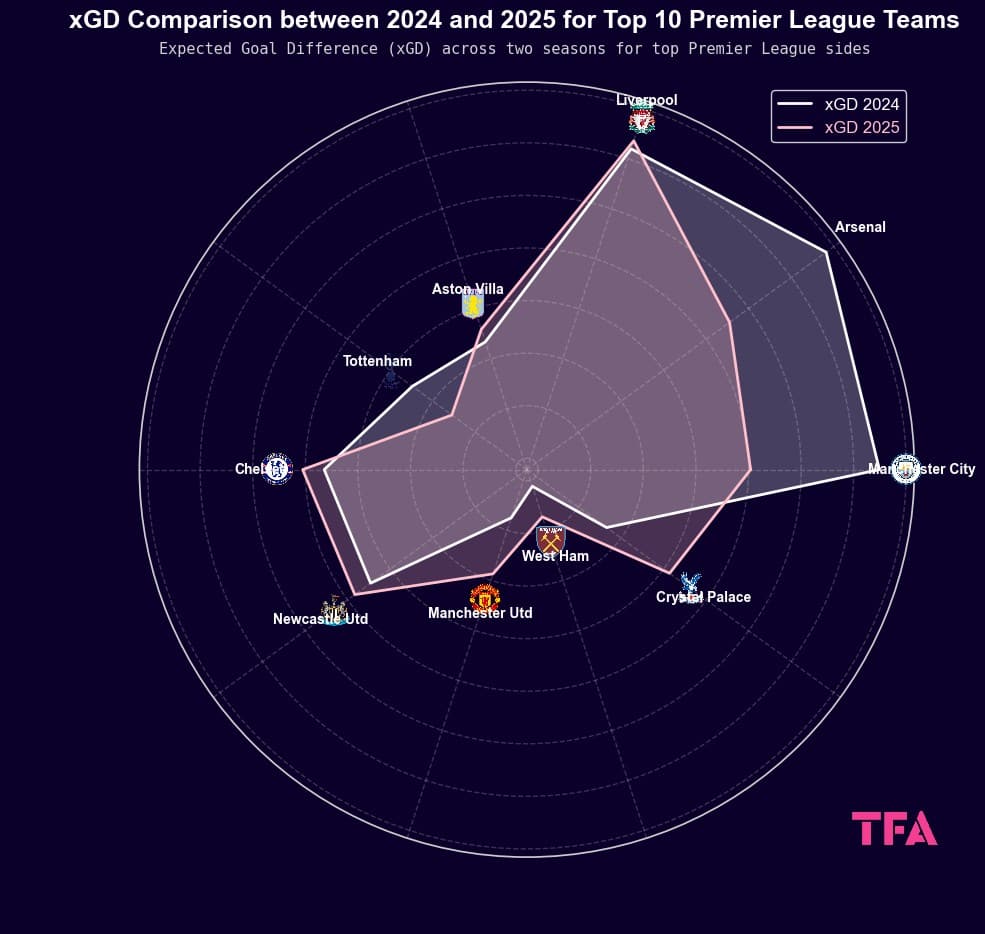
Premier League xGD Comparison Between 2023/2024 & 2024/2025
Liverpool
Take Liverpool as a prime example.
Under Jürgen Klopp in 2024, they recorded a robust xGD of 42.0 (xG: 87.8, xGA: 45.7), showcasing their typically aggressive pressing, vertical play, and high chance creation.
In 2025, under Arne Slot tactics, the xGD rose marginally to 43.6, a seemingly minor gain that reflects a significant underlying shift.
Slot’s early tactical influence is evident in the drop of xGA by 7.1, suggesting improved mid-block organisation, more structured pressing triggers, and a slightly deeper defensive line.
Though the xG dropped by 5.6, this reflects a measured trade-off in pursuit of greater control, less chaos, and more stability.
Manchester City
In stark contrast, Manchester City’s xGD collapsed from 44.9 to 20.4.
The figures, with a 12.4 drop in xG and a 12.1 rise in xGA, hint at a systemic breakdown in both phases.
The sharp decline suggests that the midfield is struggling to sustain pressure and that defensive lines are increasingly vulnerable in transition, possibly due to tactical adjustments or physical regression in key roles.
Arsenal
Arsenal’s fall from an elite 48.2 to 25.5 mirrors a similar story: declining attacking output and a defensive shape that now leaks more xGA (+6.5), suggesting that the Gunners lost their previous balance between fluid build-up and solidity out of possession.
Ultimately, xGD doesn’t just expose statistical trends; it reveals tactical fingerprints.
It’s a blueprint for understanding a manager’s philosophy in motion, whether it’s Slot installing balance at Anfield, or Chelsea ironing out their defensive naivety; xGD doesn’t wait for results to catch up, it whispers the truth before the league table shouts it.
Nottingham Forest: Tactical Growth Amid Disappointment Under Nuno Espírito Santo
Despite finishing the 2025 Premier League season outside the European spots, Nottingham Forest, under Nuno Espírito Santo‘s stewardship, demonstrated one of the league’s most intriguing turnarounds from a statistical standpoint.
While the club’s supporters were left disheartened by the final league position, the underlying data tells a story of considerable tactical and performance growth compared to the 2024 campaign.
Nottingham Forest Stats Across 2023/2024 & 2024/2025
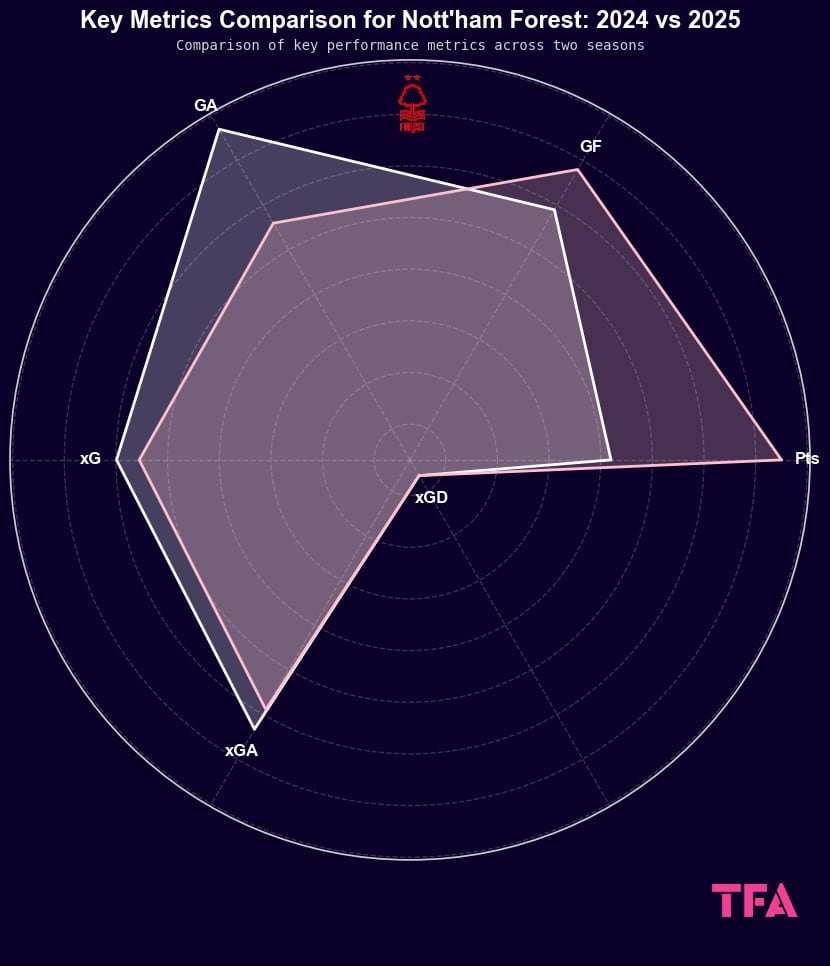
Forest’s points tally jumped from 32 to 65, a staggering +33 increase, the highest year-on-year improvement in the division. In attack, the team scored 58 goals, up from 49 the previous season, a modest but meaningful uptick in output.
However, the shift was most profound in defence.
Goals conceded dropped from 67 to 46, a 21-goal improvement, reflecting Nuno’s signature emphasis on compact structure and defensive discipline.
Their expected goals against (xGA) fell from 53.3 to 48.9, showing a more sustainable defensive improvement beyond just raw goals.
Interestingly, their expected goals (xG) dropped slightly from 49.9 to 45.5, suggesting that while the team became more efficient in both boxes, it didn’t necessarily create more or better chances.
Instead, it executed more effectively.
Yet, what truly marks their progress is consistency and control.
Their xGD (Expected Goal Difference) remained steady at -3.4, but this masked significant improvements in game management and balance, as their actual goal difference improved dramatically from -18 to +12.
In sum, while Nottingham Forest fell short of delivering European football — a dream that tantalised their fanbase as results improved — the campaign under Nuno laid the groundwork for future ambition, built on a platform of tactical clarity, defensive strength, and newfound belief.
Defensive Interventions: Tackles Plus Interceptions Evolution
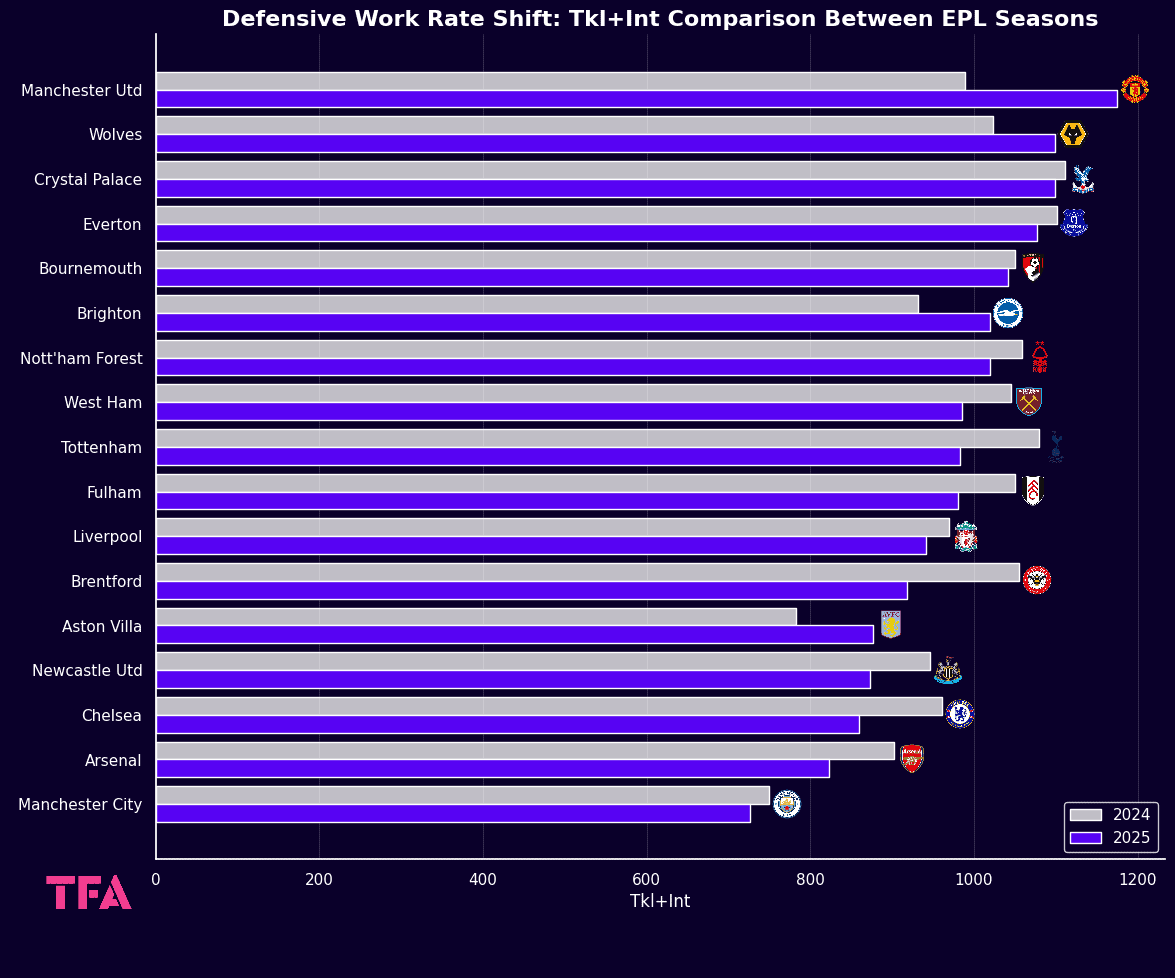
Over these seasons, a distinct shift has emerged in the collective defensive output of the Premier League’s 17 consistent participants, particularly within the tackles plus interceptions (Tkl+Int) metric.
Tackles Plus Interceptions Evolution (2024 vs 2025)
Crystal Palace
Crystal Palace and West Ham have recorded notable improvements in this area, reflecting either a refined approach to their defensive structure or increased intensity in pressing patterns.
Palace, operating under a more cohesive mid-block system, have succeeded in engaging opponents more frequently in central zones, enabling them to register higher volumes of defensive actions.
West Ham
West Ham have adjusted their defensive line slightly higher up the pitch, allowing midfielders to step in and disrupt build-up play with greater aggression.
Aston Villa
Conversely, sides like Aston Villa and Manchester United have shown a decline in this metric.
This could signal a tactical shift towards more reserved pressing schemes for Villa.
Manchester United
United, meanwhile, have struggled to establish consistent midfield pressure, which has reduced recoveries and overall ball-winning actions.
This statistical drop aligns with a broader narrative of disorganisation in their off-ball phases, particularly when facing technically dominant sides.
Manchester City
Manchester City remain remarkably stable across both seasons, a testament to the control embedded in their positional play and pressing triggers under Guardiola.
Liverpool & Arsenal
Arsenal and Liverpool have continued to rank high in Tkl+Int figures, driven by structured counter-pressing and intelligent midfield rotations.
These defensive metrics are far more than isolated statistics; they reflect systemic principles, intensity in duels, and tactical discipline.
In a Premier League environment increasingly defined by vertical transitions and compact rest-defence setups, tackles and interceptions are the clearest indicators of a team’s ability to regain control and dictate the flow of matches.
Creativity Vs Execution: Actual Assists & Expected Assists (xAG) in 2023/2024 & 2024/2025
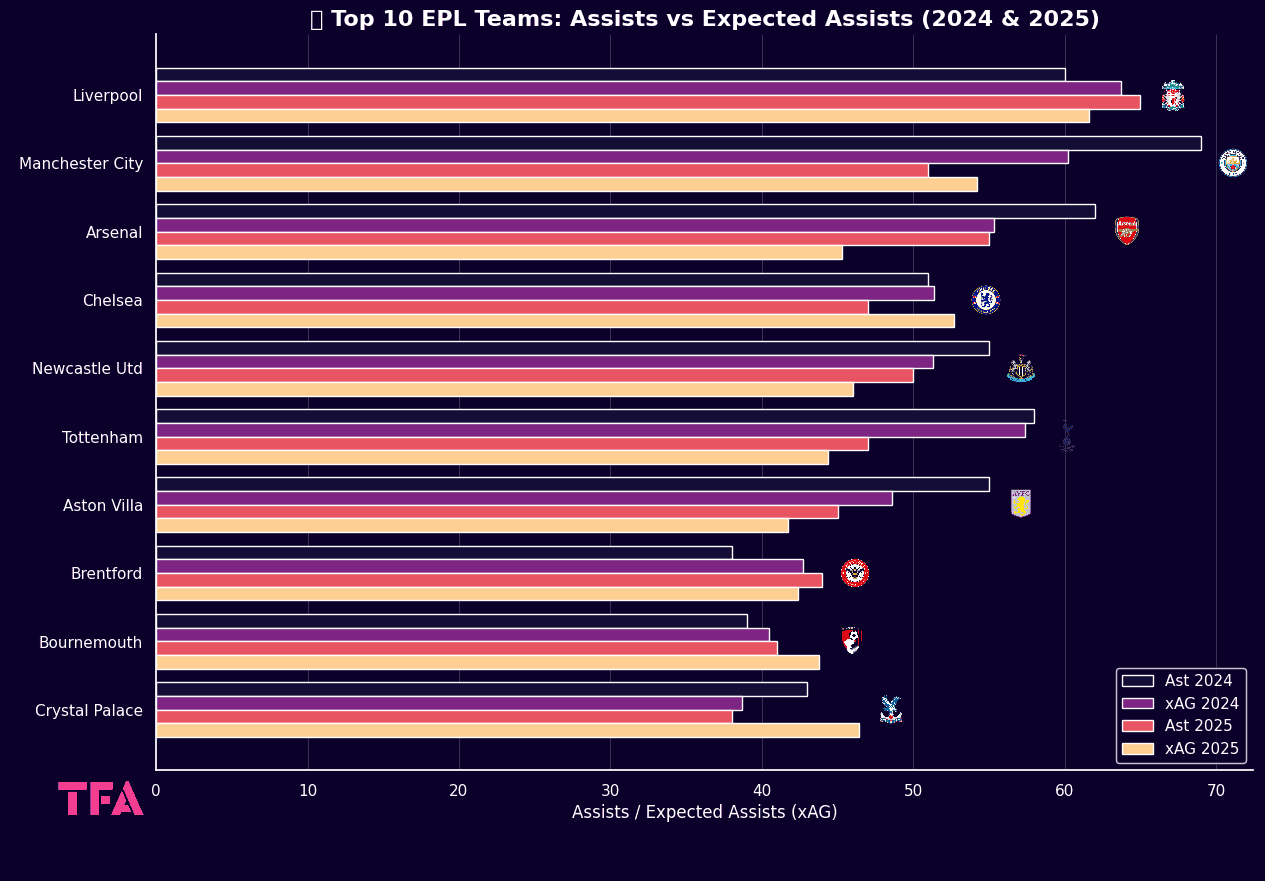
An examination of assists and expected assists (xAG) across the Premier League’s top ten clubs between the 2024 and 2025 seasons reveals important insights into creative efficiency and attacking synergy.
While assists highlight final outcomes, expected assists offer a truer reflection of the underlying creative value within attacking sequences.
Actual Assists & Expected Assists (xAG) In 2023/2024 & 2024/2025
Manchester City
Manchester City continue to lead the league in this regard, maintaining a consistently high xAG alongside a similarly elevated assist output.
Their structured possession and intelligent use of width result in high-quality final balls and a dependable conversion rate.
Arsenal & Liverpool
Arsenal and Liverpool also display strong alignment between their xAG and actual assists, underlining consistent creation, clinical finishing, and positional awareness within the box.
Chelsea
Chelsea and Newcastle United present contrasting stories.
Chelsea outperformed their xAG in 2025, pointing to moments of opportunism and individual brilliance rather than sustained structural creativity.
Newcastle United
Newcastle have declined in both measures, hinting at tactical stagnation and a drop in central zone influence, exacerbated by key injuries and less direct attacking transitions.
Brighton
Brighton xAG has grown sharply, yet their actual assists have not kept pace.
This discrepancy suggests inefficiency in final actions or a lack of composure in dangerous zones.
Tottenham Hotspur
Tottenham Hotspur have shown year-on-year improvement, reducing the gap between creation and execution through enhanced interplay and more effective decision-making in the final third.
These statistics extend beyond individual output and instead illuminate team cohesion, positional fluidity, and clarity of attacking patterns.
Closing the gap between chance creation and final execution remains one of the Premier League’s most defining battlegrounds for sustained success.
Tracing Tactical Shifts: Progressive Carries & Passes In The Premier League 2023/2024 to 2024/2025
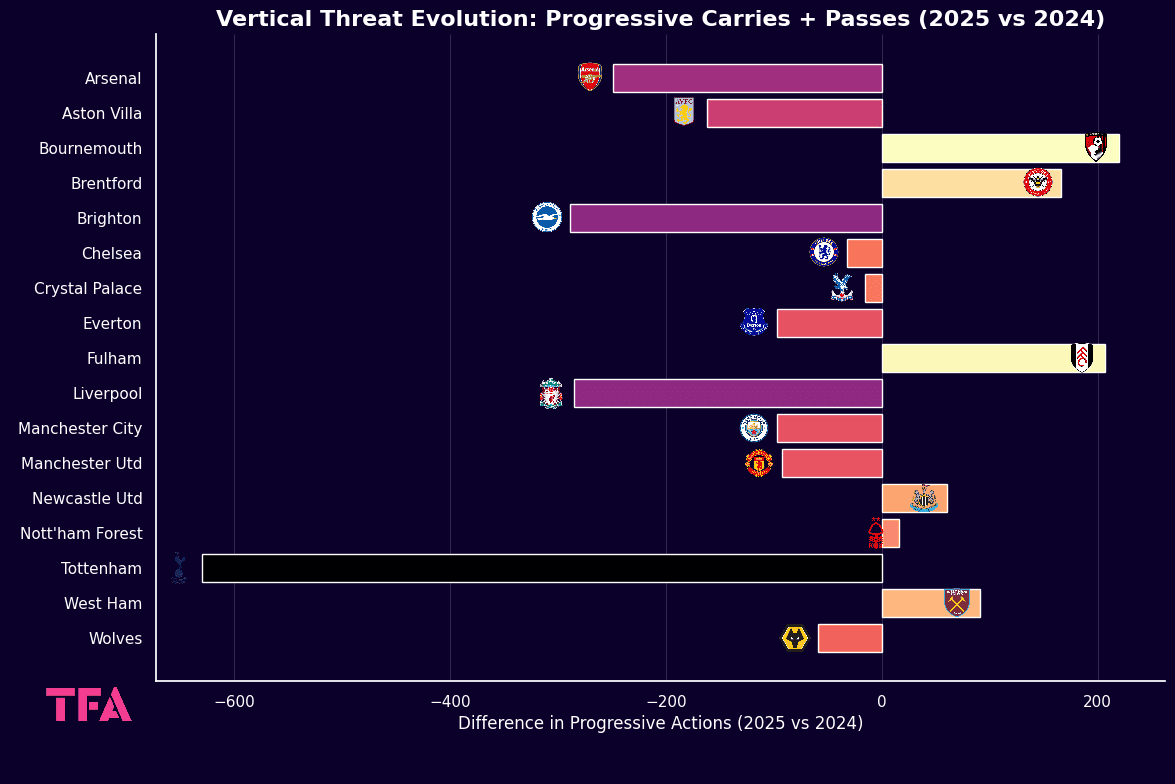
The evolution of progressive actions between the 2023/2024 and 2024/2025 Premier League seasons offers an insightful glimpse into the tactical dynamics shaping the competition.
Examining both progressive carries and progressive passes reveals how teams have adapted their approaches to ball progression, either through structural continuity or strategic reinvention.
Progressive Carries & Passes In 2023/2024 & 2024/2025
Manchester City
Manchester City, as expected, remains a benchmark in both metrics.
Their progressive carries increased slightly from 1127 to 1146, while their passes dipped modestly from 2060 to 1944.
This balance suggests Guardiola’s side is maintaining its positional discipline while encouraging more individual advancement, particularly through wide players like Jérémy Doku or Omar Marmosh.
Arsenal
Arsenal followed a similar pattern.
Progressive carries rose from 821 to 852, indicating a greater inclination for direct ball progression from midfield, possibly linked to the influence of Declan Rice and an increasingly mobile front line.
However, a notable drop in progressive passes from 2106 to 1826 might signal a more vertical, less patient approach in build-up play compared to the previous campaign.
Liverpool
Liverpool experienced the most striking regression.
While they remained in the upper echelons with 825 carries and 1924 passes, both numbers were substantially lower than their 924 and 2110 tallies from last season.
This downturn could reflect Klopp’s transitional midfield reshuffle and the phasing out of deeper-lying playmakers, shifting the load towards individual carrying efforts.
Fulham
On the other end, Fulham’s growth is hard to ignore.
Progressive carries increased from 670 to 786, while progressive passes rose from 1467 to 1558.
This surge suggests a more proactive, assertive style under Marco Silva, with midfielders and full-backs playing more expansive roles.
Bournemouth
Similarly, Bournemouth’s improvements hint at a shift from reactive to more constructive possession.
West Ham United & Newcastle United
Clubs like West Ham and Newcastle showed steady improvements, aligning with their ambitions to consolidate mid-table stability or European pushes.
Tottenham Hotspur
Meanwhile, Tottenham’s decline in both metrics underscores a tactical recalibration under Postecoglou, possibly at the expense of some verticality for greater control.
These illustrate how Premier League sides continually evolve in their interpretation of space and ball progression.
Whether through structured passing networks or assertive dribbling, teams are increasingly defined by how they move the ball through the thirds.
Conclusion
The numbers tell a compelling story.
From Manchester City’s slight pivot towards more individual progression to Arsenal’s increased verticality through carries, the Premier League is undergoing a quiet but meaningful transformation in how teams advance the ball.
Progressive carries and passes are no longer just supplementary data points—they are tactical signatures, reflecting each manager’s vision and risk appetite.
Teams like Fulham and Bournemouth demonstrate how marginal gains in progression can lead to broader shifts in performance, while Liverpool’s regression highlights the complexity of squad transitions and tactical overhauls.
Even for sides like Chelsea or Newcastle, whose raw progression numbers may appear stable, the context reveals changes in patterns, zones of influence, and stylistic intent.
Importantly, the data validate many broader narratives that emerged throughout the season.
Manchester City and Arsenal, despite losing points, are experimenting with more direct transitions and structural adjustments.
Tottenham’s decline in both progression metrics mirrors a general drop in cohesion and control.
Conversely, clubs like Nottingham Forest or West Ham show how consistency and defensive structure are beginning to underpin their ball movement strategies.
By tracing these shifts, we not only understand what is happening but also why.
The Premier League in 2025 is a league of transitions, possession battles, and carefully constructed tactical systems.
As this analysis has shown, teams are increasingly judged not just by where they finish but also by how they progress the ball and assert control.
In a league where margins are everything, understanding these progressive layers offers the clearest picture yet of who is truly moving forward and who is just standing still.
