
The 2019/20 season was a promising one for Wolfsburg in Oliver Glasner’s first season in charge, they finished in seventh place and secured Europa League qualification. The Wolves had a brilliant start to the campaign, going nine games unbeaten in their three-at-the-back formation, looking like they were in contention to finish in the UEFA Champions League places. However, due to the fact that their centre-backs had poor mobility, Wolfsburg were vulnerable to teams in transitions, this was most apparent in the back-to-back losses against RB Leipzig in the cup and Borussia Dortmund in the Bundesliga. This caused Glasner to change his tactics to a four-at-the-back formation mid-way through the season.
However, one aspect of their game which has been consistent across the campaign is their dynamic build-up strategies. Glasner’s side has multiple different ways of progressing the ball into the opposition third and this ultimately makes it more difficult for the opposition team.
This tactical analysis, which will be in the form of a scout report, will be dissecting the different build-up strategies that Wolfsburg have used throughout the 2019/20 campaign.
Direct & vertical passes
One of Wolfsburg’s main build-up strategies across the season has been playing direct and verticle passes. This tactic of building up is effective because they have had two impressive progressors of the ball in the middle, Maximilian Arnold and Xaver Schlager, they average 10.47 progressive passes per 90 between them. They also have dangerous wingers such as Josip Brekalo, who is impressive when it comes to running in behind for direct passes.
Wolfsburg mainly look to play vertically when the opposition are in some type of defensive transition, as they look to exploit the spaces. As the centre-backs that Wolfsburg have are not great passers of the ball and cannot break lines often enough when a team is in their settled shape. We can see that Wolfsburg focus on direct progression in the build-up through their season ball possession statistics. The Wolves had 1155 possessions which lasted less than five seconds, 135.9 more than the average, showing they do not keep possession for very long, as they prefer the more direct route of play, including playing long balls which I will look into later in the analysis.

Here is a clear example of this direct build-up. David Brooks receives the ball after a long ball from Freiburg, meaning that the opposition are not in a settled shape, this means that Brooks can play vertically into Arnold, who is in the half-space, very easily.

Arnold can then find Renato Steffen with another verticle pass behind the opposition backline, he then is able to cross into Wout Weghorst, who scores past the Freiburg goalkeeper. Wolfsburg were able to get into a dangerous crossing position through just two verticle passes. This shows the effectiveness of this build-up strategy.
Although I mentioned that this strategy is mainly used when the opposition is not in a settled shape, Wolfsburg still sometimes use the strategy when teams are settled, with their defenders moving into the half-spaces.

In the above graphic, we can see an example of the defender moving into the half-space with the ball, due to his centre-midfielder dropping in centrally. Then, the defender has multiple different options to play the ball to, as he is in the half-space. This means that progression and verticle directness is made easier for the centre-back.

Here is an example of this movement of the centre-back into the half-space. After the ball is played back to Koen Casteels, Marin Pongracic, Wolfsburg’s right-centre-back, moves into the right half-space to receive possession from his goalkeeper. He then is in a good position to find a great pass into Steffen’s feet, who moved centrally to receive the ball.
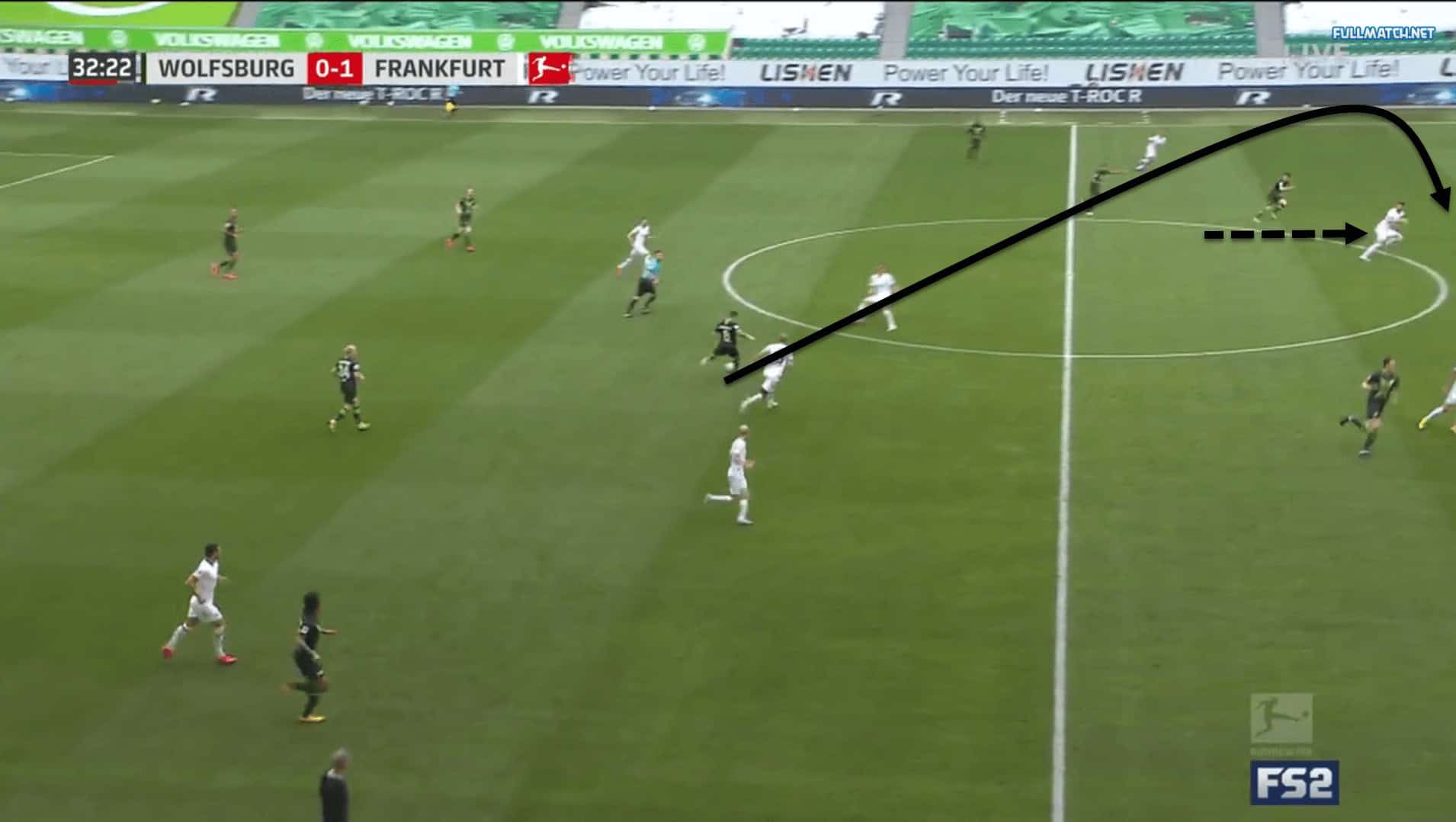
After Steffen receives the ball, his turn with his first touch is able to take two of Frankfurts players out of the game. His first reaction then is to play a direct lofted ball in behind the opposition defence towards Brekalo. The young winger is able to get a shot off but it is off-target. Again though, Wolfsburg were able to move the ball into a dangerous area with just two verticle passes.
However, this movement into the half-spaces does not occur enough at Wolfsburg, especially after the change to a back four in December. Instead, the midfielders are often cover shadowed by opposition strikers, Wolfsburg do have a build-up strategy to bypass this problem though, as I will explain in the next section.
Baiting a wide-press, then penetrating centrally
In order to bypass a defensive shape, where the opposition were looking to limit Wolfsburg’s central progression, Wolfsburg would bait a wide-press from the opposition in order to create space centrally for their midfielders, who can then receive possession and progress the ball centrally.
 Here is a graphic showing a standard shape which some teams will have against Wolfsburg. The midfield is very narrow and the two strikers (or striker and #10) are occupying passes to the Wolfsburg midfielders in their cover shadows.
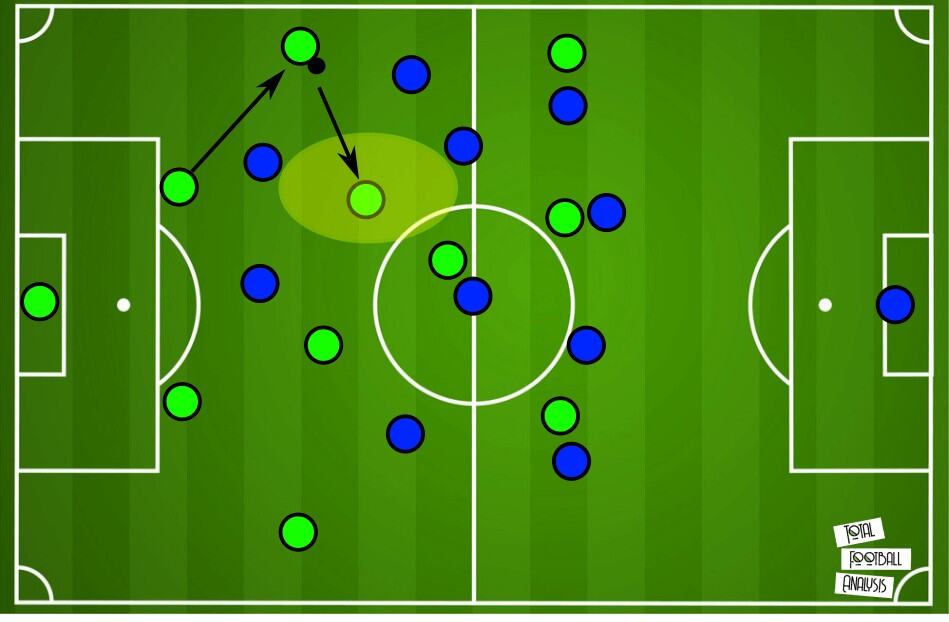
In the above graphic, we can see how Wolfsburg build-up against this kind of opposition shape. By playing the ball wide, the opposition moves towards that side, opening space centrally. This allows either Schlager or Arnold to receive the ball in some space and then they can play passes into the front men or wingers.
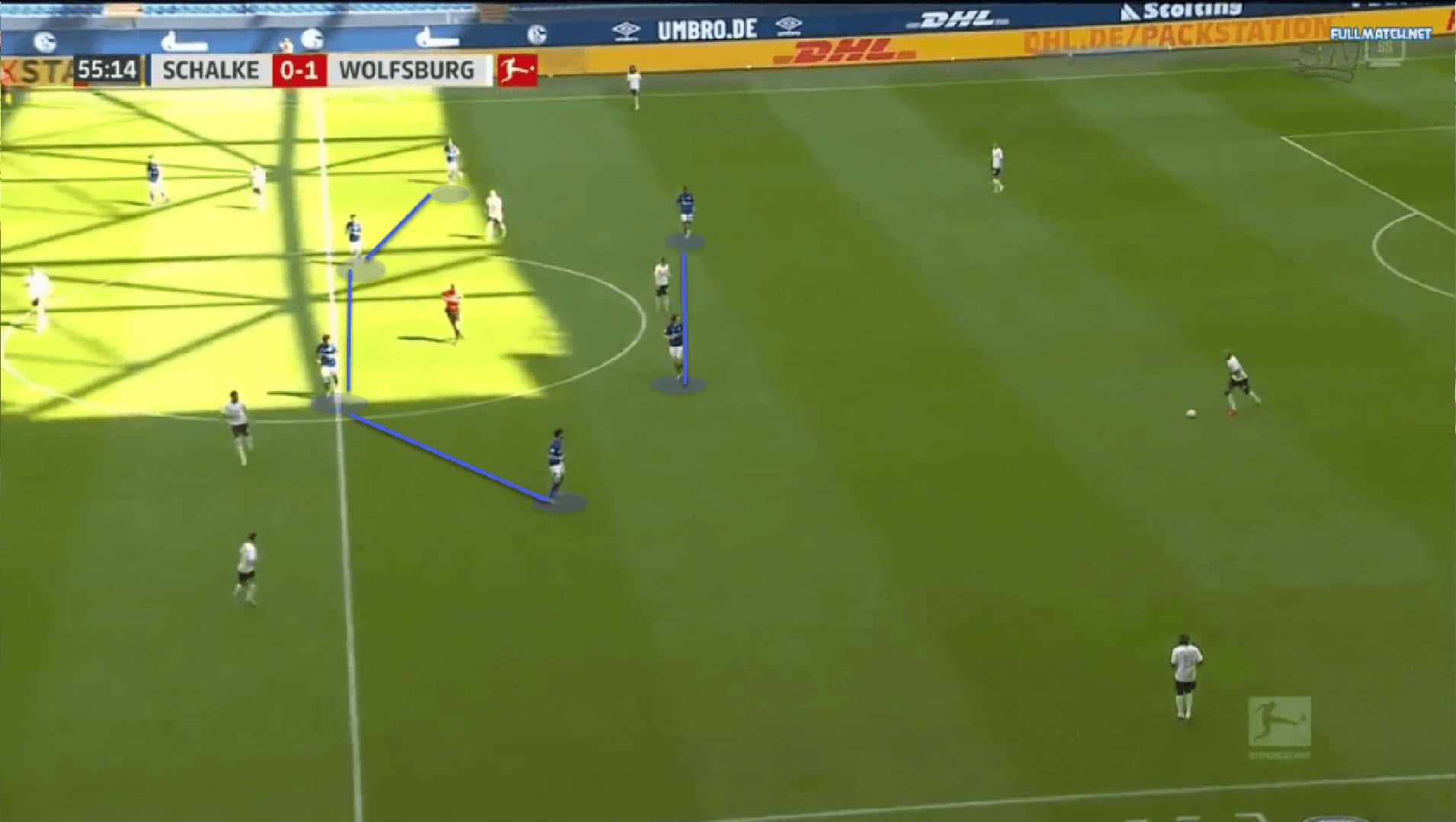
In this image, we can see that Schalke are operating in a narrow 4-4-2, this is done to try and limit central progression from Wolfsburg.
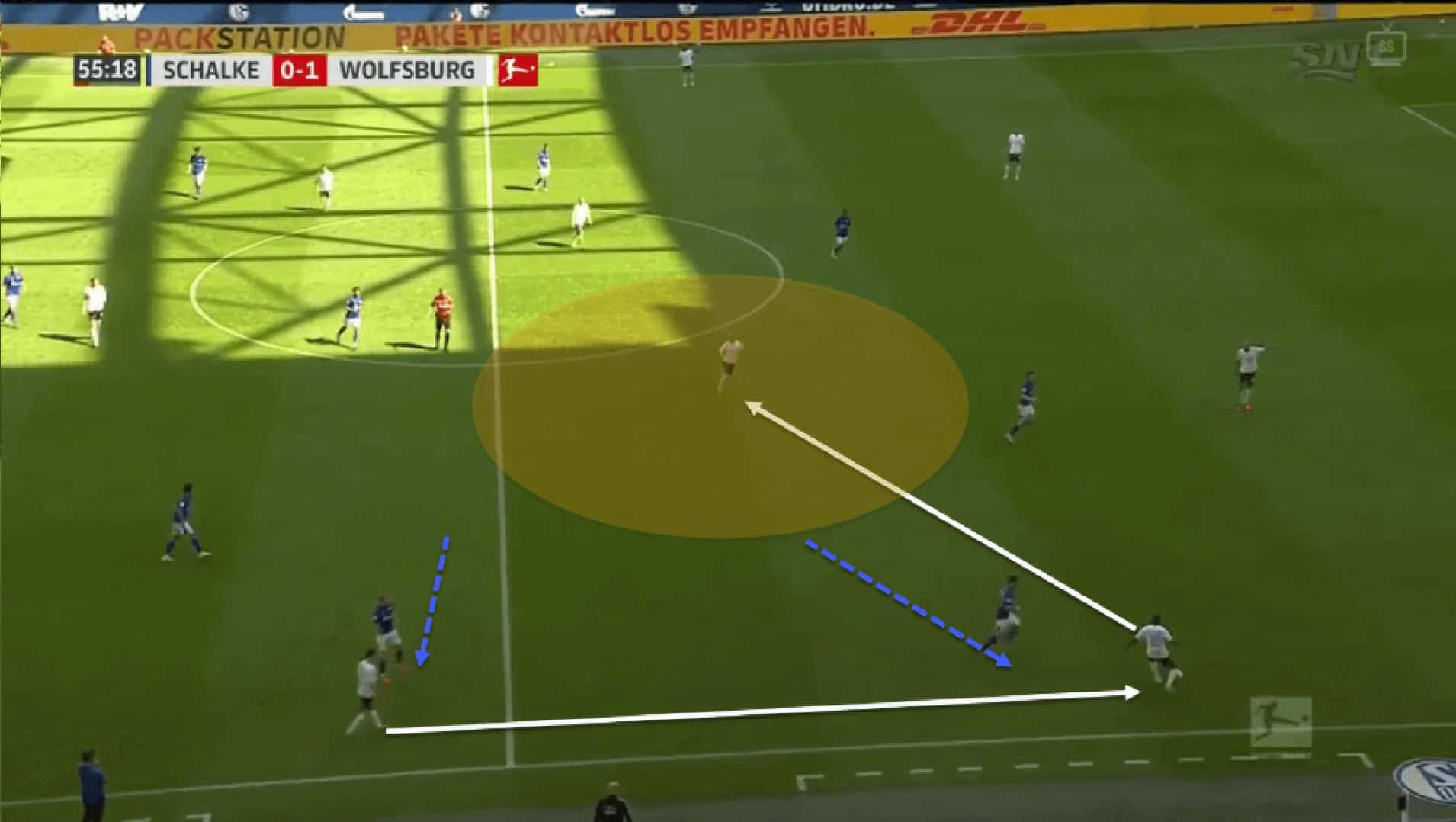
In order to bypass this, John Brooks moves the ball wide to Josip Brekalo, who then passes back towards Jérôme Roussillon. This circulation of the ball on the left-side is done to bait a wide press from Schalke. Once their settled, narrow shape is baited into the wide area, there is space in the centre for Arnold to receive the ball. He then passes across to Schlager and then two verticle passes lead to Wout Weghorst going through one-on-one with the goalkeeper and he manages to score.
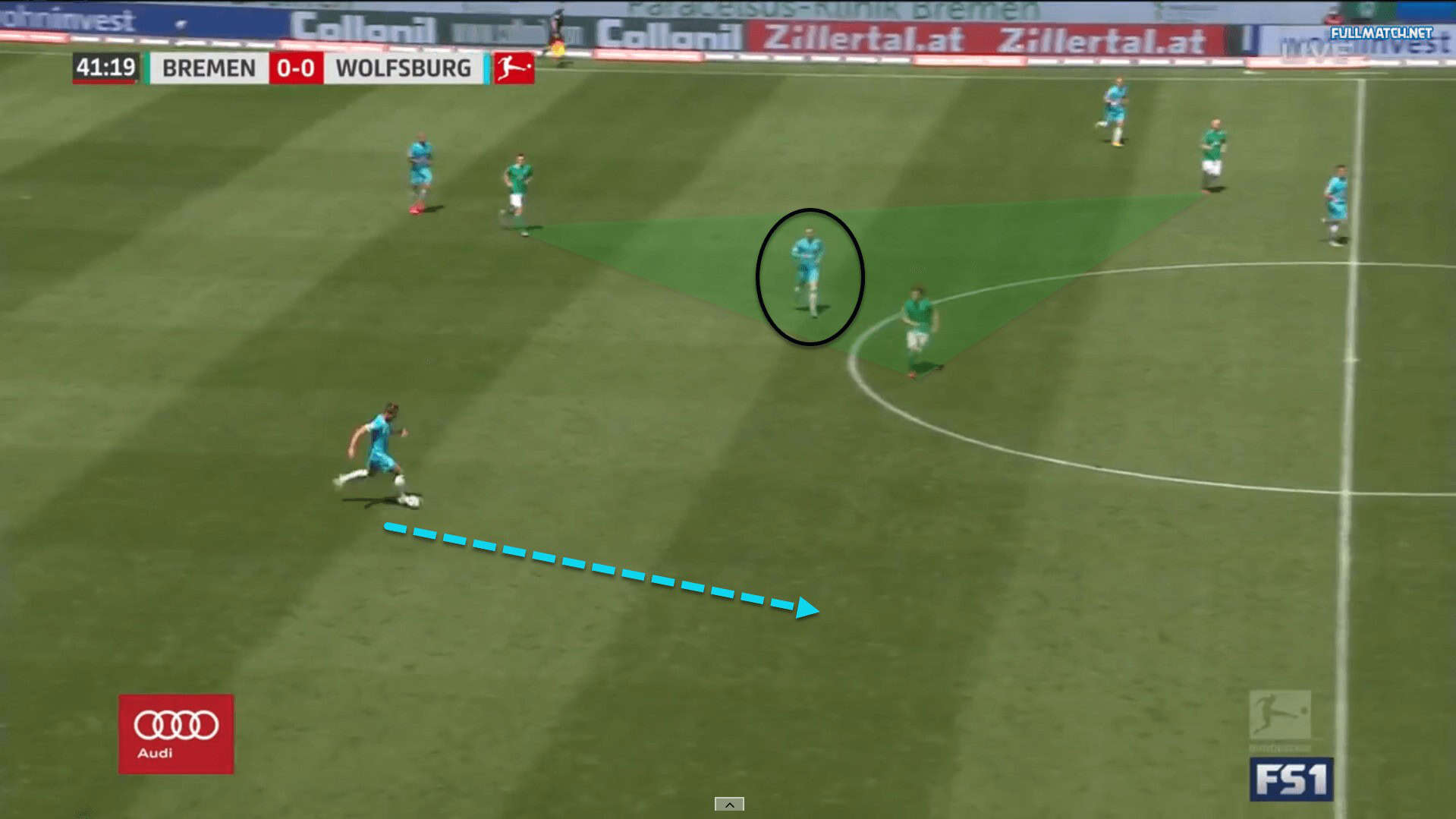 Marin Pongračić has the ball and the opposition front-three are all positioned closely to Arnold, in order to stop progression through the centre.
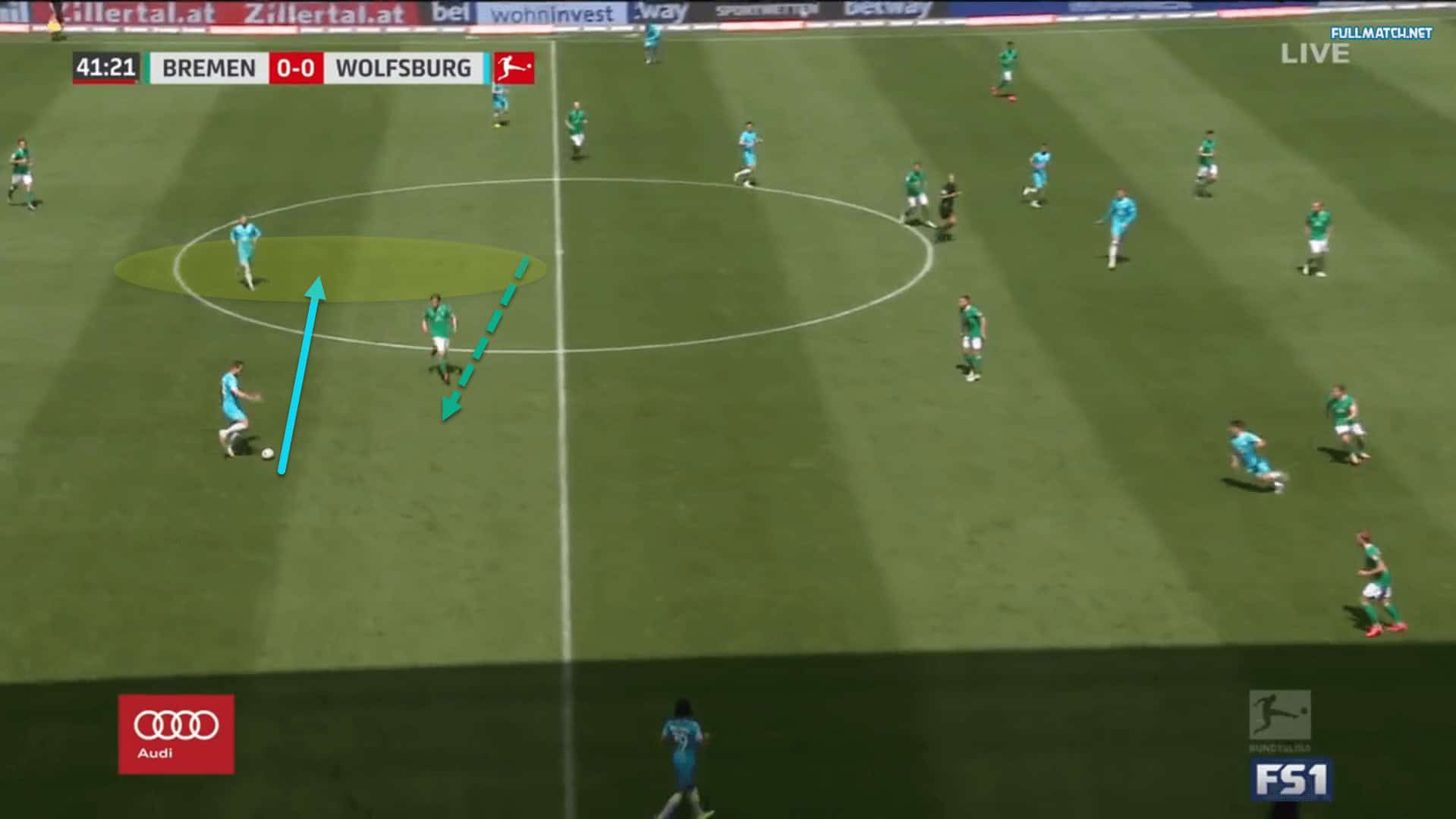
Pongračić begins to carry the ball forward on his own, this causes the opponent’s shape to stretch to try and stop the progressive carry. This, in turn, creates space for a pass into the centre to Arnold. Pongračić passes to him and then he can play a verticle pass to get the ball to the Wolfsburg forward men.
Long balls to Weghorst
While playing verticle passes through the centre is a clear build-up strategy of Wolfsburg, they also can miss out the second phase entirely through playing long passes into Weghorst. The Wolfsburg top goalscorer is a great outlet and this can help Wolfsburg move the ball into the final third quickly and effectively.
With Wolfsburg often either playing with a front-two or a #10 behind Weghors, they often have someone to pick up the second ball after a long ball to the striker.
Wolfsburg averaged 46.64 long passes per 90, this is 12.4% of their average entire passes per 90. This is a clear option of build-up for Glasner’s side.

Here we can see a long pass from the Wolfsburg goalkeeper, Casteels. He plays the ball long to Weghors, who can flick the ball straight towards Ginczek. He then passes the ball on and Wolfsburg are suddenly attacking the Freiburg backline in the final third. The effectiveness of the long ball is shown through the attack.
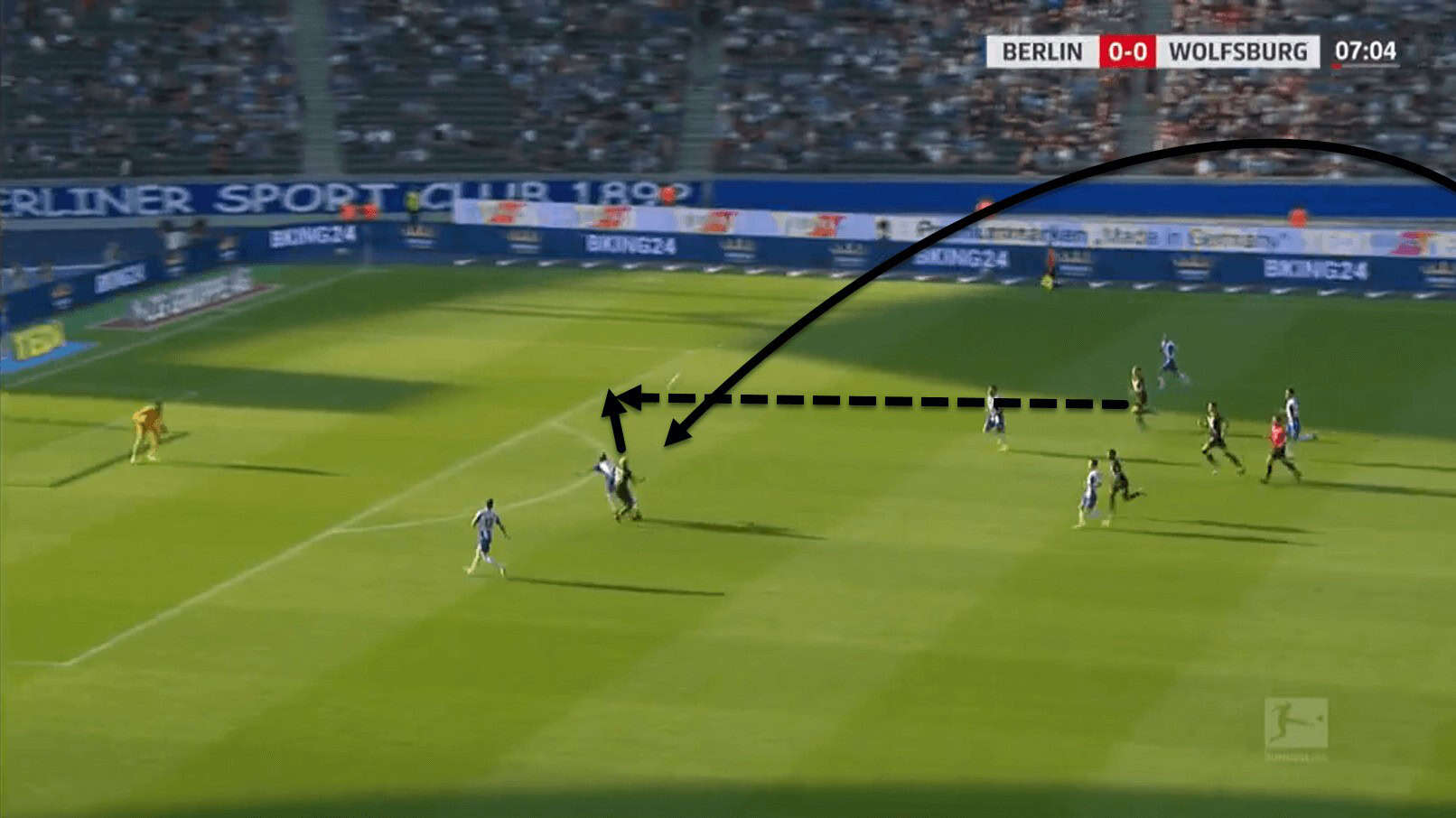
Here is an example of the long ball leading to a penalty. With Robin Knoche playing the long pass directly to Felix Klaus, the German wins the header and Weghorst is the first to make the second ball. He is then tackled inside the area and Wolfsburg wins a penalty. The importance of having players winning the second balls is what makes this a viable strategy for Wolfsburg in the build-up.
Wide combinations and attacking full-backs
Another form of build-up is through the wide areas for Wolfsburg. They look to play through passes into the flanks for players to cross the ball. Usually, it is the full-backs who are the ones who get into crossing positions. Kevin Mbabu is brilliant at getting forward with the ball, he averages 147.4 yards of progressive distance carried per 90 but can also link-up with his winger in order to create crossing opportunities. He also averages 4.36 crosses per 90. On the other side, Roussillon also progressively carries the ball 139.2 yards per 90, while he does not cross as much as Mbabu, he still averages 2.7 crosses per 90.
When the ball is circulated into a wide area, the full-backs will often look to make an over/underlapping run to receive the ball in the final third, this is usually where they will either look to combine with their winger further or cross into the box.
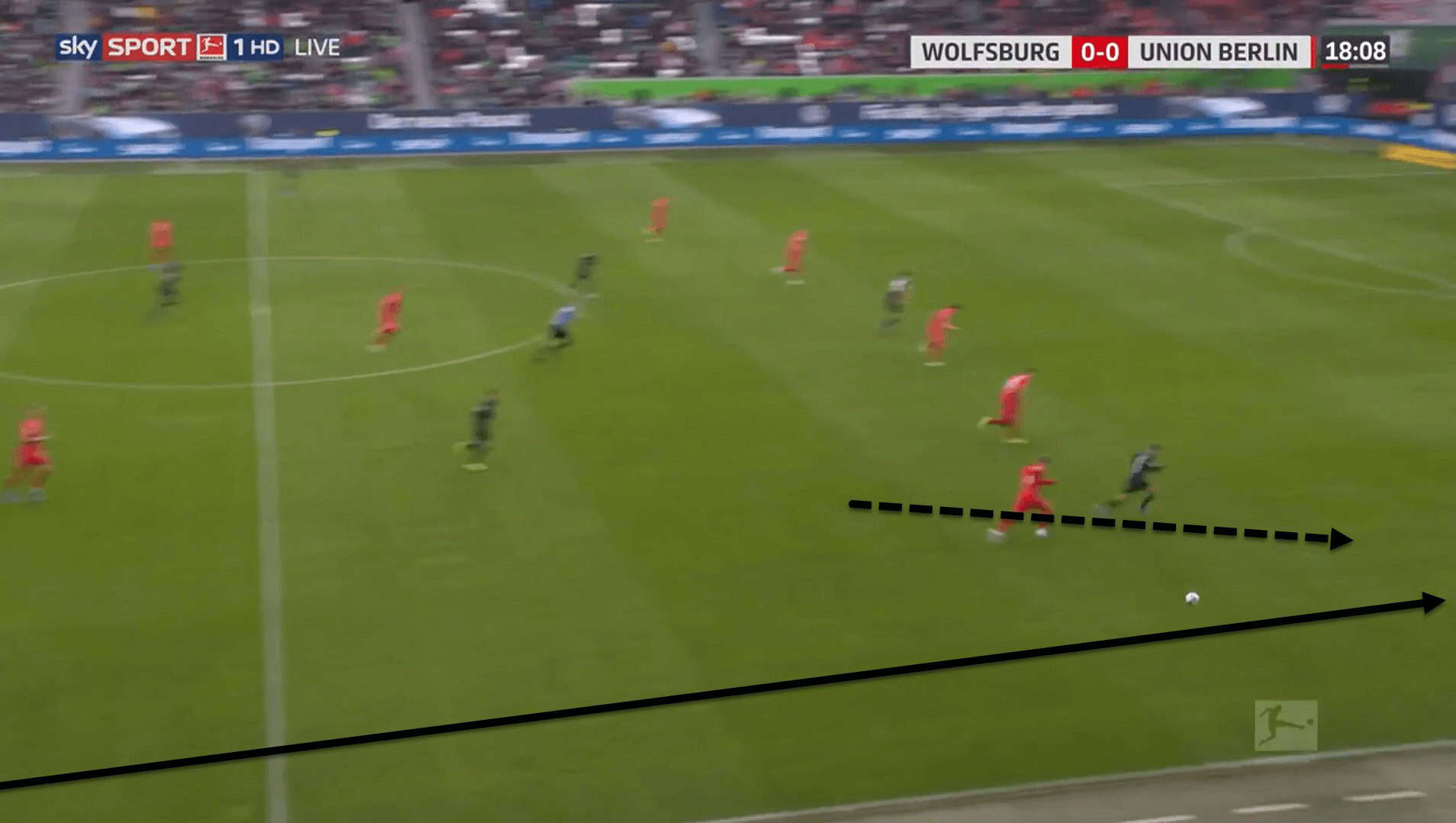 In this image, we can see an underlapping run from the Wolfsburg wing-back, William. This allows him to run across the blindside of the opposition wing-back, meaning that the through ball on the flank from Knoche can find William in space on the right. He is then able to play a dangerous cross into Weghorst, however, a strong defensive header from the opposition centre-back stops the attack. The attacking full-back/wing-back was vital to building into the final third.
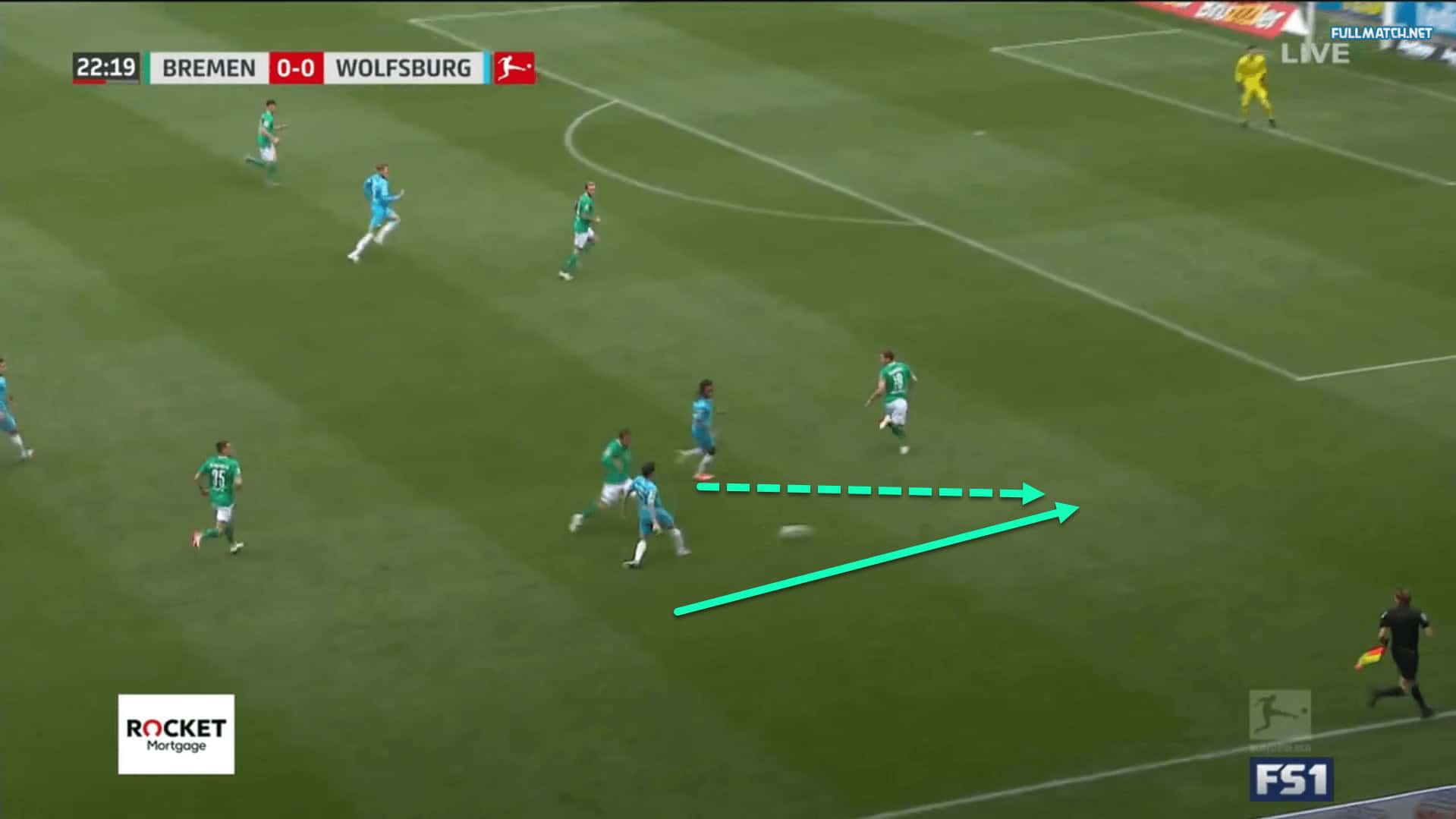
Again, here is another wide attack, this time, the Wolfsburg wide men combine with a one-two to enter the final third. Mbabu intercepts the ball in his own half, he then finds Brekalo with a quick pass forward. The right-back then makes an underlapping run past the defensive line; the ball was returned to him and since he ran on the blindside of the defender, Mbabu created the space in order to cross towards the front post, however, the opposition was able to clear the ball. The quick combinations on the right side proved to be a viable build-up option.
Conclusion
To conclude this analysis, it is clear that Wolfsburg have multiple forms of build-up play under Glasner in 2019/20, which has allowed them to create chances against different types of teams, as well as to stay unpredictable in the build-up. It is likely that Glasner will return to his favoured 3-4-3 in the next campaign if he gets the correct defensive reinforcements, this will mean that the direct build-up from the centre-backs in the half-spaces will probably be a prominent form of build-up for the Wolves. Yet, the dynamic build-up of longer direct passes, wide combinations and the baiting of a wide press, in order to penetrate centrally is likely to continue into the next campaign too.