
After eight years away—four of which were spent in England’s third tier, EFL League One—Sunderland will return to the Premier League in 2025/2026.
Régis Le Bris’ side defeated Chris Wilder’s Sheffield United 2-1 in the EFL Championship Play-Off Final at Wembley Stadium on Saturday to secure their return to England’s top flight.
They did so in dramatic fashion, with Tom Watson netting the winner in stoppage time ahead of the teenager’s summer move to Brighton & Hove Albion.
The 19-year-old’s 95th-minute strike ensured his current club would be making the jump up to the country’s elite competition along with him for the 2025/2026 campaign.
In this post-match tactical analysis, we’ll provide an in-depth analysis of both teams’ respective tactical setups on Saturday.
Our analysis details both teams’ tactics in attack and defence, with a particular focus on our key battle of the game: Sheffield United’s press versus Sunderland’s build-up play.
EFL Championship Play-Off Final 2024/2025 Lineups & Formations
Firstly, we’ll outline how both teams lined up for Saturday’s game.

Eventual winners Sunderland were set up in a 4-4-2 shape.
Anthony Patterson started in goal behind a backline consisting of right-back Trai Hume, right centre-back Dan Ballard, left centre-back Luke O’Nien and left-back Dennis Cirkin.
Chris Rigg started on the right wing next to right central midfielder Dan Neil, left central midfielder Jobe Bellingham and left winger Romaine Mundle.
Then, Enzo Le Fée played as a ‘10’, just off the scorer of Sunderland’s first goal in the game, their 76th-minute equaliser, Eliezer Mayenda.
Régis Le Bris made a total of five substitutions during the match, the first of which he was forced into after just eight minutes when O’Nien picked up an early injury.
Chris Mepham was introduced in his place, which led to Ballard switching across to left centre-back before too long, with Mepham playing at right centre-back.
In the 58th minute, we saw the introduction of Patrick Roberts for Chris Rigg at right wing.
Sunderland followed that switch with a double substitution in the 73rd minute, just before their equalising goal, which saw Tom Watson and Wilson Isidor come off the bench for Mundle and Neil.
The Black Cats’ final substitution came in the 97th minute when they introduced an extra defender, Leo Hjelde, for striker Mayenda as they put all their efforts into holding on for the victory.
The Blades also lined up in a 4-4-2 shape for this game.
Michael Cooper started in goal behind right-back Hamza Choudhury, right centre-back Anel Ahmedhodžić, left centre-back Jack Robinson and left-back Harrison Burrows.
Rhian Brewster was on the right wing alongside Sydie Peck at right central midfield, Vini Souza at left central midfield and Gustavo Hamer at left wing.
Meanwhile, Kieffer Moore and Tyrese Campbell led the line for the Yorkshire side.
Chris Wilder made six substitutions over the course of the game.
Their first two occurred just after the hour mark when Brewster and Campbell made way for Andre Brooks and Callum O’Hare.
Just seven minutes later, Hamer was replaced by Ben Brereton Díaz.
Brereton Díaz was in the game for just 18 minutes before he left the pitch alongside Peck as the Blades introduced Tom Davies and Tom Cannon.
Wilder’s final throw of the dice saw Ahmedhodžić withdrawn for Femi Seriki.
However, this failed to make the necessary impact to bring Sheffield United back into the game after the gut punch of Watson’s late winner.
Sunderland Defence Tactics Vs Sheffield United Direct Attacks
Sheffield United attacked Sunderland directly, exploiting the superior aerial ability of the Blades’ forward duo, especially 196cm Kieffer Moore, who has the third-best aerial duel success rate (52.61%) of any striker to have played at least 800 minutes in England’s second-tier this season.
That aerial dominance was plainly evident versus Sunderland, with Wilder’s side frequently taking the opportunity to float balls onto Moore’s head.
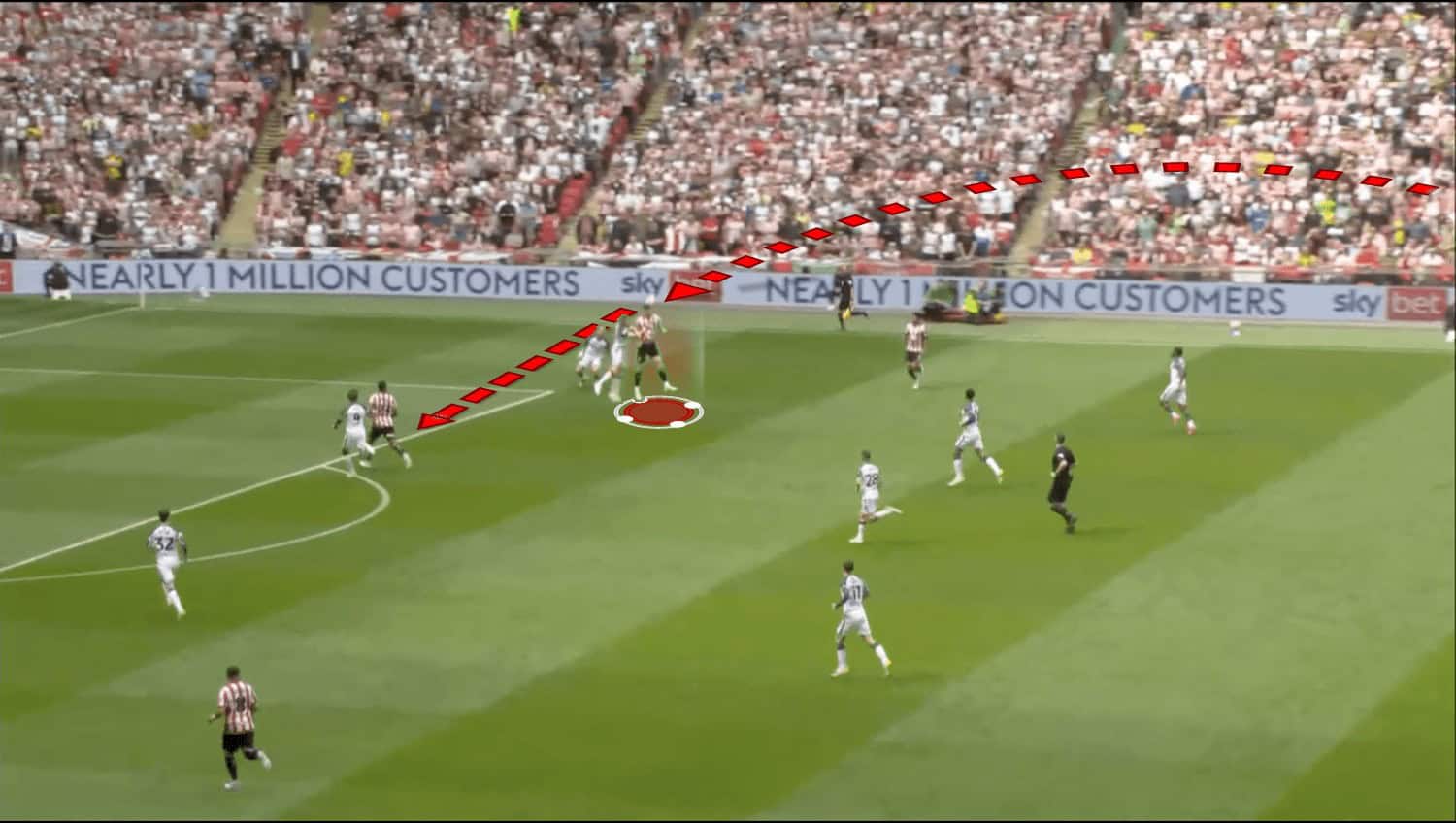
The idea would be for Campbell or a winger to make a run off Moore and get onto the ball in an advantageous attacking position from the big target man’s knock-on, which we see illustrated in Figure 2, or for Moore to knock the ball down to a supporting runner from midfield, setting the Blades up to attack from between the lines rather than going directly in behind as Figure 3 below displays.
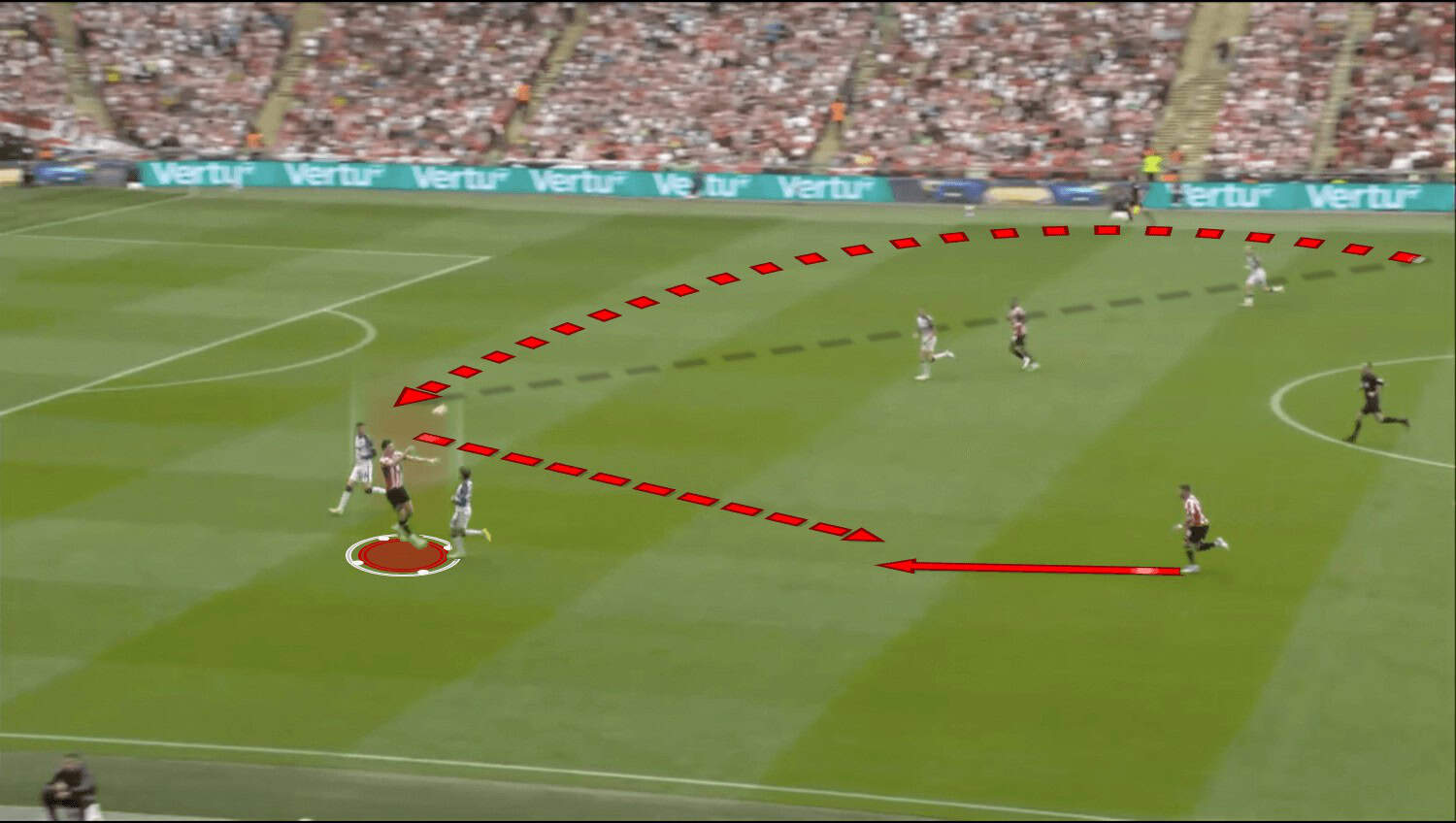
In the latter example, Hamer has some time and plenty of space between the lines to control the ball and get his head up to play Moore through on the ground, leading to an inviting cross from the big striker for Campbell.
Sheffield United frequently enjoyed this space between the lines when playing long from the back as a result of Sunderland’s pressing tactics.
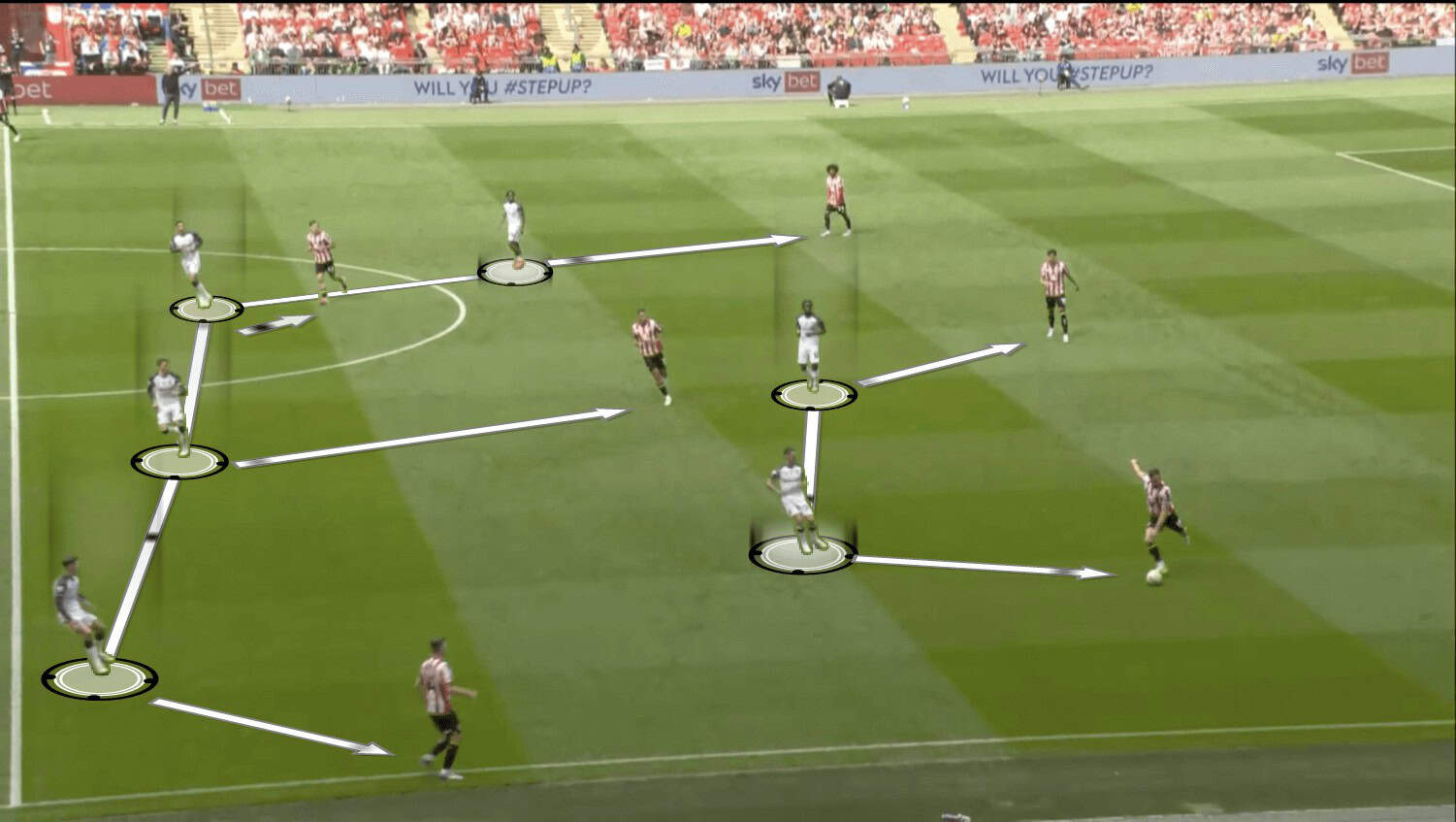
Sunderland mainly were set up to defend in a mid-block.
They typically defended zonally in deeper parts of the pitch.
However, in the mid-high block phase, they were more man-oriented, as seen in the image above.
In the build-up phase, Sheffield United played with a three-man backline, created as they shifted towards the left.
Right-back Choudhury was placed as a right centre-back while left-back Burrows hugged the touchline.
With their man-oriented press, Sunderland became something of a 4-3-3, with left winger Mundle retaining access to the deeper and more central Choudhury while right winger Rigg remained tight to Burrows out wide.
At the same time, Sunderland’s striker duo stayed fairly tight to the Blades’ two centre-backs while still trying to cut off access to their central midfielders behind them.
For extra security to protect the midfield in this phase, Sunderland’s central midfield pairing of Neil and Bellingham kept relatively close to the forwards, keeping the space between the midfield and forward lines quite compact.
This made it difficult for Sheffield United to play out from the back via short passes through midfield.
However, Wilder’s side were extremely comfortable going long, and they did so often.
This led to scenes like those in Figures 2 and 3, where long balls were played towards Moore, who could either knock it on for Campbell or knock it down for a winger or midfielder making his way into space between the midfield line and backline.
Sheffield United opened space between Sunderland’s midfield line and backline by coaxing the Black Cats’ forwards to press, thus drawing the central midfielders higher.
They could then exploit that space with their long passes from the back to the forwards.
The essence of Sheffield United’s attacking play in this game was to constantly ask questions of Sunderland’s defenders and force them into decisions, whether that was via direct passes that created advantageous 1v1 duels for the Blades like the aerial duels featuring centre-forward Moore or by pressing the Sunderland defenders aggressively when certain pressing triggers, such as a backwards pass or the player receiving with his back to Sheffield United’s half, were set off.
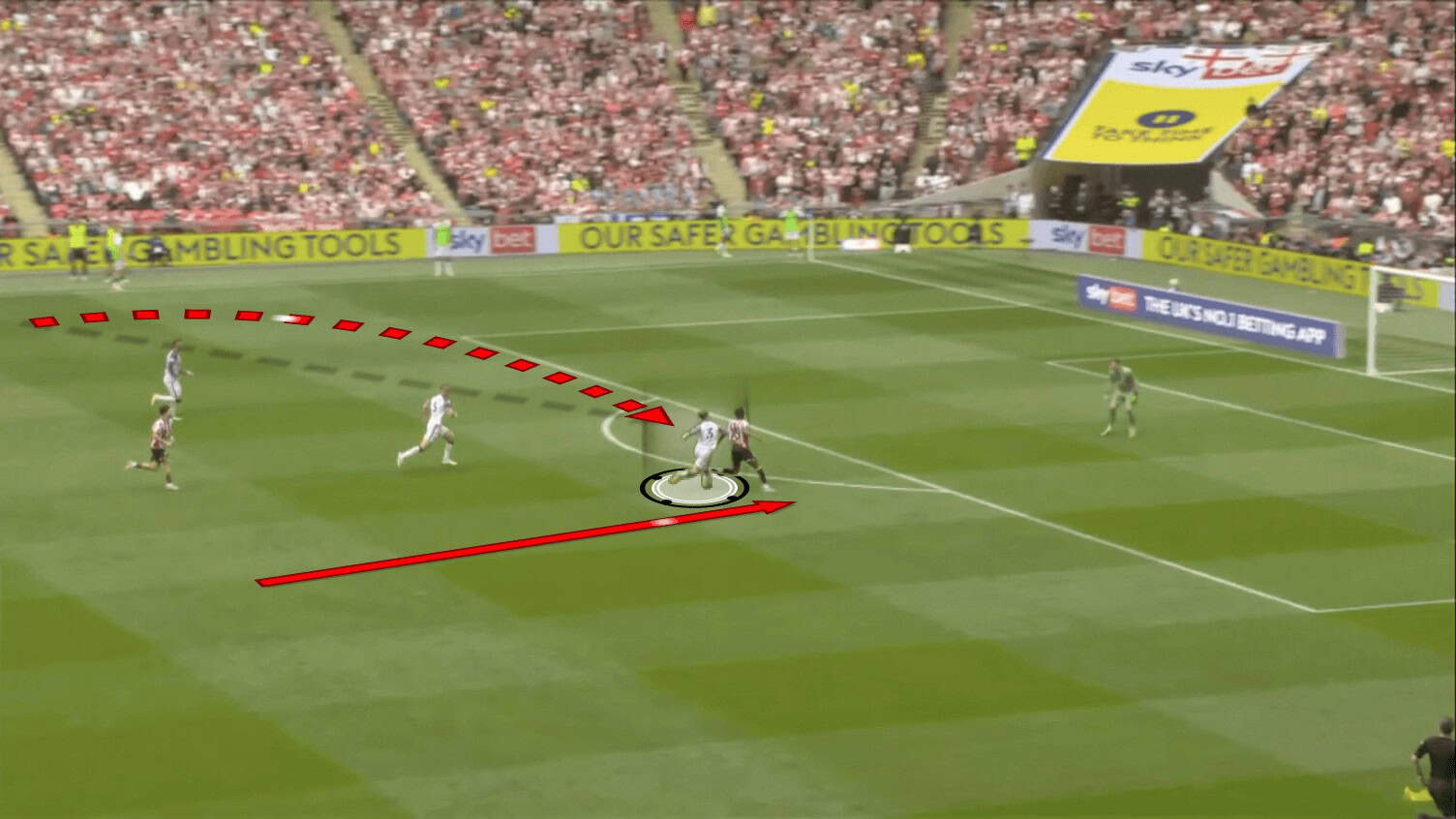
Here, Sheffield United played a long ball towards Black Cats left-back Dennis Cirkin.
Cirkin failed to deal with the long ball effectively while Andre Brooks sprinted towards the defender, putting him under pressure to make a decision about how he would deal with the long pass over the top.
Cirkin’s poor decision-making and ineffective solution for this issue led to a 1v1 opportunity for Brooks, drawing a top-class save out of Anthony Patterson.
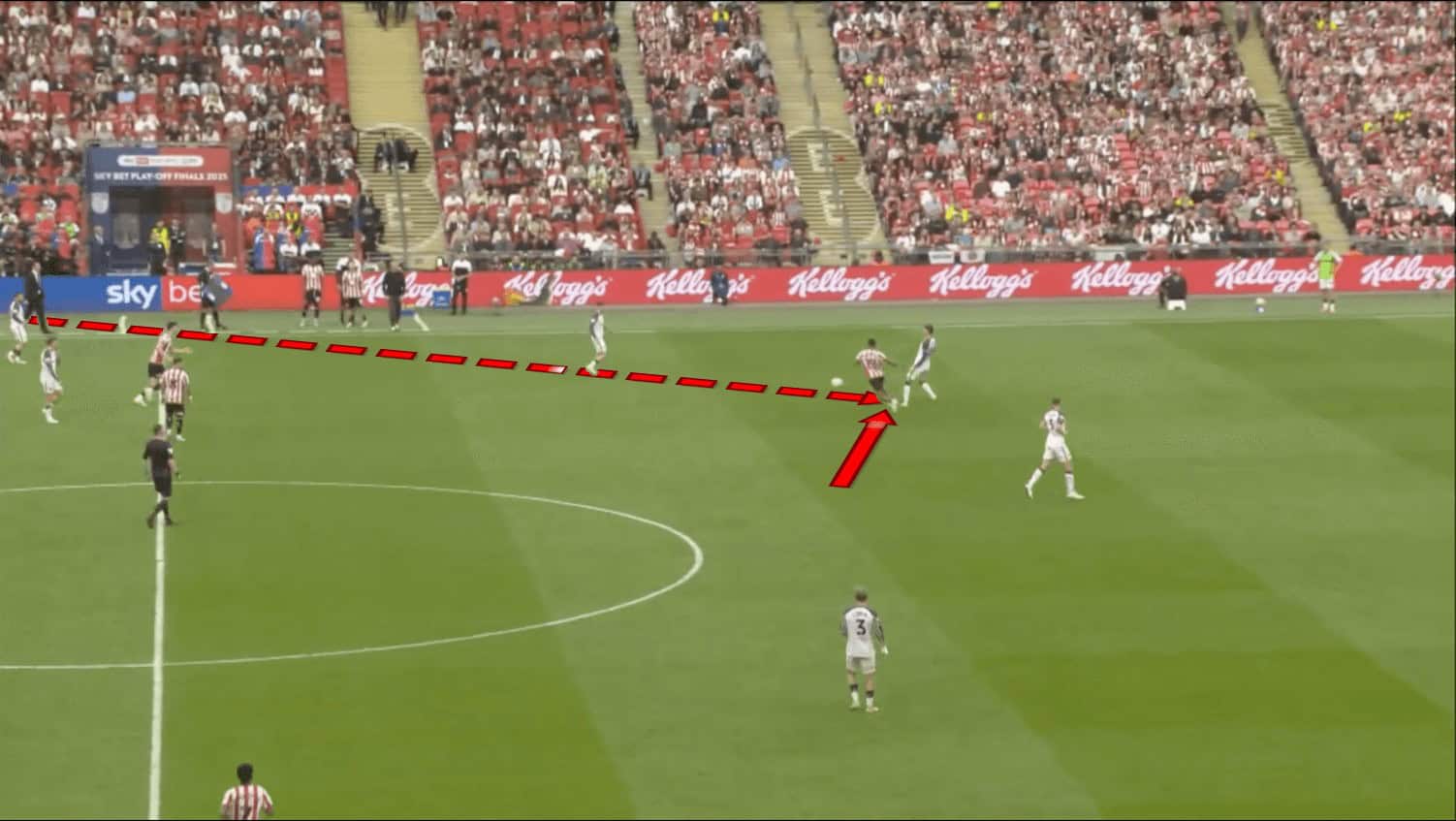
Later on in the game, Sheffield United cleared the ball towards Sunderland’s right centre-back, Chris Mepham, who was put under pressure by Campbell.
Despite the ball moving fairly casually towards Mepham by the end, the additional factor of pressure draws a mistake from the centre-back, who fails to put enough power behind his pass.
Thus, Campbell is handed possession, allowing Sheffield United to run at Sunderland’s defence from inside the Black Cats’ half.
These are two of several examples from Saturday’s Final that show how Sheffield United’s direct attacking tactics and high pressure forced Sunderland into errors and created good goalscoring chances for the Blades.
More than once, Patterson had to pull off some goalkeeping heroics.
Sheffield United Press Vs Sunderland Build-Up Play
Perhaps the most intriguing and meaningful tactical battle in Saturday’s Championship Play-Off Final was the one between Sheffield United’s press and Sunderland’s build-up play.
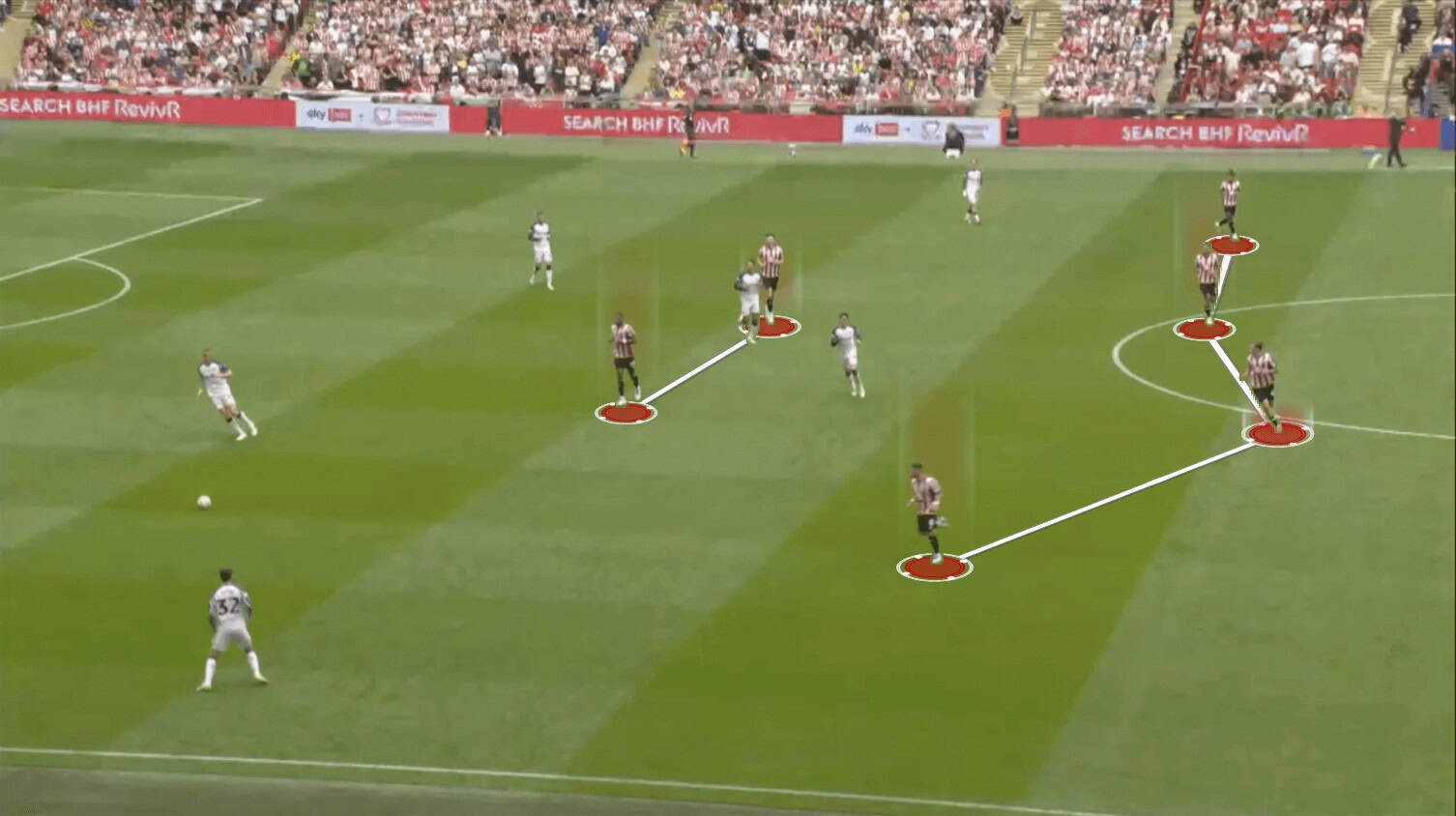
Sheffield United typically pressed aggressively on certain pressing triggers, but otherwise remained in their 4-4-2 shape in contrast to Sunderland, who became very man-oriented in the high press.
The Blades wanted to control the middle of the park, allowing Sunderland to have the ball in their backline.
They focused on preventing passes into the double-pivot and blocking passing lanes beyond those two players as well.
Le Bris, meanwhile, wanted his double-pivot to find space to receive centrally so they could take the ball on the half-turn and look to progress play beyond Sheffield United’s midfield line.
Sunderland kept their full-backs a bit deeper than Sheffield United did, though right-back Hume had the license to roam.
He proved to be one of the Black Cats’ most influential players in possession, progressing the ball into midfield and receiving in space centrally.
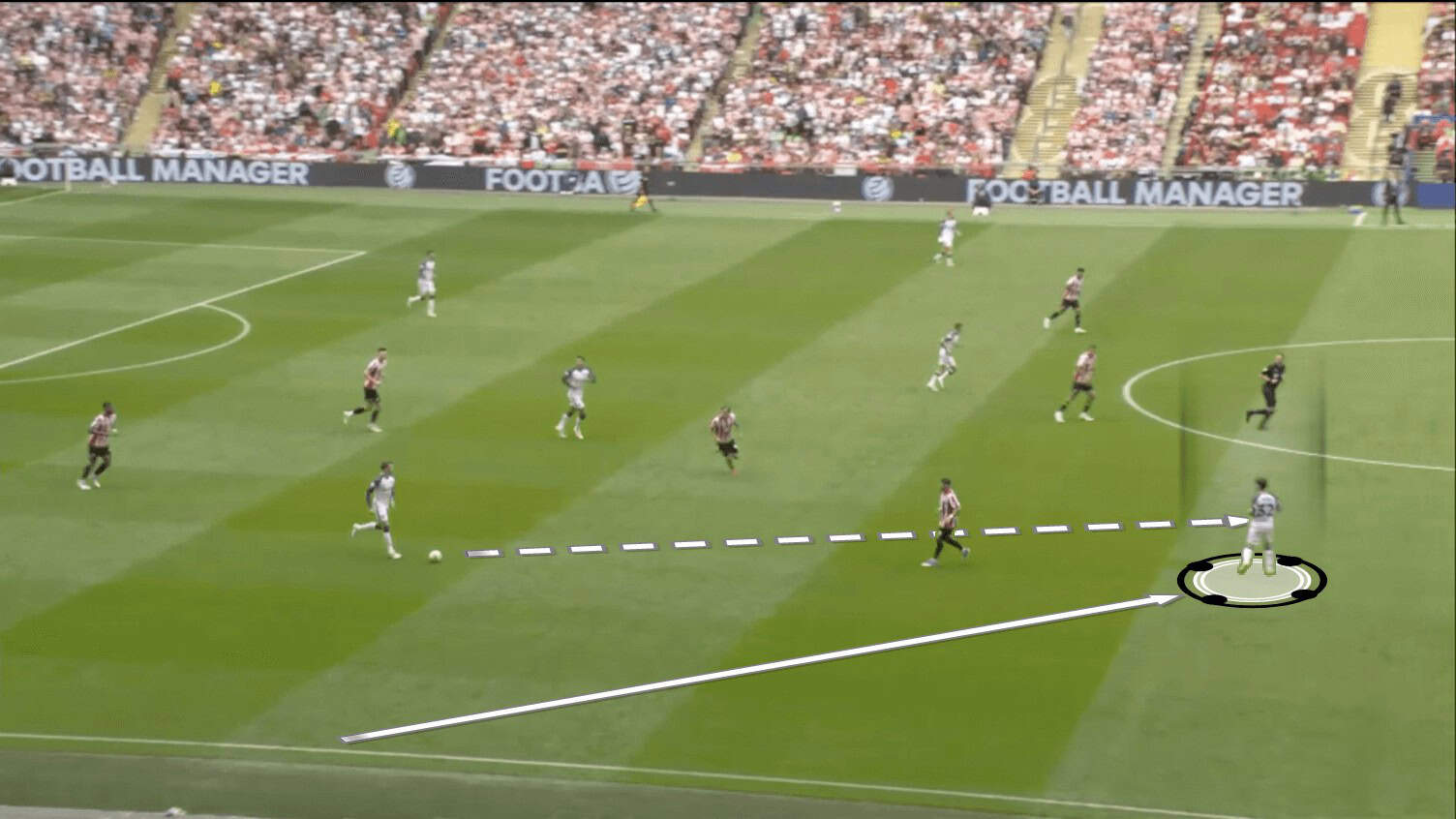
Take Figure 8, for instance.
In this case, Hume has inverted from his wide right-back position to occupy some space centrally behind Sheffield United’s midfield line.
This places him in an inviting position to receive the pass from the right centre-back and help his team advance into the opposition’s half.
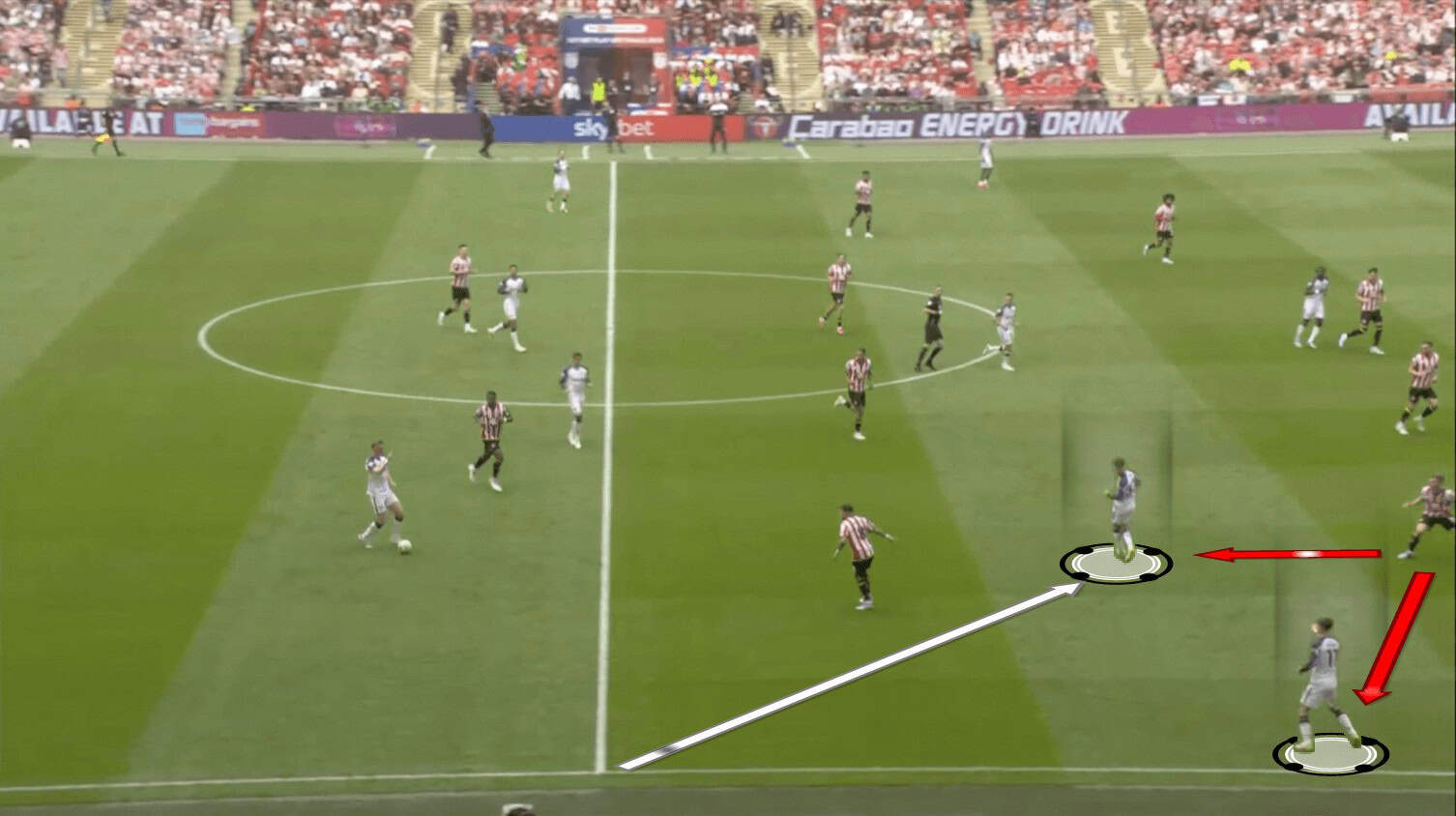
Slightly later on, Hume drifted into the right half-space once more, getting away from Sheffield United’s left winger, Hamer, who tries to pass him off to the left-back Burrows.
Burrows is already occupied by Black Cats winger Rigg, though.
As a result, this creates a 2v1 for Sunderland against Burrows.
Hume’s intelligent off-the-ball movement to exploit space in central areas was an important part of Sunderland’s build-up play and ball progression versus Sheffield United.
Equally important, though, was Hume’s passing ability and vision to pick out teammates as they found space between the lines, and Hume received deeper.
Sunderland’s biggest key to overcoming Sheffield United’s high press was the combination between right-back Hume and attacking midfielder Enzo Le Fée.
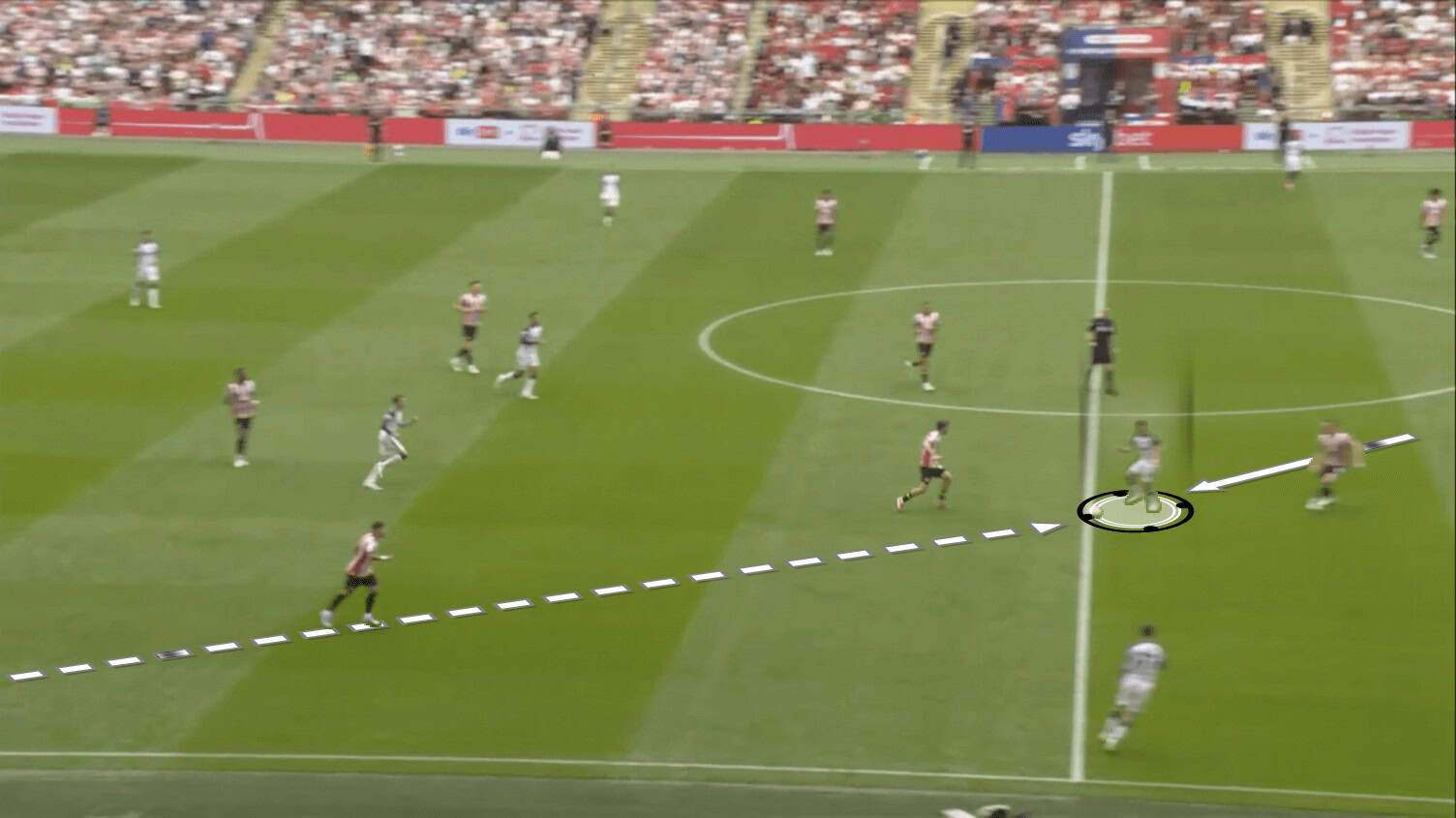
For example, in the passage of play that continues from where we left off in Figure 7, Hume fires the ball into Le Fée, who finds space between the lines and can now comfortably either link up with Rigg on the wing, knock the ball back for Bellingham, or attempt to turn and carry the ball forward.
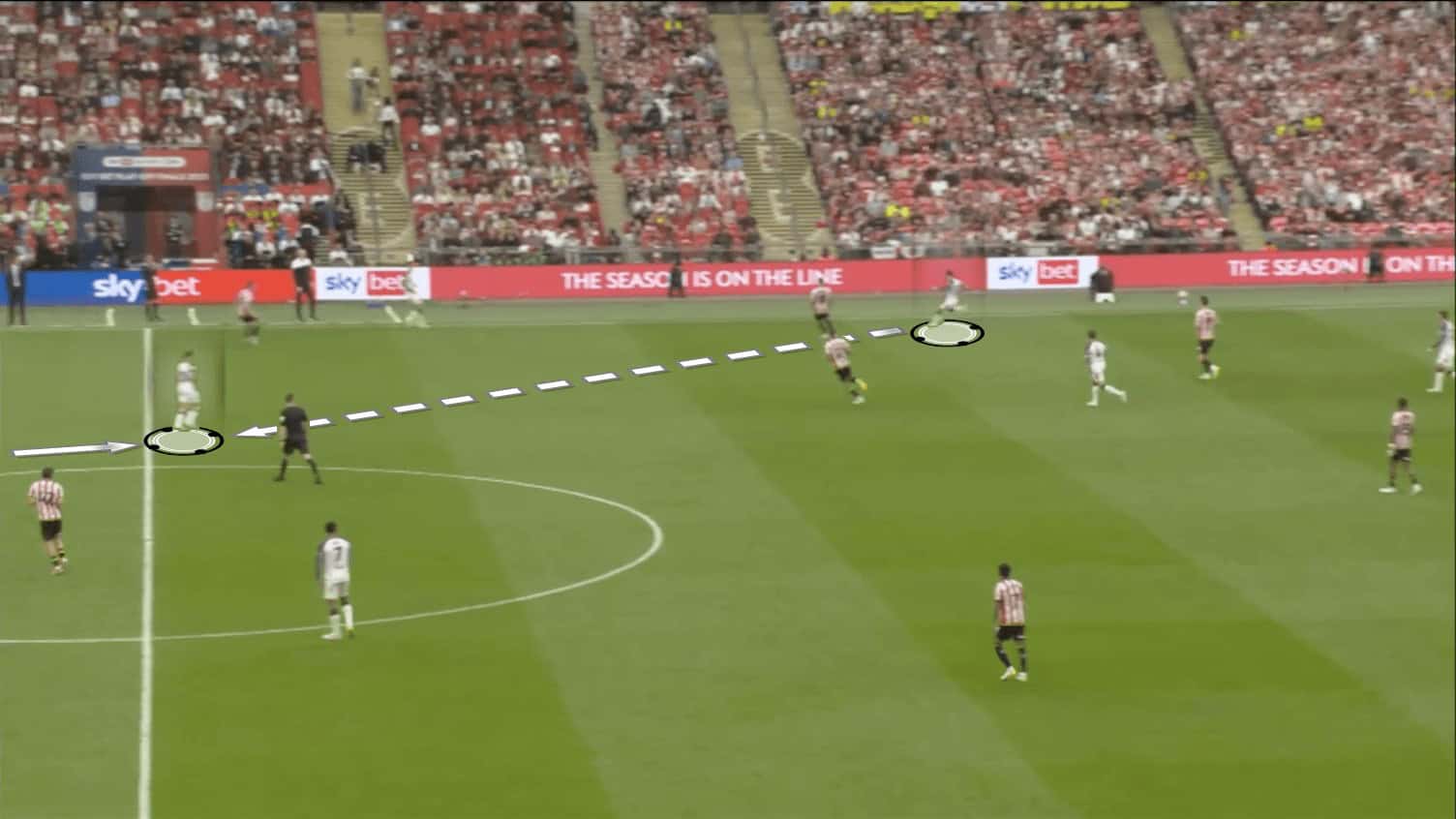
Hume receives the ball wide, drawing aggressive pressure from Sheffield United.
This creates plenty of space behind the Blades’ midfield line for Le Fée to drop into and exploit.
Hume has the technical quality to find Le Fée despite the pressure, helping Sunderland progress into midfield and putting them in a very good position to attack the Blades’ backline from that point.
Sheffield United were generally happy to allow Sunderland’s backline to have time and space on the ball and frequently targeted them with high pressure due to perceived technical deficiencies.
With the exception of Hume, Sunderland’s backline were far too error-prone in possession.
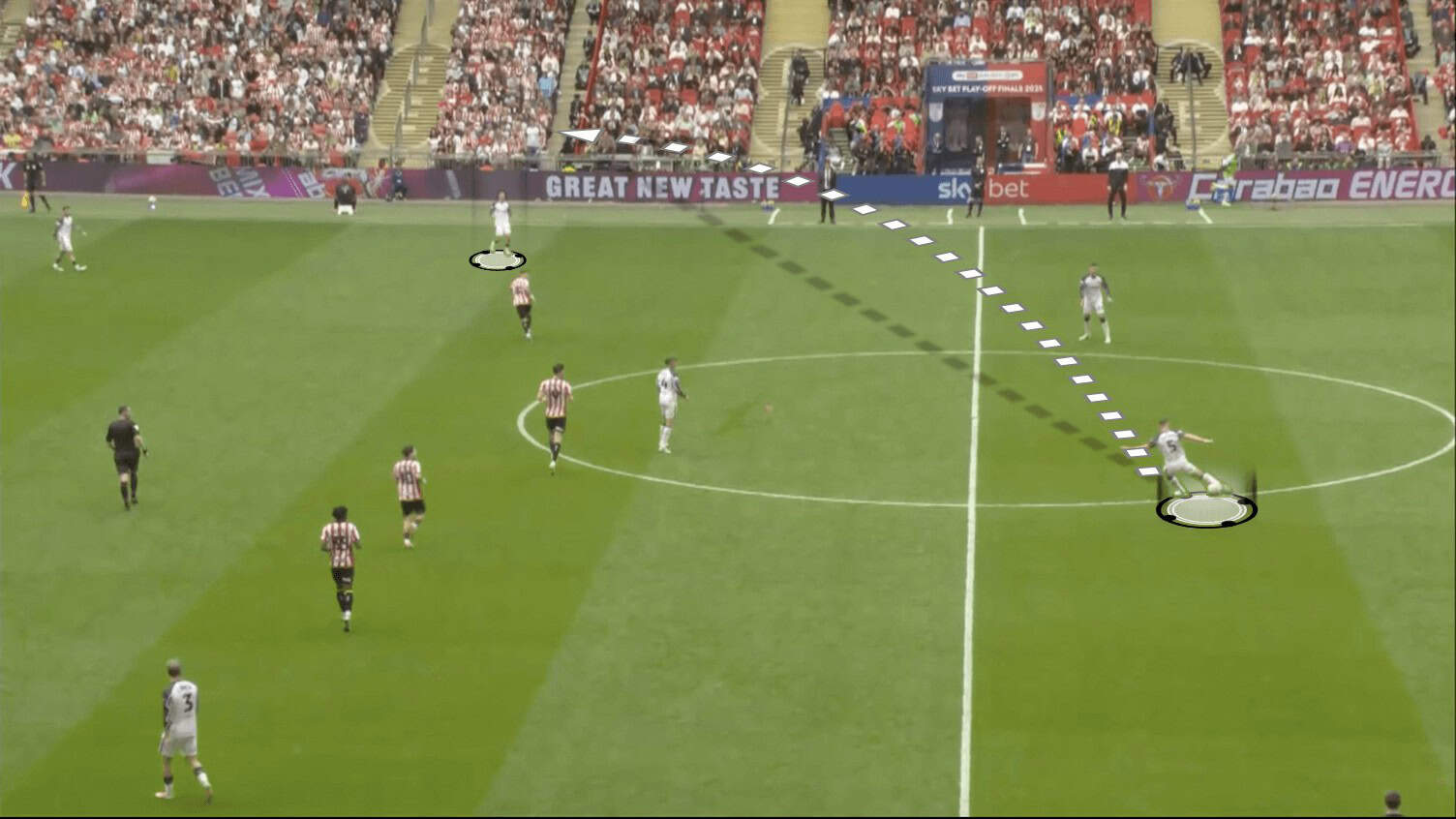
For instance, the Blades were happy to leave the switch of play from the left-back and left centre-back towards the threat on the right wing, Hume, open.
In this case, Ballard tried to play the switch and make the most of the opportunity to exploit the free man on the far side.
However, he overhit the pass, giving Sheffield United back possession.
Sunderland didn’t have the physicality up front that Sheffield United had.
So, with their backline lacking a bit of technical ability, they had to be cautious with how they built out, and midfielders had to be intelligent with their movement to create clear, safe passing options.
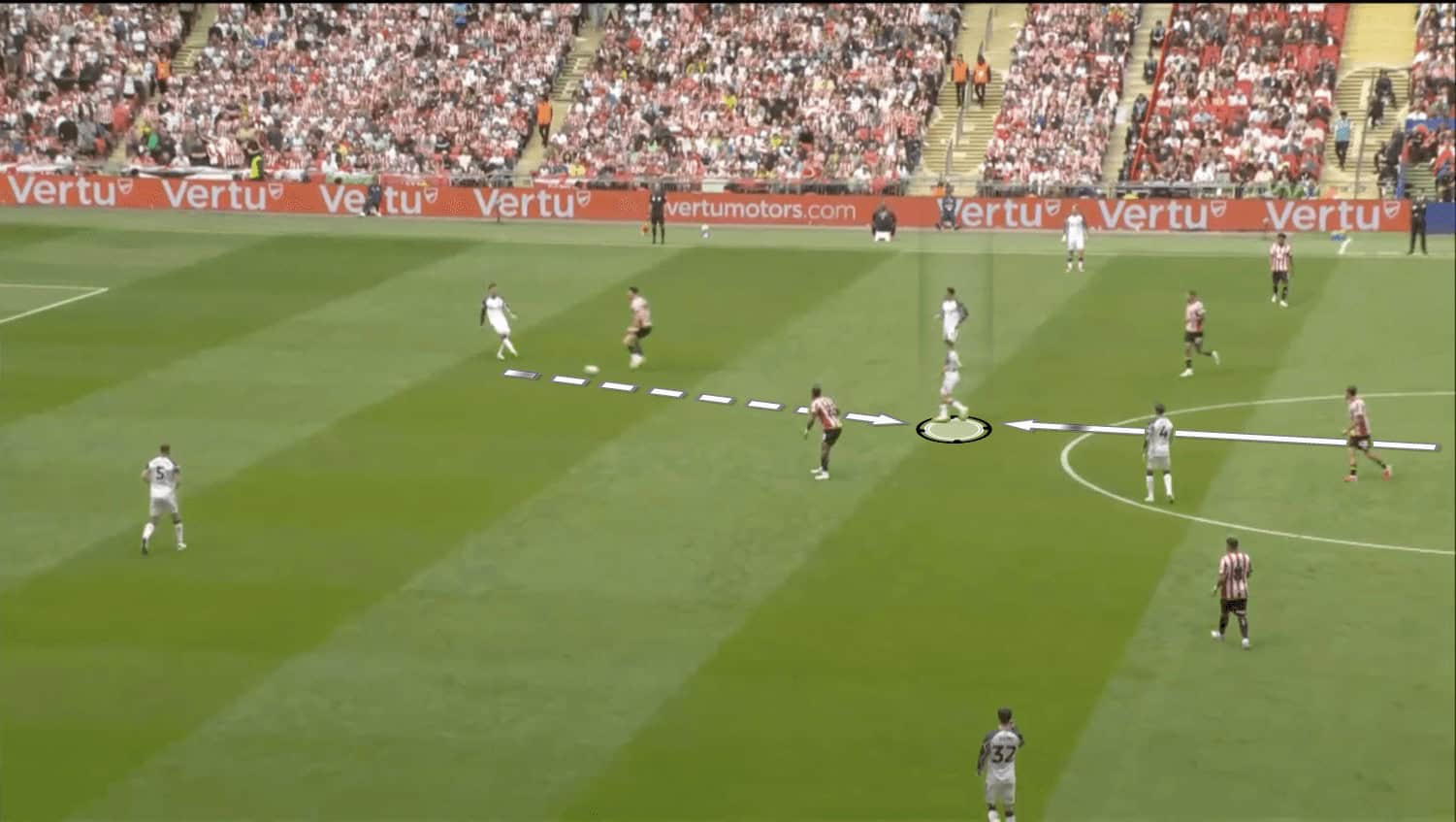
Le Fée, again, had a key role to play in some cases, dropping into space to help his team play out from the back by overloading the midfield.
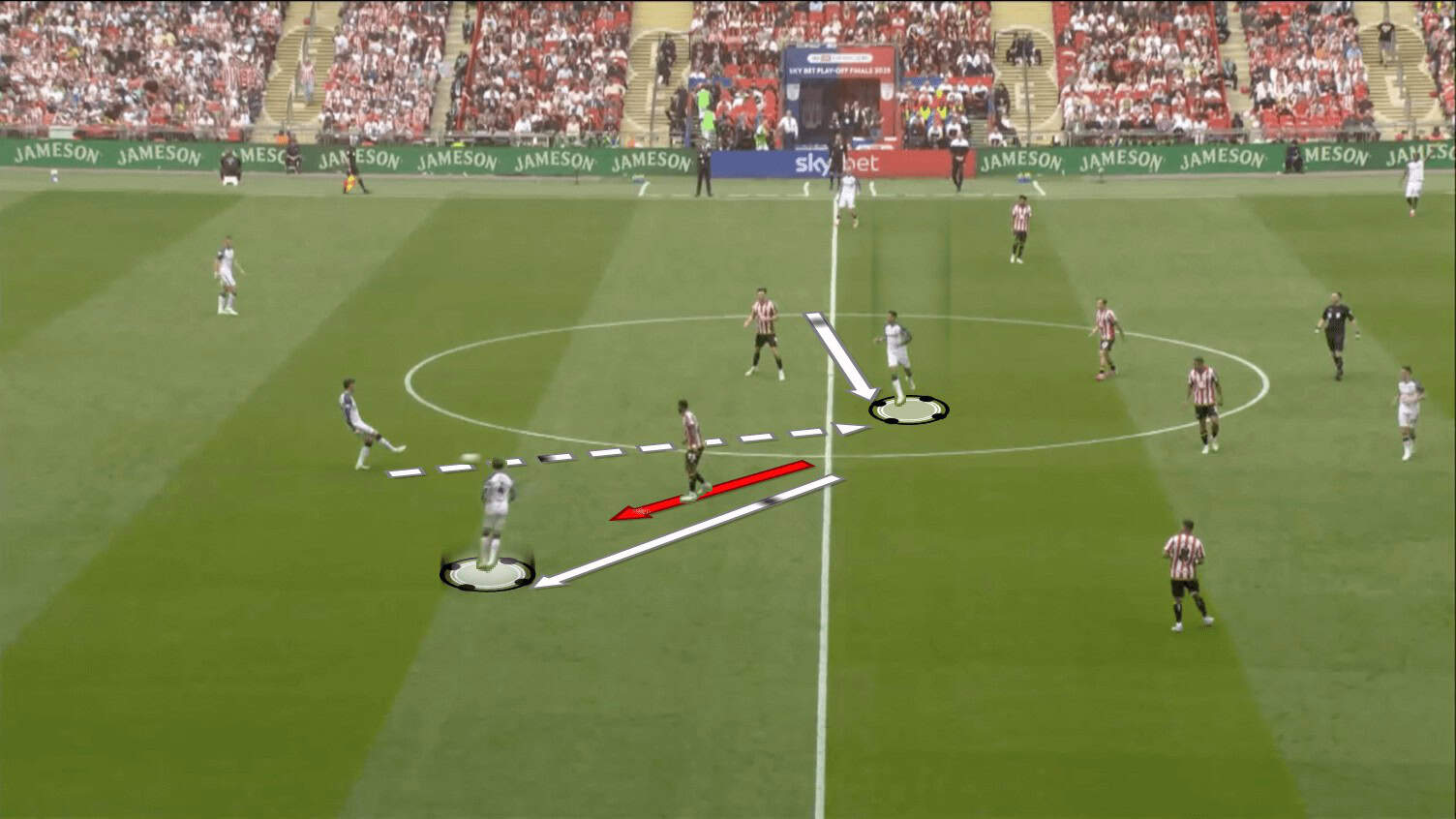
In another case, Dan Neil shifted over towards almost a right centre-back position, dragging Sheffield United’s left centre-forward, Campbell, with him.
At the same time, Bellingham drifted over to the same side, getting out of Moore’s cover shadow and opening up a passing lane between himself and the centre-back.
Sunderland really got into this game more and more as it wore on.
At the very beginning, the fast-paced transitional nature of the match suited Sheffield United far more.
However, as the game settled, Sunderland began to enjoy more and more time on the ball, thus enabling them to use the quality that players like Hume and Le Fée brought to the pitch, as well as the intelligent movement of their midfielders to progress upfield and create chances.
Tom Watson Impact In The Left Half-Space
In the 73rd minute, 19-year-old Tom Watson entered the fray and had an immediate impact.
Sunderland took more and more risks as the game wore on into the second half, and they still trailed the Blades.
At the beginning of the second half, Jobe Bellingham moved into a slightly more advanced position and began playing as an ‘8’, with Neil taking up the role of a lone holding midfielder.
One reason for this was to have greater occupation of the half-space to try to get the ball into the final third and create from there.
Watson took on this role of ‘half-space occupier’ when he came on, as he liked to invert from the left wing a lot more than Mundle, who had been there prior.
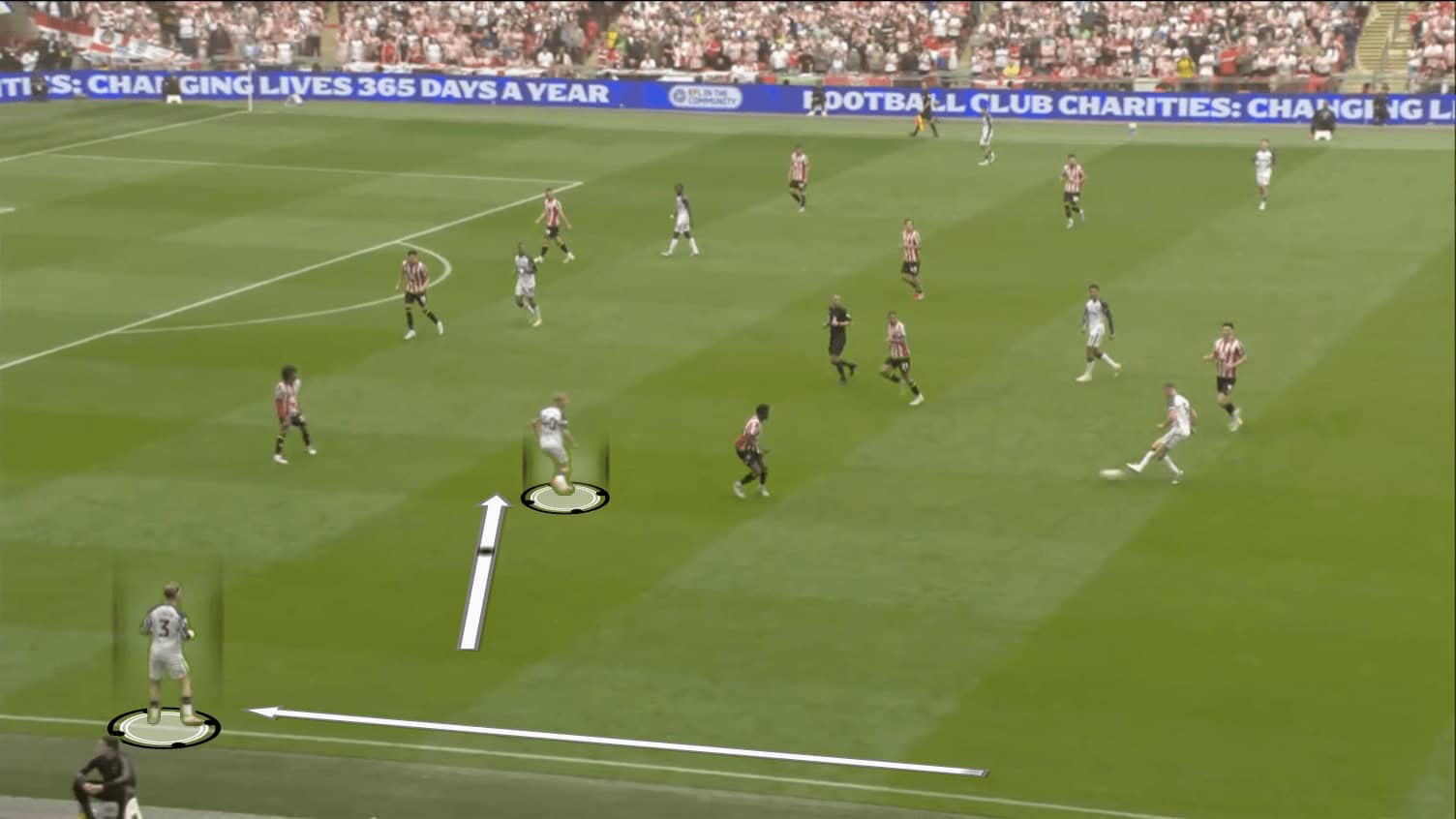
Above, we see where Watson typically positioned himself on Saturday.
He generally drifted inside, opening up space for left-back Cirkin to overlap and provide the width for his side on that flank.
Watson’s positioning and movement attracted defenders to him, opening up greater space for teammates.
He also helped Sunderland progress into the final third through the half-space when Watson found some freedom in the inside channel.
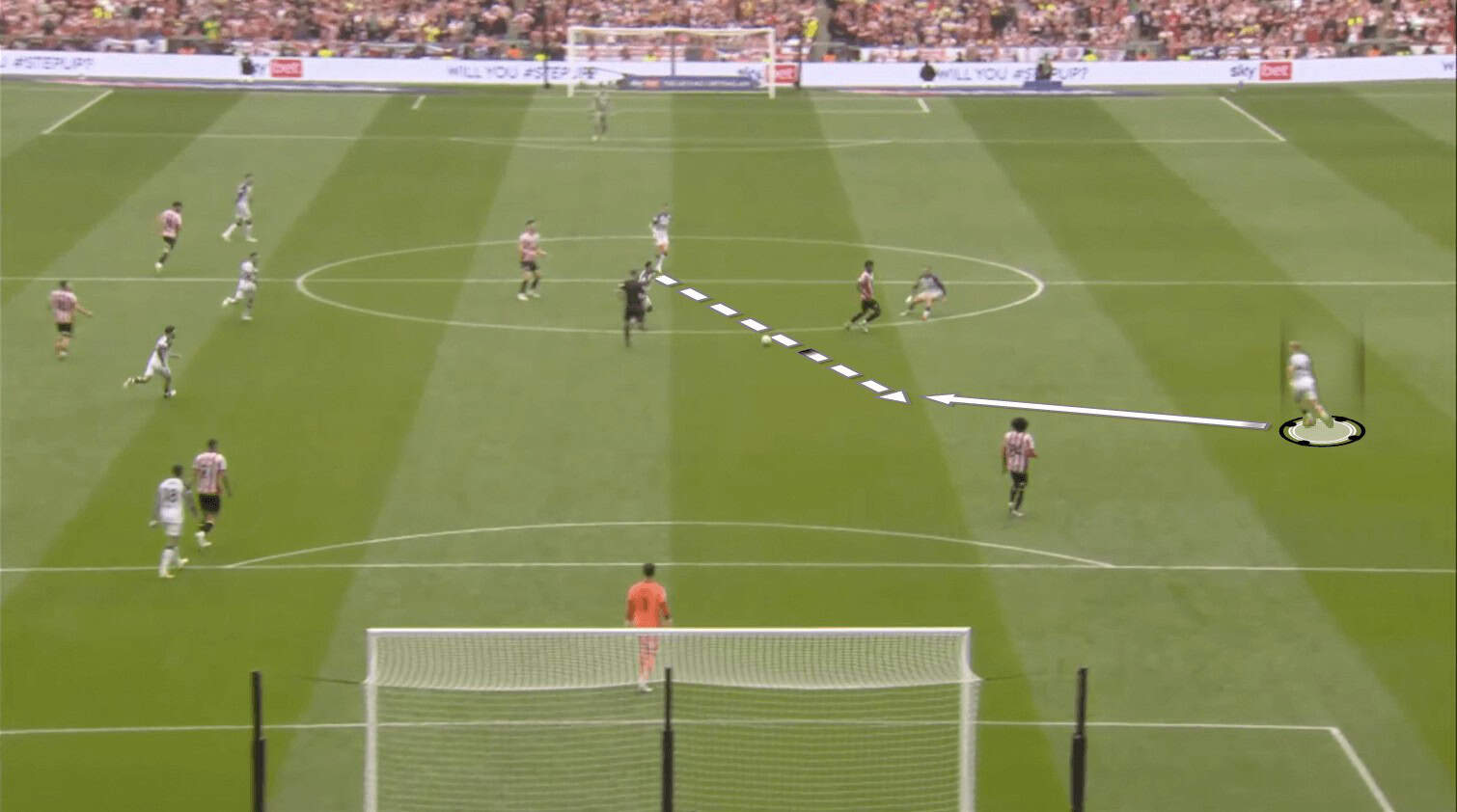
This is precisely what happened before the Brighton-bound teenager scored the winning goal of the game.
Occupying the inside-left channel, Watson is open and provides a great passing option for Sunderland as they begin a counterattack.
The winger gathers the ball, turns and runs towards goal before finishing into the corner of the net.
The 19-year-old proved his value by finding space, which made him a highly desirable passing option inside the final third.
He received and turned calmly despite the high-stakes nature of the moment and finished with composure far beyond that of a 19-year-old prospect.
Conclusion
Overall, no tactical battles tell the story of this game better than the battle between Sunderland’s deep possession play and Sheffield United’s press.
The more the game wore on, the more Sunderland took control of it, moved the ball forward into great positions for chance creation, and ultimately crossed the line.
Sheffield United succeeded in forcing plenty of mistakes with their high pressure, but they didn’t take advantage of those Sunderland errors enough to win.
The connection between Hume and Le Fée, as well as the impact of Tom Watson off the bench, proved crucial for Sunderland, who came away with the victory and Premier League promotion for next season.
