
On Saturday, 24th May, two of northern England’s most storied football clubs, Sheffield United vs Sunderland, meet in what is called the most expensive game in football: the EFL Championship Play-Off Final.
Promotion to the Premier League is at stake, along with a financial windfall that can reshape a club’s future.
Sheffield United see this fixture as a chance to return to the top flight at the first attempt after last season’s relegation.
Sunderland, in contrast, carries the weight of eight years away from the English Premier League.
Their journey has involved turbulence, rebuilding, and, more recently, a renewed optimism under progressive management.
The match has massive financial implications, estimated at hundreds of millions of pounds, but it also has an emotional meaning for both sets of supporters.
Both teams arrive at Wembley after seasons marked by consistency.

Under Chris Wilder‘s management, Sheffield United finished third in the EFL Championship.
Their route to the final was emphatic.
They won 3-0 away at Bristol City, who played much of the match with ten men, and repeated the result at Bramall Lane.
The aggregate score was a dominant 6-0.
Sunderland under Régis Le Bris’s management, finished fourth and took a more dramatic path.
Their semi-final against Coventry City was tense and unpredictable; a 1-1 draw away set up a decisive second leg at the Stadium of Light.
Sunderland won 2-1 thanks to a stoppage-time header from Dan Ballard, securing a 3-2 aggregate win.
This tactical preview is organised to provide a phase-by-phase analysis of both teams.
The structure is split into sections for Sunderland and Sheffield United.
Each part will examine the teams’ approaches in possession, the key individuals and collective battles.
It will also cover how each side can mitigate the other’s possession game model.
This preview aims to show where the match could be won or lost by linking tactical details to each club’s season.
Sheffield United In Possession Tactics
1. Structural Foundations & Build-Up
Chris Wilder’s Sheffield United typically operate from a 4-2-3-1 base, but their shape is adaptive.
The back four of Anel Ahmedhodžić and Harry Souttar centrally, Alfie Gilchrist or Femi Seriki at right-back, and Harrison Burrows at left-back maintained a controlled line in the first phase.
Both full-backs start deep, giving the team a solid rest defence and preventing exposure to early pressing traps.
The double pivot in midfield has two main functions.
First, it offers passing lanes and creates numerical superiority against the opponent’s first press.
Second, its structure provides immediate support in defensive transitions.
Usually, one midfielder holds a deeper position for protection while the other supports progression.
2. Gustavo Hamer’s Role
Gustavo Hamer is the team’s creative hub.
While he plays as a left winger, he often drops into the left half-space and deeper build-up zones.
This movement temporarily shifts United into a 4-3-3, as Hamer joins the double pivot to form a midfield triangle.
His actions create overloads on the left and force opposition midfielders out of shape, opening passing lanes for vertical progression, as shown in the league fixture versus Burnley.
When Hamer drops, Callum O’Hare or Tyrese Campbell fill the vacated wide space, rotating out to stretch the defensive line.
This creates either a 3v2 or a 1v1 out wide, which United exploit to advance the ball or manipulate the opposition’s block.
3. Progression & Wide Pinning
On the right, Jesurun Rak-Sakyi stays wide to pin and challenge 1v1 against the opponent’s full-back and stretch the defensive block, as shown in the Burnley fixture, where he can also occupy the wide midfielder.
This width opens central spaces for United’s midfield to combine and progress.
The right-back supports from behind to maintain a solid base and recycling possession as needed.
Central defenders, Ahmedhodžić and Souttar, are encouraged to break lines by passing or carrying the ball forward if the press is passive.
4. Final Third Rotation
In the attacking third, United become more vertical.
Hamer and Rak-Sakyi invert, moving into central areas and overloading the space just outside the penalty box.
This gives O’Hare and Campbell more options for combination play.
Burrows, the left-back, times his forward runs aggressively, attacking the space vacated by Hamer.
This is shown against Sheffield Wednesday, where he makes a well-timed run into the opposition box from out wide and plays a fantastic low cross into the box.
His late arrivals are targeted for cutbacks or crosses, making him a consistent threat and high-level chances.
On the right, overlaps from Gilchrist or Seriki are more restrained, only happening when Rak-Sakyi moves inside to maintain rest defence.
5. Individual Interactions
Hamer’s press resistance allows him to retain possession under pressure and find passing options quickly.
O’Hare benefits from Hamer’s movement, exploiting space in the half-spaces and making late runs into the box.
Rak-Sakyi’s decision-making about when to invert inside triggers the right-back’s movement, creating dynamic attacking layers.
Burrows’ timing and aggression give United an extra forward when attacking from the left.
6. Defensive Balance
Even when full-backs push up, the double pivot and one centre-back maintain a compact rest defence, ready to counter-press or delay opposition counters.
This limits the risk of conceding dangerous transitions.
How Sunderland Can Mitigate Sheffield United’s In-Possession Threats
Sunderland, who have alternated between a 4-2-3-1 and a 4-4-2, face several tactical challenges against Sheffield United’s fluid build-up and wide overloads.
To counter Hamer’s influence and United’s left-sided rotations, Sunderland should consider the following:
1. Tighter Half-Space Coverage
The ball-near central midfielder (e.g. Dan Neil or Jobe Bellingham) must track Hamer’s dropping movements, preventing him from receiving unopposed in the left half-space.
The wide midfielder in a 4-4-2 can narrow in without losing sight of the full-back.
2. Full-back-Winger Coordination
Sunderland’s right-back (Trai Hume) and right midfielder (Patrick Roberts) should communicate to avoid both being drawn wide by rotations.
If Hamer moves deep, Roberts can drop in, while Hume holds his position to track late Burrows runs.
3. Staggered Midfield Lines
When defending in a 4-2-3-1, the number 10 can screen passes into United’s deeper midfielders, while the double pivot stays alert to vertical passes and third-man runs.
4. Aggressive Transition Press
After turnovers, Sunderland must counter-press quickly, especially in wide areas, to disrupt United’s rest defence and exploit the space vacated by advanced full-backs.
5. Switching Defensive Shape
During sustained Sheffield United possession, Sunderland might temporarily shift to a 4-1-4-1, with one midfielder sitting deeper to help control central overloads and limit direct access to zone 14.
Combining half-space coverage, coordinated wide defending, and proactive pressing, Sunderland can reduce the threat of Sheffield United’s intricate rotations and late attacking runs.
Sunderland Tactics In-Possession
1. Structural Foundations & Build-Up
Sunderland’s in-possession structure under Régis Le Bris is a model of adaptive positional play.
They primarily set up in a 4-2-3-1 and a 4-4-2, with in-game morphing to a situational 3-2 or 2-3 backline during build-up.
The initial phase typically sees Luke O’Nien and Dan Ballard as the primary ball-progressors, supported by Anthony Patterson, who steps in to manipulate the first line of pressure.
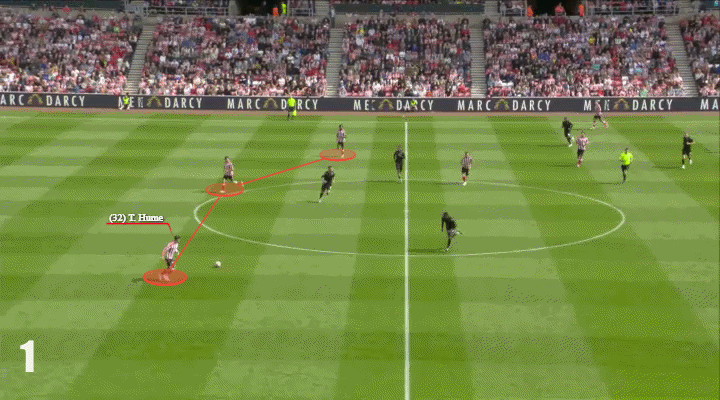
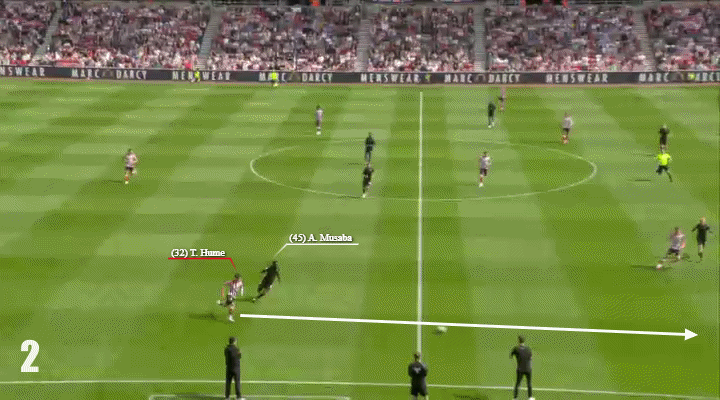
Both full-backs, Dennis Cirkin and Trai Hume, adopt staggered starting heights.
Cirkin is more aggressive with his runs, whereas Hume is more multifaceted and can provide deep circulation and fulfil overlapping or underlapping runs.
The double pivot, usually Bellingham and Neil, is responsible for creating vertical and horizontal connectivity.
Sunderland’s progression is choreographed through collective manipulation of opposition press triggers.
Bellingham’s physicality and ball-carrying, combined with Neil’s spatial awareness, permit Sunderland to attract pressure and then exploit the vacated space.
2. Midfield Dynamics & Progression
The midfield triangle (Bellingham, Neil, Chris Rigg) is central to Sunderland’s game model.
Bellingham acts as a press-resistant anchor, using third-man combinations to break the first line.
Neil operates as the primary link in the second phase, scanning for triggers to initiate wide switches or vertical penetrations.
As an advanced ‘8’ or situational ‘10’, Rigg acts as the key spatial manipulator, drifting between half-spaces and wide channels to manipulate opposition blocks.
His ability to receive on the half-turn and execute oriented controls enables Sunderland to bypass compact midfields and advance possession.
As pressure is drawn centrally, Sunderland’s rotational patterns activate: Rigg’s movement drags markers, opening wide channels for full-back advancement, while wingers invert to create central overloads.
The team’s commitment to width is less about static occupation and more about timely movements that stretch, dislocate, and then attack.
3. Wide Progression & Full-Back Involvement
Le Bris’s approach emphasises the value of manipulating the opposition’s horizontal compactness.
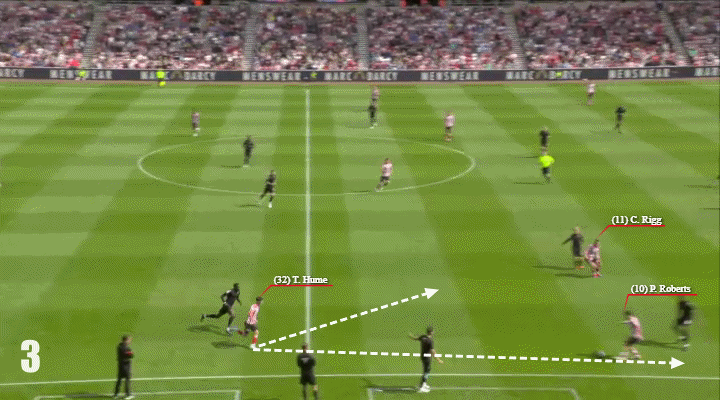
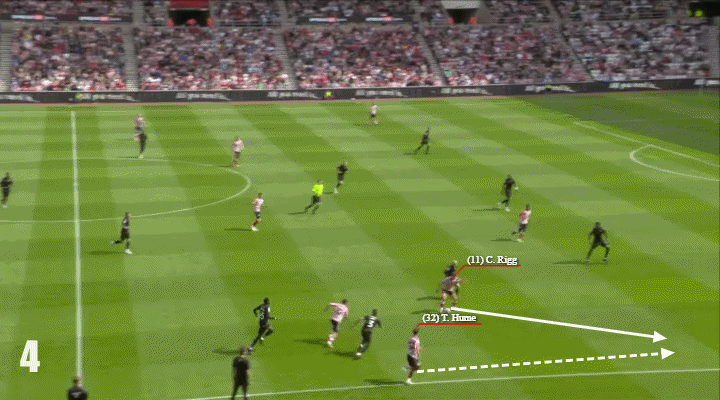
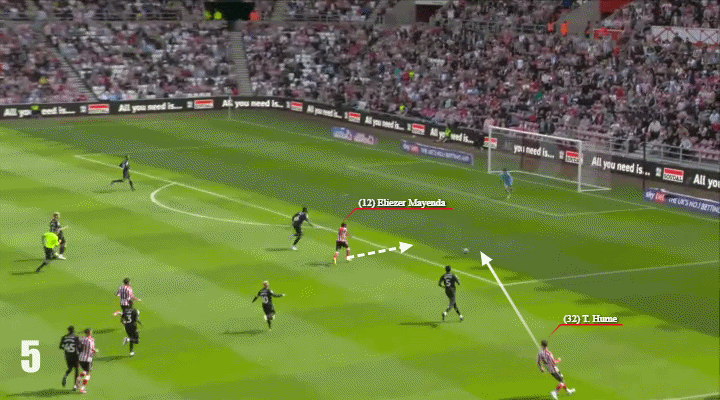
Hume is given a dual mandate: He can overlap when wide play is needed but underlaps into half-space corridors when the winger inverts.
He can also act as a situational centre-back for build-up purposes.
The timing of these runs is coordinated with the midfield’s shifting axis—Neil or Rigg dropping wide to receive, with Hume takes up the vacated space.
This forces defending teams into constant decision-making, leading to momentary disconnections between full-backs and wide midfielders.
4. Final Third Play & Rotational Attacks
In advanced zones, Sunderland becomes more vertical and combinative.
The front two (Eliezer Mayenda and Wilson Isidor, in a 4-4-2) have split movements.
One dropping to link, the other stretching the line, creates dilemmas for opposition centre-backs.
This split strikers movement and the late movement of Rigg and Neil generates multi-layered attacking sequences.
Wide players invert into zone 14 while full-backs arrive late, attacking the blindside of defenders.
Sunderland’s goal is to create high-value cutback or second-ball situations, using the chaos of layered movement to stress opposition marking schemes.
The emphasis is on destabilising the last line through positional rotations, quick one-twos, and third-man runs.
5. Technical & Tactical Interactions
- Bellingham: Brings verticality in transition and is the reference point for breaking pressure.
- Neil: Scans for opposition weaknesses, dictates phase tempo, and exploits space through passing or carrying.
- Rigg: Acts as a spatial ‘activator,’ interpreting defensive cues to overload weak points, and is critical in transitional moments.
- Hume: Provides width or underlaps based on winger movement, ensuring both attacking depth and defensive recovery capacity.
- Wide Players: Are tasked with both pinning wide defenders and inverting to draw central defenders out, key to Sunderland’s ability to switch and reorient attacks.
6. Rest Defence & Transition Management
The Le Bris game model of rest defence is always compact and numerically superior.
When full-backs push high, the pivot (Bellingham or Neil) drops in, and the ball-far centre-back shifts to cover vacated space.
The team counter-presses in a short window after turnovers, aiming to suffocate transitions and regain territorial control.
How Sheffield United Can Disrupt Sunderland’s In-Possession Structure
Sheffield United must implement a multi-layered game model to disrupt Sunderland’s fluid possession game.
This requires both collective and individual adaptation across all phases:
1. Pressing Triggers & High Engagement
Sheffield United should set pressing traps in Sunderland’s first phase, especially when Patterson is forced to distribute under pressure.
By initiating a staggered high press (e.g., 3-1-4-2 out of possession), United’s front three can lock Sunderland’s double pivot in place, with the ball-near winger screening central passing lanes and the striker curving his press to force play wide.
Central midfielders must be ready to jump when the ball is played into Neil or Bellingham, denying them the time to scan and progress.
2. Half-Space Occupation & Denial
To limit Rigg’s spatial manipulation, Sheffield United must adopt a hybrid marking system: zonal in deep build-up, man-oriented in the middle third.
The ball-near No. 8 should track Rigg’s movements between lines.
3. Wide Overload Prevention
Sheffield United’s full-backs must maintain positional discipline, resisting the temptation to press high when Sunderland rotate wide.
They should curve their runs to block passing lanes into the half-space, forcing Sunderland to play backwards or into wide traps.
The ball-far full-back must remain alert to late runs from Cirkin or Hume, preventing Sunderland’s switches from generating free-man situations.
4. Central Block Compression
When defending in a settled block, United should collapse space centrally, forming a narrow 5-3-2 or 5-4-1.
The midfield trio should focus on blocking vertical access to Neil and Rigg, using cover shadows to deny line-breaking passes.
Centre-backs must be proactive in stepping out when Mayenda or Isidor drops.
5. Transition Exploitation
When regaining possession, United should target the space vacated by Sunderland’s advanced full-backs.
Quick vertical outlets into the channels (especially behind Hume) can exploit Sunderland’s transitional vulnerability.
Forcing turnovers in Sunderland’s half, via counter-pressing or tactical fouling, creates immediate attacking opportunities while their rest defence is stretched.
Conclusion
The Championship play-off final between Sheffield United and Sunderland represents a battle for Premier League promotion but also a clash of game models.
The outcome will hinge on which team can best exploit transitional moments and neutralise the other’s strengths.
Fine margins, individual roles, and tactical adaptability are likely to decide who achieves football’s richest prize.
