
Claudio Ranieri is stepping in as AS Roma‘s fourth manager this year, following a rough start to the 2024/25 season for I Giallorossi.
The 73-year-old announced his retirement last May after helping Cagliari avoid relegation.
He is now returning to help Roma pursue a higher league position and possibly a European spot.
American owner Dan Friedkin has picked him to lead the team after the dismissals of Daniele De Rossi and Ivan Jurić earlier this season.
In this tactical analysis, we will examine the key Claudio Ranieri tactics is implementing at the club and how they could help Roma achieve a higher league-table finish in the second half of the season.
It has been an excellent start for the Italian coach, but what is the expectation for him this season? A UCL spot? A UEL spot? A UECL spot?
Anything is better than how they started this season, but at the end of this article, we will share our view on what success will mean for Ranieri reign here.
Claudio Ranieri Coaching Philosophy
Claudio Ranieri has won 10 trophies throughout his managerial career, including being named The Best FIFA Men’s Coach of 2016 for his achievements with Leicester City, which included winning the Premier League just after being promoted.
His time during Leicester’s EPL victory in 2016 is considered one of the greatest fairytale victories in football history.
Claudio Ranieri’s coaching philosophy is surrounded by flexibility and adaptability in his tactical approach.
The 73-year-old often switches formations and styles of play from one game to the next.
That adaptability earned him praise during his time with Leicester City, where he famously led the team to a Premier League title with a defence-oriented, counterattacking style.
At Roma, Ranieri is likely to implement the same philosophy with the team since they have some very versatile players who can thrive in this tactical system.
He has hinted at employing various formations, possibly alternating between more aggressive home setups and more conservative away approaches.
One thing is sure: He loves a solid defensive core coupled with fast-paced attacking transitions.
His experience with past clubs and his previous role as the manager of Roma can be vital in helping them climb the Serie A table.
Claudio Ranieri Lineup Vs Lazio
Ranieri loves to use a 3-5-2 system, and he employed this formation in Roma’s recent win over their Rome rivals, SS Lazio.
He likes to have his midfield stacked with players who can effectively play both the 6 and 8 roles, with two players under his main striker.
Leandro Paredes and Manu Koné are two versatile midfielders who can take on both the 6 and 8 roles that Ranieri favours.
They can adapt to multiple positions, dropping into a deep-lying playmaker role when in possession and sitting in a defensive role for zonal marking when out of possession.
They are also progressive passers and can feed players like Paulo Dybala and Stephan El Shaarawy, who will then progress the ball forward.
Dybala playing off Artem Dovbyk is a great striking combination.
The Argentinian feeds their central striker and helps to link with the midfielders behind him.
Dybala can also make those vertical line runs alongside Dovbyk, allowing for a great transition to attack.
Ranieri’s wing-backs at Roma, Angeliño and Alexis Saelemaekers, are a dream combo.
They offer a high work rate, intelligence, quickness on the counter, and quality crossing.
Roma’s backline of Gianluca Mancini, Mats Hummels and Evan Ndicka is a classic Ranieri defensive line featuring players with strong physicality.
The only downside I can see with this backline is not having the best progressive passer, Mario Hermoso, starting, but it’s looking good for the club now.
AS Roma Build-Up Play
 In the 3-5-2 setup, either Manu Koné or Leandro Paredes is likely to drop back to help receive the ball, usually from Hummels.
The wing-backs aim to stretch the field as much as possible to create more space in the central gaps.
These tactics enable players like Dybala and El Shaarawy to receive the ball and turn into space to initiate the transition.
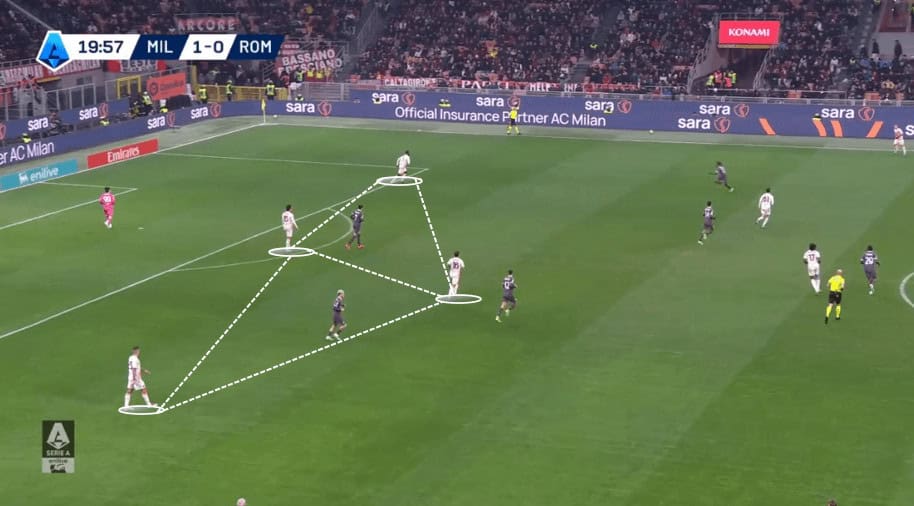 Another way to view the 3-5-2 formation is similar to a 3-1-4-2, as one of the midfielders drops down to help receive the ball and pull opposing players out of midfield.
This tactical adjustment has a significant impact on their game and adds a layer to their attack that other teams struggle to counter.
Mile Svilar Pass Map
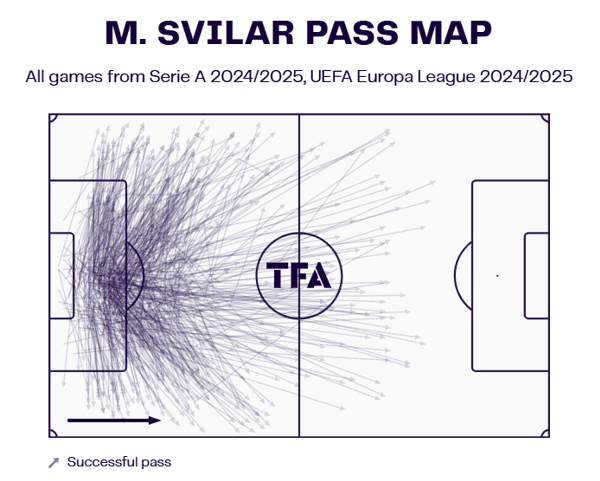 Goalkeeper Mile Svilar plays a vital role in the AS Roma’s build-up play.
Starting as a young talent who had to fight for his spot on the Giallorossi team, he plays a pivotal role in the first phase of play, as shown by his shot map above.
The Serbian occasionally plays long balls to the wide zones, where their wing-backs can make forward runs.
Thus, he plays a vital role in this setup.
AS Roma Counterattacking Play
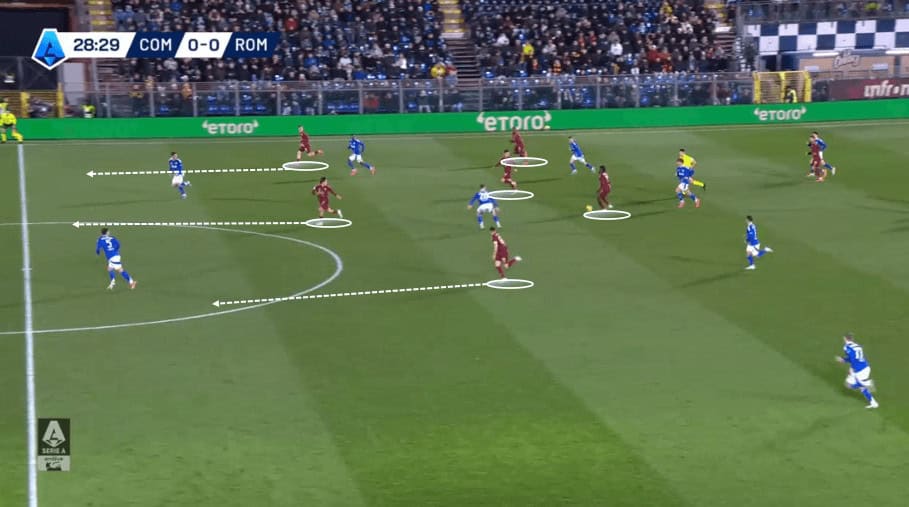
AS Roma employs a fast-paced counterattacking style to catch teams off guard and strike quickly.
As shown in the image above, the five Roma players dart forward while only four Como players are in front of them to mark them.
Stylistically, a similar counterattacking style to the one Real Madrid utilised in the 2010s is now being implemented at Roma.
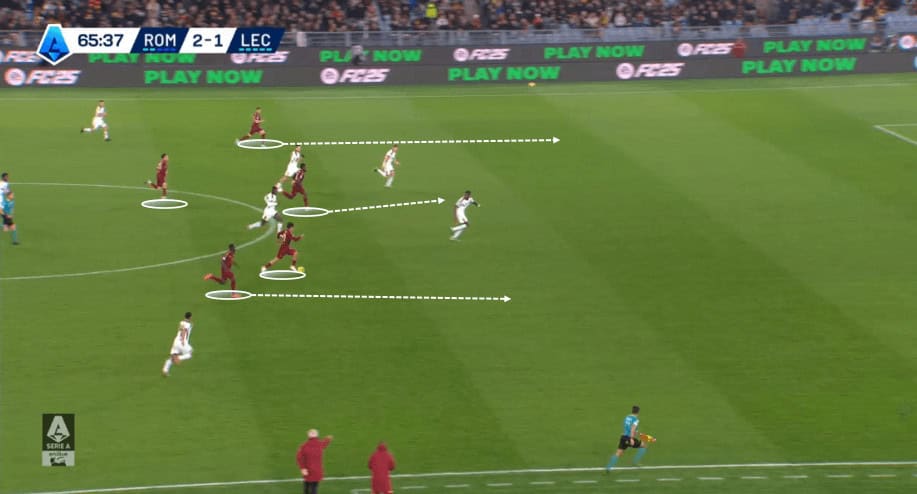 You can see another example against Lecce, where five Roma players are against just four opponents.
This has become a common theme throughout their matches, aiming to catch the team off-guard with numerical superiority on the attack.
I Giallorossi are set up in a certain way off the ball to prepare them for these scenarios, allowing them to launch hard counterattacks.
AS Roma Crossing Play & Statistics
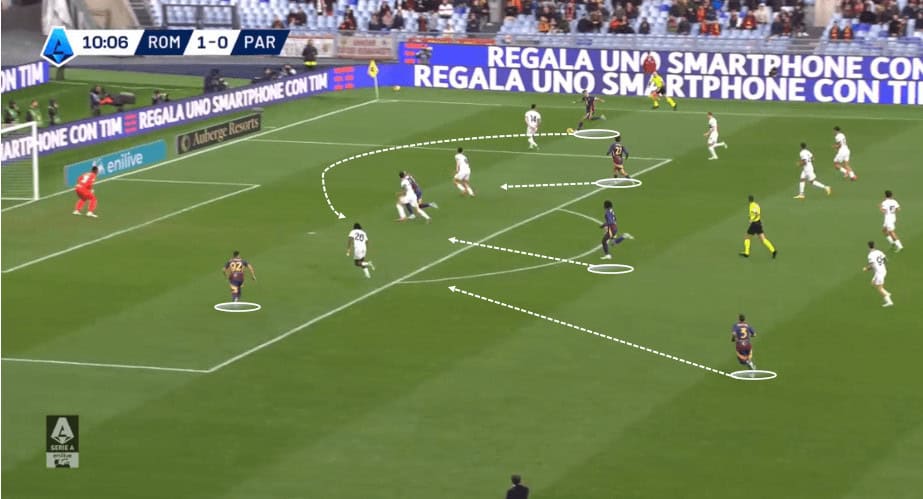 A key part of Roma’s attack that sets them apart from other teams is their crossing in the final third.
With two excellent wing-backs and other depth players, they can whip in dangerous crosses into the box.
Coupled with players like Dovbyk, Hummels, and Paredes, who can reach the end of headers, and those late box runners you can see in the image above, this strategy can create chaos in the box and make them very dangerous.
Roma averages 2.39 crosses into the penalty box per 90 minutes and 17.5 crosses per game in total, making them a constant threat in the final third.
AS Roma Crossing Zones Map
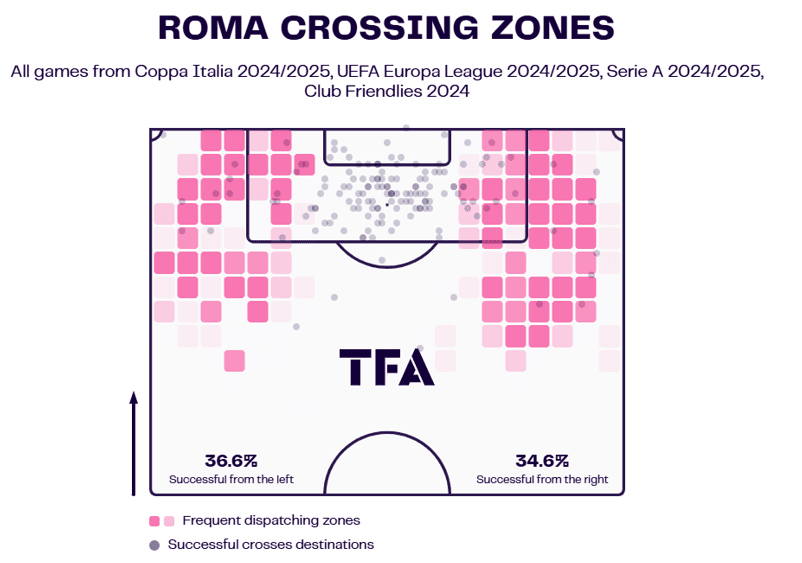 Roma’s crossing zone statistics are impressive, especially compared to average teams, which typically range in the high 20s or lower 30s.
Roma’s crossing zone statistics are impressive compared to those of average teams, which typically range in the high 20s or lower 30s.
They have a completion rate of 36.6% on the left and 34.6% on the right.
Their high completion rates show the quality of their crosses, and Roma focuses on utilising their wide areas to deliver dangerous crosses into the attacking third.
AS Roma Out Of Possession Tactics
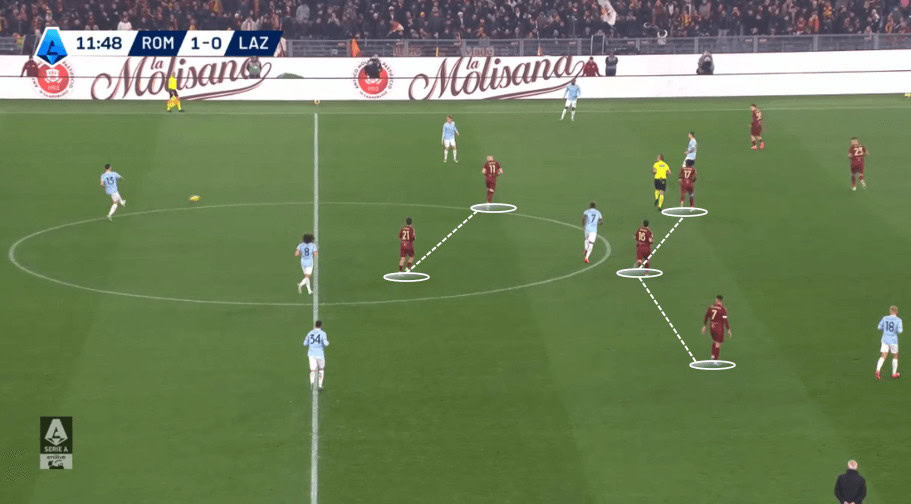 In terms of out-of-possession defending, Roma typically adopts a 5-3-2 formation, with one of the second strikers, such as Dybala or El Shaarawy, stepping forward to form a two-man defensive line at the front.
As you can see above, their midfield trio is designed to be very compact and central, enabling them to block central passes.
The five-back formation is key for them, as their wing-backs can come up and trap the opposing players when they receive the ball with their backs towards them.
Ranieri loves his defensively compact teams, and Roma have some amazing defenders at the back who can constantly shift their line and adapt to the match.
AS Roma High Regains Map
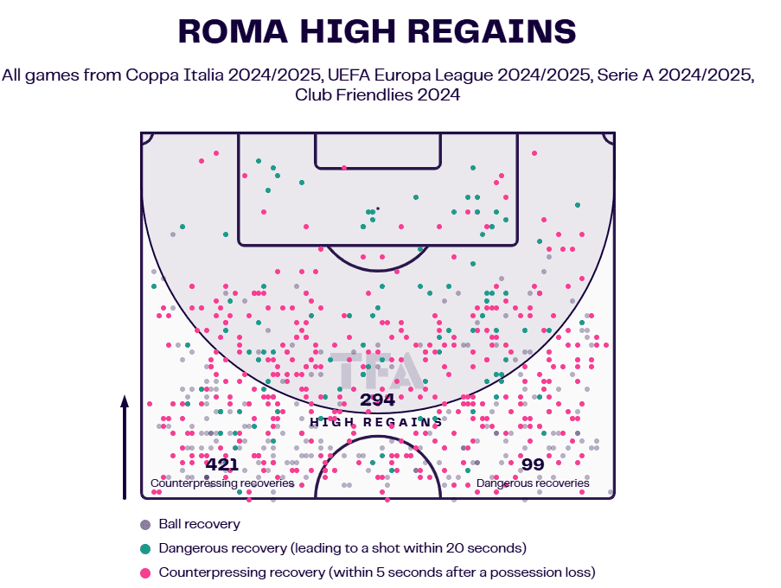
I Giallorossi achieved 249 high regains, 421 counter-pressing recoveries, and 99 dangerous recoveries.
They press with high intensity and high up the field, which is why they have a numerical advantage in their counterattacks.
They want to win the ball quickly high up the field and continue that momentum forward.
Conclusion
With Ranieri at the helm, this Roma side is looking strong to make a second-half comeback this season.
Their quick counterattacking style is dangerous, similar in style to Inter Milan or Real Madrid from the 2010s.
Their wing-backs are quick and adept at whipping crosses into the opponent’s box, causing chaos and allowing late runners to capitalise.
Their defence is compact, with players in the backline comprising a mix of experienced veterans and those at the perfect age for a balanced approach.
Ranieri’s goal is likely to lay a solid foundation for the next manager to build upon.
While a European spot will be challenging from their current position, it is possible, and they can achieve it.
This will be a challenge for the 73-year-old coach, but it’s nothing he hasn’t faced before.
