
This week marked the start of the UEFA Champions League’s highly anticipated Round of 32, with an emotional match at Celtic Park providing excellent entertainment.
European nights at Celtic are always full of passion, with the electric atmosphere providing Brendan Rodgers’ side with the belief that they could potentially snatch an unlikely result against Vincent Kompany’s Bayern Münich.
The arrival of one of Europe’s elite meant that the Bhoys knew they had to remain compact and limit the attacking threat of the Bundesliga leaders, ensuring a tasty affair when they travel to the Allianz next week.
It ultimately wasn’t to be for Celtic, with Michael Olise and Harry Kane firing the Bavarian side to a comfortable 2-0 lead either side of the half-time interval.
But Daizen Maeda’s second-half goal may have just injected further life into the tie, with Celtic emerging at just a one-goal deficit after a 2-1 final scoreline.
This opening leg provided numerous tactical narratives that must be addressed and analysed before the two sides meet again in Münich.
Whilst Celtic will rue the lapses in defensive concentration that allowed Bayern to take the lead, Vincent Kompany will be left wondering how he could set up his team next time to take advantage of some apparent issues with Celtic’s out-of-possession structure.
Our tactical analysis will highlight some of the issues that both teams faced regarding their ability to create impactful attacking sequences while also pinpointing some crucial defensive flaws that should be tweaked.
Celtic Vs Bayern Munich Lineups & Formations

Brendan Rodgers set the home side up in their 4-3-3 system, clearly recognising that Celtic would need to be defensively resilient and minimise the frequency of attacking opportunities for the away team.
Kasper Schmeichel lined up as Celtic’s experienced shot-stopper, protected by a back four of majority North American talent in Alistair Johnston, Cameron Carter-Vickers and Auston Trusty, with Greg Taylor completing the backline.
Celtic’s midfield featured captain and leader Callum McGregor operating as a deeper-lying playmaker.
Arne Engels and Reo Hatate were free to play more of a box-to-box role, which could unlock their creative talents.
Daizen Maeda and Nicolas-Gerrit Kühn provided Celtic with attacking width on the flanks, with Adam Idah as the lone striker through the centre.
Brendan Rodgers’ substitutions were incredibly impactful, allowing the Northern Irish manager to tweak his system and reintroduce the fan-favourite Jota alongside both Jeffrey Schlupp and Hyun-Jun Yang off the bench.
Vincent Kompany, on the other hand, used a 4-2-3-1 shape to familiarise his Bayern team with tactical tactics, which he hopes will propel them towards the Round of 16.
Manuel Neuer was Bayern’s stalwart sweeper keeper in goal, with a defensive line of Konrad Laimer, Eric Dier, Dayot Upamecano, and Raphaël Guerreiro set to protect the German.
Leon Goretzka and Joshua Kimmich worked well as a multi-functional and tactically versatile double-pivot, with Jamal Musiala deployed as Bayern’s ‘no.10’ in a much more free role.
Leroy Sané lined up as Bayern’s left winger, with Michael Olise continuing to dazzle in Bayern colours, operating as that inverted winger on the right flank.
This, of course, left Harry Kane to lead the Bayern attack as their centre forward.
Bayern’s First-Half Frustrations
It was always going to be one of those matches in which Celtic tried to operate as that defensively sound mid-to-low block that would frustrate their German opposition as time went on.
However, the surprising element for Vincent Kompany’s Bayern side was that they were incredibly inefficient with their attacking sequences and lacked the freedom to generate these long passing strings due to Celtic’s defensive pressure.
Despite the clear gulf in quality between the two sides, Celtic managed to hold Bayern to their lowest ball possession figure across any match in this Champions League campaign (56.8%), a stat which was quite shocking when analysing a possession-based Kompany side.
Celtic’s defensive structure resembled a classic 4-4-2 when out-of-possession, with Hatate often stepping up to support Idah as their first line of pressure.
Their 4-4-2 was nice and compact, minimising space between the lines, especially when facing a striker like Harry Kane, who we know loves to sit deeper and be more influential in his side’s link-up play.
Maintaining a resolute and combative midfield was also an essential part of Brendan Rodgers’ tactical gameplan, with Jamal Musiala popping up all over the pitch in search of possession in that aforementioned ‘free’ role for Bayern.
Jamal Musiala Heat Map
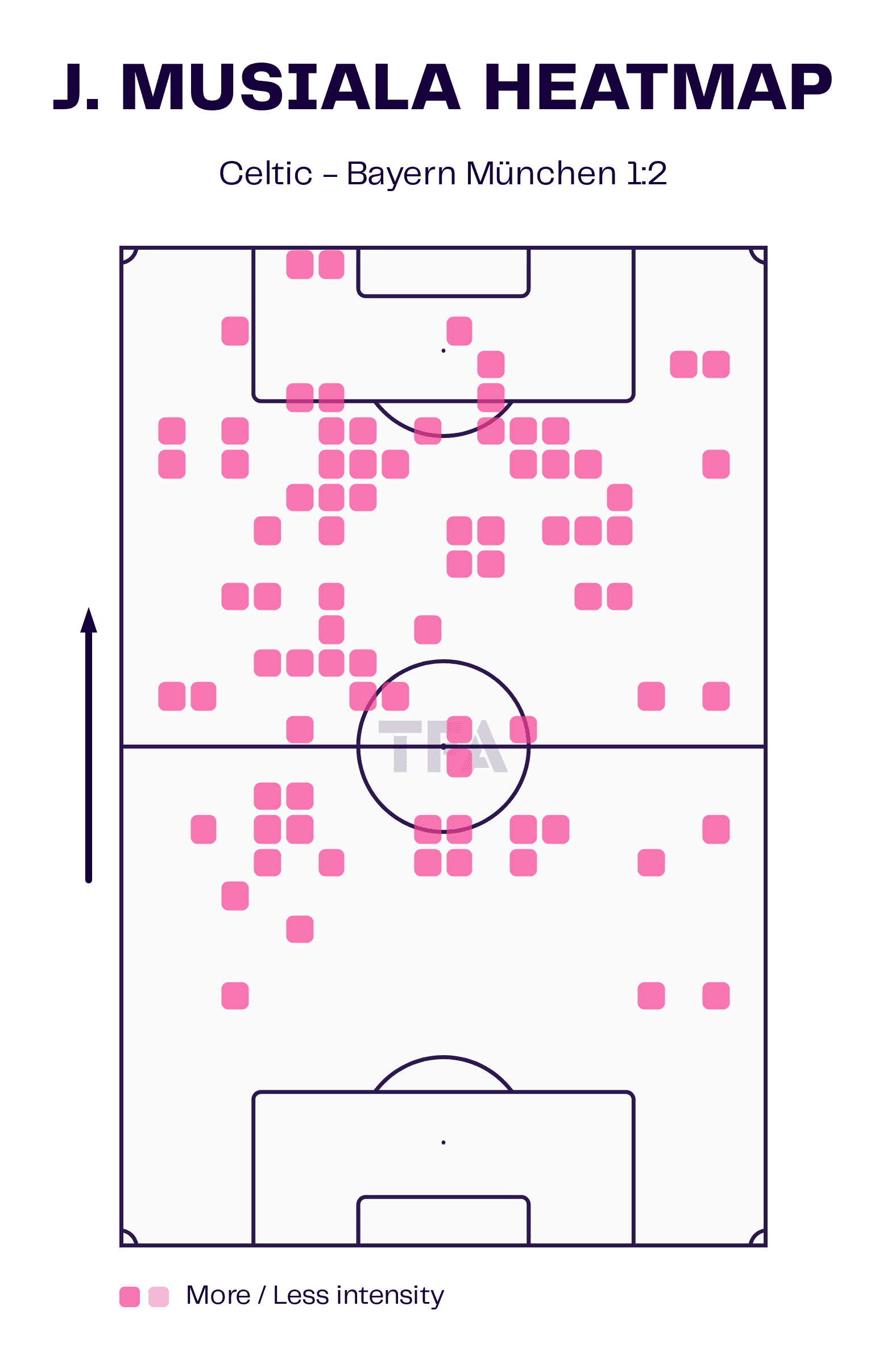
Bayern’s frustrations arise from having the positional advantages to unsettle the Celtic pressing structure but not quite having the correct personnel to execute the desired attacking outcomes.
When looking at passing networks from the match, we see how Goretzka and Kimmich would both pull extremely wide and split apart their double-pivot, creating some promising passing triangles with their corresponding full-back and winger.
Kompany would then use this space to manipulate the Celtic pressing structure, shifting from more of a two-man build-up in defence to more of a 3-2 with Kimmich dropping into right centre-back.
The key was to confuse Maeda, about whether he should follow Kimmich into those deeper zones or instead track the runs of Laimer into more advanced positions.
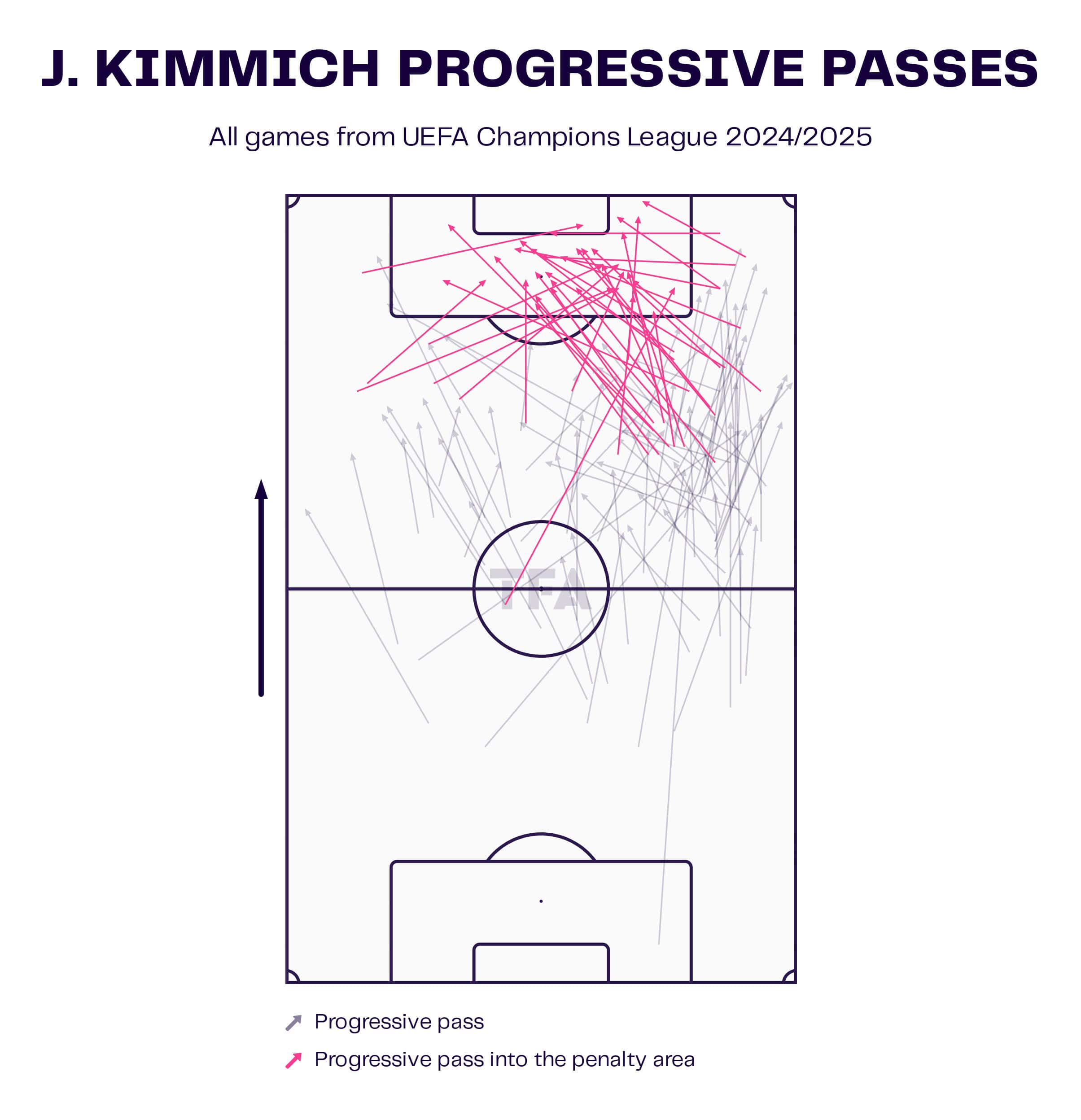
Kimmich’s progressive qualities are undeniable.
The German midfielder highlighted his ability to increase the value of Bayern’s passing sequences by accumulating 0.34 xT (expected threat) on the night.
Joshua Kimmich Progressives Passes Map
Michael Olise Isolated
To minimise Kimmich’s creative threat for Bayern, we often saw Maeda choose to press the German midfielder more intently, in turn allowing Laimer to advance unopposed and pick up pockets of space between the Celtic midfield and defence.
When positioned almost between Taylor and Trusty in the example below, this left Celtic unable to shift across in time to prevent Olise from having enough space to receive a direct ball out towards the flank.
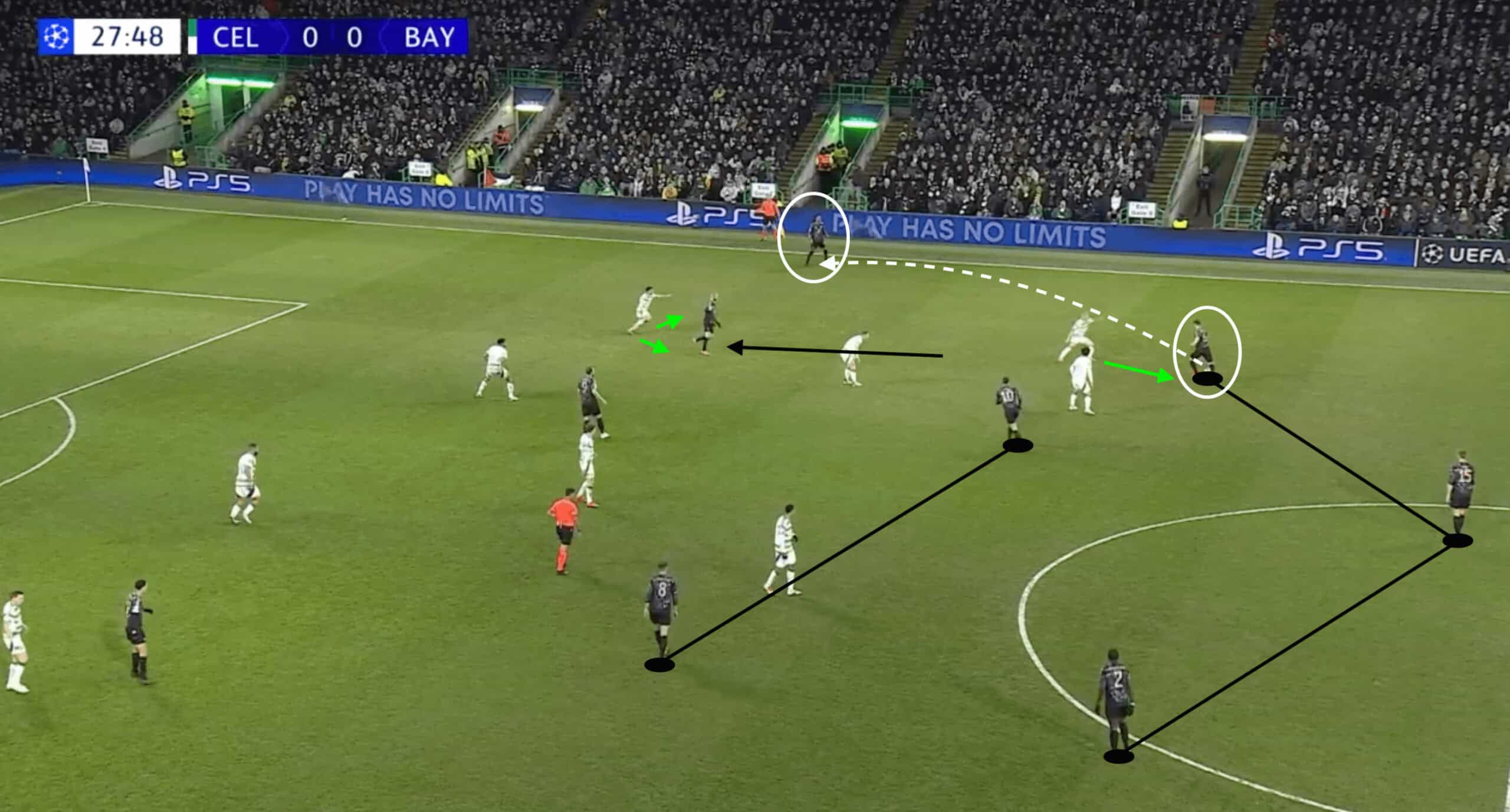
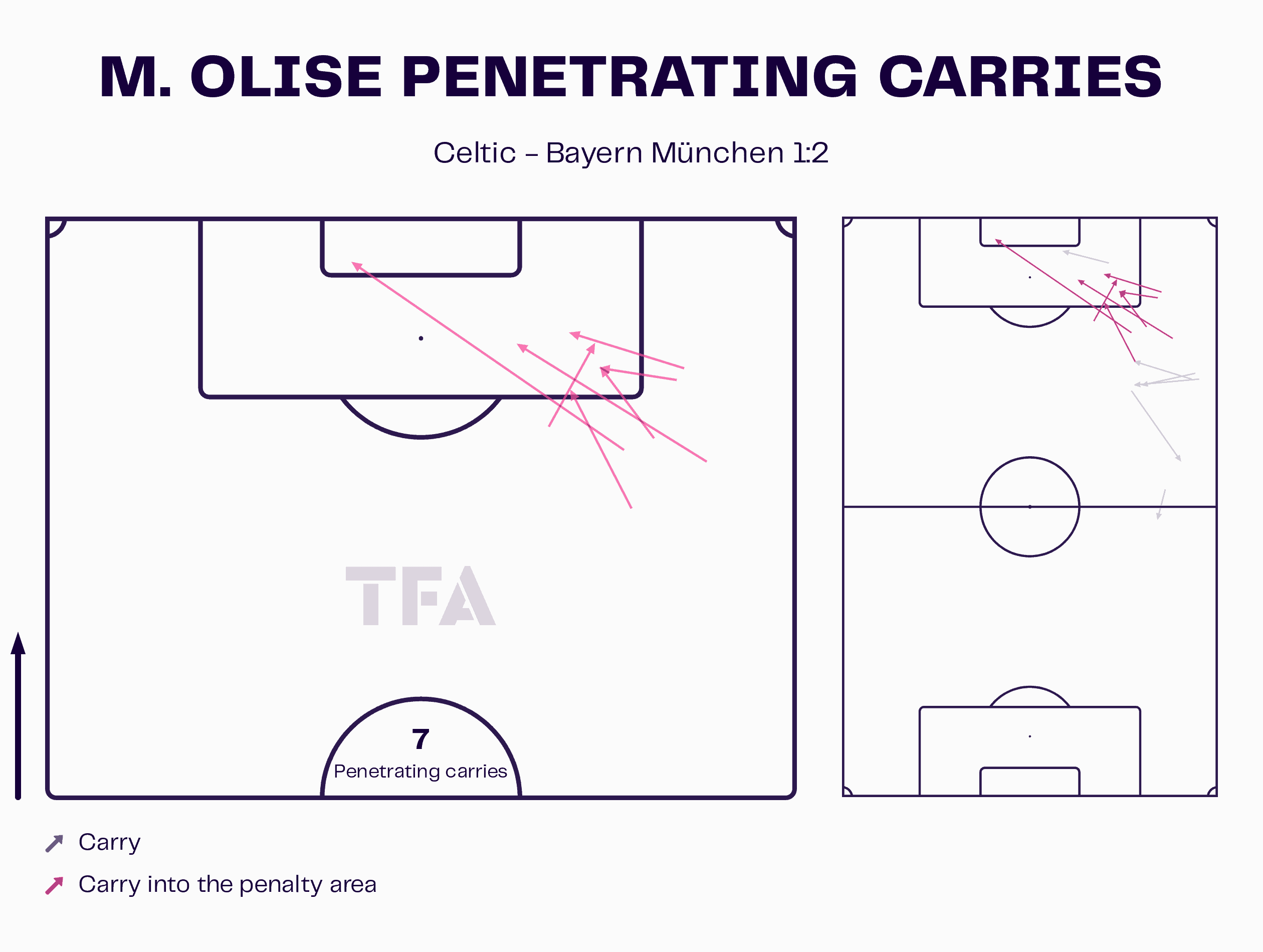
The French winger could then work the ball inside and attack the weak point of Celtic’s defence with 1v1 opportunities against the full-back.
Bayern’s issue was that they failed to take advantage of their new-found freedom with Laimer through the half-space, especially when defensive attention would be rightfully targeted towards Olise or Gnabry.
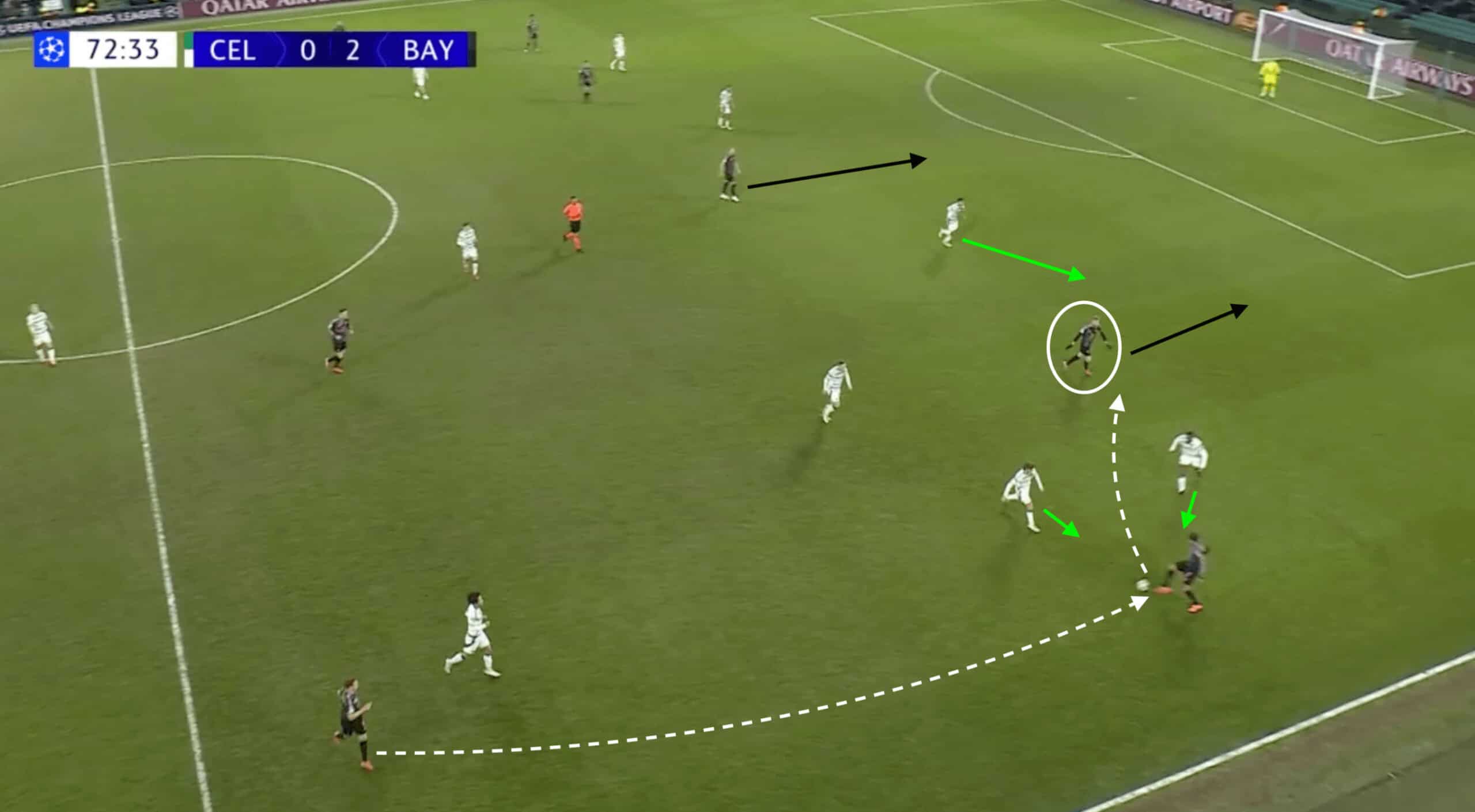
With Laimer not exactly representing that attacking role that could’ve really threatened Celtic, it begs the question of whether Kompany can find a way to work Olise into that half-space role.
Luckily for Bayern, Olise’s attacking magic shone through with an excellently struck goal just before halftime, but these opportunities were far too infrequent for Kompany’s liking.
Michael Olise Penetrating Carries Map
Celtic Vs Bayern Munich’s Press
We recently provided you with some tactical insight into Kompany’s high-pressing tactics with Bayern Münich this season, and this match was no different when we looked at either side’s defensive territory.
Celtic Vs Bayern Munich Defensive Territory Map
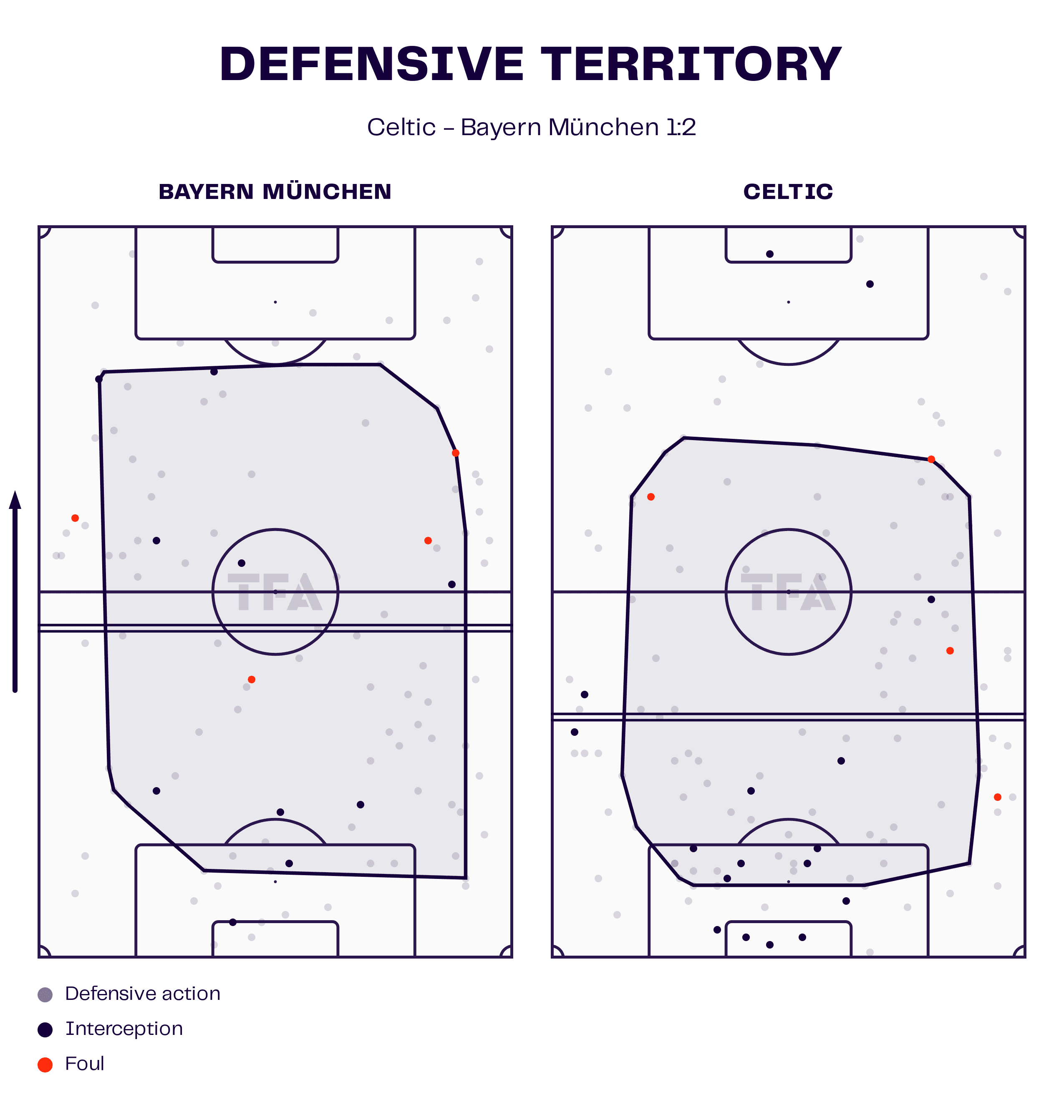
Bayern clearly intended to execute a man-oriented high press, which could suffocate any form of Celtic progression when building up play from deep.
But strangely for Bayern, a PPDA score of 23.0 was a stark contrast from their usual average of around 10.21, suggesting that Celtic was comfortable maintaining possession and not having to worry about immediately ceding control of the ball.
One of the issues with Bayern’s press was that they often left a free man at the base of midfield for Celtic to escape trouble with, resulting from a lack of pressing coordination.
Harry Kane’s offensive contributions are extremely valuable.
Still, his inability to recognise the opportunity to swap pressing assignments as Musiala closed down Carter-Vickers meant that McGregor could receive in acres of space once receiving the layoff from Idah.
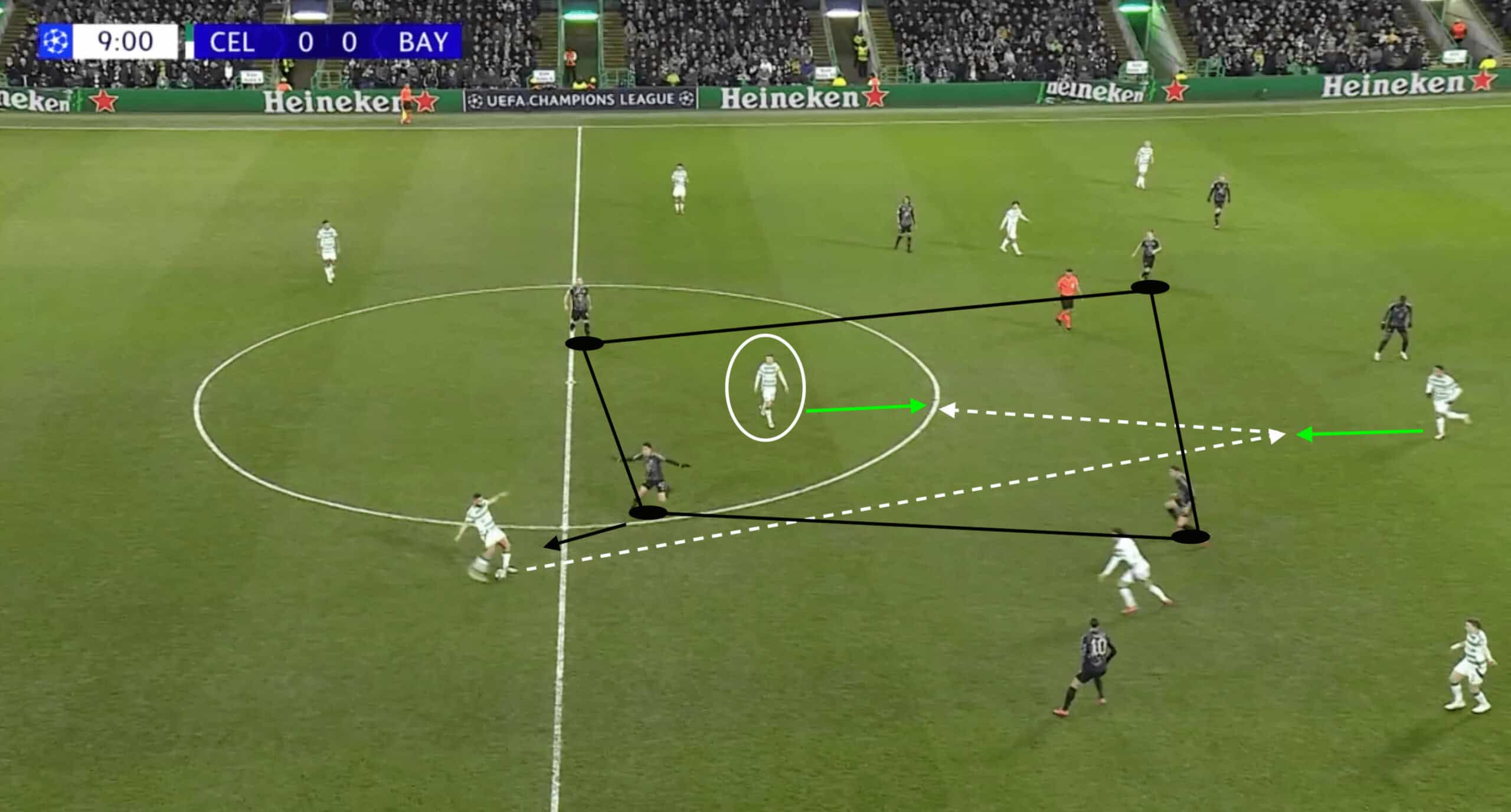
This gives Celtic that extra element of control in the middle of the park, with McGregor free to assess his progressive passing options before lofting a ball over the defensive line for Maeda to attack.
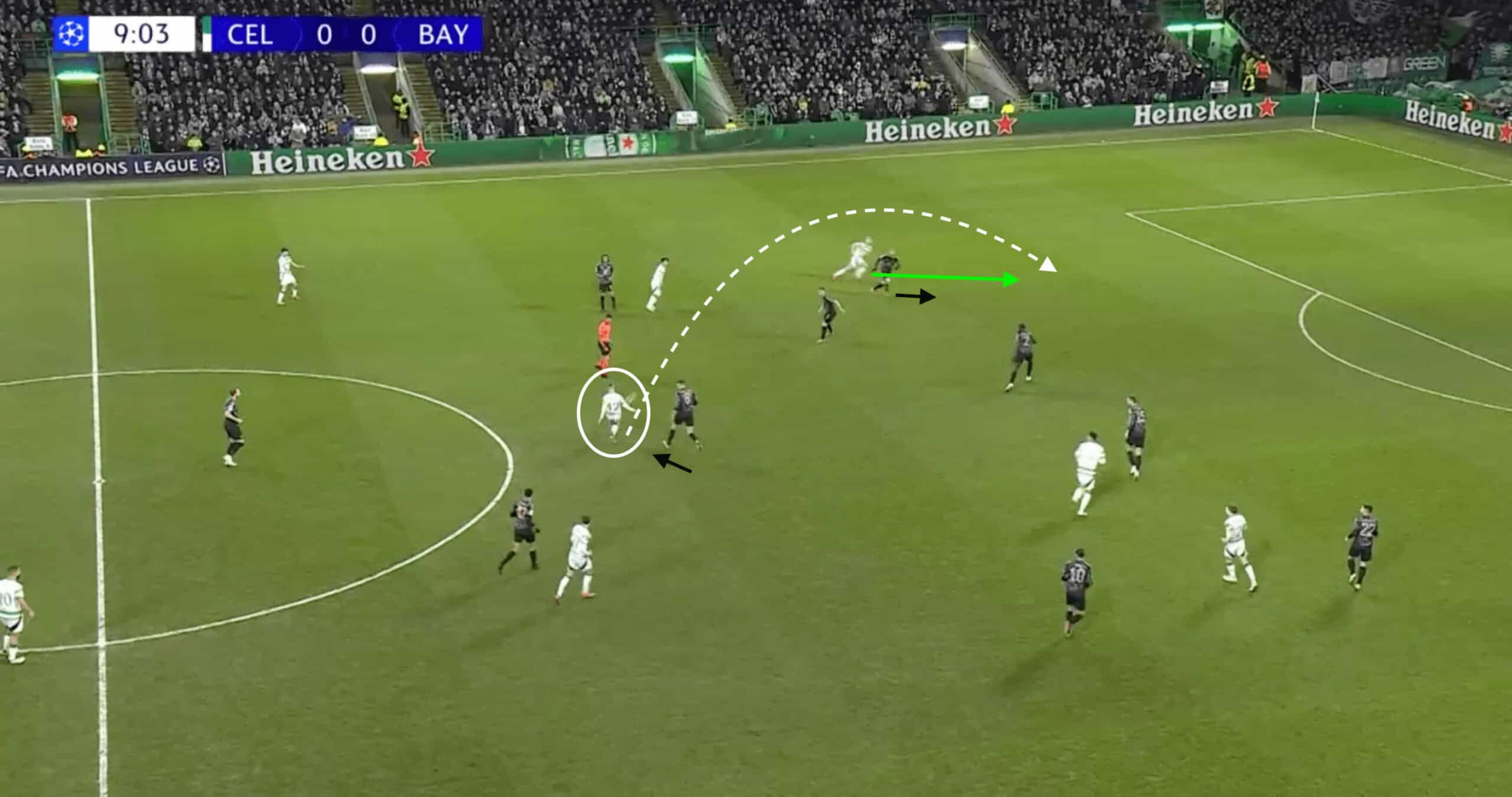
When their press is not fully coordinated from the outset, Bayern are forced to push the likes of Goretzka and even central defenders like Dier high into the Celtic half to try and neutralise their build-up play.
From positions like these, we saw how vulnerable Bayern could be when Celtic displayed a bit of one-touch quality, quickly finding Engels in plenty of space to launch a transitional attack against an unsettled Bayern defence.
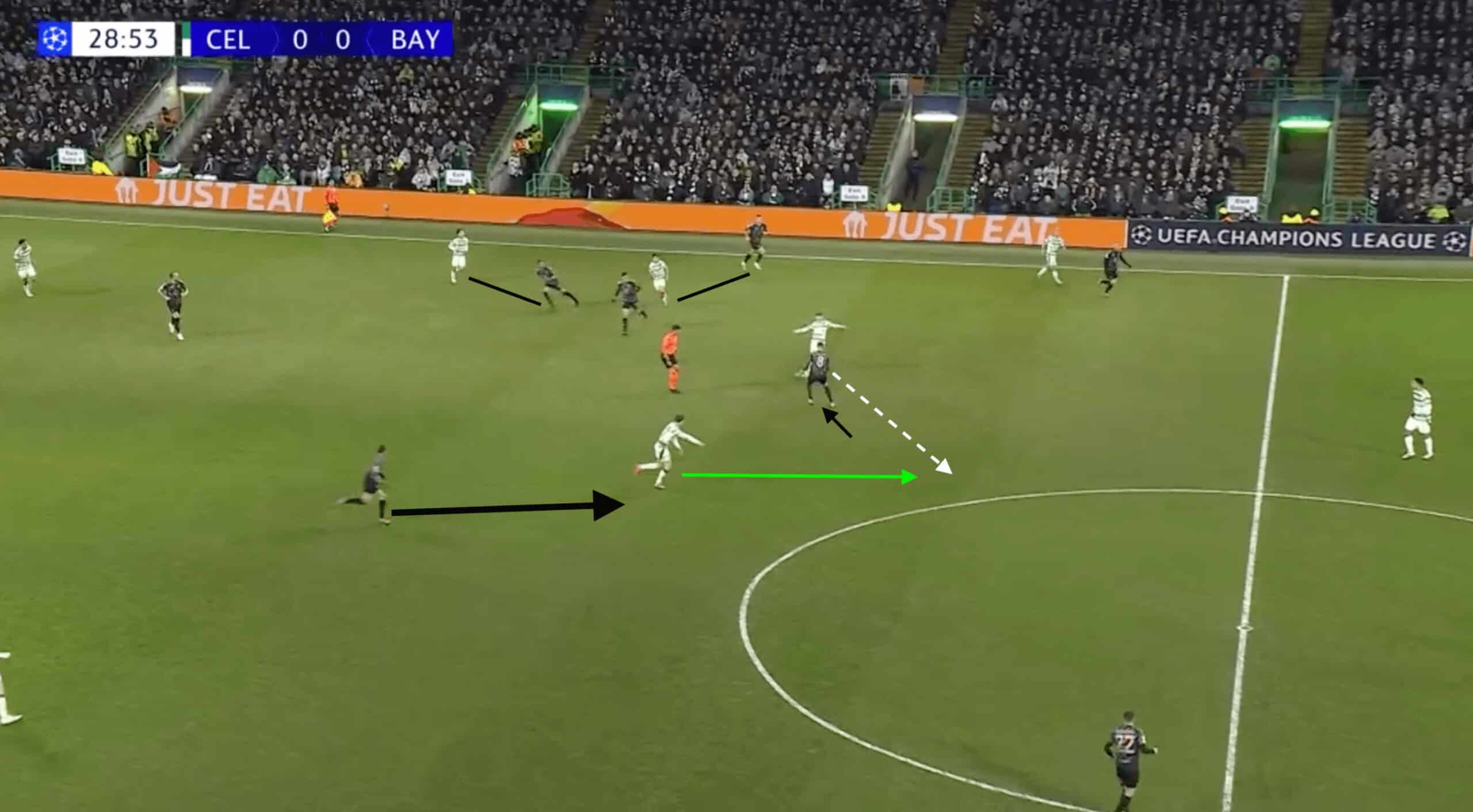
Whilst Kompany’s blushes can be spared thanks to Leroy Sane’s defensive intelligence and speed in drifting centrally and recovering possession, it begs the question of whether Bayern could effectively execute this high press against another elite side with more quality.
Bayern also seemed to owe a lot to the elite defensive performance of Upamecano on the night, who was often isolated against Idah and really minimised the effectiveness of the striker’s ball touches.
The negative effects of such a high press include your defenders often being isolated in 1v1 scenarios against the opposition attackers.
Still, Upamecano displayed a physical capacity to manage such a high defensive line with his recovery pace to mop up any balls that would target that area in behind.
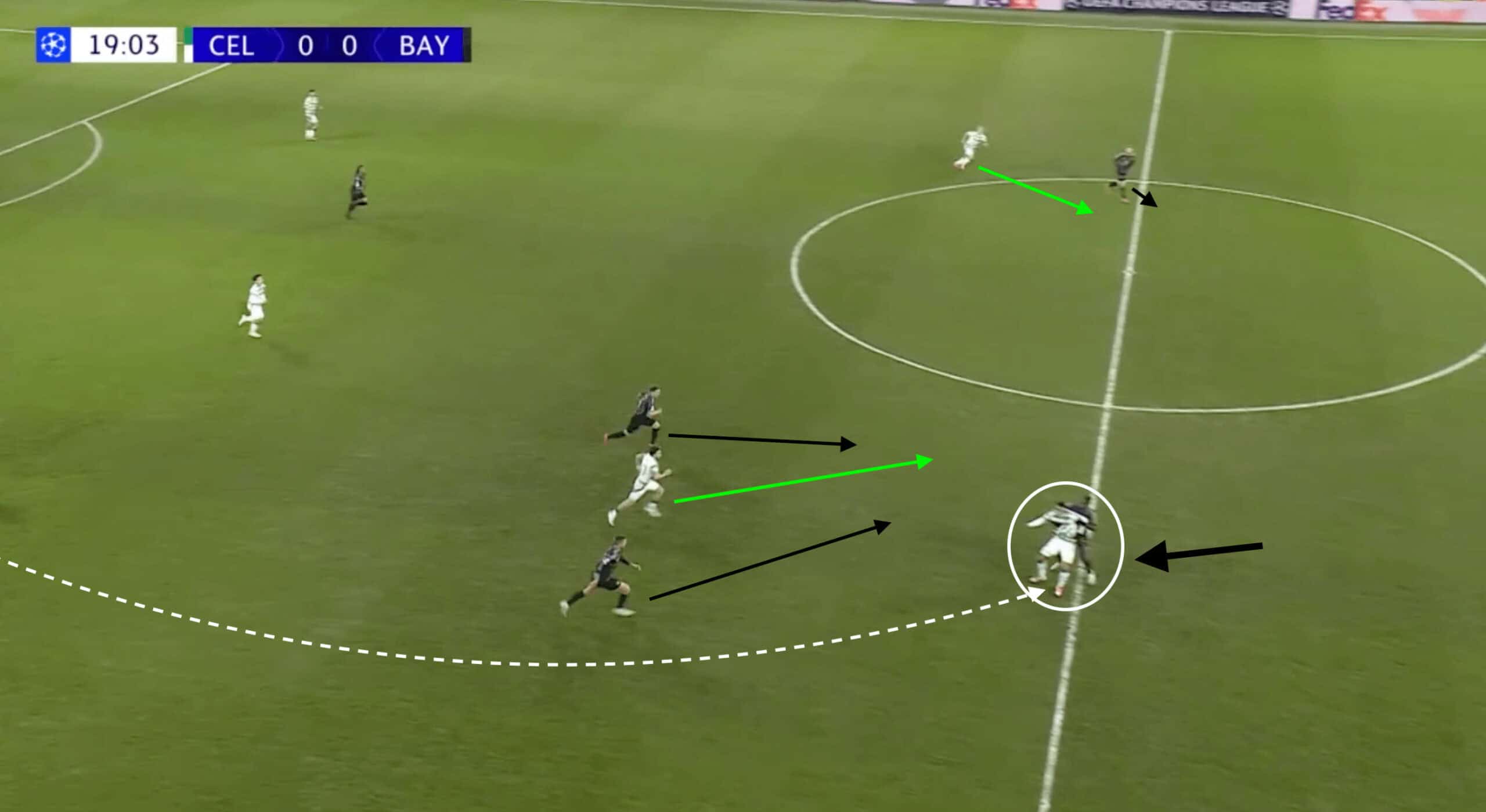
Upamecano also used his frame and strength to project an imposing figure when stepping up to apply pressure to Idah’s back.
He often forced inaccurate passes and allowed his team to counter-press effectively when Celtic received the ball in congested areas.
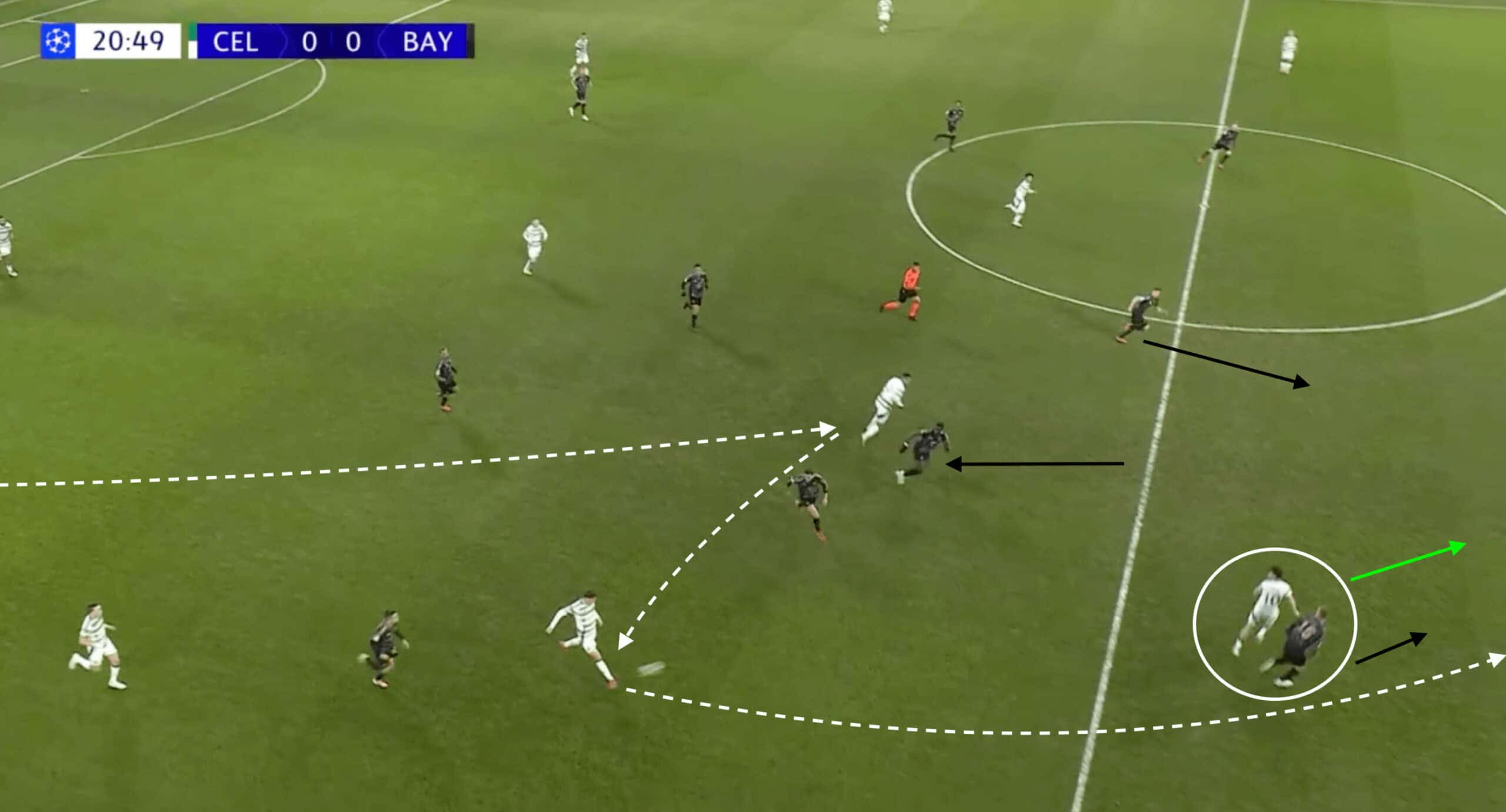
Even though Upamecano could step up and offer enough physical resistance for Idah the majority of the time, it did create an opportunity where Kühn was in an apparent mismatch running into space against Dier when Idah did get a chance to meet it first and flick the ball on—another hair-raising moment for Bayern.
Conclusion
An emotional night in Glasgow revealed a lot of tactical information that Rodgers and Kompany can digest before their return leg next week.
Rodgers’s key point would have to be the increased pressure Celtic caused the Bayern defence when Maeda was moved to a more centralised role.
The Japanese forward has the capacity to press intently and run onto any loose passes that could be caused by defensive errors at the back for Bayern or even when Celtic manages to find space behind an unsettled Bayern backline.
For Kompany, the clear focus would have to be on how he can extract more attacking innovation from his world-class front four.
Playing against a tough Celtic defence is never easy, especially at Celtic Park of all places, but Bayern’s inability to put the hosts to bed has given them further hope of an upset in the second leg.
Bayern must take advantage of their ability to manipulate Celtic’s defensive structure.
Including more technically gifted playmakers may be needed to take advantage of the space resulting from Celtic’s desire to attack.
Once again, the Champions League is set to host another tantalising affair when the two sides meet again in Germany.
