
“I am in a top condition, the best of my career”
In the last match before the Bundesliga was suspended, Bayern Munich just won their match against Augsburg 2-0 at home in the Allianz Arena.
In what was a difficult match, Leon Goretzka scored the second goal that eventually secured the win.
All good, then? Not for the 25-year-old, who started on the bench once again.
After the game, he vented his displeasure, making clear his claim to be a regular starter week in and week out.
This situation gives the first indication of the player and character Leon Goretzka has become.
The 1.89 m tall midfielder learned his skills in the youth academy of 2. Bundesliga-side VfL Bochum before joining FC Schalke in July 2013.
Even then, almost everyone was aware of what a great talent he was.
Although his time with Schalke was marked by several injuries in the beginning and many ups and downs, Goretzka continued to develop and was inevitably called into the national team by Joachim Löw.
When his contract expired in the summer of 2018, he chose the German serial champions as the next step of an ambitious career.
Goretzka’s first season in Munich was decent.
It wasn’t an easy year for the Bavarians in general, but Goretzka made 30 appearances in the Bundesliga, 23 of which were as a starter. While he missed large parts of the start of this season due to an ankle injury, he had established himself at the beginning of Hansi Flick’s tenure and earned a lot of praise from his coach.
However, as indicated above, this has slightly changed in previous weeks, which led to his dissatisfaction.
In this tactical analysis, we will examine Leon Goretzka’s transition abilities, offensive drive, and defensive contribution.
In addition, we will also examine his weaknesses while we start this scout report with his physical attributes.
Role model athlete
Goretzka’s physical attributes are one of his main strengths.
Earlier in his career, Goretzka was repeatedly thrown back due to various injuries, so he was never able to perform consistently in his first three seasons in the Bundesliga.
However, after a chronic inflammation of the intestines was diagnosed in him in 2016, the then-21-year-old started to change his nutrition.
From then on, he did without gluten, cow’s milk, pork, or nuts.
Whether or not this was the main reason, Goretzka has been less frequently injured since then, which played a key role in his development.
At 1.89 m, Goretzka is a very tall midfielder weighing only 76 kg.
Despite his rather skinny appearance, he has a strong musculature and hardly a gram of fat.
His size and stature play crucial roles in defining Goretzka’s “player type.”
One particular advantage is that his long stilts allow him to cover a large area in midfield.
Notwithstanding his size, he does that at a very high pace.
Especially in transition phases after winning the ball, you can frequently see him bridging the midfield at full speed pushing the ball forward.
Although he is not the typical dribbler, his excellent acceleration and impressive dynamics make it almost impossible for the defence to stop him.
Once Goretzka reaches his full running speed, he is arguably one of the fastest central midfielders in Europe.
We will talk about that in more depth throughout the article.
Whether in his own penalty area, in the opponent’s or just in midfield, Goretzka impresses in aerial duels.
This is a skill that already stood out in his early years and which he has constantly developed.
Thus, he radiates enormous danger, especially in the opposing penalty area, as he is often found in the box waiting for crosses from the flanks.
He convinces with excellent timing, impressive jumping power, body tension, and targeted precision.
All this naturally has a positive effect on his defensive work, too.
Goretzka possesses a larger cover shadow due to his size compared to the other midfielders in Hansi Flick’s squad.
While he does not have that low centre of gravity like Thiago, for instance, his long legs allow him to tackle players or intercept passes that normally seem out of reach.
In defensive transitions, once again, his speed and dynamics allow him to cover ground quickly and eventually stop or interrupt counterattacks.
I can still vividly remember at Schalke when Goretzka made those crazy runs over half the pitch to stop the counter with a clean tackle, which was followed by standing ovations from the fans.
Leon Goretzka Pressing and defensive intensity
Regarding his defensive duties, Goretzka not only possesses the physical attributes to compete on the highest level but is also generally a very disciplined and aggressive player against the ball.
Before examining his defensive contribution, it’s worth noticing that Bayern’s pressing has changed since Hansi Flick took over in November 2019 towards a higher intensity than under Niko Kovač.
The first pressing line usually consists of Lewandowski and the wingers with Goretzka behind them looking to support.
Bayern’s 8s act, in principle, relatively man-oriented and try to prevent a build-up through the opponent’s pivots or central midfielders.
Due to his more advanced role in midfield and since Bayern press high as a team, Goretzka is frequently involved in high-pressing situations.
He is very intelligent when blocking passing lanes and doesn’t blindly move out of the defensive shape to execute pressure when he would leave uncovered gaps in behind.
Nevertheless, if the defensive protection is ensured and he can make use of his cover shadow, he likes to leave his position and press the opponent.
The main pressing triggers are poor passes or players receiving the ball with the back to the goal in central areas.
Every now and then, he has to be careful not to get too overconfident and intense in these situations so that he can be taken out of the game by a single movement.

His defensive behaviour also benefits Bayern when faced with the opposition’s counterattacks.
Due to their dominant strategy, they push up very high, inevitably leaving space in behind.
Goretzka’s work rate in this kind of situation is very impressive.
As soon as the ball is lost, whether by him or another teammate, he transitions quickly and tries to win the ball back.
He is not too bad about returning long runs to support the defence and hunt the ball carrier.
If he eventually finds himself in a one-on-one situation, he can also defend against smaller, tricky dribblers.
Despite his size and the lack of a low centre of gravity, he maintains his strengths and balance, which allow him to get back into a duel even if he was surprised by the dribbler’s feint in the first place.
Leon Goretzka Relatively cautious passing
Passing is certainly an area, in which Goretzka has improved a lot since his transfer to Munich even though it is still not the most innovative and by no means comparable to Thiago or Coutinho.
Instead, it is rather cautious and more focused on retaining the ball, rarely opting in for risky passes.
His passing accuracy of 86.6% is very good, but as indicated, it is also a result of his risk aversion.
When Goretzka receives the ball during the build-up phase, he usually uses horizontal or backpasses rather than vertical line-breaking ones.
He mostly joins the build-up to provide an extra passing option, creating numerical superiority and circulating the ball.
Bayern have great ball progressors who can build up from the back excellently, such as Alaba, Kimmich, or Thiago.
This is helpful for the 25-year-old as he has fewer duties in this part and can operate in higher areas.
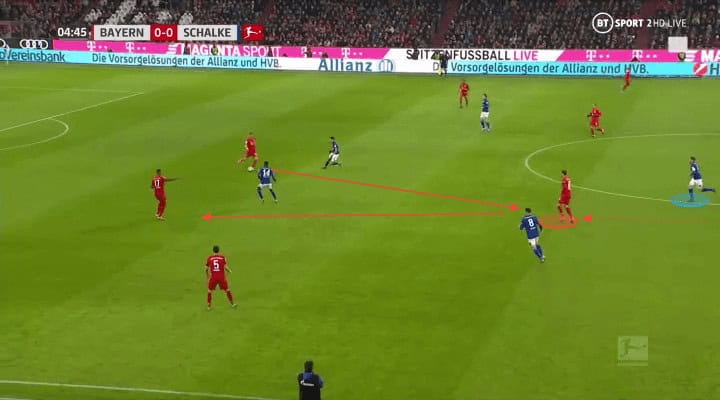
His passing in higher regions is a little riskier and sometimes aims to break through the opponent’s defence.
Nevertheless, it’s, in principle, more geared to shifting the play to wider areas, as Bayern generally has many players in central areas with one or two players occupying width.
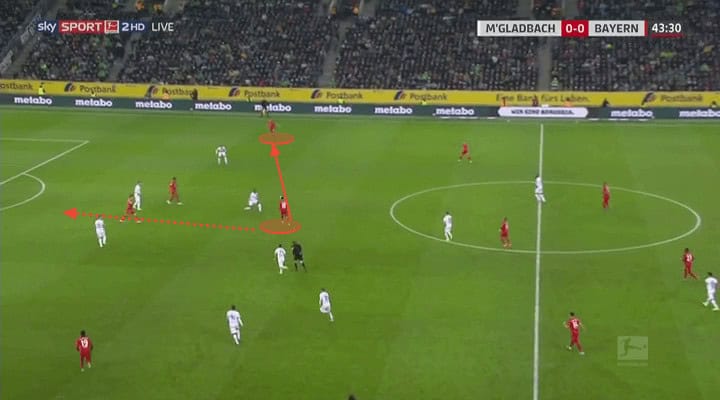
With all of that said, it would be wrong to deny him the qualities of passing in any way.
He is quite able to play opening passes or even the last pass into the channel.
Still, he does not consistently show this, especially compared to his midfield competitors.
Playing with some of the best deep-lying playmakers and creators in the world allows him to focus on other abilities, as we will see in the next section.
Leon Goretzka Offensive thrusts
Whenever his coaches are asked what makes Leon Goretzka unique, part of the answer is always his offensive drive and his threat to the opposition’s goal.
As soon as he discovers a gap, he starts running to take advantage of it.
He is not only physically fast in exploding these gaps, but also in his mind by recognizing and anticipating situations earlier than others.

As the example above shows, Goretzka likes to prepare for the emergence of his thrusts by shifting from the centre to the wings.
The basic idea is to create 1 vs 1 or 2 vs 1 situations in wider areas, with the advancing full-backs eventually crossing the ball or playing a through ball from a deeper area.
It’s interesting to observe that he often slows down a little after he passes the ball, only taking some small steps and waiting until it’s likely that the cross is about to come.
At that moment, he starts his run from deep, which allows him to arrive in the box, running forward at a high speed.
This gives him an important edge over his opponents, who usually stand still.
If the box is already occupied with enough players, Goretzka lures for second balls at the edge of the penalty area.
What should be emphasized about his offensive thrusts are his movements into the box and his positioning.
While Thomas Müller is known as the personalized Raumdeuter, Goretzka also displays some similarities (although to a lesser extent) when identifying spaces in and around the final third.
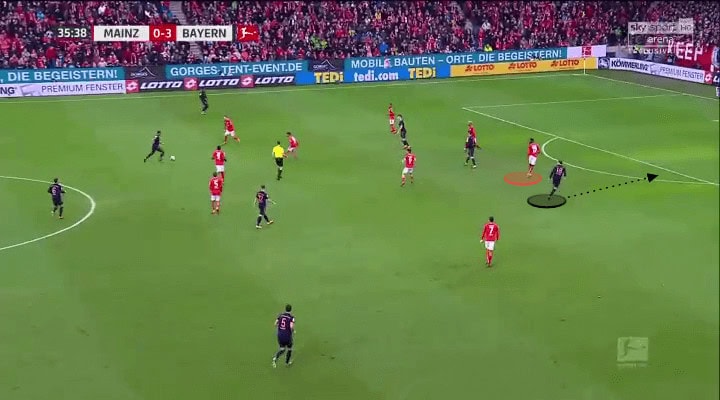
We can see his spacial awareness when he tries to attack the vertical channels between opposing defenders.
This most often results in far-side runs behind the defence, using the gap between the opponent’s CB and the FB.
While the centre-back is usually focused on the ball carrier and his marker, unaware of his blindside, the full-back’s attention is often divided by the advancing Goretzka and the winger who tucks inside.
With Alaba, Kimmich & Co., he is numerous teammates that master these passes behind the defence.
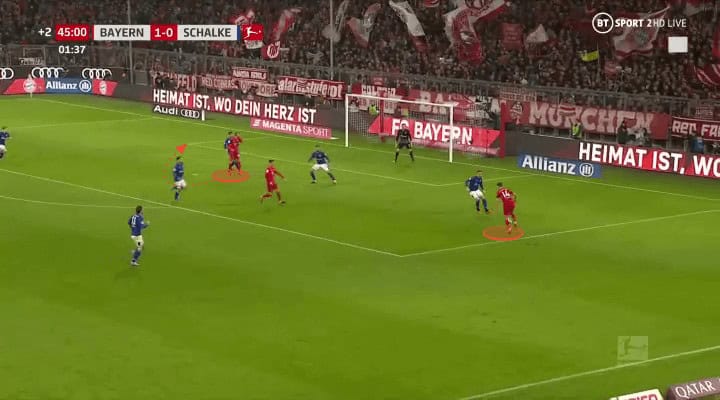
Even if he arrived in the box early on, he doesn’t just wait for a cross but tries evading his marker by sneaking into open spaces.
His offensive drive and his ability to turn up in dangerous areas are additionally underlined by his shot map.
While he likes to take some long-range shots here and there, the locations look extremely impressive for a central midfielder.
Most of his shots come not only from inside the box but also from very central positions.
His heatmap will confirm his preference for these areas later in the article.

Another interesting statistic about his shooting is that more than a quarter of the shots are headers, proving his dependency on good crosses and his ability in the air.
In fact, 44.4% of his shots are the result of crosses and his conversion inside the box in total are an impressive 25.6%
Leon Goretzka Bridging the midfield in transition
Even though Bayern are not a typical counter-attacking side, Goretzka can really excel in offensive transitions.
What makes him so exceptional in these situations are his long, space-filling steps which allow him to bridge the midfield in the shortest possible time.
He is not the classical dribbler with a repertoire of numerous tricks, but once he has picked up speed, he is very hard to stop with fair interceptions.
A perfect illustration of his abilities in transition phases was during the Confederations Cup 2017, when Goretzka played next to Sebastian Rudy as a central midfielder in Jogi Löw’s 3-4-3.
The division of roles between the two was clear: Rudy supported the build-up while the former Schalke player interpreted the role more offensively.
Since Germany applied a more defensive approach at this tournament than one year later at the World Cup, there were many counterattacks and spaces that Goretzka could penetrate into.
Transitions were usually initiated by effective pressing in Germany’s own half or around the middle circle.
Goretzka either won the ball himself or received it in the centre of the pitch and carried the ball forward before eventually passing it to a teammate on the flanks.
Subsequently, Goretzka marches through the midfield with his long strides towards the box.
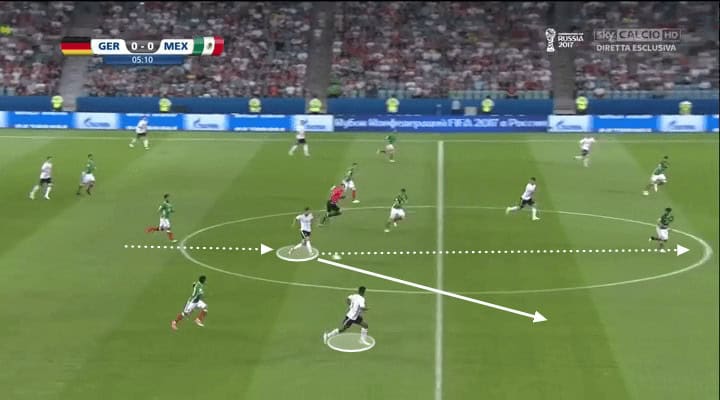
Even if it’s not him who initially carries the ball forward, Goretzka always tries to exploit gaps and join the offence if opportunities occur.
A big advantage at the Confed Cup 2017 was the very flexible interpretation of the 3-4-3 formation with many rotations.
The attackers’ rotations dragged opponents out of their positions and allowed Goretzka to execute runs from deep behind.
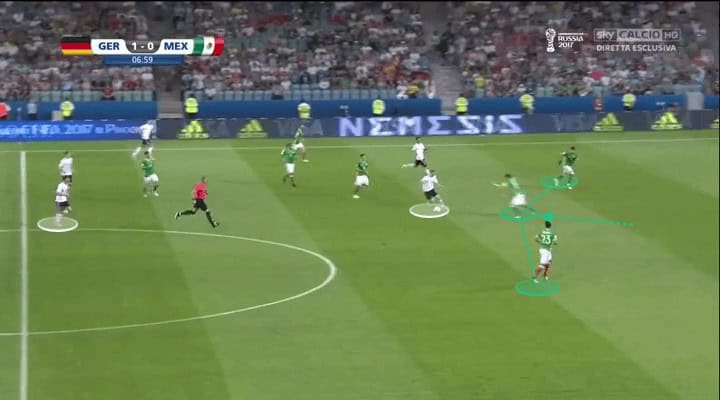
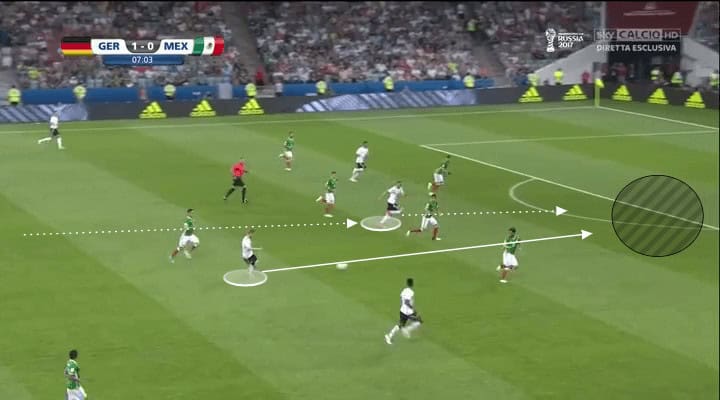
I already indicated it in the first sentence, and I think it’s fair to say that this ability is required to a lesser extent at Bayern.
They just play such a dominant style that they rarely sit deeper and lure for counterattacks.
This was different at the Confed Cup and with Schalke: They often sat deeper and he was the key player when it came to transitioning from defence to offence.
His goal for Schalke 04 against Ajax Amsterdam in the Europa League 2016/17 is still one of the most memorable ones, and it describes him quite well—a goal full of willpower and pure athleticism.
Leon Goretzka Areas to improve
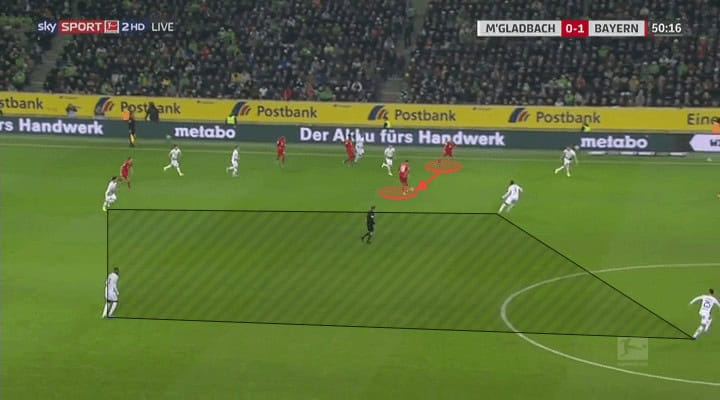
One area where Goretzka can certainly improve is his decision-making, especially in the final third.
As an attacking midfielder, he inevitably finds himself in situations where he is in possession shortly before the penalty area, and it’s up to him to create something: Shot? Through ball? Penultimate pass?
It often seems that, in these situations, he lacks the vision to consider all possibilities while focusing too much on the ball.
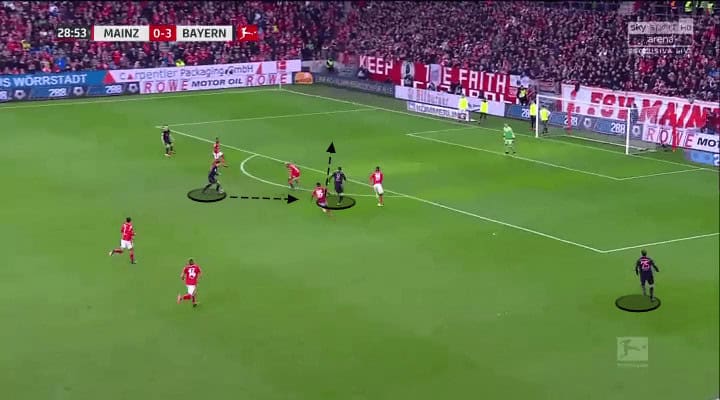
Similar situations can be seen in deeper areas of the pitch.
While he has good spatial awareness when it comes to exploiting the gaps of the opponent, he sometimes lacks awareness when he receives the ball due to a lack of scanning.
Also, his first touch in these situations is not always optimal, so that he cannot continue playing the ball with the second touch.
This can cause problems, especially under high pressure in tight areas.
Leon Goretzka Positioning issues and his role at Bayern
With all his strengths and weaknesses in mind, his best position is probably as a box-to-box midfielder in a 4-3-3/4-1-4-1 formation, in which he enjoys the freedom to drive forward and turn up in the opposition’s box.
Bayern coach Hansi Flick might agree to that.
He usually uses Goretzka in this position or even as a number ten when deploying a 4-2-3-1 formation.
When discussing his positioning, it’s important to note that Hansi Flick has reimplemented several facets of positional play.
The build-up is done by the centre-backs, Thiago and Kimmich, one of whom often drops between the centre-backs.
As we examined in the section about his defensive duties, Goretzka occasionally joins them to create numerical superiority and provide an additional passing option.
Once Bayern manages to break the opponent’s press or if no pressing is executed at all, Goretzka can move into higher areas again.

His heatmap shows that he mostly occupies the 10-space in the middle zone or the half-spaces, pre-dominantly the right one.
He positions himself intelligently in relation to the opponents and his teammates, offering passing lanes to help him progress the ball.
Under Hans Flick, even Robert Lewandowski acts more spacious and drops out of the last line cover to be involved in build-up phases.
In such situations, Goretzka can occupy the missing depth in the centre.
The heatmap also illustrates very well his ability to turn up between the 6-yard area and the penalty spot.
Conclusion
Goretzka possesses a lot of valuable qualities, many of which are unique advantages to a very competitive and strong Bayern squad.
He combines defensive intensity with his offensive drive and the ability to get into dangerous situations inside the box.
One of his biggest strengths, his contribution in transitions, is not even regularly visible at Bayern due to their strategy.
We could see how he can excel in these situations at Schalke, the Confed Cup 2017, and hopefully next year at the European Championship.
What has come a little short in this analysis are his leadership qualities.
Already at Schalke, he was one of the leaders and most likely even captain today, if he had stayed.
If he can establish himself as a regular starter, he undoubtedly has the potential to take on more responsibility at Bayern and in the national team.
Even off the pitch, his public perception has increased significantly in recent months through many intelligent statements.
With all of that said, The 25-year-old is entering his peak, and he won’t accept being benched in the most important games of the season going forward.
He made his demands clear, and whenever he played, he performed well.
However, others have also shown similar performances.
Ultimately, it’s undoubtedly also a question of Hansi Flick’s tactics and the player role that he wants in his starting lineup: the raumdeuter Müller, the playmaker Coutinho, or a box-to-box midfielder in Goretzka?
