
Operating predominantly as an attacking midfielder, left or right winger, or occasionally as a false nine, Phil Foden combines technical proficiency with spatial awareness to influence both possession-based and transitional phases.
At Manchester City, he has operated across multiple positions, adapting his movements, positioning, and decision-making to Pep Guardiola’s tactical framework.
This Phil Foden scout report explores the tactical versatility and positional intelligence of one of England’s most dynamic attackers in 2025/2026.
Phil Foden Tactical Role & Positional Behaviour
During the 2025/2026 season, Phil Foden has been deployed predominantly as a left-sided interior midfielder, most often in Man City‘s 4-3-3 and 3-2-4-1 formations.
Rather than operating consistently in high positions between opposition lines, Foden’s role now emphasises structural involvement across build-up and middle-third phases.
His responsibilities include regular participation in circulation, intelligent occupation of the left half-space, and dynamic height adjustments depending on ball progression and match context.
The positional and touch maps from the performance data indicate a clear increase in ball receptions in the central and left-central zones, confirming a deeper average positioning than in earlier seasons.
This positional shift allows Phil Foden to influence possession sequences earlier, acting as a connective reference rather than a fixed final-third attacker.
Phil Foden’s mobility between the interior and advanced zones forces opponents to continuously adjust their marking schemes and compactness.
By vacating and reoccupying spaces, he indirectly facilitates more advantageous attacking situations for teammates such as Erling Haaland, Rayan Cherki, or Omar Marmoush, who are able to exploit open channels and receive in higher-value zones.
While Phil Foden retains the capacity to operate across multiple attacking positions when required, these deployments are situational rather than predominant in 2025/2026.
His primary function has evolved toward a role that prioritises positional balance, progression support, and collective stability, enabling Manchester City to maintain attacking flexibility without compromising structural control.
As seen in the analysis below, Phil Foden’s evolution involves dropping deeper into the defensive line to facilitate ball progression.

Phil Foden drops deep into the middle third to act as a connective reference during the initial circulation phase in the image above.
Once the ball moves past the first line of pressure, Foden quickly reoccupies “the pocket” between the opponent’s midfield and defence.
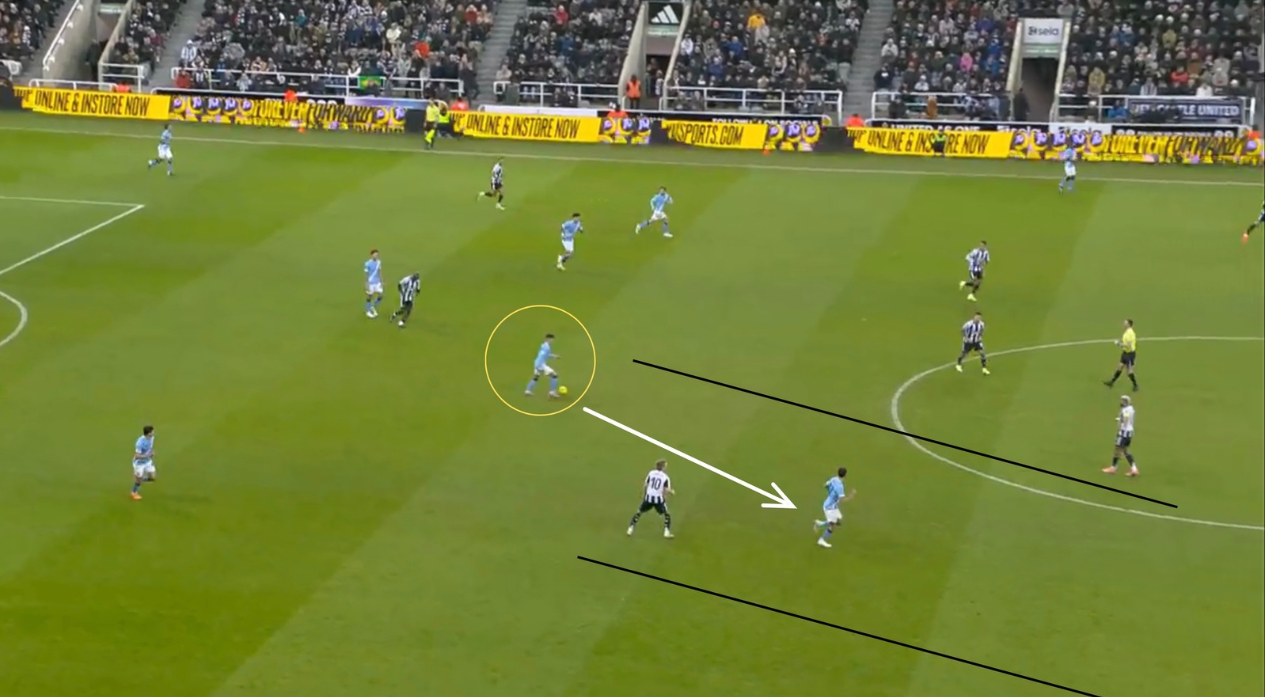
By maintaining his position between the lines, Phil Foden successfully draws markers away from key attacking teammates such as Erling Haaland, Rayan Cherki, and Omar Marmoush, allowing incisive passes to be played to those attacking threats in high-value goal-scoring zones.
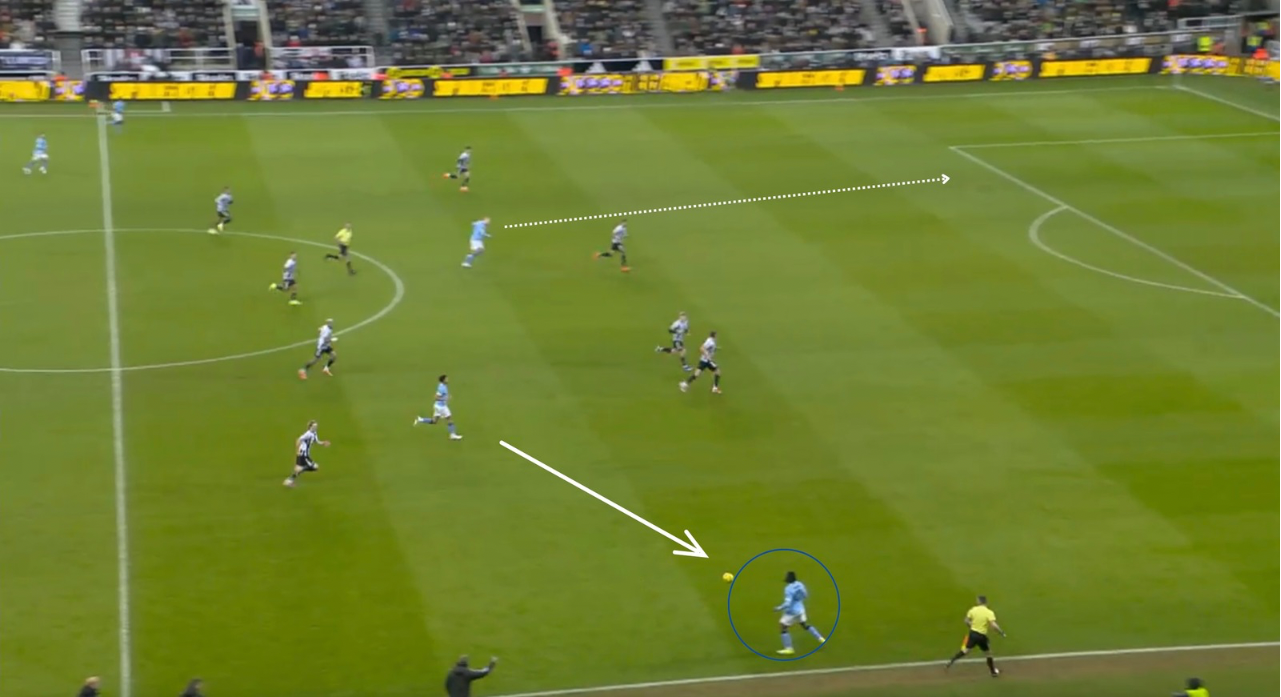
Phil Foden Offensive Positioning & Technical Profile
Phil Foden’s technical profile is characterised by close ball control, quick combinations, and intelligent movement off the ball.
These traits allow him to operate effectively in different offensive zones.
In the 2025/2026 Premier League season, Phil Foden recorded 7 goals and 2 assists in 18 appearances, demonstrating his scoring ability and creative contributions from varied positions.
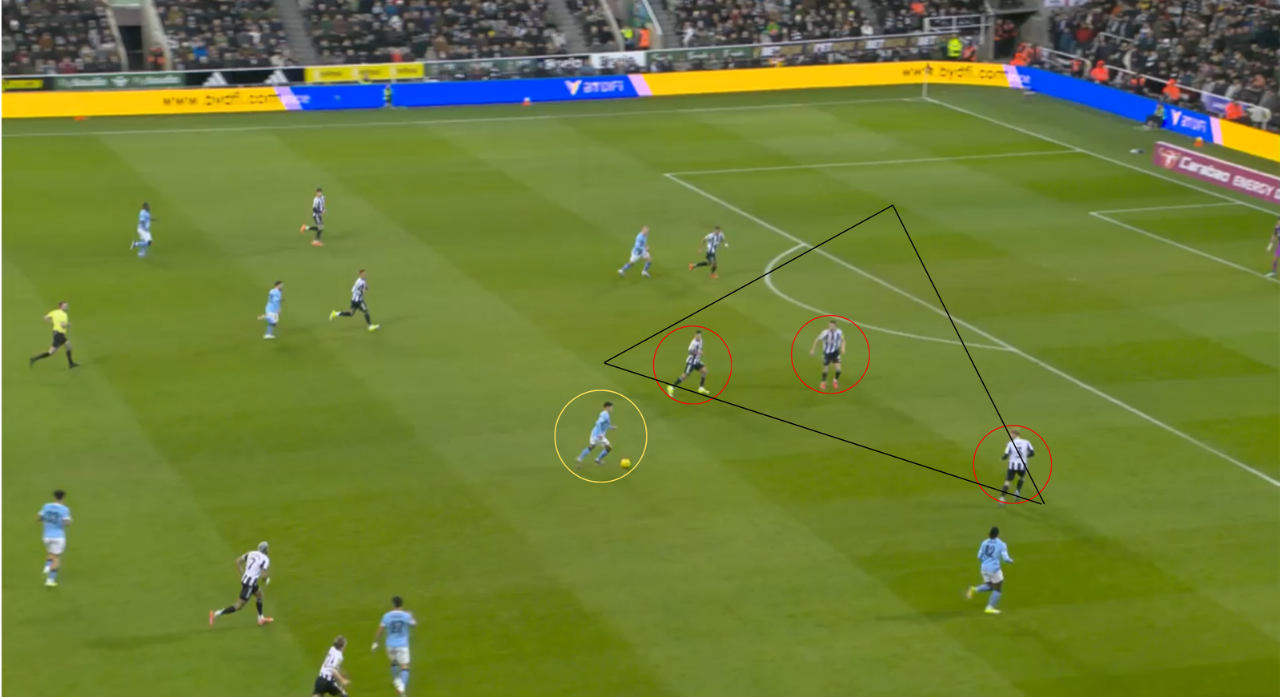
Phil Foden can be seen carrying the ball into the final third in the image above.
His verticality creates “Defensive Gravity,” forcing three opponents to collapse their shape to stop his progression.
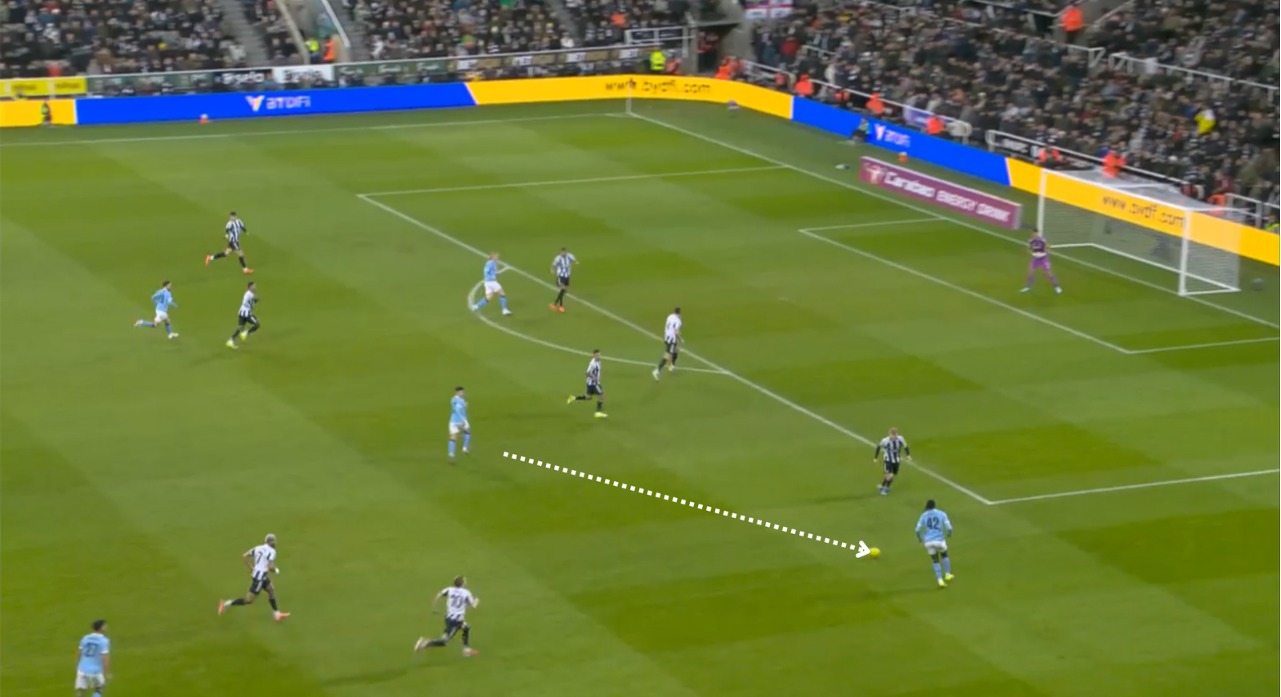
Above, Phil Foden is seen scanning the horizon.
Despite the collapsing block, Foden identifies the overlapping run on the right flank and prepares to exploit the space vacated by the defenders.
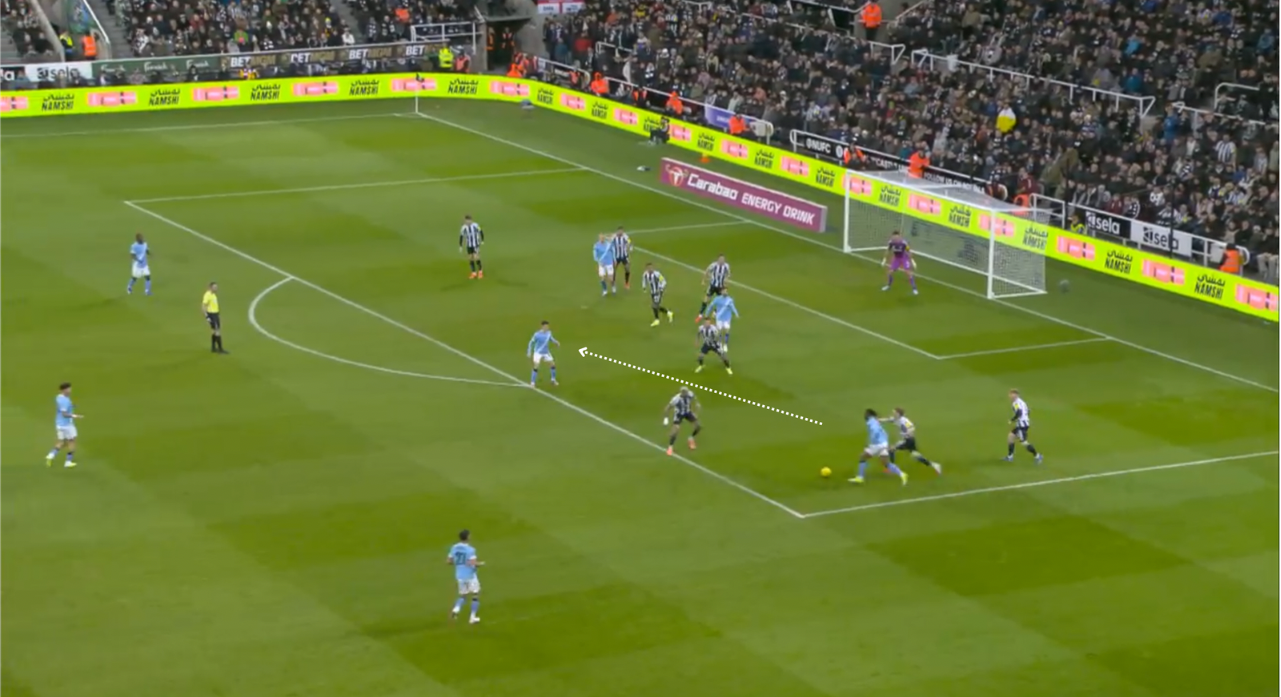
Foden executes a perfectly weighted through-ball that leaves the entire defensive line behind, putting the winger in a high-value crossing position.
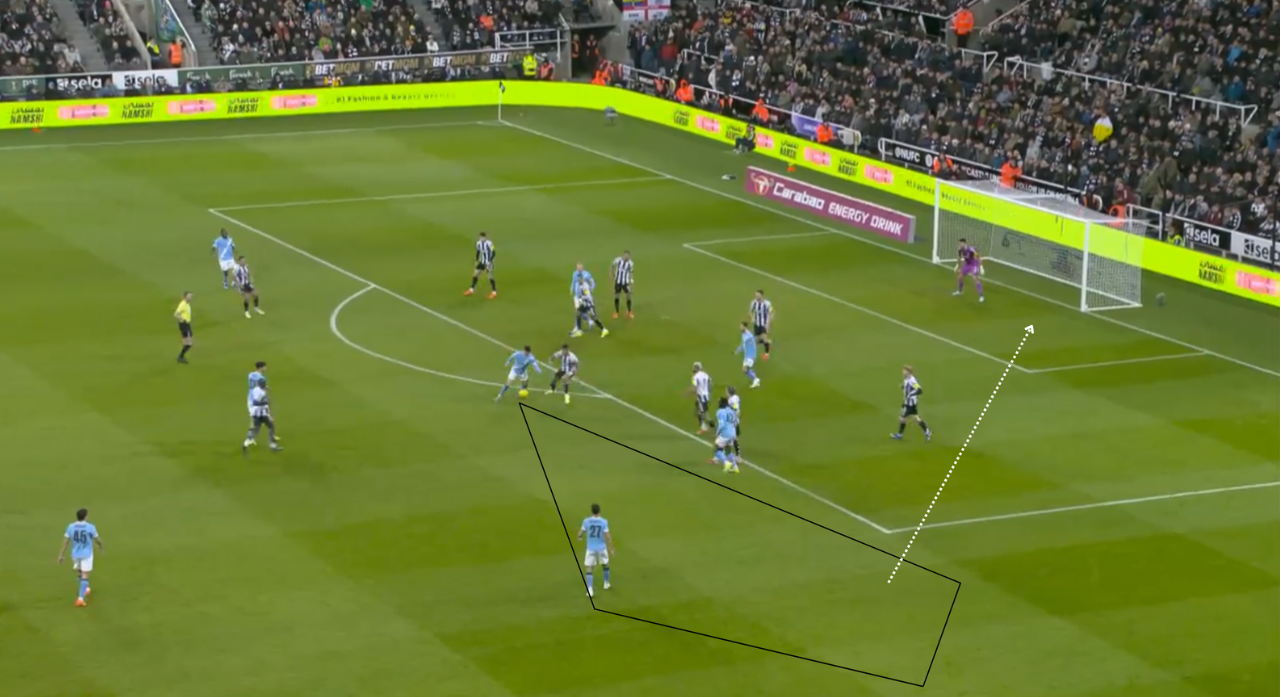
This passage of play highlights Phil Foden’s contribution to his team’s chance creation.
The sequence results in a clear goalscoring opportunity, highlighting Phil Foden’s role as the primary creative engine in transition phases.
In addition, his left foot remains a core attacking tool, whether cutting inside from wide positions or striking from central spaces.
Additionally, Foden frequently combines with forwards like Erling Haaland to destabilise compact defensive blocks with late runs into the penalty area or incisive passes into goal‑threat zones.
Phil Foden Off-The-Ball Movement & Spatial Intelligence
Phil Foden’s off-the-ball movement and spatial awareness remain key components of Manchester City’s structure during the 2025/2026 season.
He consistently occupies the half-spaces between opposing defensive lines, using subtle lateral movements and well-timed runs to manipulate opposition marking and open passing lanes.
These movements have a clear collective impact.
By vacating and reoccupying zones, Foden draws defenders out of position and helps create space for teammates such as Erling Haaland to attack central channels or receive in higher-value areas, particularly against compact or high-pressing defensive blocks.
Out of possession, Foden contributes through intelligent positioning rather than high-intensity pressing.
He screens central passing lanes, guides opponents toward wide areas, and supports team compactness during defensive transitions.
This positional discipline helps Manchester City limit central threats and quickly regain possession.
Overall, Foden’s spatial intelligence allows him to influence games beyond direct involvement in final actions, providing both attacking fluidity and structural balance within Pep Guardiola’s system.
Conclusion
Phil Foden’s 2025/2026 campaign represents his full maturation into a complete interior midfielder.
No longer defined solely by final-third flair, his evolution into a structural pillar within Guardiola’s system has provided Manchester City with a rare blend of tactical discipline and elite playmaking.
By transitioning from a situational attacker to a connective reference in the middle third, Phil Foden has become the engine that balances the team’s possession-heavy style with the necessary verticality to break down elite defences.
The connection Foden has developed with creative partners like Rayan Cherki and Omar Marmoush, alongside his telepathic connection with Erling Haaland, has redefined City’s offensive ceiling.
His ability to exert “Defensive Gravity”, attracting multiple markers only to release the ball into vacated spaces, makes him an impossible puzzle for opposition managers.
This selfless manipulation of space, combined with his clinical output of seven goals and two assists, confirms his status as one of the most intelligent footballers in the modern game.
Ultimately, Foden embodies Manchester City’s tactical flexibility.
He is the vital link between structural control and creative chaos, capable of stabilising a game through circulation or winning it with a single incisive pass.
As the 2025/2026 season progresses, Foden remains the indispensable tactical heartbeat of this squad, proving that his spatial intelligence is just as valuable as his technical brilliance.