
The footballing world was once again reminded of Rayan Cherki’s prodigious talent when he came on as a substitute in the 63rd minute of France’s dramatic 5-4 defeat to Spain in the UEFA Nations League.
In that brief period, he delivered both an assist and a goal, which showed why he is one of the most creative players in the world today.
Cherki’s departure from Olympique Lyonnais (Lyon) was widely anticipated, with top European clubs circling in expectation.
Ultimately, it was Manchester City who secured his signature for a reported £30 million.
His arrival coincides with a period of introspection at City following an underwhelming campaign.
Notably, Phil Foden — a player once heralded as the natural successor to Kevin De Bruyne — has found his role diminished.
This development casts doubt on his long-term status as the creative main man.
Pep Guardiola’s recent ventures in the transfer market, including the acquisition of Omar Marmoush from Eintracht Frankfurt, further suggest a pursuit of renewed attacking impetus.
The addition of Cherki, in particular, raises questions regarding Foden’s future.
Does Guardiola now envision the Englishman as a rotational option rather than a central figure?
Or, is there scope for both Cherki and Foden to operate and harmonise their distinct creative profiles within the same starting XI?
This analysis aims to dissect the individual strengths each player brings to Man City, assess their tactical compatibility, and determine whether Guardiola can accommodate both talents simultaneously.
Phil Foden Strengths

Foden’s overall campaign has been disappointing despite registering seven goals and two assists in 27 Premier League appearances and adding three goals and an assist in nine UEFA Champions League outings.
Once heralded as De Bruyne‘s natural heir, Foden has at times found himself pushed to the periphery, with Pep Guardiola seemingly hesitant to entrust him with the full creative licence.
From a quantitative perspective, Foden’s metrics remain impressive.
He sits in the 83rd percentile among positional peers in Europe’s top five leagues for expected goal contributions per 90 and 71st percentile for dangerous passes per 90.
He also has the ability to advance play in controlled build-up and during transitional moments.
These figures highlight his enduring value, even if his statistical output has not always translated into a secure starting role.
Tactically, Foden exemplifies flexibility and spatial intelligence, operating most often as an attacking midfielder, right winger, or false nine.
He occupies interstitial pockets between the opposition midfield and defence, exploiting these spaces to create moments of defensive indecision and open up avenues for progression.
In a league match against Southampton, Foden receives the ball between the lines, turns, and slips a through ball to Erling Haaland for a shot on goal.
This positioning forces defenders into difficult choices and allows City to destabilise compact blocks.
The importance of Foden’s movement was shown in the March 2024 Manchester Derby, where Kevin De Bruyne’s positioning was adjusted to accommodate Foden’s central presence, and reflected Guardiola’s trust in his spatial manipulation.
Technically, Foden’s ability to receive the ball under pressure is a key differentiator.
He utilises the half-turn and his back foot to immediately prepare for vertical progression.
In the FA Cup quarter-final against Bournemouth, Foden wins the ball under heavy pressure in a tight space and immediately plays it first-time to Bernardo Silva, who moves forward into space.
His characteristic spins in tight areas, combined with close control and rapid acceleration, enable him to evade pressure and create high-quality scoring opportunities for himself and his teammates.
The technical acuity is particularly valuable in transitions, where his burst and dribbling make him a constant threat against unset defences, as well as in more settled phases due to his sharp turns.
Additionally, Foden is able to exploit the half spaces well.
Through underlapping runs and intelligent positioning following switches of play, he generates overloads and stretches defensive structures vertically.
His off-the-ball movement, as well as his ability to draw pressure and release teammates into advanced areas, demonstrates both footballing intellect and understanding.
However, Foden’s inclination towards directness and a preference for playing at a high tempo can sometimes lead to forced actions.
While injecting dynamism and unpredictability, this tendency can also result in missed opportunities to manipulate blocks with greater subtlety.
Despite these limitations, Foden’s technical superiority and spatial awareness continue to make him an important player for Manchester City.
Yet, the context of his current season raises questions about how his role will evolve.
As City integrate new creative player in Cherki, the challenge lies in maximising Foden’s strengths within a highly competitive squad.
Rayan Cherki Strengths
Rayan Cherki’s arrival is exciting for Manchester City.
It marks the introduction of a player whose creative output and technical sophistication set him apart in European football.
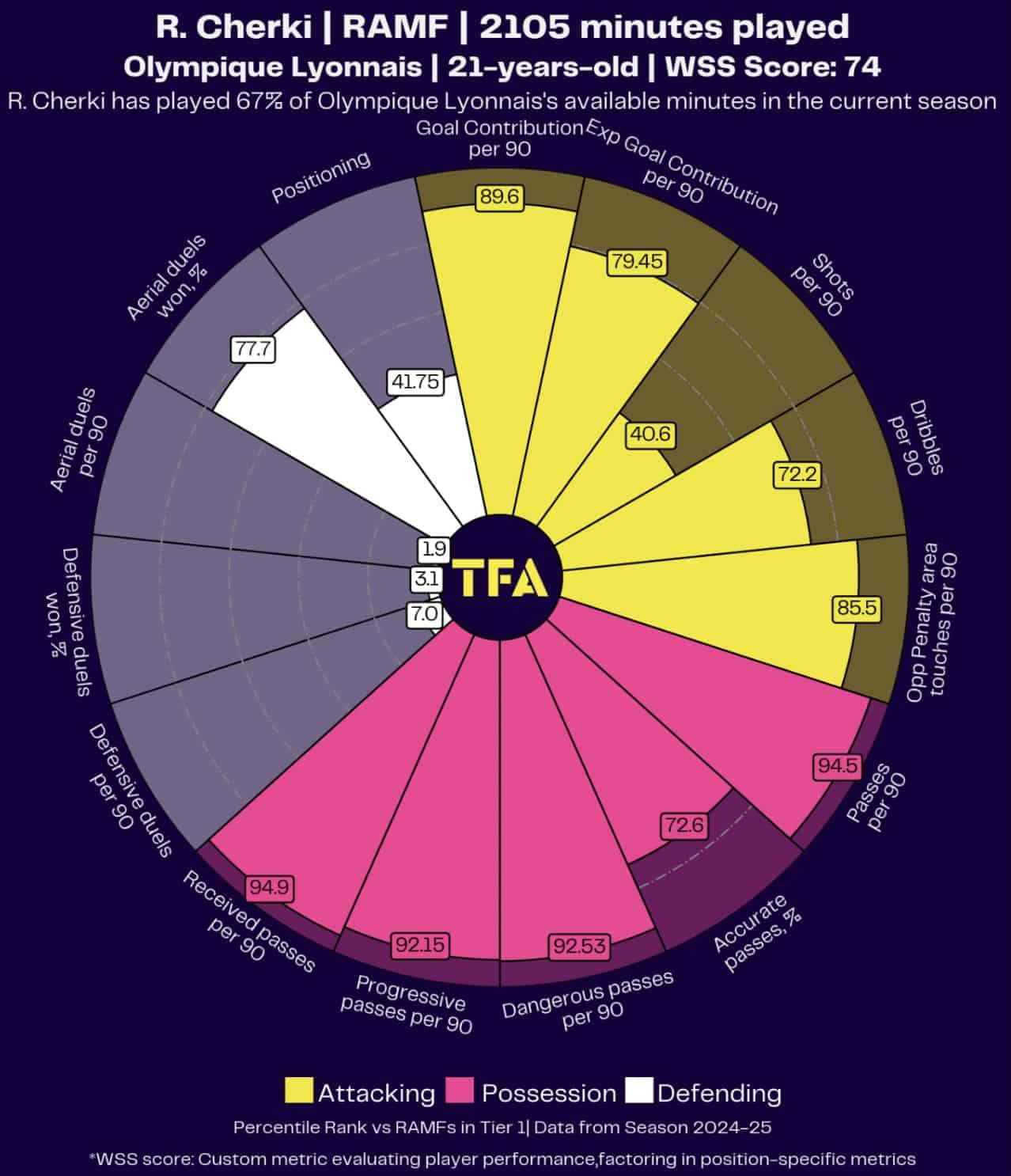
At just 21 years old, Cherki’s 2024/25 season statistics with Lyon are exceptional.
In 30 Ligue 1 appearances, he contributed eight goals and 11 assists, while his European campaign produced four goals and eight assists in 12 Europa League matches.
These numbers only begin to describe the multi-dimensional threat Cherki brings to the final third.
This past season in Ligue 1, he sat in the 89th percentile and 79th percentile for goal contributions and expected goal contributions, respectively.
He also produced a relatively high number of progressive passes per 90 and dangerous passes per 90—both over the 90th percentile.
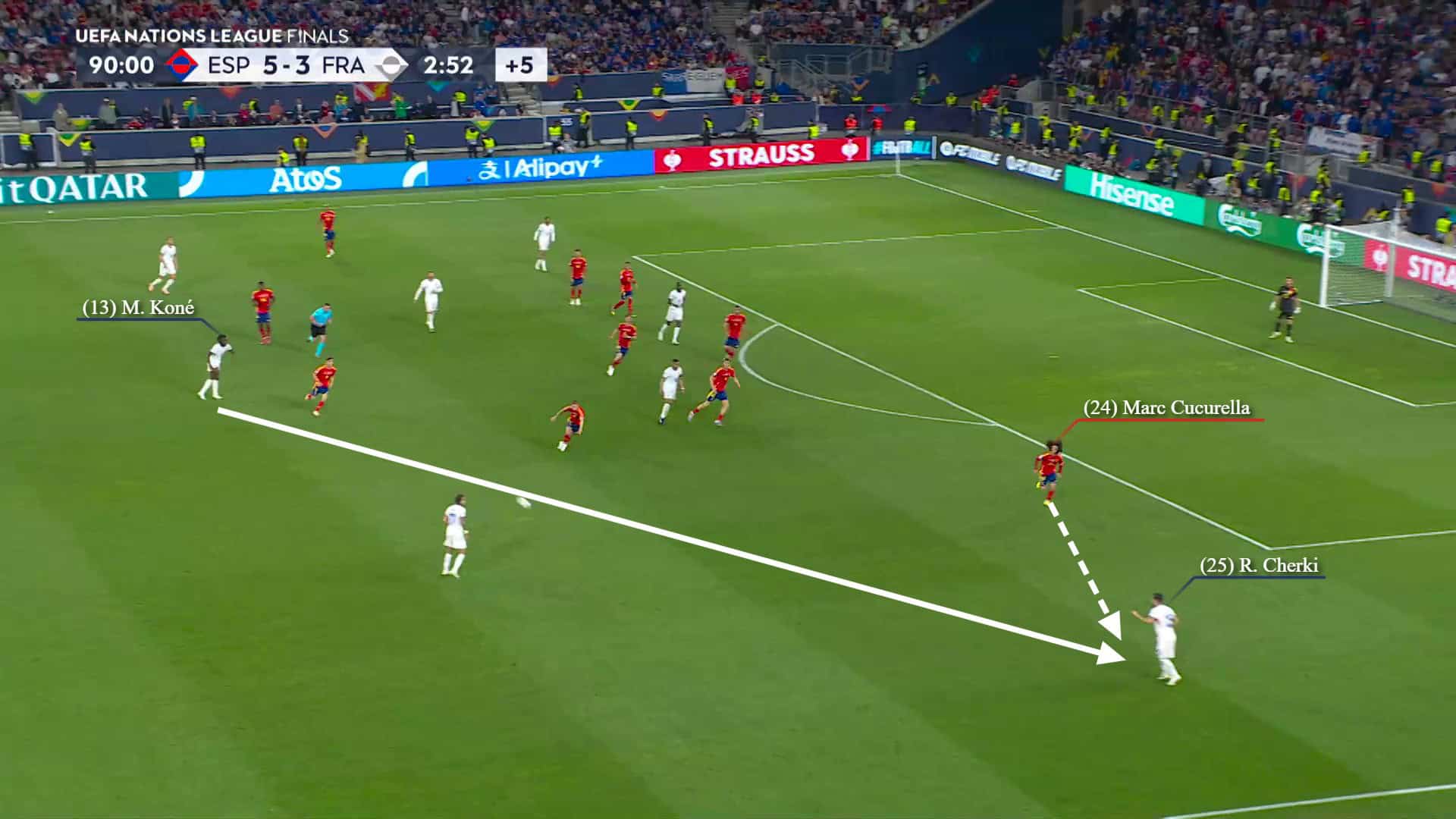
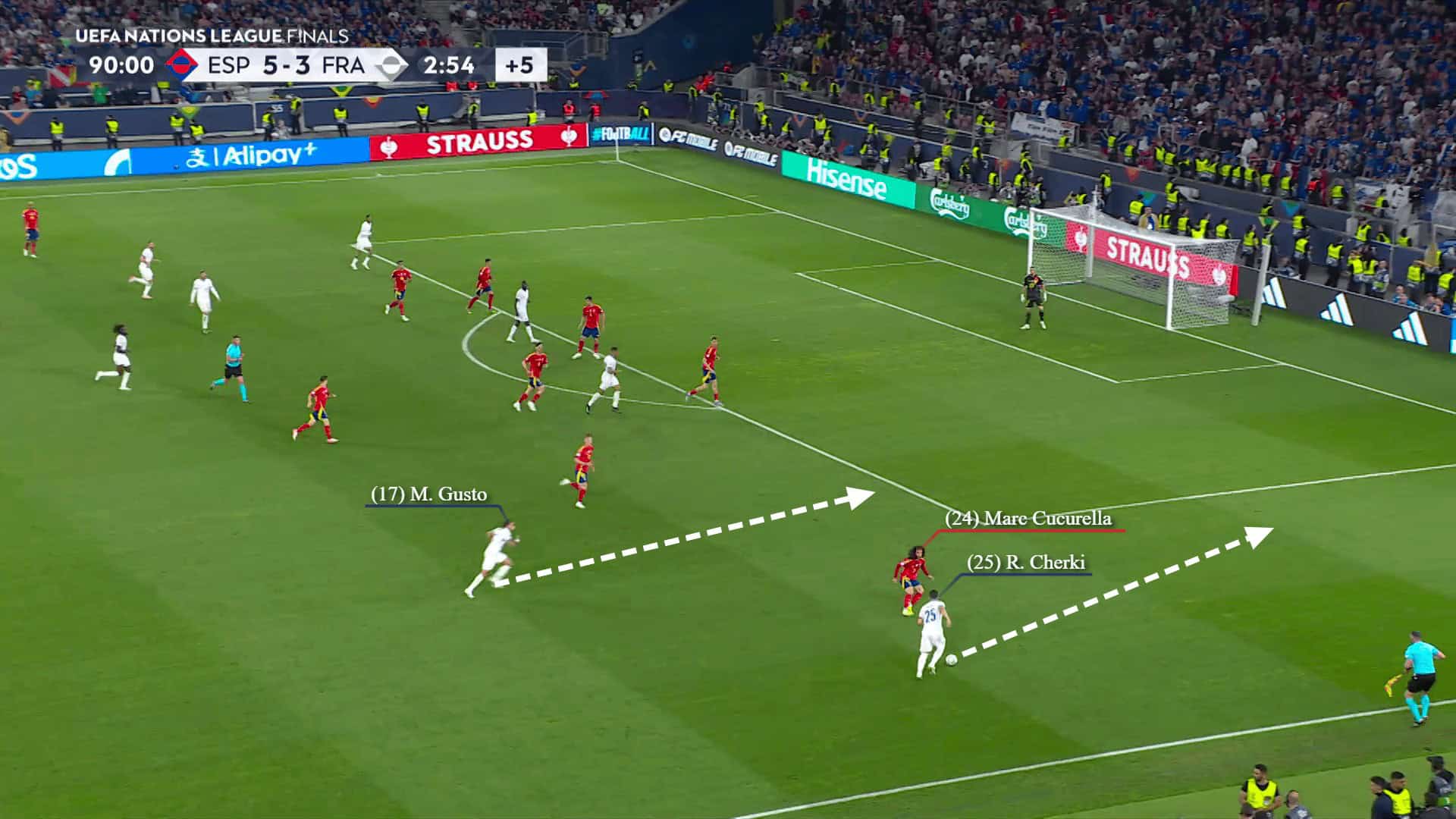
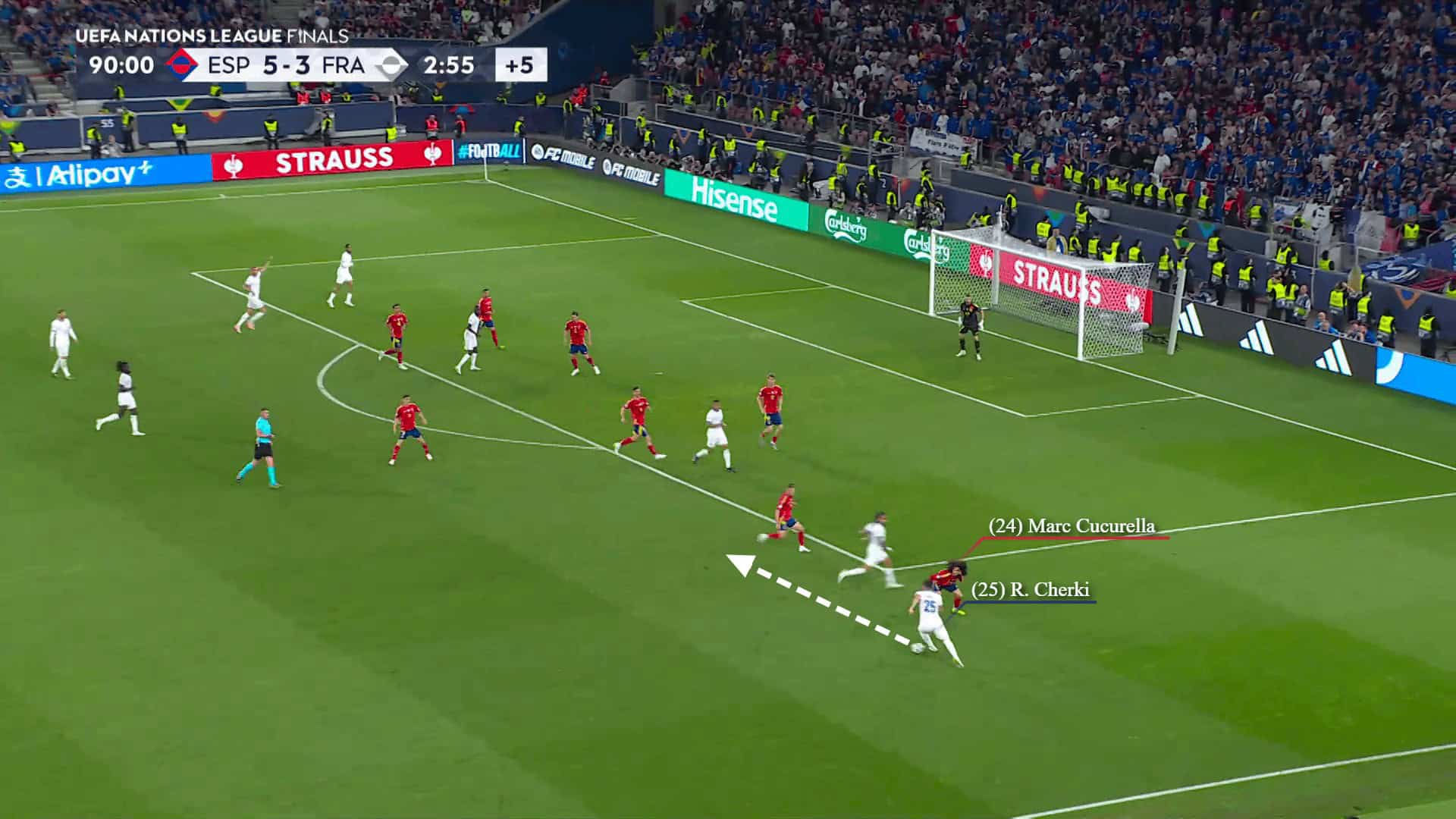
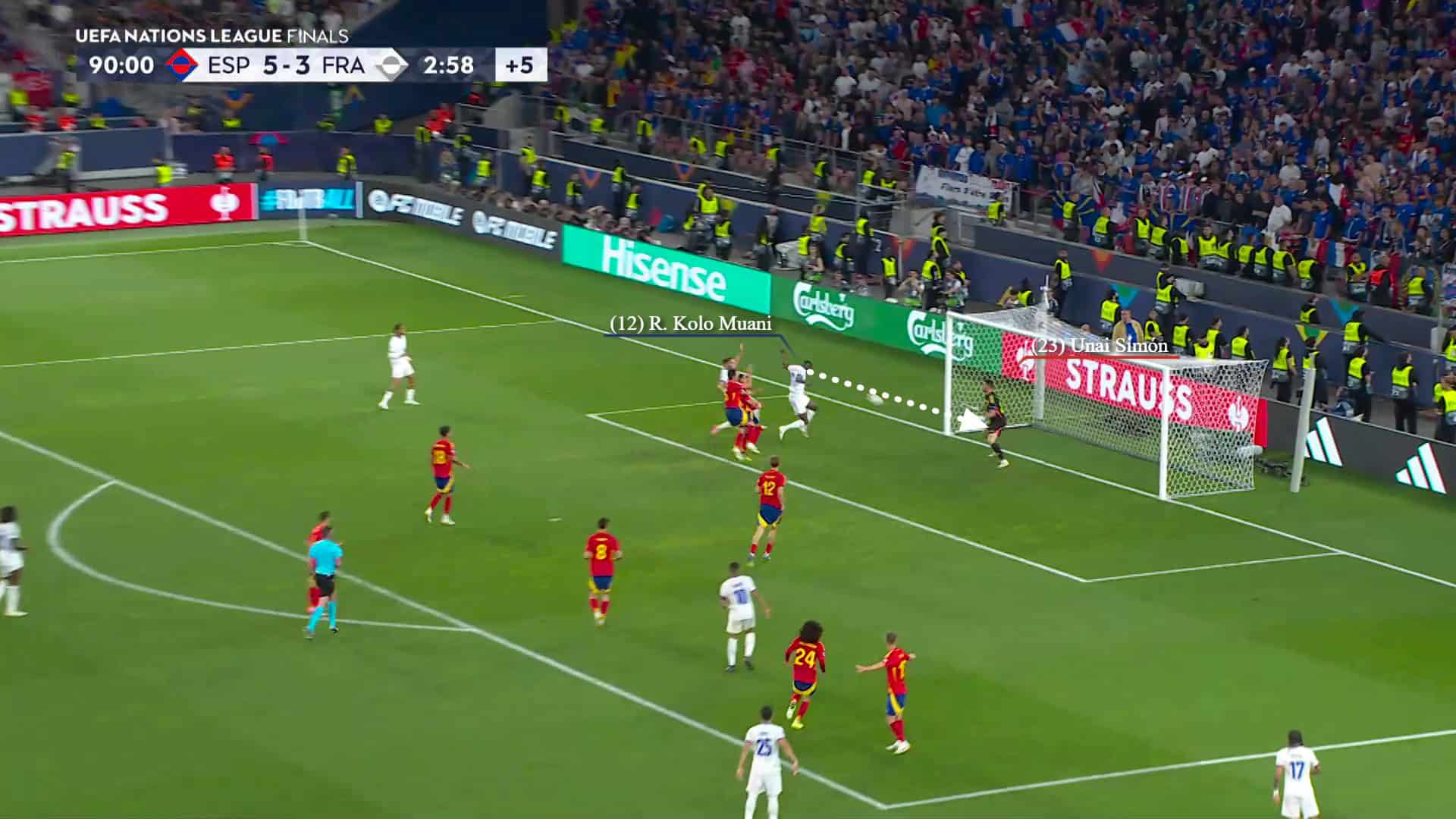
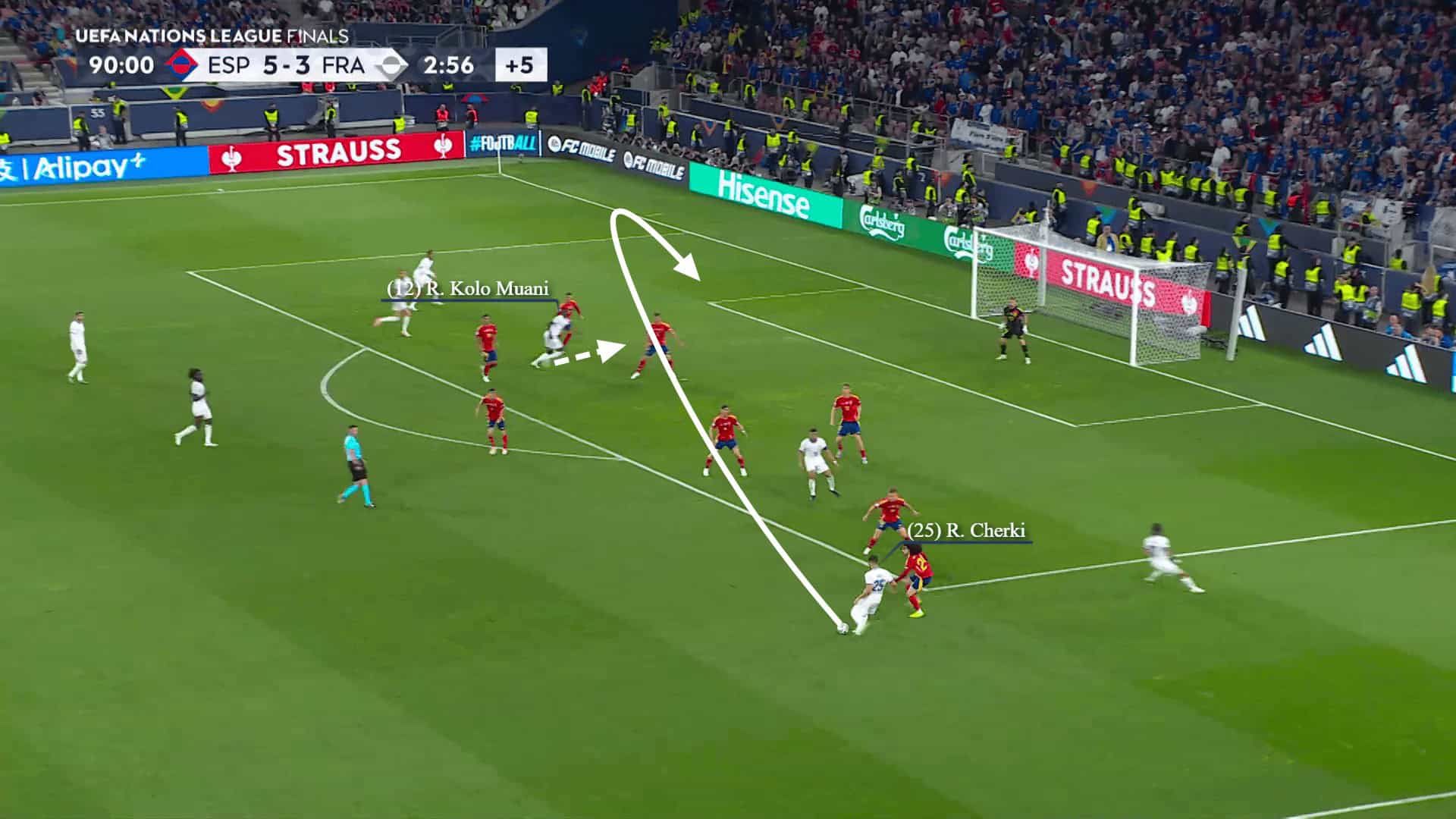 In the Nations League semi-final against Spain, Cherki receives the ball.
He tricks Marc Cucurella into thinking he will go down the line.
Using Malo Gusto’s run, Cherki shifts left and wrong-foots Cucurella.
He then delivers a perfect cross for Randal Kolo Muani to score.
He also produces 4.88 progressive carries per 90 (81st percentile), which shows that Cherki has the dual capacity to advance play through passing and ball progression.
Predominantly left-footed, he is comfortable operating as a wide midfielder or winger, but also successful in central roles.
His positional flexibility enables him to exploit various spatial relationships according to the team’s needs.
When playing as a right winger, Cherki often receives the ball on his front, left foot, enabling rapid initiation of dribbles and immediate ball control.
His habitual use of the sole for ball manipulation and short, diagonal touches allows him to create separation from defenders in tight areas.
It means he can open up the outside channel and uses body feints to draw defenders before accelerating into vacated space.
In terms of ball reception, Cherki excels in both wide and congested central areas.
His ability to receive under pressure, particularly on his front foot, enables him to protect possession and shield the ball from would-be tacklers.
He routinely uses his body, outstretched arm or torso as a physical barrier to prevent interceptions and maintain ball retention in high-traffic zones.
Cherki’s skill on the half-turn augments this capacity to maintain control in tight spaces.
His turning radius is smooth and compact.
This is beneficial because it allows him to swivel away from pressure and open up new passing or dribbling lanes.
Cherki’s creative flair is most apparent in the final third, where he thrives with the tactical freedom to roam between lines and exploit emergent spaces.
He habitually starts in the right half-space but is quick to drift horizontally, seeking to overload whichever side presents a numerical advantage or greater attacking potential.
This roaming behaviour makes him a maverick operator.
In addition, his willingness to both drop into deeper build-up zones and advance into the box reflects a rare comfort across all vertical zones.
Uniquely, Cherki is comfortable passing with both feet, with little bias and makes him unpredictable in possession.
One of Cherki’s defining technical attributes is his passing vision.
He is able to identify and exploits passing lanes others overlook, threading balls or switching play to isolate teammates in space.
His passes are delivered with subtle variations in weight and trajectory, maximising the receiving player’s options and preserving attacking momentum.
In a UEFA Europa League match against FCSB Bucharest, Cherki is tugged, but his close control allows him to keep dribbling.
He draws the defender in and then releases the ball at the right moment.
Cherki is not the most explosive athlete; his ball-carrying is good but not predicated on pace or power.
He compensates with exceptional ball control, spatial awareness, and an ability to manipulate defenders.
His dribbling is characterised less by acceleration and more by deception.
Overall, Rayan Cherki arrives at Man City as a singular creative force.
He is equipped to influence games against a variety of blocks and game models.
His ability to operate between lines, receive under pressure, and execute the right actions in the most demanding contexts marks him out as a potential difference-maker in Guardiola’s plans.
Can Guardiola Play Foden & Cherki Together?
Yes: As Complementary Profiles With Full-Back Support
Structuring Manchester City’s attack around Phil Foden and Rayan Cherki is tactically viable, especially if Pep Guardiola leverages their contrasting approaches and tailors the supporting cast accordingly.
Foden, predominantly on the left, and Marmoush, as a second striker, are both “shoot-first” attackers.
Their natural instinct is to create separation and attack goal themselves, whether through quick one-twos, direct dribbles, or aggressive positioning to receive in shooting zones.
This means City can maintain a persistent direct threat, pin the opposition, and force them to collapse centrally.
Cherki, by contrast, is the “give me the ball” creator.
He prefers to receive in the right half-space, manipulate defenders through feints and technical guile, and slip teammates in with disguised passes.
His role is a high-volume creative fulcrum, and he likes to drift from zones vacated by the overlapping full-back.
This is where a profile like Tino Livramento becomes important: his constant overlapping runs on the right would stretch the opposition horizontally, freeing Cherki to invert and operate with minimal congestion.
With Livramento holding width, Cherki can focus on ball progression and combination play, finding Foden, Marmoush, or, more importantly, Erling Haaland.
The presence of Erling Haaland raises the ceiling of this setup.
Both Foden and Marmoush seek shooting zones, and Cherki specialises in threading passes into advanced runners, which means Haaland benefits from increased service and more chaos in the box.
Cherki’s creativity and vision can supply Haaland with early, disguised through balls or cutbacks, exploiting the spaces created by the defenders’ need to track multiple shoot-first threats.
This mix unleashes Foden’s ability to enter the box via intelligent movement.
Marmoush’s wings are threatened by Haaland’s elite finishing, while Cherki dictates the tempo and final pass.
The contrasting profiles create a layered attack: Foden, Marmoush, and Haaland threaten with directness and shooting, while Cherki conducts, slows the play when needed, and engineers high-quality chances.
Phil Foden Vs Rayan Cherki Stats
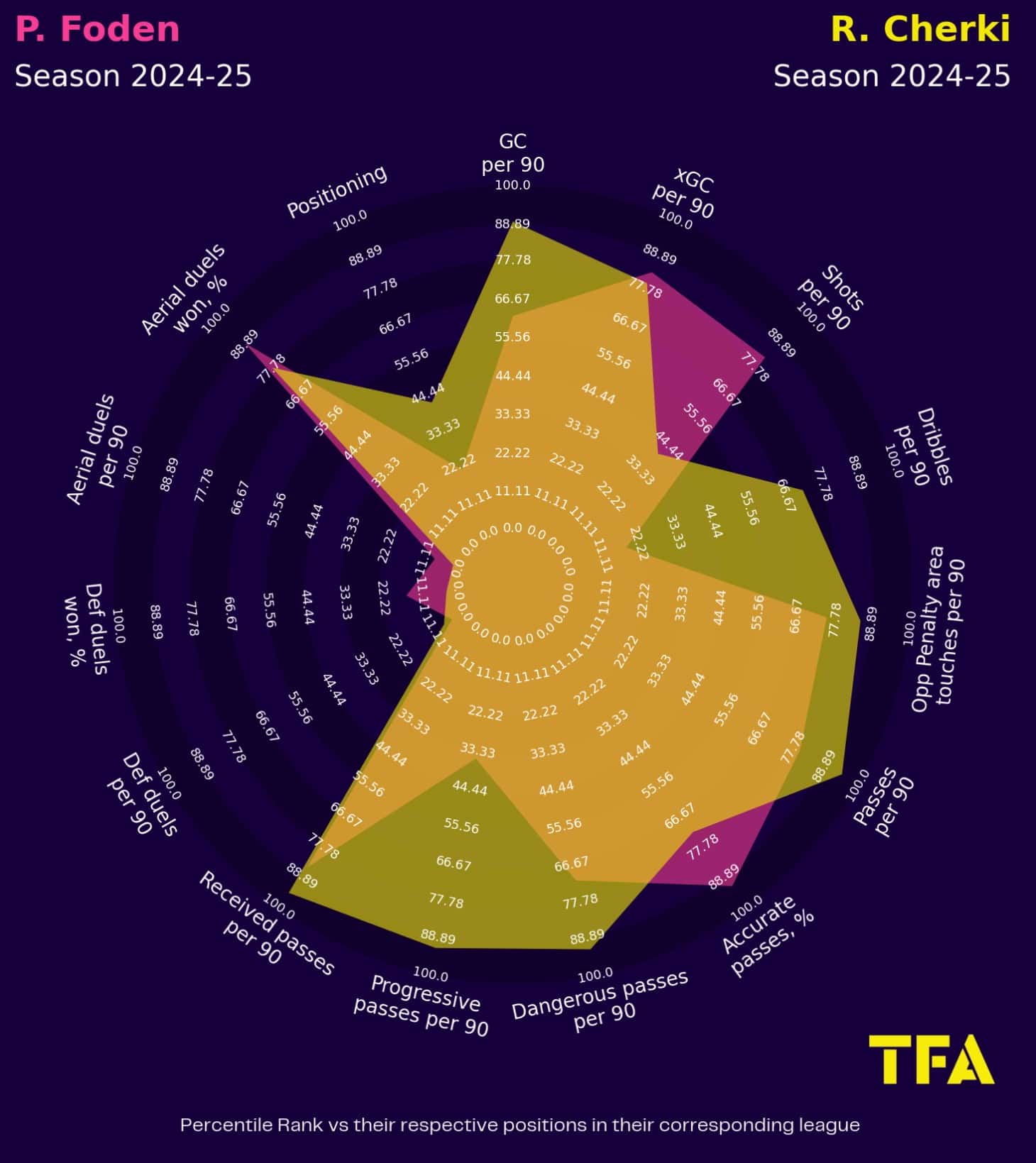
All the data used are percentile values calculated for each player within his league and within his position.
The 50th percentile is the league median of the selected player’s position.
Cherki excels in creativity, ball progression, and dribbling, ranking higher in progressive and dangerous passes.
Phil Foden, meanwhile, offers greater goal threat, shooting, and defensive contribution.
Cherki is the primary creator, while Foden is more direct, complementing their skill sets.
No: Structural Imbalance & Exposure
However, having multiple shoot-first players alongside a dominant creator risks attacking congestion and off-ball imbalance.
Foden, Marmoush, and Haaland may crowd central shooting zones, particularly if Cherki drifts inside and reduces space.
City risk narrowing their attack without disciplined wide occupation, especially if the right full-back does not advance.
This plays into compact blocks.
Defensively, neither Foden, Cherki, nor Marmoush are not known to be the most intelligent off the ball (Marmoush to a much lesser extent).
This could expose City in transition, especially with full-backs stretched high.
Guardiola must therefore balance technical freedom and creative layering with the positional blueprint and pressing structure that can bring collective stability.
Conclusion
The arrivals of Rayan Cherki and Phil Foden’s up-in-the-air roles pose the question: Can two elite players who like to take up similar positions play together, or is one destined to supersede the other?
While their differing creative profiles offer Guardiola tactical variety, their coexistence will depend on smart structural balance and clear role definition.
If Guardiola can harmonise their strengths, both could elevate City’s attack; if not, Cherki’s presence may gradually edge Foden from the spotlight.
