
As the Olympic 2024 soccer tournament finishes up, all eyes are on the thrilling final matchup between France and Spain, as they both fight for a Gold medal.
Both teams, renowned for their rich footballing history and tactical prowess, are set to clash in what promises to be a captivating encounter.
France, with its blend of unknown youthful exuberance and seasoned experience, faces a formidable Spanish side coached by Santi Denia, known for his technical abilities and strategic brilliance.
Join us as we delve into our comprehensive Olympics scout report and in-depth tactical analysis of the key tactics and potential game-changers in this analysis preview of the highly anticipated showdown for Olympic glory.
2024 Men’s Olympic Final France Vs Spain Tactical Analysis
For each country, we will examine how each team likes to build up in possession, how they prefer to sit without possession.
What each team’s weaknesses and strengths are.
One key player who has helped them reach this stage.
France Statistics
France has had a challenging journey to reach this final, facing Argentina in the first knockout stage and a surprisingly strong Egypt team to reach the Olympics 2024 final.
France utilizes a 4-3-3 diamond formation, or a 4-3-1-2, with two strikers and a number 10 right behind them.
Below are some key statistics for the France U23 campaign this Olympics.
France U23 has shown exceptional attacking prowess in the 2024 Paris Olympics. They lead in shots with 96 attempts and in crosses with 103. They dominate in 1v1 dribbling, with 200 successful dribbles and lead in touches in the penalty area with 132. They rank 5th in fouls suffered (53) and top the list in corners taken (45).
Defensively, France U23 ranks 4th in shots against (53) and 5th in shots blocked (16). They are 2nd in both defensive duels (399) and interceptions (210). They rank 3rd in aerial duels (150) and 2nd in ball losses (534). They are 3rd in challenge intensity (5.5) and PPDA (9.08). They lead in fouls committed (82) and are 4th in yellow cards (11) and 5th in red cards (1).
In construction, France U23 ranks 2nd in total passes (2,534) and key passes (20) and passes to the final third (324). They lead in smart passes (16) and are 2nd in progressive passes (344). They rank 1st in progressive runs (158) and are tied for 3rd in deep completions (45). Their high passing rate and effective build-up play underline their strong possession and offensive capabilities.
France Strengths
It’s no surprise that the strength of this French team lies in their attacking talent.
Scoring 11 goals in 5 matches is extraordinary, tying them with Spain for the most goals scored, whom they will face in the final match.
France boasts strong attacking talents in Alexandre Lacazette, Jean Mateta, Michael Olise, Rayan Cherki, and Arnaud Kalimuendo.
Some of these players will be future starters in the main French national team.
This setup accommodates the talents of strikers Lacazette and Mateta, with Olise positioned just behind them.
Thierry Henry opted for this formation to leverage France’s large attacking pool, ensuring both strikers are supported while giving Olise the space to create and link up play.
This formation maximizes the strengths of their key attacking players, creating a dynamic and potent offensive unit.

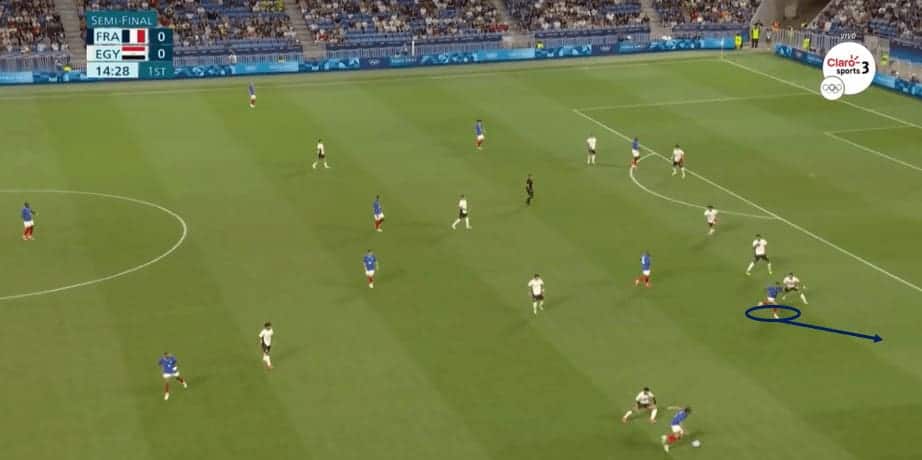
Above is an excellent example of how talented their attacking players are.
There are 5 French players marked in blue in the Egyptian half against 8 Egyptian players.
The main attacking trio of Lacazette, Mateta, and Olise is all France needs to break down the opponent’s defence.
In the image above, France overcame this unfavourable scenario to tie the game 1-1 in the 83rd minute before winning in extra time.
When considering the best teams in football history, we often recall their attacking talent.
Think of the glory days of Barcelona, Real Madrid, Bayern Munich—our minds automatically recall their attacking prowess.
This French team will be remembered in Olympic history as an attacking powerhouse.
France Weaknesses
This French team doesn’t have any notable weaknesses, creating 10.85 xG and conceding only 3.3 xG.
They have the second-lowest xG against and the second-highest xG for in the tournament.
They’ve conceded only one goal throughout the tournament, which came in the semi-final against Egypt.
However, what could hold France back is the pressure to perform.
Despite having a solid squad from front to back, the pressure to play their best football can affect their confidence.
Psychological weaknesses are as crucial as on-field issues; this French team is strong on paper but can be held back by mental barriers.
France Defensive Phase
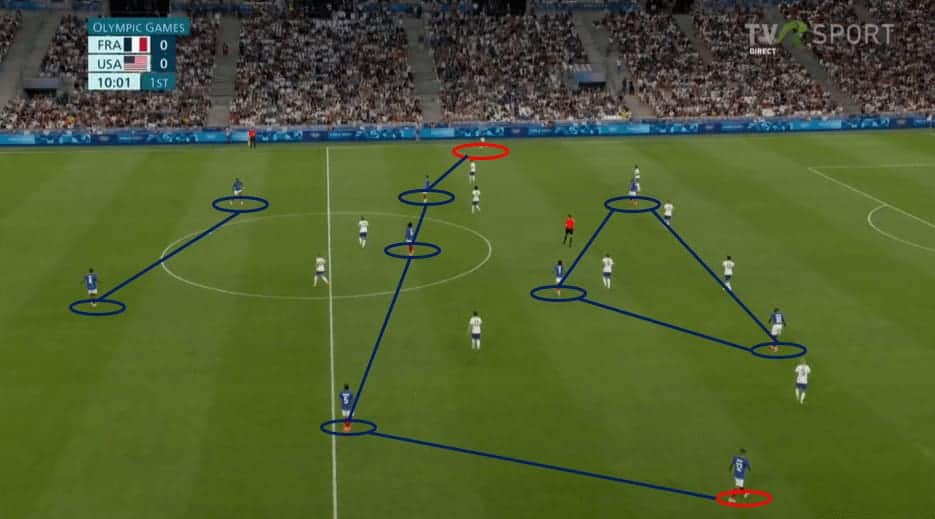
In their build-up, France employs a 2-5-3 or 2-5-1-2 formation, using a diamond shape in attack.
Examples from their match against the USA show the wing-backs (marked in red) playing very wide to stretch the field while the three central midfielders drop back to receive the ball from the centre-backs or wing-backs.
The formation varies slightly depending on Olise’s positioning behind the strike partnership of Lacazette and Mateta, either forming a front three or acting as a number 10 behind the strikers.
This setup leverages high and wide wing-backs with attacking intent and a central playmaker supporting the dual strikers.
France Attacking Phase
France like to play with freedom when they reach the attacking phase.
Thierry Henry, once a world-class attacker, encourages his players to play with freedom to maximize their abilities.
One instruction that is certain in this phase is for Olise to move to the right and play as a right winger, where he naturally thrives.
Circled in black, you can see him moving to the right to receive the ball and then further work his magic.
France Out Of Possession
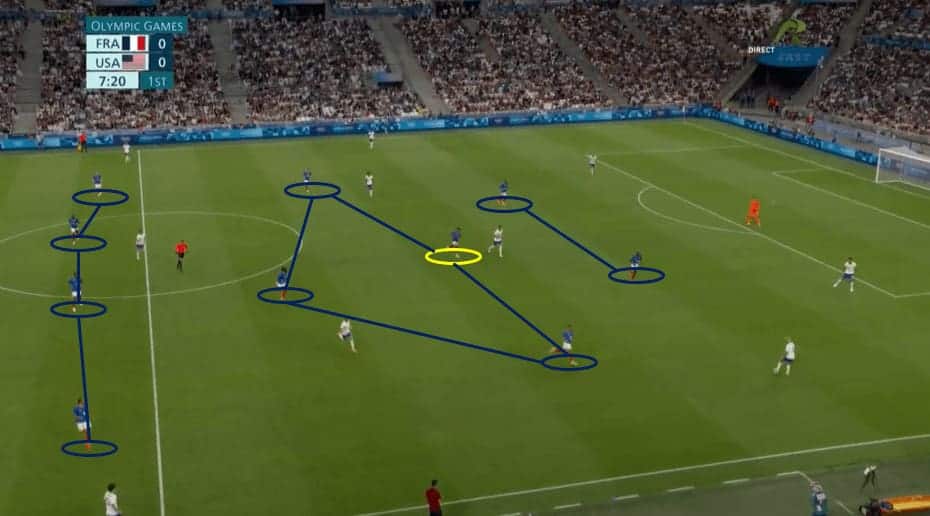
Out of possession, France simplifies their approach with a 4-4-2 mid-block. Olise (marked in yellow) drops from his attacking role into central midfield, forming a second defensive line while maintaining the dual striker partnership.
This structure aims to create a solid defensive block, making it challenging for the opposition to break through.
The midfielders and strikers work in tandem to apply pressure and intercept passes, effectively disrupting the opponent’s build-up play.
France Key Player – Michael Olise
Michael Olise has emerged as one of the world’s top young talents over the past season, earning a move to Bayern Munich for the 2024/2025 season.
An electric winger known for his exceptional ball-carrying abilities, stop-motion dribbling, and the intelligence and technical skill to play as a central midfielder.
In the Olympics, he’s been playing as a number 10, scoring two goals and providing four assists.
This performance ranks him tied for fourth in goals, first in assists, and first in combined goals and assists with a total of six.
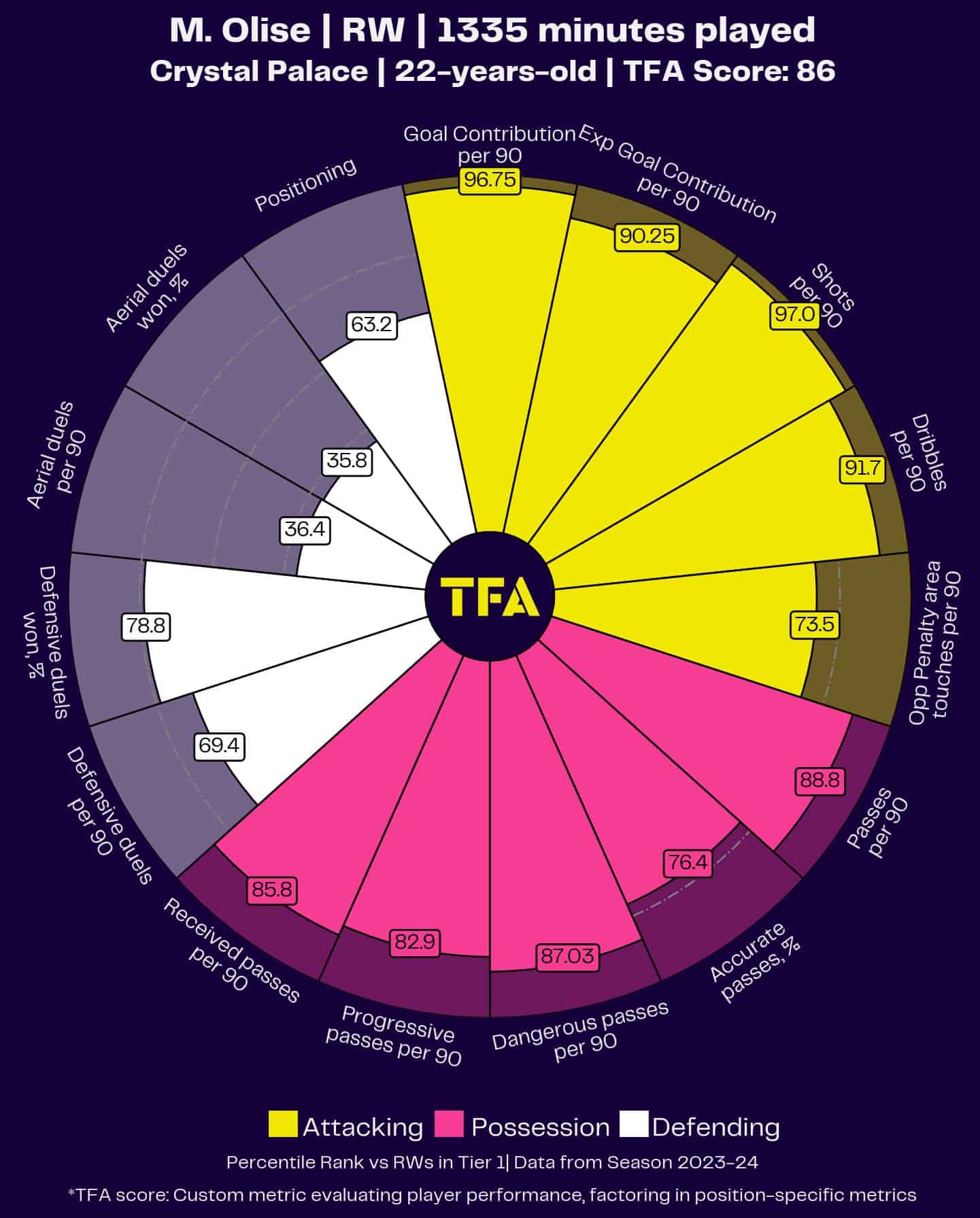
Overall, Olise’s radar chart reflects a well-rounded player who contributes significantly to the game’s offensive and defensive aspects, making him capable of playing in central midfield.
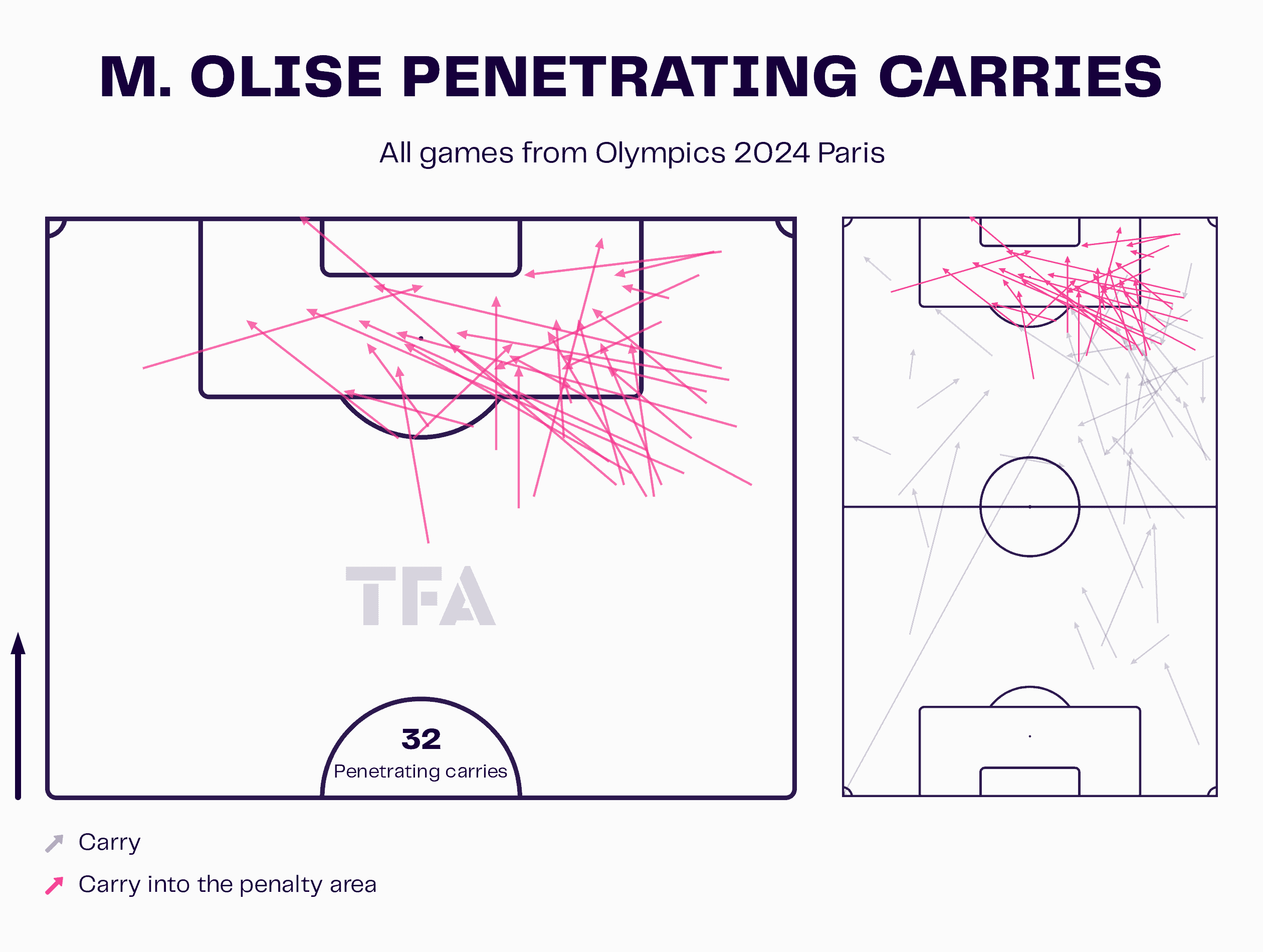
Olise’s brilliance as a ball carrier is evident through his numerous penetrating carries into dangerous zones in the final third and the opponent’s penalty box.
He plays mostly from the right side of the pitch and tends to drift to his natural right-wing position.
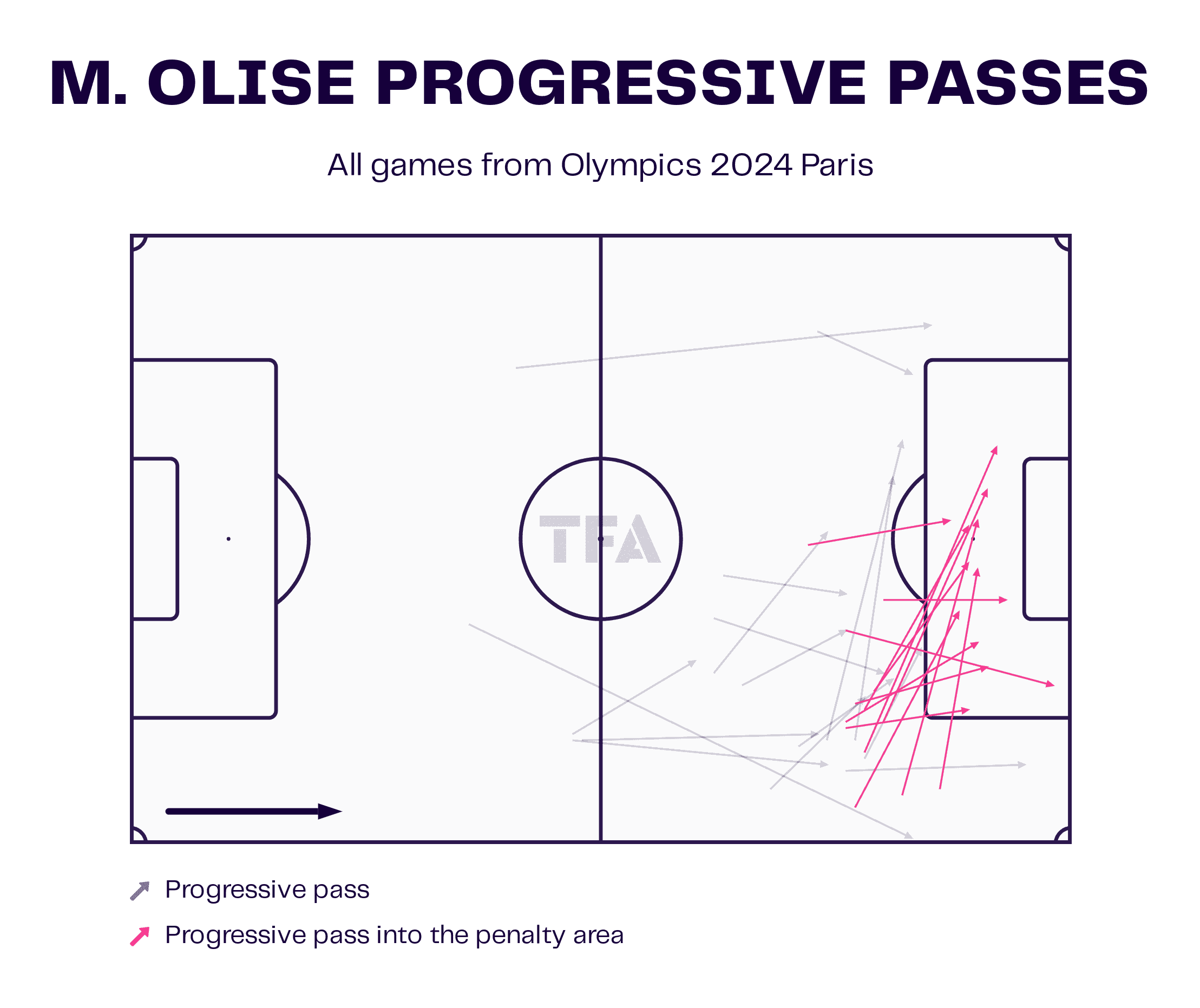
His progressive pass map highlights his proficiency with the ball in these critical areas.
Olise is able to find pockets of space where he can turn and play his strikers, which is part of the reason he is so trusted to play this number 10 role over other French Talent like Ryan Cherki.
His heatmap reveals a commendable defensive work rate, showcasing his ability to track back when necessary.
It also illustrates his dominance across the attacking width, particularly on the right side, reflecting his natural position as a right-winger.
This versatility allows him to execute dangerous plays from anywhere in the front three.

Spain Statistics
Spain has also faced a challenging journey to reach this final, facing group leaders Japan in the first knockout stage and group leaders Morocco to reach the Olympics 2024 final.
Spain utilizes a 4-2-3-1 formation on paper and during their build-up, but also transition between a 4-3-3 as well.
Spain U23 has demonstrated strong attacking capabilities in the 2024 Paris Olympics.
They rank 4th in shots with 68 attempts and 2nd in crosses with 94.
While they don’t rank in the top five for 1v1 and dribbling, they are 5th in touches in the penalty area with 88. They rank 3rd in fouls suffered (64) and 3rd in corners taken (26).
Defensively, Spain U23 ranks 5th in shots against (52).
They are 4th in defensive duels (317) but do not rank in the top five for shots blocked interceptions, or aerial duels.
They rank 4th in ball losses (418). Spain U23 is 2nd in challenge intensity (5.5) and PPDA (8.58).
They are 2nd in fouls committed (76) and 2nd in yellow cards (13), indicating a need for better discipline.
In construction, Spain U23 leads in total passes (2,780) and key passes (20).
They are 3rd in long passes (179) and lead in passes to the final third (335).
Spain U23 ranks 1st in progressive passes (386) but does not rank in the top five for smart passes.
They are 5th in progressive runs (38) and 5th in deep completions (38).
Their high passing rate and effective build-up play emphasize their strong possession-based play and creative passing abilities.
Spain Strengths
Spanish teams have always excelled in creating technically gifted and intelligent players with the ball at their feet.
This tournament showcases yet another generation of Spanish talent destined for the main national team.
Spain’s strength lies in holding possession and tiring out opponents, essentially “defending with the ball.”
A major advantage for the Spaniards is that most of their young Olympic players have already received significant senior minutes in top-flight football.
Notable players include Juan Miranda, Pau Cubarsi, Eric Garcia, Pablo Barrios, Sergio Gomez, and Fermin Lopez, all with substantial top-flight experience.
Spain Weaknesses
A key weakness in this Spanish side is their defensive concentration at certain times.
The Spanish team has conceded a goal in every match during this Olympics campaign except for their quarter-final match against Japan, where VAR disallowed a goal.
The final group stage match against Egypt highlights this issue.
They conceded two goals and lost the match 2-1.
The reason behind the two goals conceded was due to a Spanish player’s error in passing back, giving the Egyptian striker a free shot on goal.
The second goal resulted from ball-watching by the Spanish defence, which left open space that the Egyptians exploited and executed.
These examples of lapses in concentration and ball-watching by the Spanish defence indicate a lack of defensive stability, as conceding in almost every match of the campaign is not a good sign.
Spain Defensive Phase
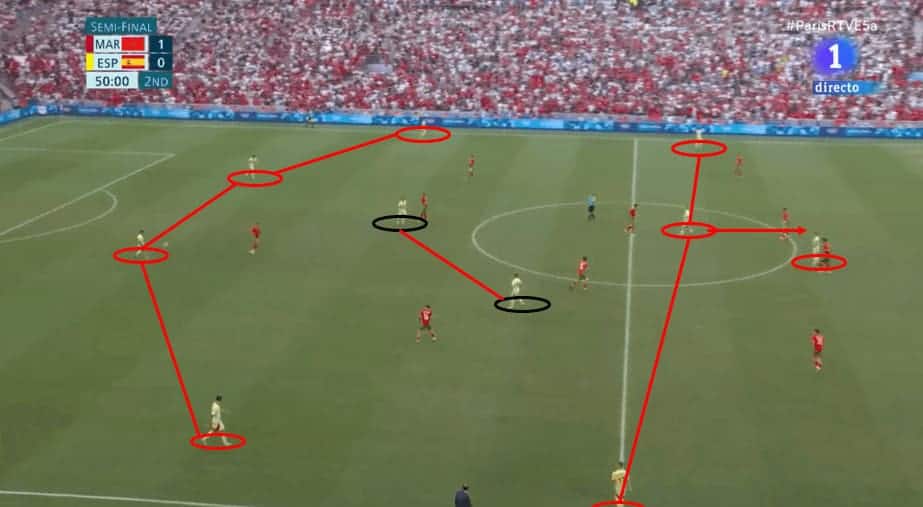
Spain likes to build up with their nominal 4-2-3-1 formation, where the two pivot midfielders decide who drops to receive the ball from the centre-backs and full-backs.
Two pivots are marked in black.
However, it’s not just a 4-2-3-1. Spain often plays with Fermin Lopez as a number 10 or second striker, who either drops to receive the ball from midfield or moves up to form a dual-striker partnership with Abel Ruiz.
When this happens, Spain instructs their wingers to push higher, creating a 4-2-4 formation.
As the wingers move forward and Lopez shifts into the striker position, the full-backs advance into midfield, transitioning into a 2-4-4 formation.
Spain Attacking Phase
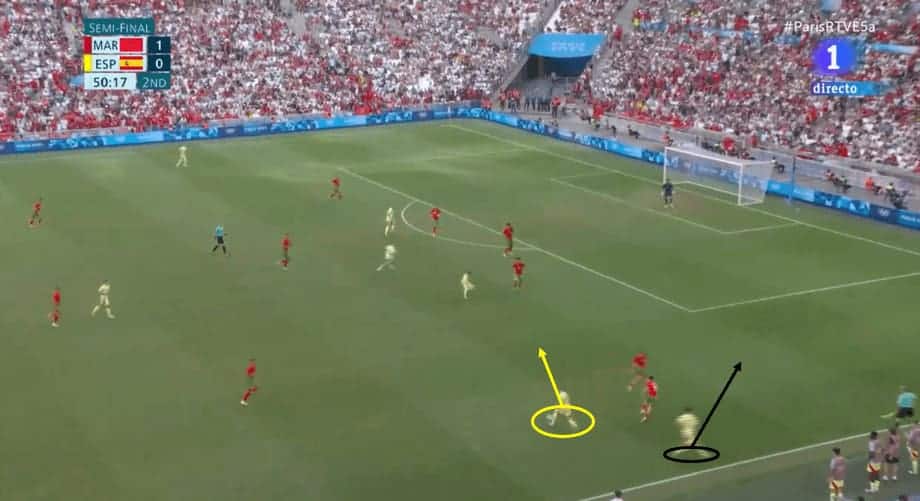
Once Spain progresses to the attacking phases, and their full-backs are higher up the pitch, they employ a tactic where their wingers (marked in yellow) move into central zones and cut inside.
Meanwhile, the full-backs (marked in black) are instructed to overlap.
This basic yet effective tactic can create chaos in the opponent’s defensive structure, disrupting their organization and opening up spaces for attacking opportunities.
Spain Out Of Possession
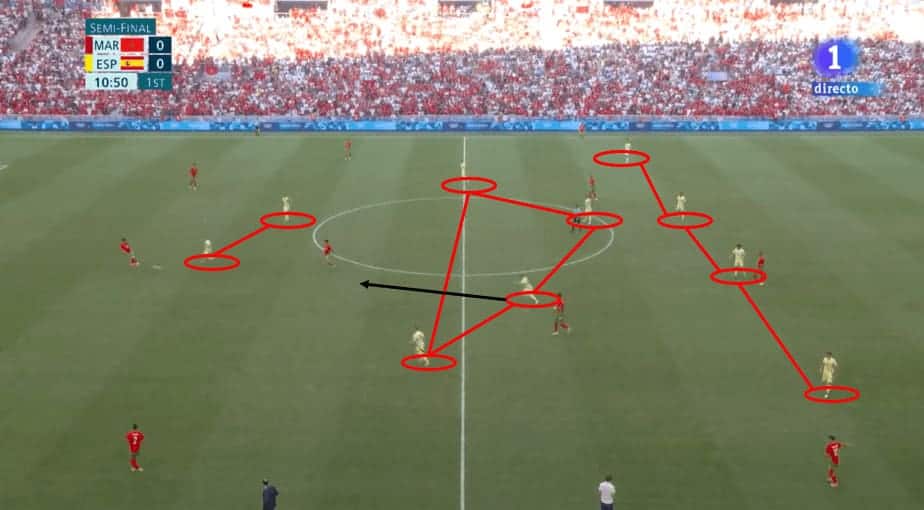
Spain prefers to play in a more compact 4-4-2 formation.
They aim for their second line of defence to be centrally packed rather than covering the width simultaneously.
The midfield four in the second line are instructed to play aggressively and adopt a man-marking role.
In the image below, you can see a Spanish player pushing forward to apply quick pressure on the Moroccan player, attempting to regain possession swiftly—a pressing second-man line of defence.
Spain Key Player – Fermín López
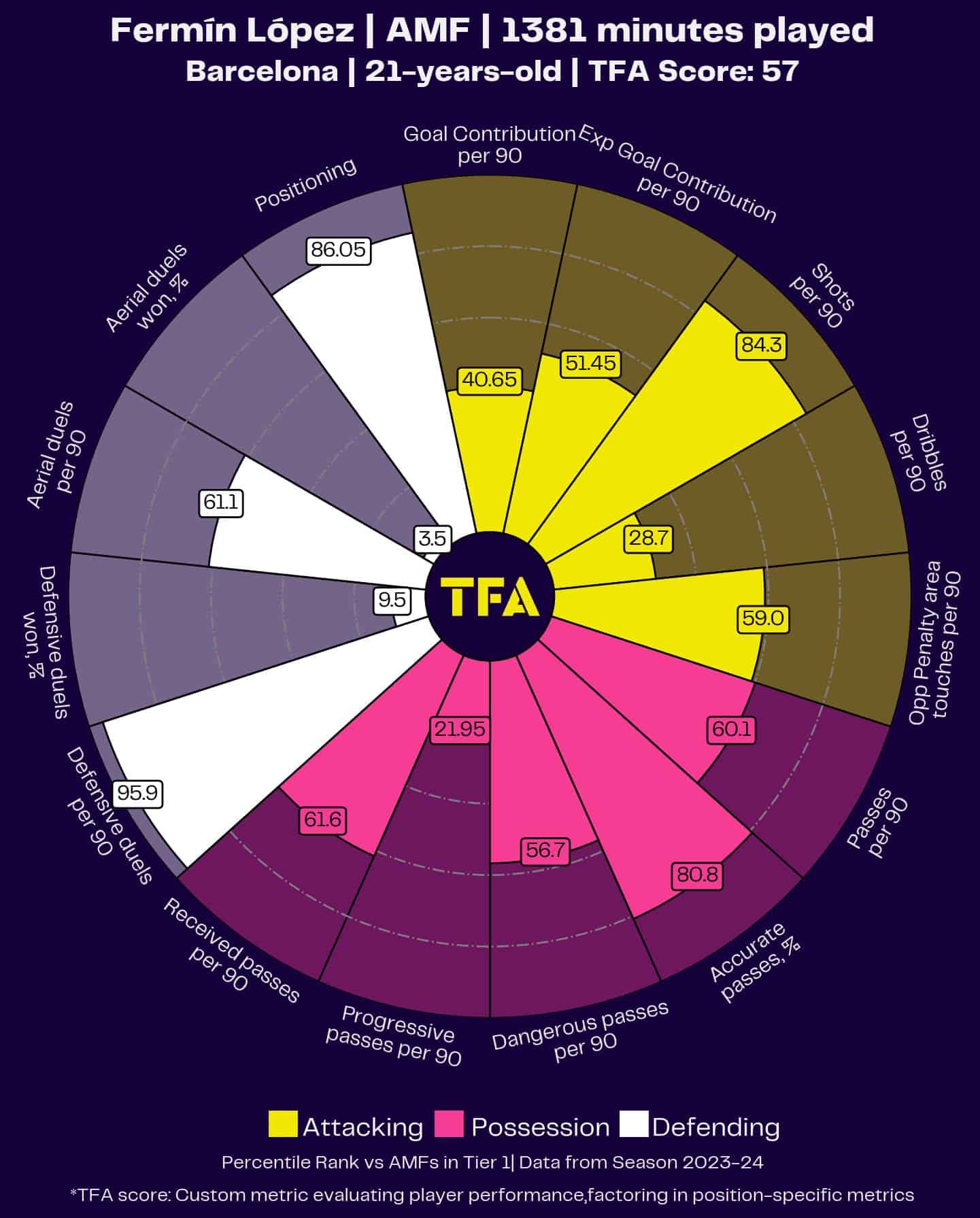
Fermín López has emerged as a key player for Barcelona, excelling as an attacking midfielder.
At 21 years old, López has played 1,381 minutes this season, ranking 2nd in goals with four and 3rd overall in combined goals and assists with a total of 5 during this Olympic campaign.
Overall, Fermín López is a versatile and well-rounded midfielder, contributing significantly to both offence and defence, making him a promising talent for Barcelona and Spain.
Lopez isn’t confined to a single position; he can play as a central midfielder, striker, or second striker.
However, he thrives most as a second striker, positioned between a central midfielder and a striker, which has been his role during this Olympics campaign.
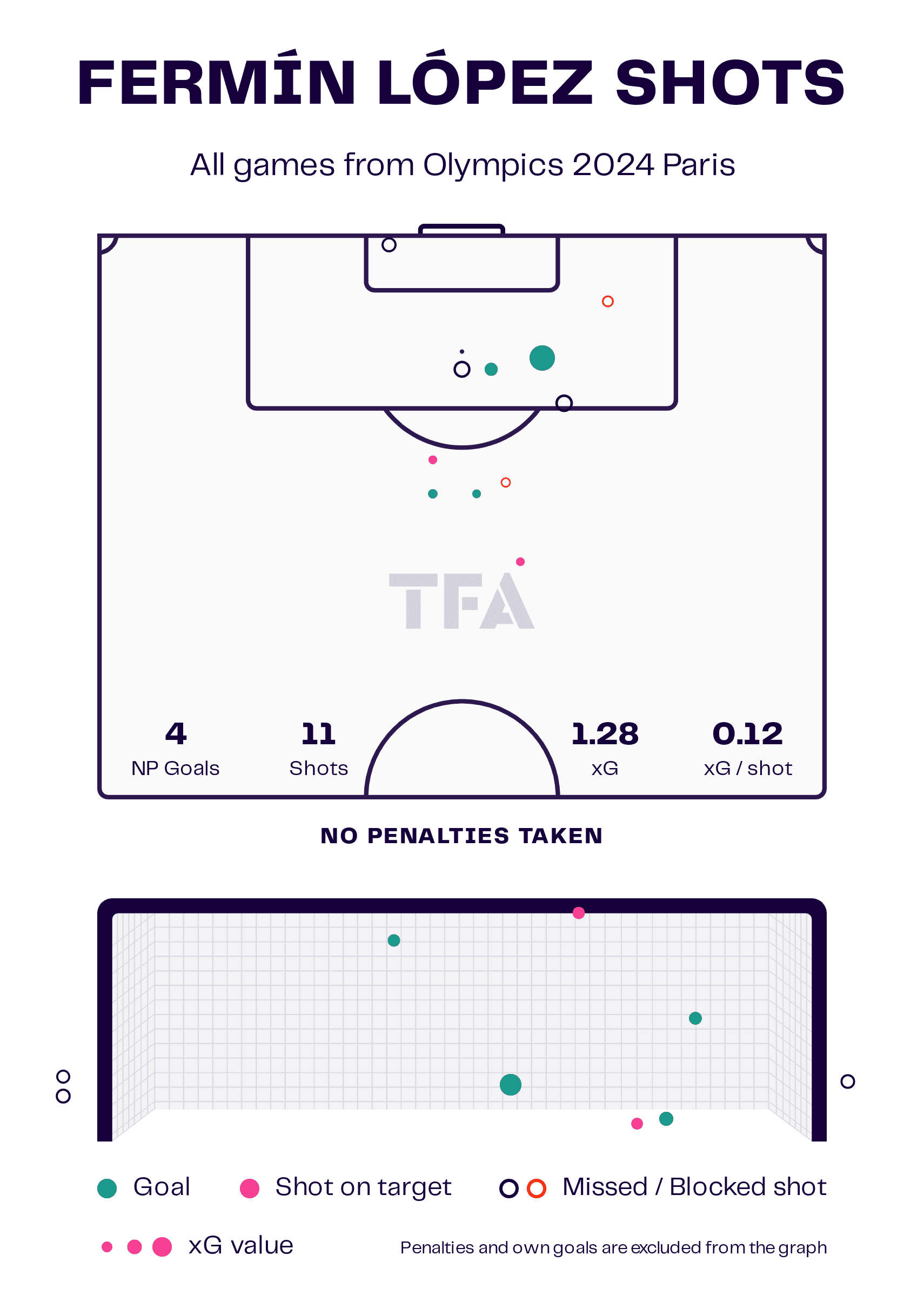
This makes the shot map below particularly relevant, as he’s been placed in a prime position to score goals.
Lopez is overachieving his xG, with four non-penalty goals from an xG of 1.28.
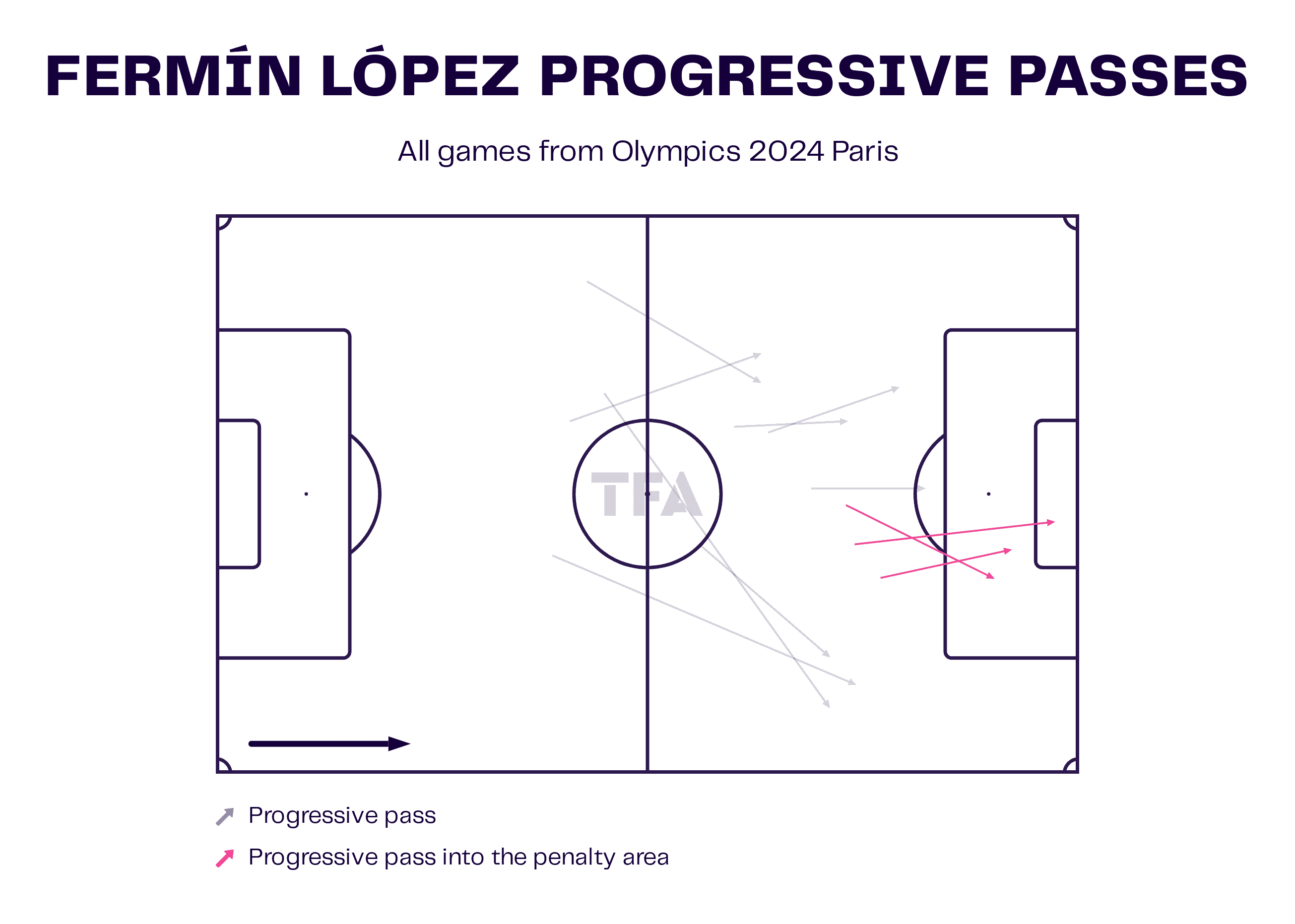
As expected, his progressive pass map shows that his passes come from central areas of the pitch.
Interestingly, you can find progressive passes originating from the centre circle, some at the top of the penalty box and others in between those areas.
No matter where the ball is at his feet, he can find pockets of space to progress his team forward.
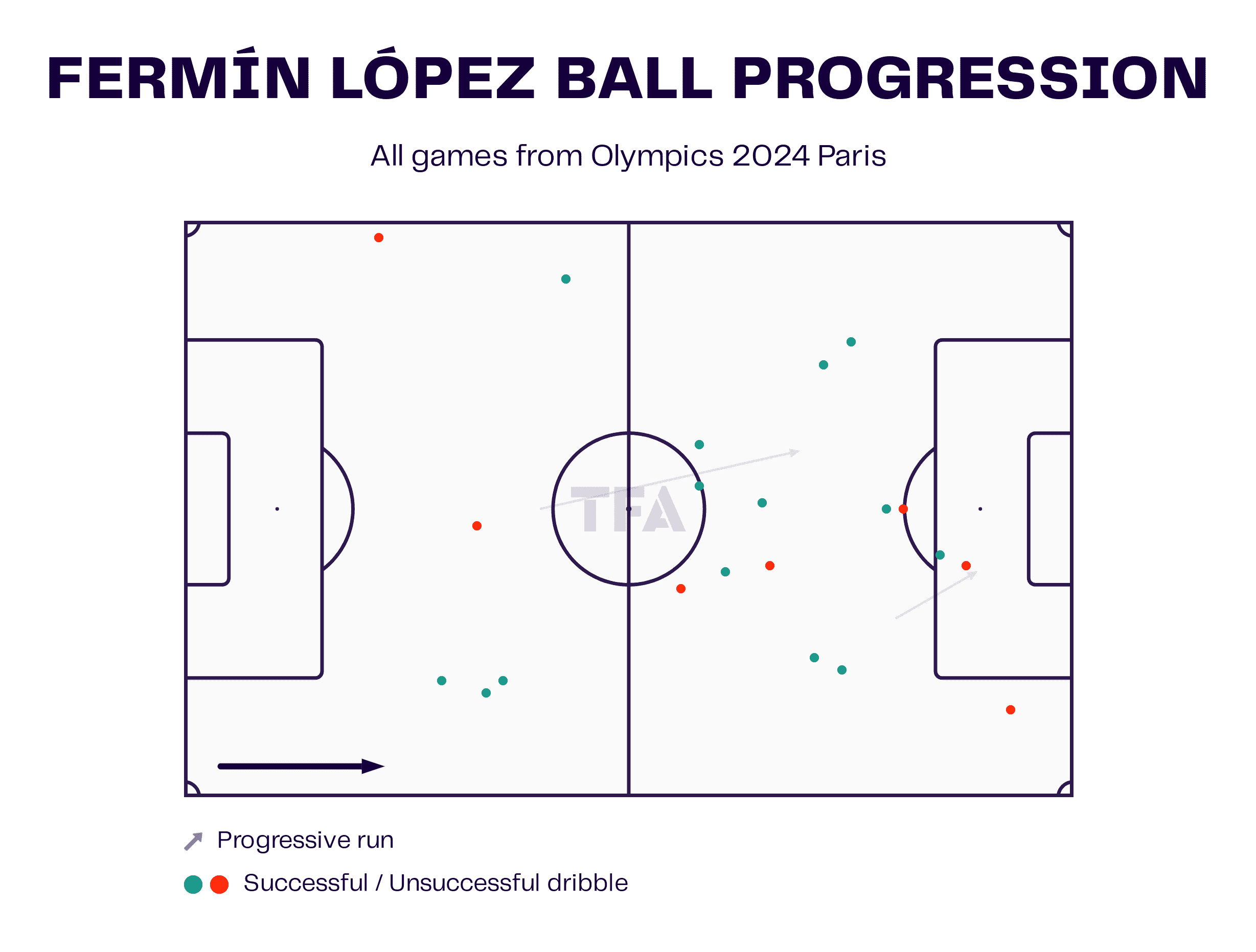
Now, looking at this ball progression map, we can see how Lopez advances play without passing.
We can analyze how he progresses his team with his dribbling abilities. It’s interesting to note his attempts to take on dribbles in wide areas of the pitch and in defensive zones, where he occasionally drops back to aid in the team’s build-up play.
His versatility in advancing the ball, both centrally and from wider positions, demonstrates his crucial role in driving the team’s offence.
What To Expect For France Vs Spain Olympic Final
France is a team extremely talented in attacking, facing an opponent with lapses in defensive concentration.
France has conceded only 1 goal and scored 11 throughout the tournament, while Spain has also scored 11 but conceded 5.
Spain will continue to dominate possession, as they have in every match, boasting the highest possession per match in the competition, aiming to break France down.
Overall, Spain’s youngsters have the most playing time, making them strong favourites.
However, France’s senior attackers can challenge any Olympic team.
This will be a high-intensity, attacking match as France seeks revenge for their Euro 2024 knockout and aims for Olympic Gold on Friday.
