Total Football Analysis
Once.Sport
  • Football Analysis
    • Data Analysis
    • Formations
      • 2-2-4 Formation
      • 2-3-5 Formation
      • 3-1-4-2 Formation
      • 3-2-2-3 Formation
      • 3-2-4-1 Formation
      • 3-1-6 Formation
      • 3-3-4 Formation
      • 3-4-1-2 Formation
      • 3-4-2-1 Formation
      • 3-4-3 Formation
      • 3-5-1-1 Formation
      • 3-5-2 Formation
      • 4-1-4-1 Formation
      • 4-2-2-2 Formation
      • 4-2-3-1 Formation
      • 4-2-4 Formation
      • 4-3-1-2 Formation
      • 4-3-3 Formation
      • 4-4-2 Formation
      • 4-5-1 Formation
      • 5-3-2 Formation
      • 5-4-1 Formation
      • 6-3-1 Formation
    • Head Coach Analysis
    • Match Analysis
    • Player Analysis
    • Recruitment Analysis
    • Set Piece Analysis
    • Tactical Theory
    • Tactical Preview
    • Team Analysis
    • Training Analysis
    • Tactical Analysis
    • Scouting Report
  • Competition
    • ALL Competitions
    • English Premier League
    • Champions League
    • La Liga
    • Bundesliga
    • Serie A
    • Ligue 1
    • Eredivisie
    • EFL Championship
    • FIFA World Cup 2022
    • WEURO 2022
    • Women’s Super League
    • NWSL
    • Belgian First Division A
    • A-League
    • Liga Profesional de Argentina
    • Austrian Bundesliga
    • Campeonato Brasileiro Série A
    • DFB Pokal
    • 1. HNL
    • Danish Superliga
    • EFL League One
    • EFL League Two
    • FA Cup
    • EFL Cup
    • Indian Super League
    • K-League
    • J1 League
    • Liga MX
    • Copa América 2021
    • Copa del Rey
    • MLS
    • Eliteserien
    • Euro 2020
    • Primeira Liga
    • Scottish Premiership
    • Allsvenskan
    • Europa League
    • UEFA Nations League
    • Liga AUF Uruguaya
  • Coaches
    • All Coaches
    • Alfred Schreuder
    • Ange Postecoglou
    • Antonio Conte
    • Arne Slot
    • Bo Svensson
    • Brendan Rodgers
    • Bruno Lage
    • Carlo Ancelotti
    • Christophe Galtier
    • Claude Puel
    • Claudio Ranieri
    • David Moyes
    • Dean Smith
    • Diego Simeone
    • Domenico Tedesco
    • Frank Lampard
    • Eddie Howe
    • Edin Terzić
    • Emma Hayes
    • Erik ten Hag
    • Ernesto Valverde
    • Gennaro Gattuso
    • Gerardo Seoane
    • Gian Piero Gasperini
    • Giovanni van Bronckhorst
    • Graham Potter
    • Igor Tudor
    • Imanol Alguacil
    • Jesse Marsch
    • Jonas Eidevall
    • Jorge Sampaoli
    • José Bordalás
    • José Mourinho
    • Julen Lopetegui
    • Julian Nagelsmann
    • Julien Stéphan
    • Jürgen Klopp
    • Luciano Spalletti
    • Lucien Favre
    • Manuel Pellegrini
    • Marcelo Bielsa
    • Marco Rose
    • Marco Silva
    • Massimiliano Allegri
    • Mauricio Pochettino
    • Maurizio Sarri
    • Mikel Arteta
    • Niko Kovač
    • Nuno Espírito Santo
    • Oliver Glasner
    • Patrick Vieira
    • Paulo Fonseca
    • Pep Guardiola
    • Peter Bosz
    • Rafa Benítez
    • Ralf Rangnick
    • Ralph Hasenhüttl
    • Roger Schmidt
    • Roy Hodgson
    • Sean Dyche
    • Sérgio Conceição
    • Simone Inzaghi
    • Sonia Bompastor
    • Stefano Pioli
    • Steffen Baumgart
    • Steven Gerrard
    • Thiago Motta
    • Thomas Frank
    • Thomas Tuchel
    • Unai Emery
    • Vincenzo Italiano
    • Xavi
  • Teams
    • ALL Teams
    • AC Milan
    • Ajax Amsterdam
    • Arsenal
    • AS Monaco FC
    • Atalanta
    • Atlético Madrid
    • FC Barcelona
    • FC Bayern Munich
    • Borussia Dortmund
    • Celtic FC
    • Chelsea FC
    • Everton F.C.
    • Inter Milan
    • Juventus F.C.
    • Leeds United F.C.
    • Liverpool FC
    • Manchester City
    • Manchester United FC
    • Paris Saint-Germain
    • Rangers FC
    • RB Leipzig
    • Real Madrid CF
    • Tottenham Hotspur
    • West Ham United
  • Players
    • ALL Players
    • Alisson Becker
    • Bukayo Saka
    • Erling Haaland
    • Harry Kane
    • Jack Grealish
    • John Stones
    • Julián Alvarez
    • Kalvin Phillips
    • Kevin De Bruyne
    • Kyle Walker
    • Kylian Mbappé
    • Lamine Yamal
    • Lionel Messi
    • Luis Díaz
    • Mohamed Salah
    • Phil Foden
    • Virgil Van Dijk
  • Contact
  • Write For TFA
No Result
View All Result
No Result
View All Result
Total Football Analysis
No Result
View All Result
Home Analysis Formations 4-2-3-1 Formation

Daniel Farke Tactics At Leeds United 2024/2025 – Game Model Explained

Alexis Guanchez by Alexis Guanchez
October 29, 2024
in 4-2-3-1 Formation, Analysis, Brenden Aaronson, Daniel Farke, EFL Championship, Head Coach Analysis, Jayden Bogle, Joe Rodon, Junior Firpo, Leeds United F.C., Pascal Struijk, Tactical Analysis, Wilfried Gnonto
0
Daniel Farke at Leeds United 24/25 Tactical Analysis

Who Is Daniel Farke?

After more than a year at Leeds United, Daniel Farke has already built a recognisable team in the EFL Championship.

He knew the tournament well after five years at Norwich City, where he was promoted to the Premier League and relegated twice.

Ten years ago, he worked alongside Thomas Tuchel at Borussia Dortmund Reserves, where some elements of Daniel Farke coaching style were derived.

After leaving Norwich three years ago, he passed through Krasnodar and Borussia Mönchengladbach, but none of these were as recognisable teams as his Norwich side in England.

His philosophy seems solid, and his key players have shown an exciting potential to compete for promotion this season.

In this head coach analysis & tactical football analysis, we will provide a complete view of Daniel Farke tactics this season at Leeds United.

Daniel Farke Style Of Play 

“It’s about being dominant. I want our players to be protagonists on the pitch. I like to have the ball—if I could choose, I would have the ball for 90 minutes.” Farke told The Independent in 2017.

With this, we can create a picture of Daniel Farke’s style of play.

Daniel Farke’s playing model is prominently positional football — maybe the most representative positional proposal in the Championship right now.

Daniel Farke Tactics In Possession

Under Daniel Farke’s tactics, Leeds United are daring in possession.

They always want the ball and as much time as possible.

Leeds have the second-highest percentage of possession in the Championship—let’s discuss their structure and how they do this.

In general, their shape is a 4-2-3-1 that resembles Daniel Farke’s formation at Norwich.

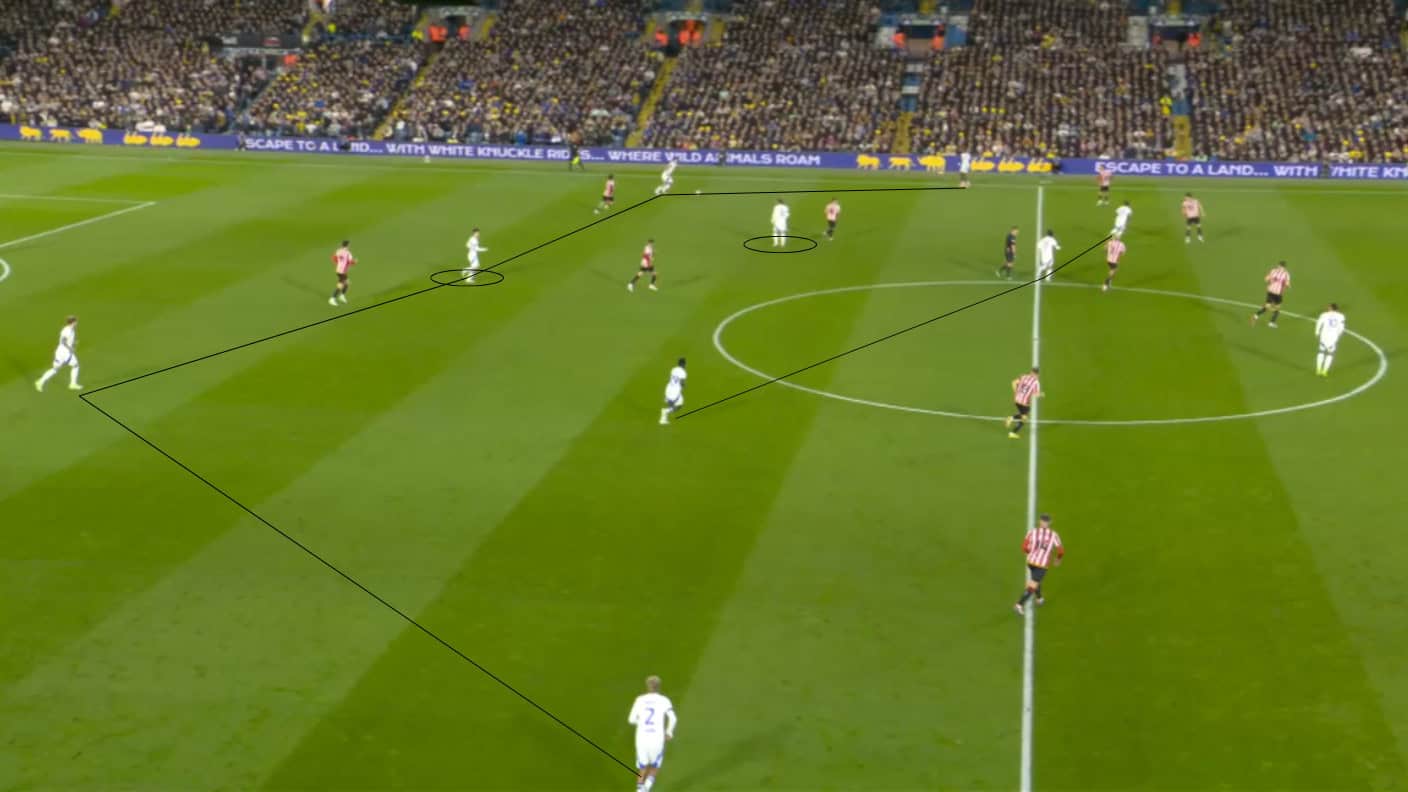
Figure 1
Figure 1 shows Leeds’ usual shape in 4-2-3-1 in possession.

Where The Play Starts In Possession: Build-Up Details

The most crucial phase with the ball for Daniel Farke’s Leeds is the beginning of the possession.

In that sense, their centre-backs are the team’s soul: Pascal Struijk and Joe Rodon, two old acquaintances from the Premier League.

Centre-backs position themselves high and wide in the build-up, looking for progress by exploiting their clean passing range.

They feel great in this style of play, defending as little as possible, being left-footed and right-footed in natural positions, and playing wide to get a better view of the pitch.

In these first matches of the Championship, they seem like the perfect couple.

Pascal Struijk & Joe Rodon Progressive Passes Map
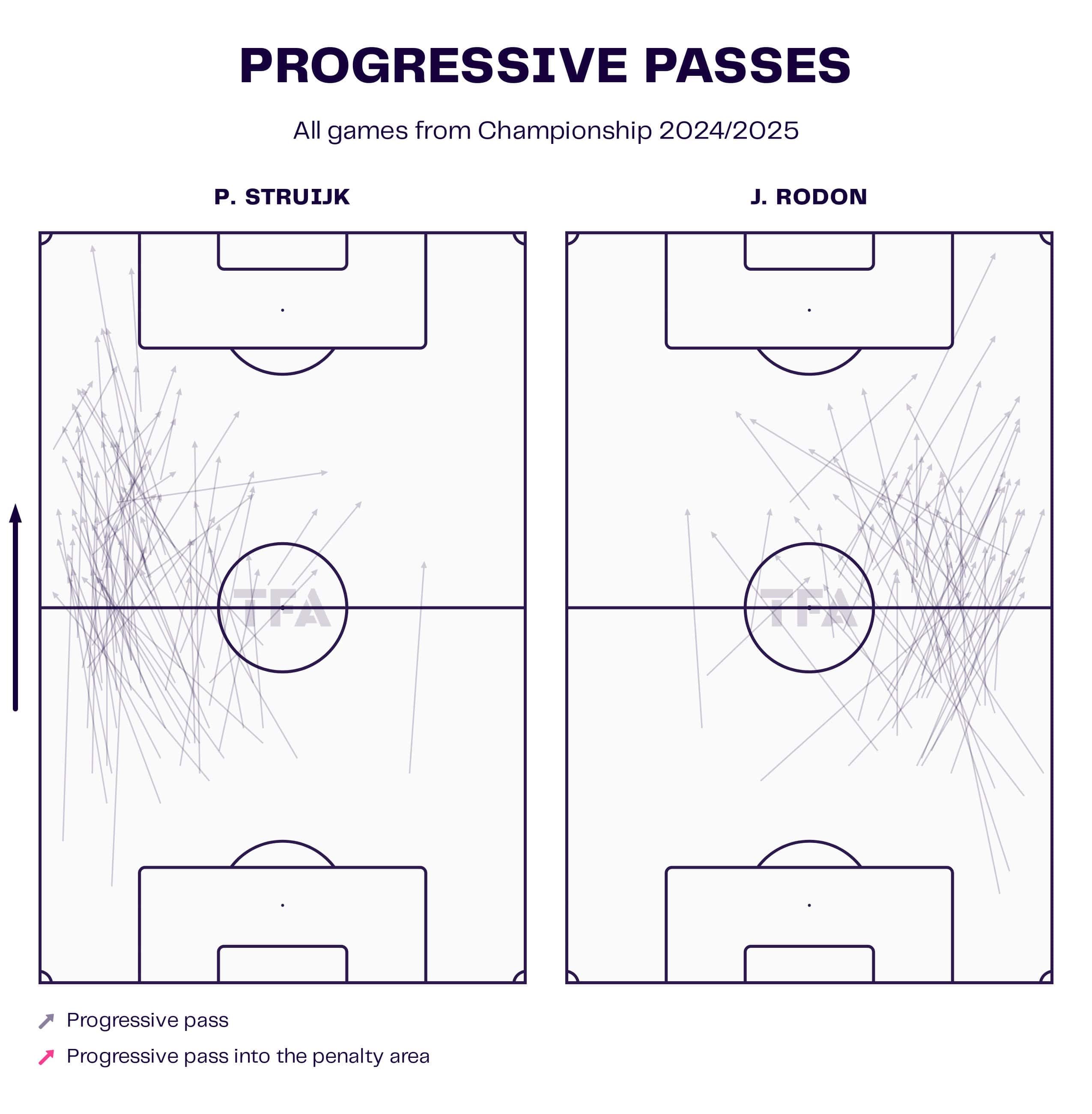
Figure 2
Figure 2 shows Struijk & Rodon’s progressive passes maps at the Championship 2024/25.

From there, Leeds builds its structure, and other players move forward, considering that the ball is safe in Rodon’s or Struijk’s feet and that they will progress if they have the chance.

They are capable of playing around or through the opposition accurately.

Both centre-backs’ abilities in possession allow progression to the next phase of possession.

Considering the wide position of the centre-backs, the role of the wide defenders in the team is also crucial.

Junior Firpo and Jayden Bogle, both natural wingbacks, are always high and placed one height above the centrebacks.

Since the beginning of the play, they have been responsible for providing the maximum structural width, positioning themselves higher as the possession advances and the opponent sinks.
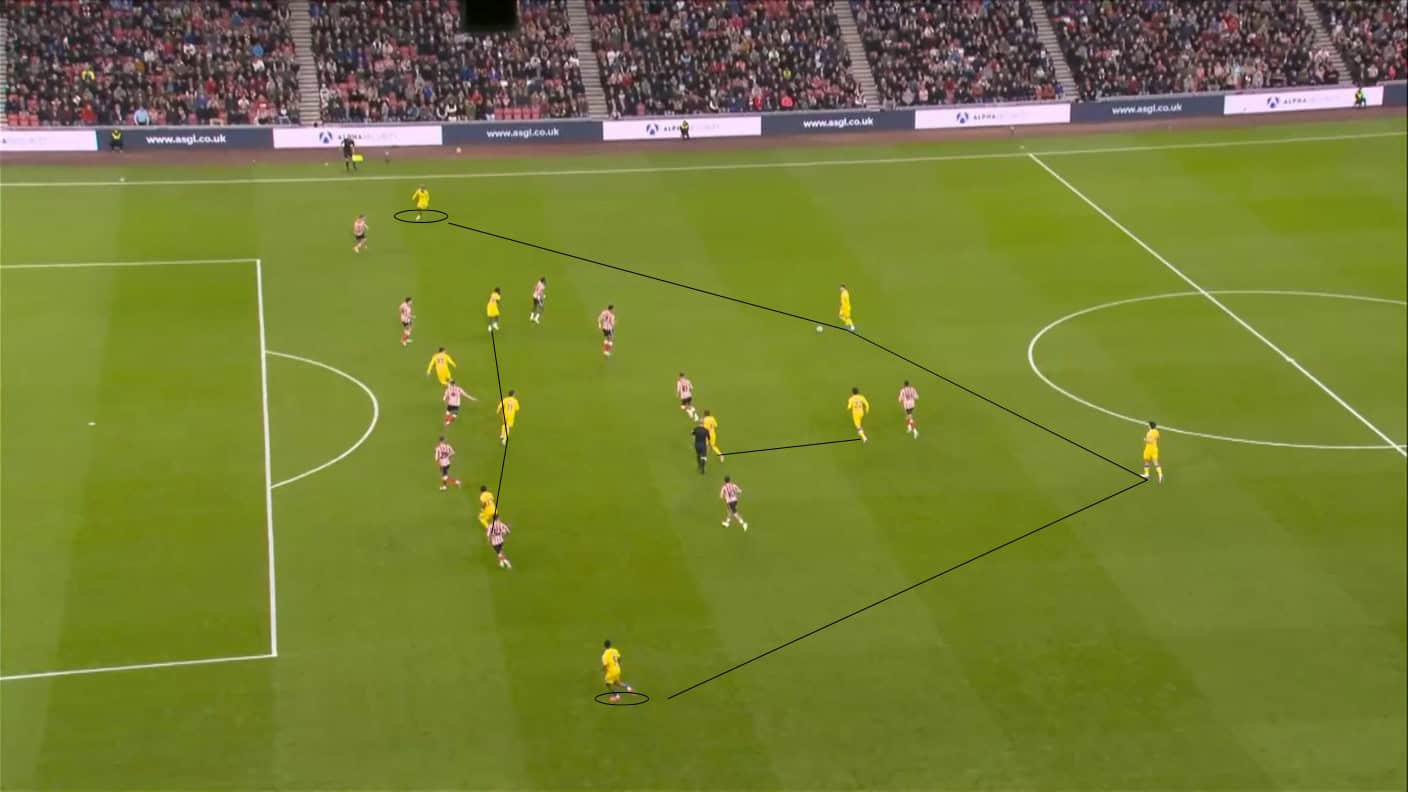
Figure 3
Figure 3 shows Leeds in the opposition’s half, with the wing-backs high in maximum width.

So, Leeds have a lot of space in the first line, but their wing-backs are not there, and their centre-backs are positioned wide.

Depending on the rival/moment, Leeds can also build up play with one of their midfielders—Rothwell, Tanaka, Ampadu, or Gruev—dropping in to help progress and control possession with vision and clarity.

They apply this adjustment mostly when the rival is strong in the mid-block, and they can progress without stumbling close to their box.

In this way, they can pin the position of the opposing midfielders pressing Leeds’ double-pivot.
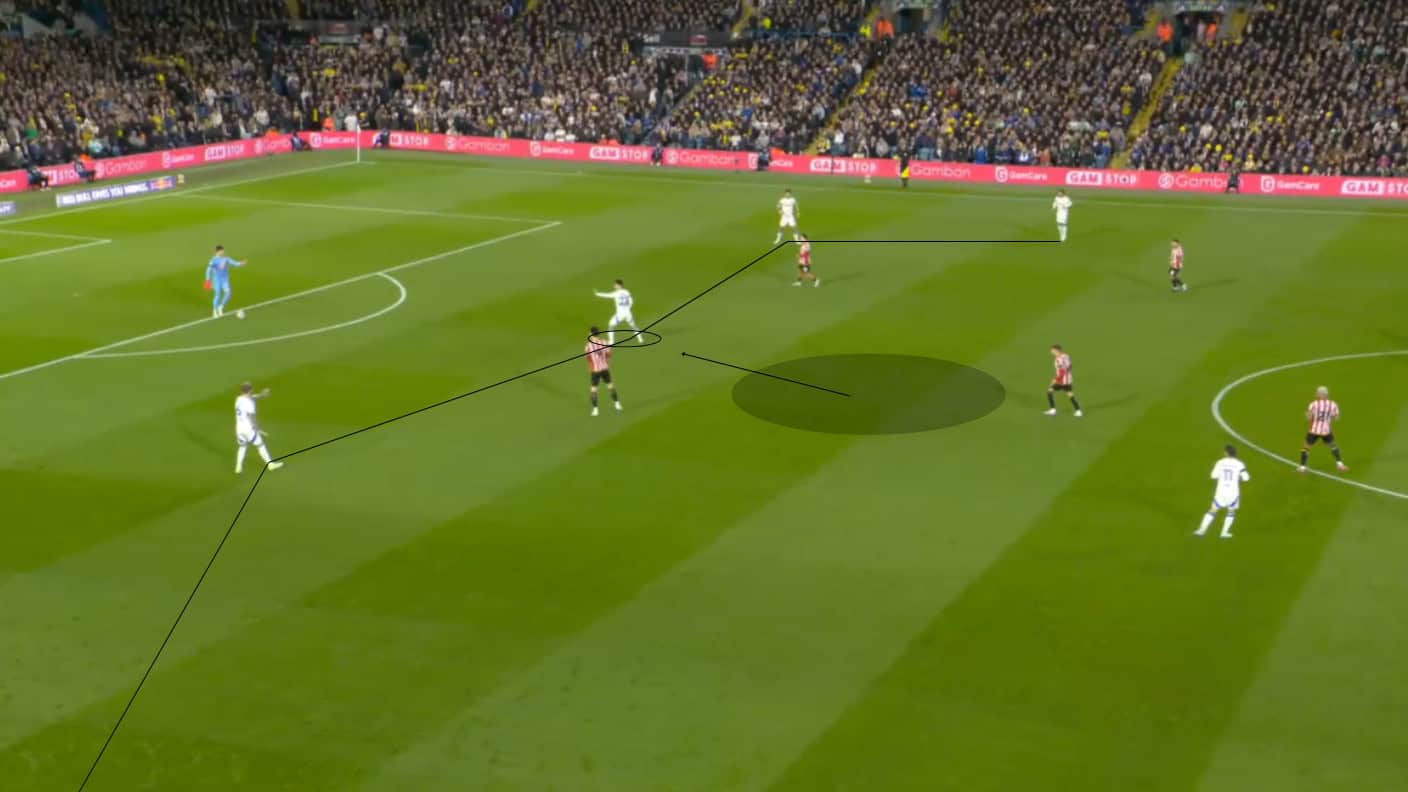
Figure 4

Figure 5
Figures 4 and 5 show Leeds’s build-up, with Ao Tanaka dropping in at the same height as the centre-backs.

Central Overloads

This 4-2-3-1 tends to become a 4-3-3 with different heights and channels between the double-pivot and the attacking midfielder (Aaronson) and a 4-4-2 in the defensive phase, with the ‘10’ moving into the forward line.

That configuration sounds familiar.

It has been one of the most commonly used ones in each phase in recent seasons, with different approaches from each team.

Without going very far, we have spoken about how Régis Le Bris’ Sunderland uses the same shape to create wide overloads during possession.

In this case, Farke uses it to create central overloads.
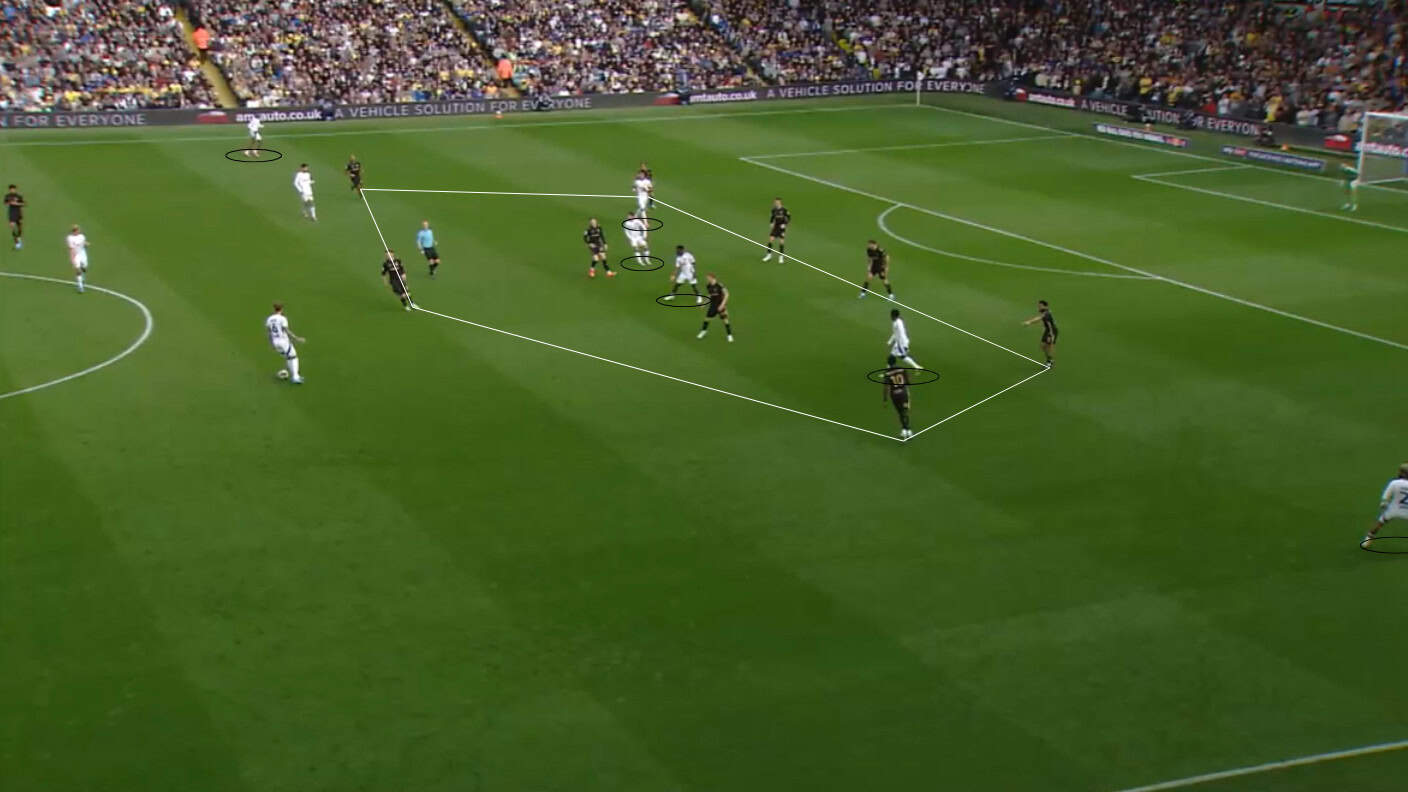
Figure 6
Figure 6 shows how Leeds builds central overloads with many players entering inner channels to break a low block.

Leeds’ wingers move into inner channels, and they accumulate four players there while the wing-backs advance.

With the ball in the centre-back’s feet and the double pivot deeper in rest defence, if possession is lost, Leeds has two ways to progress in positional attacks.

The first one is playing around from the back line.
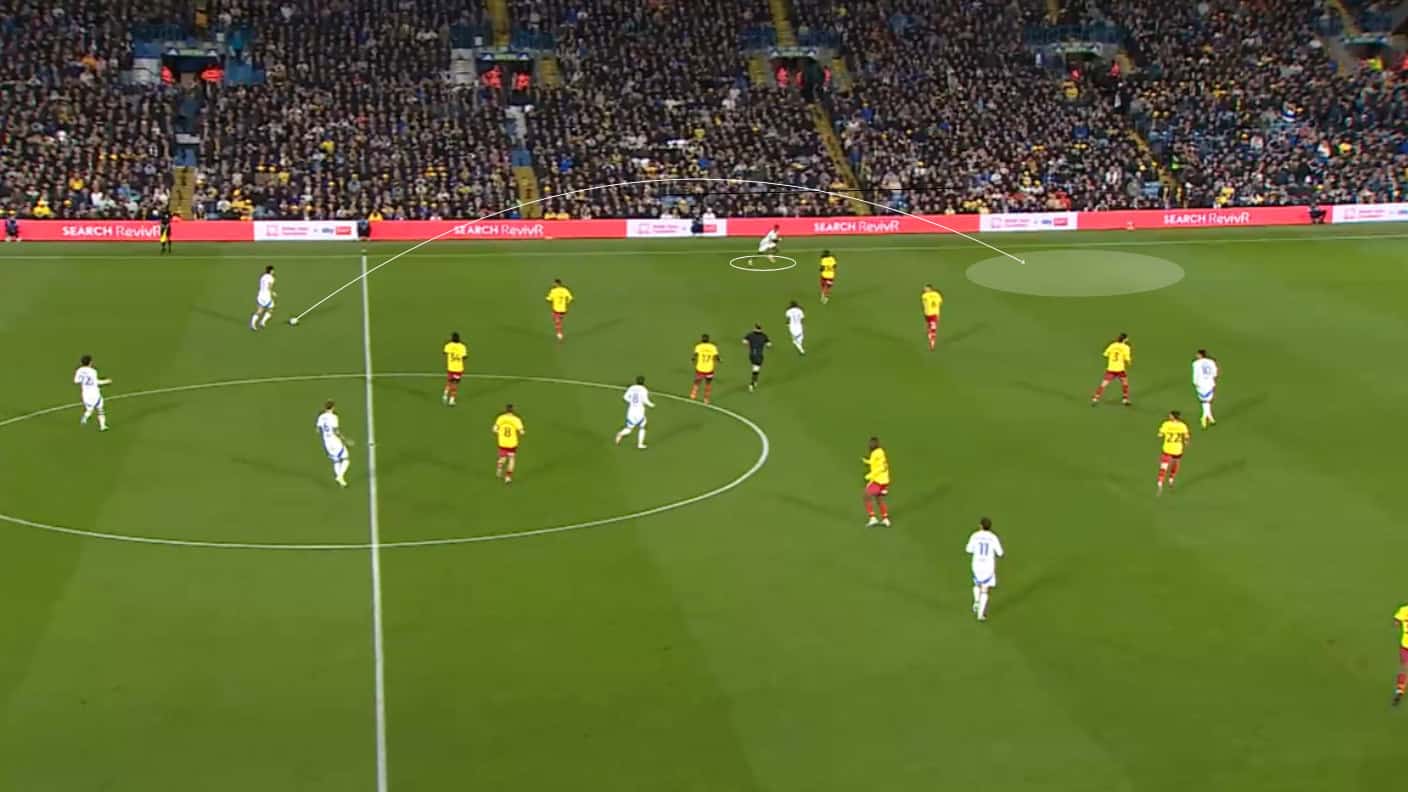
Figure 7
Figure 7 shows Struijk playing around from the backline while Junior Firpo runs in behind.

Rodon & Struijk’s technique of launching is fantastic, as it often finds Junior or Bogle running in behind and sending passes to them.

Even when very pressed, Junior and Bogle have excellent carrying techniques, which means they can progress from deeper positions as wingbacks.

Junior Firpo & Jayden Bogle Ball Progression Map
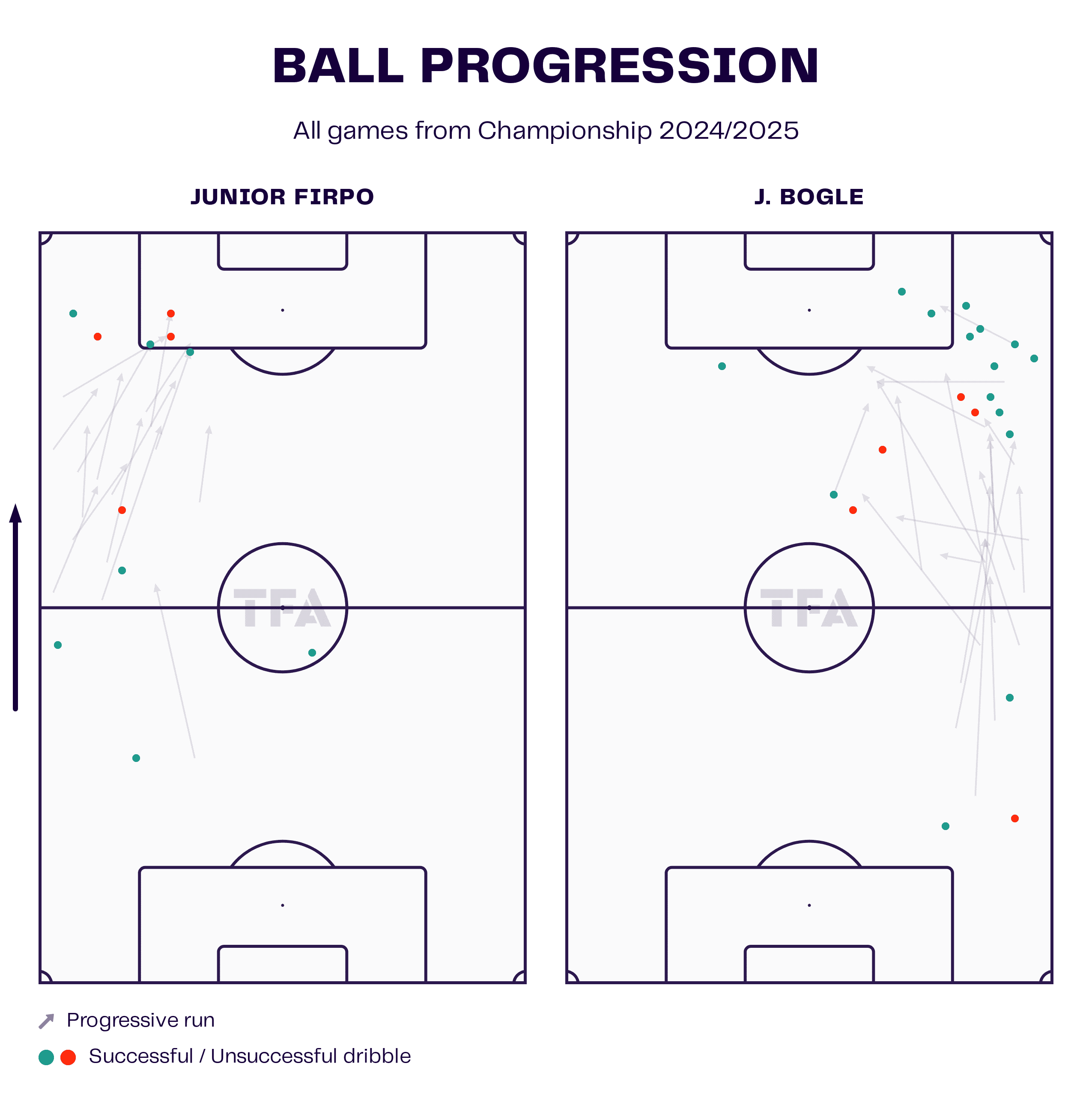
Figure 8
Figure 8 shows Junior Firpo & Jayden Bogle’s ball progression maps at the Championship 2024/25.

They tend to arrive aggressively into finishing zones after completing underlaps or attacking the weak side.
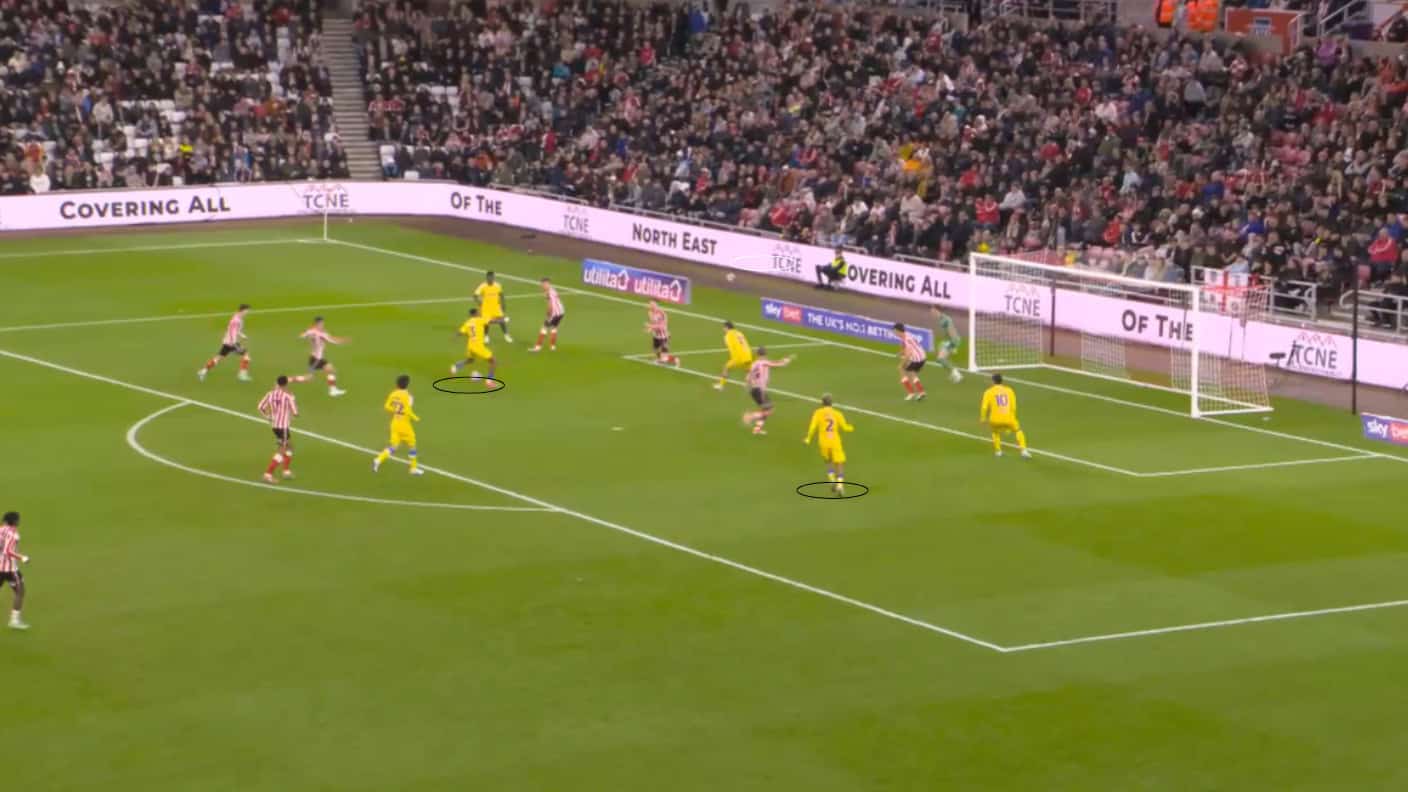
Figure 9
Figure 9 shows the position of Leeds’s wing-backs in a goal after Firpo’s carry + underlap and Bogle’s attack on the weak side.

But what happens when Leeds play through in the build-up?

Well, Daniel Farke has decided to position his wingers there to create some inner dribble and imbalance in the central channels.

If Struijk (mainly) and Rodon’s capacity to complete complex passes inside is understood, Leeds’ dribbling talent can make the difference in advanced and central zones.

This is valuable; if the ball is inside and a team can progress from there, the finishing is closer than in wide positions.
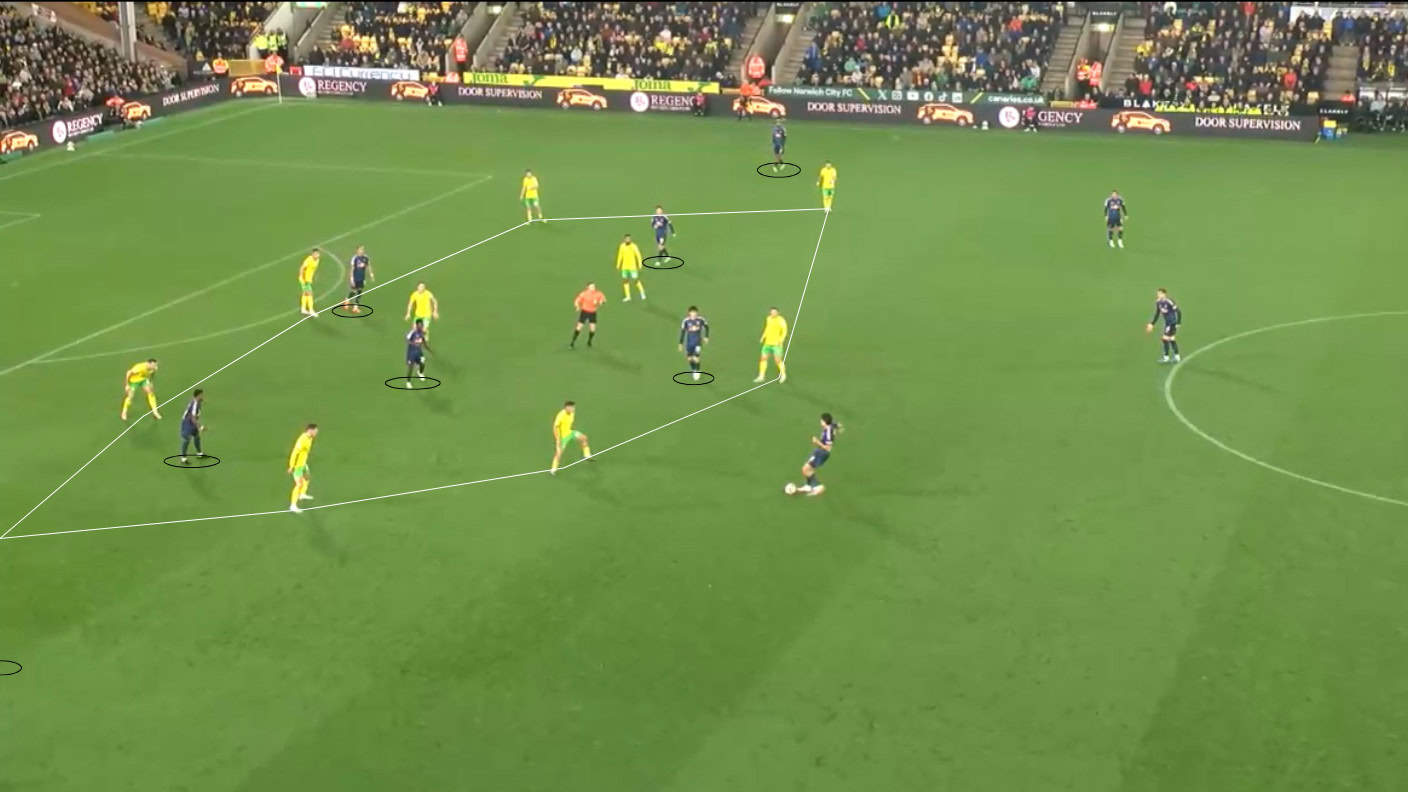
Figure 10
Figure 10 shows Struijk making a pass in the inner channels to a winger who will dribble and try to skip markers in a challenging but potentially dangerous zone.

There, Wilfred Gnonto has been the most critical winger starting wide and going inside.

The 20-year-old is short and can escape from congested areas and accelerate quickly, thanks to his low centre of gravity and quick change of pace/direction.

Wilfred Gnonto Ball Progression Map
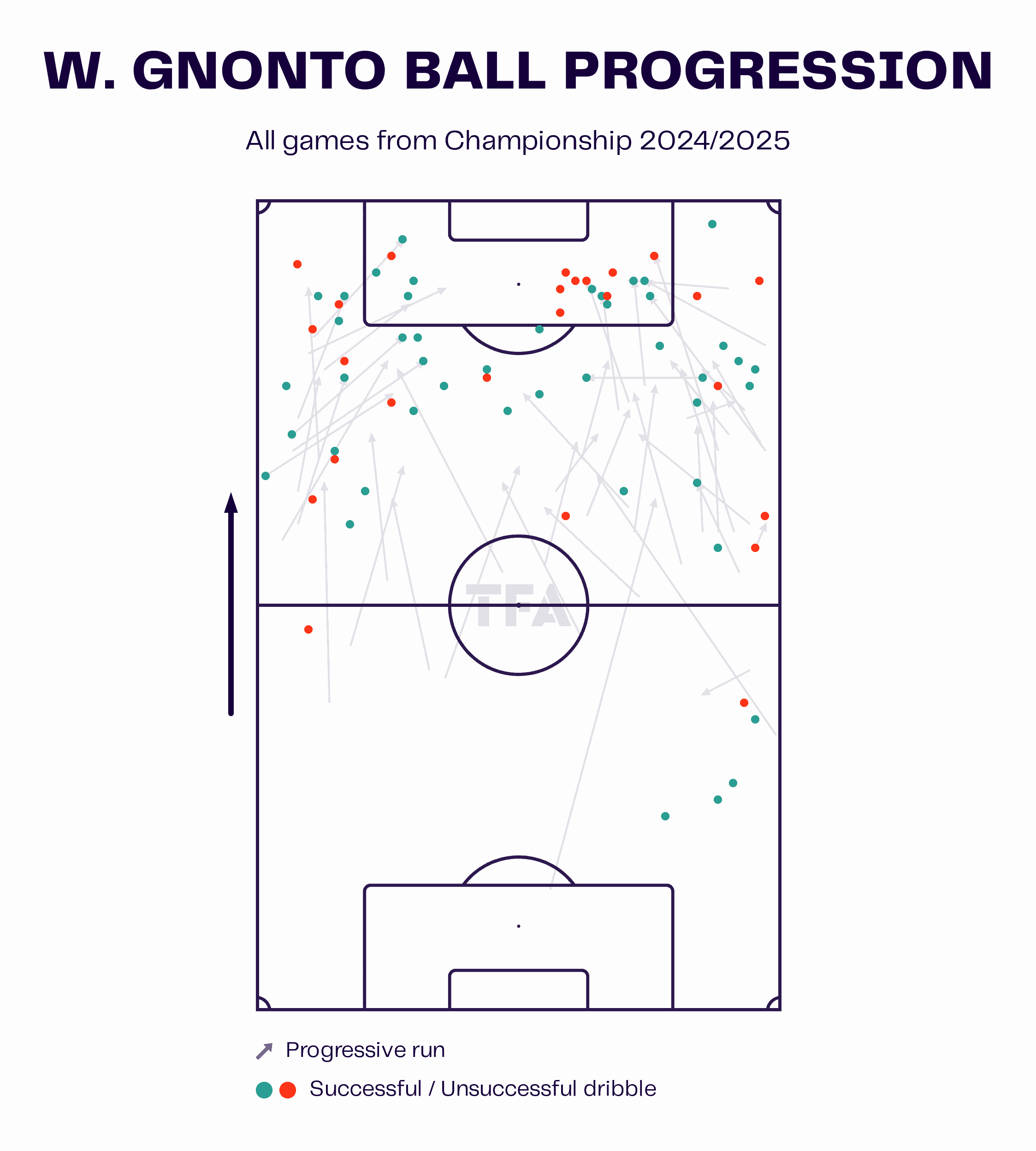
Figure 11
Figure 11 shows Wilfred Gnonto’s ball progression map, with many dribbles and runs in central channels.

With other dribblers and pure wingers like Manor Solomon, Largie Ramazani and Daniel James, this Leeds will boost their performances by using them in the central lanes and trying to shake in tight spaces.

Out-Of-Possession Behaviour

Daniel Farke’s philosophy in the Championship has always been daring, as we told you before.

But this season at Leeds, it is even more so than any other.

His defensive line is clearly higher than before, and Leeds avoid defending in their box as much as possible.

Given the weaknesses of their wing-backs in defending and the agility (Struijk) and strength (Rodon) of their centre-backs, defending high is their best option.

So, this Leeds is not very similar to Norwich in the Championship in defending.

Norwich had many resources in transition and could attack quickly after recovering deeper.

Leeds are better at recovering the ball faster; they need the ball.

And they are more dangerous in positional attacks than in any other phase.

Daniel Farke Defensive Territory Map
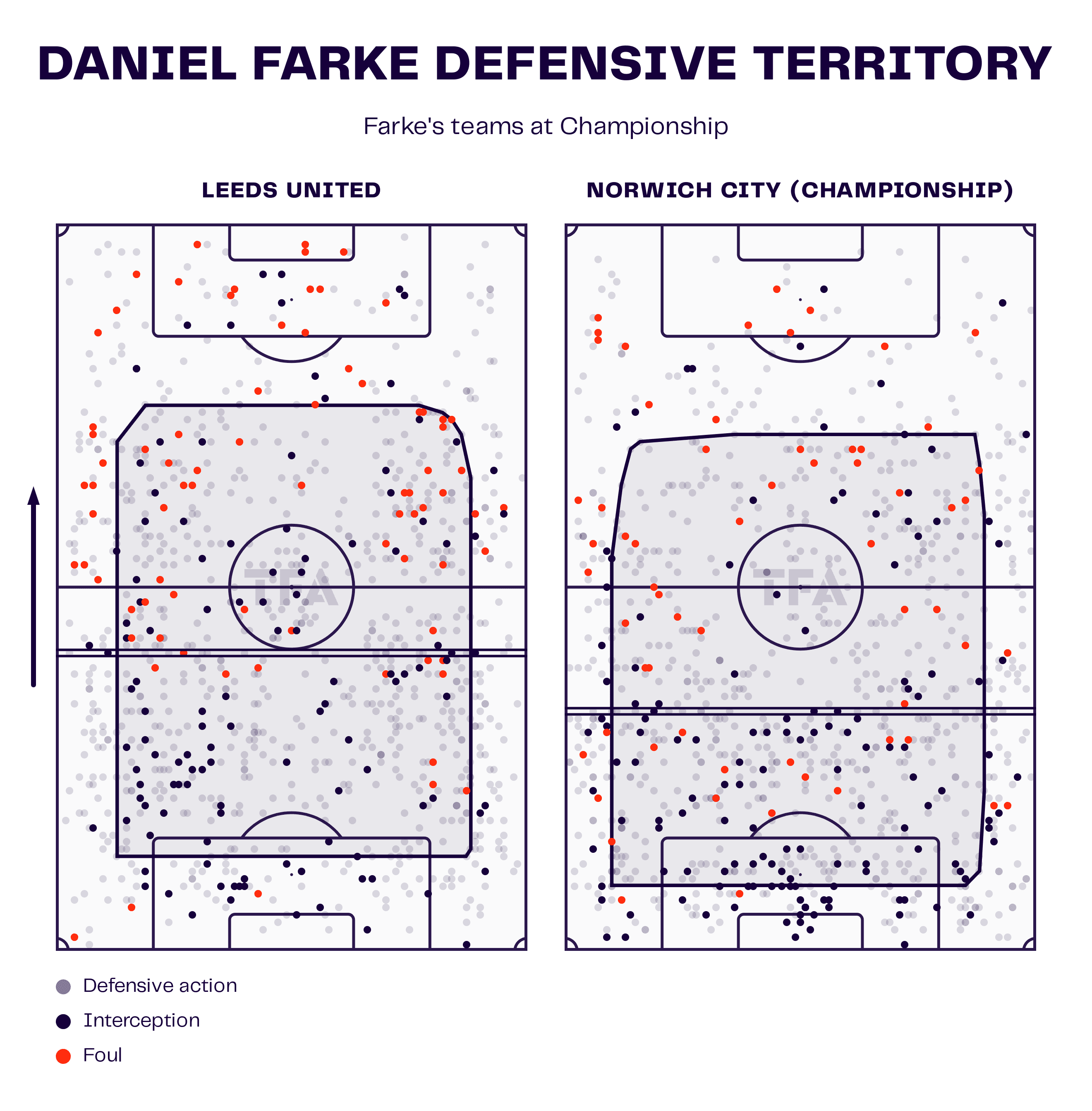
Figure 12
Figure 12 shows a comparison between Farke’s Leeds United and Norwich City in the Championship.

Where The Play Starts Off Possession: Pressing After Loss

As it happens, in possession, Leeds’ most valuable aspect without the ball is the beginning.

Once they lose the ball, there is a designated and aggressive man-oriented press.
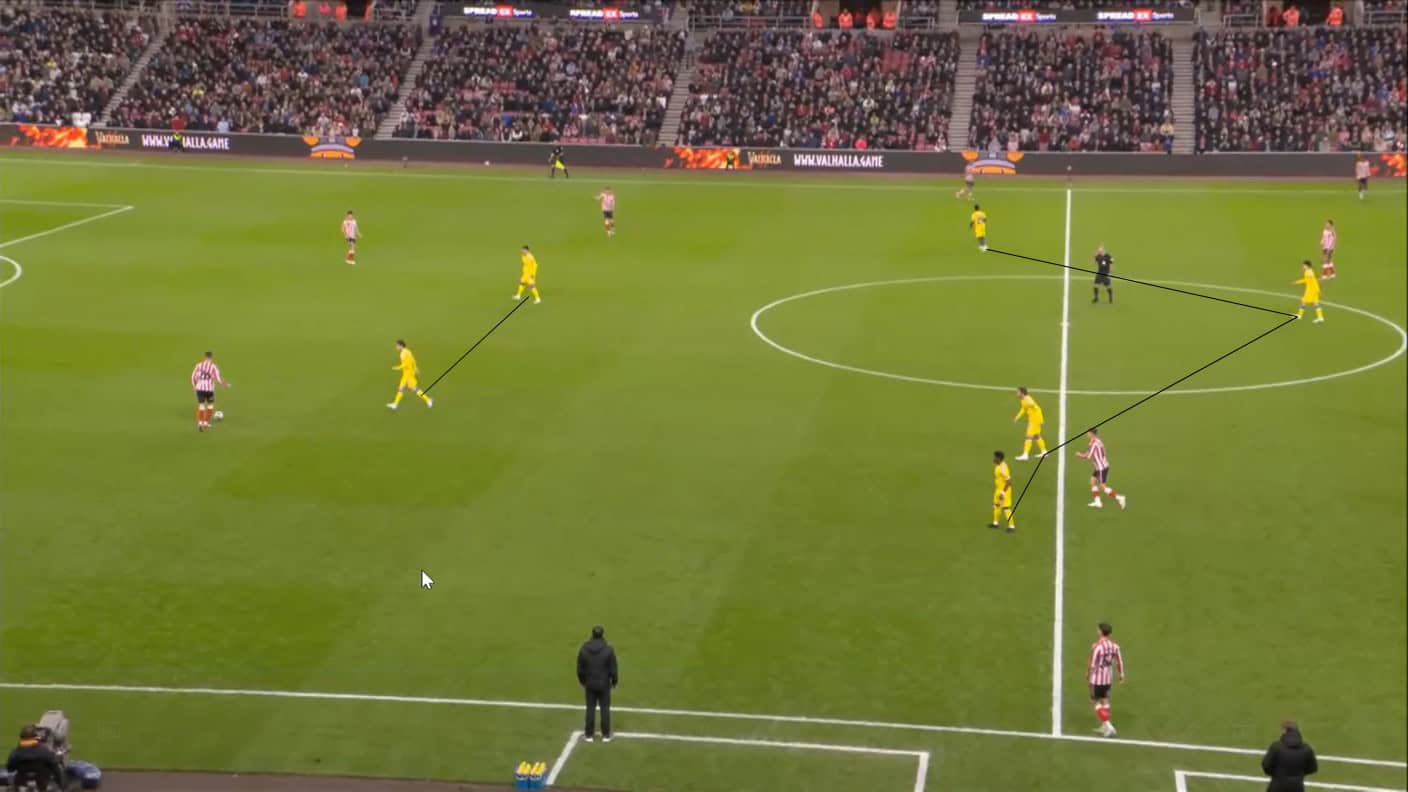
Figure 13
Figure 13 shows the 4-4-2 tactical shape that Leeds applies when they lose the ball.

In inner channels, they jump aggressively into central man-to-man marking or wait and reorganise their structure to close channels while the rival progresses.

But when the rival plays on the flanks, they cut the pitch in half with the wing-back pressing higher, using the touchline as one more defender and forgetting the weak side because the player will not be able to make a switch with the oriented press.
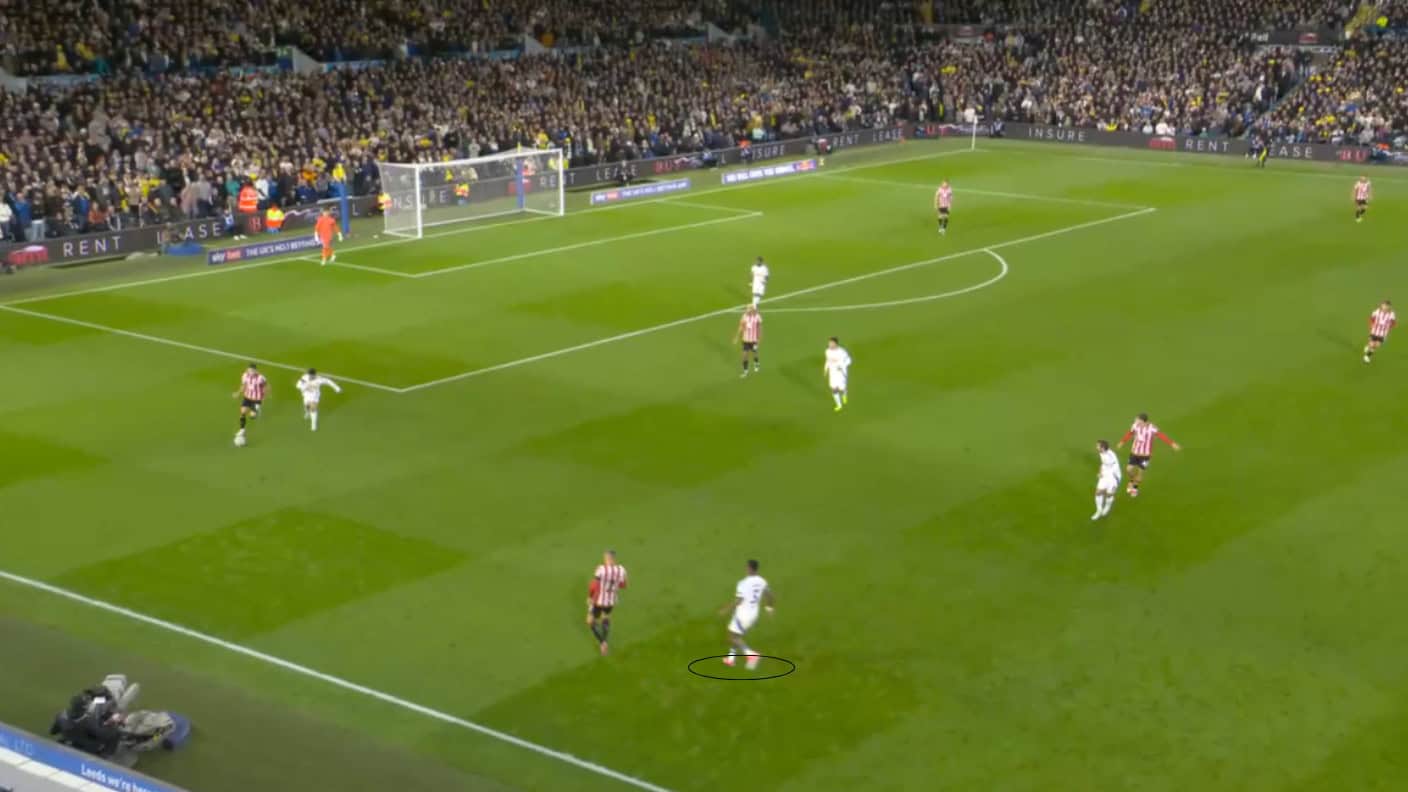
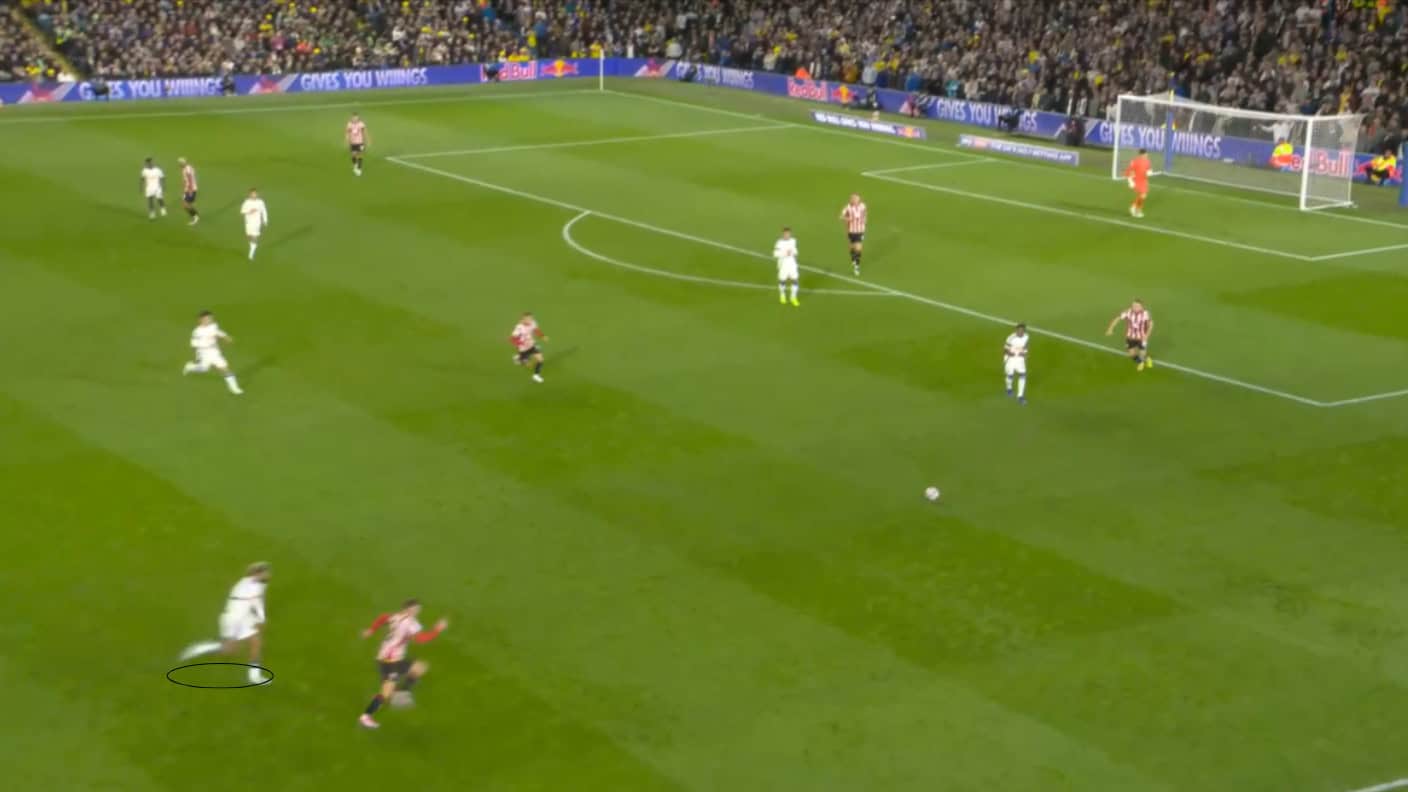
Figure 14

Figure 15
Figures 14 and 15 show how Leeds cut the pitch in half and pressed with the wing-back higher, focusing on one side.

In this phase, more than the structure — which is very important — Farke has many players who are intense, have stamina, and are intelligent while pressing.

After playing at the Champions League level with Union Berlin for one year, Brenden Aaronson returned from his loan to demonstrate his value.

The 24-year-old was already known as a high-pressure specialist because of his intensity after losing the ball, and now he is a fantastic resource for Leeds.

In addition, Leeds had made the second-highest number of high regains in the Championship at the time of writing, only below Luton Town.

However, the team’s pressing work is impressive.

Leeds United High Regains Map
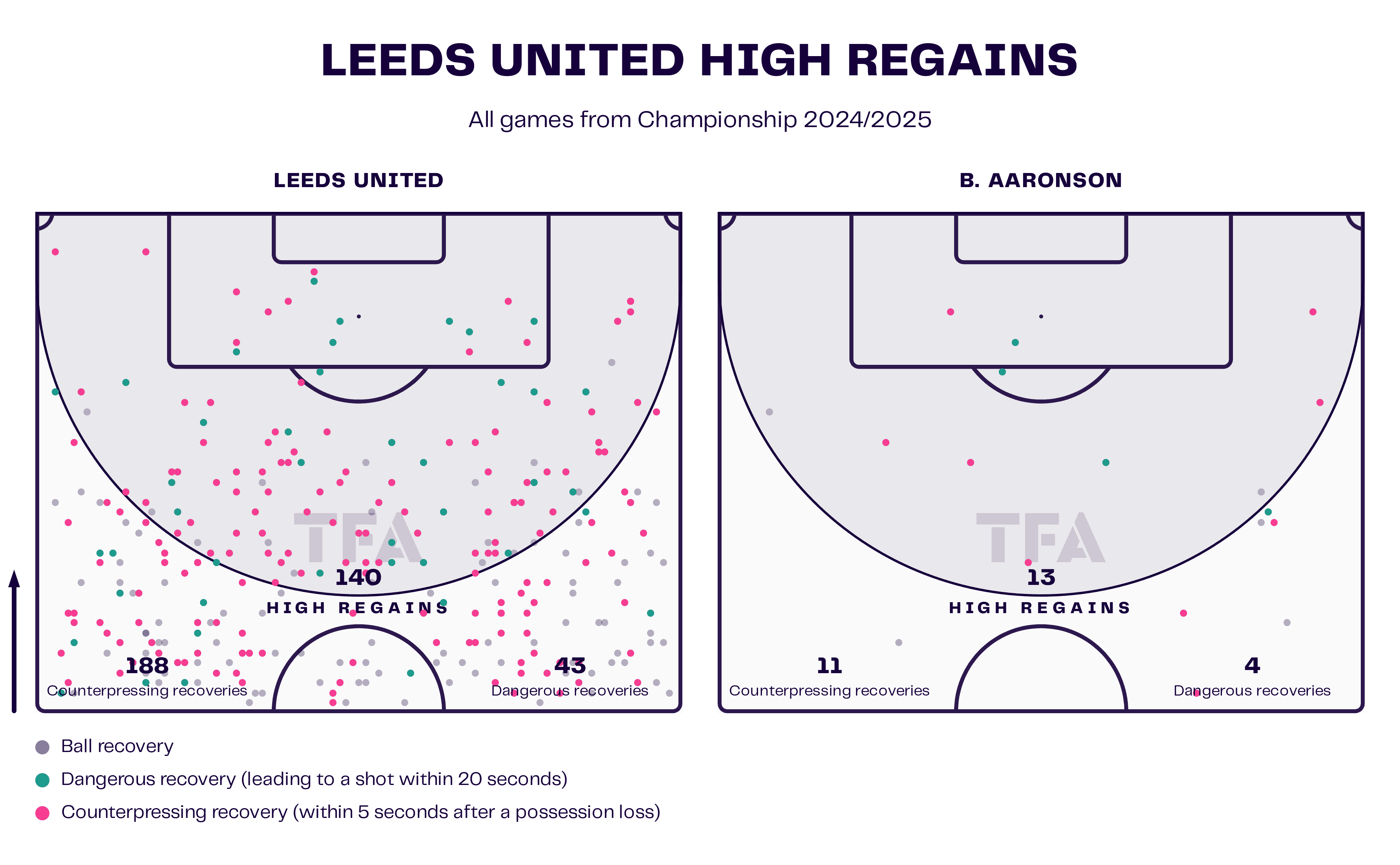
Figure 16
Figure 16 shows a high regains map from Leeds United this season and Brenden Aaronson’s same register.

Aaronson offers an impressive volume of counter-pressing so that Leeds can build a solid system around him on that topic.

Gnonto and Ramazani should grow, but they have experienced a considerable volume of committed pressing in recent weeks.

Conclusion

Daniel Farke wishes to bring his ideas and playing style to the Championship once again.

Their last transfer window was good, but if they are going to be promoted, they have to improve the level of some positions to shine and keep reinforcing ideas and the main structure.

We hope you liked Daniel Farke’s tactics at Leeds United, as we conducted a comprehensive, in-depth analysis.

Still, Ethan Ampadu has to recover after an injury.

He would be the best defensive midfielder on this team because he is capable of anticipating and executing many defensive actions, so there is still significant room for improvement.

Tags: Daniel FarkeDaniel Farke Coaching StyleDaniel Farke FormationDaniel Farke Manager StyleDaniel Farke NewsDaniel Farke Style Of PlayDaniel Farke Tactical AnalysisDaniel Farke TacticsLeedsLeeds FormationLeeds LineupLeeds Style Of PlayLeeds Tactical AnalysisLeeds TacticsLeeds Transfer News
Previous Post

How England Will Look Under Thomas Tuchel Tactics

Next Post

Protectors Of The Backline: Exploring The 3 Different Archetypes Of Defensive Midfielders

Next Post
Protectors Of The Backline: Exploring The 3 Different Archetypes Of Defensive Midfielders

Protectors Of The Backline: Exploring The 3 Different Archetypes Of Defensive Midfielders

  • About Total Football Analysis
  • Contact Total Football Analysis
  • Write For Total Football Analysis
  • Advertise
  • Privacy Policy
  • Cancellation / Refund Policy
  • Resources
  • Terms Of Service

© 2026 Total Football Analysis

No Result
View All Result
  • Football Analysis
    • Data Analysis
    • Formations
      • 2-2-4 Formation
      • 2-3-5 Formation
      • 3-1-4-2 Formation
      • 3-2-2-3 Formation
      • 3-2-4-1 Formation
      • 3-1-6 Formation
      • 3-3-4 Formation
      • 3-4-1-2 Formation
      • 3-4-2-1 Formation
      • 3-4-3 Formation
      • 3-5-1-1 Formation
      • 3-5-2 Formation
      • 4-1-4-1 Formation
      • 4-2-2-2 Formation
      • 4-2-3-1 Formation
      • 4-2-4 Formation
      • 4-3-1-2 Formation
      • 4-3-3 Formation
      • 4-4-2 Formation
      • 4-5-1 Formation
      • 5-3-2 Formation
      • 5-4-1 Formation
      • 6-3-1 Formation
    • Head Coach Analysis
    • Match Analysis
    • Player Analysis
    • Recruitment Analysis
    • Set Piece Analysis
    • Tactical Theory
    • Tactical Preview
    • Team Analysis
    • Training Analysis
    • Tactical Analysis
    • Scouting Report
  • Competition
    • ALL Competitions
    • English Premier League
    • Champions League
    • La Liga
    • Bundesliga
    • Serie A
    • Ligue 1
    • Eredivisie
    • EFL Championship
    • FIFA World Cup 2022
    • WEURO 2022
    • Women’s Super League
    • NWSL
    • Belgian First Division A
    • A-League
    • Liga Profesional de Argentina
    • Austrian Bundesliga
    • Campeonato Brasileiro Série A
    • DFB Pokal
    • 1. HNL
    • Danish Superliga
    • EFL League One
    • EFL League Two
    • FA Cup
    • EFL Cup
    • Indian Super League
    • K-League
    • J1 League
    • Liga MX
    • Copa América 2021
    • Copa del Rey
    • MLS
    • Eliteserien
    • Euro 2020
    • Primeira Liga
    • Scottish Premiership
    • Allsvenskan
    • Europa League
    • UEFA Nations League
    • Liga AUF Uruguaya
  • Coaches
    • All Coaches
    • Alfred Schreuder
    • Ange Postecoglou
    • Antonio Conte
    • Arne Slot
    • Bo Svensson
    • Brendan Rodgers
    • Bruno Lage
    • Carlo Ancelotti
    • Christophe Galtier
    • Claude Puel
    • Claudio Ranieri
    • David Moyes
    • Dean Smith
    • Diego Simeone
    • Domenico Tedesco
    • Frank Lampard
    • Eddie Howe
    • Edin Terzić
    • Emma Hayes
    • Erik ten Hag
    • Ernesto Valverde
    • Gennaro Gattuso
    • Gerardo Seoane
    • Gian Piero Gasperini
    • Giovanni van Bronckhorst
    • Graham Potter
    • Igor Tudor
    • Imanol Alguacil
    • Jesse Marsch
    • Jonas Eidevall
    • Jorge Sampaoli
    • José Bordalás
    • José Mourinho
    • Julen Lopetegui
    • Julian Nagelsmann
    • Julien Stéphan
    • Jürgen Klopp
    • Luciano Spalletti
    • Lucien Favre
    • Manuel Pellegrini
    • Marcelo Bielsa
    • Marco Rose
    • Marco Silva
    • Massimiliano Allegri
    • Mauricio Pochettino
    • Maurizio Sarri
    • Mikel Arteta
    • Niko Kovač
    • Nuno Espírito Santo
    • Oliver Glasner
    • Patrick Vieira
    • Paulo Fonseca
    • Pep Guardiola
    • Peter Bosz
    • Rafa Benítez
    • Ralf Rangnick
    • Ralph Hasenhüttl
    • Roger Schmidt
    • Roy Hodgson
    • Sean Dyche
    • Sérgio Conceição
    • Simone Inzaghi
    • Sonia Bompastor
    • Stefano Pioli
    • Steffen Baumgart
    • Steven Gerrard
    • Thiago Motta
    • Thomas Frank
    • Thomas Tuchel
    • Unai Emery
    • Vincenzo Italiano
    • Xavi
  • Teams
    • ALL Teams
    • AC Milan
    • Ajax Amsterdam
    • Arsenal
    • AS Monaco FC
    • Atalanta
    • Atlético Madrid
    • FC Barcelona
    • FC Bayern Munich
    • Borussia Dortmund
    • Celtic FC
    • Chelsea FC
    • Everton F.C.
    • Inter Milan
    • Juventus F.C.
    • Leeds United F.C.
    • Liverpool FC
    • Manchester City
    • Manchester United FC
    • Paris Saint-Germain
    • Rangers FC
    • RB Leipzig
    • Real Madrid CF
    • Tottenham Hotspur
    • West Ham United
  • Players
    • ALL Players
    • Alisson Becker
    • Bukayo Saka
    • Erling Haaland
    • Harry Kane
    • Jack Grealish
    • John Stones
    • Julián Alvarez
    • Kalvin Phillips
    • Kevin De Bruyne
    • Kyle Walker
    • Kylian Mbappé
    • Lamine Yamal
    • Lionel Messi
    • Luis Díaz
    • Mohamed Salah
    • Phil Foden
    • Virgil Van Dijk
  • Contact
  • Write For TFA
  • Login

© 2026 Total Football Analysis