
Norwich City’s 2024/2025 campaign was a disappointment, finishing 13th in the EFL Championship.
The Canaries struggled for consistency, and their performances reflected a lack of direction.
This led to the sacking of Johannes Throup, who managed the team for just over a year and ended his tenure with a win rate of 29.8%.
To ignite a revival, Norwich City have appointed former player Liam Manning as their new manager.
Manning arrives with a reputation for coaching possession-based and progressive football, built on his success with Bristol City.
Manning guided the Robins to their first Championship Play-Off appearance in 17 years, although they fell short in a 6-0 aggregate defeat to Sheffield United.
Despite the heavy defeats, his ability to transform Bristol into a competitive and tactically astute team has made him a sought-after coach.
This tactical analysis will focus on Liam Manning background, innovative philosophy, formations, and tactical principles that define his teams.
We’ll also examine how Manning can bring out the best in Norwich squad, including key players like Josh Sargent and Borja Sainz.
Liam Manning: A Coach Shaped By Hard Work & Innovation
Liam Manning’s rise through the coaching ranks is a testament to his relentless work ethic and commitment to learning.
Released by Ipswich Town as a player at the age of 20, Manning quickly transitioned to coaching, throwing himself into the grassroots game.
He recalls “putting in the hard yards” by coaching multiple teams and managing every aspect of youth setups, including driving the minibus.
His early career included 13 years in academy football at Ipswich and West Ham United, where he refined his ability to nurture young talent and develop technical players.
Manning’s big break came with the City Football Group (CFG), where he was the Director of Coaching and Academy Director at New York City FC.
CFG’s influence on Manning’s philosophy is evident: a commitment to possession-based football, tactical flexibility, and data-driven decision-making.
At MK Dons, Manning built on Russell Martin’s foundations, creating one of the most tactically advanced teams in EFL League One.
His time at Bristol City further highlighted his ability to adapt his system to a squad’s specific demands while maintaining a clear tactical identity.
Liam Manning Tactical Philosophy
Liam Manning’s tactical philosophy is rooted in control and fluidity, both in possession and out of possession.
His teams are built to dominate the ball, create numerical superiority, and exploit spaces through intelligent movement and positional play.
This section will analyse some of his key principles.
Liam Manning High Counterpressing: Turning Transitions Into Opportunities
Liam Manning’s counterpressing system is meticulously organised and relies on collective intensity.
When possession is lost, his players react with coordinated movements to regain the ball as fast as possible.
The aim is to win the ball high up the pitch, where the opposition is disorganised and the attacking players are already in advanced positions.
Technically, this requires excellent spacing and compactness in possession.
By maintaining close distances between players, Manning ensures that counterpressing triggers are achievable and that multiple players are always ready to engage the ball carrier.
This minimises the time and space available to the opponent, forcing errors and creating opportunities for quick transitions.
From a coaching perspective, implementing this system demands detailed work on pressing triggers and pressing angles.
Players are trained to recognise cues, such as a poor first touch or a backward pass, and to press in a way that limits the opponent’s passing options.
The rest of the team must also shift laterally and vertically in unison to close passing lanes and ensure a cohesive press.
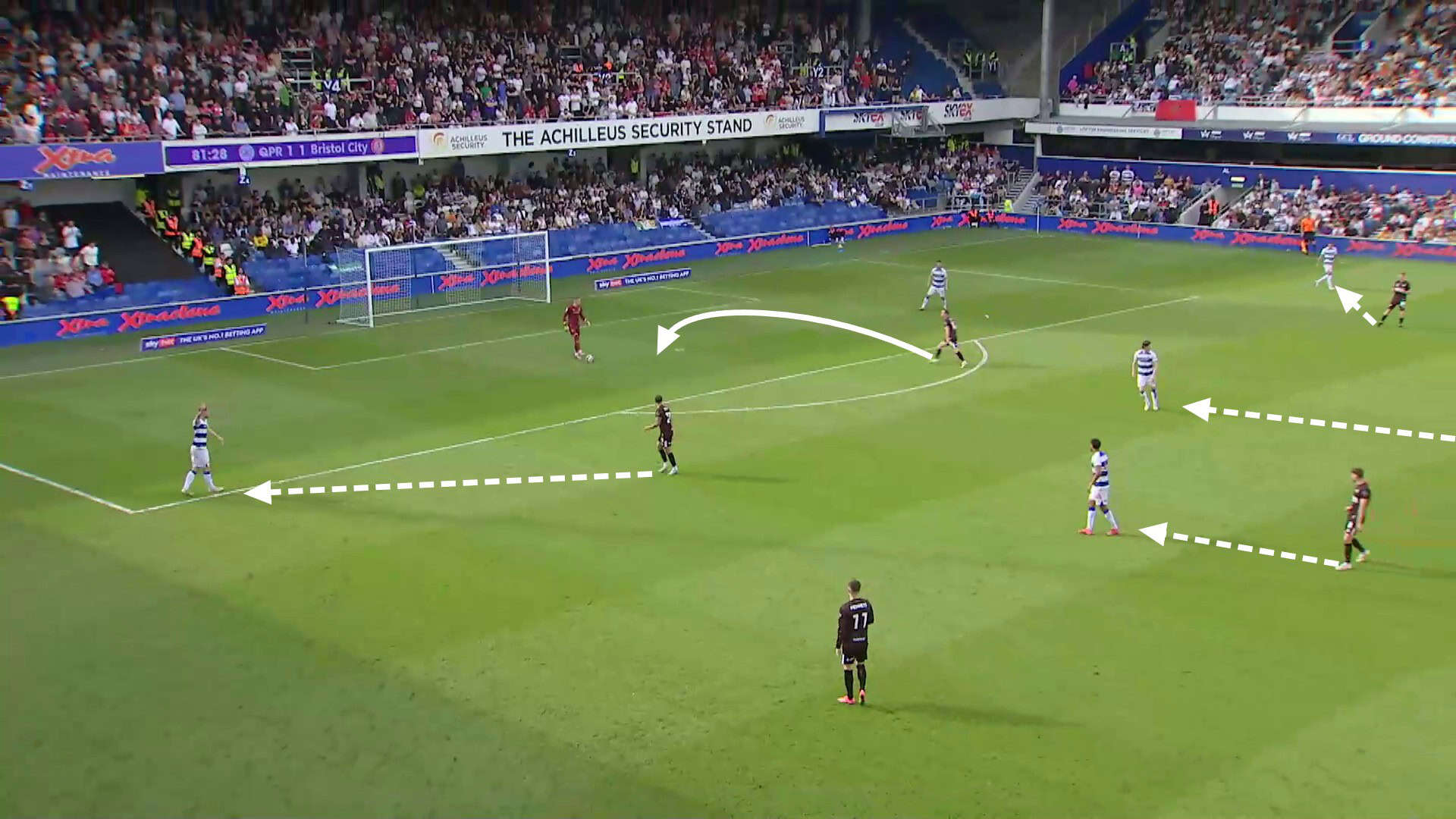
The image shows a pressing sequence, as shown in a league fixture against QPR.
The curved run from the Bristol City forward is a key element of Liam Manning’s out-of-possession tactics.
The forward’s arced movement cuts off access to the left side of the pitch while simultaneously pressing the goalkeeper, forcing play into a pre-determined zone.
This curve is deliberate.
It blocks passing options to the left-back or centre-back, funnelling the ball toward the right side, where Manning’s team has numerical superiority.
The pressing players behind the forward are well-positioned to close down secondary options.
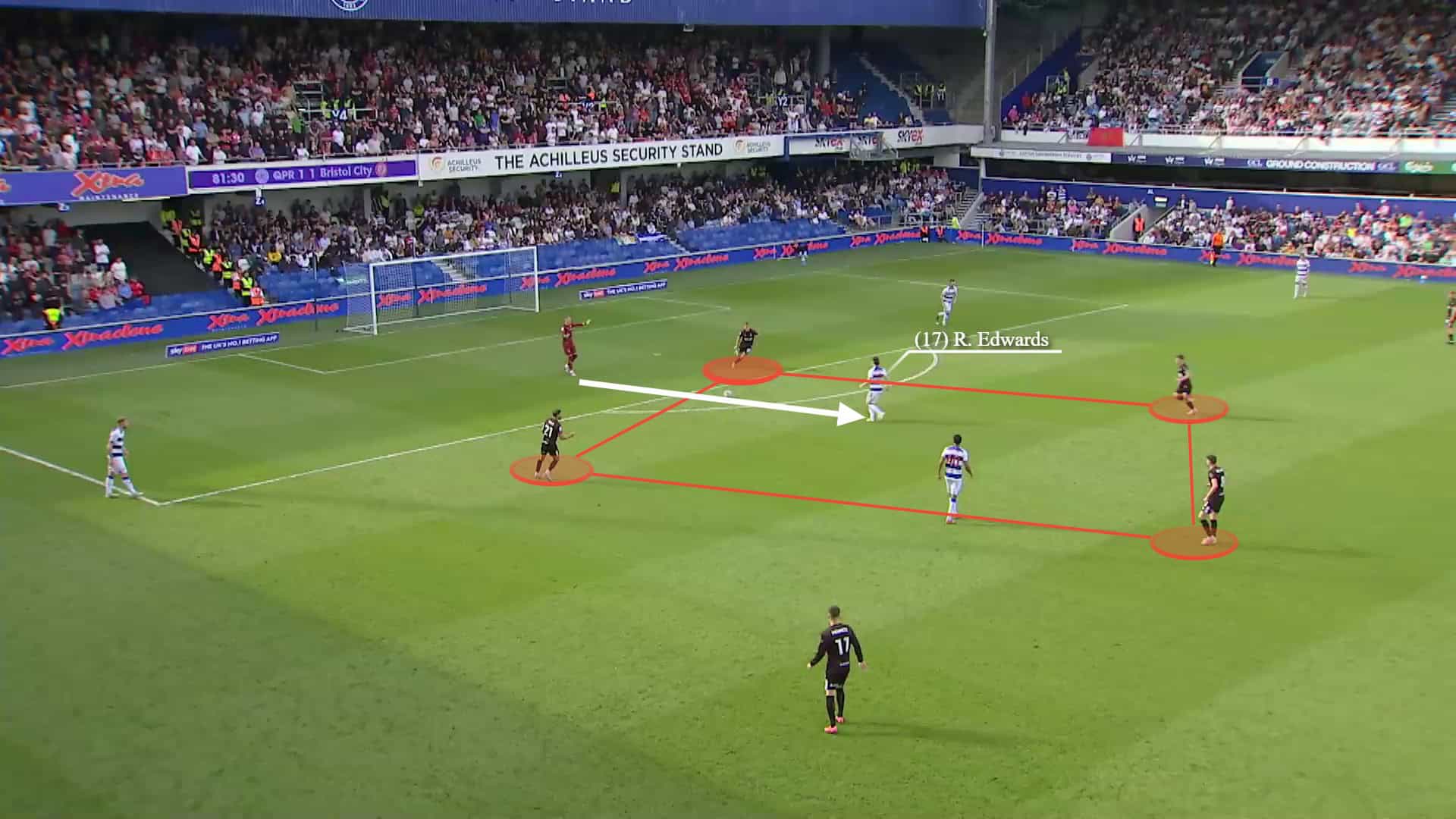
The second image complements the subsequent pressing action, where Ronnie Edwards receives the ball.
The Bristol City players are in close proximity and apply pressure to close down Edwards, while two other players block central passing lanes, isolating the ball carrier.
The compact rectangular setup traps the ball on one side of the pitch, forcing risky passes or long clearances instead.
First-Line Overload: Liam Manning Build-Up Tactics
One of Liam Manning’s trademarks is his use of first-line overloads to bypass the opposition’s initial press.
This involves creating numerical superiority in the build-up phase by forming a temporary back three or four with the goalkeeper, centre-backs, and a holding midfielder.
The key to this is spacing and positioning.
By drawing the opposition forward, Manning’s teams create gaps between the lines that can be exploited with vertical passes or third-man combinations.
The holding midfielder plays a crucial role as a pivot, constantly moving to offer passing angles and responsible for quick ball progression.
In training, this phase focuses on technical action under pressure.
Players are drilled in receiving the ball under tight marking and scanning for options.
Wide 3v2 Situations: Overloading The Flanks
Liam Manning’s teams excel at creating wide overloads, often using rotations to disorganise the opposition.
The goal is to isolate the opposition’s full-back and create a 2v1 advantage, allowing for dangerous crossing or cut-back opportunities.
This involves coordinated movements between the full-back, wide midfielder, and inside forward.
For example, the wide midfielder might drop deeper to pull the opposition’s full-back out of position, while the full-back overlaps into the vacated space.
Alternatively, the inside forward might drift wide to create a passing triangle, further complicating the defensive task.
A high level of spatial awareness and the ability to execute quick, accurate passes are needed.
Timing is also essential, as the success of these rotations depends on exploiting the momentary disorganisation caused by the opponent’s defensive shifts.
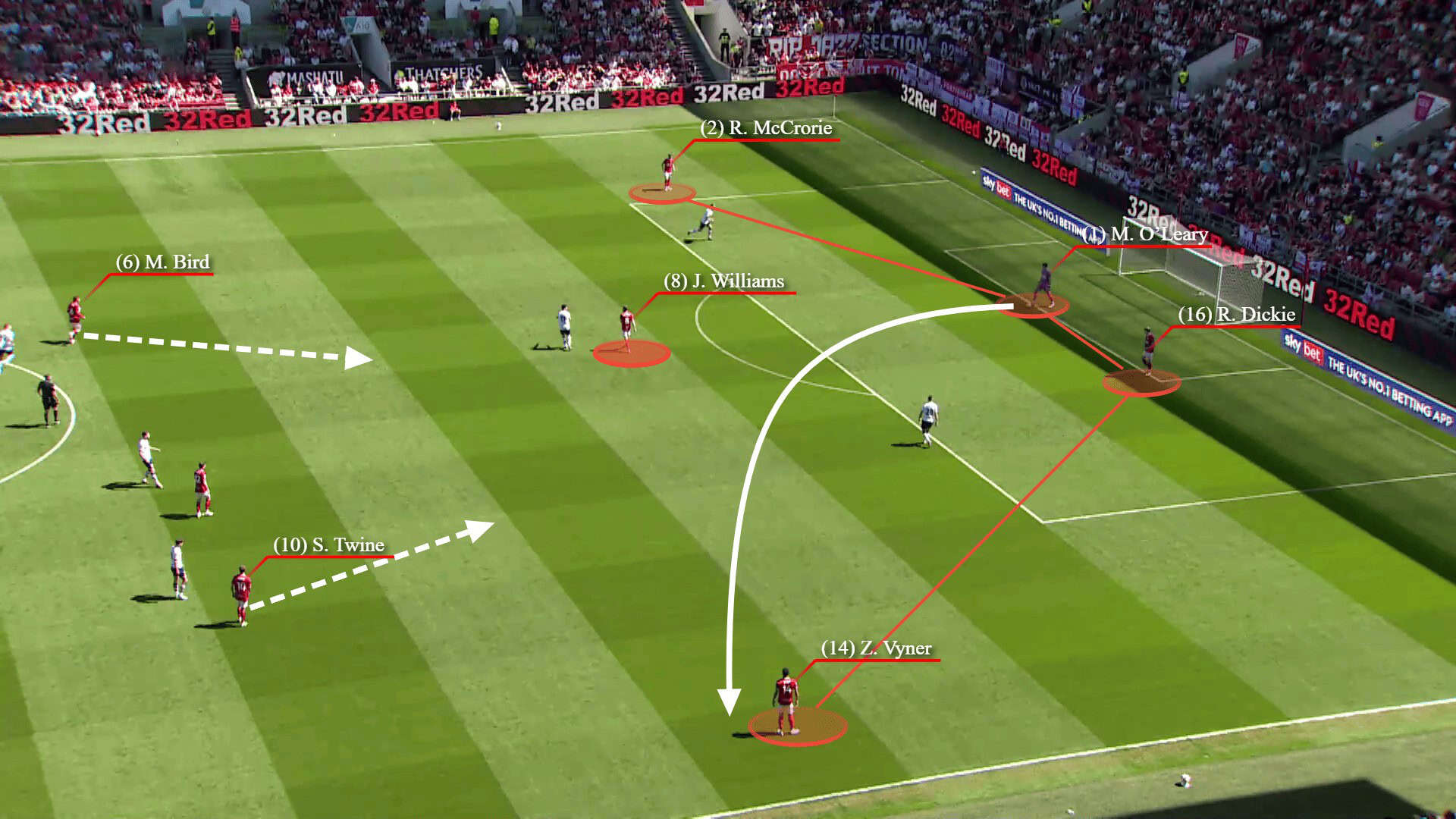
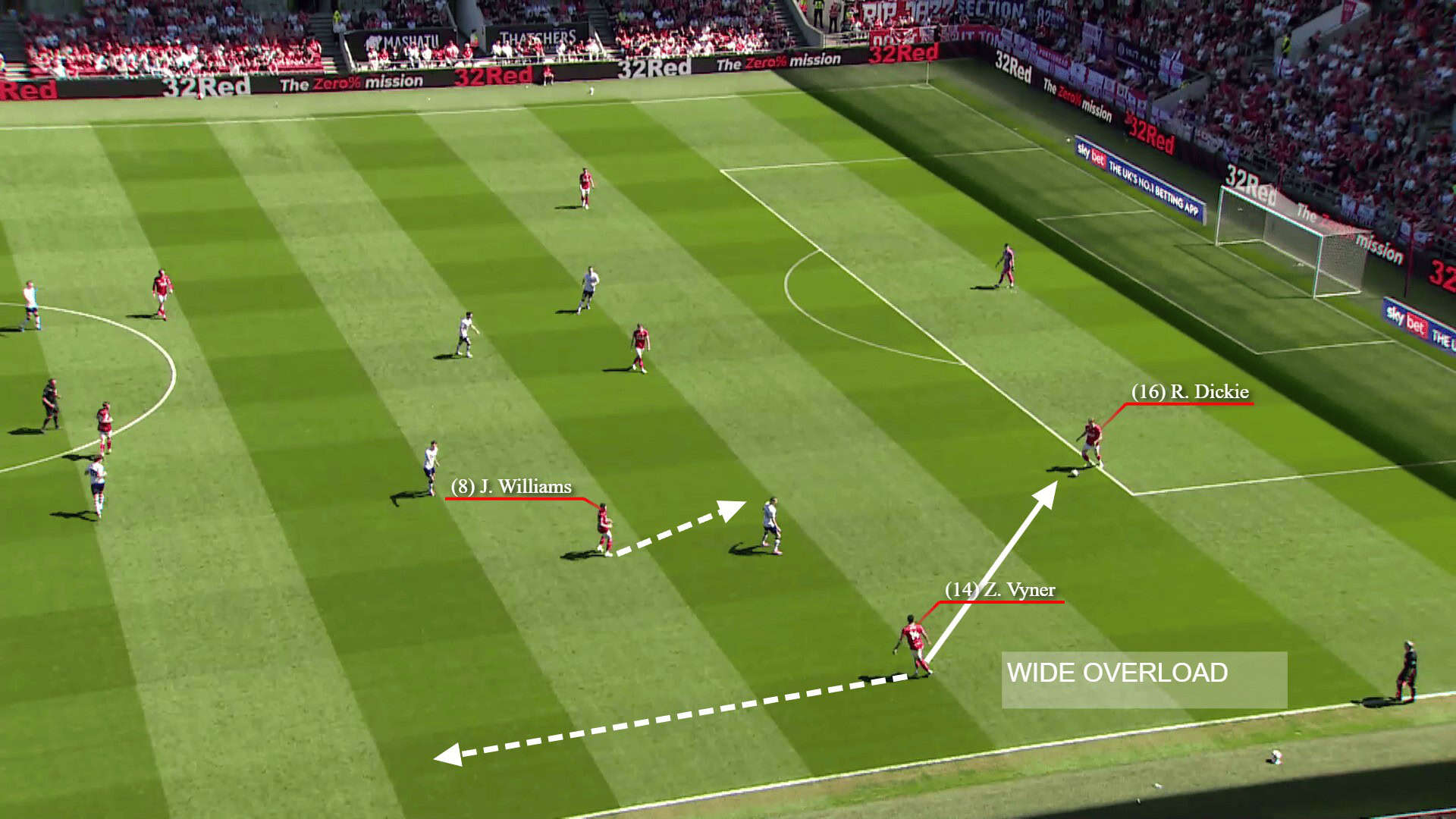
As shown against Preston North End, the build-up begins deep in the defensive third, with Rob Dickie in possession of the ball.
Liam Manning’s principles of structured build-up are evident as players position themselves to stretch the opposition’s pressing shape.
Zak Vyner moves wide to occupy the touchline, creating width and offering a progressive passing lane.
Joe Williams positions himself higher but within proximity to Vyner, forming the foundation of a wide overload against the opposition’s press.
The goalkeeper and deeper defenders provide additional outlets, which allow numerical superiority in the first line of build-up.
Attacking Centrally: Exploiting Gaps With Patience
While wide play is a key component of Liam Manning’s philosophy, he is equally focused on creating chances for his players to exploit central spaces.
His teams use patient ball circulation to stretch the opposition horizontally and create gaps between their opposition lines.
This involves multiple switches of play, forcing the opposition to shift their defensive block and eventually lose compactness.
Once a gap appears, Manning’s players are trained to exploit it with penetrative passes or runs.
The use of inverted wingers or inside forwards, who occupy the half-spaces, adds another layer of complexity to this approach.
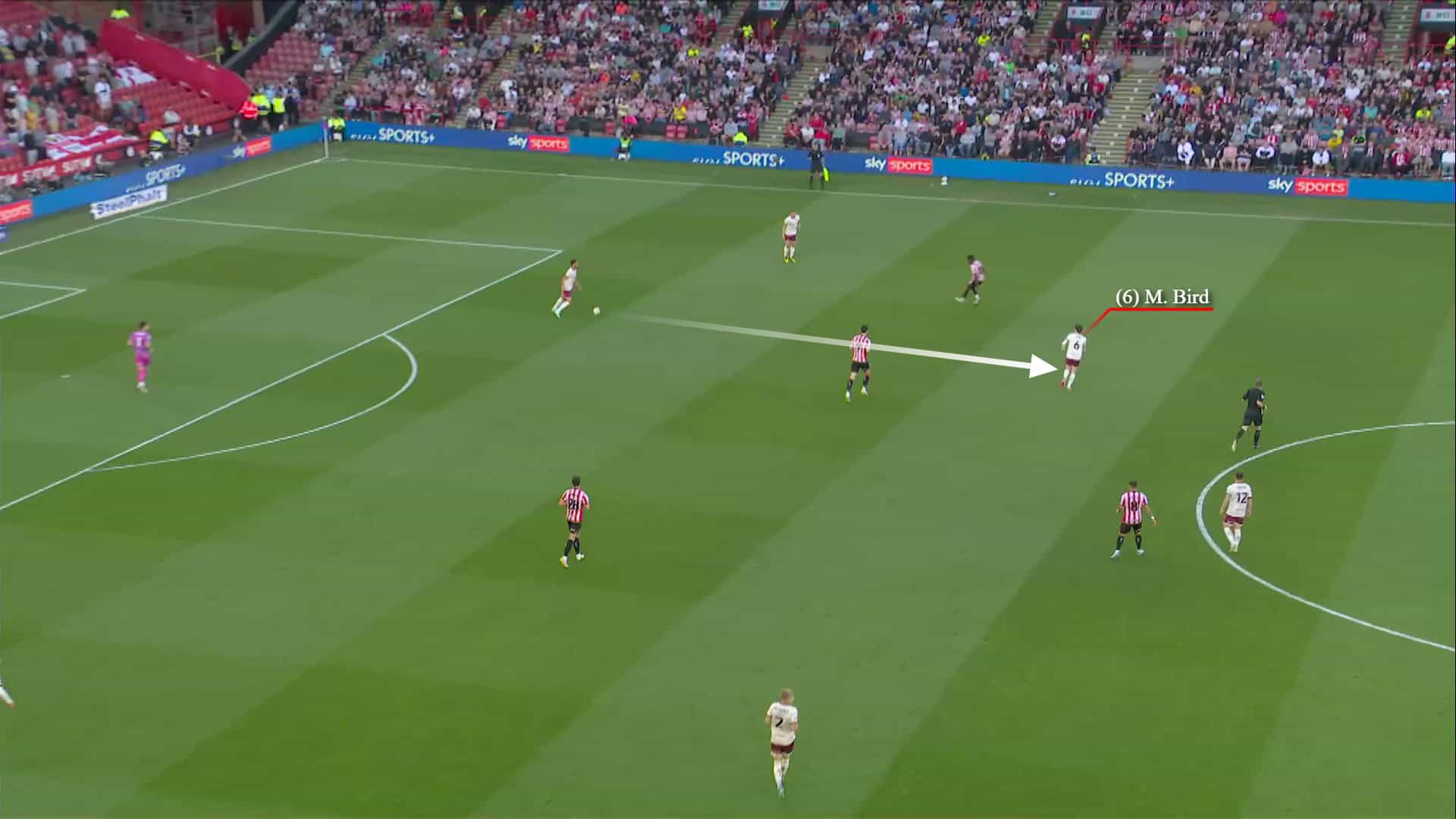
This is from the Play-Off Semi-Final versus Sheffield United.
In this phase, Manning’s team begins their attack from deep.
The centre-back has possession, while the holding midfielder, Max Bird, drops into the half-space to provide a passing option.
This movement reflects Liam Manning’s principle of creating first-line overloads, where the build-up includes numerical superiority in the initial phase.
By drawing Sheffield United’s press toward the ball, Bird’s positioning provides a dual purpose:
- Breaking the Press: Bird offers a vertical passing lane to bypass the first line of pressure from Sheffield United’s forwards.
- Central Access: His deeper position stretches the Sheffield midfield, forcing them to decide between pressing higher or maintaining their shape.
This positioning allows the ball to be transitioned centrally, setting the stage for further progression.
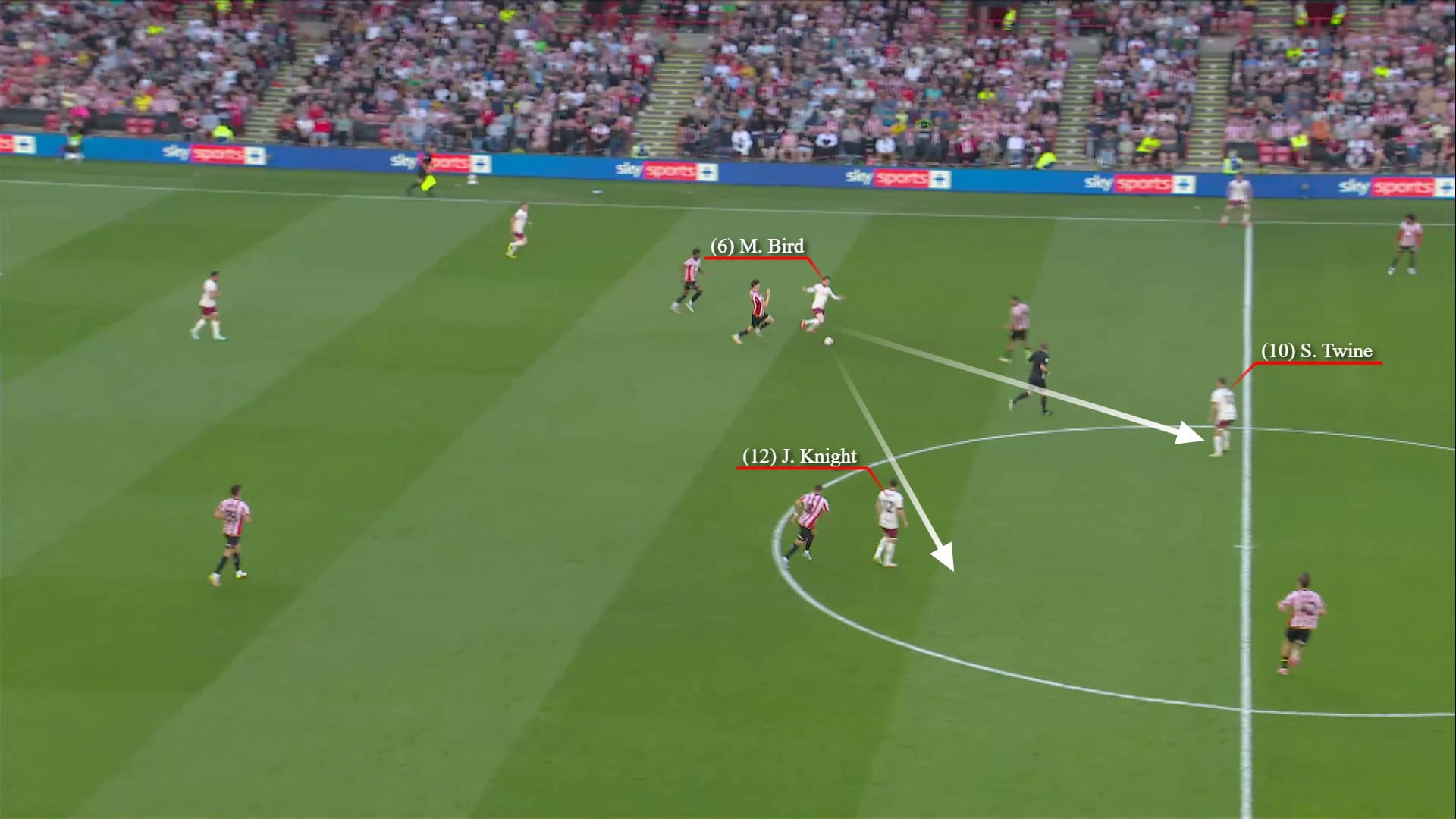
As the ball moves into midfield, the team’s shape focuses on creating overloads in the central channel.
Bird receives the ball and makes a forward pass to Scott Twine, showing Manning’s use of third-man combinations.
- Rotations and Space Creation:
Twine’s positioning between the lines means he remains an option to receive the ball in a central zone. Jason Knight makes a diagonal supporting run, pulling his marker out of position and opening up a passing lane for Bird to play forward. - Exploiting Gaps:
The Sheffield midfield is stretched horizontally due to the movement of Knight and Twine.
The staggered positioning of the attacking players gives multiple progressive passing options.
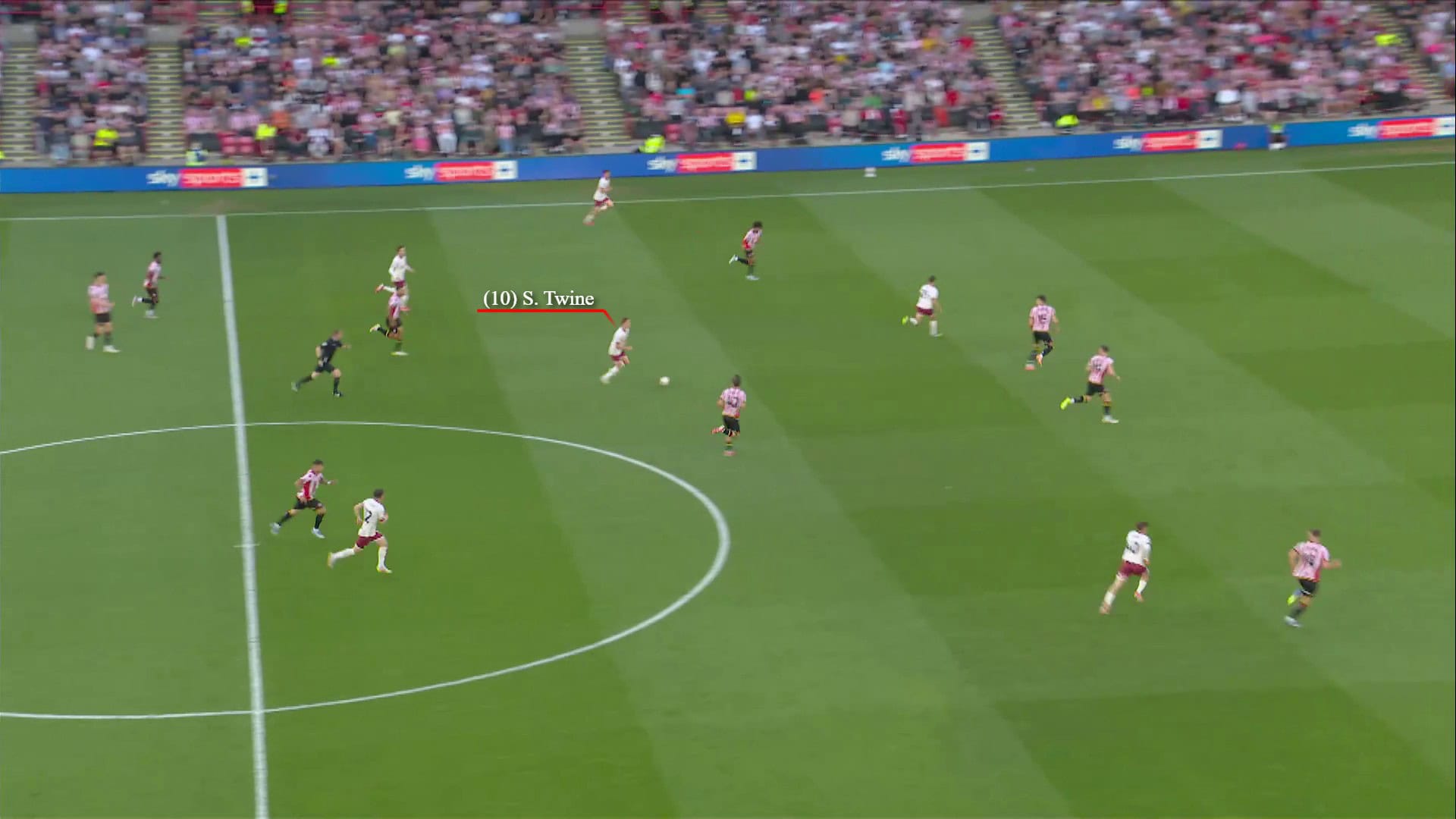
There is an emphasis on fluid positional play, where players rotate to pull the opposition out of shape and create exploitable gaps in central areas.
Liam Manning Formations & Tactical Adaptability
Liam Manning’s tactical flexibility is one of his greatest strengths.
Rather than adhering to a single system, he tailors his formations to his squad’s strengths and the demands of each match.
At MK Dons, he frequently employed a 3-4-2-1 or 3-4-3 formation, which provided defensive solidity in central areas while maintaining attacking fluidity.
These systems transitioned into a 5-4-1 out of possession, with the wing-backs dropping deep to form a back five.
In possession, his teams often adopt a 3-2-5 structure, with the wing-backs pushing high and wide, the inside forwards occupying the half-spaces, and the striker providing a central focal point.
This setup creates multiple passing options, and the team can overload different areas of the pitch as needed.
Manning may experiment with similar formations at Norwich, depending on the squad’s strengths.
Players like Borja Sainz, who thrives in wide areas, and Josh Sargent, who excels in pressing and link-up play, will be central to his tactical plans.
Borja Sainz Radar Chart
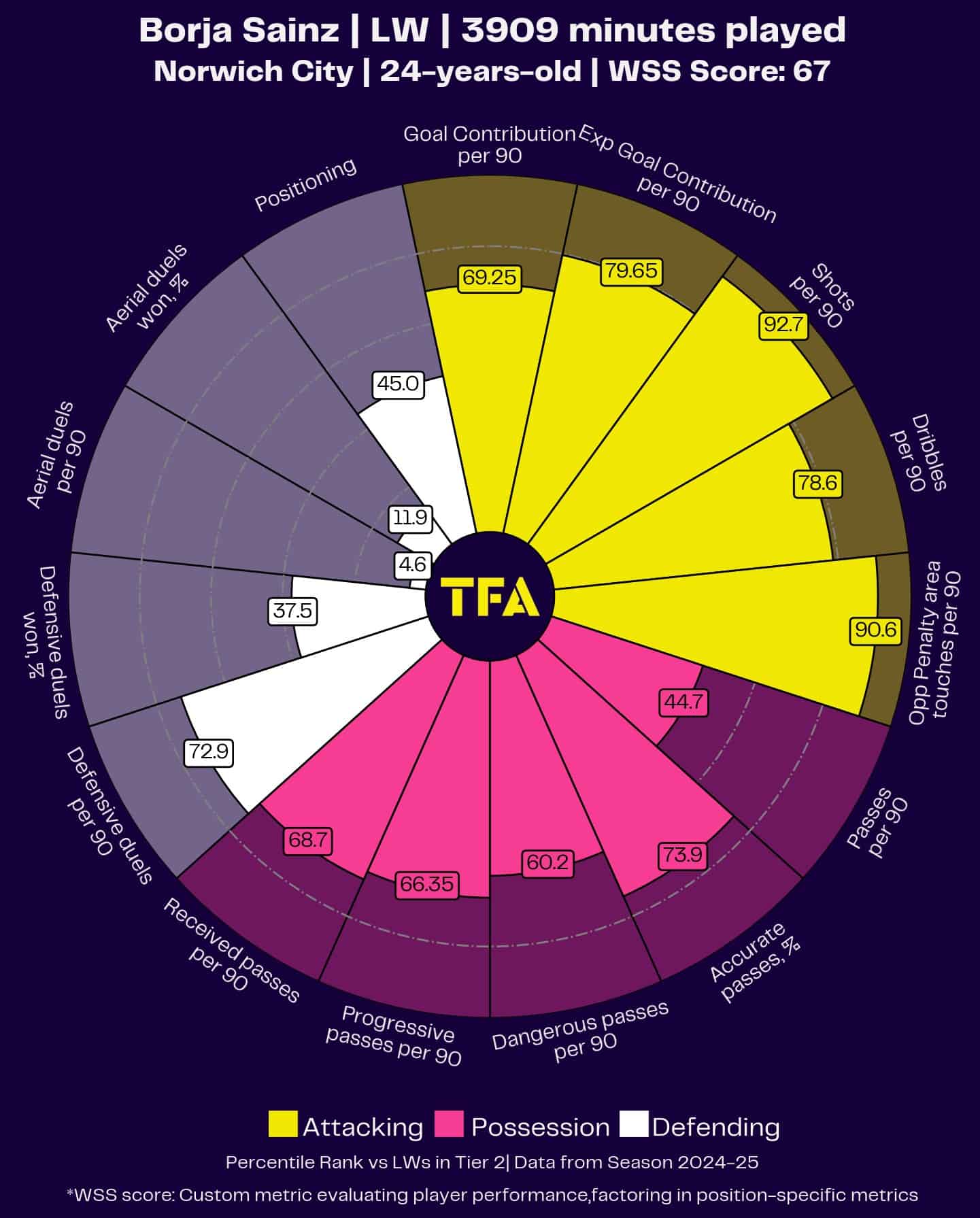
Borja Sainz is a left winger who excels in attacking and possession phases.
His standout metrics include opposition penalty area touches (90.6 percentile) and shots per 90 (92.7 percentile), indicating his ability to consistently penetrate dangerous areas and pose a key goal threat.
Sainz’s skill suits well with Liam Manning’s philosophy of creating wide overloads and exploiting 3v2 situations.
His high involvement in forward areas will be important for Manning’s system, where wide players are tasked with combining with overlapping full-backs and midfielders to stretch the opposition.
Manning’s emphasis on rotations and positional fluidity will allow Sainz to find space and isolate defenders to maximise his ability to cut inside.
Josh Sargent Radar Chart
Josh Sargent is a hard-working forward who thrives in transitional and pressing systems.
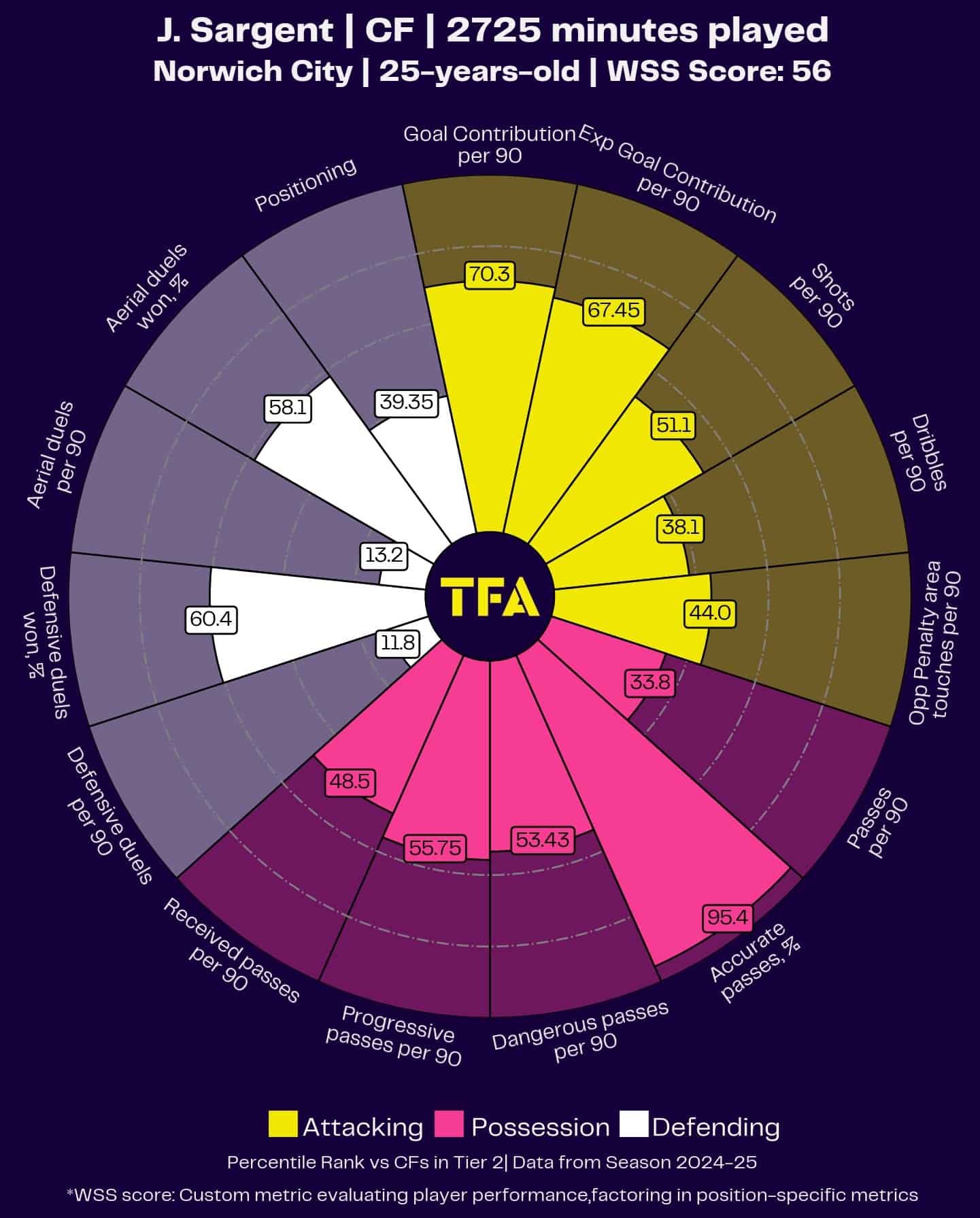 His goal contribution per 90 (70.3 percentile) and expected goal contribution (67.45 percentile) show his ability to finish and create chances.
Sargent’s pressing ability and work rate are suited for Manning’s counterpressing philosophy.
As the first line of defence, Sargent can lead the press, forcing turnovers and creating attacking opportunities.
