
MK Dons gained considerable attention last season under Russell Martin for their easy–on–the–eye, fluid, possession-based football style.
The team finished thirteenth in the League One table last season, and Martin was subsequently poached by Swansea City in the Championship after Steve Cooper resigned.
While results may not have been overly impressive, MK Dons were clearly progressing in terms of the team’s playing style, and the players had clearly responded to fresh ideas from such a young coach.
The board wanted to continue this project, so in August, it appointed the rather unknown Liam Manning as the new head coach.
Manning’s only managerial experience was with Lommel SK in Belgium, but the 36-year-old previously coached with Manchester City, West Ham United, and New York City FC in the United States.
Manning has been in charge for 20 matches so far and even picked up September’s Manager of the Month award.
The Dons have been playing some of the best football in England’s third tier and are extremely entertaining in possession.
They sit fifth in the division.
This article will be a tactical analysis of MK Dons under Liam Manning’s tactics.
It will be an analysis of the tactics in possession that the coach has deployed since he arrived at the Stadium MK.
Liam Manning formation, lineup, and personnel
Liam Manning’s preferred system with MK Dons has been the 3-4-2-1 or 3-4-3 when the wingers are wider, which drops to a 5-4-1 out of possession.
The Dons have used a 3-4-2-1 variant in 77 percent of their games this season.

Last season in the Belgian First Division B, the young coach preferred a 4-2-3-1, which he used in 75 percent of the team’s games.
This shows that Manning does not have a favoured system and uses the formation that best utilizes the players at his disposal.
Perhaps his vision is to switch to a 4-2-3-1 long-term with MK Dons, but he doesn’t have the personnel to do so at the moment.
It is vital to remember that formations are simply structures for maximizing the available players’ use.
One formation that has succeeded with one side may not work as well with another.
It is up to the coach to rectify this and set his team up most efficiently.
MK Dons are no strangers to using the 3-4-2-1; Martin used it in 21 percent of the team’s games last season alongside his preferred 3-5-2.
The players are suited to this structure, so Manning has kept things consistent for them.

Here is MK Dons’ typical starting lineup under the 36-year-old head coach.
One important aspect of Manning’s team selections is that they are quite consistent, although this continuity will almost certainly get more difficult as the season progresses.
Andrew Fisher is a decent goalkeeper for the Dons.
At just 23, the shot-stopper is comfortable and confident with the ball at his feet, which is a huge requirement for the team’s system, which will be analysed later in this article.
Dean Lewington, Harry Darling, and Warren O’Hora, the back three, also suit the head coach’s system very well.
There is a blend of youth and experience, but all three centre-backs are solid with the ball, comfortable playing out from the back, and, most importantly, playing forward.
Lewington, who was the caretaker manager after Martin’s exit, is also left-footed due to his past playing as a fullback.
So MK Dons have a left-footer at left centre-back, which gives them more possibilities in their build-up play.
The double-pivot ahead generally comprises Ethan Robson and Matt O’Riley, two really splendid forward passers, while David Kasumu is heavily rotated among the two.
Former Chelsea youth star Josh McEachran is also no stranger to game-time this season.
Daniel Harvie and on-loan defender Peter Kioso almost flank the pivot.
The pair keep the width and have been instrumental in providing assists for the team, with a combined total of 6.
Tennai Watson has also been trusted at right wingback too though as a rotation option for Kioso.
The forward line is rotated the most by Manning.
Scott Twine has started every game for the Dons in League One, while Troy Parrott, Mohamed Eisa, and Hiram Boateng have rotated quite a lot among the remaining two positions.
Use of Andrew Fisher in the build-up phase
Carrying on Martin’s principles of play, Manning wants his side to play out from the back and build their attacks from deeper areas of the pitch.
This invites the opposition to press, which leaves space further down the field if the Dons can break the press’s first and second lines.
Teams tend to use different approaches and MK Dons’ approach is one of the most intriguing and unconventional in England at the moment.
The goalkeeper has a heavy influence during the build-up phase.

When in this phase, MK Dons’ two wide centre-backs push high and wide while the central centre-back shifts to the edge of the box to accommodate the goalkeeper.
The goalkeeper pushes up alongside the central defender and plays as a temporary ball-playing defender.
This is the reason why Fisher needs to be comfortable with the ball at his feet.
It could be catastrophic without doing so as the keeper is out of his goal.
This is a high-risk, high-reward strategy as it gives the Dons an extra passing option in the deeper areas of the pitch.
Of course, it can also leave the team very susceptible to conceding should they lose possession through the opposition press or make an error that leads to a turnover.
Ahead of the backline is one of the pivot players who drops shorter than his partner to receive.
His main aim in possession is to play outside to the wide centre-backs, who can then take the ball forward and advance the team further up the pitch.
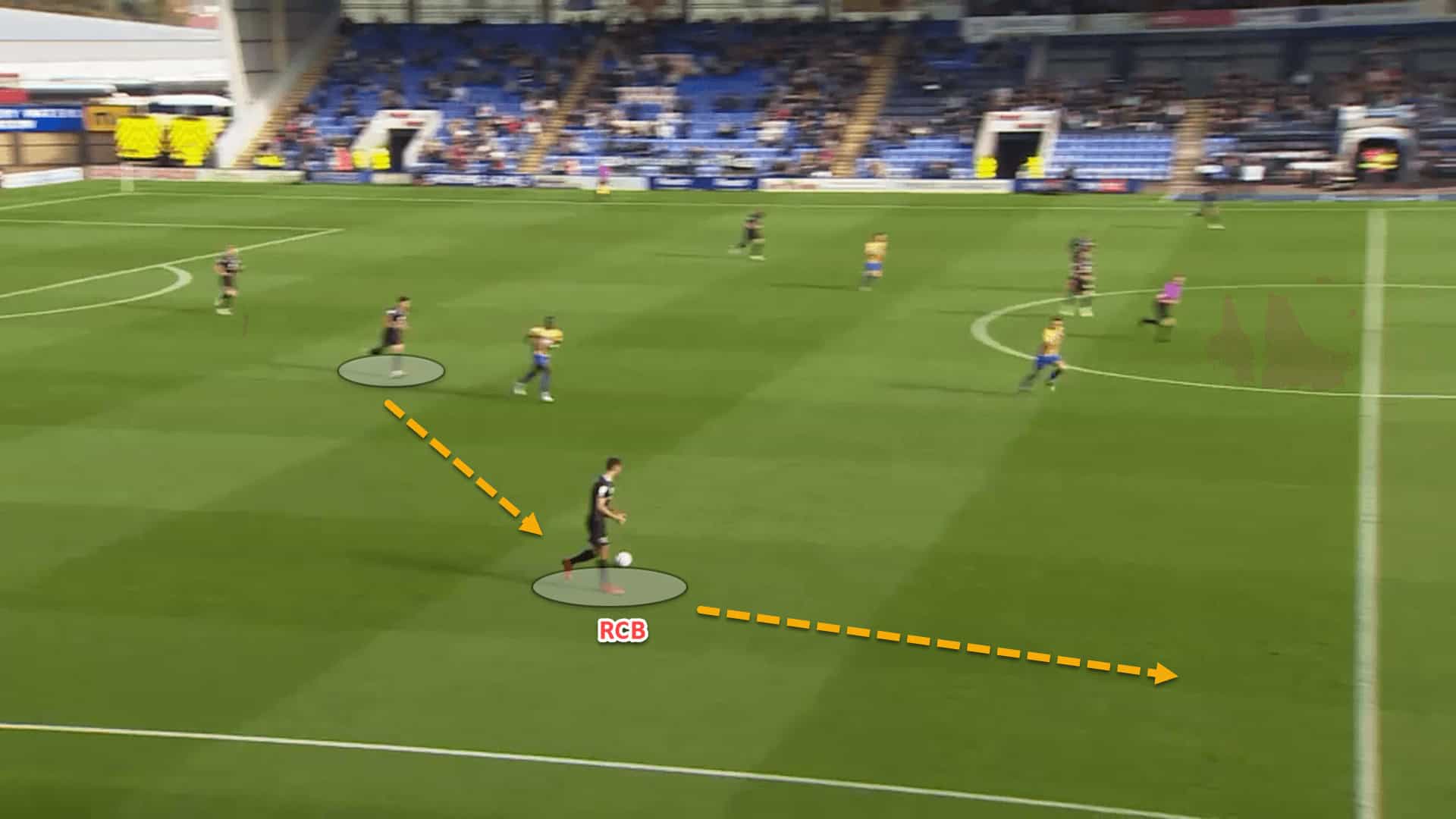
In the build-up phase, or in deeper areas of the pitch, MK Dons overload the central areas and the space between the lines with their double-pivot and front three.
This generally forces the defending team to stay compact, even when pressing high, which leaves space out wide.
The goalkeeper or central defender can play a simple pass into the feet of the deepest midfield pivot player who acts as a wall-pass and plays out wide to one of the wide central defenders who are free in space on the flanks.
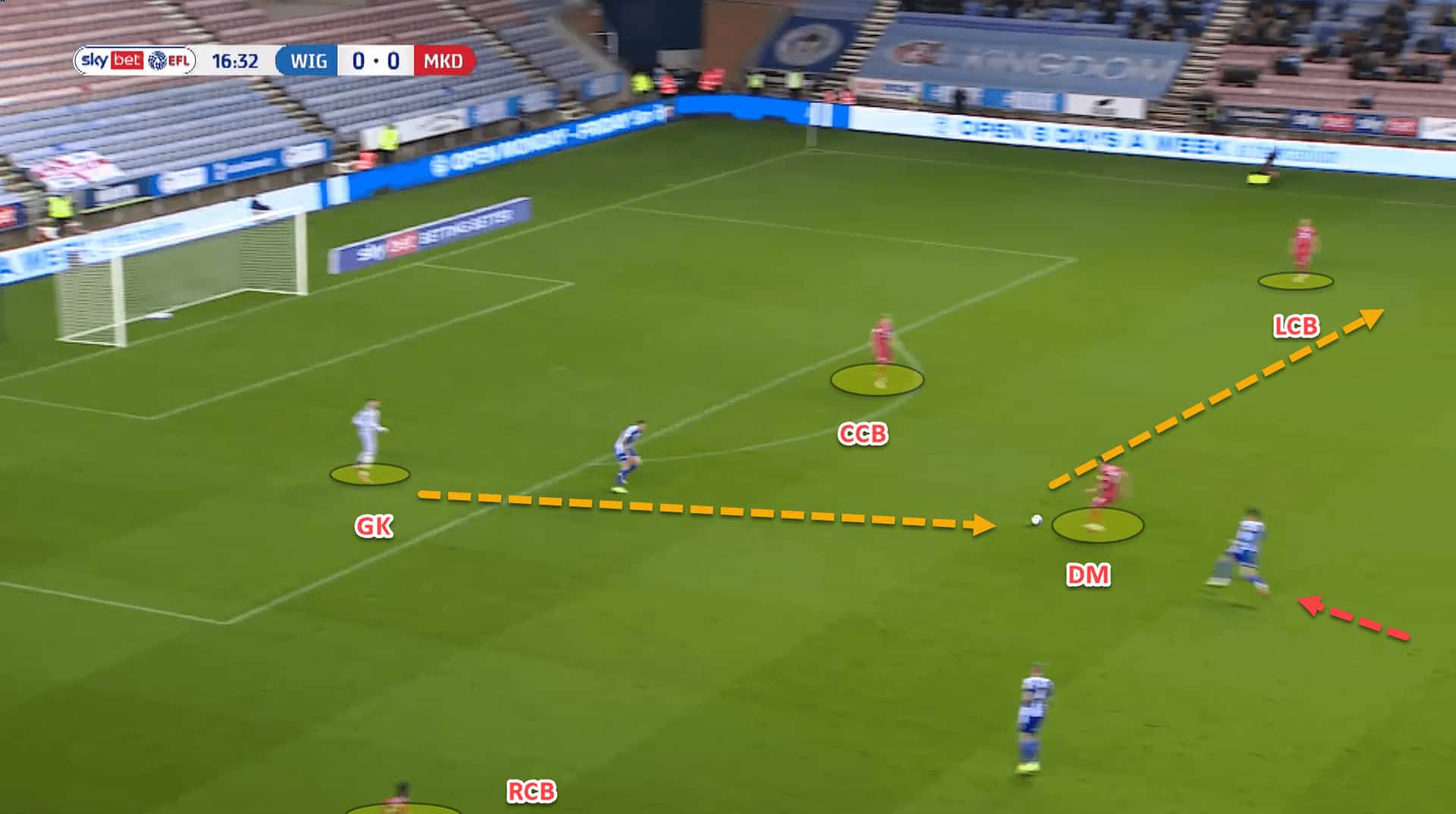
This is an effective and efficient passing pattern, which has been outlined in the previous two images.
MK Dons’ build-up play has been impressive in League One this season.
Manning’s side has had more build-up attacks than any other side in England’s third tier this season, with 48.
Ipswich Town are second with 32 which shows the demand the coach has for passing out from the back.
The Dons have also had the highest number of passages of play with 10 or more passes with 186 so far this season.
Again, this is the most in the league.
They sometimes make it look easy, which is a massive credit to the head coach.
However, for all their passing glory, MK Dons are no stranger to a long ball.
In fact, the Dons have had the eighth-highest number of direct attacks in League One with 26 so far this season, while they are averaging 45.94 long balls per 90.
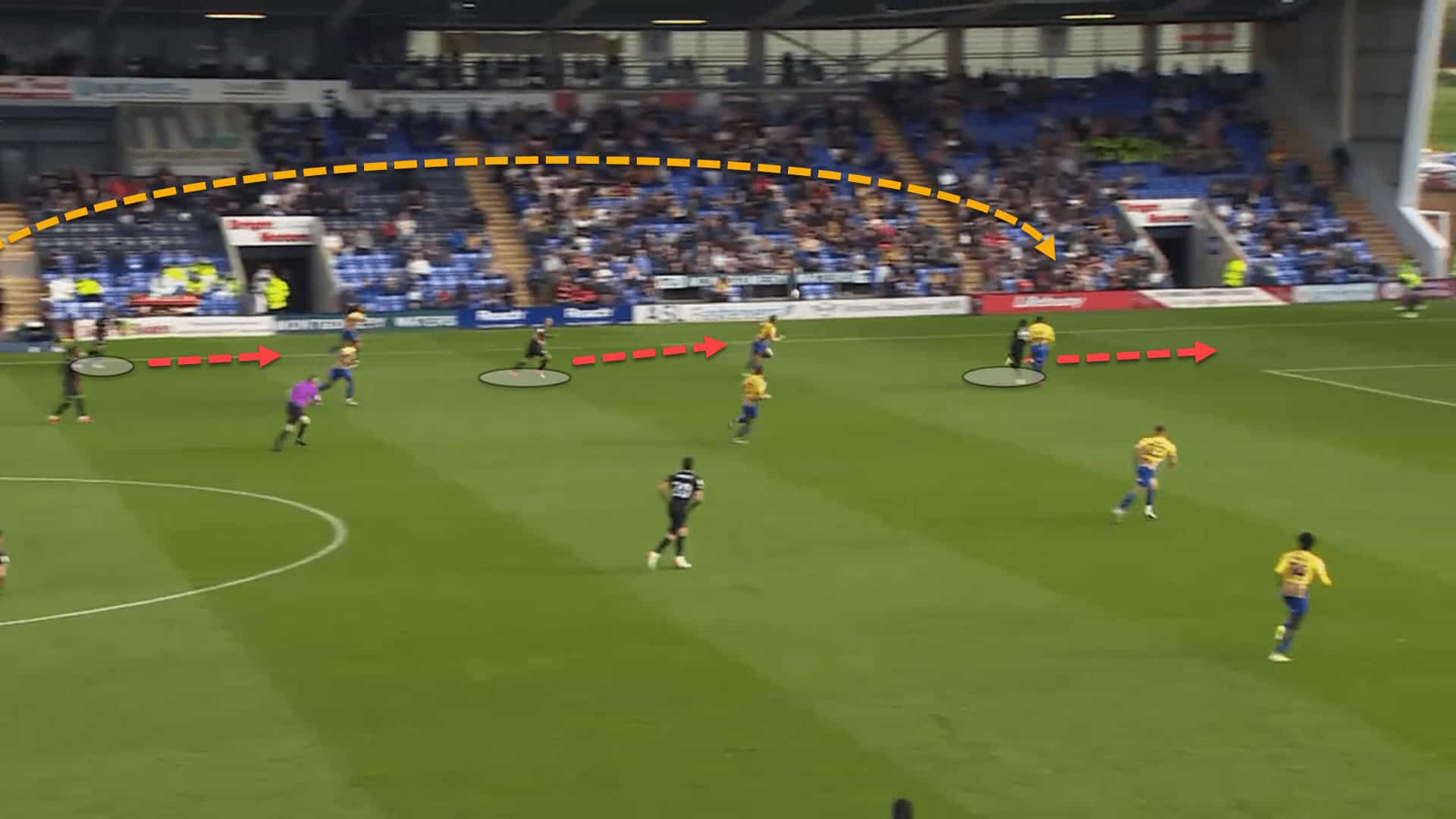
When this happens, MK Dons skip the build-up phase and even the second phase to move quickly into the final third.
These long passes are completed in moderation, though, and are only played if there is a runner in the channel between the opposition’s fullback and central defender.
While being able to play out from the back efficiently is a great trait, it will not always work.
Manning understands this and so has given his players the license to play runners in behind too.
High line to counterpress
When MK Dons have the ball in the middle third of the pitch and are looking to break down the opponent’s deep defensive block, otherwise known as the ‘positional attack’ phase in the analytical world, Manning sets his team up in a 3-2-5 structure.
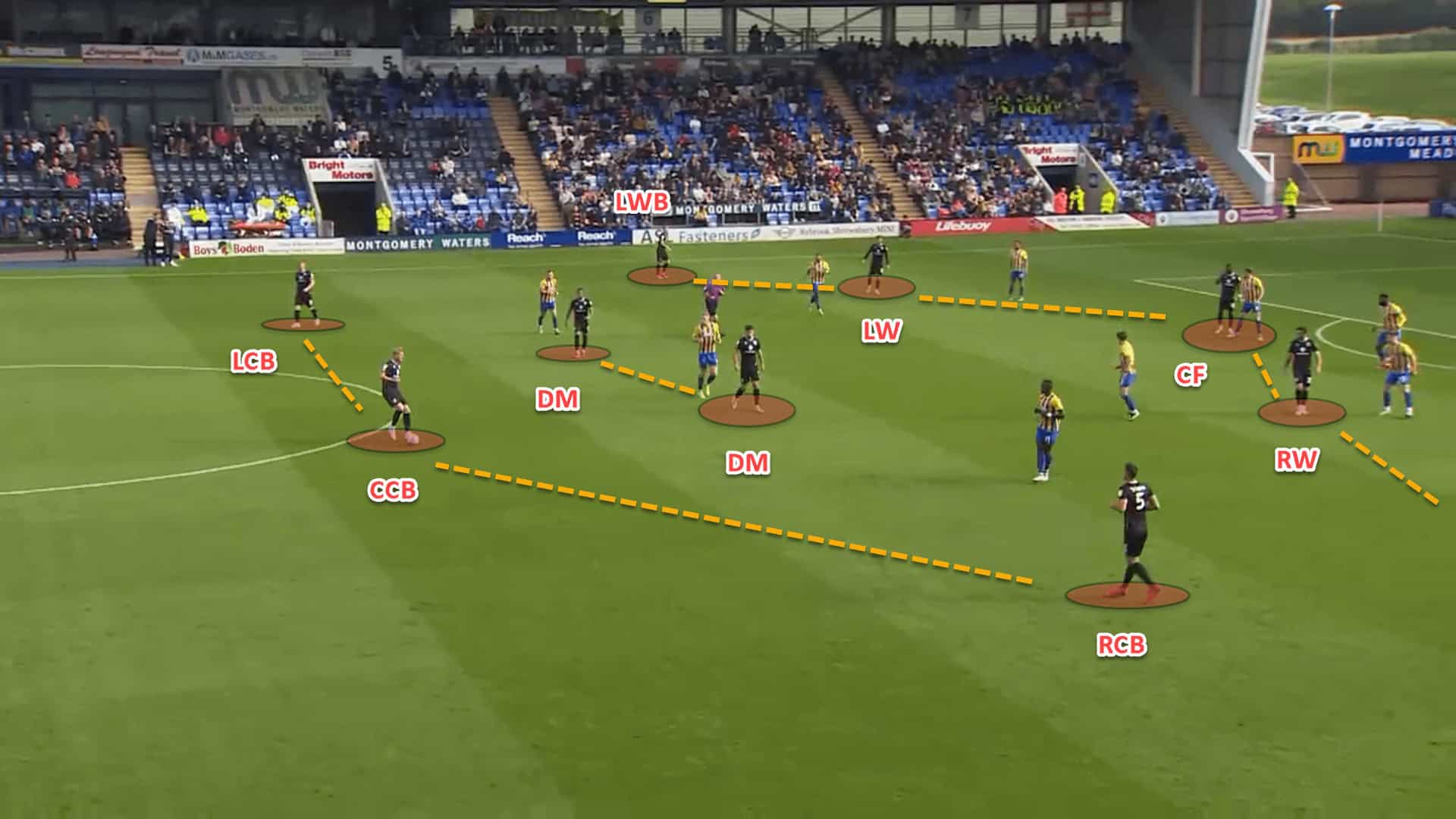
The wingers keep the width on the flanks while the wingers push inside and play in the half-spaces of the pitch in between the lines.
The double-pivot is tasked with sitting behind the opposition’s first line of pressure, moving into space to receive, and circulating the ball from one flank to the other to create holes in the defensive block.
The 3-2-5 shape in possession is evident from their pass maps.
Here is just one example of a pass map from MK Dons’ recent 4-1 league victory over Crewe Alexandra.

The centre-backs push very high into the opponent’s half to allow for shorter passing options and easier space manipulation.
These short passes can pull the defending players out of position.
This does leave them quite susceptible at the back to direct counterattacks due to their deployment of a high line but, once again, the strategy here is high-risk, high-reward.
If the defending team wins possession, the Dons can press very efficiently as numerous players are close to one another.
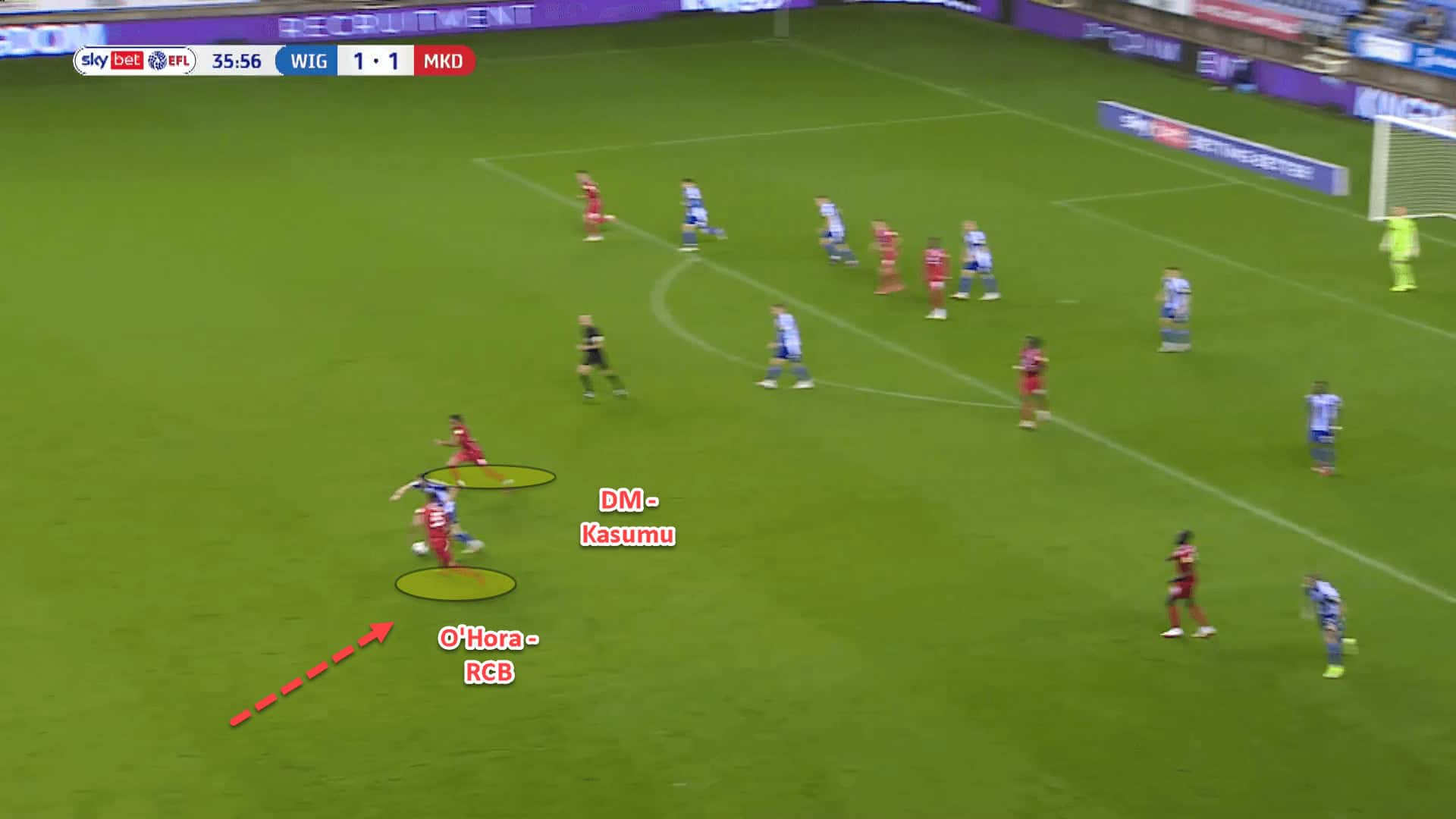
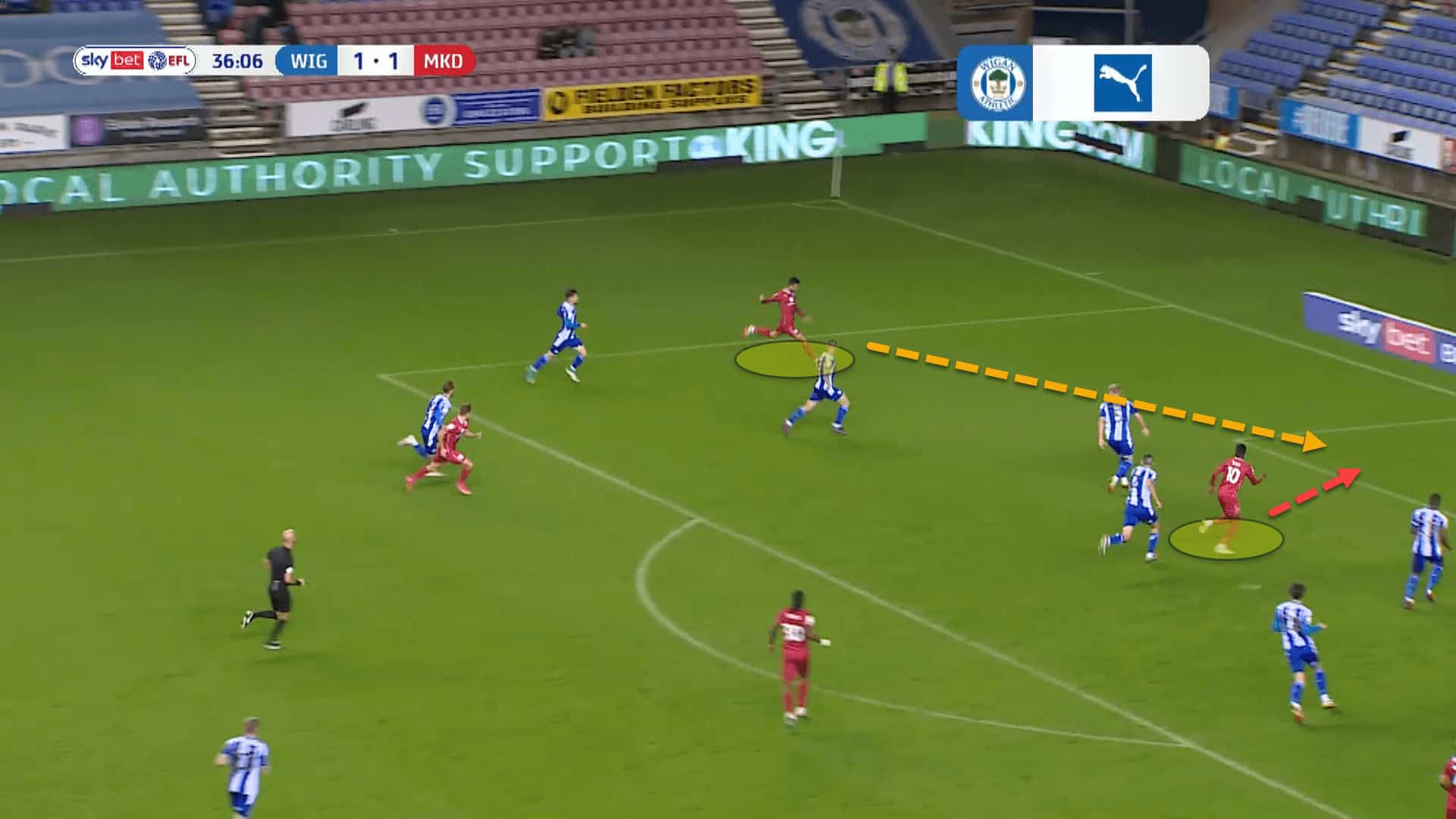
For instance, in this example from a recent 2-1 victory against Wigan Athletic, the Latics have regained possession and are now trying to counterattack as quickly as possible.
O’Hora steps up from his high position alongside Kasumu to counter-press.
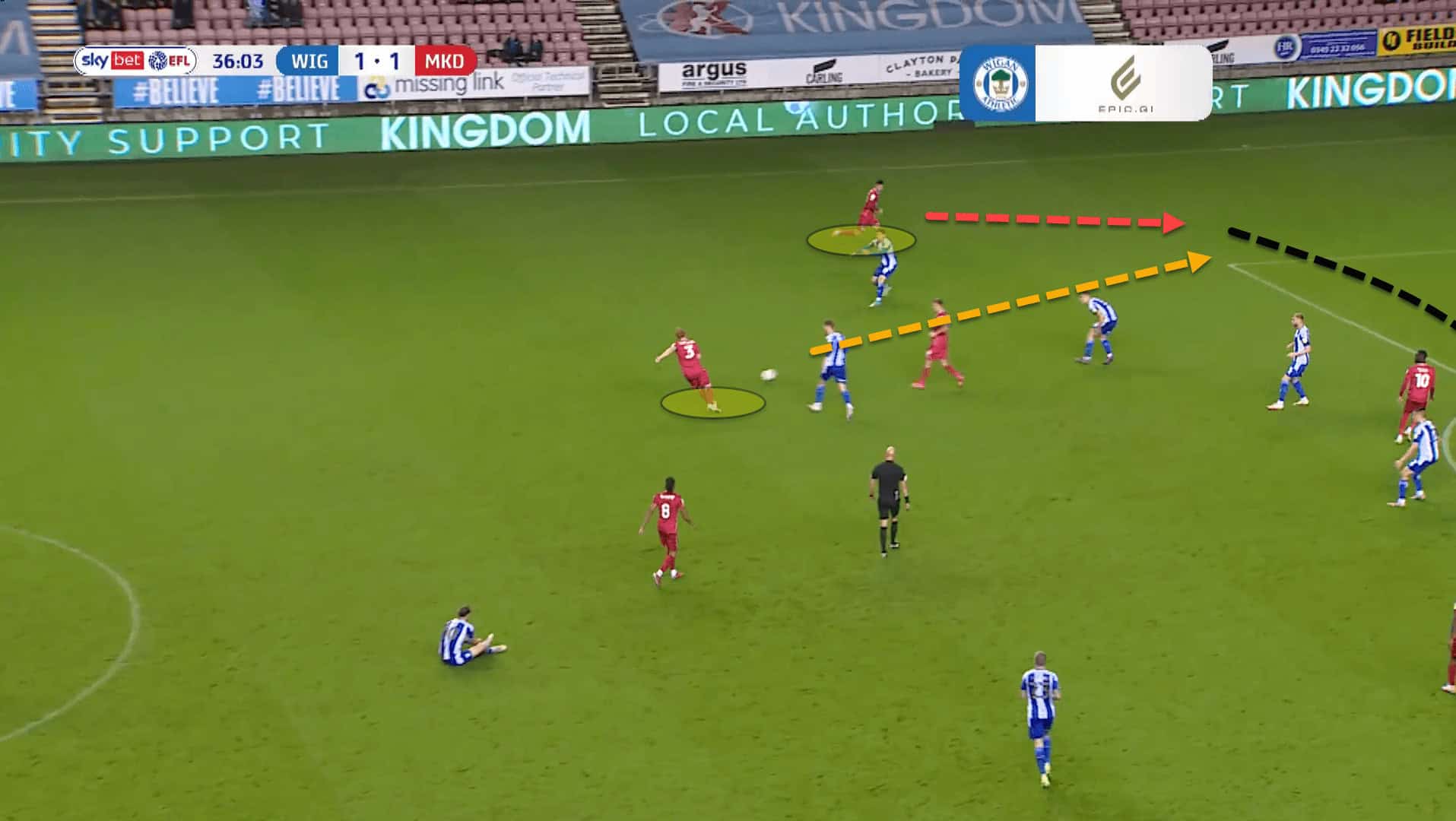
This is successful, and the ball is played across to the left centre-back in the left halfspace, who slips in the wingback.
The wide man’s cross is poked home for an excellent goal that even Jurgen Klopp would be impressed with.
Using the halfspaces to break down a defensive block
Overall, when attempting to break down a team’s deep defensive block, Manning instructs his side to play through the half-spaces to players between the lines.
The wingers excel in the halfspaces and need to gain positional superiority to be effective.
What is positional superiority, you may ask?
Essentially, positional superiority is gained when a player is in an excellent position between the lines and has room to receive, turn on the ball and play forward.
To get the ball to this area, though, MK Dons tend to create overloads, doubling up in the halfspace.
The overload is generally completed with one of the wide centre-backs, the ball-near wingback, the closest winger, and the nearest pivot player.
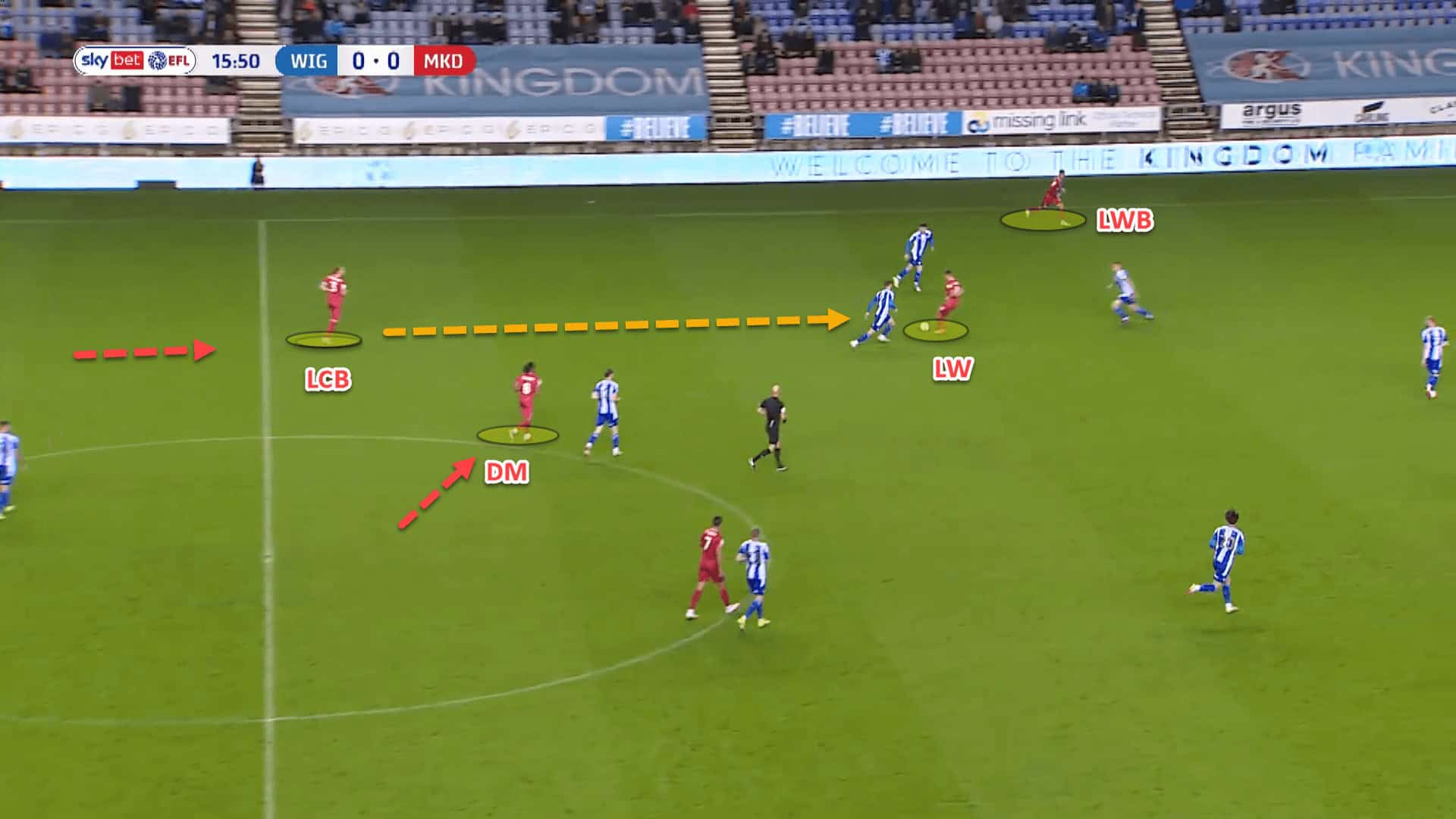
By overloading the wide areas, there are more players to mark for the defending team.
Intelligent or quick passing combinations can help them to find the winger in the halfspace as there will be increased space and more players to manipulate the opponent’s positioning.
Upon reception of the ball in this area, the opponent’s defensive block automatically narrows as the defending players will be looking to try and stop the ball carrier from playing forward.
Then, the winger can slip it out to a wingback.
As the defending team comes narrower, space opens up out wide.
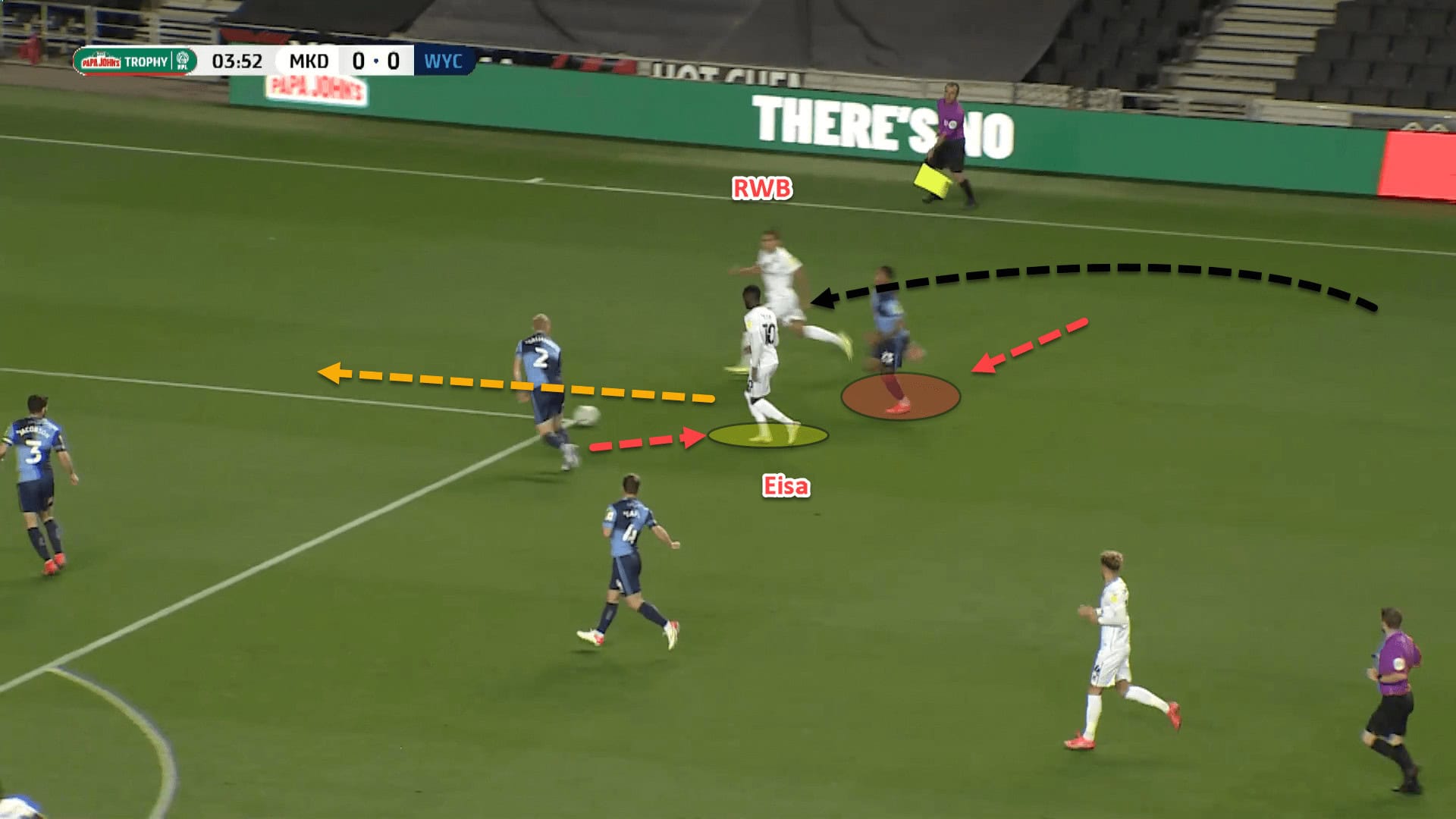
Here, Eisa has the ball in half-space.
By natural reaction, the Wycombe Wanderers defenders narrowed to try to swarm the Sudanese forward, which left space out wide for Watson to overlap and put a ball into the box, which was converted home.
MK Dons are averaging 12.33 crosses per 90 in League One.
Their accuracy on these crosses has averaged out at 37 percent, which is the fourth-highest in the league.
Manning’s side have shown that crossing the ball is a really efficient method of goalscoring for them.
Generally, their crosses come from just at the edge of the box and are whipped low and hard to the feet of the centre-forwards and around the backline rather than floating over the top.

Here is a map of all of MK Dons’ crosses from a recent game against Aston Villa’s U21s in the Papa John’s EFL Trophy.
Most of the crosses are coming from the area just at the edge of the box, inside the box, and just past the 18-yard line.
Overall, the Dons have scored the third-most goals in England’s third-tier, with 31, an average of 1.77 per 90.
Almost 20 percent of their goals have come from outside the penalty area too which is interesting.
Manning’s men have also overperformed their xG this season.
Currently, their xG stands at 25.98 in the league, meaning MK Dons are overperforming by almost 5 goals.
The Dons boast an xG per shot of 0.12, though, which is rather high.
Conclusion
The new head coach has transformed this MK Dons team from a side that plays attractive, possession-based football to one that has held on to these principles while being far more efficient in front of goal and safer at the back through the team’s counter-pressing structure.
The Dons are fifth at the moment in League One, and if they manage to stay in the play-off spots by the end of the season, there is a great chance we will see Manning’s side promoted at the first time of asking.
