
There are a bunch of teams in La Liga that struggle with scoring goals this season.
Eight teams are currently sitting at below one goal per game, and especially in the relegation battle, pretty much all of the teams heavily struggle with creating opportunities for themselves.
One of those teams is Valencia CF, with their manager Carlos Corberán.
It all seemed like a miracle just a year ago, when the young Spanish manager took over his boyhood club, turning around a dire situation quickly and guiding the club out of the relegation battle into the top half of the table.
Now, the team has only scored 16 goals in 17 games and ranks in the bottom-third in pretty much every single attacking statistic, which caused them to only win one out of their last 12 league games.
Valencia is back in the relegation battle because of their struggles in attack, currently sitting in 17th place with just one point to spare compared to FC Girona in the relegation zone.
So, in this Valencia tactical analysis, we will look at how Valencia play with the ball under Carlos Corberán this season, why this style of play causes problems for the team, and which areas they need to improve to get out of the relegation fight in 2026.
Valencia Triangles On The Wing
Looking at the way Valencia play in possession, especially in the attacking stage of play, they often try to get their final breakthroughs on the wings and then cross the ball into the penalty area.
Corberán has a very interesting way of finding the space behind the opposing team’s backline, mainly through rotations in the triangle and through passes.
Los Che are often trying to get wide very early on when they progress their attacks through the middle third, and they rank in the top third in the league in total crosses so far this season.
Most of the time, Corberán pushes his wingers in his 4-2-3-1 formation into the half-spaces while the full-backs are the ones actually providing the width, but positional rotations are a key part of Valencia’s attacking play.

Here we can see the very typical triangle for Corberán’s team on the right side in their game against RCD Mallorca.
In this case, the right winger, right-back, and right central midfielder formed a triangle and established possession on the wing.
The other players are moving away from them, pretty much isolating the triangle on their side, preventing additional defenders from helping the players already covering the three players in the triangle.
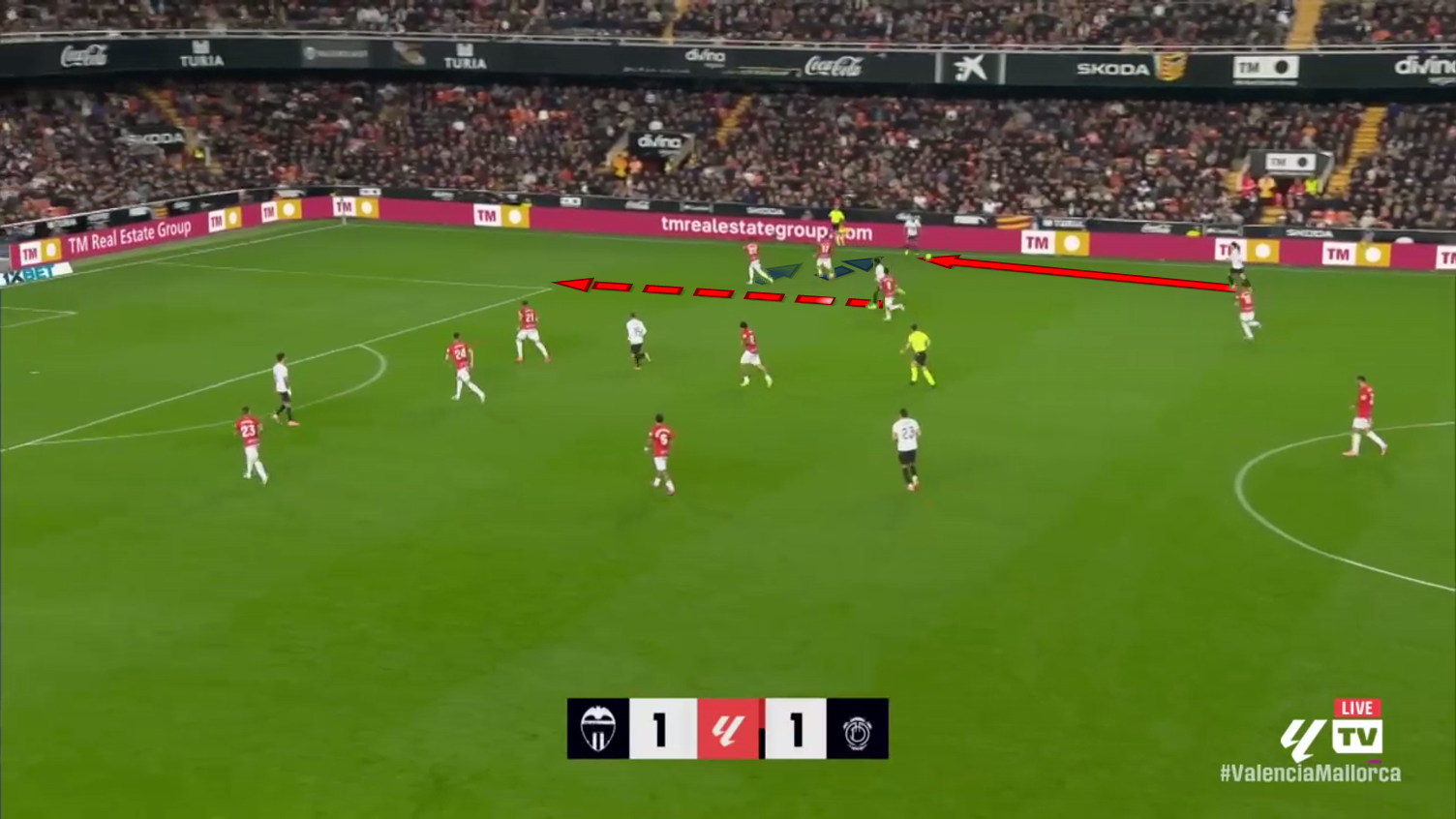
From there on, the three players rotate in the triangle after playing their passes, often moving forward, while the third man falls back to secure the space behind them.
Their key principle is relatively simple.
One player positions himself right at the sideline, dragging multiple defenders towards him, opening up a hole between the centre-back and the full-back in these situations.
While the ball is played, the third man is making an underlapping run right into the gap that opened up.
In this case, Thierry Correia is the one making the run, one of the quickest players in La Liga over the last couple of years.
They can then play a through ball from the wing into the half-space, creating an opportunity for a cross for their right-back here.
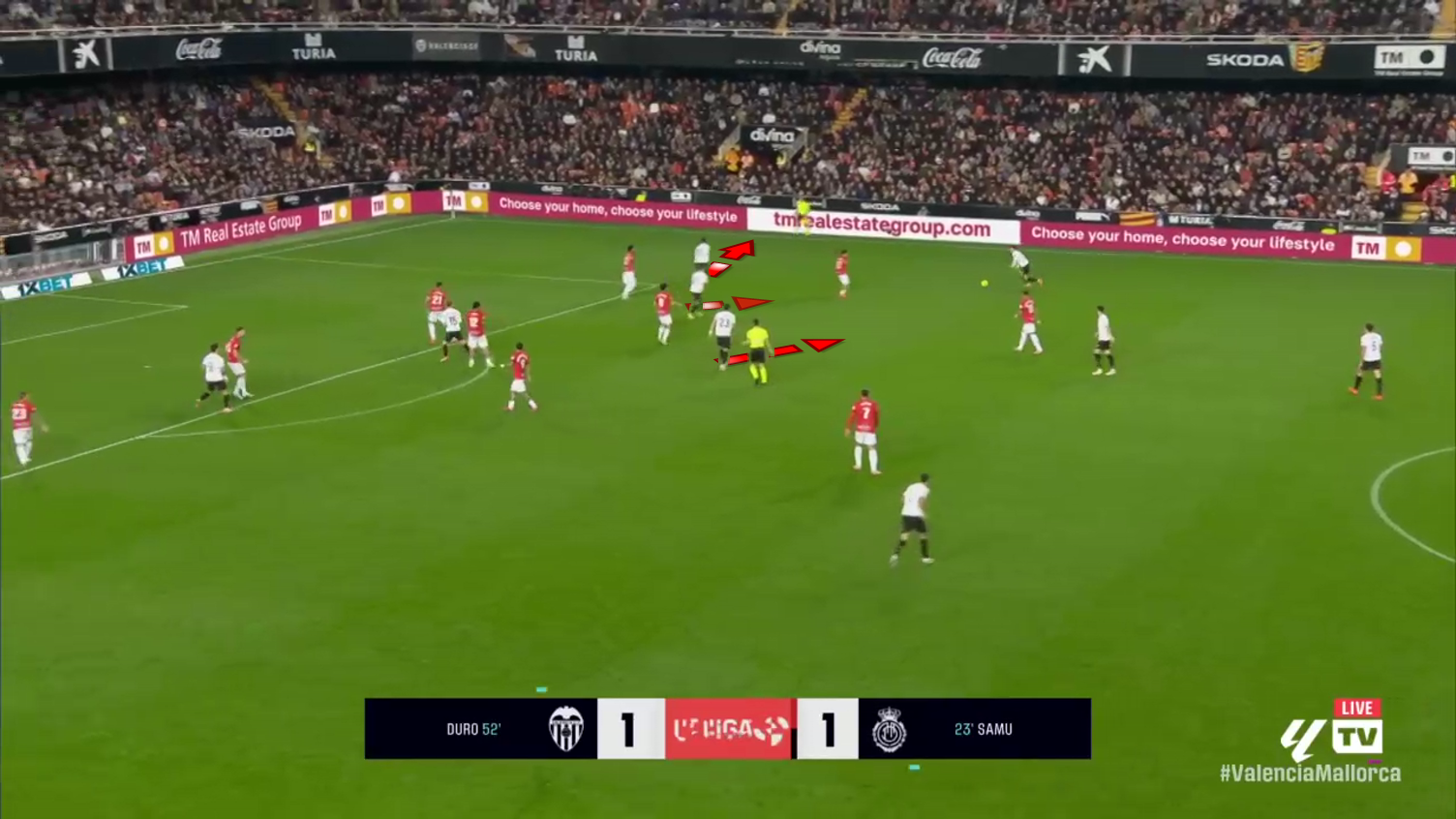
But here is where their struggles begin.
Often, the players see the run, but do not take the risk of actually playing the through-ball towards the space behind the backline.
In this case, Luis Rioja opted to cut inside rather than play the vertical pass, and the situation lost all its tempo.
Then, they swarm the ball instead of just forming another triangle.
Too often, multiple players drop into the space near the ball, and they have to adjust their positional play a second time after winning the ball, costing them valuable time again.
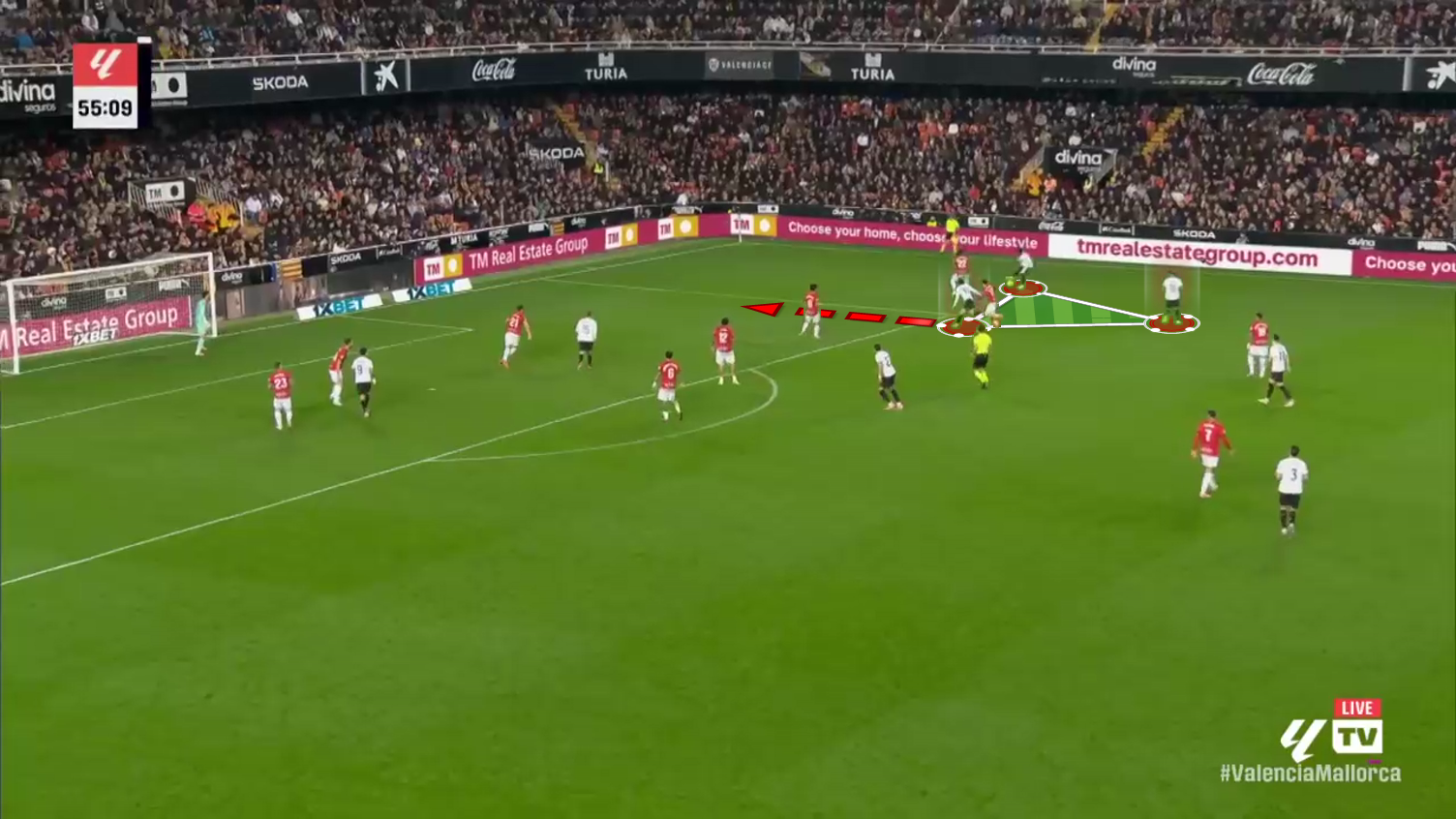
Then the team returns to the same pattern of play, forming a triangle on the wing and playing the ball towards the outside, with the third man making an underlapping run into the box.
Again, they fail to thread the ball through the gap, actually use the principle they want to use, and are instead forced backwards by Mallorca once again.
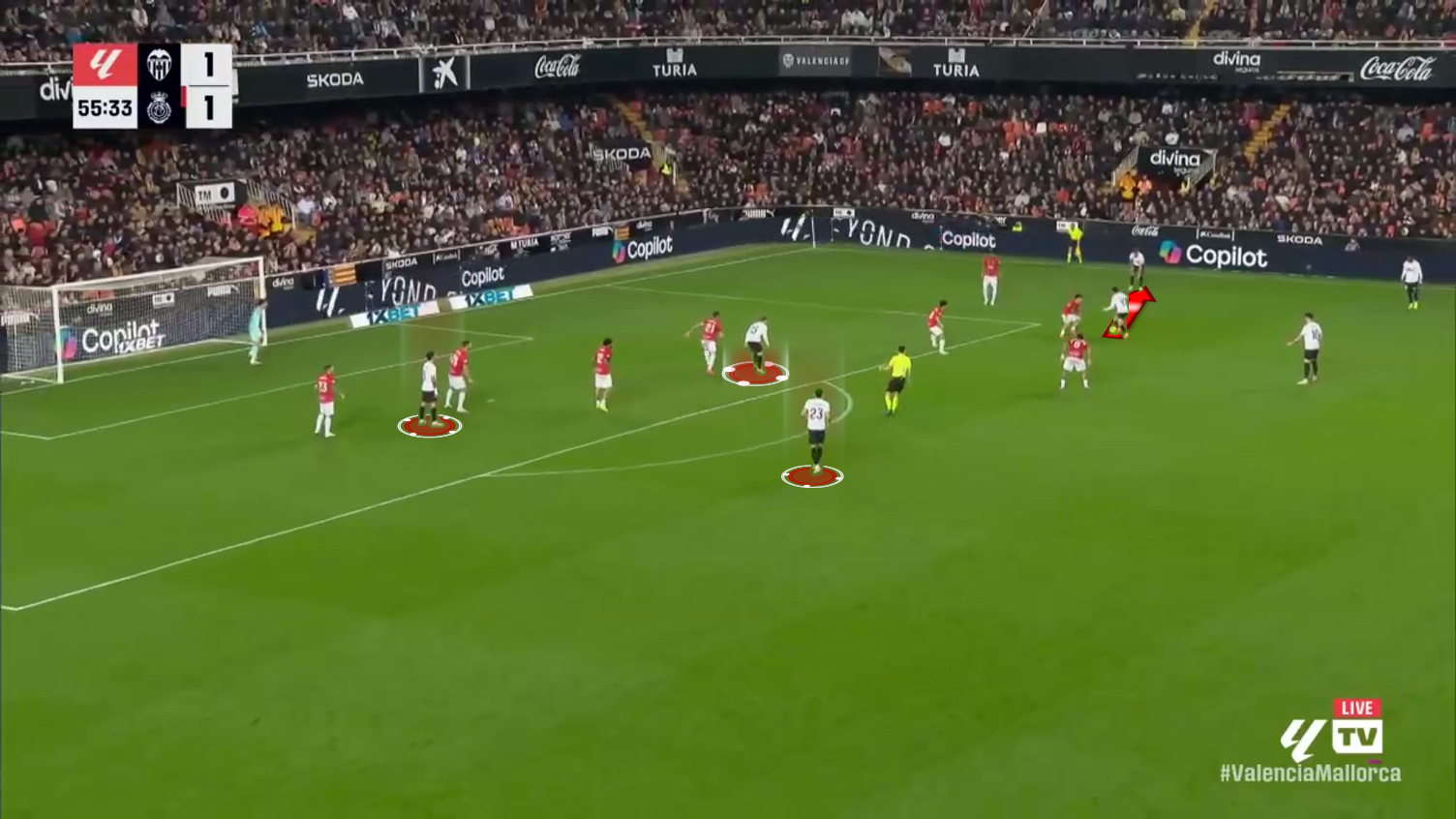
In the end, they get stuck in the triangle and do not find a solution to actually attack the backline or maybe find a switch to the other side.
This often forces Valencia into crosses from outside the final third, meaning they are just not played out of dangerous positions and are easy to defend.
Another problem is their poor presence in the box; only two players are actually there to receive the ball, and the near-sided one has poor positioning anyway.
One midfielder covers the area at the edge of the box for second balls, but it isn’t an option for a cut-back here.
This just means that many Valencia attacks, despite having a clear idea behind them, end in bad crosses that are easily defended by the opposing teams.
Valencia Trouble With Finding Structure
Looking at how Carlos Corberán lines up his team, it’s very fluid and stretched out.
While he prefers to use a 4-2-3-1 or, sometimes, a 4-4-2 formation, the players do not really hold their positions when attacking the opposing team’s goal.
While this makes Valencia harder to read and prepare for, it also creates a lot of chaos for Corberán and his men as well.
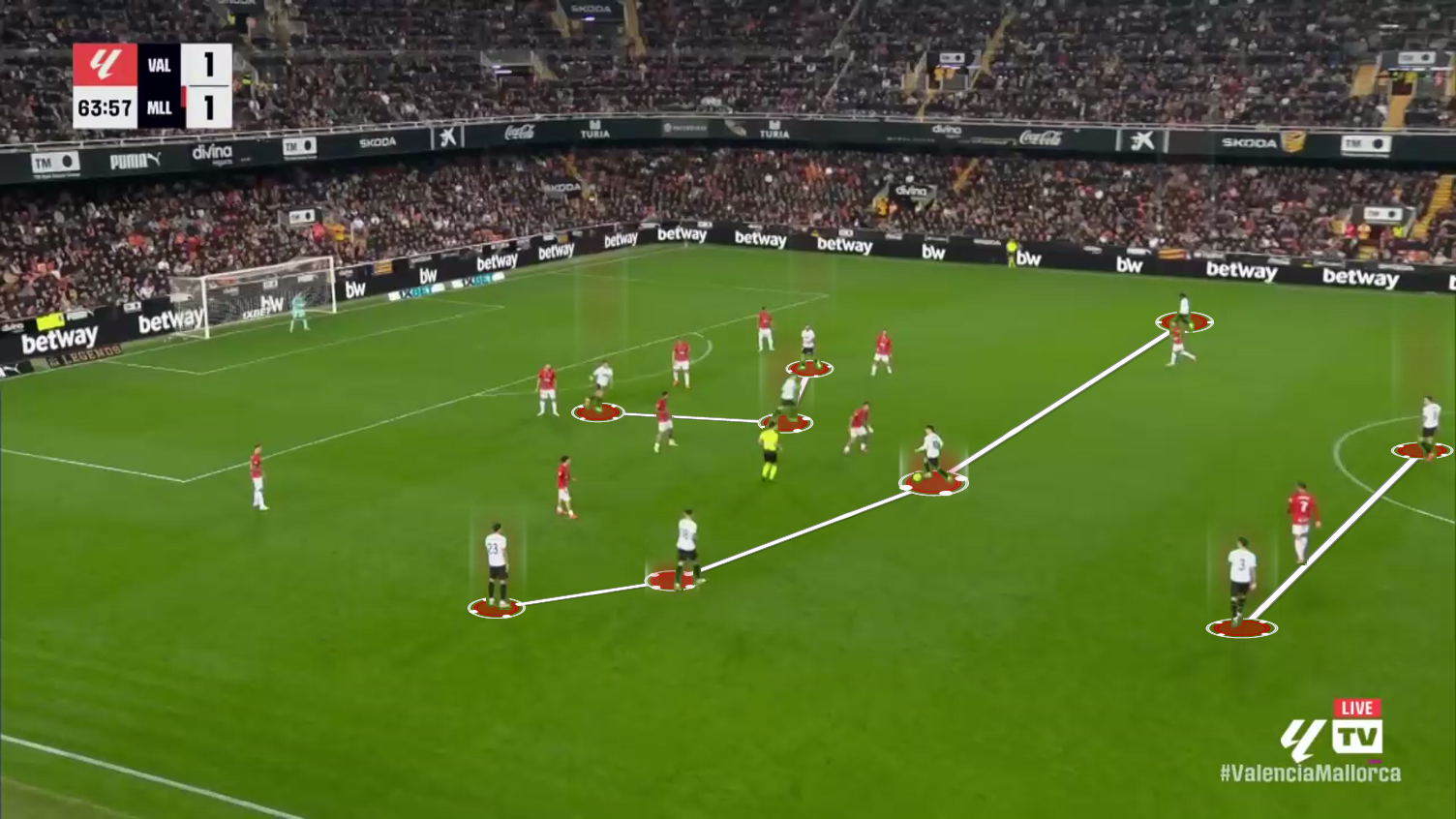 In the picture above, we can see the structure Valencia uses in their attacking phase.
Skipper José Gaya is not in the picture; he is near the left sideline in this situation.
The three attacking players are hunched together in the centre of attack, while the three midfielders are in one line, shifted to the left side here.
Correia stays very wide on his right side, so in the end, Corberán wants to overload the left side and the centre and isolate his two full-backs.
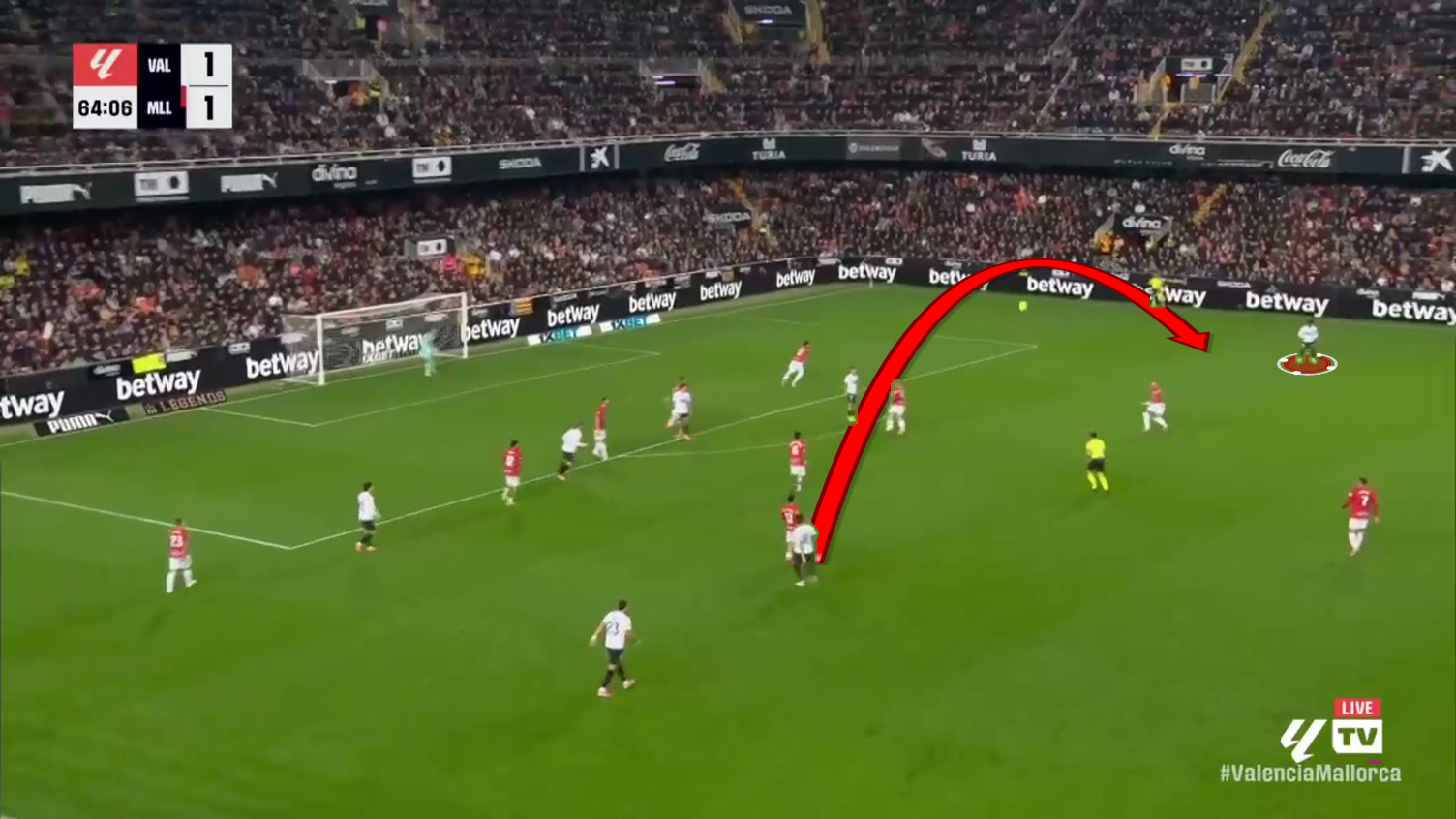
Valencia overloads to isolate and often plays diagonal switches with long balls, in this case to their right side.
More often, they target Gaya on the left for these types of passes.
Gaya has an elite first touch and is just way more dangerous in the final third compared to Correia on the right, who only has one goal and five assists in 133 games in La Liga in his career.
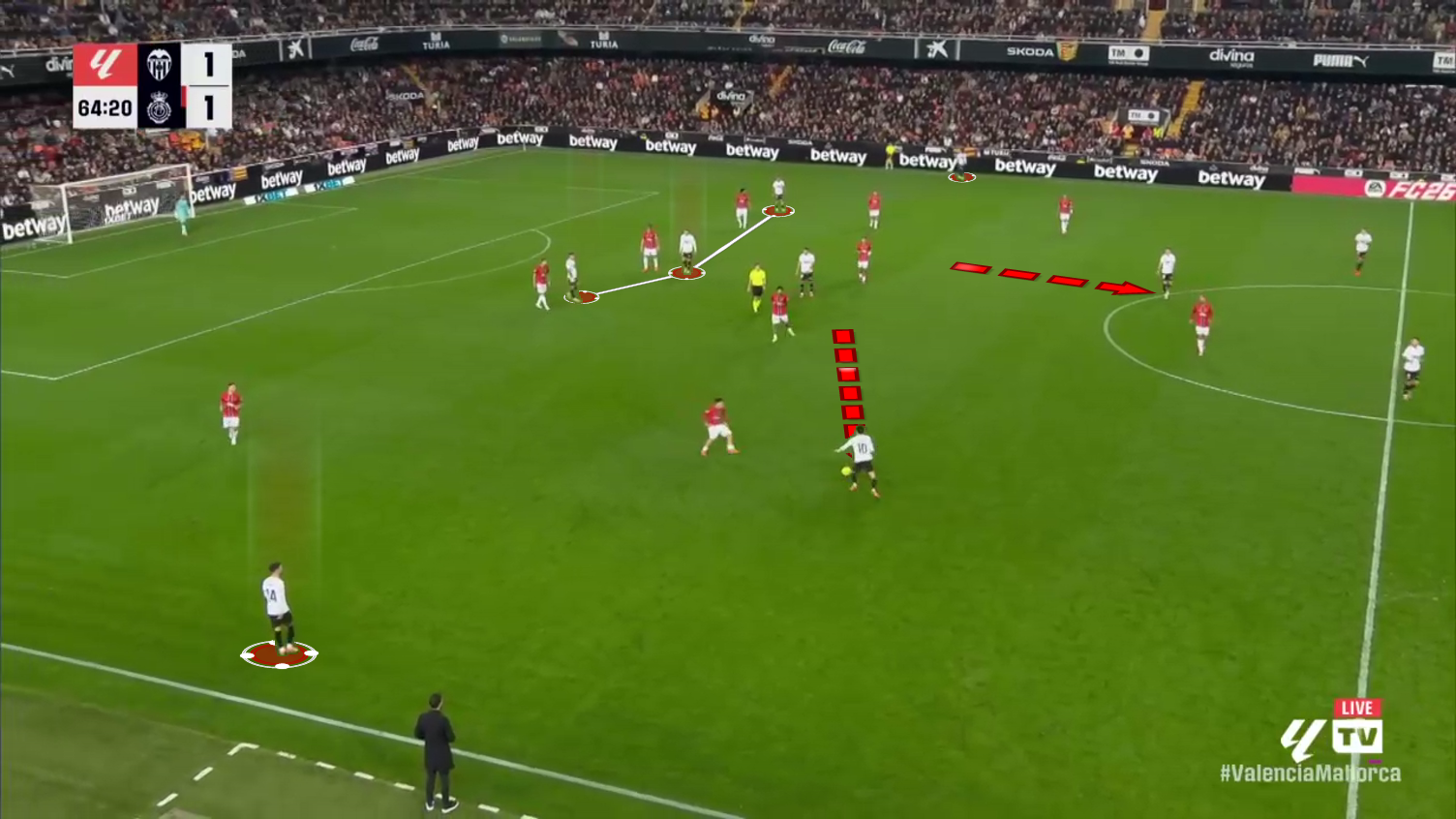 Corberán really prioritises width and always has his two full-backs near the sideline to stretch out the effective playing space and get them in isolated 1-v-1 situations.
The other players are always very narrow in the centre of the field, and the attackers stay high up the field, putting some pressure on the backline.
This creates a lot of space, especially in midfield, and Corberán wants his midfielders to move into the open space and create dynamism that way.
While the idea is good and the Valencia midfielders often find themselves in space, the details of who and when are supposed to move into what space are just not there.
In the situation pictured above, two midfielders dropped back, creating a problem for André Almeida on the ball because he now lacks passing options, despite playing towards the wing again.
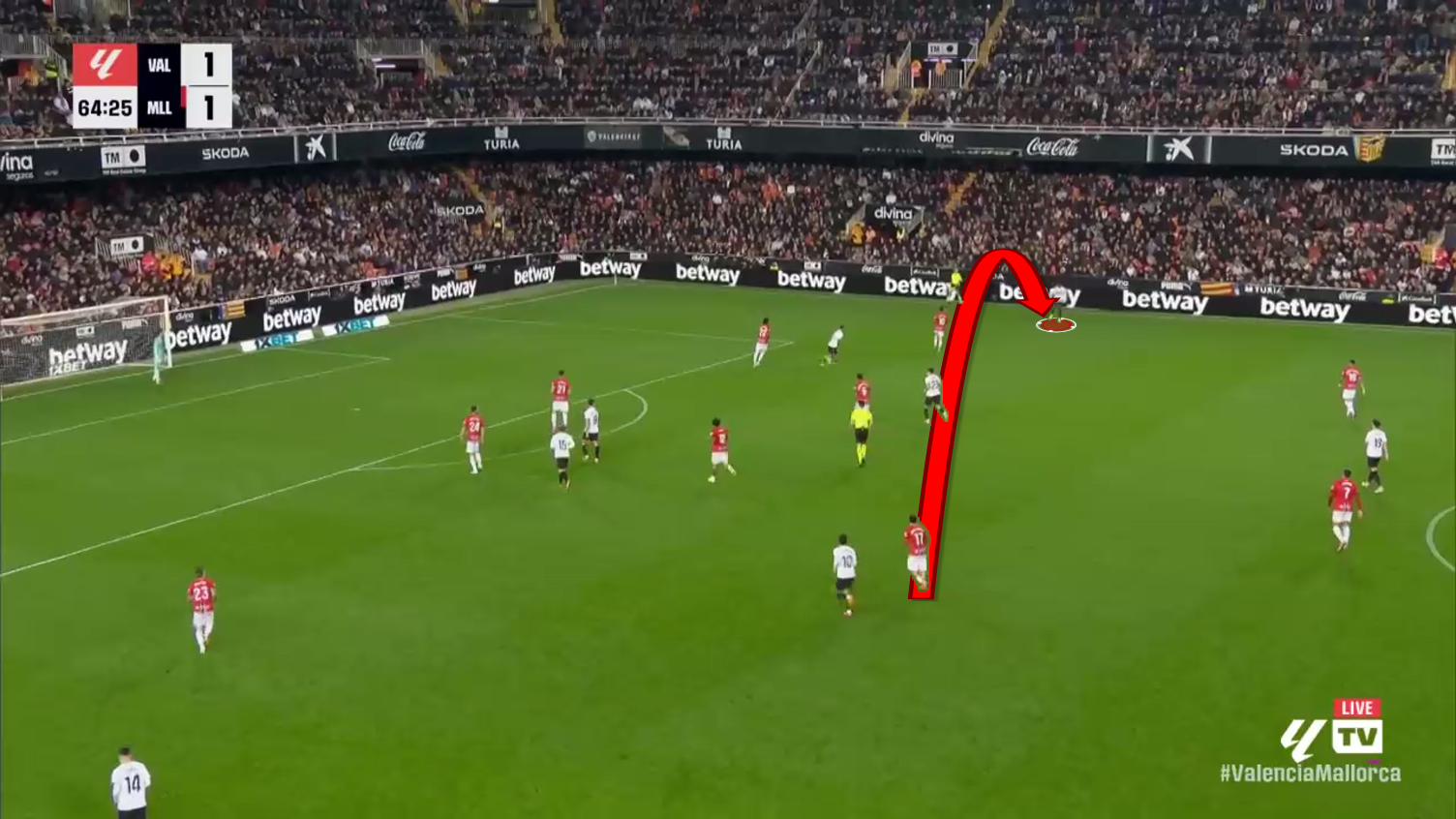
In the end, they are forced to play another switch to Correia, but these passes are just so hard to play and hard to control for the full-back as well, resulting in him having to move backwards and Valencia to build up again.
These problems lead to Valencia not having enough control over the central areas of the field, and while they definitely want to play through the wings, you need to somehow get to the centre to score, so it’s a huge issue for them at the moment that they can’t find any combinations in that area.
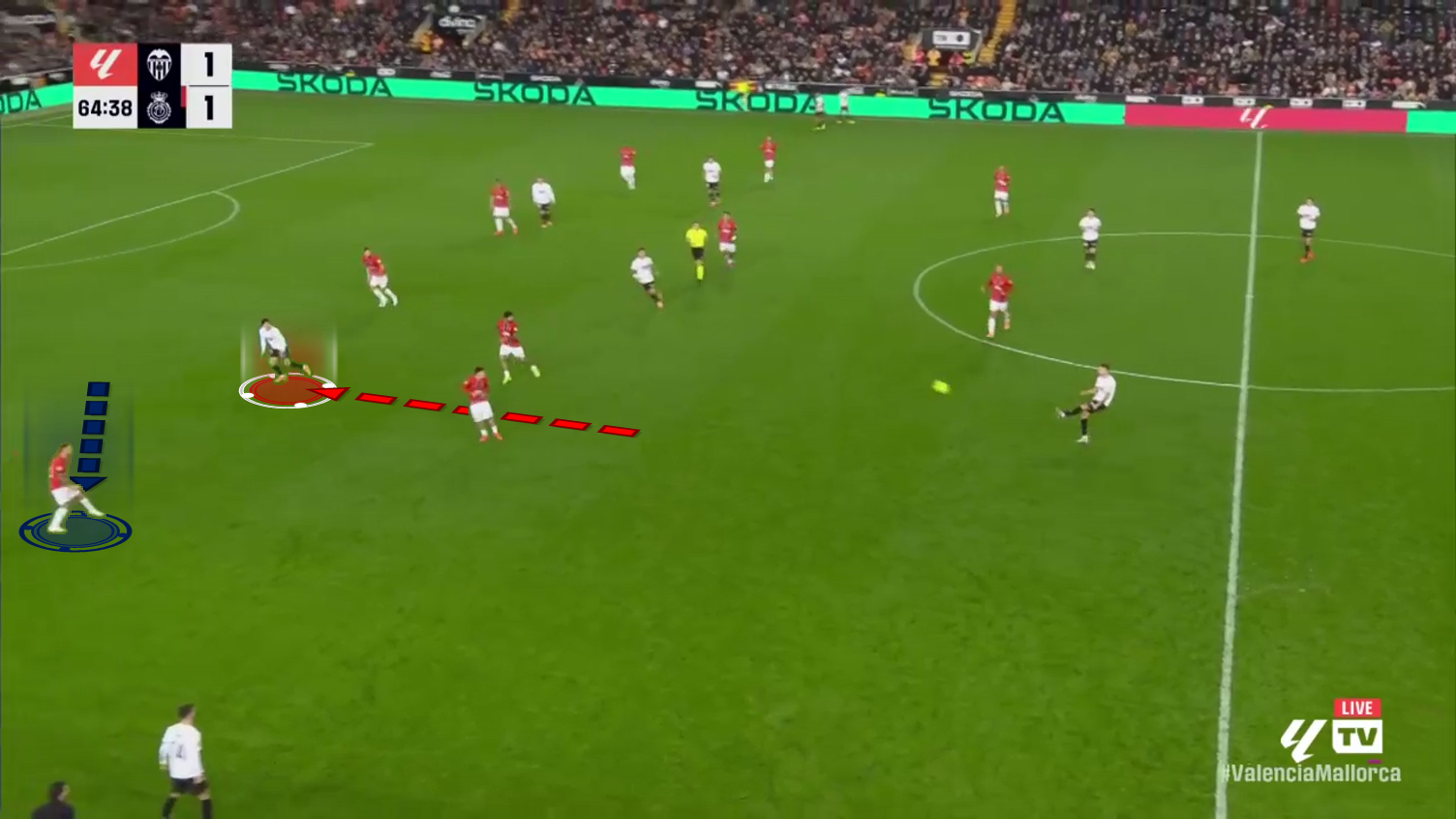
Valencia use their width in more than just one way; they also use it to enable their central players to make runs in the space behind the backline and attack the channel in the half-space vertically.
In the situation pictured above, the centre-backs are forced to cover the attackers in a very narrow shape, but the right-back has to cover Gaya on the outside, meaning there is a gap between the two players.
Almeida makes the vertical run and receives the chipped pass, and then gets in the box easily and creates a huge opportunity with a cross for his team, but the goalkeeper saves it.
While the basic ideas behind Corberán’s playstyle are visible, the details are not fleshed out enough, and it costs Valencia more often than not.
They use their width well, but they just don’t seem to get control over the centre, which is the most important area on the pitch.
Valencia Problematic Beginnings
While many of Valencia’s struggles are rooted in their attacking play, they often also have trouble setting up their attacking play in the first place.
Looking at their build-up play, there are a lot of problems with their positional play and the passing quality of the individual players.
We are going to take a look at a situation from their game against Atlético Madrid now, where they won the ball in midfield.
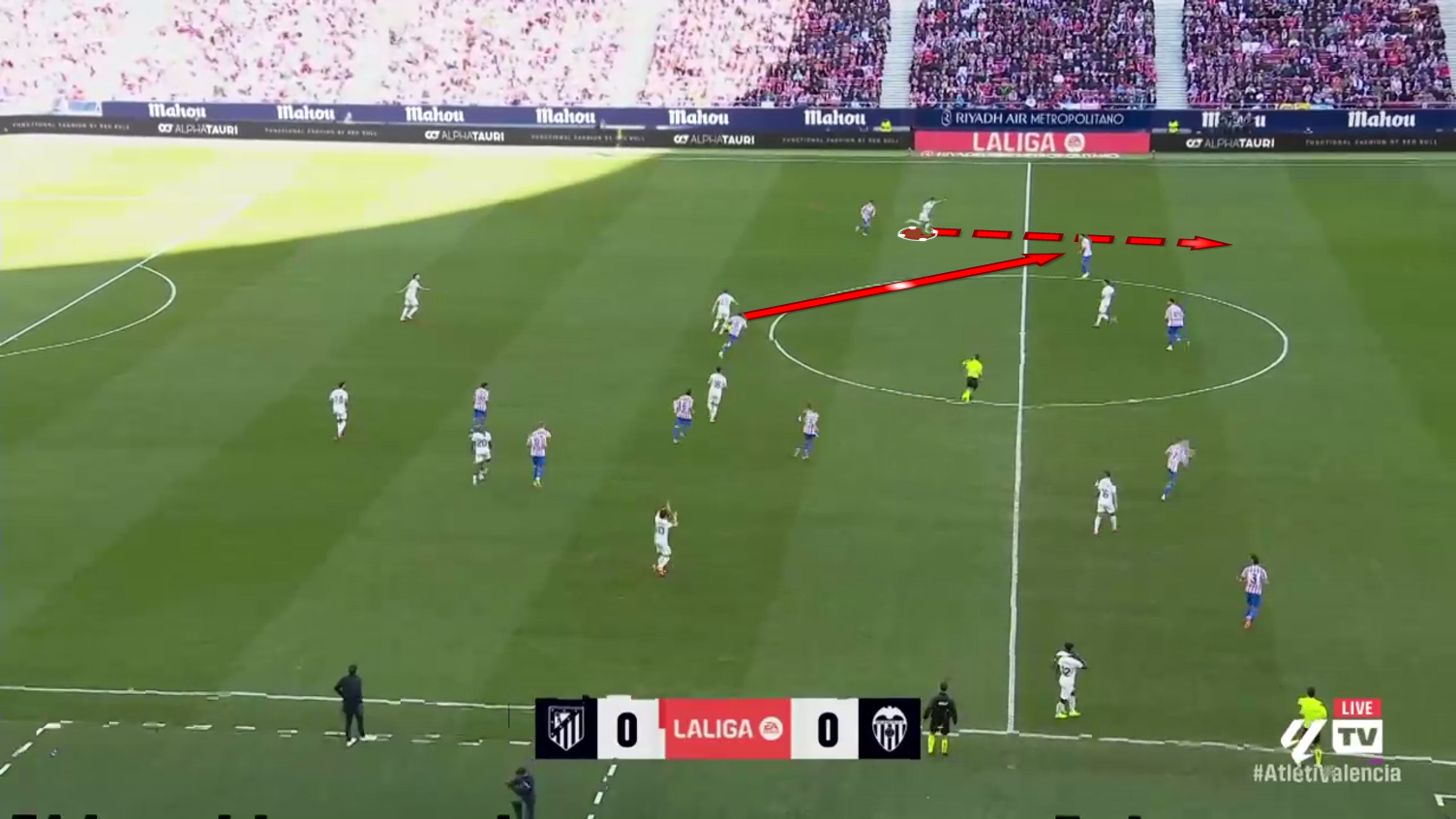
Right after winning the ball, they instantly get the opportunity for a counterattack.
Once again, their full-back provides a good run on the wing, and the midfielder has the opportunity to play the pass towards him, but Valencia does not like to take these risks, as we have established before.
This leaves a wasted opportunity for a counterattack, and Valencia now has to build up from the back.
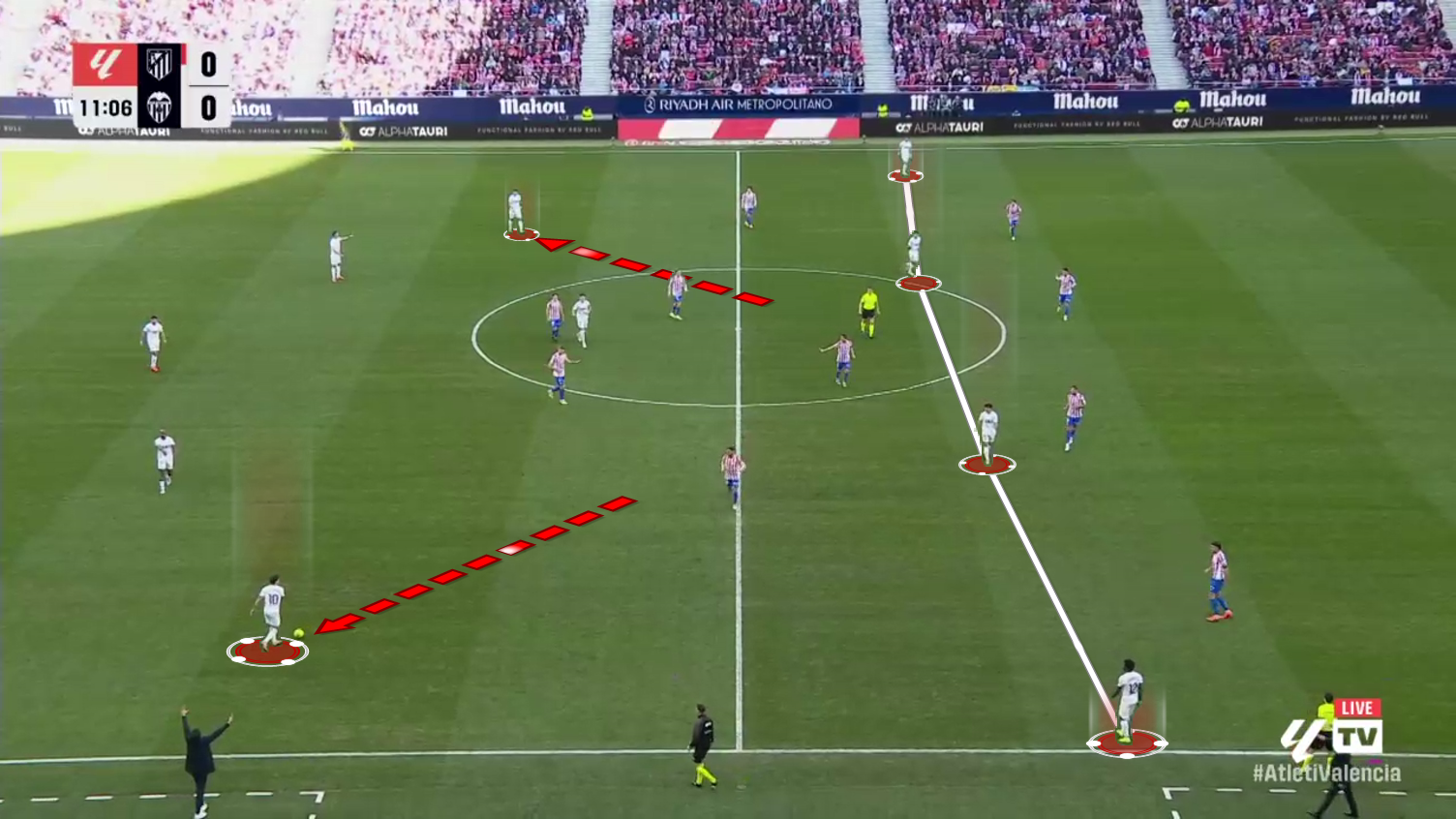 Football is a numbers game, and Valencia really has trouble with getting numerical advantages in the right areas.
Here, two midfielders drop back diametrically, and one full-back stays behind to build a back-three with the two centre-backs, so now Valencia pretty much plays 5-v-0 in the first line.
This leaves them with only one midfielder and no spatial control in the centre.
The four players in the attacking line are pushed high up the field, so the only way to build up are long passes from here on out.
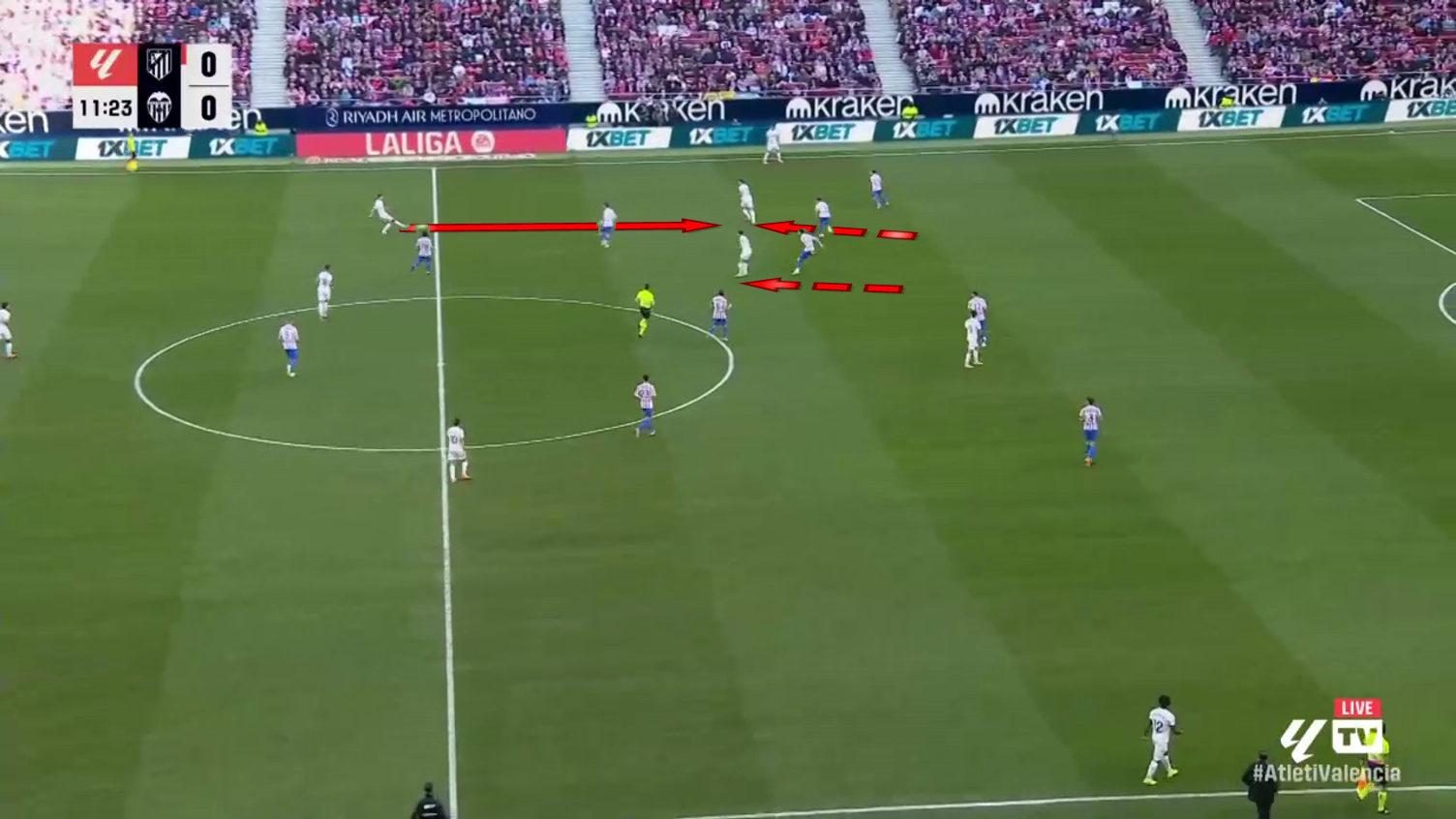
In the end, they switch play once, and then two players drop back, before trying to find a vertical pass down the channel in the half-space, but they are forced to play it towards the full-back on the wing once again.
In the end, Valencia just lacks control from the early stage of play and is forced towards the wing too often.
This means that their full-backs are the most important attacking players, but that’s just not how you find success in the final third.
Conclusion
In the end, Carlos Corberán has implemented some ideas, and they are visible and work at times, but with their positional play, Valencia rarely gets control over key areas and is forced towards the outside too often.
The team overall fails to take risks and harms itself as a result, leading many good-looking attacks to end up as completely harmless crosses into the box, where the team lacks presence.
The lineups have been under a lot of scrutiny as well.
The best striker, Hugo Duro, is not starting regularly, and in the midfield, there has been a lot of talk about the lack of minutes Javi Guerra is currently getting.
Corberán needs to work on the details to get his ideas to work.
If he managed to tweak his approach just a little bit, I think Valencia has a lot of untapped potential with their attacking play.
