
Manchester City’s attacking department for the 2025/2026 season boasts one of the most intriguing pairings in European football: Erling Haaland and Omar Marmoush.
While the Norwegian striker needs no introduction following another prolific campaign in 2024/2025, the Egyptian forward has emerged as a rising tactical wildcard after joining Man City mid-season from Eintracht Frankfurt.
This data analysis seeks to explore the dynamics of their potential partnership under Pep Guardiola.
It examines each player’s positional roles, attacking tendencies, and statistical profiles to assess whether they are best utilised together or individually.
The analysis is built upon detailed data from Marmoush’s 2024/2025 season, encompassing his performances for both Frankfurt and Manchester City, alongside Haaland’s complete campaign with the Citizens.
By investigating their respective heat maps, shot profiles, dribbling zones, off-the-ball movement, and involvement in build-up play, we aim to determine which positional combinations are most effective and how their roles may evolve when deployed simultaneously.
A key aspect of this study revolves around identifying each player’s best position, not in isolation, but within the collective framework.
Is Haaland’s central presence more effective when flanked by Marmoush?
Or does the Egyptian operate more effectively from the left when Haaland leads the line?
The report will address who performs best as the primary striker and which role Marmoush is most suited to when both are on the pitch.
Ultimately, this analysis offers tactical insight into one of the season’s most fascinating selection dilemmas: can Marmoush and Haaland co-exist in the same XI without compromising City’s fluid attacking structure?
Or should Guardiola consider using them as rotational options depending on the opposition and match scenario?
This Manchester City data analysis will reveal the answers.
Tactical Heat Map Insights: Omar Marmoush Positional Distribution Post-January Move To Manchester City
The visualisation below maps Omar Marmoush’s positional distribution in Premier League matches for Manchester City following his January arrival, offering a revealing glimpse into his tactical usage under Pep Guardiola.
Omar Marmoush Position Heat Map At Manchester City – Premier League 2024/2025

It clearly illustrates that the Egyptian forward operated predominantly from the left-wing zone, occupying that channel in 35% of his positional actions, the highest single share across the pitch.
Just below that area, in the left half-space within City’s attacking half, Marmoush featured 9% of the time, often acting as an auxiliary playmaker when drifting inside.
His involvement on the right flank was more limited at 10%, while the right half-space saw just 5% of his activity, indicative of his natural preference for operating from the left or central channels.
Crucially, Marmoush spent 18% of his time in the advanced left half-space and 11% in the right half-space, zones typically associated with the “shadow striker” role, especially when deployed alongside Erling Haaland in a front two.
These areas allowed him to exploit gaps between the opposition’s midfield and defence, creating space for interplay and late box entries without being fixed to the touchline.
Meanwhile, in matches where Haaland was absent, Marmoush filled the role of a central striker, positioning himself in the heart of the penalty box for 15% of his time on the pitch.
His activity in this central zone highlights his ability to act as a direct goal threat, with intelligent movements in and around the six-yard area.
This positional breakdown reflects a forward with remarkable tactical flexibility, capable of alternating between winger, second striker, and centre-forward roles depending on the match context.
Importantly, his most active zones, the advanced central areas and half-spaces, are crucial to destroying compact defences.
In the following section, we will assess Marmoush’s statistical performance when leading the line as City’s primary striker, offering further clarity on whether he is best suited as Haaland’s partner or his replacement.
Omar Marmoush Attacking Profile 2024/2025 in Numbers & Context
The 2024/2025 season proved to be a breakout campaign for Egyptian forward Omar Marmoush.
His performances with Eintracht Frankfurt and subsequently Manchester City marked him out as one of the best-rounded attacking threats in European football.
His attacking return of 22 goal contributions in league football alone was a key factor in prompting City to secure his services mid-season.
Attacking Metrics For Omar Marmoush 2024/2025 With Eintracht Frankfurt & Manchester City
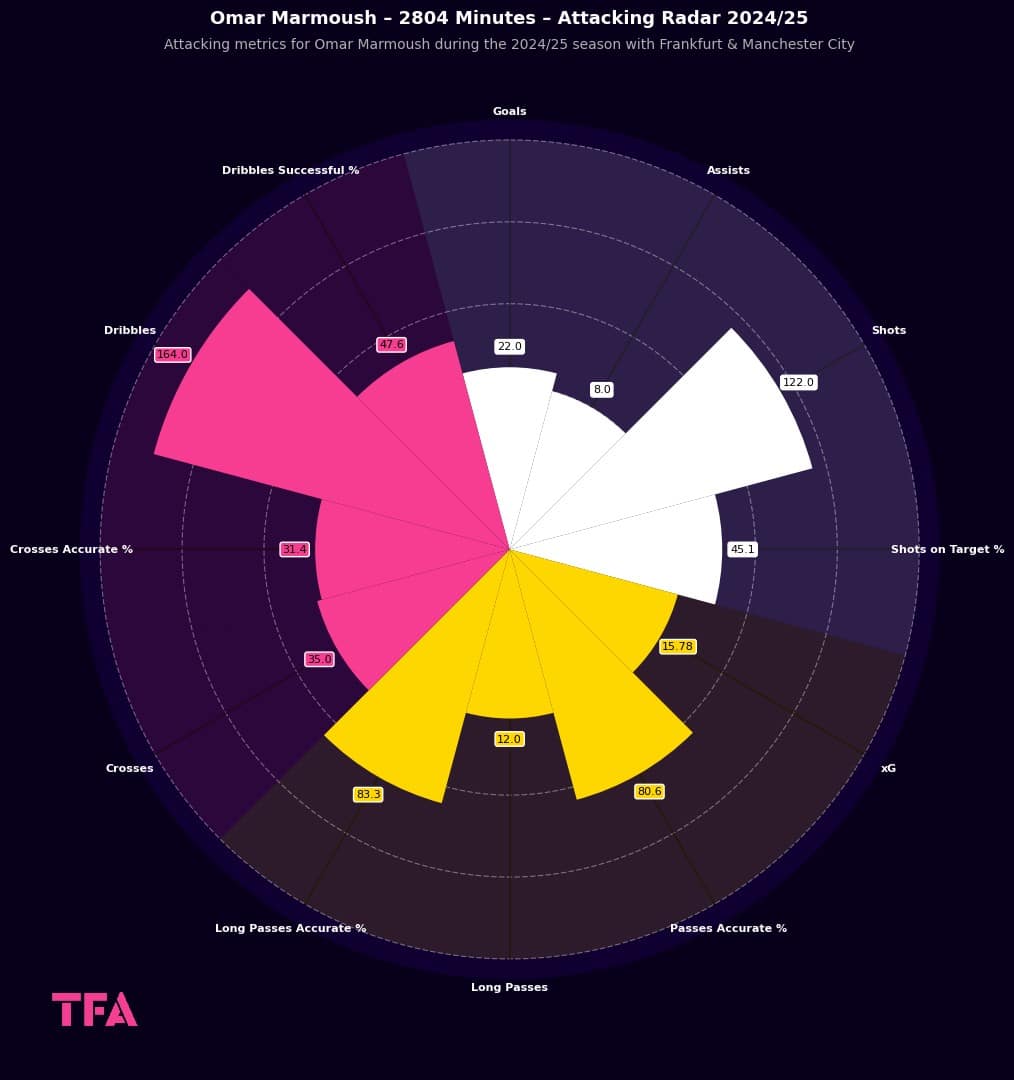
The radar above highlights the attacking metrics for Omar Marmoush during the 2024/2025 season, showcasing his evolution into a tactically reliable forward.
Across 2804 minutes split between Eintracht Frankfurt and Manchester City, Marmoush registered 22 goals and eight assists, underlining his growing efficiency in front of goal.
His tally of 122 shots, 45.1% accuracy, and 15.78 xG speaks to a forward who not only finds space consistently but also takes up high-quality positions inside the box.
Perhaps the most telling thing is how these metrics translated after his January move to Manchester City.
Under Pep Guardiola, Marmoush’s dynamic profile became essential in a frontline that previously lacked variety and directness.
His dribbling figures, 164 attempts with a 47.6% success rate, added much-needed verticality, allowing City to destabilise deep blocks.
Furthermore, his involvement in build-up play improved markedly: 649 passes with 80.6% accuracy reflected his ability to recycle possession.
In comparison, his 12 long passes (83.3% accuracy) and 35 crosses (31.4% accuracy) show growing tactical responsibility in wide zones.
Marmoush’s integration into Pep’s positional play proved key to the team’s resurgence in the second half of the campaign.
With the Egyptian offering pace, directness, and improved link-up play, City became more balanced and incisive in the final third.
This attacking cohesion was crucial in securing a top-four finish and UEFA Champions League qualification.
As the data shows, Marmoush’s versatility was not just statistical but systemic.
His adaptability helped harmonise City’s attacking mechanics post-January, filling gaps left by injuries and offering a flexible alternative to Haaland.
Tactical Finishing Efficiency: Omar Marmoush Shot Quality & xG Overperformance At Manchester City
Since joining Manchester City in January 2025, Omar Marmoush has made a striking impact with his shooting efficiency, showcasing a rare blend of audacity and precision.
The visualisation of his shot map from the Premier League campaign offers a compelling insight into his shot selection and finishing ability.
Each circle represents an attempt; the larger the circle, the higher the expected goals (xG) value, and pink markers indicate actual goals scored.
Omar Marmoush xG Shot Map At Manchester City – Premier League 2024/2025
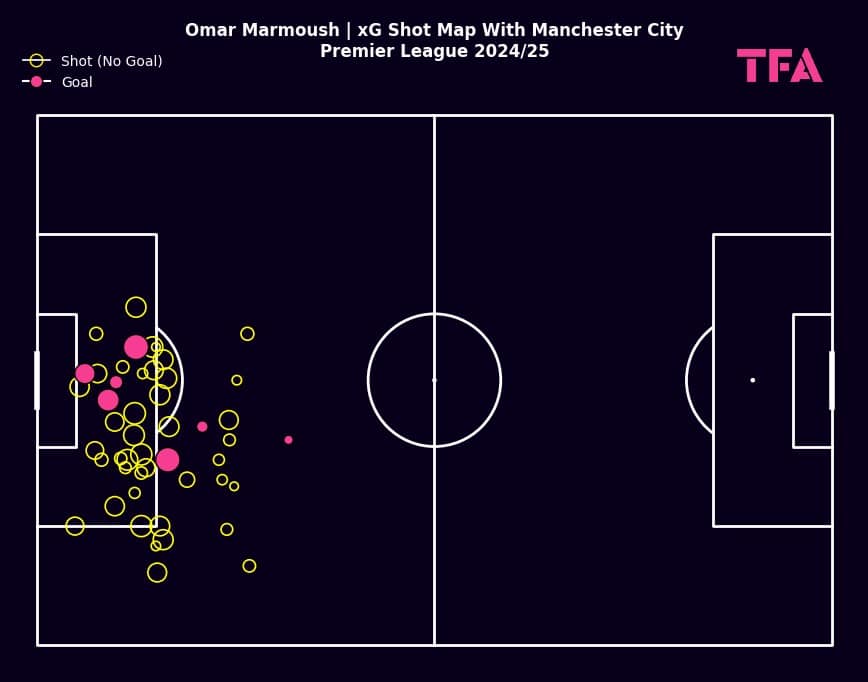
What stands out immediately is Omar Marmoush’s ability to outperform his xG.
He netted seven goals from a total of 49 shots, converting chances with a total xG of just 5.49.
That overperformance of +1.51 suggests clinical finishing, particularly from unfavourable positions.
Perhaps most remarkably, three of his seven goals came from outside the box, two of which carried extremely low xG values (0.02 and 0.05).
Such goals are statistical anomalies, highlighting Marmoush’s capacity to conjure goalscoring moments from limited opportunities.
Inside the penalty area, his remaining four goals were produced from xG values of 0.08, 0.11, and 0.23, reaffirming a sense of composure and positioning.
On average, his shots carried an xG of just 0.11, further underlining how he made the most of relatively low-quality chances.
Tactically, this profile reflects a forward who thrives on unpredictability, can shoot from range, and generates returns even when traditional metrics suggest otherwise.
For City, it offers a versatile dimension to their frontline, particularly in tightly contested matches where goals need to be manufactured rather than created through clear-cut chances.
Marmoush’s shot map does more than show where he scores; it reveals how he scores and why he’s fast becoming a key figure in Guardiola’s attacking blueprint.
Omar Marmoush Defensive Application 2024/2025: Tactical Effort Behind The Versatility
While Omar Marmoush is primarily recognised for his attacking flair and positional adaptability, his defensive contributions during the 2024/2025 season, split between Eintracht Frankfurt and Manchester City, reveal a forward who actively engages in the out-of-possession phase, even if the statistical returns point towards areas of tactical improvement.
Defensive Metrics For Omar Marmoush 2024/2025 With Eintracht Frankfurt & Manchester City
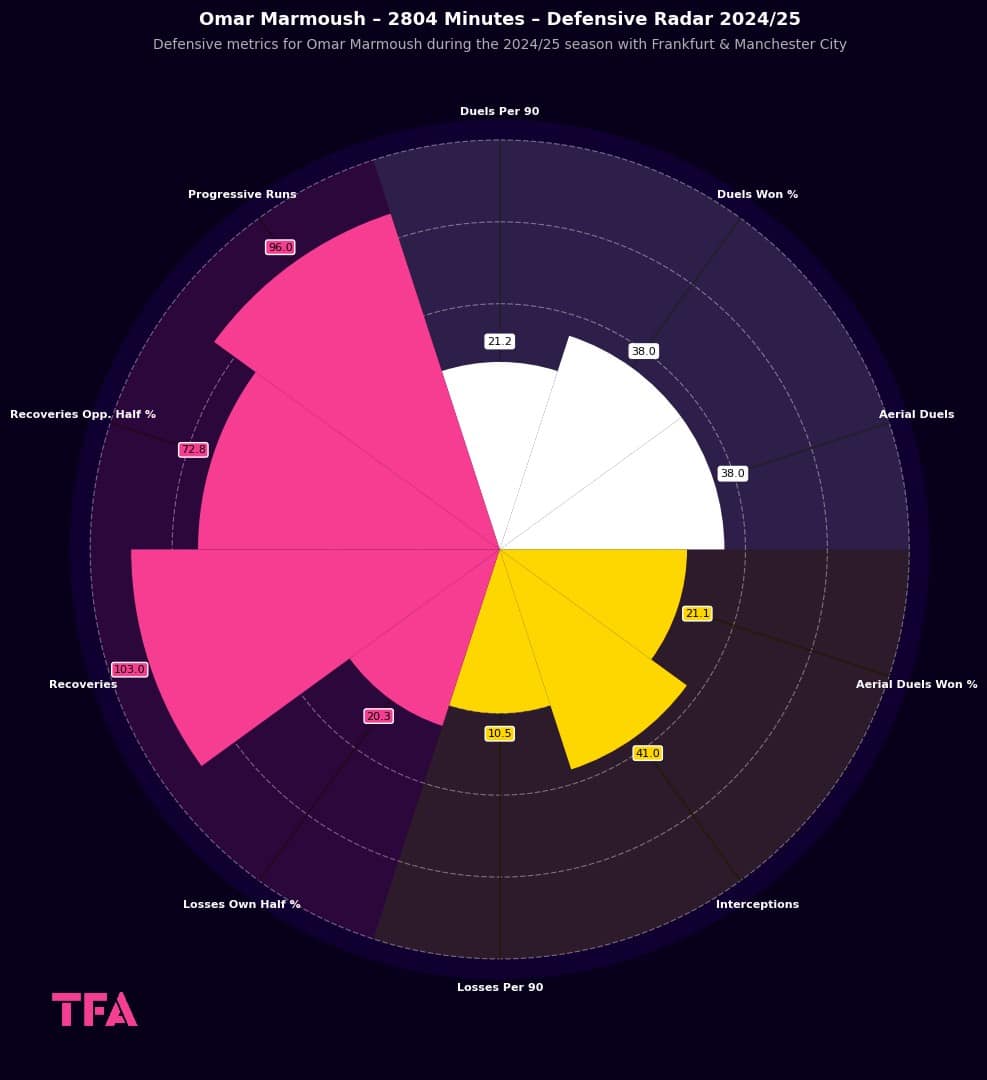
Marmoush participated in an impressive 655 duels across the season, a figure that reflects his consistent involvement in transitional battles and one-on-one scenarios.
However, with a success rate of just 38%, the Egyptian’s proactive approach to contesting possession is reflected in his often-failed execution, suggesting that his pressing may have been more about disrupting rather than regaining the ball.
His aerial numbers paint a similar picture.
Out of 38 aerial duels, he succeeded in just 21.1%, which is notably low for a forward who is sometimes used as a central or hybrid wide striker.
This highlights a tactical reality: Marmoush is not a target man and is often deployed to chase second balls or press from the front, rather than win direct aerial challenges.
In terms of defensive positioning, the 41 interceptions across the campaign indicate a reasonable level of awareness and tactical discipline, especially for a player operating higher up the pitch.
Meanwhile, his 325 ball losses, 20.3% of which occurred in his own half, underline both his high-risk dribbling style and areas for caution when dropping deep.
Positively, his 103 recoveries, with a striking 72.8% of them occurring in the opposition half, reflect Guardiola’s and Frankfurt’s demands for advanced pressing.
Additionally, 96 progressive runs underscore his willingness to carry the ball forward post-recovery, turning defence into attack.
In essence, while the raw numbers suggest room for refinement, Marmoush’s defensive statistics represent a tactically involved forward who complements his versatility with defensive work rate, particularly in systems reliant on collective pressing.
Erling Haaland Evolving Positional Tendencies – Heat Map Insights 2024/2025 Premier League
Erling Haaland’s positional heat map for the 2024/2025 Premier League season offers revealing insight into how his role at Manchester City has evolved, particularly in matches where he shares the pitch with Omar Marmoush.
Erling Haaland Position Heat Map At Manchester City – Premier League 2024/2025
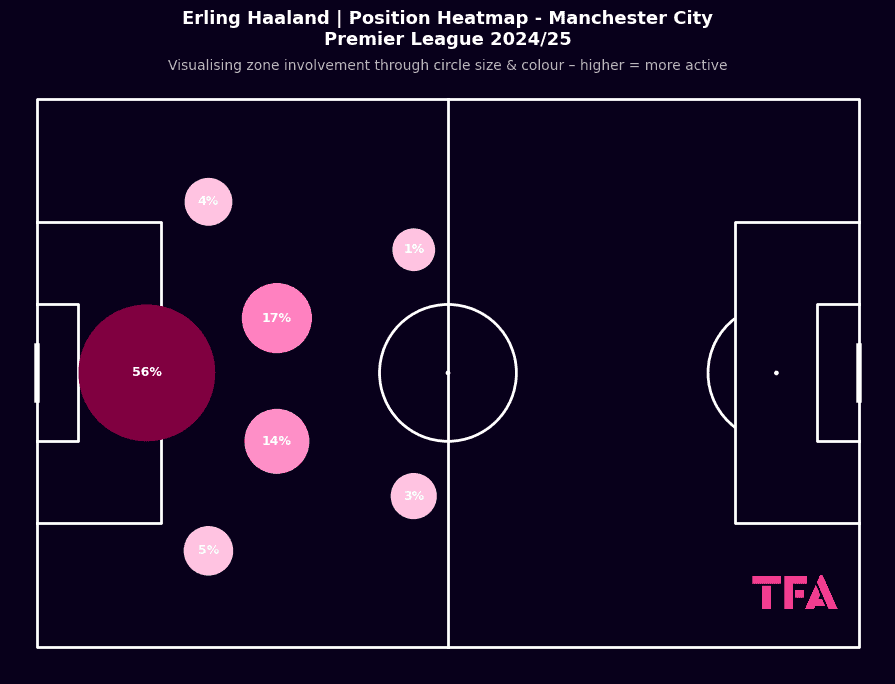
According to positional data, Haaland spent a commanding 56% of his time in the central penalty area, maintaining his identity as a traditional number nine.
However, his spatial spread shows subtle tactical shifts.
In the advanced half-spaces, areas often utilised by inside forwards and creative midfielders, Haaland operated with measurable consistency: 14% of his positional presence was in the left advanced half-space and 18% on the right.
These figures reflect a tendency to drift slightly wider to link play or make diagonal runs, rather than simply waiting for service in the box.
Interestingly, this lateral mobility often correlates with matches in which Marmoush features, as the Egyptian forward’s dynamism encourages positional interchange.
In several matches, Haaland operated almost as a false nine, dropping deeper to draw central defenders out of position and open lanes for Marmoush to exploit with direct runs behind the backline.
His presence in the wide channels remained minimal, 5% on the left wing and 4% on the right, indicating a clear tactical decision to avoid diluting his threat through wide isolation.
His occupation of central midfield zones was even more marginal, with just 3% and 1% presence in the left and right central midfield areas, respectively.
This data suggests a nuanced tactical adjustment: rather than anchoring himself to the six-yard box, Haaland is becoming a more fluid central figure whose positioning adapts depending on Marmoush’s vertical runs and Pep Guardiola’s evolving system.
Erling Haaland Injury-Affected Output – Analysing the Numbers Behind A Still-Efficient Striker
Erling Haaland’s attacking output during the 2024/2025 Premier League campaign paints a nuanced picture of a forward whose raw numbers remain threatening, yet fall short of the extraordinary standards he has previously set.
Attacking Metrics For Erling Haaland 2024/2025 At Manchester City
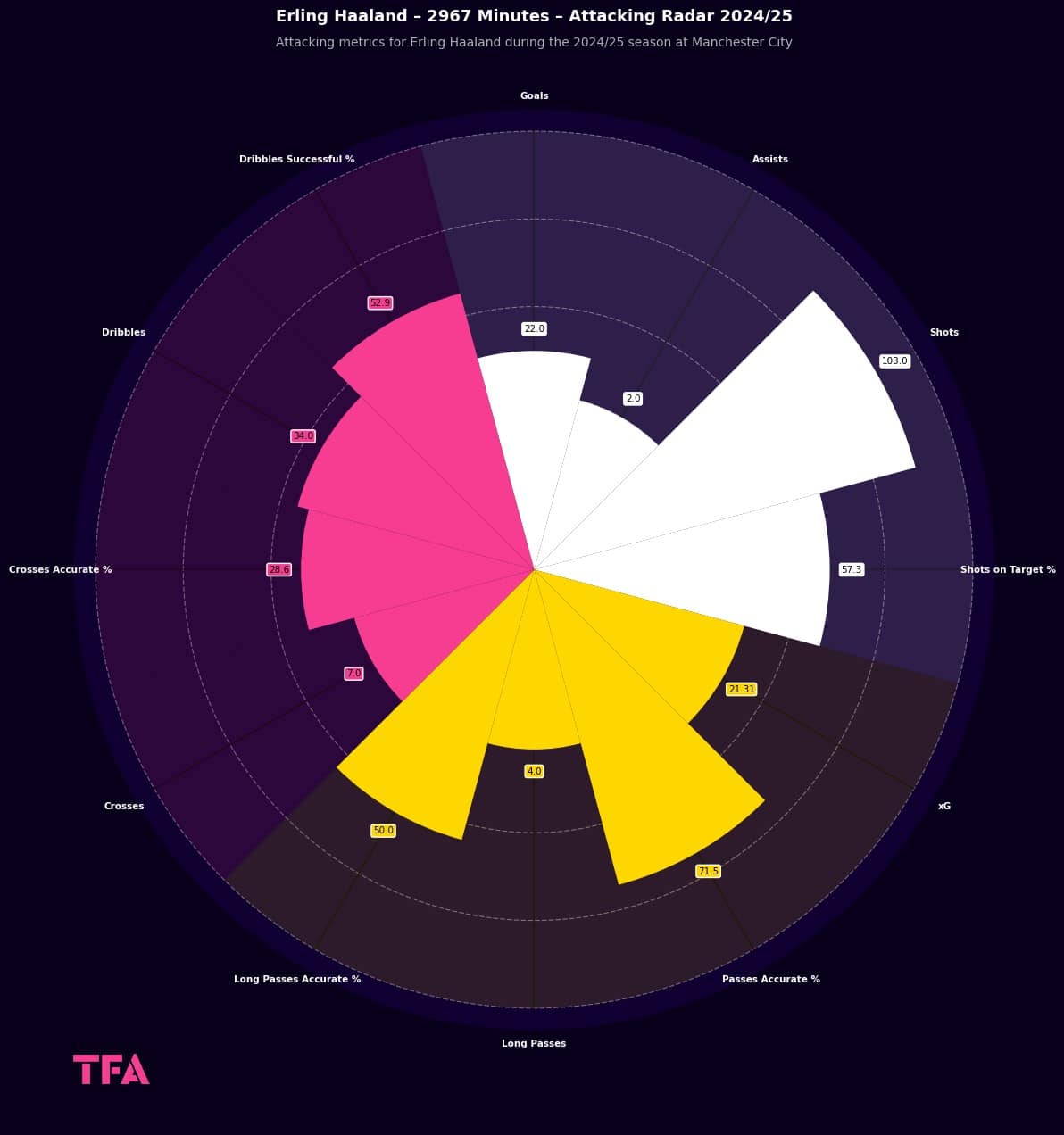
Across 2,967 minutes of league action, Haaland registered 22 goals and two assists, a commendable return by most standards, but relatively modest compared to his Golden Boot-winning tallies in prior seasons.
This statistical dip can largely be attributed to an extended spell on the sidelines due to injury, which not only limited his total minutes but also appeared to affect his rhythm and explosiveness in front of goal.
His xG for the season stood at 21.31, closely mirroring his goal return and suggesting that his finishing remained efficient when given the chances, though perhaps lacked the sheer volume of opportunities typical of his previous campaigns.
Haaland attempted 103 shots, 57.3% of which hit the target, a respectable accuracy rate that reinforces his reputation as a clinical finisher.
However, his overall involvement in build-up play appeared more restrained.
He completed 330 passes with a 71.5% accuracy, numbers that reflect his role as a final-third focal point rather than a facilitator.
His dribbling statistics (34 attempted, 52.9% success rate) suggest a forward who occasionally took on defenders, though this was not a defining aspect of his game.
Notably, his crossing and long passing contributions were minimal and inaccurate, consistent with a striker tasked primarily with occupying central areas and finishing moves.
In tactical terms, Haaland’s season illustrates how City continued to rely on him as a pure goal threat rather than an all-round creator, a reliance that may have exposed their attacking fluidity during his absence.
Despite the dip, Haaland’s numbers remain elite when considered in context.
Conclusion
The data from the 2024/2025 season presents a compelling tactical case for pairing Omar Marmoush and Erling Haaland together in Manchester City’s starting XI for the 2025/2026 campaign.
While Haaland’s goal return remains elite, 22 goals from an xG of 21.31, it’s clear his impact was somewhat muted by injury and a reduced attacking rhythm.
Marmoush, in contrast, brought fresh verticality and dynamism after arriving in January.
He registered 30 goal contributions across the season and statistically outperformed his xG in key moments.
What is particularly striking from a positional analysis standpoint is how naturally Marmoush complements Haaland.
Marmoush’s activity in the advanced left half-space and shadow striker zones aligns seamlessly with Haaland’s central dominance.
His intelligent off-the-ball movement, ability to carry possession into dangerous zones, and high pressing intensity offer tactical Qualities City often lacked in Haaland’s absence.
Crucially, Haaland’s heat map reveals a growing fluidity in his role, drifting into half-spaces and occasionally acting as a false nine, allowing Marmoush to exploit central gaps with direct runs.
Their respective positioning suggests compatibility, not competition.
While Haaland remains the spearhead, Marmoush’s ability to operate between the lines, press intelligently, and score from range enhances City’s attacking unpredictability.
From a team-structure perspective, Pep Guardiola’s use of Marmoush post-January contributed to renewed attacking fluency and greater pressing cohesion, both areas that were tactically vulnerable during Haaland’s layoff.
Rather than serving as a rotational deputy, Marmoush’s metrics and movement profiles position him as an ideal partner in a flexible front two.
In conclusion, the optimal solution is not to alternate between the two forwards but to harmonise their distinct attributes.
The data suggests Marmoush and Haaland are most effective when deployed in tandem, a partnership that could redefine City’s attack in 2025/2026.
