
After a season that fell short of their usual dominance, Manchester City approached the 2025 FIFA Club World Cup with a refreshed outlook, both on the pitch and in the coaching setup.
The club reinforced their squad with several additions, most notably Rayan Cherki from Olympique Lyonnais, Rayan Aït-Nouri from Wolverhampton Wanderers, and Tijjani Reijnders from AC Milan.
Off the pitch, Man City also made a significant coaching addition by appointing 2 ex-Liverpool staff; Pepijn Lijnders as Pep Guardiola’s assistant and James French as set-piece coach.
While the Dutch coach’s impact may take longer to materialise, given the brief lead-up to the competition, it is worth examining this latest version of Man City.
In this tactical analysis, we break down Manchester City’s in-possession strategies during the Club World Cup, focusing on matches against Wydad, Juventus, and Al Hilal — all of which defended with a back five — to offer insights beyond the final results.
We’ve structured this football analysis into three pieces to provide a comprehensive view: build-up, progression, and the final third.
This enables us to examine how Manchester City’s approach evolved across the various phases.
This piece starts with the build-up phase and examines how Manchester City approached each game.
What are the core principles they maintained?
What tactical adaptations did they introduce, given that although every opponent defended with a back five, each team applied its strategy and nuances to counter Manchester City’s build-up?
Manchester City Build-Up Tactics Vs Wydad AC

In this match against Wydad AC, Manchester City lined up with Ederson in goal.
Vitor Reis and Nathan Aké operated as the centre-backs, flanked by Rico Lewis on the right and Nico O’Reilly on the left as full-backs.
Tijjani Reijnders started as the six, with Phil Foden and Omar Marmoush playing as the right and left eights respectively — a switch from what we see on the board, which had Rayan Cherki listed in that role.
Instead, Cherki featured as the centre-forward.
Savinho and Jérémy Doku occupied the right and left-wing positions on the flanks.
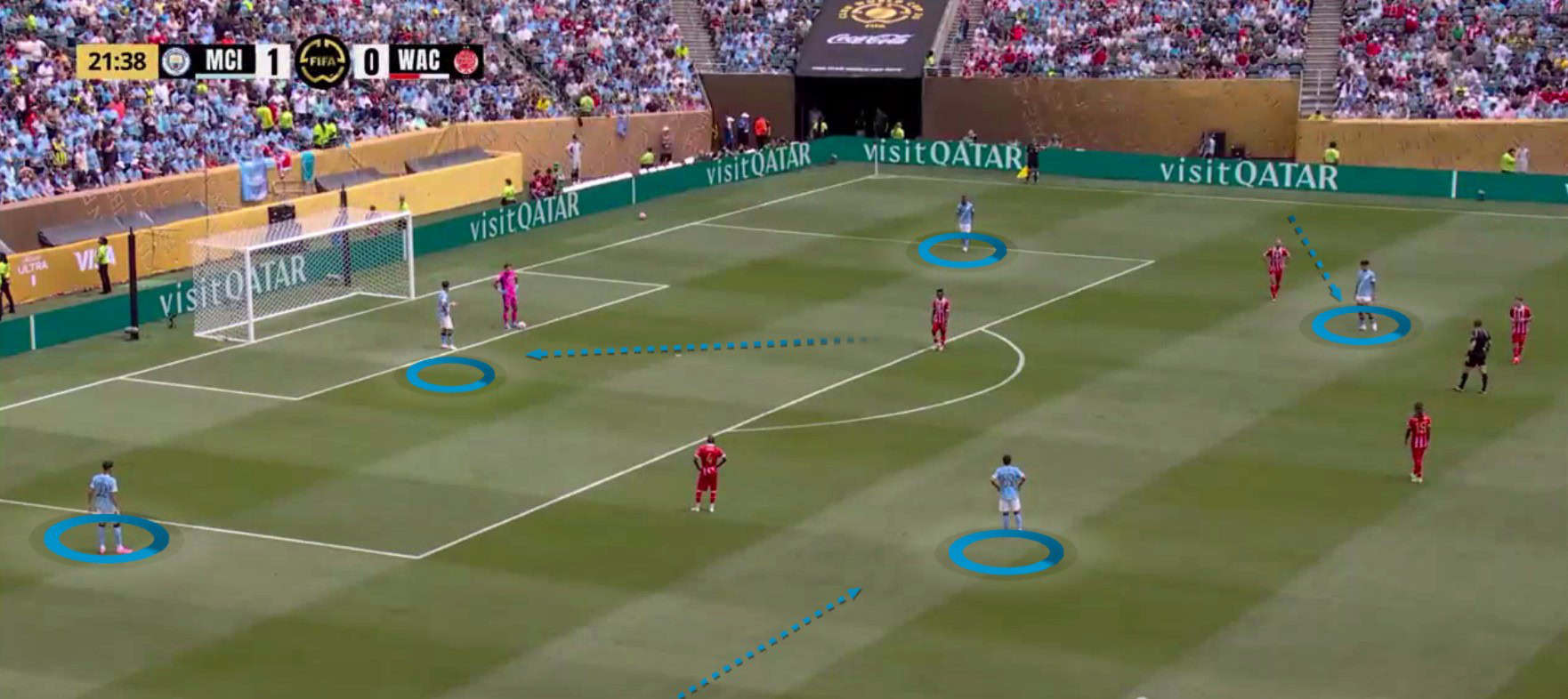 In the figure above, Manchester City’s build-up from goal kicks sees Reijnders drop very deep near Ederson, with Reis and Aké positioned outside the box.
Both full-backs, Lewis and O’Reilly, move slightly inward into the centre. (It’s not too central, just to the half-spaces.)
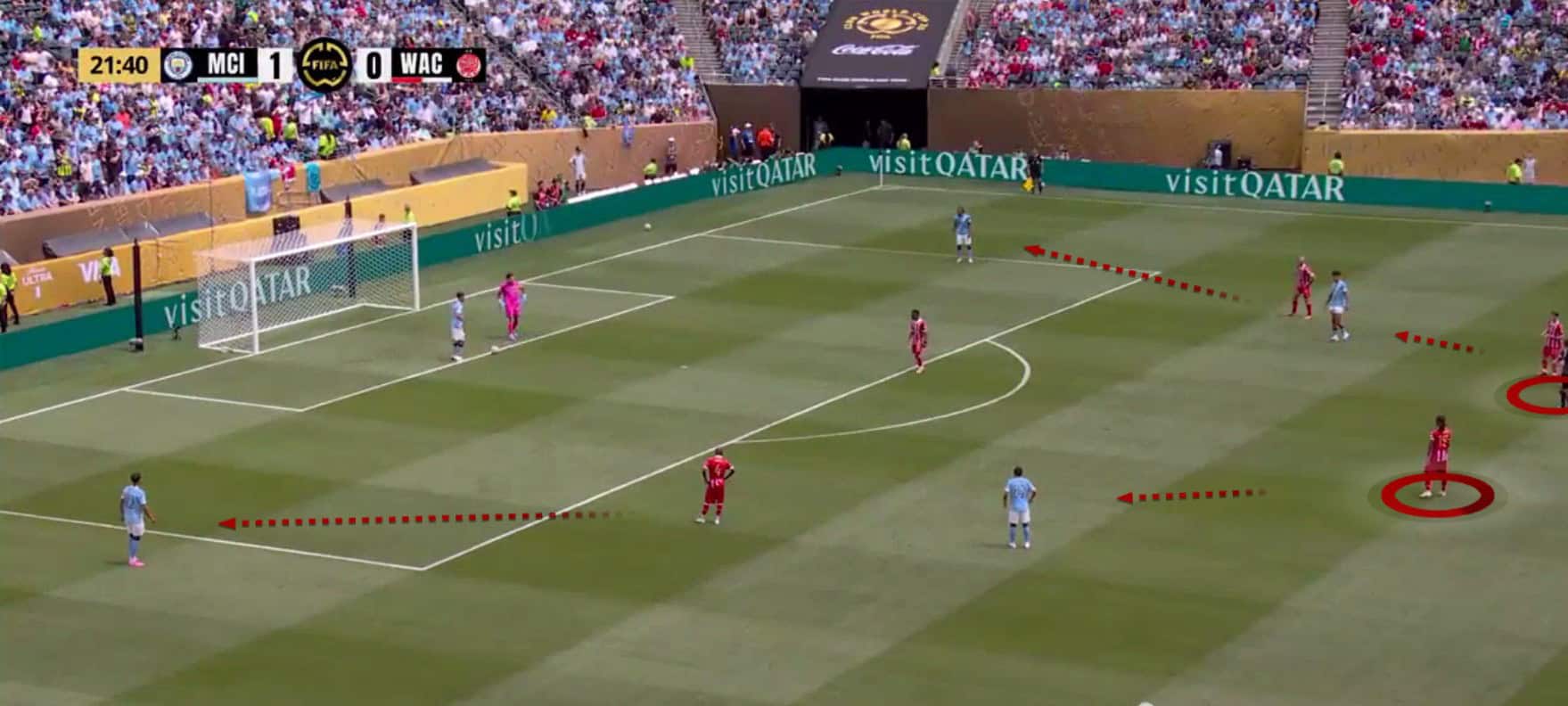 With five defenders at the back, Wydad’s high press in this phase sees the centre-forward Cassius Mailula ready to press Reijnders if he receives the ball.
Wingers Nordin Amrabat and Thembinkosi Lorch position themselves at the edge of the box in the half-spaces to press City’s centre-backs.
Both sixers, Oussama Zemraoui and El Mehdi El Moubarik, start zonally in the centre to block central passes and are prepared to press Lewis and O’Reilly.
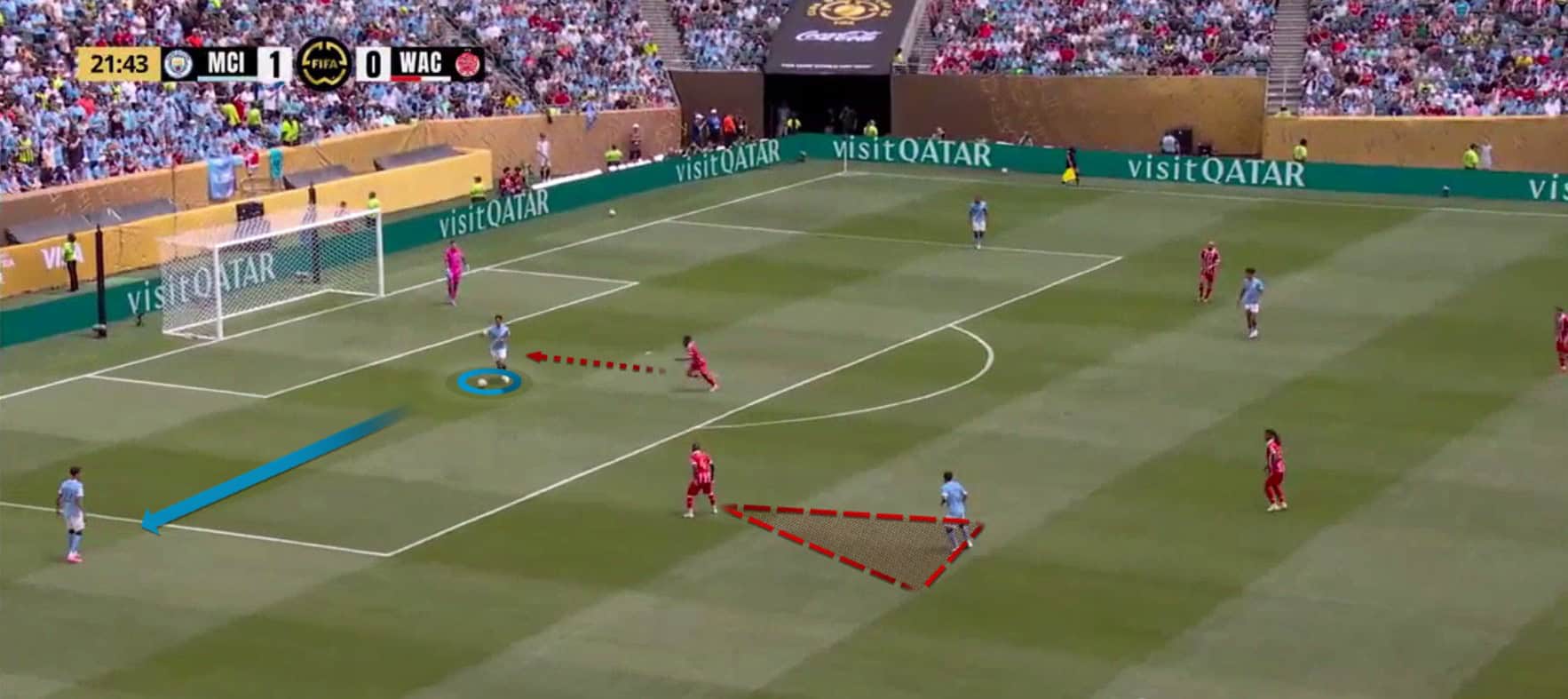 Lorch starts in the half-space to block Lewis’s passing lane before pressing Reis upon receiving the ball.
Reijnders collects Ederson’s pass and carries centrally for a few steps.
With Mailula positioned centrally, he quickly applies pressure, forcing Reijnders to pass to Reis.
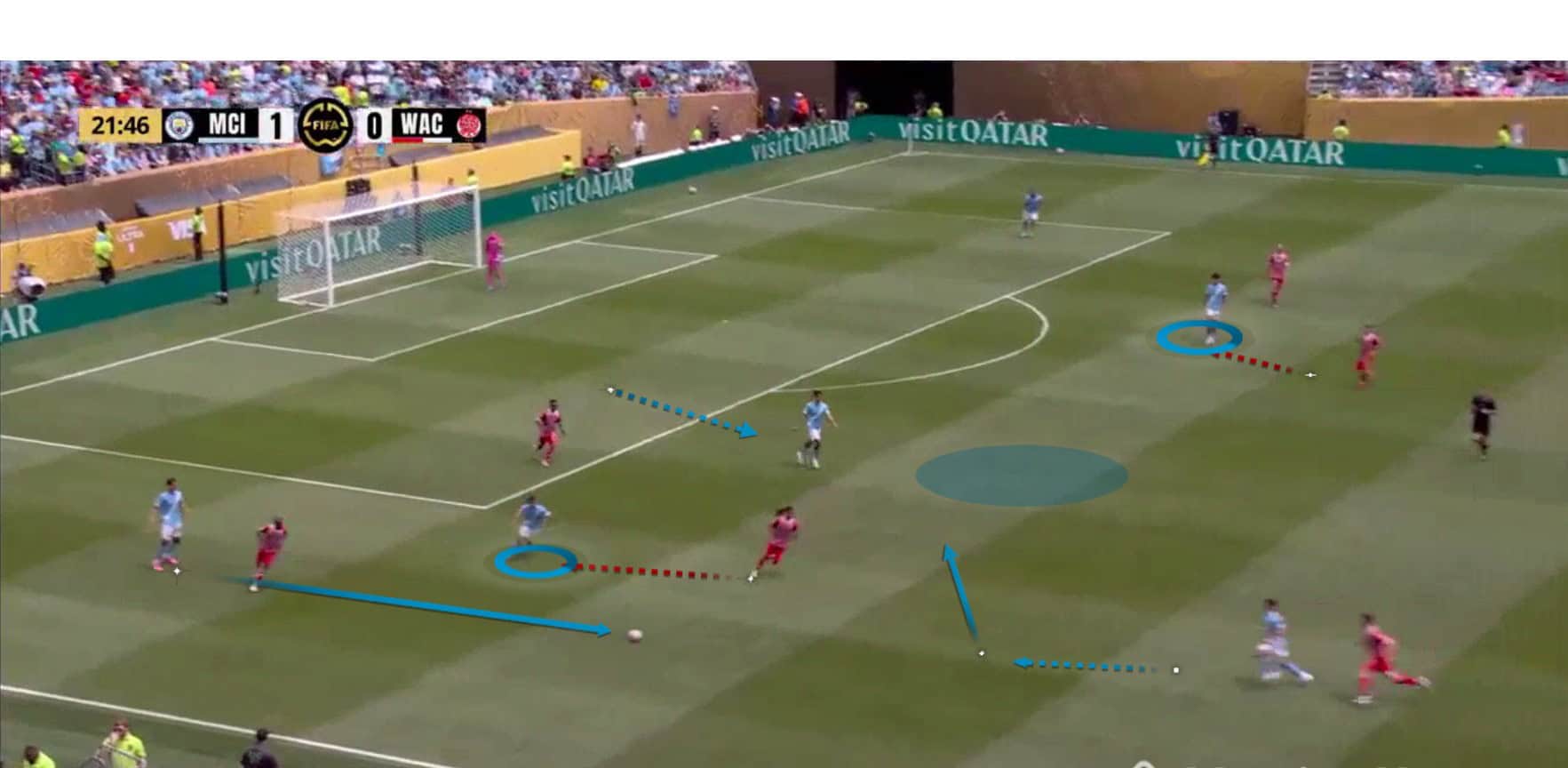 From Wydad’s shape, El Moubarik steps up to press Lewis, while Lorch presses Reis.
This leaves Reis with only one option — the vertical pass to Foden, who drops and is tightly followed by Meijers.
From Gouardiola’s team perspective, Reijnders continues his run after passing to Reis, with Mailula not tracking him, space begins to open.
Lewis moves closer to Reis, drawing El Moubarik and creating a pocket of space behind him.
Foden plays a one-touch pass, while O’Reilly stays away from the ballside.
This keeps Zemraoui occupied and unable to cover the free space, explaining why Lewis and O’Reilly didn’t start too centrally.
The only problem is the nature of this pass and how Foden handles it.
As he drops, he does so with forward momentum while being tightly marked from behind by Meijers, while El Moubarik is ready to press from the front, making the reception difficult.
In this scenario, Foden must play a one-touch pass, ideally into the space ahead of Reijnders to maintain his momentum, or at least clean to his feet.
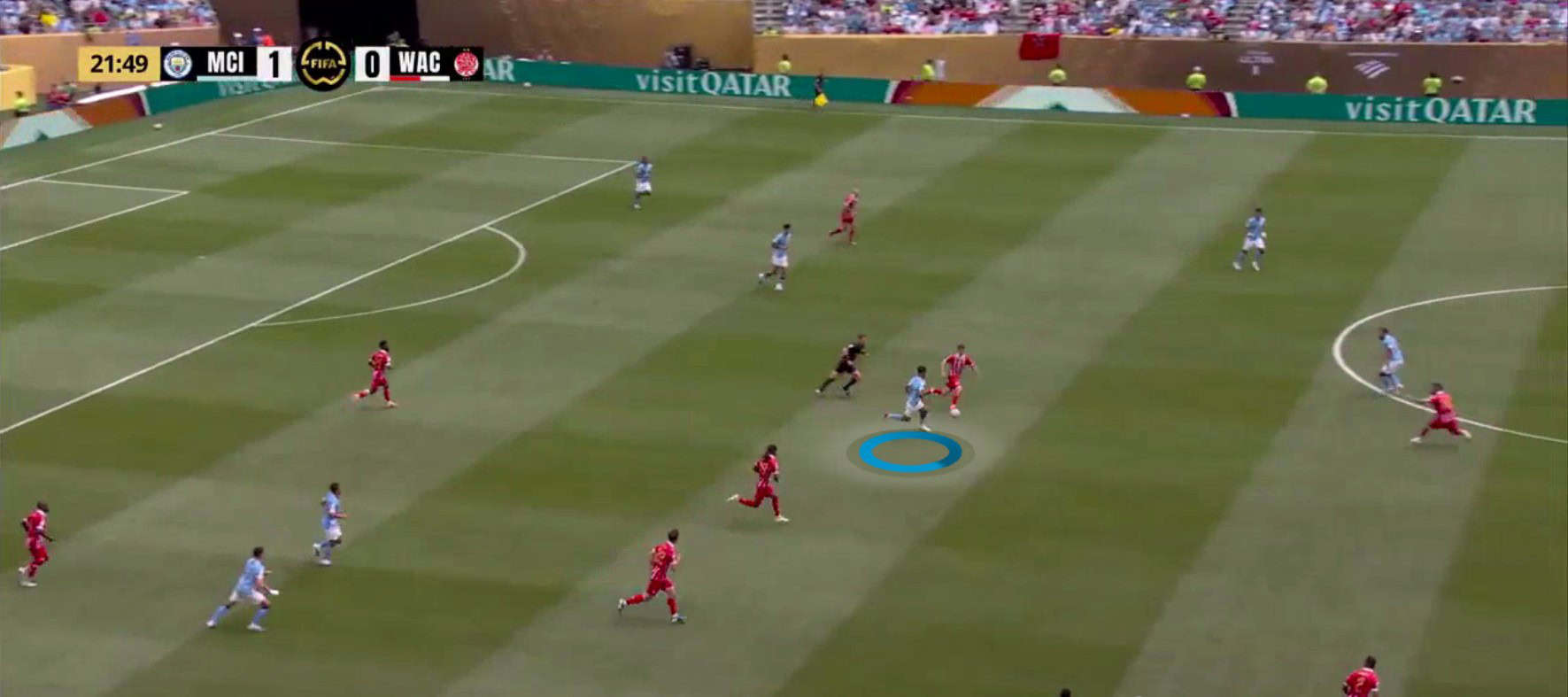 Above, we see Reijnders still must work to secure possession before progressing.
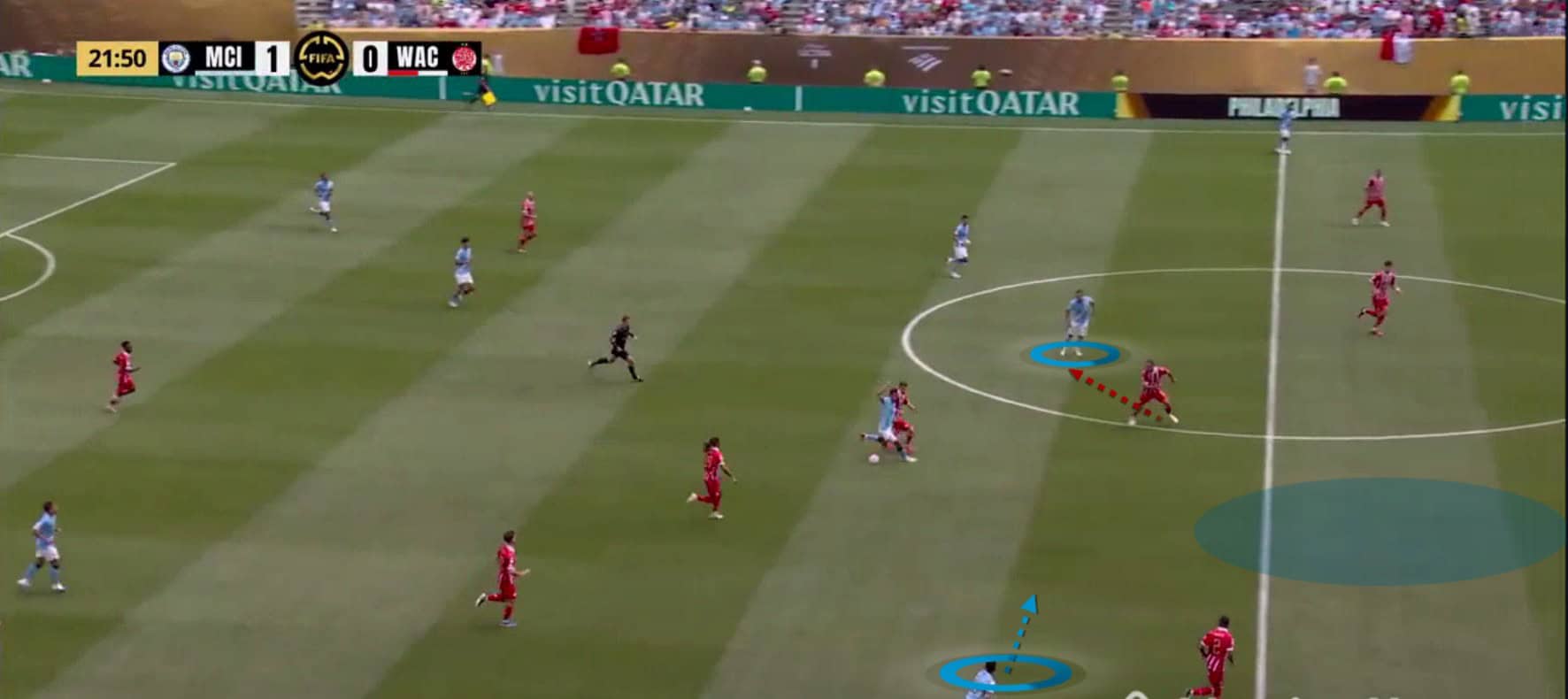 Reijnders manages to retain possession.
With Cherki dropping from the centre-forward position, he draws Abdelmounaim Boutouil, the central centre-back.
Savinho holds the width, pinning his marker, Mohamed Moufid, the left wing-back, while Bart Meijers, the left centre-back, tracks Phil Foden.
All of these create free space between Wydad’s defenders.
At this point, Savinho makes a horizontal, almost diagonal, run to shake off his marker.
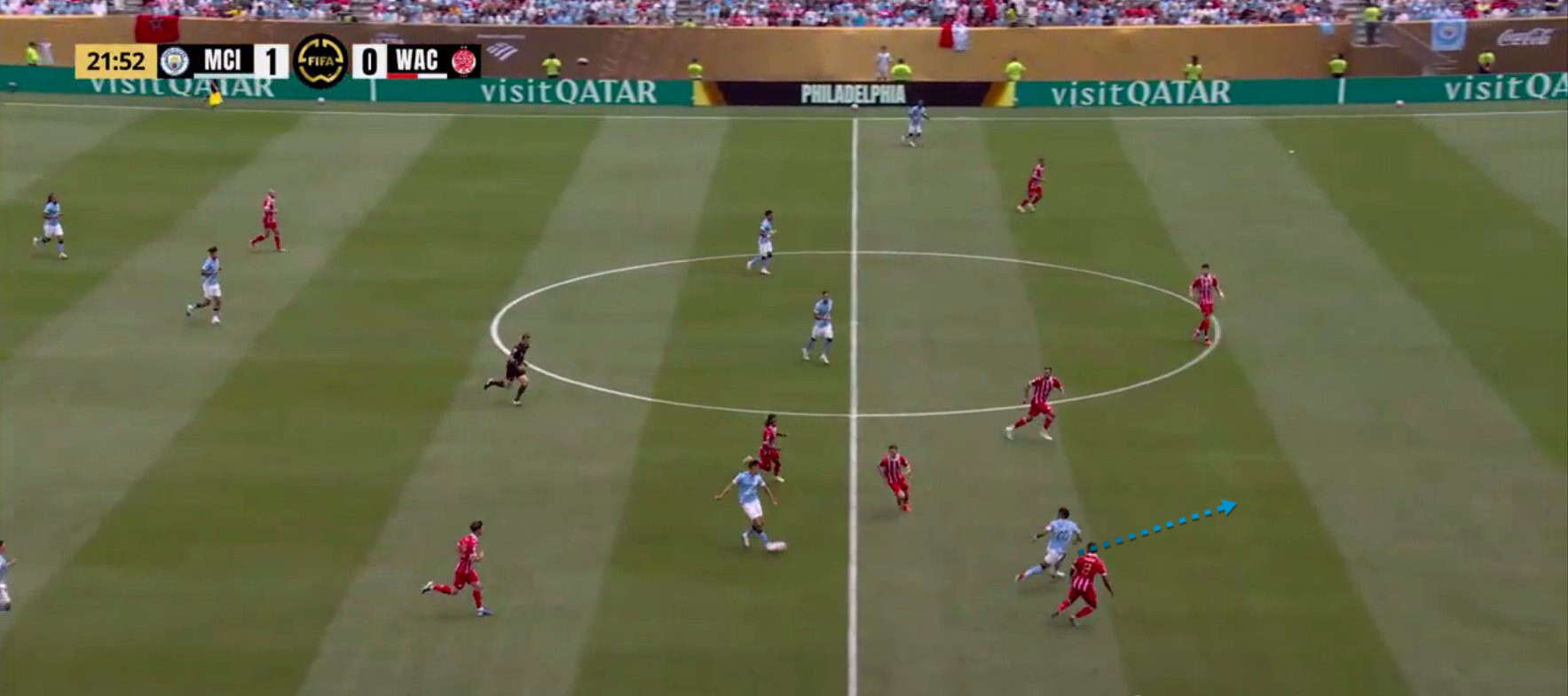 He is able to receive the pass from Reijnders in the vacated space.
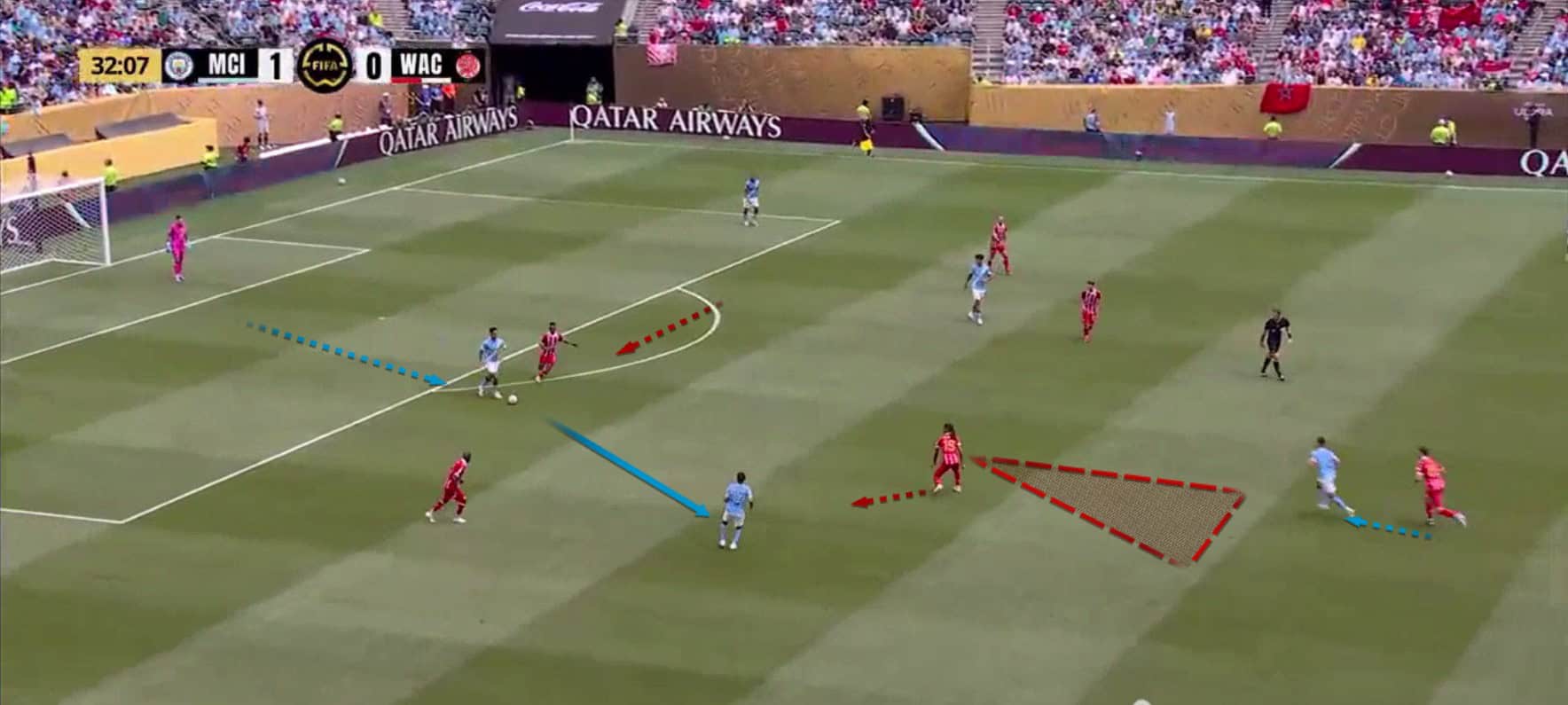 In the figure above, we start with Wydad, who maintains the same pressing scheme.
El Moubarik ensures he blocks the vertical pass to the centre before pressing Lewis, while Meijers follows Foden as he drops.
Reijnders receives from Ederson and carries the ball centrally again, but this time, he is exploiting the space created by Mailula’s positioning further away.
As Reijnders advances beyond the box, Foden drops centrally — a slight variation.
El Moubarik is caught between closing the pass to Foden, which would increase the space between himself and Lewis—potentially allowing Lewis to get behind him—or stepping towards Lewis and leaving the central lane exposed.
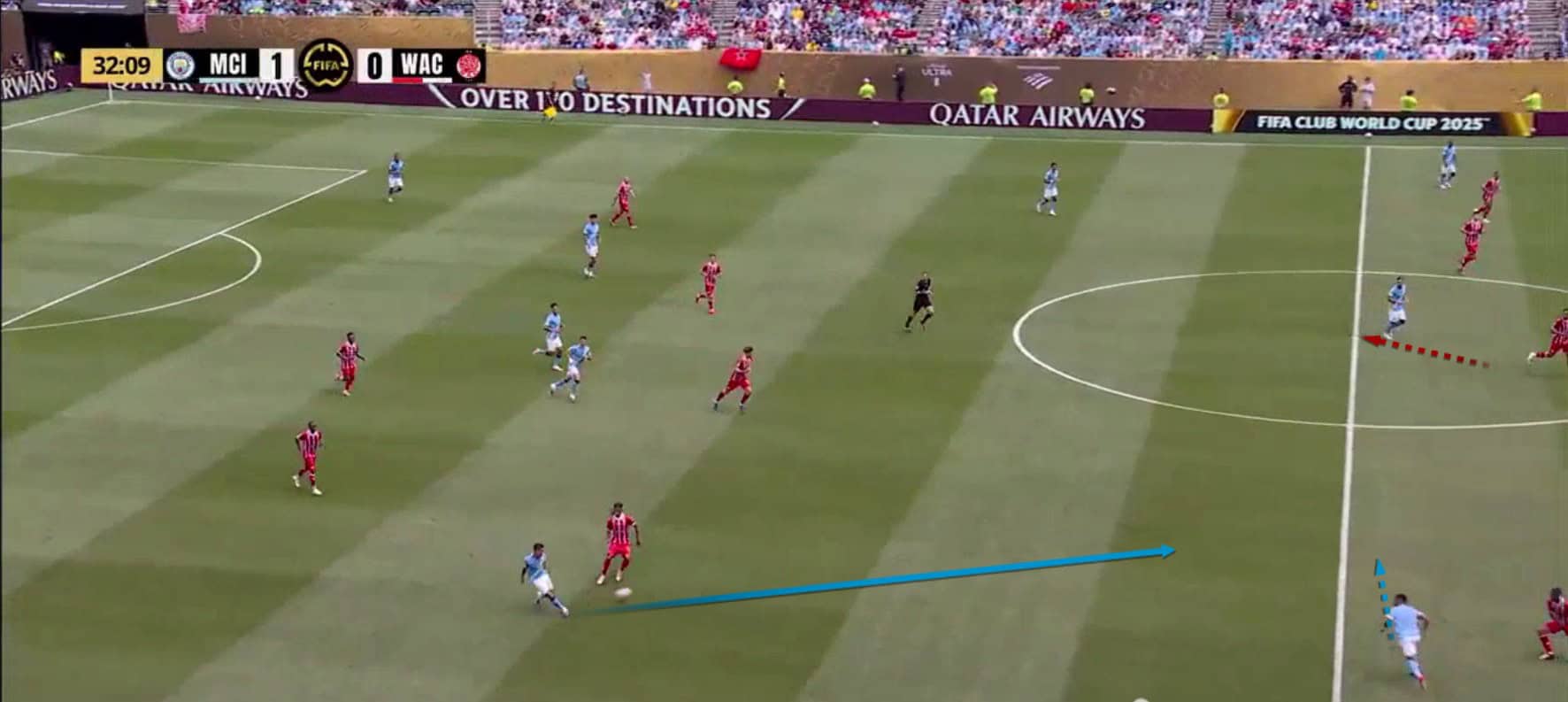 El Moubarik stays zonal, prioritising the vertical pass to the centre, allowing Lewis to receive Reijnders’ pass more comfortably than Foden’s previous situation.
Once again, Boutouil remains with Cherki, and Moufid marks Savinho.
This time, Savinho exploits the space created by Meijers tracking Foden by making a horizontal run to shake off his marker and receive Lewis’ pass directly to his feet instead of into space.
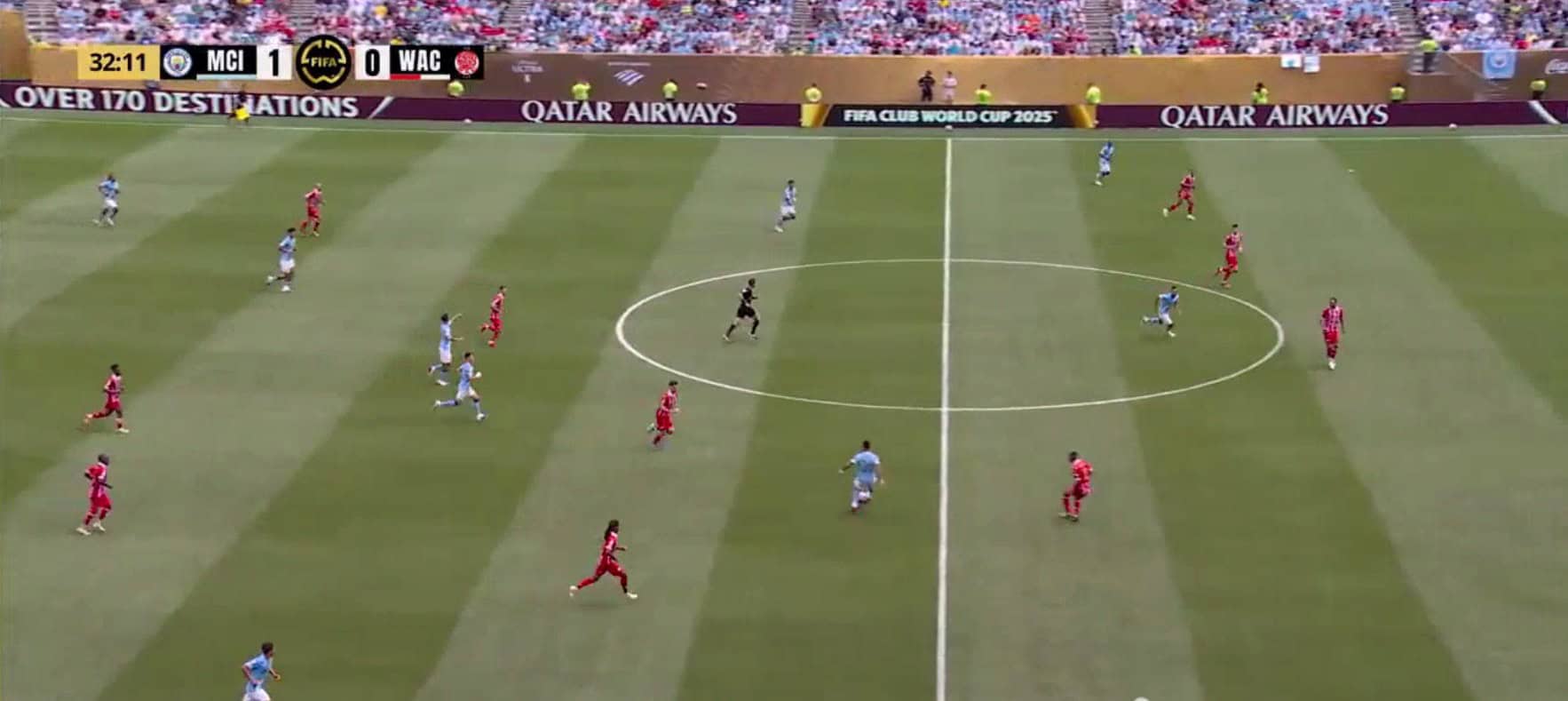
And he did that.
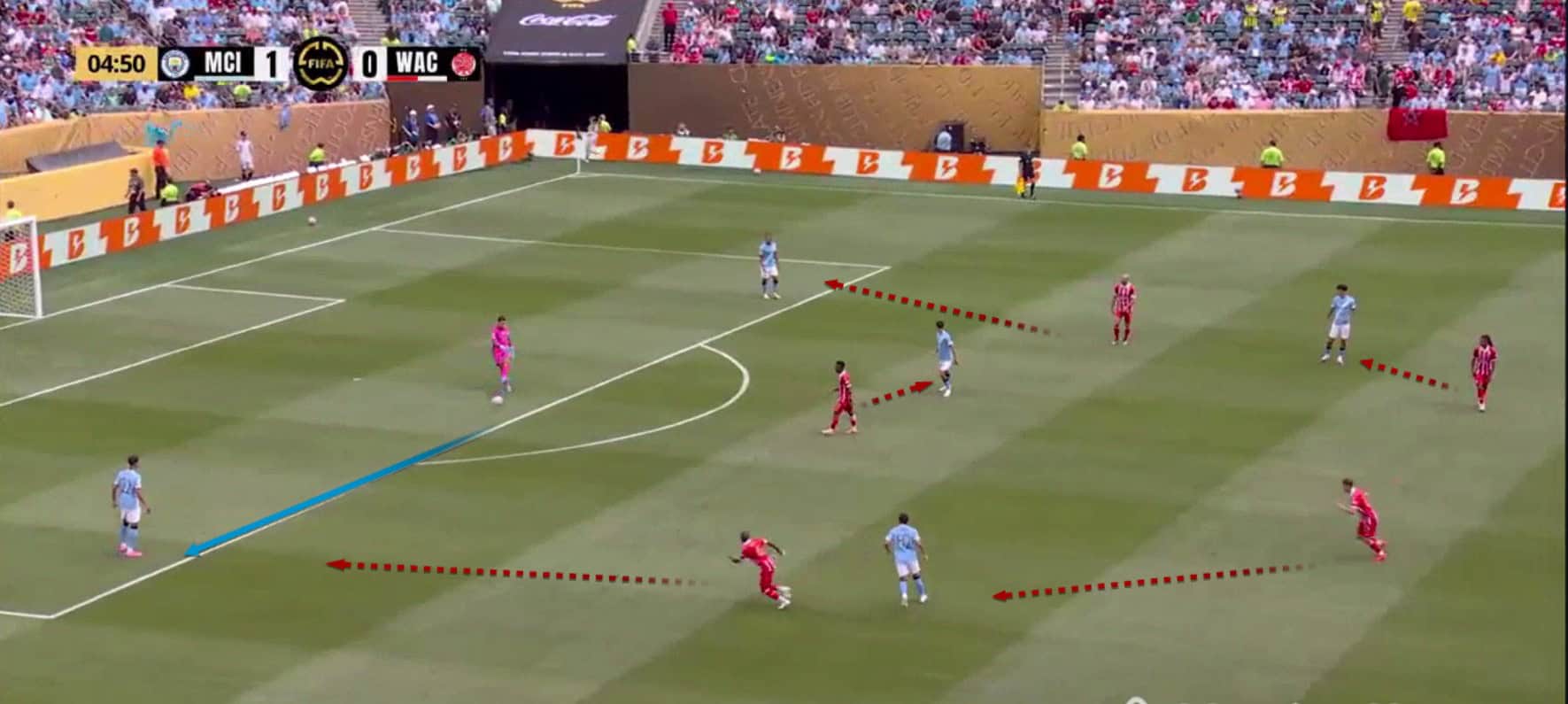
Now, we’re moving to the open play.
City kept the same idea in the figure above with slight adjustments, and Wydad responded similarly.
When Ederson has the ball, Wydad opts not to press him.
Mailula stays with Reijnders, who positions slightly left outside the box, while Wydad’s wingers and sixers keep their previous responsibilities.
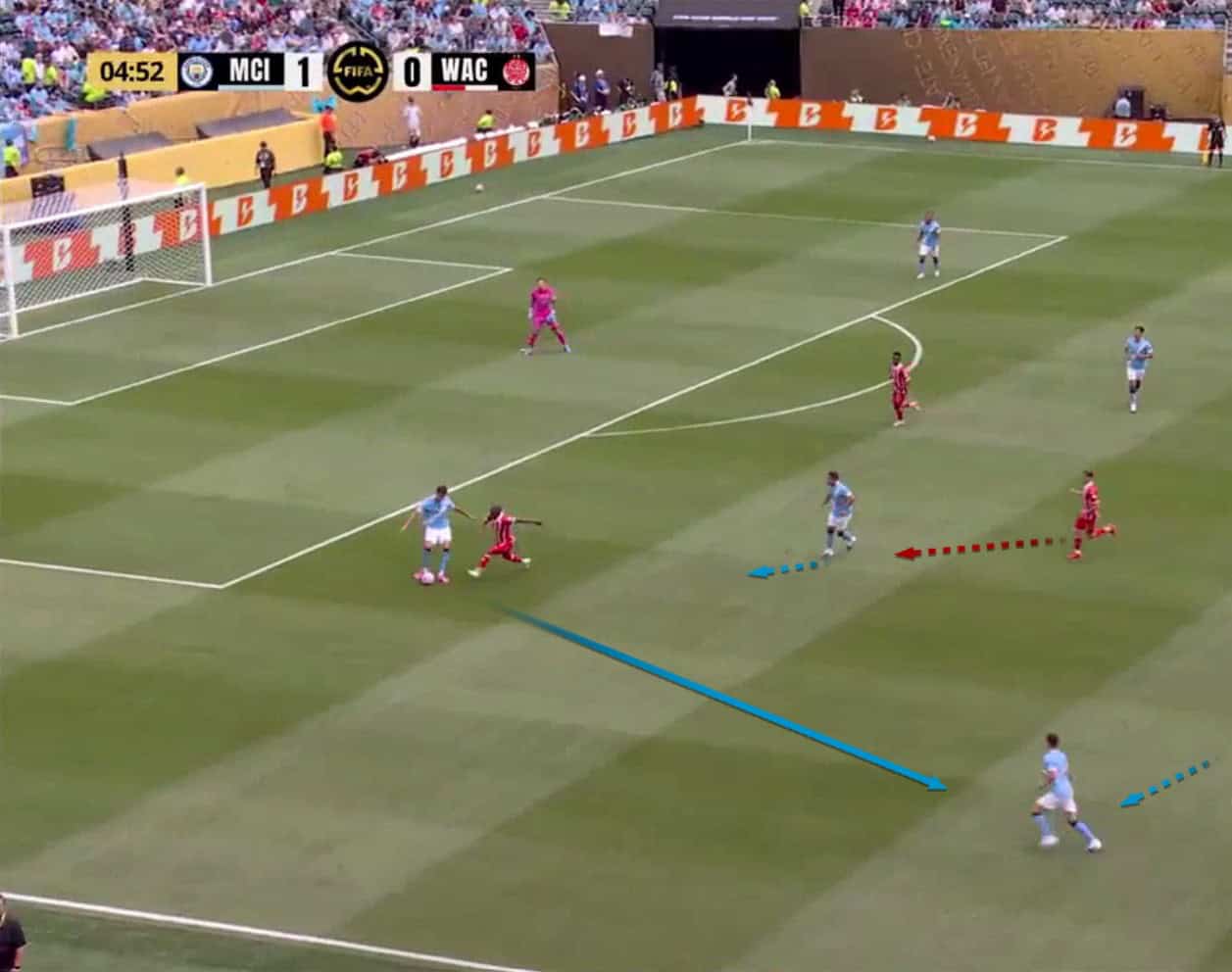 Now Ederson plays to Reis, and again Foden drops wide to receive.
Meijers doesn’t follow him immediately this time, likely to avoid exposing the space behind.
That allows Foden to receive and turn comfortably.
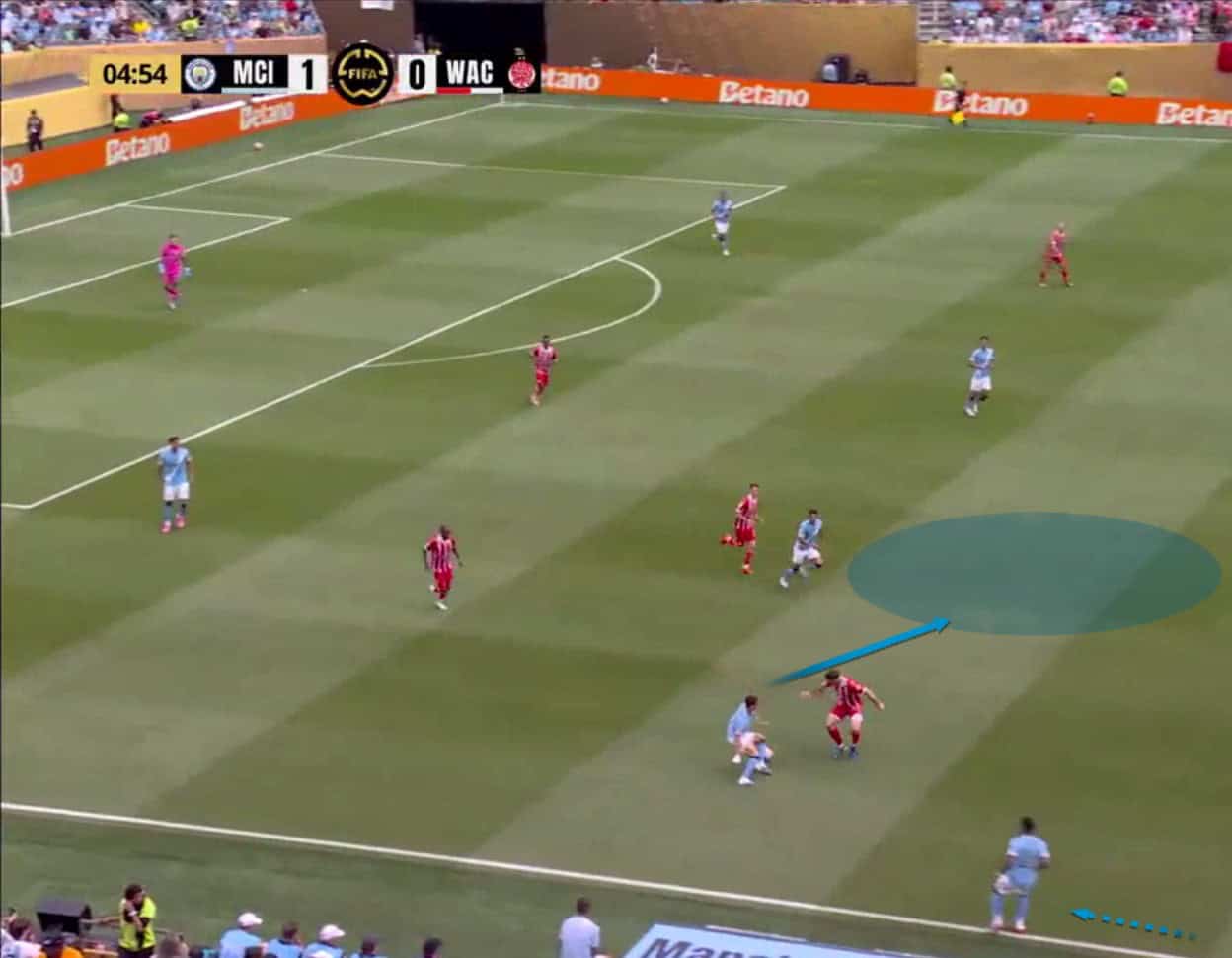 With O’Reilly positioned in the left half-space, Reijnders slightly to the left, and Lewis running towards Reis to draw Wydad’s left sixer, the space opens again — this time for Lewis.
Foden receives and turns, forcing Meijers into a tougher one-on-one duel with him facing forward.
Foden uses a body feint to find space and pass to Lewis, who is not tracked.
Meanwhile, Savinho drops deeper to support Foden if necessary.
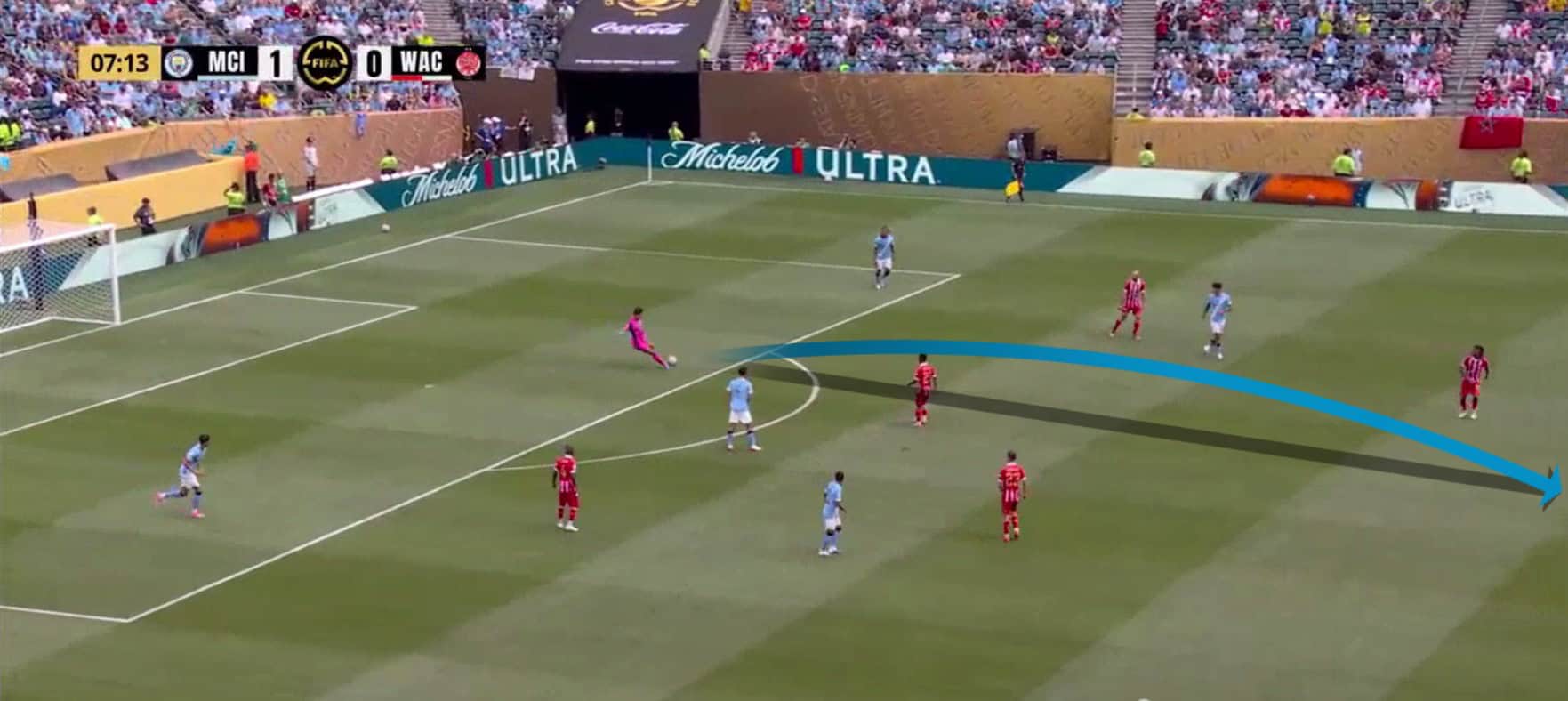 Another variation City used was playing long, direct balls from Ederson.
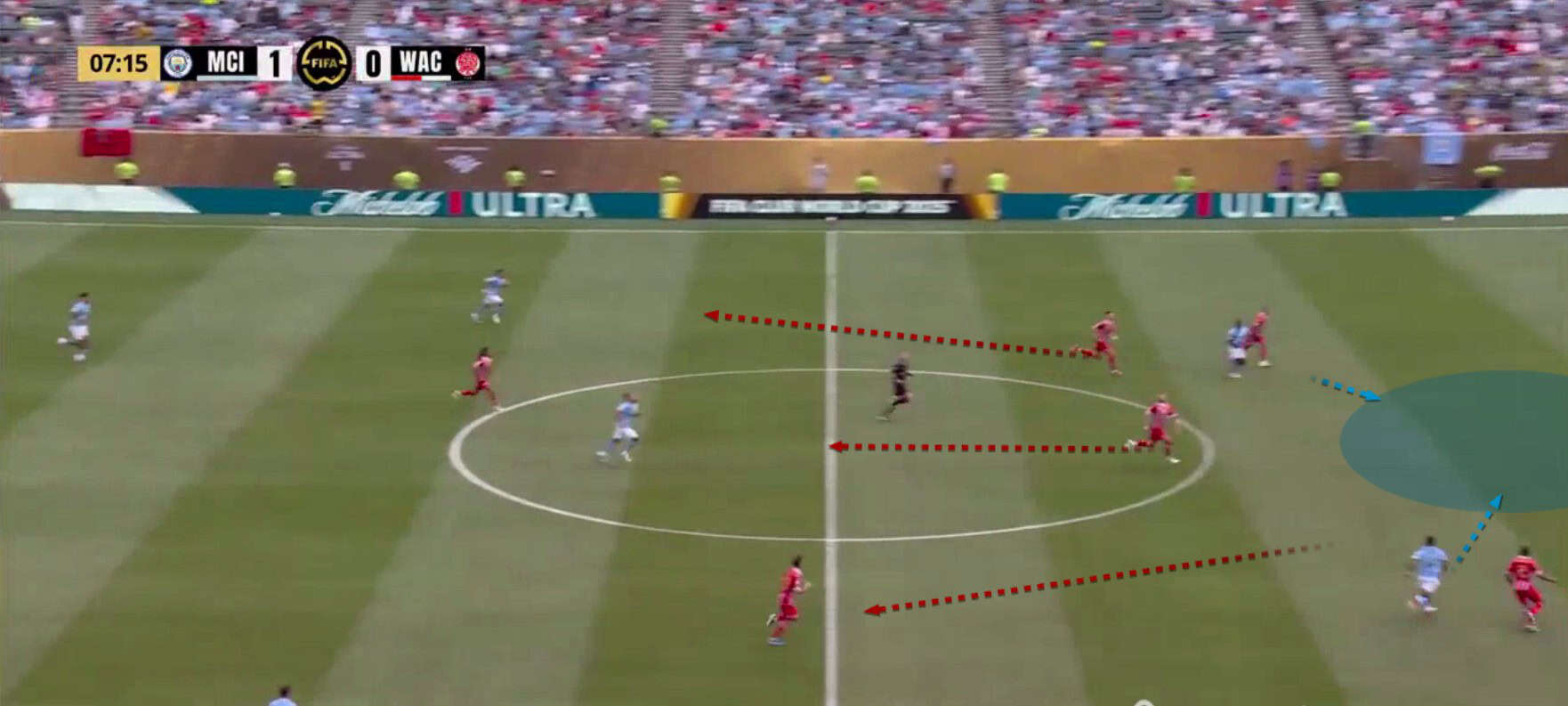 From what we observed, Wydad’s defenders, especially Meijers, show an intention to drop with Manchester City’s free midfielders and forwards — not always instantly, but the intent is there.
This creates spaces between or behind them, as seen before. A long ball from Ederson into the central space offers wingers like Doku and Savinho a chance to exploit with well-timed out-to-in runs.
That was for the Wydad game, let’s move to the next one.
Manchester City Build-Up Tactics Vs Juventus
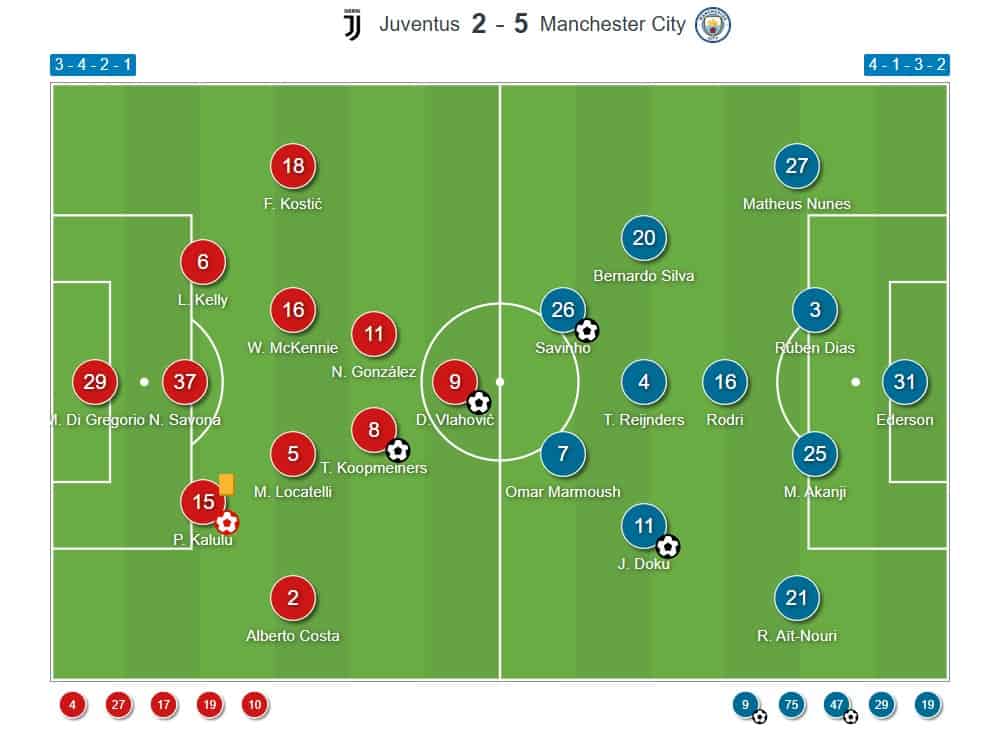 Juventus start this game with Michele Di Gregorio in goal and a defensive line of five defenders: Pierre Kalulu (right centre-back), Nicolò Savona (central centre-back), Lloyd Kelly (left centre-back), Alberto Costa (right wing‑back), and Filip Kostić (left wing‑back).
Manuel Locatelli (right central midfielder) and Weston McKennie (left central midfielder) are in the midfield, with Nicolás González (right winger), Teun Koopmeiners (left winger) on the outside.
Up front, Juventus played Dušan Vlahović (centre-forward).
Regarding Manchester City, this game’s lineup shows changes not only in the players’ names but also in their profiles and roles — all of which influence Manchester City’s attacking style of play during build-up.
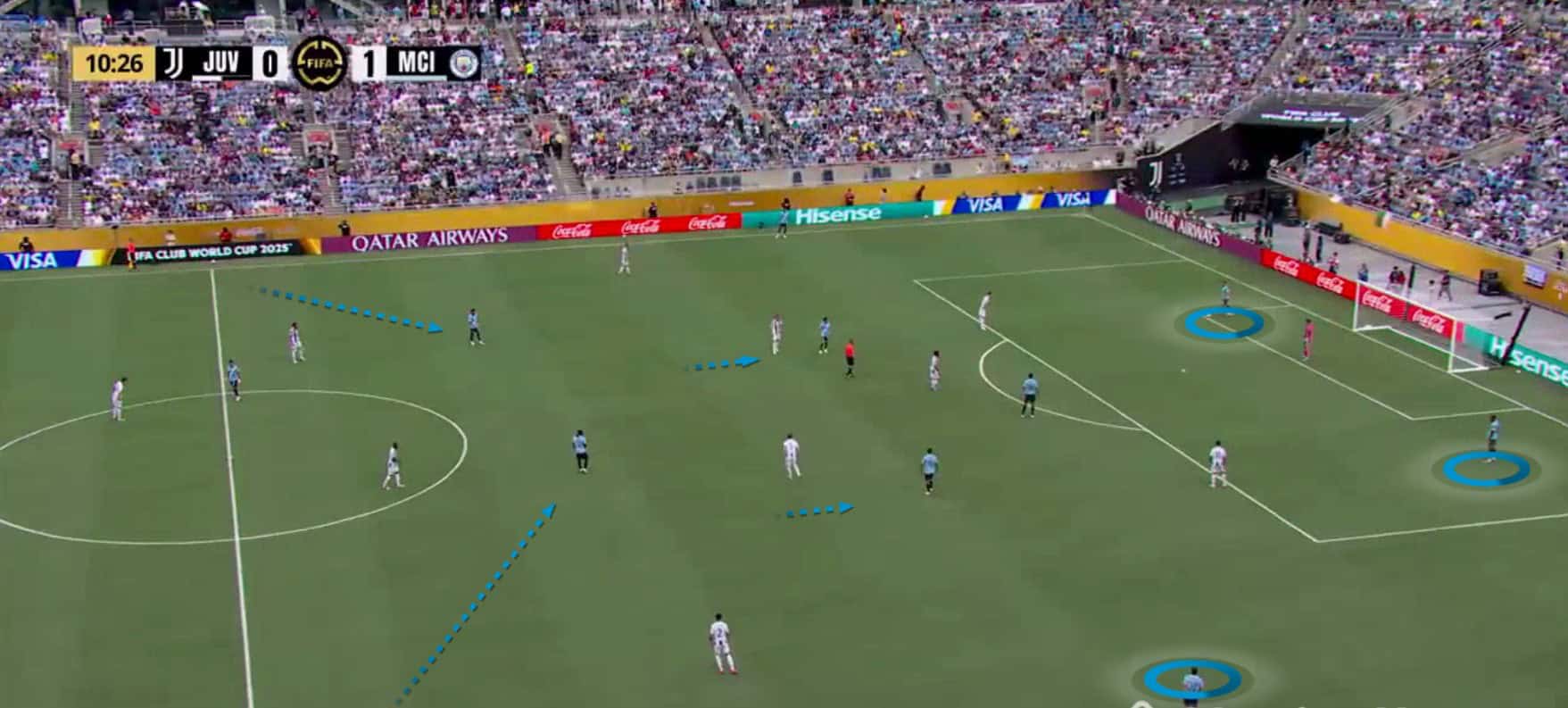 In the figure above, we see Guardiola’s team in build-up from goal kicks.
Rúben Dias and Manuel Akanji are the right and left centre-backs, both positioned inside the box.
Matheus Nunes and Rayan Aït-Nouri stay wide as full-backs — unlike Lewis and O’Reilly against Wydad.
This shifts the task of occupying half-spaces to Bernardo Silva and Reijnders, who drop deep and near to the box ahead of the six, Rodri, who is positioned outside the box — unlike Reijnders in the Wydad game.
The wingers, Savinho and Doku, tuck into the centre, taking the zones the eights covered previously, with Marmoush as the centre-forward.
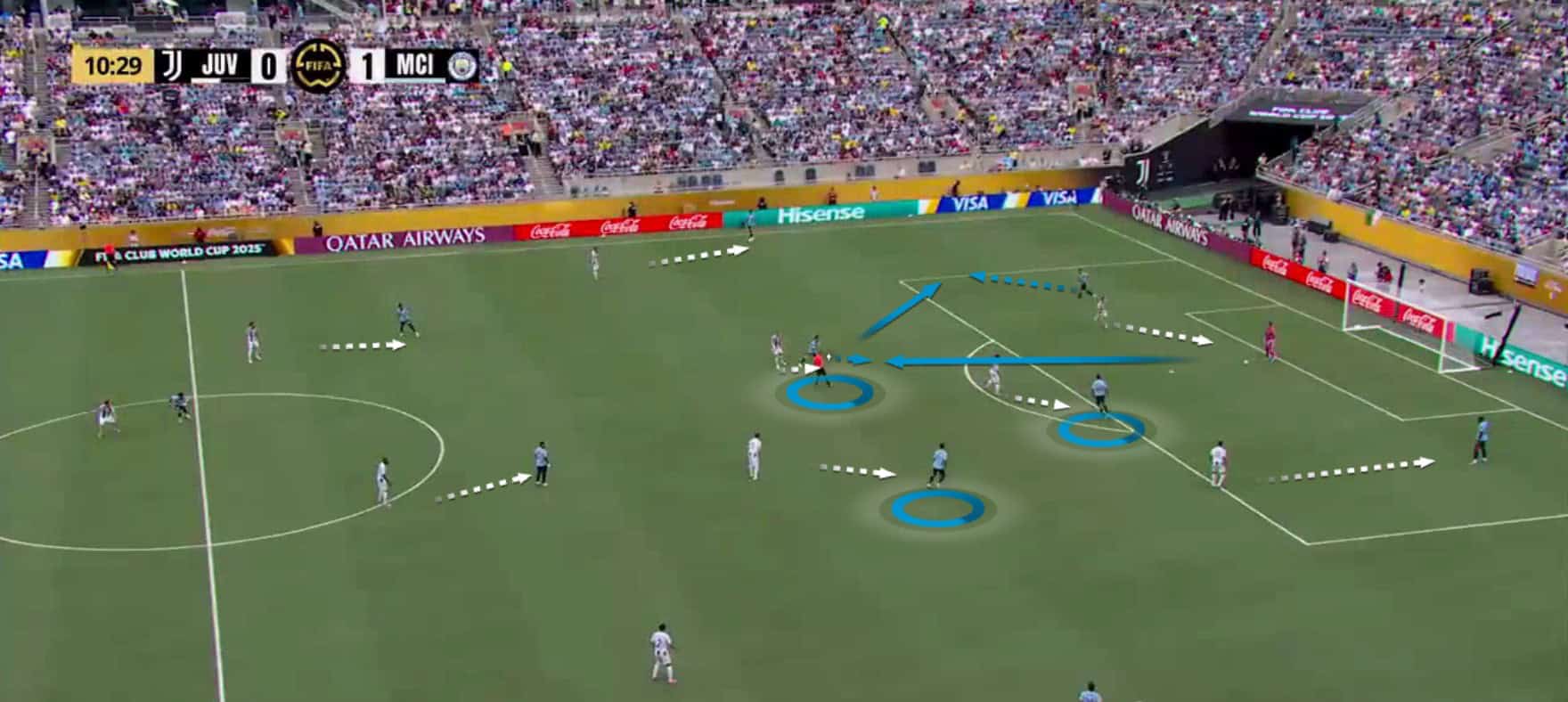 Juventus’ pressing scheme is based on man-marking across the pitch.
Vlahović stays just outside the box near Dias, ready to press Ederson while shadowing Dias.
McKennie pushes up to mark Rodri, Koopmeiners tucks inside to track Silva, and Locatelli marks Reijnders.
Manchester City’s idea is to exploit the moment when Vlahović leaves Dias to press Ederson, making Dias the free man.
Dias passes to Ederson and immediately pushes forward.
Rodri shifts slightly left to drag McKennie away and open the lane, allowing Ederson to find Silva, who drops to lay it off to Dias.
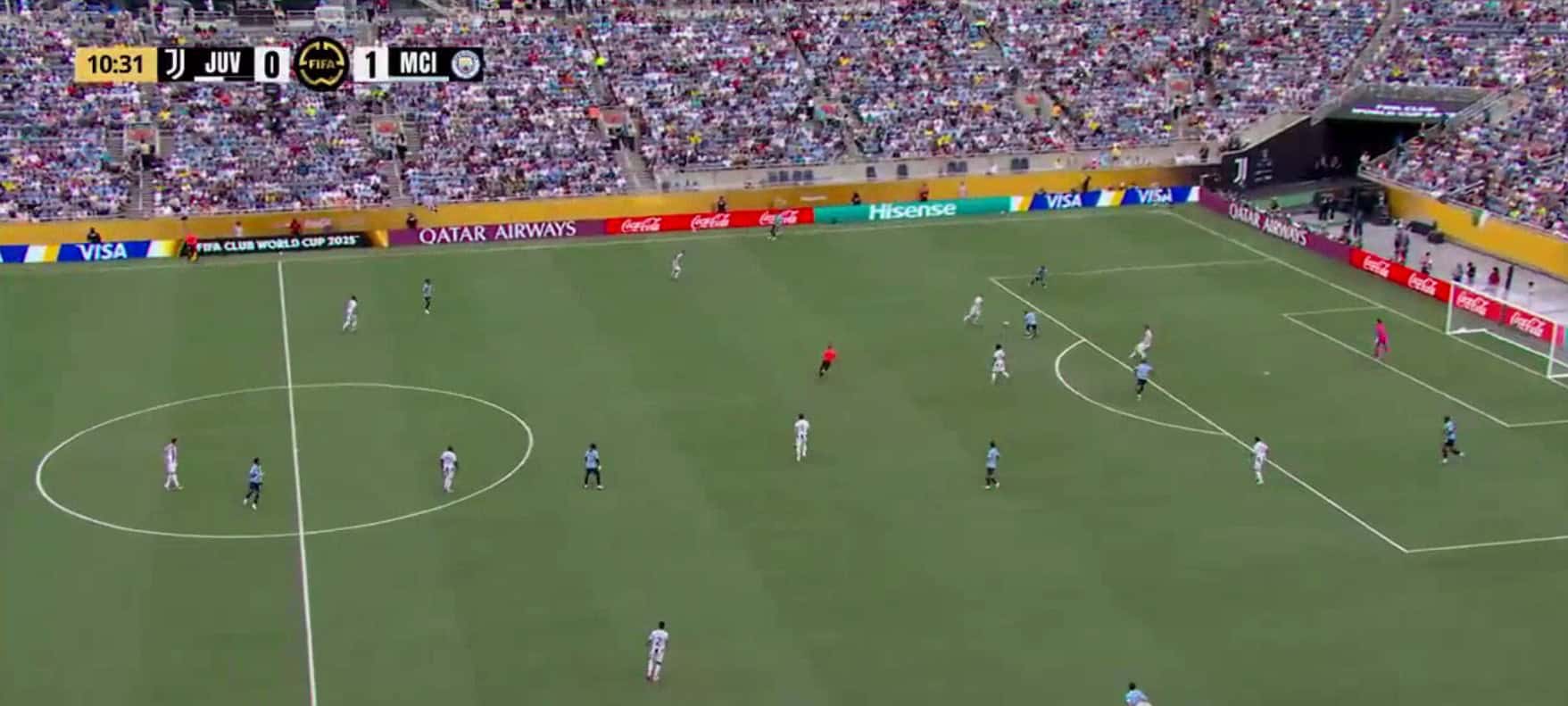 However, a lack of communication between Ederson and Silva disrupts the sequence, ultimately leading to Juventus’ equaliser.
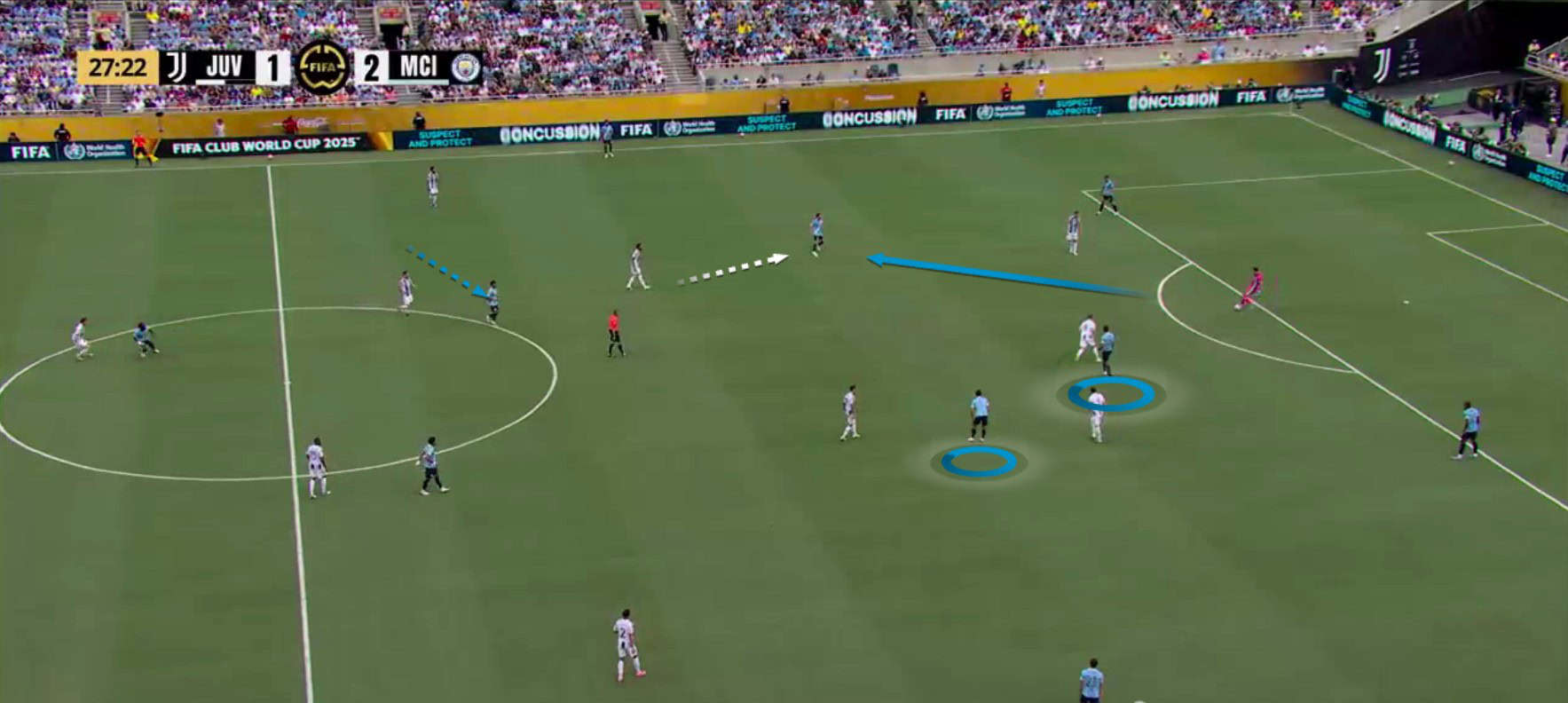 In open play, Manchester City maintain a similar idea — Rodri draws his marker, Silva positions to receive from Ederson, and Savinho remains tucked inside.
However, Juventus chose not to press Ederson in this phase.
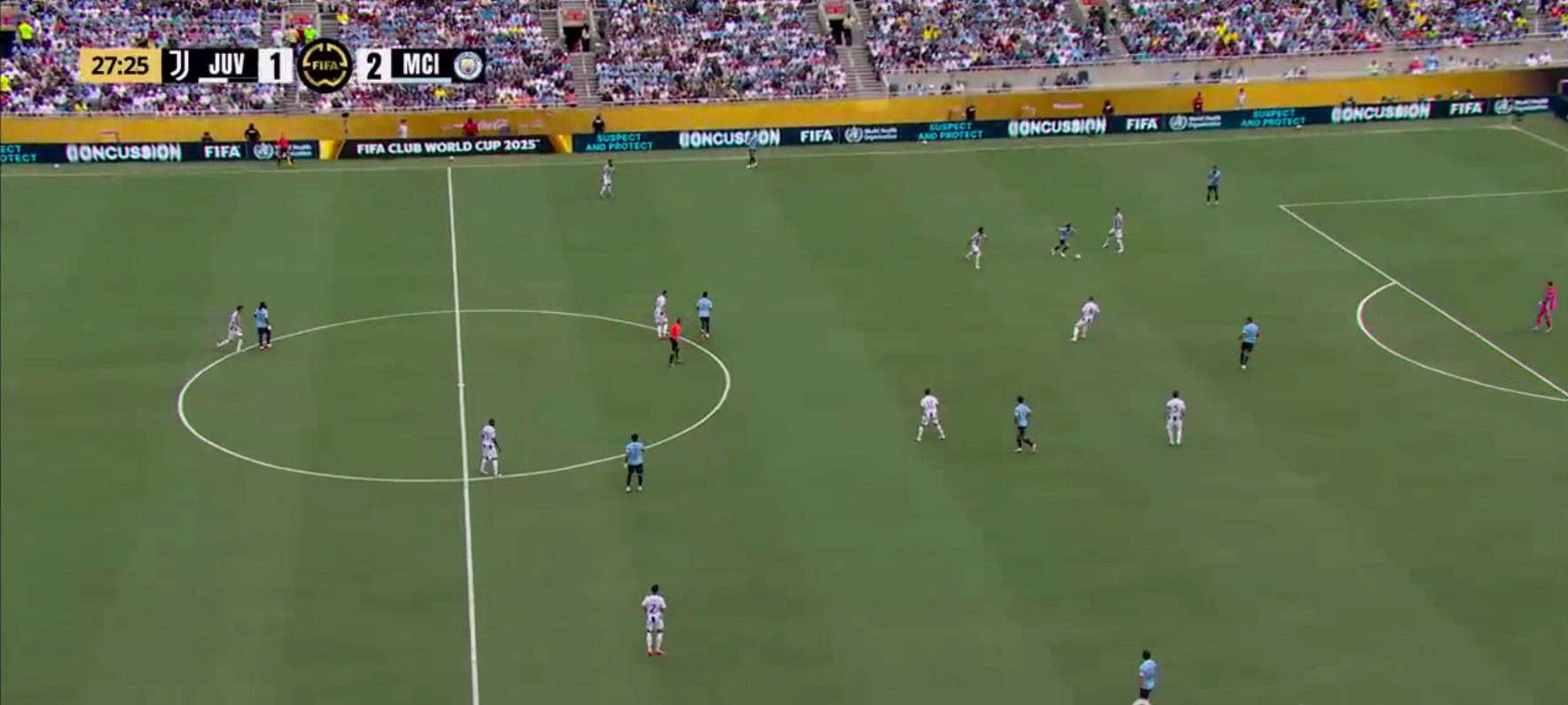 When Silva receives from Ederson, Vlahović immediately closes him down, blocking the pass to Dias.
Silva responds by carrying the ball horizontally to disrupt Juventus’ press and free a teammate — a sequence that suits his strengths.
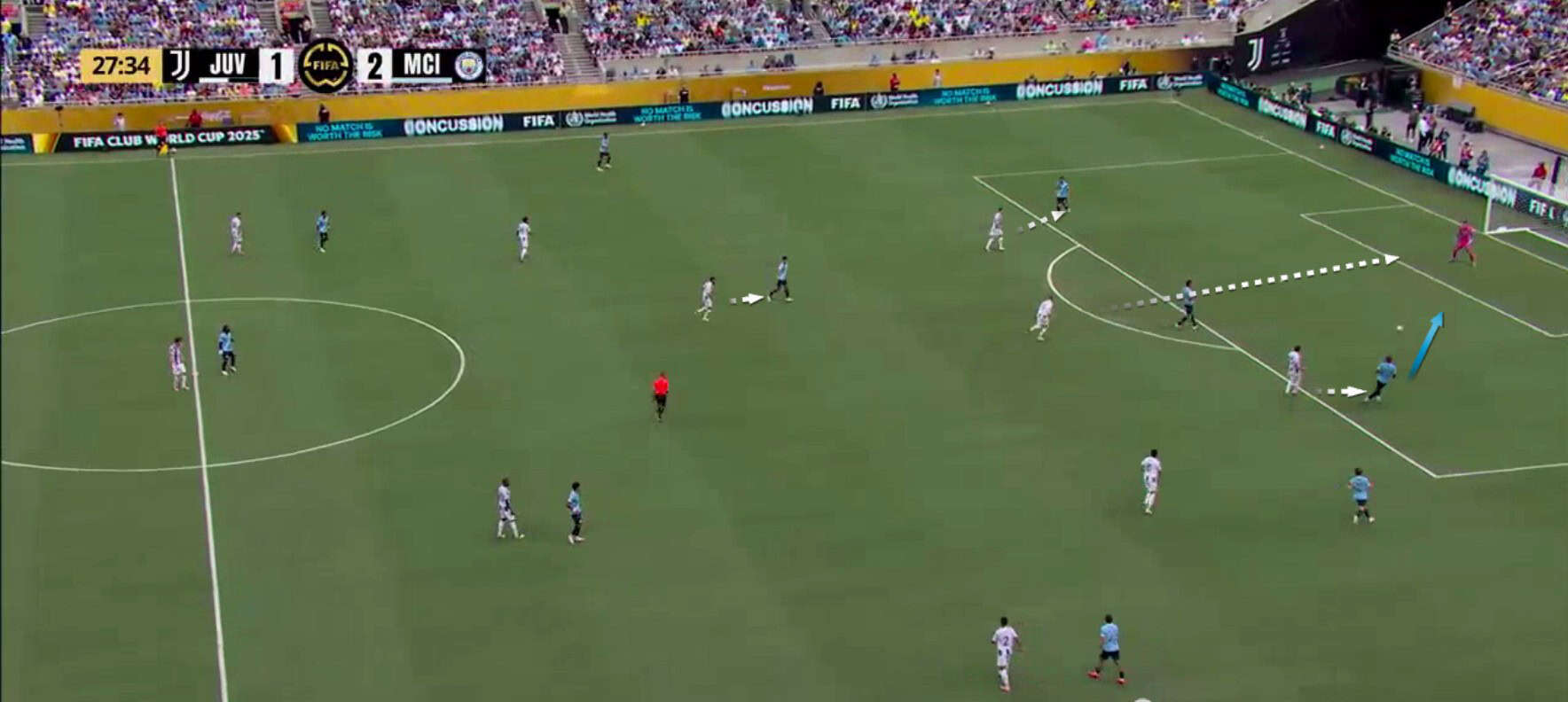 After a passing sequence, the ball reaches Akanji, who plays back to Ederson.
This action serves as a pressing trigger for Juventus.
Rodri’s marker initiates the press this time, advancing vertically while shadowing him.
This means Dias is not the free player here, as his marker stays put instead of stepping out to press Ederson.
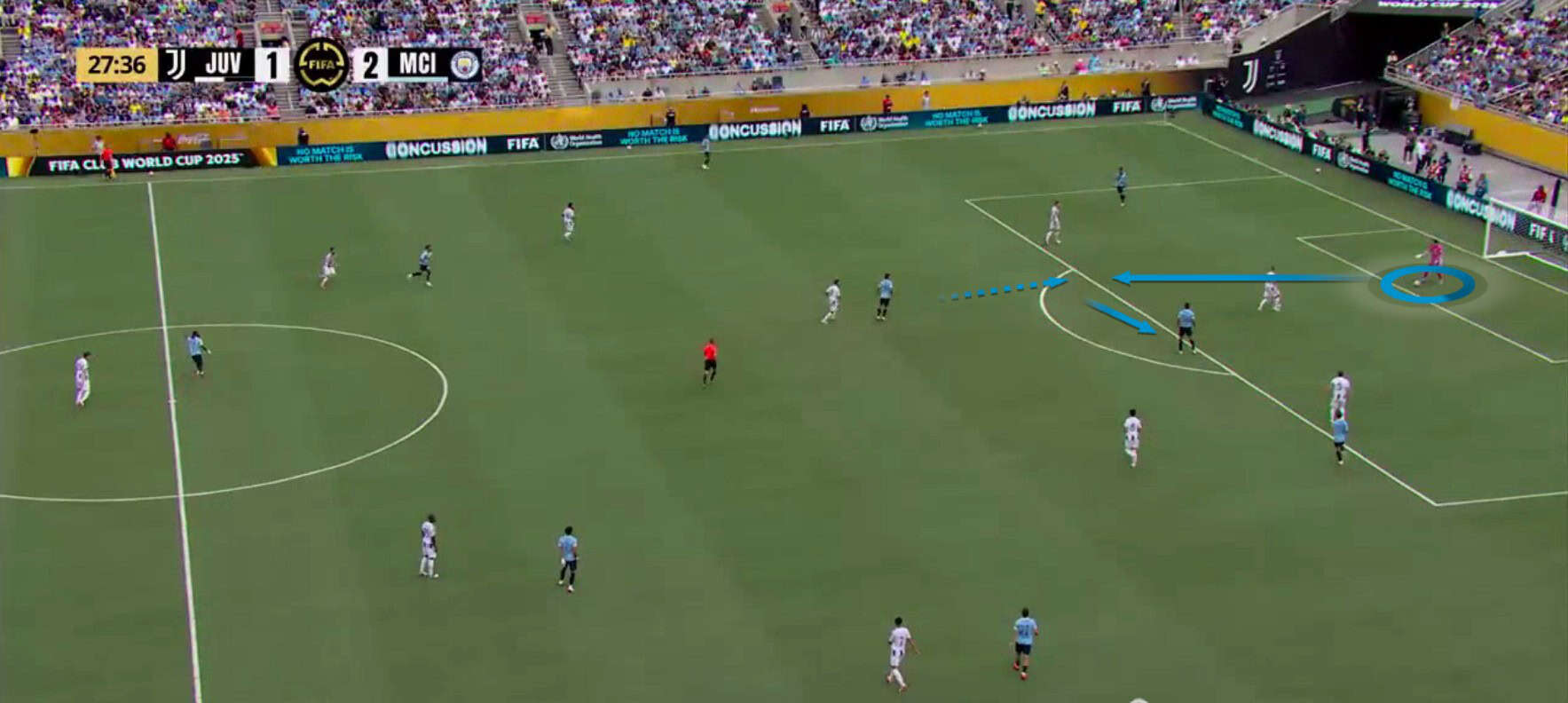 Since Rodri’s marker presses Ederson, Rodri is now the free player.
Reijnders, positioned where Silva usually is, should drop to receive from Ederson and quickly find Rodri.
Ederson even gestures, prompting Reijnders to drop and provide the passing option.
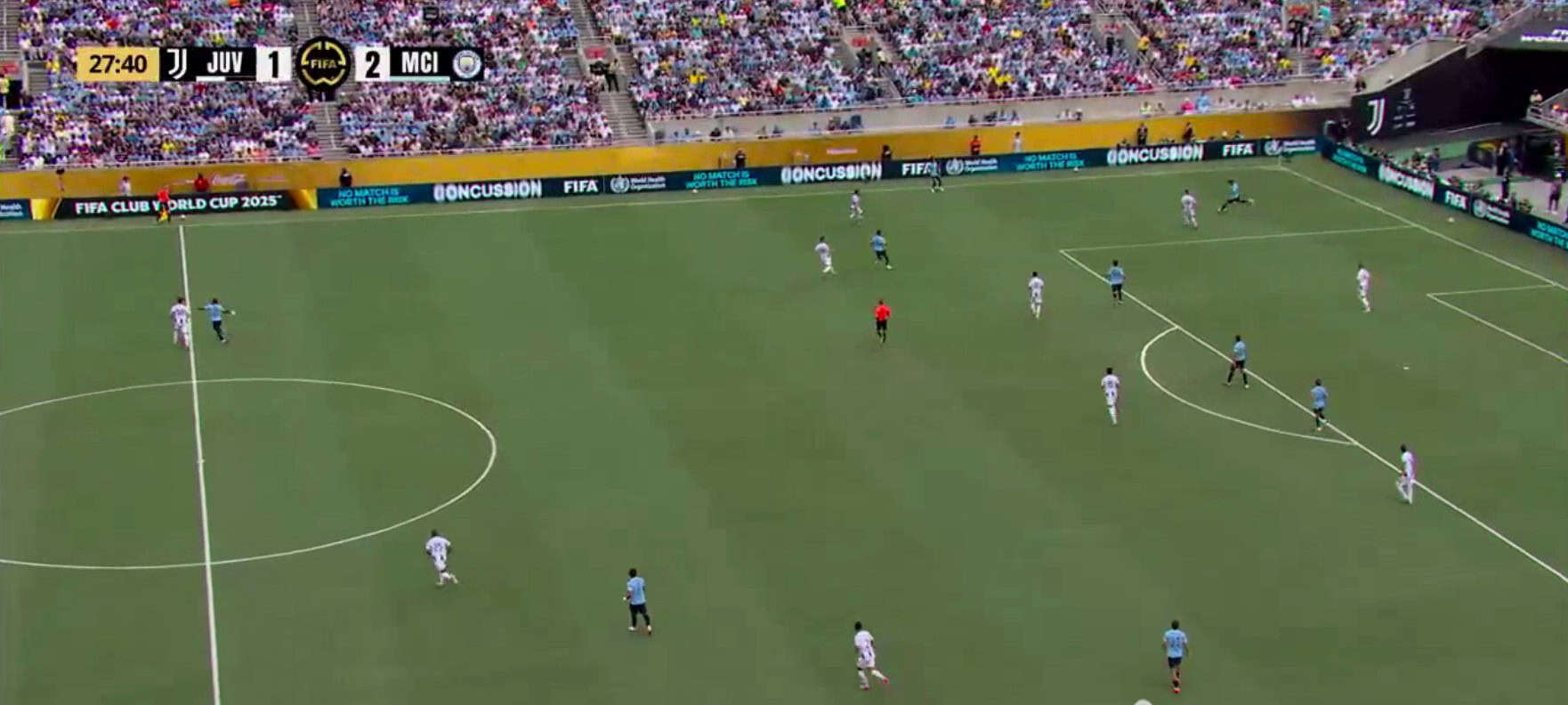 But Reijnders doesn’t drop, so Ederson forces the pass to Dias, who is under pressure and forced to go long to relieve the situation.
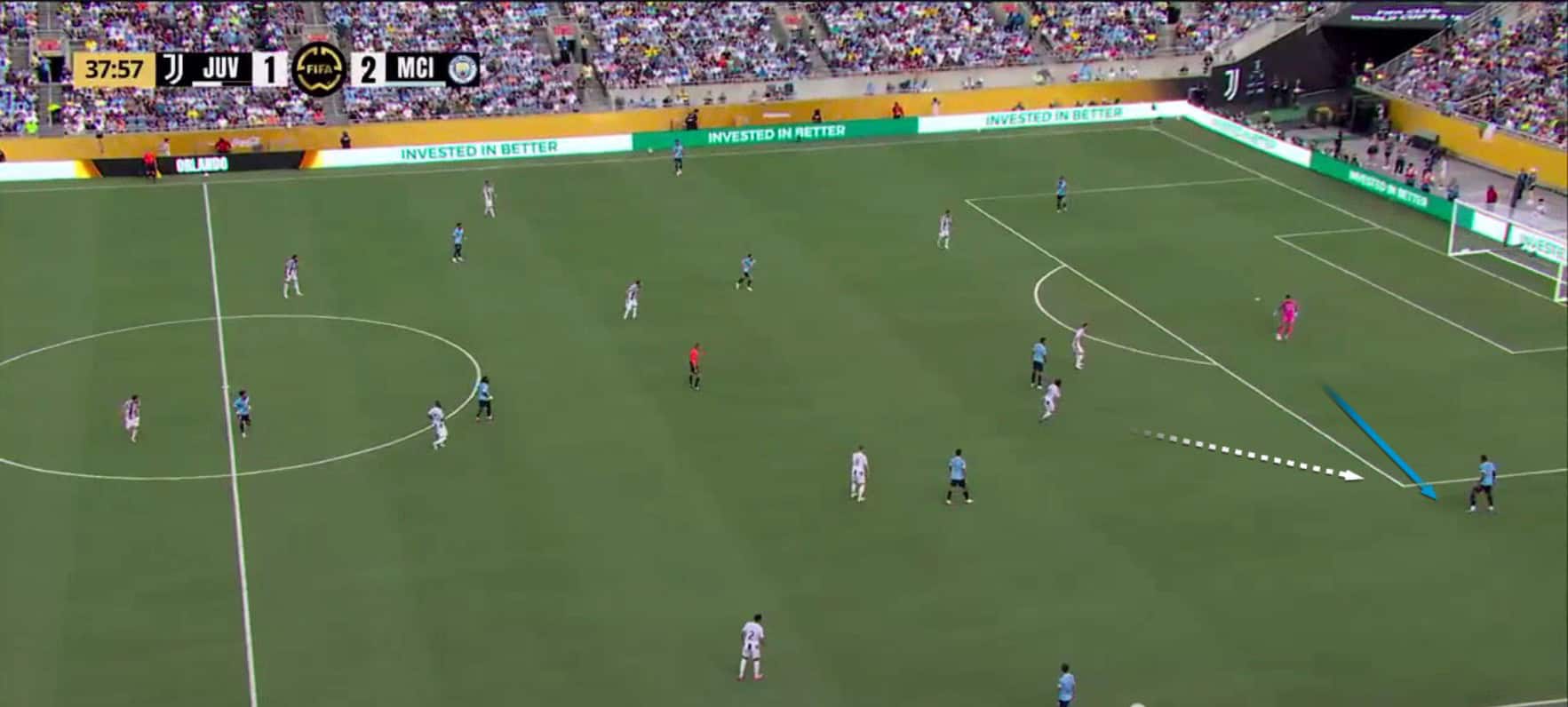 Looking for an alternative, Manchester City switches to the other side as Ederson finds Akanji, who has space to receive with his slightly off marker.
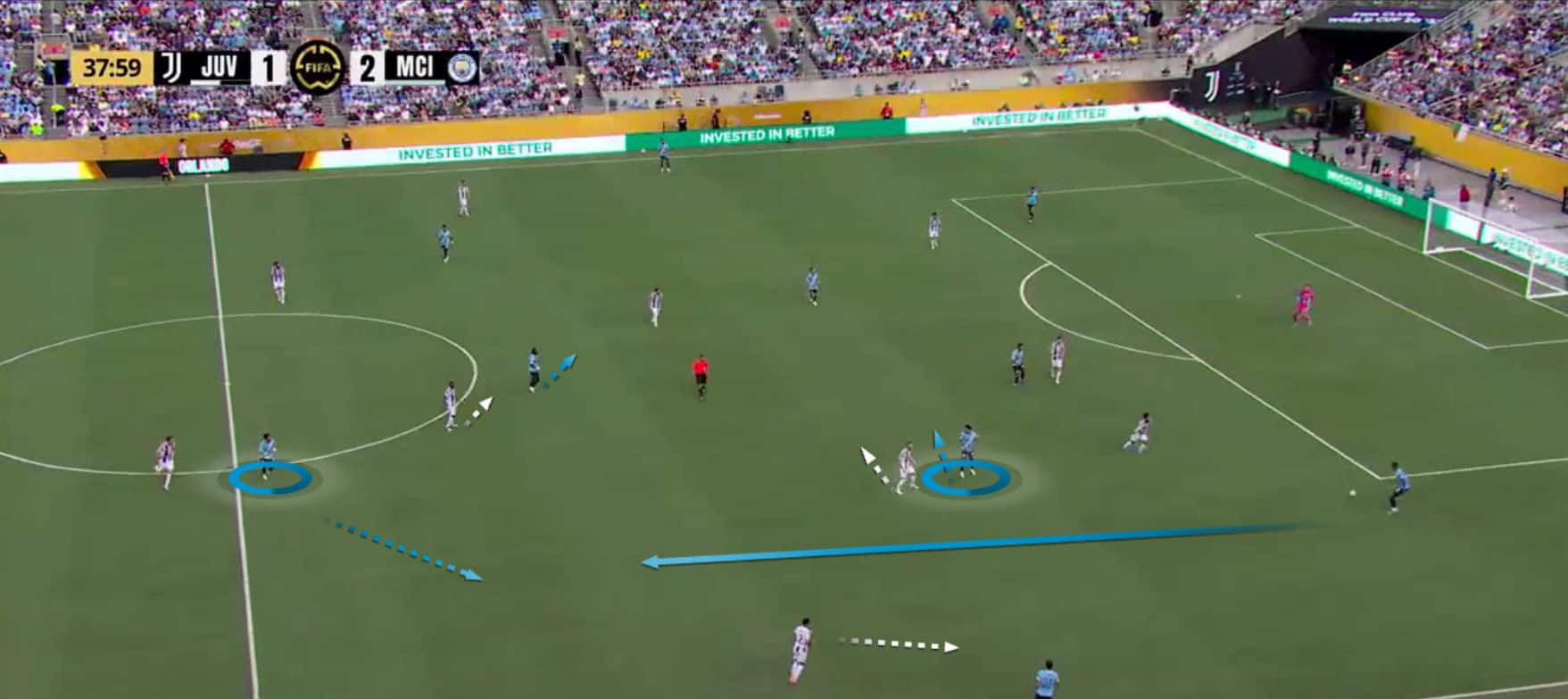 Above, we see that while Akanji receives, Doku shifts centrally to drag his marker, Kalulu, with him.
Reijnders mirrors the move, pulling his marker away to open the passing lane from Akanji to Marmoush.
Reijnders moves backwards and horizontally into the centre, keeping his body oriented towards the ball side to position himself for the next forward run.
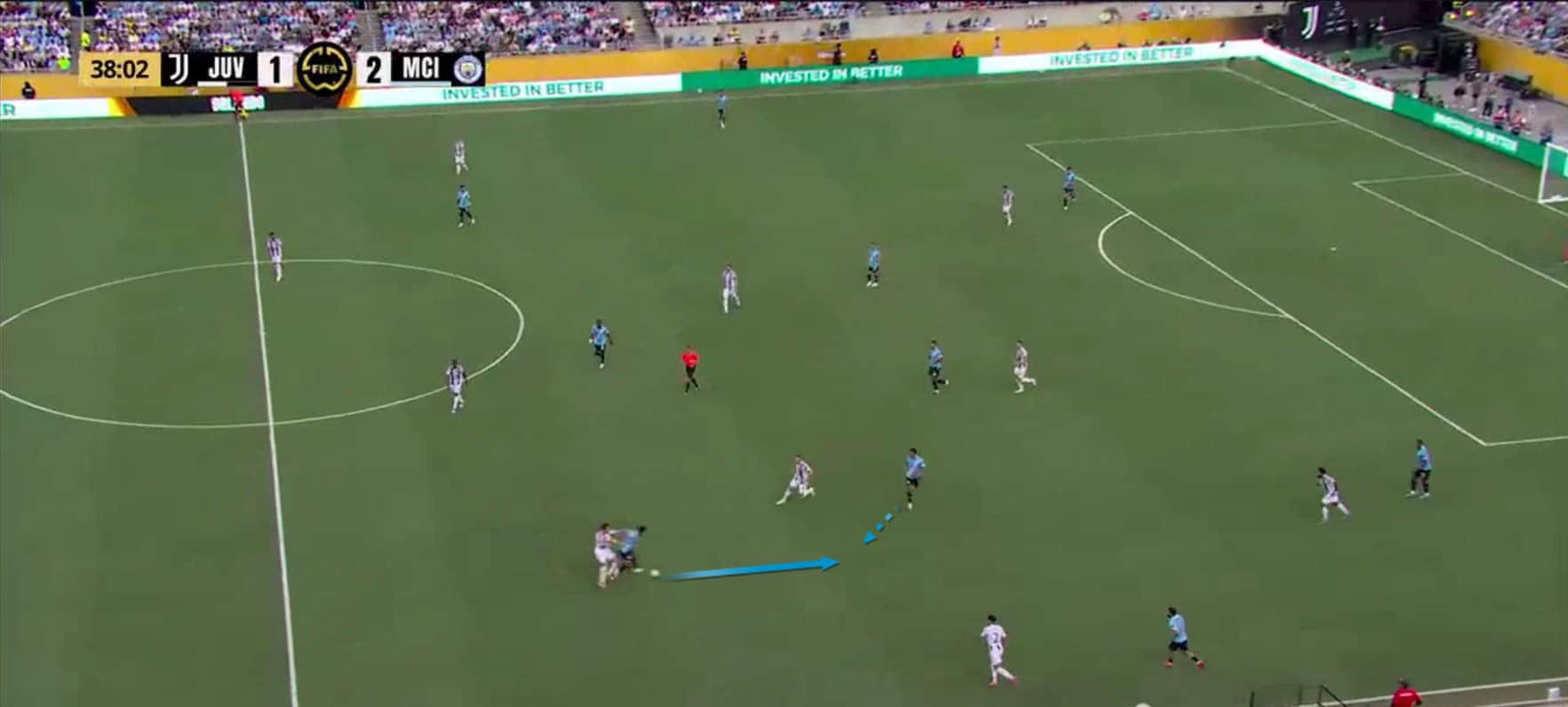 He can then receive the lay-off pass from Marmoush.
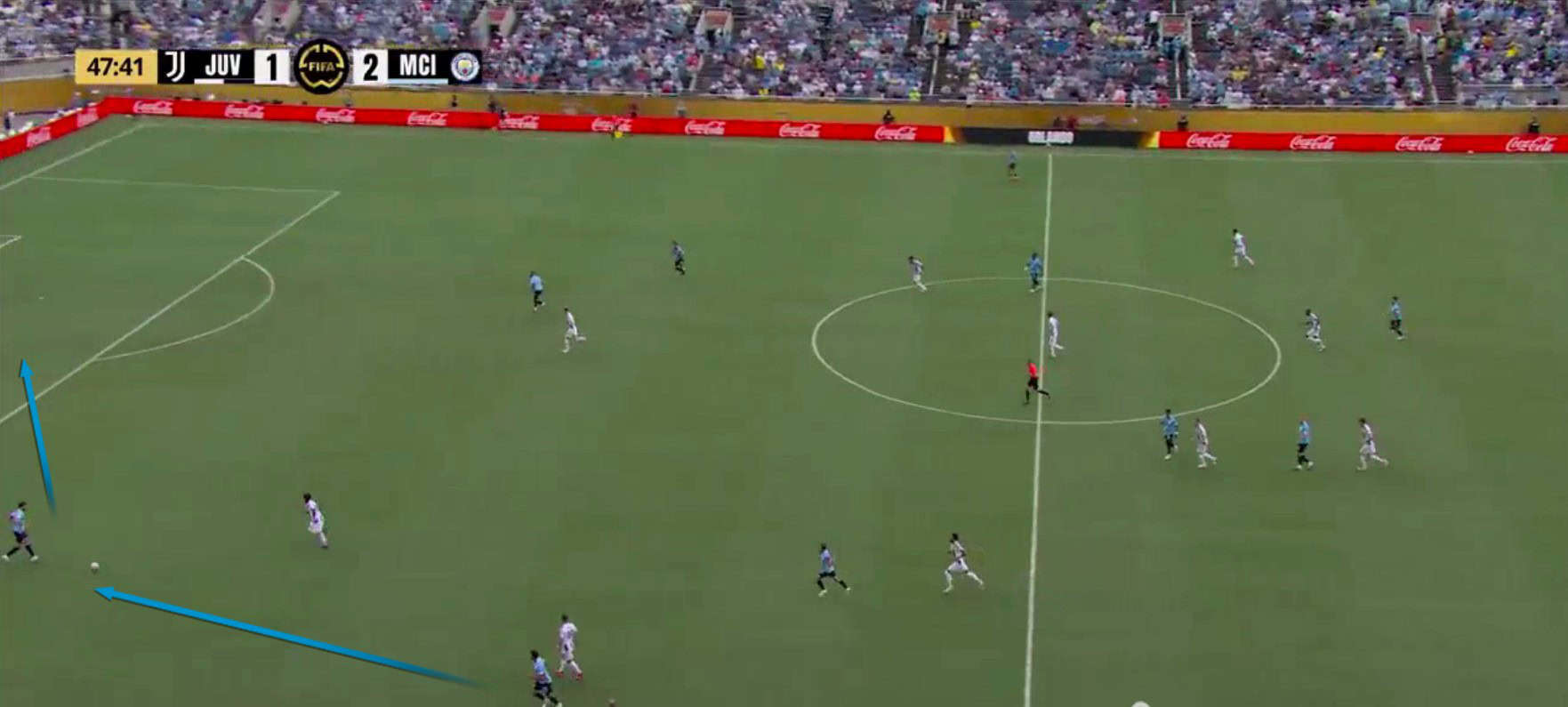 In the second half, Guardiola’s team sought a right-sided solution through Dias, following a similar pattern to the one used with Akanji earlier.
Aware that one of Juventus’ pressing triggers is a back pass to Ederson, City initiates it, but this time via Dias from a more advanced position.
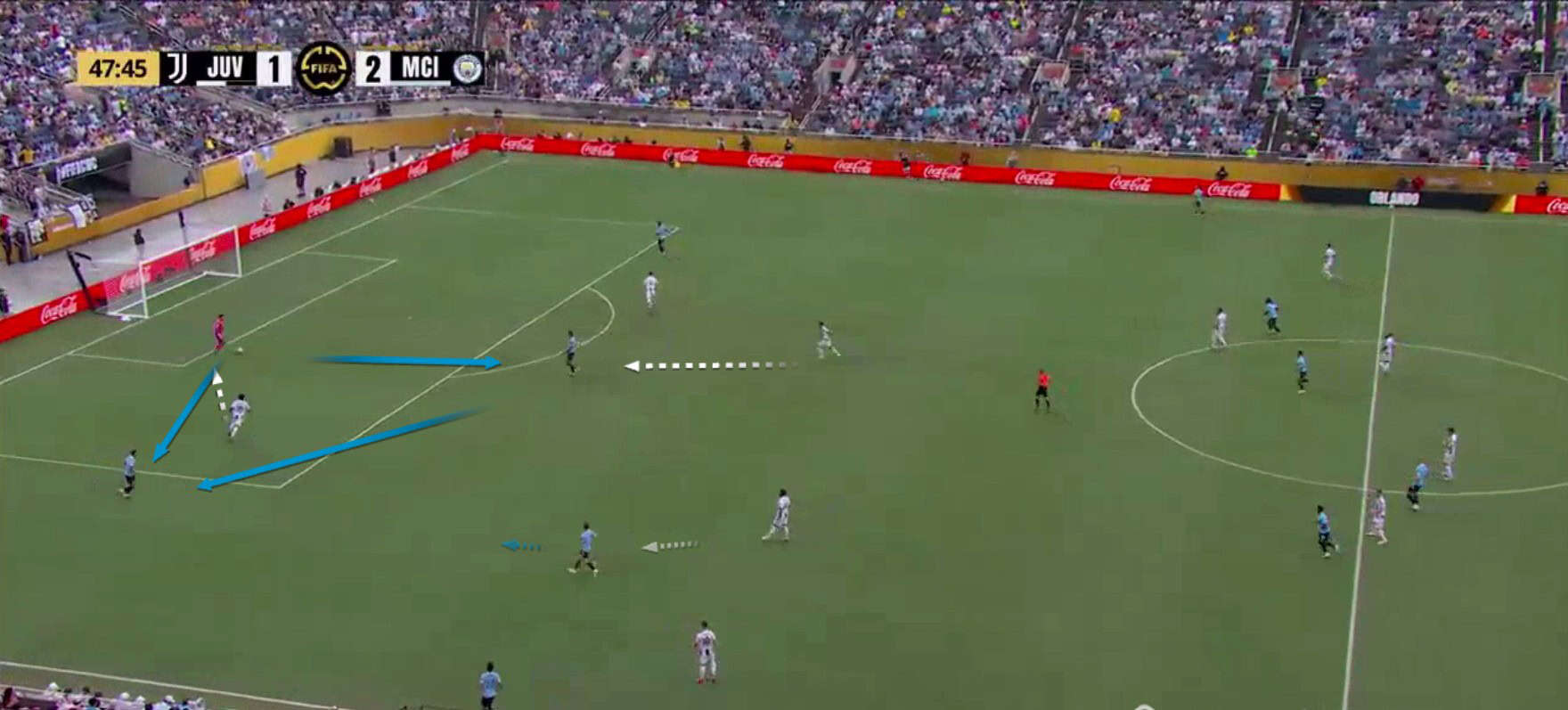 That back pass triggers Dias’ marker to press Ederson, leaving Dias as the free man to receive, especially with Rodri’s marker also drawn away.
Silva drops deep as the ball returns to Dias, drawing his marker, who expects him to receive as usual.
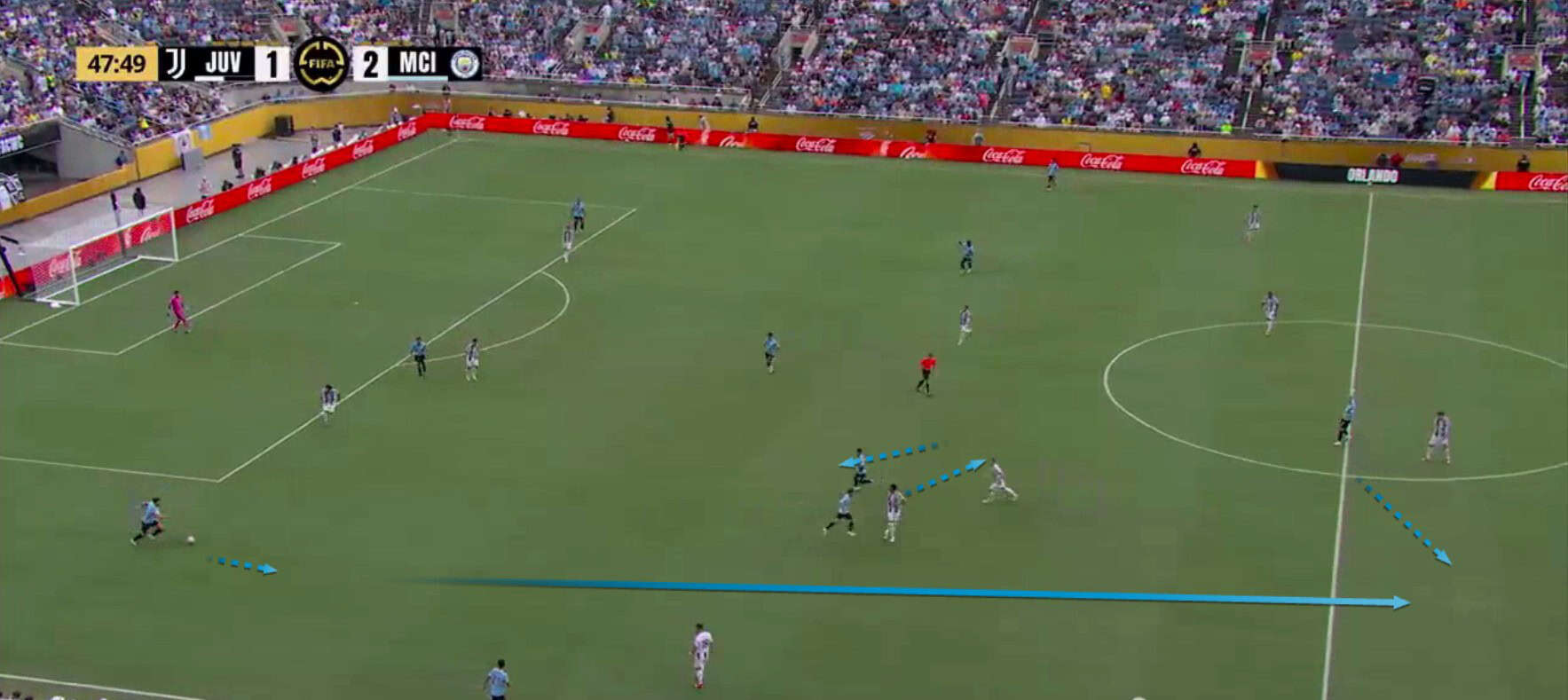 However, Silva quickly turns and darts forward, dragging his marker and leaving space for Dias to advance.
At the same time, Savinho drops and runs forward, preventing his marker from closing the lane from Dias to Haaland, who replaced Marmoush, creating a clear path for direct progression.
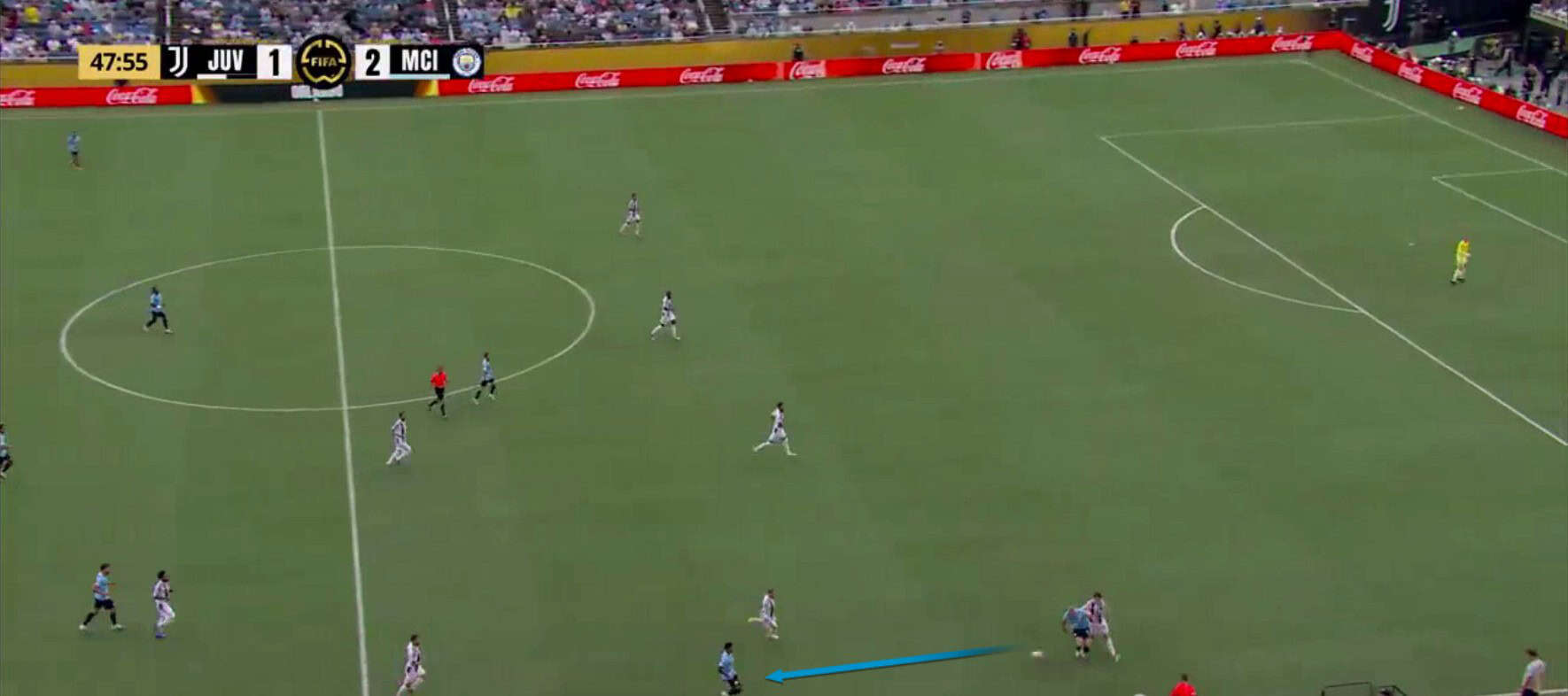 Savinho is facing forward, ready to support Haaland by receiving the lay-off pass.
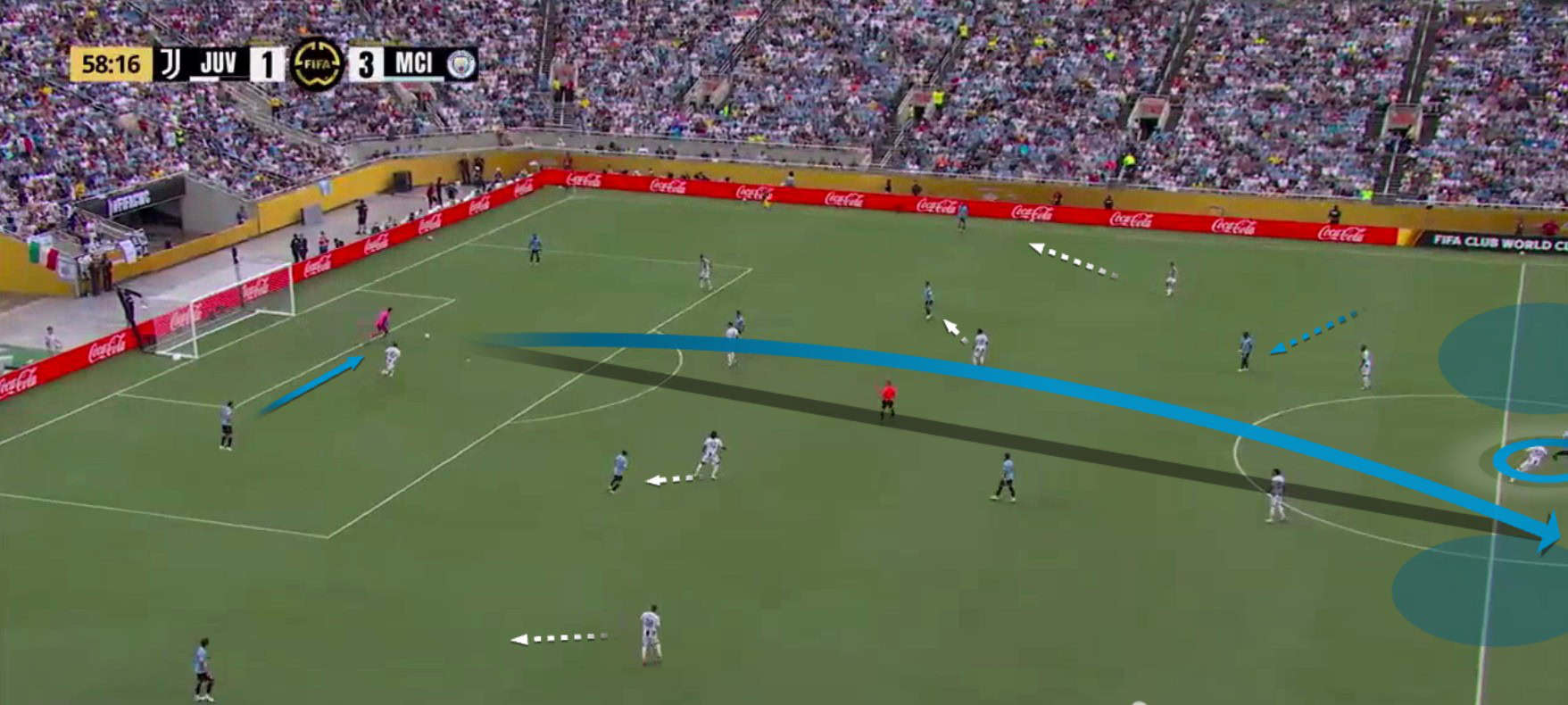 Similar to their approach against Wydad, Manchester City sought to exploit Ederson’s long ball, this time targeting the centre-forward instead of the wingers.
Given the structure, positioning, and Juventus’ man-to-man scheme, it was a logical solution.
With the centre-backs following Manchester City’s wingers as they tucked inside, spaces opened behind the backline for Haaland to exploit, offering a direct outlet for Ederson’s long ball into these advanced areas on either side.
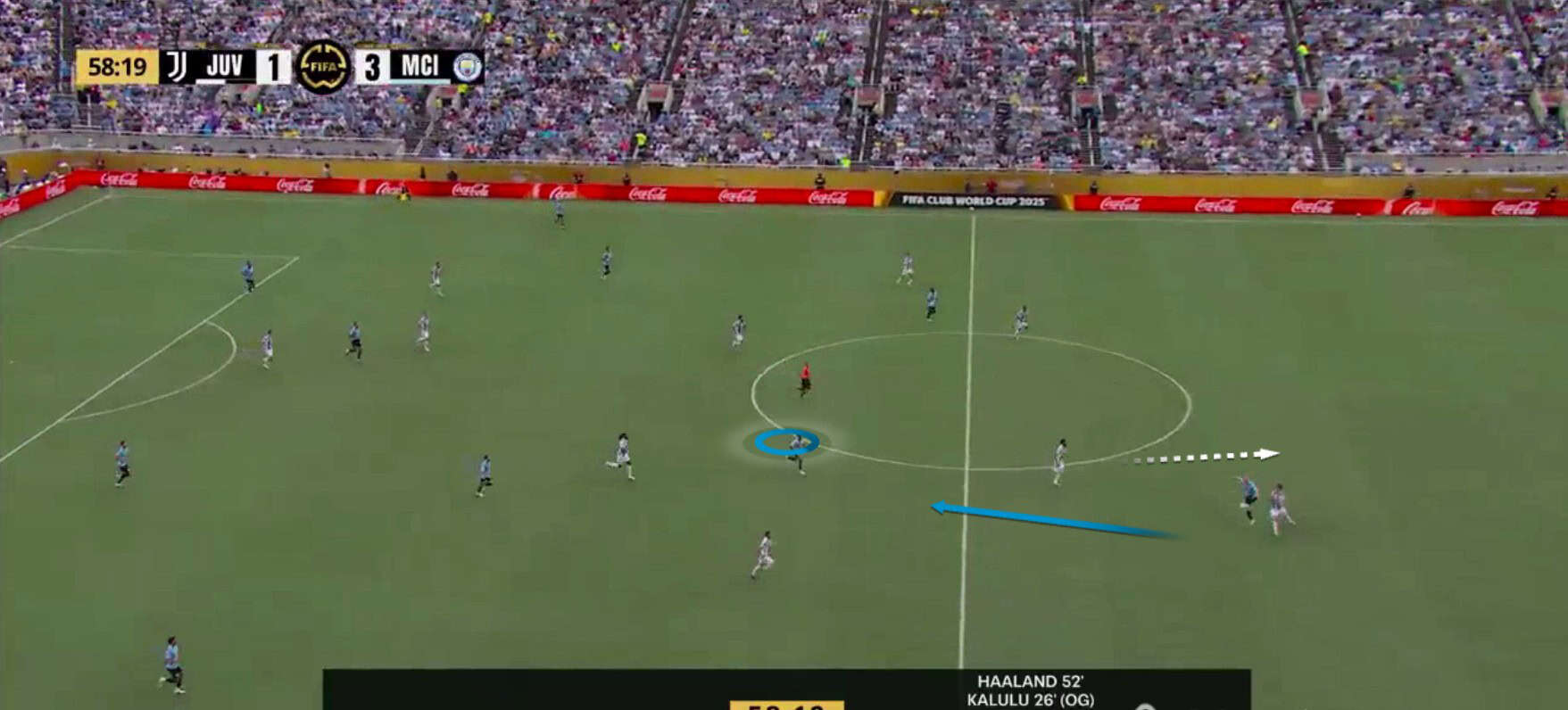 Now defenders are often hurried to fall back and cover the space behind the teammate contesting the aerial duel, as Savinho’s marker does here.
This opens more room for City’s wingers to win Haaland’s lay-off and the second ball, giving Savinho a clear advantage to exploit the space and time created.
Now, facing an opponent that also defended with a back five but with a contrasting defensive setup, Guardiola’s side adjusted not only the personnel but also its tactical approach.
So, what did the final match in City’s tournament journey reveal?
Manchester City Build-Up Tactics Vs Al Hilal
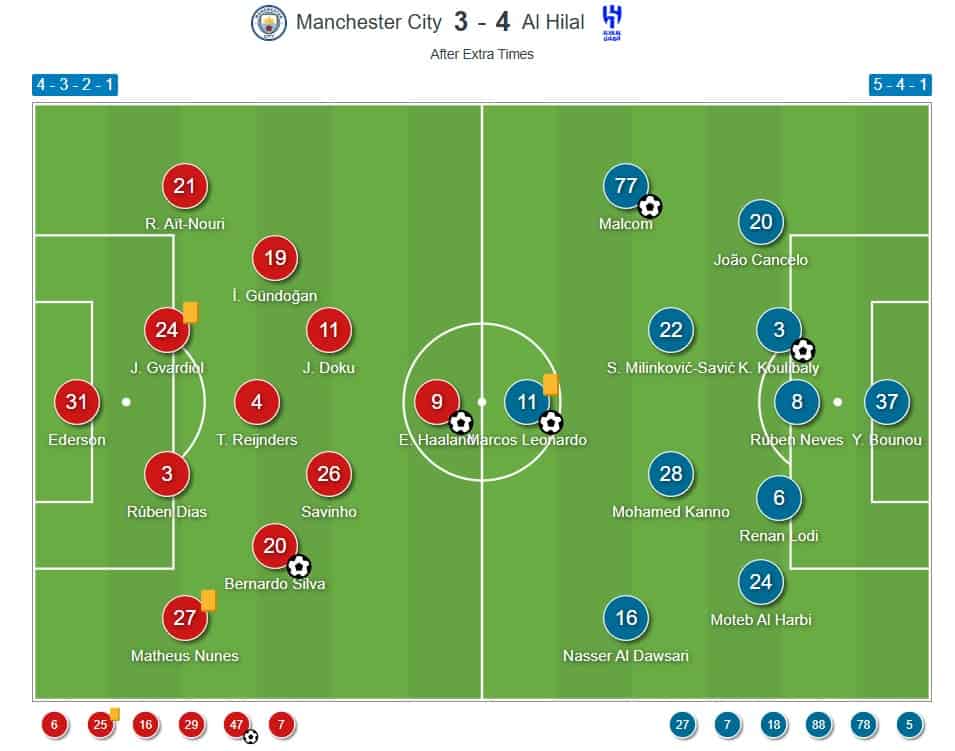 Al Hilal starts with goalkeeper Yassine Bounou.
Their defenders are João Cancelo (right wing‑back), Kalidou Koulibaly (right centre-back), Rúben Neves (central centre-back), Renan Lodi (left centre-back), Moteb Al-Harbi (left wing‑back).
In midfield, they lined up Sergej Milinković-Savić (right central midfielder), Mohamed Kanno (left central midfielder), Nasser Al-Dawsari (left winger), and Malcom (right winger).
Marcos Leonardo lined up as the centre-forward.
In this match against Al Hilal, Manchester City made several adjustments to their starting XI.
Joško Gvardiol replaced Manuel Akanji as the left centre-back.
İlkay Gündoğan was introduced as the left eight, with Tijjani Reijnders dropping deeper to operate as the six in place of Rodri.
Additionally, Erling Haaland started as the centre-forward.
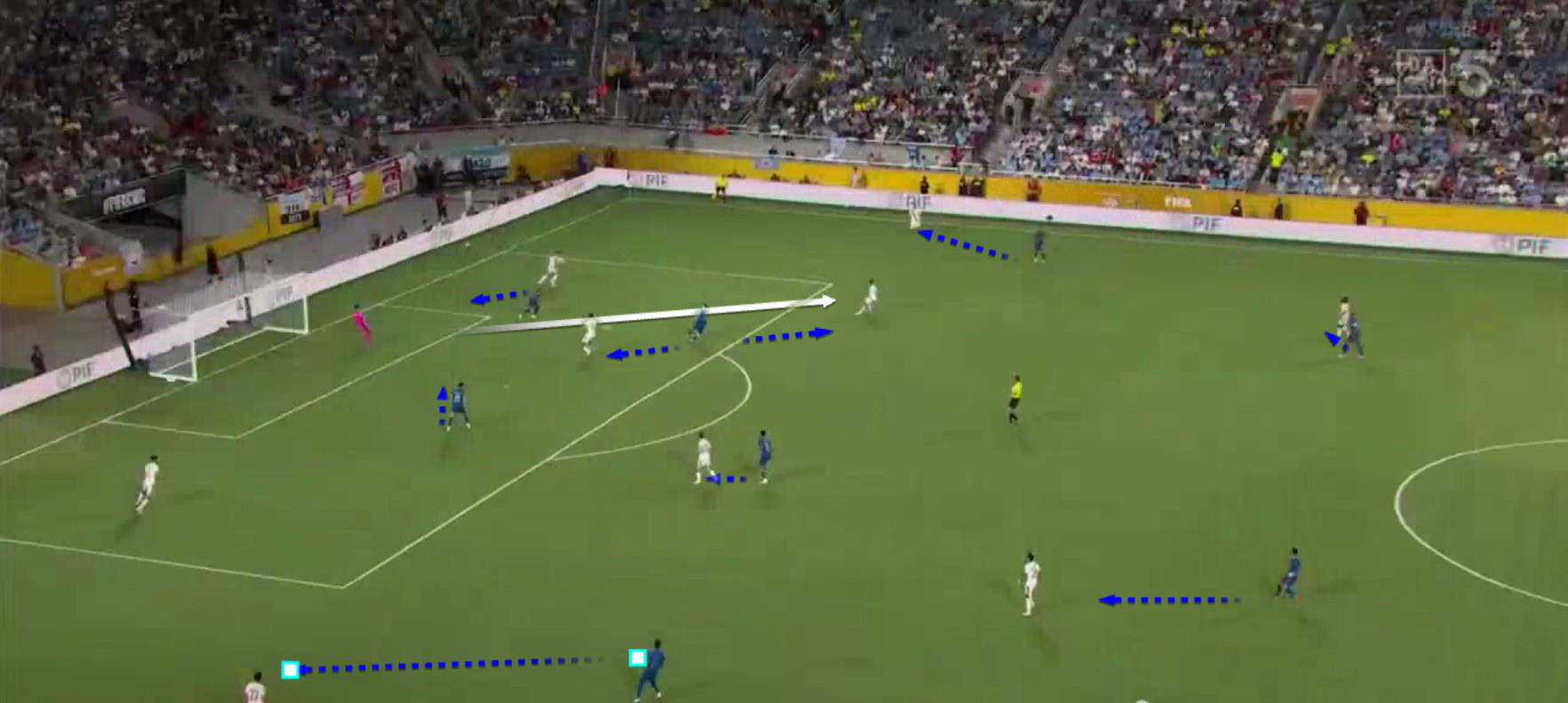 In the figure above, we see Manchester City in goal kicks, employing a structure similar to the one used in the Juventus match.
Both centre-backs stayed inside the box, with Reijnders as the six just outside, flanked by Silva and Gündoğan in the half-spaces near the box.
The full-backs held wide positions, the wingers tucked into the half-spaces, and Haaland occupied the central lane.
Though the broadcast didn’t show the full build-up, when the camera angle widens, we see Ederson in possession during open play, suggesting that one of the centre-backs — most likely Gvardiol — initially passed to him.
In Manchester City’s half, Al Hilal applied strict man-marking: Malcom and Leonardo pressed the centre-backs, Al-Dawsari tracked Silva, both wing-backs stayed on Manchester City’s full-backs, Kanno marked Doku, and Lodi followed Savinho.
Except for Milinković-Savić, who held a more zonal role between Reijnders and Gündoğan.
As he moved closer to Reijnders, this naturally opened a passing lane from Ederson to Gündoğan, providing City with an outlet to bypass the first line of pressure.
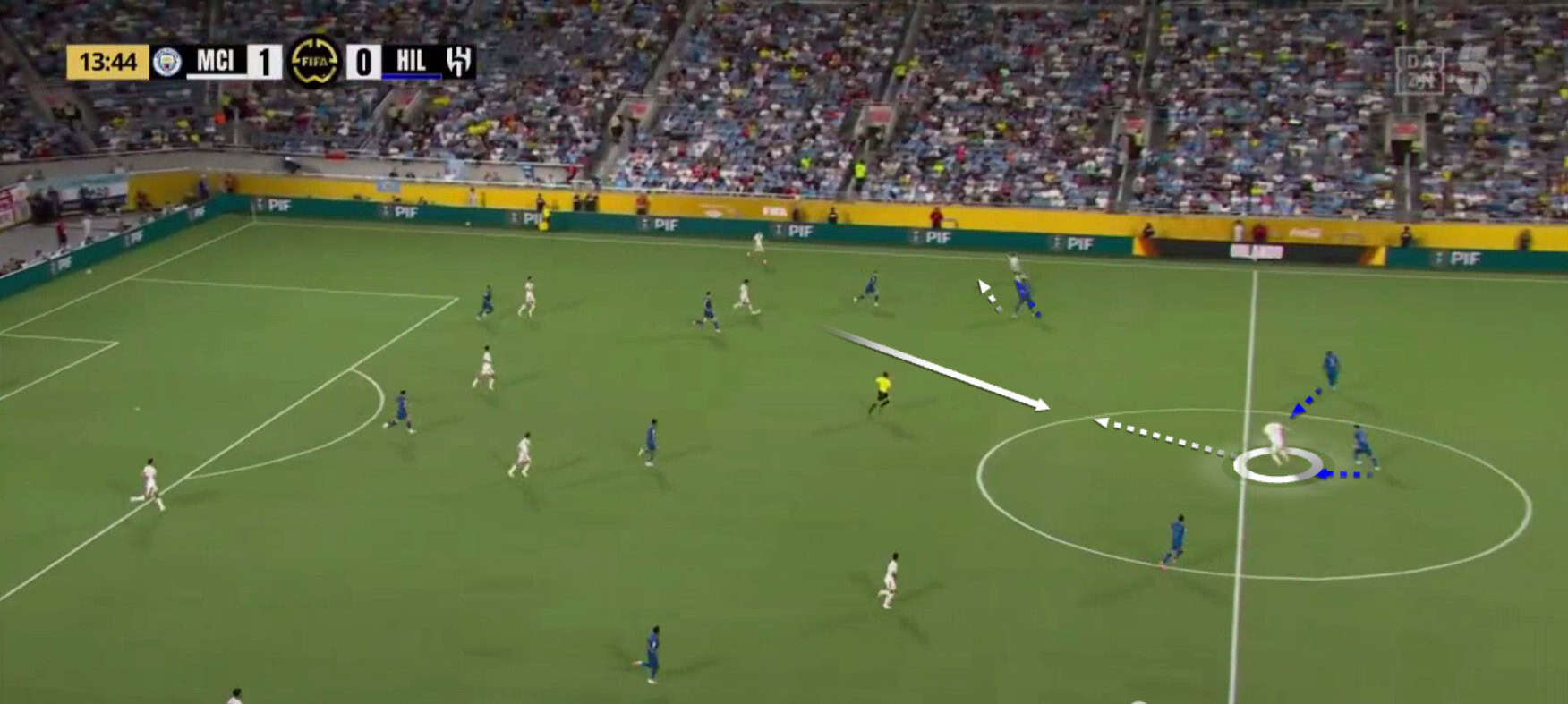 Ederson finds Gündoğan, who advances with the ball, highlighting why Al Hilal positioned Milinković-Savić between Reijnders and Gündoğan: to keep two defenders close to Haaland at the back.
However, Haaland drops deeper, offering a passing option for Gündoğan.
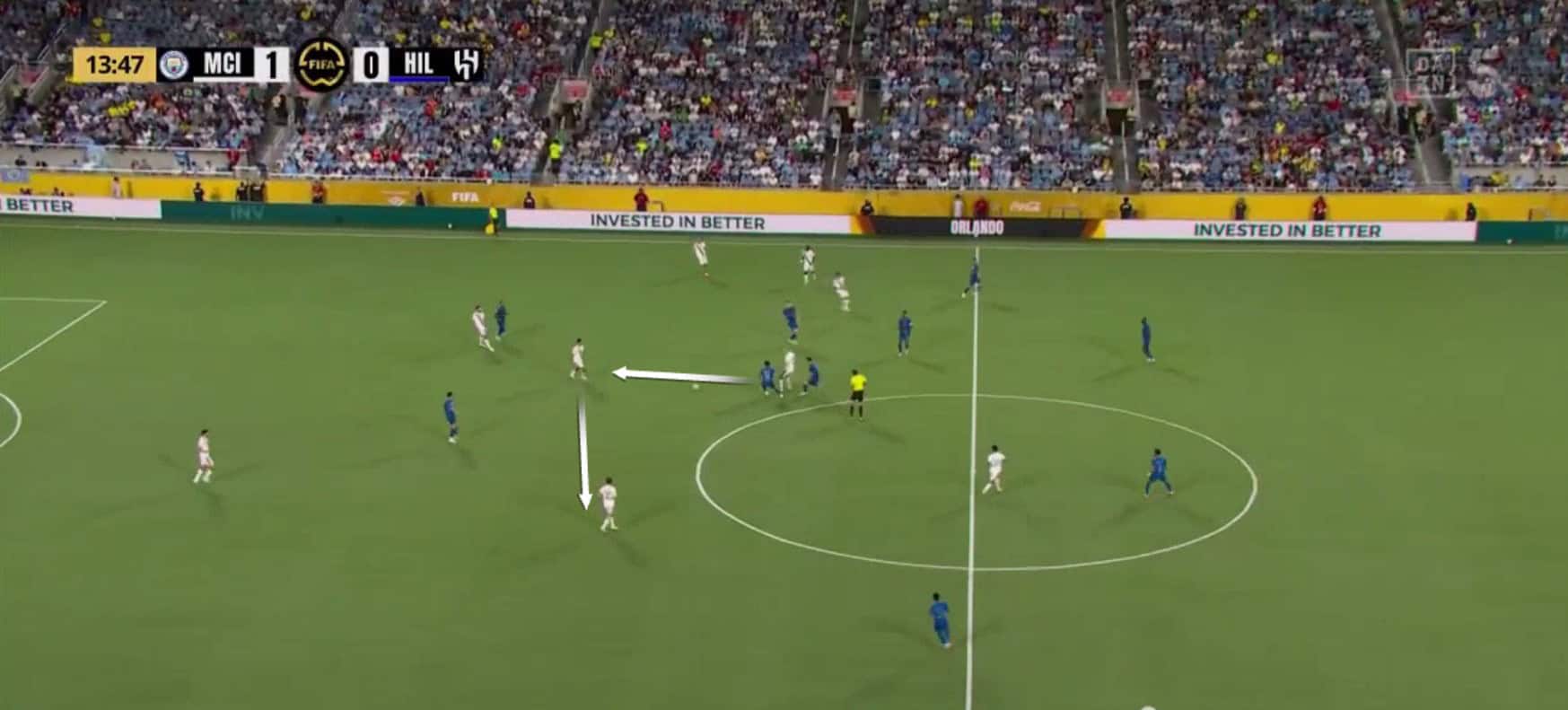 With Haaland’s link-up, Reijnders has the chance to help City advance, but his pass to Silva is imprecise and instead reaches Nunes.
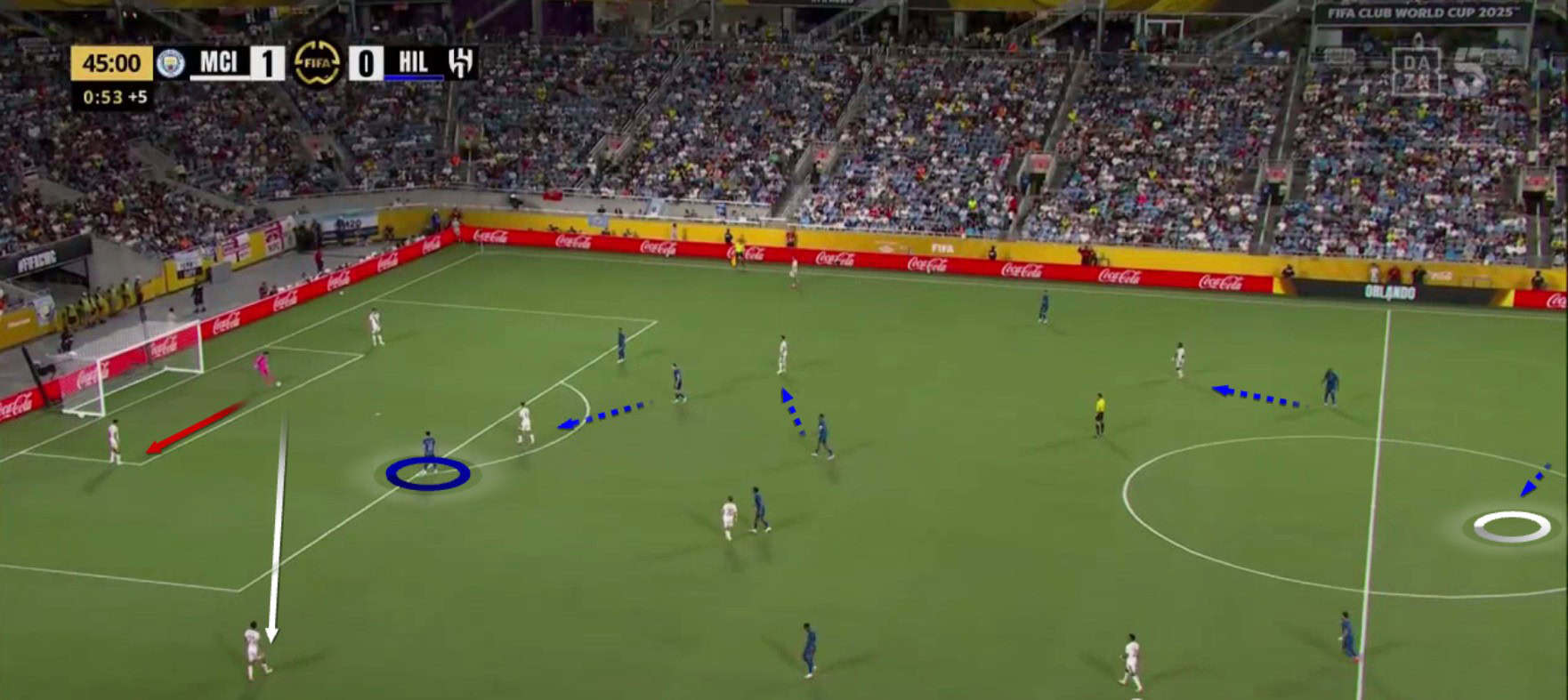 Al Hilal adjusted by pushing Koulibaly forward to mark Doku, with Kanno stepping higher behind Milinković-Savić.
This setup ensured Kanno could cover Gündoğan if Milinković-Savić pressed Reijnders.
City responded by exploiting Leonardo’s central position to press Dias, which opened a direct passing lane from Ederson to Nunes.
However, it raises the question: why did City opt for the direct pass to Nunes (White Pass) when Dias was still accessible (Red Pass) with Leonardo positioned away?
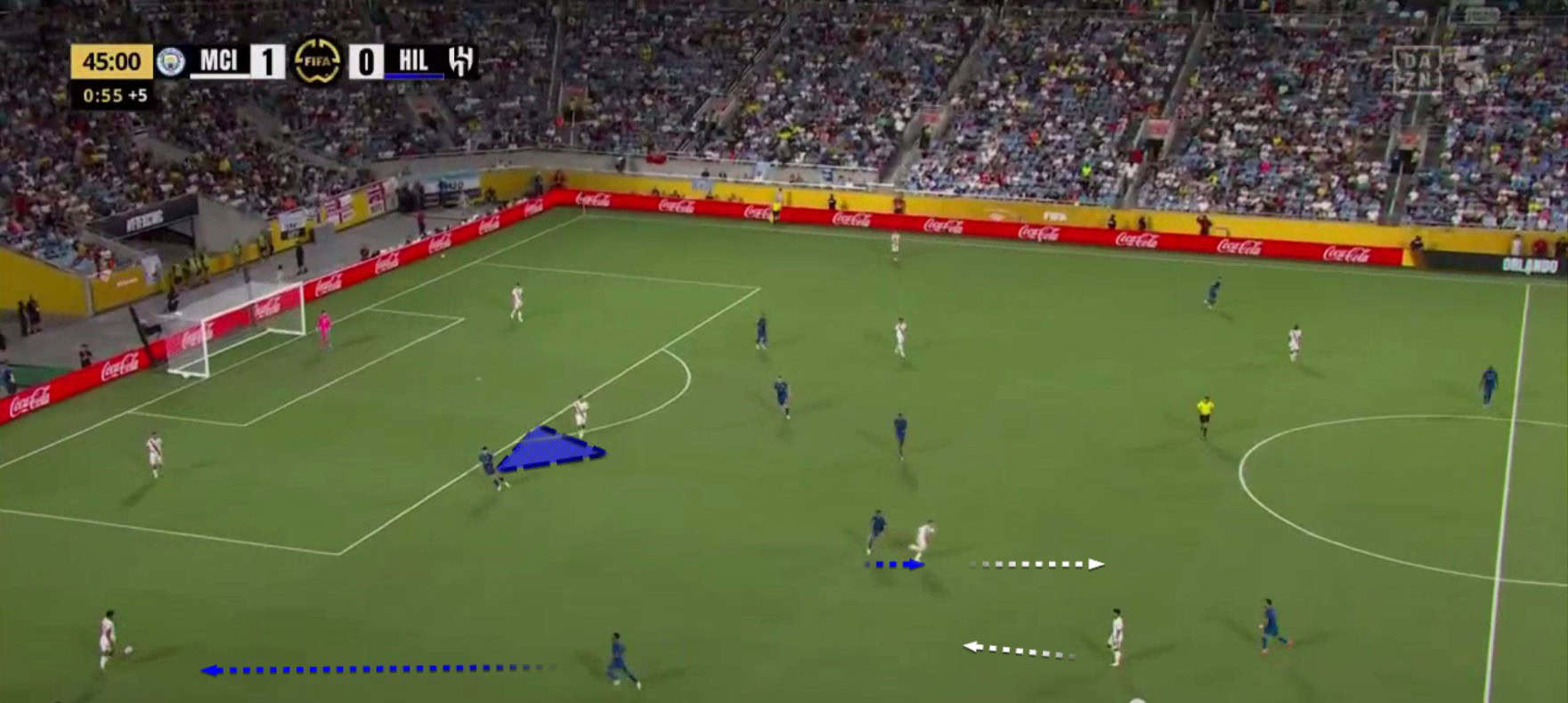 Leonardo positions himself to block the lane to Reijnders, meaning if he presses Dias, the latter must pass to Silva or Nunes under heavy pressure, or go long.
Instead, by playing directly to Nunes, this forces Leonardo to shift and close the lane from Nunes to Reijnders, especially with Milinković-Savić still between Reijnders and Gündoğan, and Silva’s movement dragging his marker.
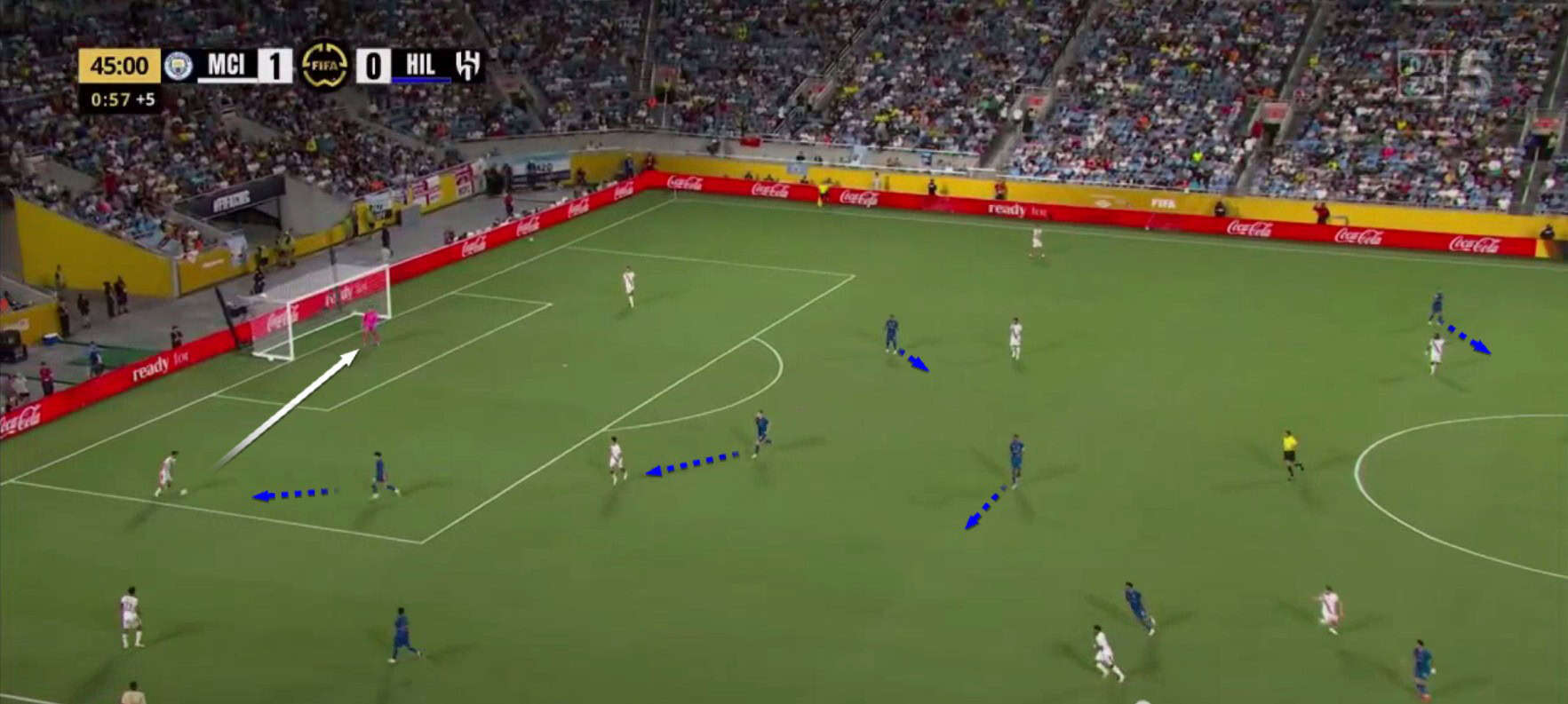 This triggers two key effects: the space between Leonardo and Dias widens, and with Milinković-Savić moving towards Reijnders and Kanno covering zonally, Malcom shifts to Gündoğan.
So, when Nunes passes to Dias, he can easily recycle back to Ederson.
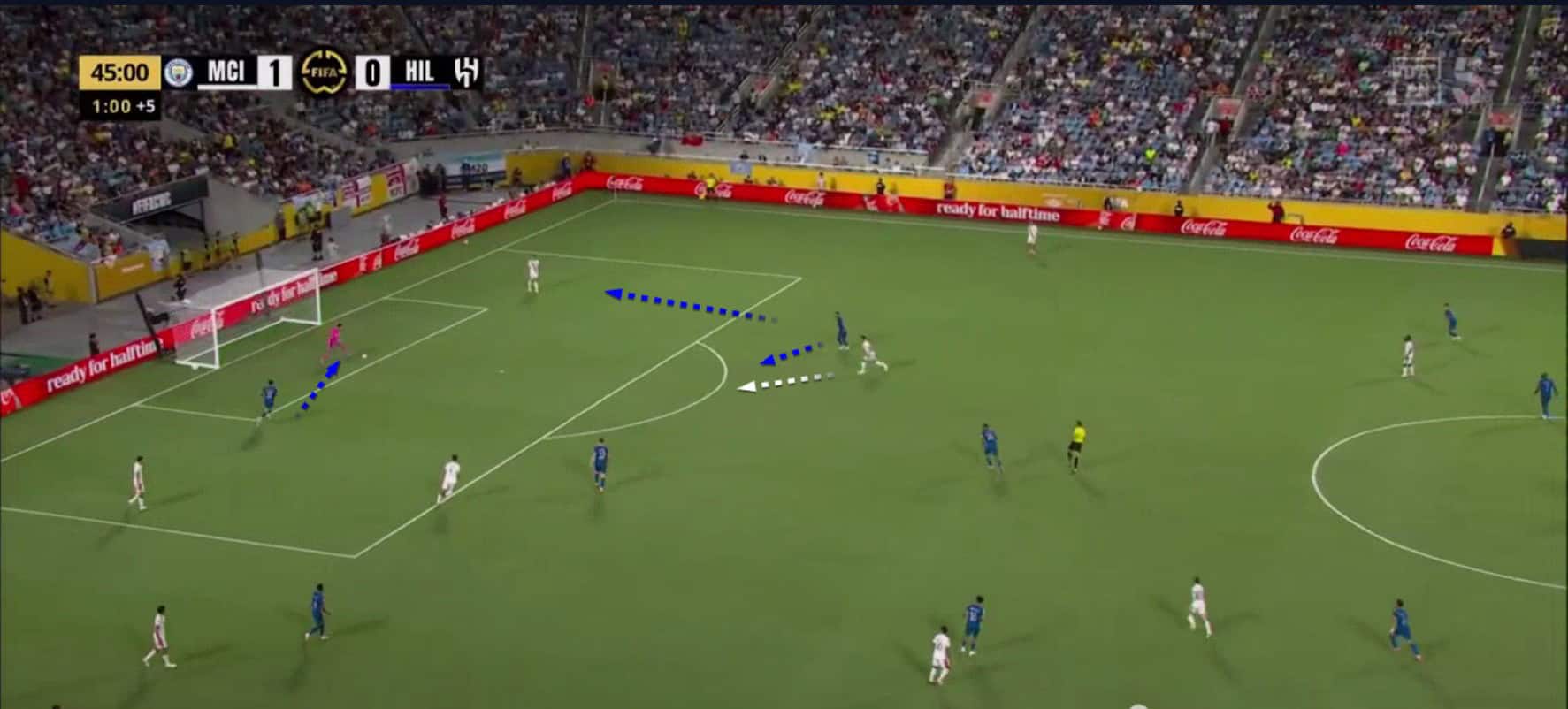 Now, Leonardo continues pressing Ederson, while Malcom hesitates between closing the lane to Gvardiol or tracking Gündoğan.
To exploit this, Gündoğan drops deeper, making Malcom’s decision harder and offering Ederson a clearer option — using the space Reijnders created by drawing Milinković-Savić.
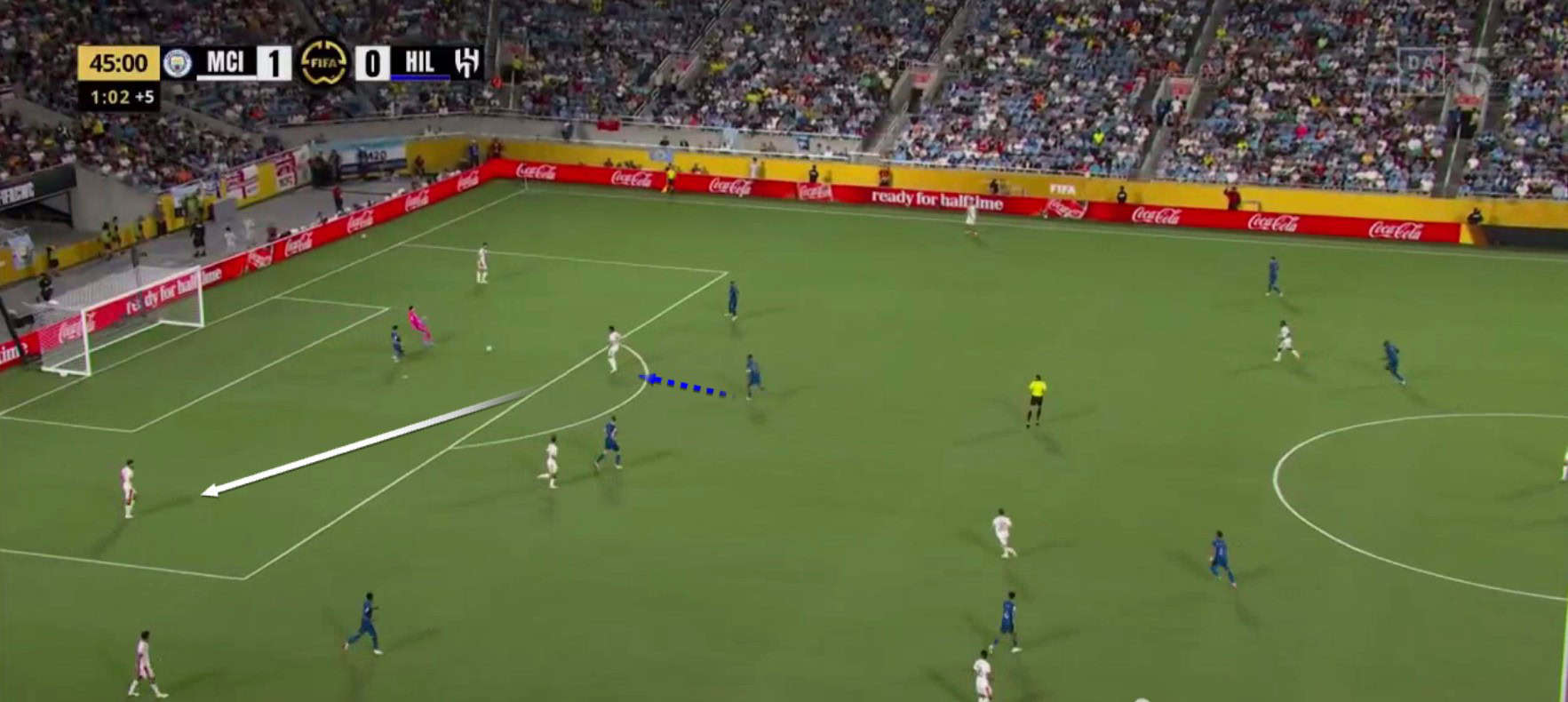 Gündoğan passes to Dias as Leonardo continues pressing Ederson, moving further away and leaving Dias free to receive in space.
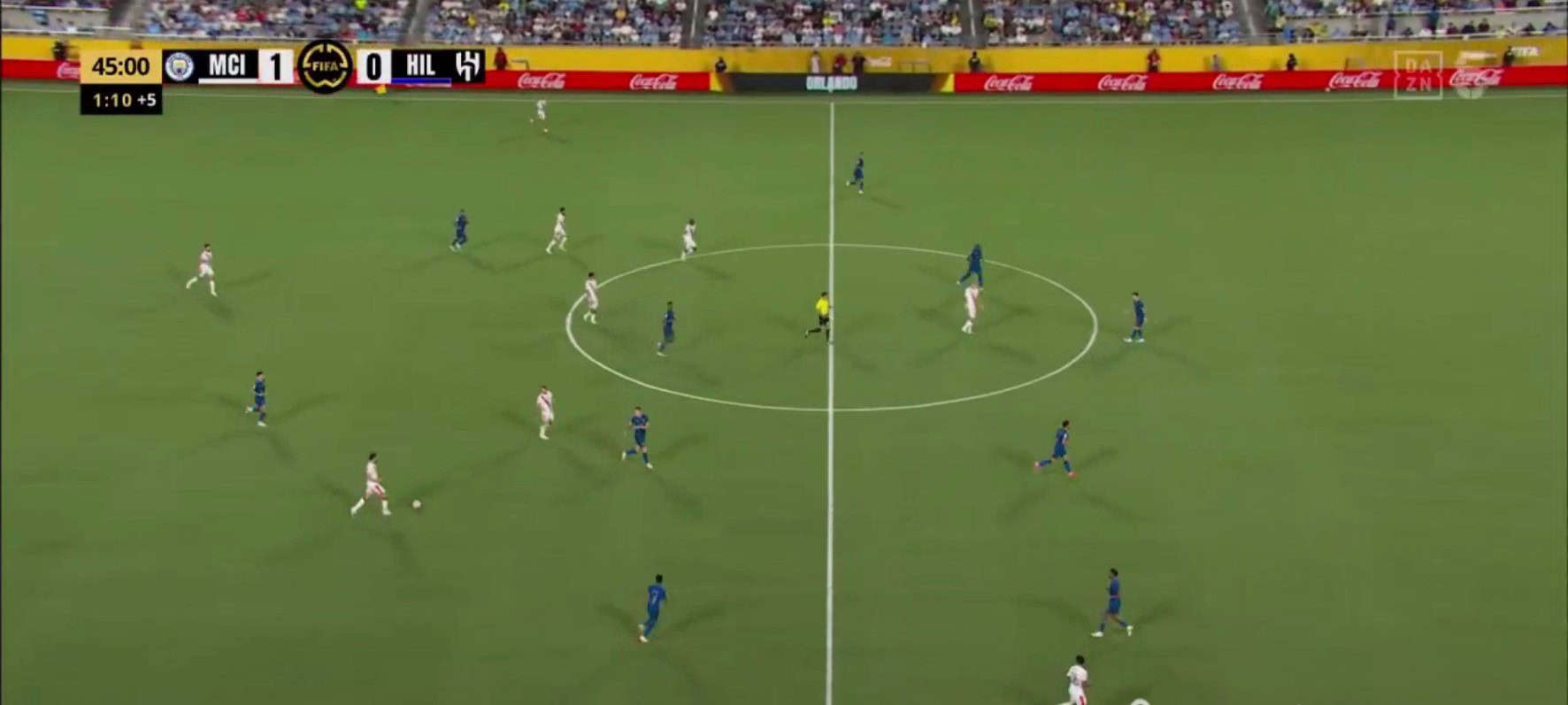 This helps Manchester City bypass Al Hilal’s high press to advance further up the pitch.
Conclusion
Manchester City’s build-up is shaped by both the opponent and the profiles of the starting players.
Lewis and O’Reilly offered different solutions against the press compared to Nunes and Aït-Nouri.
As observed, Rodri remains just outside the penalty area, while Reijnders can drop deeper to receive near Ederson and carry the ball forward, though he didn’t do this against Al Hilal.
These choices not only influenced the defenders but also affected the shape and roles of the wingers, Savinho and Duko, and the centre-forward, ultimately reshaping how the team builds from the back.
