
Fluminense emerged as one of the biggest sensations of the 2025 FIFA Club World Cup.
The team led by Renato Gaúcho arrived at the competition with questionable credentials, sitting in seventh place in the Brasileirão standings.
Even though teams like Palmeiras, Botafogo (reigning Copa Libertadores champions), and eternal rival Flamengo were considered the strongest from South America beforehand, Fluzão were the CONMEBOL side that went furthest in the tournament.
They were also the only non-European team to reach the Club World Cup Semi-Finals.
Placed in Group F with Borussia Dortmund, Mamelodi Sundowns, and Ulsan HD, the Brazilian team remained unbeaten and qualified for the Round of 16 as group runners-up behind BVB.
They pulled off the tournament’s big upset by eliminating the 2024/2025 UEFA Champions League runners-up, Inter Milan, by two goals to nil.
In the quarter-finals, they defeated Al-Hilal, who had previously eliminated Manchester City; the fairy tale ended in the semi-finals with a worthy performance against Chelsea, ultimately losing 2-0.
Led by an outstanding figure in the Colombian midfielder/attacking midfielder Jhon Arias, accompanied by super-mobile midfielders prone to support + breaking movements like Matheus Martinelli and long wing-backs ready to receive on the weak side like Samuel Xavier, the team, coached by the former Brazilian national team player, displayed a refreshing style of play.
In this tactical analysis, we will examine Renato Gaúcho style of play and how his Fluminense tactics using Relational Play, led his Brazilian side on an impressive run in the 2025 Club World Cup.
Renato Gaúcho Fluminense Tactics
Asymmetrical Relationships
As he has with other teams he has coached, such as Grêmio and Flamengo, Gaúcho has placed vital importance on short and combative relationships between his players.
Renato Gaúcho’s Grêmio (2023).
Even though his Fluminense usually forms in an on-ball structure of 3-2-2-3 (stemming from a 5-3-2 off the ball) like most positional teams, Fluzão usually operate with broad corporal freedom: bodies can move out of their positions, in, out, up, down.

This means they can afford not to occupy a specific space (as is expected in positional play paradigms) and cross the field to create a strong side asymmetry compared to the weak side, enhancing short and combinative relationships.
“Everything has to do with everything and nothing happens that can’t happen, but the interactions between players are interactions, not actions.”
(Paco Seirul-lo, 2017).
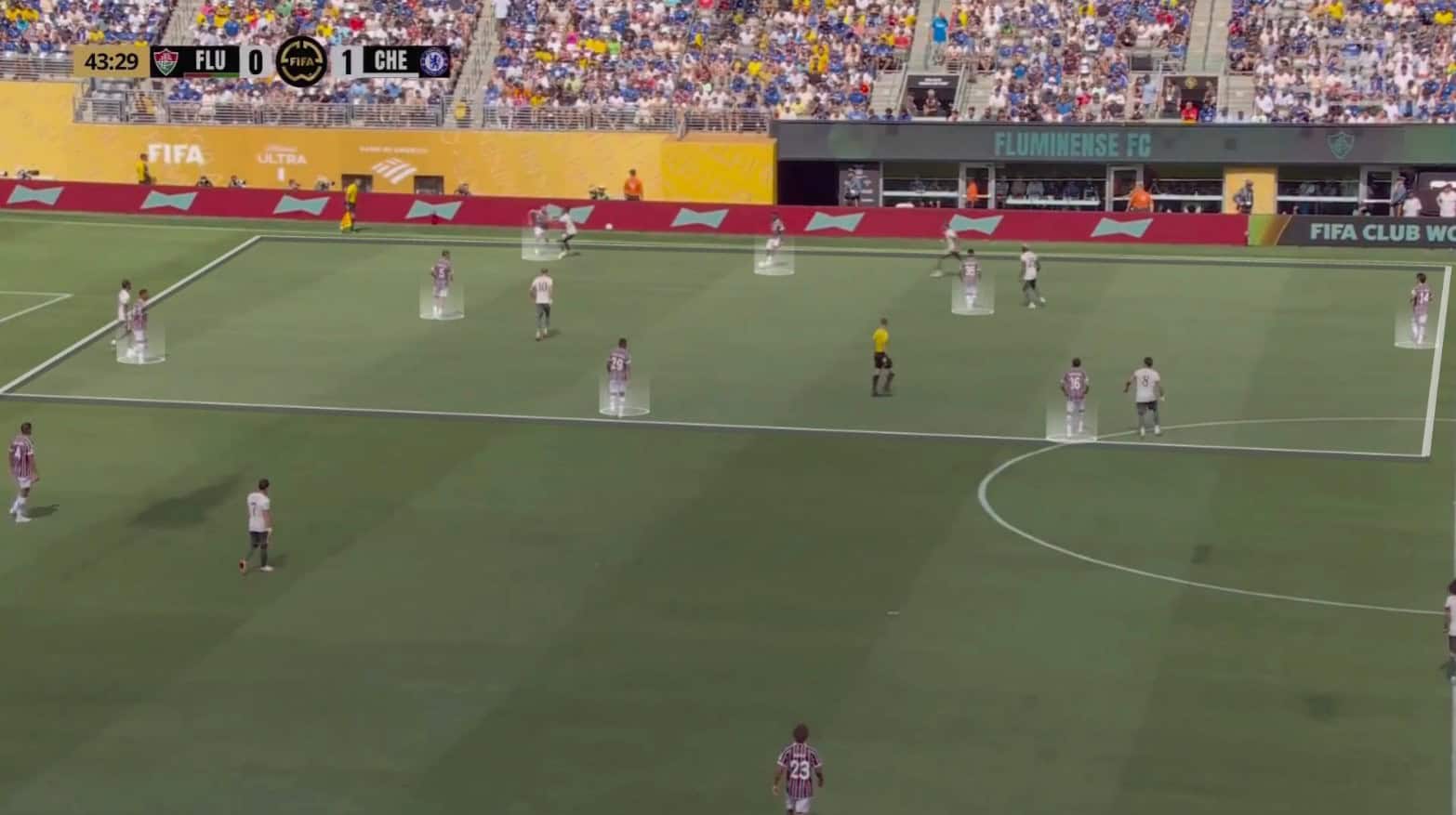
Fluminense Asymmetry: Bringing many players close to the ball on a strong side.
It’s a flexible order of bodies; escapes to control time and dominate space in turn (the inverse path of the fundamental ideas of Positional Play).
Relationism or approximation play isn’t simply about players being close together asymmetrically.
Nor do Fluminense exclusively rely on it, as they are often organised within positional structures or uniformly to fill spaces rationally.
Just as in Positional Play, the goal is not merely to rationally occupy spaces, but to create superiorities from that (controlling space to dominate time), in relationism, the mission is for players to move together and in sync while communicating through signals and gestures—socio-affective relationships, in short and again, controlling time to dominate spaces.
Fluminense Relationist Features: ‘Tabelas’ & ‘Toco y Me Voy’
With players inclined toward a culture that encourages invading spaces and frequent ball contact, the best thing you can do is encourage that.
Many remember Juan Manuel Lillo‘s comment during the broadcast of the 2010/2011 UEFA Champions League Final: “Pedro is contributing a lot without touching the ball.”
Dominate the space to hold the opponent; fix outside to free up the inside.
Well, not here.
Gaúcho seeks, in many phases of his team, to climb up the field through a progressive movement of his players; touch and go.
Both in the build-up phase to overcome a high press and create a sort of dynamic third man with the wing-back advancing, and in organised attack to overcome numerical superiorities with the opponent creating density over the wing and half-space.
“Any point of the rhizome can be connected with any other—and must be—that doesn’t happen with trees or roots, which always fix a point, an order (…) A rhizome would never stop connecting semiotic chains, power organisations, circumstances related to arts, sciences, social struggles.”
(Deleuze & Guattari, 1980).
As mentioned earlier, in approximation play, players have the freedom to move in much wider spaces (freedom of the bodies).
In its purest form, a team’s entire attacking style can be based on the idea of touching and advancing, constantly changing the landscape, daring to provoke a penetration movement.
As mentioned, the goal is to try to overcome Numerical or Positional Superiorities within a block through movement and second/third man runs, in dynamic construction and fostering socio-affective ties.
Fluminense Role Of Full-Backs
As the only wide players, both had to provide depth, in addition to generating, as we’ve seen, progression routes on the flank through touch and go to climb the field.
However, within a model that favours asymmetrical strong-side structures, the full-backs usually have a greater offensive contribution.
They can receive qualitative and positional superiority through a quick switch of play to the weak side.
In other situations, a defensive diagonal can be performed by moving toward the tilt and overloading on the strong side when the team is in the on-ball phase.
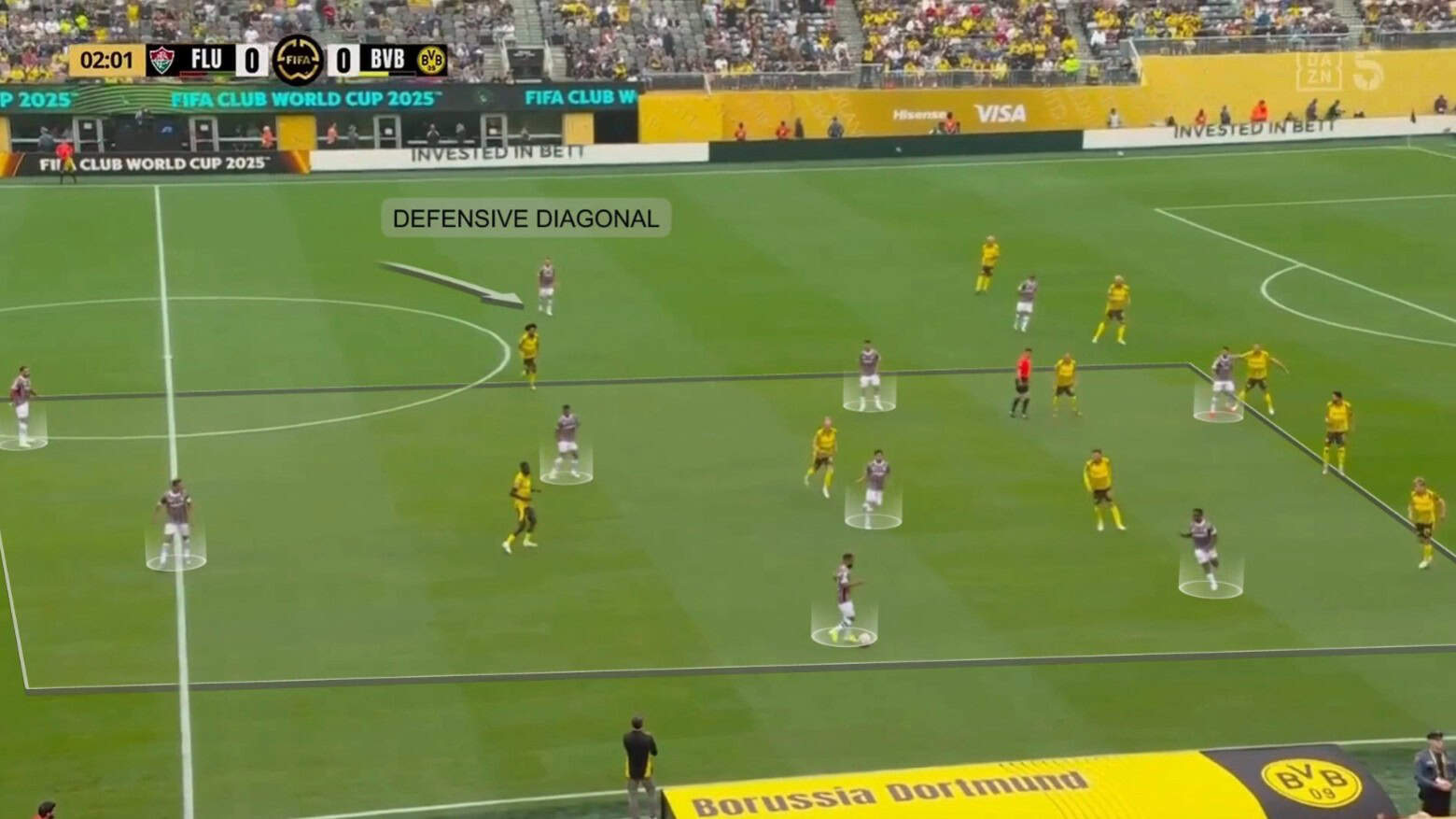
Wing-back defensive diagonal closing of interior space.
In short, the defensive diagonal is an inward movement performed by the opposite full-back to mark the far-side winger or close the interior space.
With a well-timed switch of play, the full-back performing the defensive diagonal can quickly become an offensive threat, as in the first video example.
Diagonal Progressions As ‘Escadinhas’
Escadinhas, which comes from the Portuguese word for little stairs, are dynamic (not static) structures in a rising diagonal shape.
They don’t respect the rational occupation of spaces; they are a-positional and, therefore, structures formed through the negotiation of bodies invading spaces.
“A rhizome doesn’t start or end, it’s always in the middle (…) inter-being, intermezzo.
Where are you going? Where are you starting from? Where do you want to go? All those questions are useless.”
(Deleuze & Guattari, 1980).
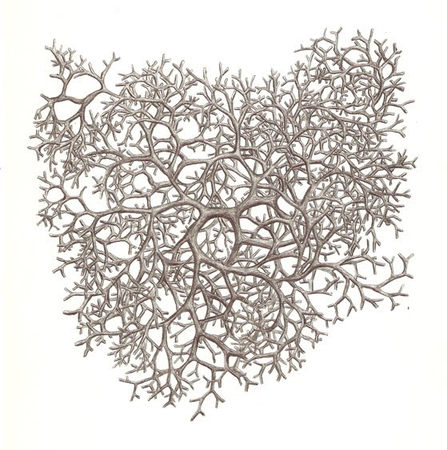
Rhizome (Deleuze & Guattari).
Under the principle of asignifying rupture (4th principle of rhizomes from Deleuze & Guattari), teams with flexible body order like Fluminense, who open the doors to these asymmetrical and a-positional structures with their ginga and improvisational ability, don’t fall apart after a failed play, but instead mutate, adapt, and find new paths—like a rhizome that, when cut, reemerges elsewhere.
These dynamic structures allow them to break through blocks via support movements combined with ruptures.
Or combine these escadinhas with toco y me voy and/or tabelas.
In the end, what matters is how functional the player is in the context of the environment, teammates, opponent, and ball.

Clip Credit: The Game Changer (@TH_GAME_CHANGER on X).
In this case, Fluminense destabilise the individual matchups proposed by Ulsan HD through a toco y me voy + tabela by Matheus Martinelli.
At the same time, diagonal passing lanes begin to appear through his teammates’ off-the-ball movement.
“It was improvisation because it arose spontaneously and naturally (…) and it was organization because the same players organized themselves on the spot.”
(Dante Panzeri, 1967).
Tilting As A Counterpressing Method
Although we’ve already emphasised the importance of tilting and asymmetry on the strong side as a basis for creating short relationships and fostering toco y me voy, tabelas, and escadinhas, it’s also a defensive tool.
For Fluminense, distributing themselves less uniformly means minimising the risk of counterattacks during defensive transition, as there is a high density of their own players to jump into post-loss moments.
Additionally, an extra defender limits passing angles for opponents trying to start a defence-to-attack transition, in the form of the touchline.
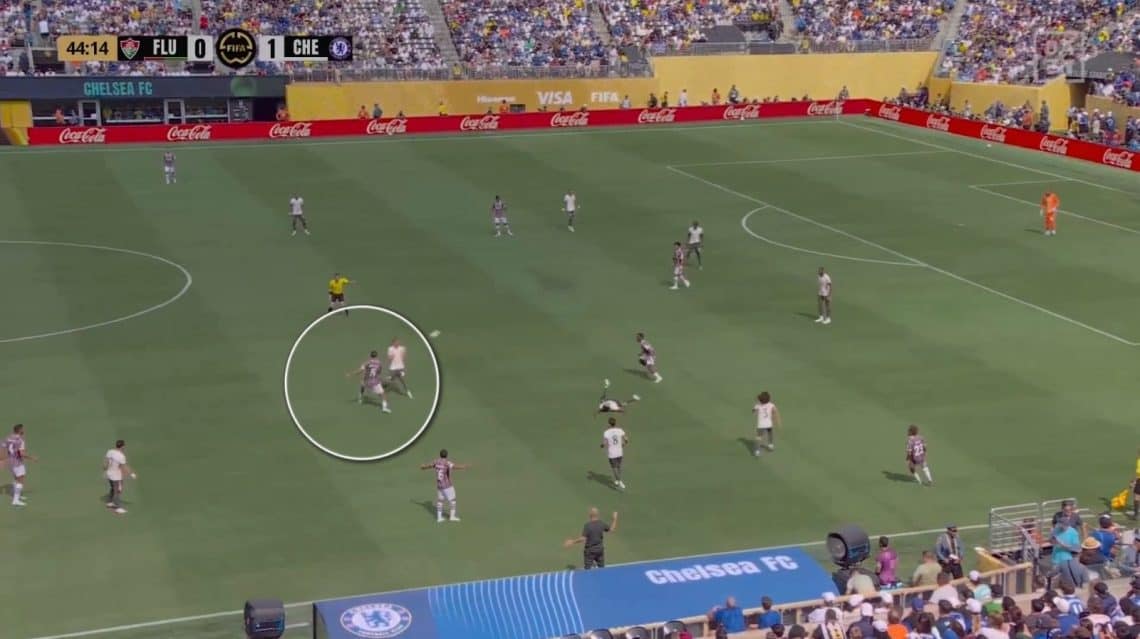
The tilt, in turn, produces forward defences instead of retreating; it’s a proactive stance.
Conclusion
Even though Fluminense often distribute themselves uniformly on the field in a 3-2-5 structure, they clearly allow enormous freedom of movement.
Otherwise, the great tournament from Martinelli and Arias, for example, wouldn’t make sense—players are more prone to entering and exiting spaces, stepping into already occupied zones.
Surely, if we asked Renato Gaúcho about the importance of short and combinative relationships as semantic dialogues and spaces of intra-communication, he would assign them immense value.
That’s why, within an apparently uniform structure, so many asymmetrical spaces are formed, where player gestures, and the plurality and dialogue of those gestures among them, take precedence.
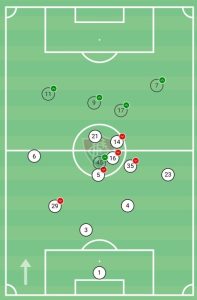
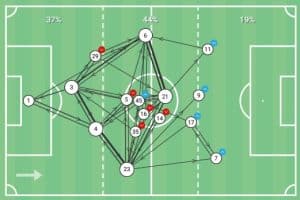
Fluminense vs. Chelsea. Positioning and pass map.
Although belonging to the positional school—where a more inflexible body order prevails to dominate time—Paco Seirul-lo explained these dynamics well, and the importance of socio-affective relationships as semantic and intra-communication spaces.
“The circulating socio-affective components within the team provide the sustainability of self-management during the match.
They manage to absorb uncertainty in the dialogues between teammates, ensuring qualitative information (…)
(…) as well as the acceptance of the possible and always unexpected appearances of chance.”
(Paco Seirul-lo, 2024).
